- Product Description Description
- Table of Contents TOC
- List of Table & Figure LOT
- Get Free Sample PDF Sample PDF
Market Size, 2025
$49.87 BnMarket Estimate, 2026
$53.06 BnMarket Forecast, 2034
$87.16 BnCAGR, 2026–2034
6.4%Executive Summary: Cassava Flour Market
- Market Scope: Comprehensive global cassava flour market analysis covering source categories, application segments, end-use industries, regional leadership shares, production volumes, and dietary trend drivers.
- Market Valuation: Valued at USD 49.87 billion (2025), estimated at USD 53.06 billion (2026), and projected to reach USD 87.16 billion by 2034, registering a solid CAGR of 6.40% (2026–2034).
- Primary Growth Drivers: Rising demand for gluten-free baking alternatives, health-conscious product formulation, and robust global production yields. Key structural and agricultural benchmarks include global cassava production exceeding 300 million tons in 2023, a 38% increase in cassava flour adoption by North American and European food manufacturers since 2020, non-celiac gluten sensitivity affecting up to 13% of the population, Thailand exporting 5.8 million metric tons of cassava products worth USD 1.9 billion in 2023, and Nigeria producing over 60 million metric tons annually.
Key Market Segment Metrics (2026–2034)
| Category | Leading Segment (2025 Position) | Fastest-Growing Segment |
|---|---|---|
| By Source | Conventional cassava flour (held the dominant share in 2025) | Organic cassava flour (forecast to grow at an 11.3% CAGR) |
| By Application | Chips and snack processing (led with a 59.1% share in 2025, supported by cassava flour's 20–30% amylose content) | Sweeteners and syrup formulations (projected to grow at a 9.6% CAGR) |
| By End Use | Food and beverages (held the largest share) | Animal feed and agricultural nutrition sectors (forecast to expand at an 8.7% CAGR) |
| By Region / Country | Asia-Pacific (led with 42.3% of the market in 2025, followed by Africa with 31.3%) | North American and European specialty gluten-free manufacturing hubs |
Major Market Players & Market Structure
Market Structure: Highly competitive global agricultural processing and specialized food ingredient marketplace featuring multinational food corporations, agricultural enterprises, and health-food brands competing intensely on vertical integration, organic and sustainable certifications, processing automation, smallholder farmer partnerships, and strategic diversification into higher-value industrial and culinary applications.
Key Companies: Siemens Healthineers, Abbott Laboratories, Roche Diagnostics, Anthony's Goods, Otto's Naturals, American Key Food Products, Food to Live, GEM Farmers Way, Pamela's Products, Ciranda, and Carrington Farms.
Global Cassava Flour Market Size
The global cassava flour market size was calculated to be USD 49.87 billion in 2025 and is anticipated to be worth USD 87.16 billion by 2034 from USD 53.06 billion in 2026, growing at a CAGR of 6.4% during the forecast period.
The Cassava Flour is the commercial ecosystem involved in the processing, distribution, and utilization of flour derived from cassava root (Manihot esculenta), which is a starchy tuber predominantly cultivated in tropical and subtropical regions. As per the Food and Agriculture Organization (FAO), over 300 million tons of cassava were produced globally in 2023, with Nigeria, the Democratic Republic of Congo, and Thailand ranking as the top producers.
MARKET DRIVERS
Rising Global Demand for Gluten-Free and Allergen-Friendly Foods
The increasing prevalence of gluten-related disorders with the growing demand for alternative flours, is escalating the growth of the Cassava Flour Market. According to the U.S. Centers for Disease Control and Prevention, approximately 1 in 133 Americans suffers from celiac disease, while non-celiac gluten sensitivity affects up to 13% of the population, as reported by the Mayo Clinic in 2023. This has led to a surge in gluten-free product development across bakery, pasta, and snack categories. The Global Allergy Consortium notes that food manufacturers in North America and Europe have increased their use of cassava flour by 38% since 2020 in response to consumer demand for clean-label, allergen-free ingredients.
Expansion of Cassava Cultivation in Climate-Vulnerable Regions
Cassava’s drought and poor soil conditions make it a strategic crop in the face of climate change in regions where staple grains are becoming less viable, which is greatly influencing the growth of the Cassava Flour Market. According to the Consultative Group on International Agricultural Research, cassava yields remain stable at 15–25 tons per hectare even under 30% reduced rainfall, outperforming maize and wheat in arid conditions. Around 18 African countries intensified cassava farming as part of national climate adaptation programs, with Ethiopia and Malawi increasing cultivated area by 22% and 17% respectively, over the past three years. This agricultural shift ensures a steady raw material supply for flour production, supporting both domestic food systems and export-oriented processing industries.
MARKET RESTRAINTS
Post-Harvest Losses Due to Perishability of Fresh Cassava Root
The rapid deterioration of harvested roots, which begin to degrade within 24–72 hours after extraction due to enzymatic and microbial activity, is degrading the growth of the Cassava Flour Market. In Nigeria, the world’s largest producer, only 30% of cassava is processed into stable forms such as flour or starch, as reported by the Federal Department of Agricultural Extension in 2023. The absence of decentralized processing units in rural farming communities forces producers to rely on slow transportation networks, exacerbating spoilage.
Inconsistent Quality Standards in Commercial Cassava Flour Production
The absence of harmonized quality benchmarks, which limits international trade, is solely hindering the growth of the Cassava Flour Market. As per the African Organization for Standardization, fewer than 12 of the 54 African countries have established official specifications for cassava flour, resulting in variable moisture content, particle size, and cyanogenic glycoside levels. Moreover, inadequate detoxification processes in artisanal mills can leave residual cyanide, posing health risks. The Codex Alimentarius Commission has emphasized the need for standardized processing protocols, yet implementation remains fragmented.
MARKET OPPORTUNITIES
Integration of Cassava Flour into Industrialized Food Manufacturing
Food processing companies are increasingly adopting cassava flour as a functional ingredient in ready-to-eat meals, extruded snacks, and gluten-free bakery products due to its high starch content and binding properties. The rapid adoption of advanced technologies is expected to enhance the growth of the Cassava Flour Market in the coming years. According to a 2023 technical assessment by the Institute of Food Technologists, cassava flour demonstrates a water absorption capacity of 1.2–1.5 g/g, comparable to wheat flour, making it suitable for dough-based applications. In Brazil, major bakery chains have reformulated 20% of their bread products with cassava flour to reduce reliance on imported wheat, as disclosed by the Brazilian Association of Bakery Industries. Additionally, Nestlé and Danone have incorporated cassava-derived carbohydrates into infant formula and clinical nutrition lines, citing its hypoallergenic profile.
Development of Fortified and Nutraceutical Cassava Flour Products
Innovations in biofortification are transforming cassava flour into a vehicle for micronutrient delivery, particularly in regions affected by malnutrition, which is expected to elevate the growth of the Cassava Flour Market. In 2023, the Nigerian National Agency for Food and Drug Administration and Control approved the commercial sale of iron-enriched cassava flour, targeting anemia reduction in women and children. Furthermore, research at the International Center for Tropical Agriculture has demonstrated that fermenting cassava flour enhances its protein digestibility by 40%, improving its nutritional profile.
MARKET CHALLENGES
Limited Mechanization in Small-Scale Cassava Processing Units
Most cassava flour production in developing nations occurs in artisanal or semi-mechanized facilities, where outdated equipment leads to inefficiencies and contamination risks, hindering the growth of the Cassava Flour Market. According to the United Nations Industrial Development Organization, over 80% of cassava processing in West Africa is conducted using manually operated graters and sun-drying methods, which are highly susceptible to weather disruptions and microbial contamination. This lack of mechanization not only reduces output but also compromises hygiene and product uniformity.
Competition from Alternative Root and Grain-Based Flours
Cassava flour faces growing competition from other gluten-free flours such as almond, coconut, tapioca, and sorghum, which benefit from stronger branding and consumer familiarity in Western markets. According to the Specialty Food Association, almond flour sales in the U.S. grew by 19% in 2023. In online retail platforms like Amazon, almond and coconut flours receive nearly three times more customer reviews than cassava flour, indicating higher consumer engagement. Additionally, tapioca flour derived from the same cassava root but processed differently is often marketed more aggressively in industrial applications.
REPORT COVERAGE
| REPORT METRIC | DETAILS |
| Market Size Available | 2025 to 2034 |
| Base Year | 2025 |
| Forecast Period | 2026 to 2034 |
| CAGR | 6.40% |
| Segments Covered | By Source, Application, End-user, And Region |
| Various Analyses Covered | Global, Regional & Country Level Analysis, Segment-Level Analysis, DROC; PESTLE Analysis. Porter’s Five Forces Analysis, Competitive Landscape, Analyst Overview of Investment Opportunities |
| Regions Covered | North America, Europe, APAC, Latin America, Middle East & Africa |
| Market Leaders Profiled | Siemens Healthineers, Abbott Laboratories, Inc., Roche Diagnostics, Anthony's Goods, Otto's Naturals, American Key Food Products, Food to Live, GEM Farmers Way, Pamela's Products, Ciranda, Carrington Farms |
SEGMENTAL ANALYSIS
By Source Insights
The conventional segment accounted for a dominant share of the Cassava Flour Market in 2025, with its affordability and widespread availability, particularly in producing regions where organic certification infrastructure is underdeveloped. In Nigeria, the world’s largest cassava producer, only 5% of farms are organically certified, largely due to limited access to organic inputs and certification support, according to the Nigerian Ministry of Agriculture. Additionally, industrial buyers in the food processing and animal feed sectors prioritize volume and cost-efficiency over organic labeling with reliance on conventionally sourced flour. The absence of price premiums in domestic markets further disincentivizes smallholders from transitioning to organic practices, ensuring conventional production remains the backbone of supply.
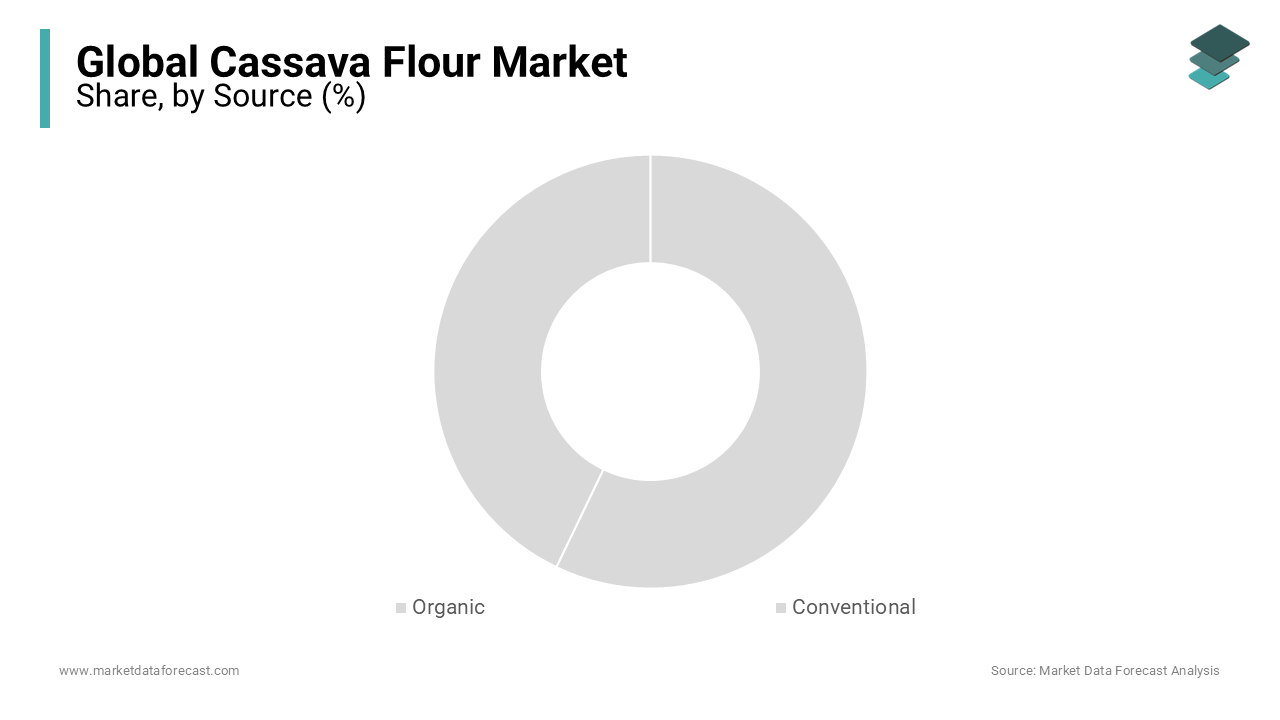
The organic cassava flour segment is expected to witness a CAGR of 11.3% during the forecast period, with the rising consumer demand for clean-label, pesticide-free ingredients in North America and Europe. The alignment of organic cassava with the regenerative agriculture narrative, smallholder farms in Thailand and Colombia are increasingly adopting agroecological practices to meet export standards set by the European Union’s Organic Regulation (EU) 2018/848.
By Application Insights
The chips segment was the largest by accounting for 59.1% of the Cassava Flour Market share in 2025, with cassava flour’s high amylose content (20–30%), which enhances crispness, texture retention, and oil resistance in extruded and fried snacks. In Indonesia, the world’s second-largest cassava producer, over 1.2 million metric tons of cassava are processed annually into flour for snack manufacturing, according to the Indonesian Center for Agricultural Processing and Postharvest Research. Major brands such as Indofood and Garuda use cassava flour as a partial wheat substitute in ready-to-eat chips, reducing import dependency on cereal grains. Additionally, cassava-based chips are gaining popularity in African urban markets, where processed snacks are replacing traditional staples.
The sweeteners segment is expected to grow with a CAGR of 9.6% during the forecast period, with the increasing use of cassava-derived glucose and maltodextrin in natural sweetener production, particularly as a substitute for corn syrup in response to GMO and allergen concerns. The U.S. Food and Drug Administration has recognized cassava-based sweeteners as non-allergenic and compliant with clean-label standards, boosting their adoption in functional beverages and infant nutrition. Companies like Tate & Lyle and Cargill have integrated cassava syrup into plant-based drink formulations, citing its neutral taste and low glycemic index.
By End Use Insights
The food and beverage industry was the largest and held a dominant share of the Cassava Flour Market in 2025. The growth of the segment is likely to grow with the integration of cassava flour into gluten-free bread, pasta, and bakery products in regions with high celiac prevalence. In the European Union, where 1% of the population suffers from celiac disease, as per the European Society for the Study of Coeliac Disease, manufacturers are reformulating products with cassava flour to comply with allergen labeling regulations. Nestlé and Danone have incorporated cassava-based thickeners into yogurts and instant meals, leveraging their high gelatinization temperature and stability.
The animal feed segment is anticipated to grow with a CAGR of 8.7% during the forecast period, with the cassava flour’s role as a cost-effective energy source in livestock and aquaculture diets, particularly in regions facing cereal grain shortages. In Vietnam, cassava-based feed constitutes 30% of pig and poultry rations, reducing reliance on imported corn, according to the Vietnamese Ministry of Agriculture and Rural Development. In Nigeria, the Livestock Productivity Program reported a 22% reduction in feed costs when cassava replaced 40% of maize in broiler diets.
REGIONAL ANALYSIS
Asia-Pacific Cassava Flour Market Insights
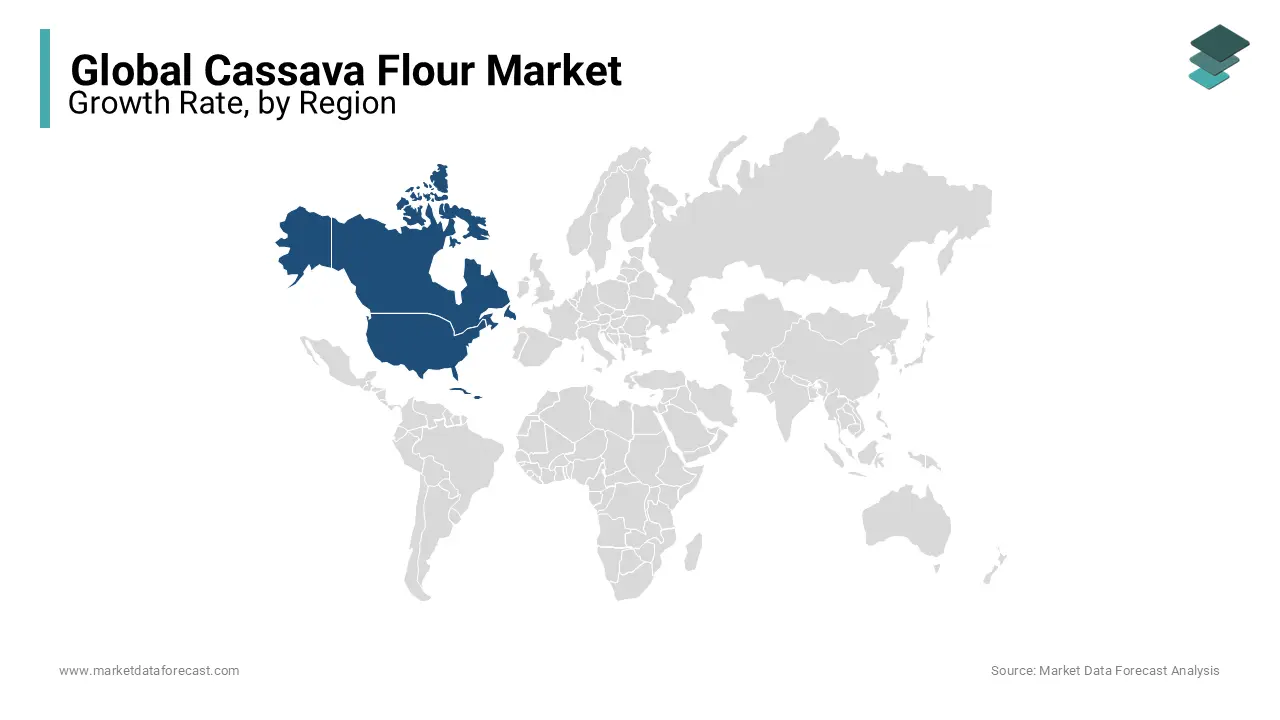
Asia-Pacific was the top performer in the global cassava flour market with 42.3% of the share in 2025. Thailand alone exported 5.8 million metric tons of cassava products in 2023, generating $1.9 billion in revenue, as reported by the Thai Department of Agricultural Extension. The region’s dominance is reinforced by strong domestic demand for processed snacks and animal feed, as well as robust export linkages to Europe and China. Innovations in drying and milling technologies have improved flour quality, enabling compliance with international standards. Additionally, government-backed initiatives like Indonesia’s National Food Estate Program are promoting cassava as a strategic substitute for wheat, further embedding it in national food security frameworks.
Africa Cassava Flour Market Insights
Africa was positioned second by capturing 31.3% of the global cassava flour market share in 2025, with the origin and primary consumer of the commodity, according to the African Union’s Regional Agricultural Transformation Strategy. Nigeria, the continent’s largest producer, harvests over 60 million metric tons of cassava annually, with increasing efforts to shift from subsistence farming to industrial processing. The African Development Bank’s Cassava: The Future initiative has funded over 200 processing plants since 2020, boosting flour output for urban food systems. In Ghana and Uganda, cassava flour is being promoted as a wheat replacement in bread, with the government mandating 10% inclusion in commercial flour blends.
Latin America Cassava Flour Market Insights
Latin America's cassava flour market growth is likely, with Brazil and Colombia leading regional production and innovation. Brazil cultivates over 2 million hectares of cassava, primarily for domestic consumption in traditional dishes like beiju and farofa, according to the Brazilian Institute of Geography and Statistics. The country has also emerged as a hub for bio-based product development, with Embrapa researching cassava flour applications in biodegradable packaging and ethanol.
Europe Cassava Flour Market Insights
Europe cassava flour market is likely to grow with high-value imports and an innovation-driven consumption hub. While domestic production is minimal, demand is growing due to the region’s stringent gluten-free and clean-label food regulations. Germany and France are the largest importers, sourcing over 100,000 metric tons annually from Thailand and Nigeria, as documented by the European Commission’s Directorate-General for Trade. The European Food Safety Authority has approved cassava flour for use in infant formula and medical nutrition, which is expanding its application beyond retail. Additionally, plant-based food manufacturers in the Netherlands and Denmark are incorporating cassava into vegan meat analogs for its binding properties.
North America Cassava Flour Market Insights
North America's cassava flour market growth is driven by consumer demand and regulatory standards. The U.S. imports over 45,000 metric tons of cassava flour annually for gluten-free and paleo diet products. Consumer interest is driven by rising awareness of food sensitivities 18% of Americans now follow a gluten-free or grain-free diet, according to the International Food Information Council’s 2023 survey. Canada has also seen a 33% increase in cassava flour imports since 2021.
COMPETITIVE LANDSCAPE
KEY MARKET PLAYERS
Some of the companies that are playing a dominating role in the global cassava flour market include
- Siemens Healthineers
- Abbott Laboratories, Inc
- Roche Diagnostics
- Anthonys Goods
- Otto's Naturals
- American Key Food Products
- Food to Live
- GEM Farmers Way
- Pamelas Products
- Ciranda
- Carrington Farms
Top Strategies Used By Key Market Participants
Key players in the cassava flour market are deploying five core strategies to consolidate their position: vertical integration of the supply chain, investment in sustainable and organic certification, technological modernization of processing facilities, strategic partnerships with smallholder farmers, and product diversification into high-value applications. Companies are establishing direct sourcing networks to ensure raw material consistency and reduce post-harvest losses. They are also upgrading to automated drying, milling, and packaging systems to meet international food safety standards. To appeal to health-conscious consumers, firms are pursuing organic, non-GMO, and gluten-free certifications. Collaborations with research institutions are driving innovation in biofortification and waste utilization. Additionally, expansion into nutraceuticals, animal feed, and industrial starch applications is enabling revenue diversification and reduced dependency on volatile food markets.
COMPETITION OVERVIEW
The competition in the Cassava Flour Market is evolving from a commodity-driven landscape into a value-based contest centered on quality, sustainability, and innovation. While traditional processors dominate regional supply chains, new entrants from the health food and biotech sectors are redefining market expectations through premium positioning and traceability. Incumbents in Asia and Africa face pressure to modernize operations to meet export-grade standards, while European and North American importers exert influence through stringent regulatory and ethical sourcing requirements. Strategic differentiation is emerging through certifications, technological integration, and downstream product development.
LEADING PLAYERS IN THE CASSAVA FLOUR MARKET
Thai Tapioca Flour Co., Ltd.
Thai Tapioca Flour Co., Ltd. has maintained its position as a leading force in the Asia-Pacific cassava flour market through decades of specialization in high-quality starch and flour processing. Based in Thailand, the company leverages the country’s status as the world’s largest cassava exporter to supply premium-grade flour to food manufacturers across Japan, South Korea, and Europe. In recent years, it has invested in advanced drying and milling technologies to enhance product consistency and meet international food safety standards, including ISO 22000 and HACCP certification. The company has also partnered with local farmer cooperatives to ensure traceability and sustainable sourcing, reducing post-harvest losses through decentralized pre-processing units.
Nufarm Limited
Nufarm Limited, an Australian agribusiness with expanding interests in specialty food ingredients, has strategically entered the Asia-Pacific cassava flour sector through targeted investments in processing infrastructure and sustainable farming partnerships. While traditionally focused on crop protection, the company diversified into value-added agricultural products by establishing a joint venture with Vietnamese agro-processors in 2022 to develop non-GMO, pesticide-residue-free cassava flour for export. Nufarm provides technical support to smallholder farmers in Cambodia and Laos, promoting good agricultural practices to improve root quality and yield. Its integrated supply chain model ensures compliance with EU and North American organic standards, enabling access to premium markets.
Siam Tapioca Company
Siam Tapioca Company, one of Thailand’s oldest and most vertically integrated cassava processors, plays a pivotal role in shaping the Asia-Pacific cassava flour landscape. The company operates across the entire value chain from contract farming and harvesting to milling, packaging, and export logistics by ensuring consistent supply and quality control. It supplies both conventional and organic cassava flour to major food manufacturers in China, India, and the Middle East, with a growing focus on industrial applications such as bioplastics and adhesives.
MARKET SEGMENTATION
This research report on the global cassava flour market is segmented and sub-segmented into the following categories.
By Source
- Organic
- Conventional
By Application
- Sweeteners
- Chips
- Feed
By End Use Insights
- Household Use
- Food and Beverage Industry
- Animal Feed
- Others
By Region
- North America
- Europe
- The Asia Pacific
- Latin America
- The Middle East and Africa