- Product Description Description
- Table of Contents TOC
- List of Table & Figure LOT
- Get Free Sample PDF Sample PDF
Global Cast Elastomers Market Size
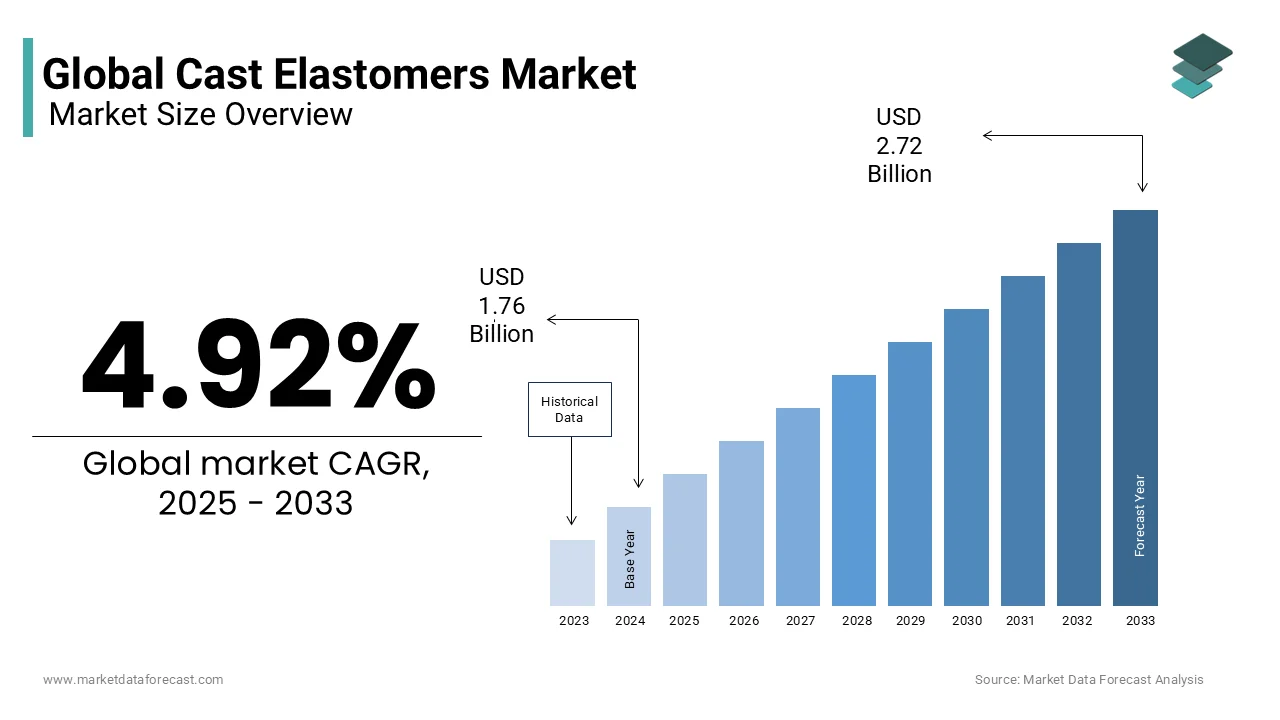
The cast elastomers market size was valued at USD 1.76 billion in 2024 and is expected to reach USD 2.72 billion by 2033, growing from USD 1.85 billion in 2025. The market is projected to exhibit a promising CAGR of 4.92% during the forecast period.
The Cast Elastomers is a specialized segment within the polymer industry that involves the production and application of elastomeric materials formed through casting processes. These materials, primarily based on polyurethane, silicone, or natural rubber compounds, are known for their high elasticity, durability, and resistance to wear, making them ideal for use in demanding industrial environments. The casting process allows for the creation of custom shapes and components tailored to specific mechanical and engineering applications.
Cast elastomers find extensive use across industries such as automotive, construction, mining, aerospace, and energy, where they serve roles in components like bushings, rollers, seals, and vibration dampeners. According to the American Chemistry Council (ACC), global demand for specialty elastomers has grown steadily due to their adaptability and superior mechanical properties.
MARKET DRIVERS
Growth in Industrial Automation and Machinery Demand
The rapid expansion of industrial automation and machinery production globally is a significant factor propelling the growth of the Cast Elastomers Market. There is a corresponding need for durable and reliable components that can withstand continuous operational stress as industries strive for higher efficiency, precision, and uptime. Cast elastomers play a crucial role in this context by providing resilient, wear-resistant parts such as conveyor rollers, gears, and shock-absorbing mounts. According to the International Federation of Robotics (IFR), the global stock of operational industrial robots reached a record high in 2023, with over 3 million units deployed worldwide. This surge in automation has significantly increased the demand for customized elastomeric components that ensure smooth operation and reduced mechanical failure. Moreover, as per Deloitte’s 2024 Global Manufacturing Outlook, nearly 65% of surveyed manufacturers indicated plans to increase capital expenditure on automation technologies over the next three years.
Expansion of Renewable Energy Infrastructure
The global push toward renewable energy infrastructure for wind and solar power installations is also to fuel the growth of the Cast Elastomers market. These energy systems require highly durable and flexible materials to ensure long-term reliability under harsh environmental conditions. Cast elastomers are increasingly used in wind turbine blade bearings, vibration isolation pads, and protective coatings due to their ability to absorb dynamic loads and resist degradation from moisture, UV exposure, and temperature fluctuations. According to the International Energy Agency (IEA), global wind power capacity grew by more than 17% in 2023, with major investments coming from North America, Europe, and Asia.
MARKET RESTRAINTS
Volatility in Raw Material Prices
The volatility in raw material prices those are derived from petrochemical sources such as polyols, isocyanates, and natural rubber is restraining the growth of the Cast Elastomers market. These materials constitute a significant portion of production costs, and fluctuations in their pricing driven by geopolitical tensions, supply chain disruptions, and changes in crude oil markets can severely impact profit margins and production planning for manufacturers.
As per the U.S. Energy Information Administration (EIA), crude oil prices experienced sharp fluctuations in 2023 and early 2024, influenced by OPEC+ production policies and global economic uncertainties. This volatility directly affected the cost of synthetic polymers used in cast elastomer formulations, which is leading to price increases for end users and potential delays in procurement decisions.
Regulatory Pressures and Environmental Concerns
The environmental regulations and sustainability concerns are also to hinder the growth of the Cast Elastomers Market. Governments around the world are implementing stricter guidelines on chemical emissions, waste disposal, and recyclability of polymer products, which can complicate manufacturing processes and increase compliance costs for producers. According to the European Chemicals Agency (ECHA), several substances commonly used in polyurethane-based cast elastomers—including certain isocyanates and plasticizers are under regulatory scrutiny due to potential health and environmental hazards. In response, companies must invest in reformulating products or adopting cleaner production methods, which can be costly and time-consuming. In addition, as reported by the Ellen MacArthur Foundation, there is growing pressure on the plastics and polymer industry to transition toward circular economy principles. This includes developing fully recyclable or biodegradable alternatives, which remains a technical challenge for cast elastomers due to their complex cross-linked molecular structures. North America and Europe have already introduced mandatory labeling and exposure control requirements for industrial elastomers, while similar discussions are gaining traction in emerging markets.
MARKET OPPORTUNITIES
Development of Bio-Based and Sustainable Elastomers
The development and commercialization of bio-based and sustainable elastomer alternatives is promoting the growth of the Cast Elastomers Market. Manufacturers are exploring renewable feedstocks such as castor oil, soy-based polyols, and lignin-derived compounds to create eco-friendly cast elastomers with increasing emphasis on reducing carbon footprints and minimizing dependence on fossil fuels.
Rising Demand from Emerging Economies and Infrastructure Projects
The emerging economies present a substantial growth opportunity for the Cast Elastomers Market, fueled by rapid urbanization, industrialization, and government-led infrastructure development. Countries in Asia-Pacific, Latin America, and Africa are investing heavily in transportation networks, energy projects, and manufacturing facilities sectors that extensively utilize cast elastomers for heavy-duty applications. According to the World Bank, infrastructure spending in low- and middle-income countries is expected to exceed $1 trillion annually by 2030, with a strong focus on roadways, railways, and mining operations. These projects require durable components capable of withstanding extreme mechanical stress, making cast elastomers an essential material choice.
MARKET CHALLENGES
Technical Complexity and Long Lead Times in Custom Manufacturing
The technical complexity and extended lead times associated with custom manufacturing processes is a major factor challenging the Cast Elastomers Market players. Unlike mass-produced polymers, cast elastomers often require precise formulation, mold design, and curing cycles tailored to specific applications, which can delay production timelines and increase costs. According to Plastics Today, the average lead time for producing custom-engineered cast elastomer components ranges from four to eight weeks, depending on part complexity and material availability. This extended duration can be a bottleneck for industries requiring rapid turnaround, such as automotive repair, emergency infrastructure maintenance, and just-in-time manufacturing setups. Additionally, as per data from the Society of the Plastics Industry (SPI), the lack of standardized formulations and testing protocols across different suppliers creates inconsistencies in product performance, complicating procurement decisions for end users.
Competition from Alternative Materials and Substitutes
The Cast Elastomers Market growth is likely to decline with the increasing competition from alternative materials such as thermoplastic elastomers (TPEs), engineered plastics, and composite materials, which offer faster processing times, lower costs, and easier recyclability. These substitutes are gaining traction in applications traditionally dominated by cast elastomers, particularly in the automotive, electronics, and consumer goods sectors. Additionally, thermoplastics can be reprocessed multiple times without degradation, which is making them more attractive in industries prioritizing circularity and waste reduction. In the footwear and sports equipment industries, for example, companies are shifting toward TPU (thermoplastic polyurethane) foams and molded components due to their lighter weight and quicker manufacturing cycles.
REPORT COVERAGE
| REPORT METRIC | DETAILS |
| Market Size Available | 2024 to 2033 |
| Base Year | 2024 |
| Forecast Period | 2025 to 2033 |
| CAGR | 4.92% |
| Segments Covered | By Type, End-use Industry, and Region. |
| Various Analyses Covered | Global, Regional and Country Level Analysis; Segment-Level Analysis; DROC; PESTLE Analysis; Porter’s Five Forces Analysis; Competitive Landscape; Analyst Overview of Investment Opportunities |
| Regions Covered | North America, Europe, APAC, Latin America, Middle East & Africa |
| Market Leaders Profiled | BASF SE (Germany), The Dow Chemical Company (US), Huntsman International (US), Covestro AG (Germany) Chemline (US), LANXESS AG (Germany), Mitsui Chemicals (Japan), Wanhua Chemicals (China), ERA polymer (Australia), Accella Corporation (US). |
SEGMENTAL ANALYSIS
By Type Insights
The hot cast elastomers segment dominated the global Cast Elastomers Market share in 2024 due to the superior mechanical properties and customization capabilities offered by the hot casting process, which involves high temperature curing to produce durable, high-performance components. As per data from the Society of Plastics Engineers (SPE), hot cast elastomers exhibit up to 30% higher tensile strength compared to cold-cast alternatives.
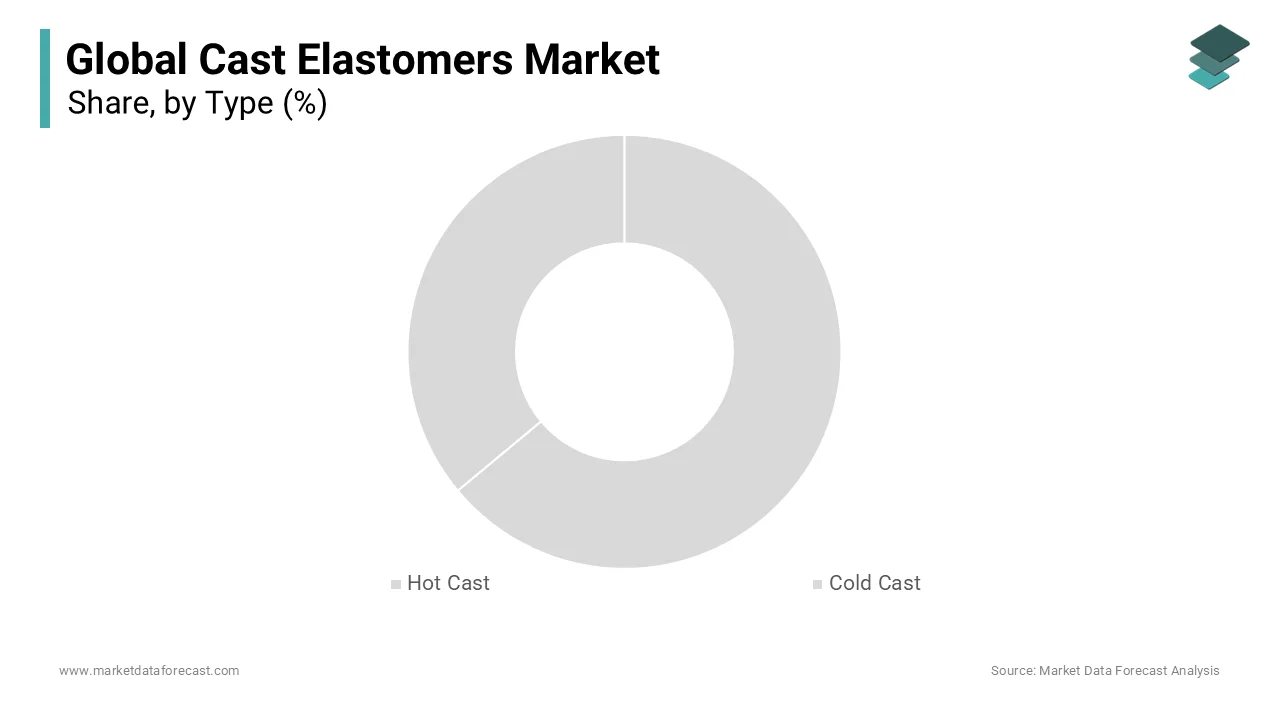
The cold cast elastomers segment is likely to witness a CAGR of 6.9% in the next coming years. A primary factor contributing to this surge is the rising demand for fast-turnaround elastomeric parts in the automotive aftermarket and consumer goods industries. Unlike hot casting, cold casting does not require high-temperature curing, significantly reducing production time and energy usage. Another significant driver is the growing emphasis on sustainability and environmental compliance. Cold cast formulations often incorporate bio-based resins and emit fewer volatile organic compounds (VOCs) during processing. Furthermore, advancements in material science have enhanced the performance characteristics of cold cast elastomers, allowing them to compete with traditional methods in terms of flexibility and resilience.
By End-use Industry Insights
The automotive and transportation sector was the largest and held 35.4% of the Cast Elastomers Market share in 2024 due to the widespread application of cast elastomers in vehicle suspension bushings, shock mounts, gear couplings, and sealing components that enhance ride comfort, durability, and noise reduction. According to the International Organization of Motor Vehicle Manufacturers (OICA), global vehicle production exceeded 90 million units in 2023, with a notable shift toward electric vehicles (EVs) requiring specialized vibration-damping materials. Cast elastomers are extensively used in EV drivetrains and battery mounts to absorb mechanical stress and improve overall system reliability. Additionally, the replacement and aftermarket segments drive consistent demand. The U.S. National Highway Traffic Safety Administration (NHTSA) estimates that over 270 million vehicles were registered in the United States alone in 2023, creating a vast aftermarket for wear-prone elastomeric components.
The mining industry segment is swiftly growing with an expected CAGR of 7.4% from 2025 to 2033. According to the U.S. Geological Survey (USGS), global mine production of copper, lithium, and cobalt key raw materials for batteries and green technology increased by over 12% in 2023 compared to the previous year. These operations rely heavily on cast elastomers for conveyor belt idlers, chute liners, grinding mill liners, and screen panels due to their superior abrasion resistance and ability to withstand extreme loads. In addition, the transition toward underground and deep-sea mining projects necessitates the use of highly durable materials capable of performing under harsh conditions. Furthermore, equipment manufacturers are increasingly specifying elastomeric components in original designs to reduce downtime and maintenance costs.
REGIONAL ANALYSIS
Asia Pacific Market Analysis
Asia-Pacific was the top performer by capturing 38.2% of the global Cast Elastomers Market share in 2024. China remains the epicenter of demand, supported by its vast automotive, electronics, and heavy machinery sectors. India is also emerging as a key growth hub, particularly in the railway and mining sectors, where elastomeric components are crucial for vibration damping and wear resistance. Japanese and South Korean firms continue to lead in advanced elastomer formulation and automation-integrated production, ensuring high-quality output tailored to precision-driven industries.
North America Market Analysis
North America Cast Elastomers Market held 22.3% of the share in 2024 with the industrial ecosystems, stringent quality standards, and a strong presence of leading polymer manufacturers. The United States leads the regional market, followed by Canada and Mexico, where demand is driven by automotive, aerospace, and energy sectors.
According to the American Chemistry Council (ACC), the U.S. plastics and polymers industry generated over USD 450 billion in economic value in 2023, with engineered elastomers playing a pivotal role in high-performance applications. The country's automotive sector, one of the largest globally, continues to adopt cast elastomers for suspension bushings, engine mounts, and transmission components to enhance ride quality and durability.
Europe Market Analysis
Europe Cast Elastomers Market growth is to have highest CAGR during the forecast period with its focus on high-value applications, regulatory compliance, and technological advancement. Countries such as Germany, Italy, France, and the Netherlands serve as major production and R&D centers for engineered elastomeric solutions.
Germany leads the regional market owing to the world-renowned automotive and mechanical engineering industries. According to the German Chemical Industry Association (VCI), the country accounted for nearly 30% of all polymer-related patents filed in Europe in 2023 with its commitment to innovation in materials science. Environmental regulations such as REACH and the EU Green Deal are pushing manufacturers to develop low-emission, recyclable elastomer variants. As reported by the European Environment Agency (EEA), over 40% of new polymer product launches in 2024 included bio-based or circular economy-aligned features.
Latin America Market Analysis
Latin Cast Elastomers Market growth is likely to grow with Brazil, Mexico, and Chile serving as key growth drivers. The region’s demand is primarily fueled by expanding mining operations, agricultural mechanization, and urban infrastructure development. Brazil stands out as the largest national market in Latin America with its robust automotive and construction sectors.
Middle East & Africa Market Analysis
The Middle East and Africa is to showcase steady growth opportunities for the Cast Elastomers Market in the coming years. South Africa is a key market in the African continent, particularly in the mining and mineral processing sectors. The Department of Mineral Resources and Energy reported a 4.8% increase in mineral production in 2023. While still relatively small compared to other regions, the Middle East and Africa offer promising opportunities for cast elastomer manufacturers seeking untapped markets and long-term industrial development prospects.
COMPETITIVE LANDSCAPE
KEY MARKET PLAYERS
Some of the key players in the cast elastomers market are
-
BASF SE (Germany)
-
The Dow Chemical Company (US)
-
Huntsman International (US)
-
Covestro AG (Germany)
-
Chemline (US)
-
LANXESS AG (Germany)
-
Mitsui Chemicals (Japan)
-
Wanhua Chemicals (China)
-
ERA Polymer (Australia)
-
Accella Corporation (US)
TOP STRATEGIES USED BY KEY MARKET PLAYERS
One of the primary strategies employed by leading companies in the Cast Elastomers Market is product innovation and formulation customization by allowing them to meet specific industry requirements while enhancing performance characteristics such as abrasion resistance, flexibility, and thermal stability. This approach helps maintain a competitive edge in niche applications across mining, automotive, and industrial sectors.
Another key strategy is expanding into emerging markets through localized production facilities and partnerships by enabling firms to better serve growing demand in regions like Asia-Pacific and Latin America. Establishing regional footholds reduces logistics costs and improves responsiveness to local regulatory and customer needs.
The sustainability-driven development and green chemistry initiatives have become central to corporate strategies. Companies are investing in bio-based and recyclable formulations by aligning with global environmental regulations and consumer expectations for responsible sourcing and reduced carbon footprints.
COMPETITION OVERVIEW
The competition in the Cast Elastomers Market is characterized by a blend of technological sophistication, application-specific customization, and strategic market positioning. These large firms leverage their extensive R&D capabilities, established supply chains, and brand recognition to maintain leadership positions, particularly in developed markets. However, smaller manufacturers are increasingly gaining traction by offering cost-effective, niche-oriented solutions tailored to local industry needs. The market is also witnessing intensified rivalry due to the rising demand for high-performance materials across sectors such as mining, automotive, and renewable energy infrastructure. Innovation remains a key battleground, with firms continuously striving to develop next-generation cast elastomers that offer enhanced mechanical properties and longer service life. This evolving competitive environment necessitates constant adaptation, compelling market participants to refine their offerings and expand their reach to sustain growth.
TOP PLAYERS IN THE MARKET
- BASF is a global leader in chemical solutions and plays a pivotal role in the Cast Elastomers Market by offering high-performance polyurethane systems tailored for industrial, automotive, and mining applications. The company’s innovation in raw material development supports customized casting formulations that meet evolving technical and environmental demands. Through continuous R&D efforts and strategic partnerships, BASF ensures its elastomer solutions deliver superior durability, flexibility, and resistance to wear with its strong presence across key industries worldwide.
- Covestro is a major contributor to the Cast Elastomers Market, known for its advanced polyurethane technologies used in manufacturing resilient and high-strength components. The company focuses on sustainable material development by aligning with global trends toward eco-friendly production processes.
- Huntsman specializes in developing polyurethane-based cast elastomers that cater to diverse industrial needs, including automotive parts, conveyor systems, and heavy machinery components. With a focus on performance-driven materials, the company delivers tailored solutions that enhance product lifespan and operational efficiency. Huntsman’s expertise in formulation chemistry enables it to produce high-quality, durable castings that withstand harsh environments.
RECENT HAPPENINGS IN THE MARKET
- In February 2024, BASF launched a new line of low-emission polyurethane systems designed specifically for cast elastomer applications, which is aiming to meet stricter environmental regulations while maintaining high-performance standards across industrial sectors.
- In June 2024, Covestro expanded its technical service center in Shanghai, focusing on supporting customers in Asia-Pacific with custom-formulated cast elastomer solutions tailored for automotive and machinery applications by enhancing regional customer engagement.
- In October 2023, Huntsman Corporation introduced a proprietary mold simulation software for cast elastomer manufacturing, helping clients optimize part design and reduce production lead times, which is improving overall efficiency and customer satisfaction.
- In January 2024, a leading European polymer group acquired a specialty cast elastomer manufacturer based in Italy, which is strengthening its portfolio in precision-engineered components for rail and industrial automation applications.
- In August 2023, a prominent Japanese chemical firm partnered with a German machinery integrator to develop fully automated casting lines for high-volume elastomer production by addressing the need for consistent quality and scalability in demanding industrial environments.
MARKET SEGMENTATION
This research report on the global cast elastomers market has been segmented and sub-segmented based on type, end-use industry, and region.
By Type
-
Hot Cast
-
Cold Cast
By End-use Industry
- Automotive & Transportation
- Industrial
- Mining
- Oil & Gas
By Region
- North America
- Asia Pacific
- Europe
- Latin America
- Middle East and Africa