- Product Description Description
- Table of Contents TOC
- List of Table & Figure LOT
- Get Free Sample PDF Sample PDF
Market Size, 2025
$128.02 BnMarket Estimate, 2026
$133.20 BnMarket Forecast, 2034
$183 BnCAGR, 2026–2034
4.05%Executive Summary: Global Chocolate Market
- Market Scope: Comprehensive global market analysis of the chocolate industry covering products (traditional, artificial), distribution channels (supermarket & hypermarket, convenience store, online), and regional landscapes across North America, Europe, Asia-Pacific, Latin America, and Middle East & Africa.
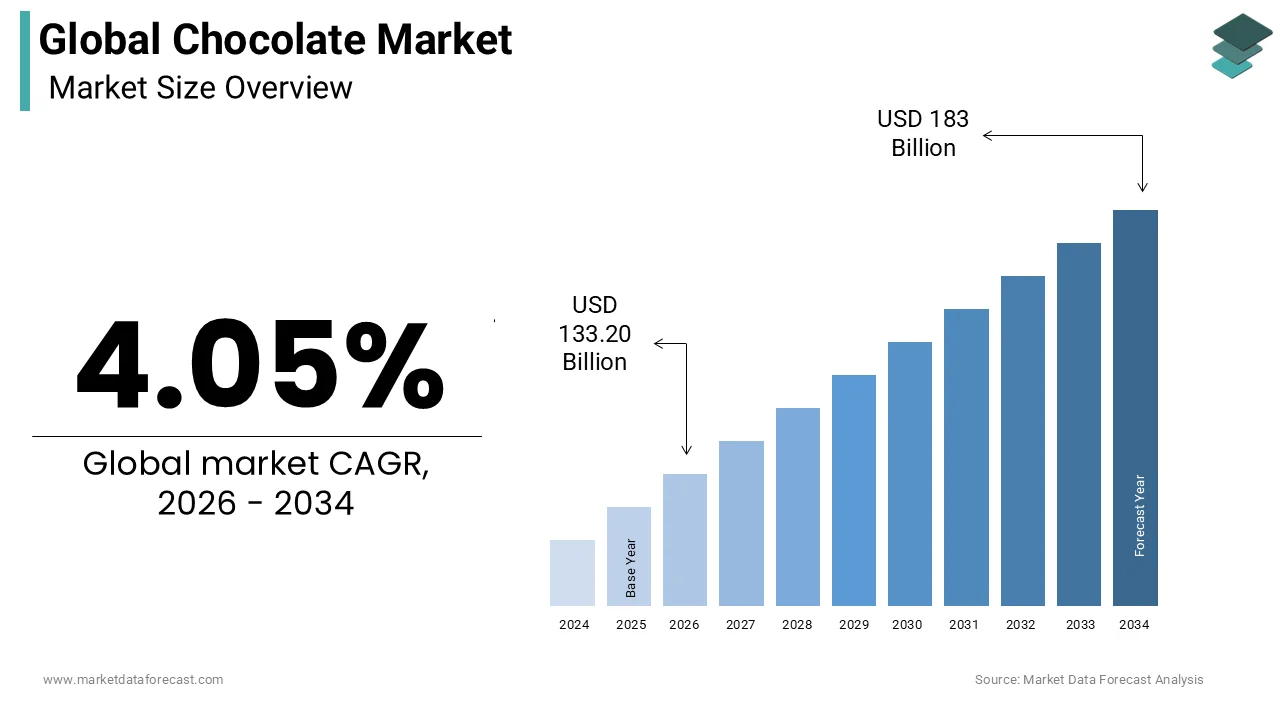
- Market Valuation: Valued at USD 128.02 billion in 2025, estimated at USD 133.20 billion in 2026, and projected to reach USD 183.00 billion by 2034, registering a steady CAGR of 4.05% during the forecast period.
- Primary Growth Drivers: Rising demand for dark chocolate driven by perceived health and antioxidant benefits; the rapid expansion of premiumization, artisanal offerings, and origin transparency; and lifestyle changes propelling confectionery consumption across emerging markets.
Key Market Segment Metrics (2026–2034)
| Category | Leading Segment / Position | Growth Dynamics |
|---|---|---|
| By Product | Traditional Chocolate (dominated the market in 2025, backed by authentic cocoa solids, butter, and strong brand heritage) | Artificial chocolate is projected to register the highest CAGR of 10.7%, driven by demand for cost-effective, stable alternatives in price-sensitive and baking applications. |
| By Distribution Channel | Supermarkets & Hypermarkets (captured 58.4% of the global market share in 2025 via routine grocery shopping and impulse buys) | Online distribution is estimated to register the fastest CAGR of 15.2%, propelled by e-grocery platforms, social commerce, and DTC websites. |
| By Region | Europe (top performer with 39.3% market share in 2025, anchored by high per capita consumption and manufacturing legacy) | Asia-Pacific is positioned as the most lucrative and fastest-growing region, fueled by rising disposable incomes and urban lifestyle changes. |
Major Market Players & Market Structure
Market Structure: Intensively competitive global landscape characterized by multinational giants leveraging vast scale alongside agile artisanal brands emphasizing ethical sourcing, clean labels, and flavor localization.
Key Companies: Mars Incorporated, Mondelēz International, Ferrero Group, Nestlé S.A., The Hershey Company, Lindt & Sprüngli AG, Barry Callebaut, Meiji Holdings Co. Ltd., Grupo Arcor, Pladis Global, Godiva Chocolatier, Ghirardelli Chocolate Company, and Blommer Chocolate Company.
Global Chocolate Market Size
The global chocolate market size was calculated to be USD 128.02 billion in 2025 and is anticipated to be worth USD 183 billion by 2034 from USD 133.20 billion In 2026, growing at a CAGR of 4.05% during the forecast period.
Chocolate is derived from cocoa beans, primarily Theobroma cacao, transformed into confectionery, beverages, and ingredient forms. Beyond its role as a confection, chocolate holds cultural significance in gifting, celebrations, and emotional wellness, supported by its psychoactive compounds such as theobromine and phenylethylamine. According to the Food and Agriculture Organization of the United Nations, over 5 million metric tons of cocoa beans were harvested globally in 2023, with West Africa accounting for more than 70% of supply. Côte d’Ivoire and Ghana remain the largest producers, collectively generating 60% of the world’s cocoa. However, consumption is concentrated in temperate regions. Switzerland has one of the highest per capita consumption rates for specific products like chocolate and organic foods.
MARKET DRIVERS
Rising Demand for Dark Chocolate Due to Perceived Health Benefits
The dark chocolate has gained traction among health-conscious consumers which drives the growth of chocolate market. The demand of dark chocolate is due to its high concentration of flavonoids and low sugar content. According to a study, regular consumption of dark chocolate is associated with a reduction in cardiovascular disease risk, attributed to improved endothelial function and blood pressure regulation. This scientific endorsement has influenced purchasing behavior, particularly in North America and Western Europe. In Germany, sales of dark chocolate increased 2019 and 2023, reaching metric tons annually, as per research.
Expansion of Premiumization and Artisanal Chocolate Segments
The global shift toward experiential and luxury consumption has elevated artisanal and bean-to-bar chocolate is amplifying the growth of chocolate market. These products emphasize origin transparency, small-batch production, and flavour complexity which appeals to affluent urban consumers. Premium and artisanal chocolate makers are a robust part of the market, driven by consumer demand for unique flavours, ethical sourcing, and higher quality. In Japan, premium chocolate accounts for a portion of total confectionery sales, driven by seasonal gift-giving traditions such as giri-choco during Valentine’s Day, as per research. The United States recorded a rise in specialty chocolate boutique openings, according to the study.
MARKET RESTRAINTS
Persistent Child Labor and Ethical Concerns in Cocoa Supply Chains
The cocoa industry continues to face severe scrutiny over human rights violations, which is hindering the growth of chocolate market. According to a 2020 NORC study, a more accurate figure is 1.6 million children engaged in hazardous tasks on cocoa farms in Côte d'Ivoire and Ghana during the 2018–2019 harvest. Despite two decades of industry pledges and multi-stakeholder initiatives, eradication efforts have yielded limited results. The cocoa sector in Côte d’Ivoire employs over 1.8 million farmers, many of whom earn less than USD 1 per day, perpetuating cycles of poverty that compel child labor, as per the International Institute of Tropical Agriculture. Regulatory burden is mounting. The European Union’s Corporate Sustainability Due Diligence Directive (CSDDD), which entered into force in July 2025, is being implemented on a staggered schedule beginning in 2027. It will require certain large companies, including major players in the chocolate industry, to proactively identify, prevent, and mitigate adverse human rights and environmental impacts, such as supply chain labor abuses, through a mandatory due diligence process.
Volatility in Cocoa Bean Prices Due to Climate and Geopolitical Instability
The volatility in cocoa prices is challenging the growth of chocolate market. The global benchmark price on ICE Futures reaching USD 10,000 per metric ton in March 2025, a historic high driven by supply deficits. According to the study, global cocoa production fell in 2023 due to prolonged drought and swollen shoot virus outbreaks in Ghana and Côte d’Ivoire, which together supply a portion of the world’s beans. In Ghana, yields dropped to 0.38 metric tons per hectare, down from 0.52 in 2021, as per study. Simultaneously, currency devaluations and civil unrest have disrupted farmer payments and export logistics. These fluctuations increase input costs for manufacturers, compress margins, and force reformulation or price pass-throughs.
MARKET OPPORTUNITIES
Development of Climate-Resilient Cocoa Varieties Through Biotechnology
The scientific advancements in plant genetics for stabilizing cocoa supply is providing new opportunities for the expansion of chocolate market. It uses disease- and drought-resistant cultivars. Research on CRISPR-edited cocoa plants for enhanced resistance to the fungal pathogen Phytophthora was conducted by Pennsylvania State University, not UC Berkeley. Apart from these, the Cocoa Research Centre at the University of the West Indies has bred hybrid clones, which yield up to three times more than traditional varieties under stress conditions. In Colombia, hectares have been replanted with high-performance clones since 2020, increasing farm productivity, according to the research. Thus, these innovations could mitigate climate-induced shortages and support sustainable intensification without expanding into forested areas.
Growth of Functional and Fortified Chocolate Products
The chocolate is increasingly being reformulated to deliver targeted health benefits, which is to enhance the growth of the chocolate market. Manufacturers are incorporating ingredients such as probiotics, plant-based proteins, adaptogens, and vitamins into chocolate bars to appeal to wellness-focused consumers. According to the study, the functional confectionery business, including fortified chocolate, expanded. In South Korea, functional chocolate products containing GABA (gamma-aminobutyric acid) for stress reduction captured a portion of the premium chocolate segment in 2023, as per the study. These innovations expand chocolate’s utility beyond taste by offering new consumer segments in preventive health and medical nutrition.
MARKET CHALLENGES
Deforestation and Biodiversity Loss Linked to Cocoa Farming Expansion
Cocoa cultivation is a significant driver of tropical deforestation which is challenging the growth of chocolate market. Much of this loss is attributed to illegal cocoa farming within protected areas. Like, according to study, a portion of deforestation in Ghana’s Atewa Forest Reserve was due to cocoa encroachment. This ecological degradation threatens biodiversity, including endangered species like the pygmy hippopotamus and white-naped mangabey. The European Union’s Deforestation Regulation mandates geolocation traceability for all cocoa imports after 2026, compelling companies to verify non-deforestation compliance. However, fragmented land tenure and weak enforcement in producing nations hinder effective monitoring. Reconciling cocoa production with conservation remains a systemic challenge requiring coordinated policy, technology, and financial incentives.
Rising Sugar Taxes and Regulatory Burden on High-Sugar Confectionery
Governments worldwide are implementing fiscal and regulatory measures to combat obesity and diabetes, is challenging the growth of chocolate market. As per the World Health Organization, over 40 countries have introduced sugar-sweetened beverage taxes, with several extending policies to confectionery. The United Kingdom’s Soft Drinks Industry Levy inspired a broader sugar reduction strategy. Likewise, as per study, a decline in sugar content across chocolate products due to reformulation stress. In Mexico, an 8% tax on high-calorie processed foods led to a 5.1% reduction in the purchase volume of taxed foods during the first year, according to the National Institute of Public Health. Chile enforces strict front-of-package warning labels on high-sugar foods, resulting in a drop in chocolate purchases among health-conscious households, as per the University of Chile’s Nutrition Department. These regulatory trends compel manufacturers to invest in sugar reduction technologies, such as enzyme-based sweeteners and texture modifiers, to maintain taste appeal while complying with public health mandates.
REPORT COVERAGE
| REPORT METRIC | DETAILS |
| Market Size Available | 2025 to 2034 |
| Base Year | 2025 |
| Forecast Period | 2026 to 2034 |
| CAGR | 4.05% |
| Segments Covered | By Product, Distribution Channel, and Region |
| Various Analyses Covered | Global, Regional & Country Level Analysis; Segment-Level Analysis; DROC, PESTLE Analysis; Porter’s Five Forces Analysis; Competitive Landscape; Analyst Overview of Investment Opportunities |
| Regions Covered | North America, Europe, APAC, Latin America, Middle East & Africa |
| Market Leaders Profiled | Mars, Incorporated, Mondelēz International, Ferrero Group, Nestlé S.A., The Hershey Company, Lindt & Sprüngli AG, Barry Callebaut, Meiji Holdings Co. Ltd., Grupo Arcor, Pladis Global, Godiva Chocolatier, Ghirardelli Chocolate Company, Blommer Chocolate Company |
SEGMENTAL ANALYSIS
By Product Insights
The traditional chocolate segment dominated the chocolate market by capturing a significant share in 2025. Consumer preference for authentic cocoa-based confectionery derived from natural ingredients, particularly in mature markets such as Germany, Switzerland, and the United States, is primarily driving the growth of the traditional chocolate segment in the global market. Traditional chocolate, made from cocoa solids, cocoa butter, sugar, and milk, benefits from centuries-old production techniques and strong brand loyalty. In Europe, a notable share of chocolate consumed is classified as traditional, with countries like Belgium and Austria maintaining artisanal manufacturing standards that date back to the 19th century, according to the study. Apart from these, premium dark and single-origin chocolates which is exclusively part of the traditional category are gaining traction among discerning consumers.
The artificial chocolate segment is predicted to witness the highest CAGR of 10.7% during the forecast period due to the rising demand for cost-effective, shelf-stable alternatives in price-sensitive markets and functional applications. Artificial chocolate, which uses cocoa powder or substitutes like carob along with vegetable fats instead of cocoa butter, is widely used in baked goods, confectionery coatings, and mass-produced snacks. In India, artificial chocolate accounts for a portion of industrial chocolate usage due to lower import duties and reduced dependency on volatile cocoa prices, according to the study. Moreover, in Nigeria and Indonesia, local producers leverage artificial formulations to offer affordable chocolate bars to expanding urban populations.
By Distribution Channel Insights
The supermarkets and hypermarkets segment led the chocolate market by capturing a 58.4% of the global market share in 2025. The growth of the supermarkets and hypermarkets segment is driven by the integration of chocolate into routine grocery shopping, strategic product placement near checkouts, and promotional bundling with other confectionery and beverages. In countries like France and Australia, a portion of chocolate purchases occurs in large-format stores, where retailers leverage seasonal displays and loyalty programs to boost impulse buying, particularly during holidays like Easter, as per study. Hypermarkets also serve as primary platforms for new product launches with manufacturers investing heavily in shelf space and visibility. In South Africa, Pick n Pay and Shoprite control a portion of chocolate sales volume, according to the South African Retail Sector Report, emphasizing the centrality of organized retail.
The online distribution segment is estimated to register the fastest CAGR of 15.2% from 2026 to 2034 with the proliferation of e-grocery platforms, direct-to-consumer (DTC) brand websites, and social commerce in both developed and emerging economies. In China, online chocolate sales surgedin 2023, with Tmall and JD.com hosting dedicated premium chocolate zones during festivals like Valentine’s Day and Mid-Autumn, according to the research. Artisanal brands are leveraging digital channels to bypass traditional retail gatekeepers.
REGIONAL ANALYSIS
Europe Chocolate Market Insights
Europe was the top performer in the chocolate market by holding 39.3% of share in 2025. The growth of Europe in the global market is primarily driven by its long history of chocolate manufacturing. The region combines deep cultural affinity with advanced product innovation and stringent quality standards. Germany, the largest consumer, with supermarkets and seasonal gifting driving demand, as per the research. Switzerland which is renowned for its premium milk chocolate maintains the highest per capita. This is supported by domestic production excellence and export branding. The European Union enforces strict labeling laws requiring minimum cocoa content for dark and milk chocolate, supporting consumer trust. However, regulatory burdens related to sugar reduction and deforestation-free sourcing are reshaping product development. Therefore, demand for organic, single-origin, and ethically certified chocolate continues to expand in Scandinavia and the Benelux countries, despite market maturity.
North America Chocolate Market Insights
North America is the second-largest market in the chocolate market and accounted for 27.5% of the share in 2025. The growth of North America in the global market is driven by the presence of established brands, significant consumption and rising e-commerce. The United States, the region’s primary market, consumes over 4.5 million metric tons of chocolate annually. According to the National Confectioners Association (NCA), the "big four" candy seasons, Halloween, Valentine’s Day, Easter, and the winter holidays (Christmas), account for approximately 62% to 64% of annual confectionery sales. Mass-market brands like Hershey’s and Mars dominate shelf space, but premium and functional variants are gaining share. Canada’s chocolate business grew in 2023, driven by urban demand for dark and plant-based options, according to Statistics Canada. E-commerce has transformed accessibility, with online chocolate sales increasing, as per the research. The region also leads in regulatory innovation, with front-of-package labeling proposals and sugar taxation debates influencing formulation strategies. North America remains a testing ground for new flavors, textures, and health-integrated products.
Asia Pacific Chocolate Market Insights
Asia Pacific is expected to be the most lucrative region in the chocolate market. Factors such as the rising disposable incomes and Westernized lifestyles, which are transforming urban eating habits, are majorly propelling the chocolate market in North America. At the same time, per capita consumption remains low. India’s organized chocolate sector grew annually over the years, with premium brands like Amul and Nestlé expanding distribution in tier-1 cities, according to the reseacrh. Japan maintains a sophisticated palate. The proliferation of convenience stores and e-commerce platforms is accelerating penetration. This positions Asia Pacific as the next frontier for global chocolate expansion.
Latin America Chocolate Market Insights
Latin America grew steadily in the chocolate market with an evolving consumer base and a major cocoa producer. The region accounts for 12% of global chocolate consumption, with Brazil and Mexico as the largest markets, according to the Inter-American Institute for Cooperation on Agriculture. Domestic brands like Garoto and Lacta dominate, but international players are expanding premium offerings in urban centers. Despite economic volatility, the cultural integration of chocolate, especially in traditional recipes like mole, ensures steady demand. However, price sensitivity limits premiumization which keeps the market focused on affordable and mass-market products.
Middle East and Africa Chocolate Market Insights
Middle East & Africa is likely to grow in the chocolate market with Gulf countries serving as high-value import markets and Sub-Saharan Africa remaining largely underpenetrated. The Gulf Cooperation Council nations imported significant metric tons of chocolate in 2023, with the UAE and Saudi Arabia as primary destinations, according to the study. Demand is driven by expatriate populations, luxury retail, and religious gifting during Eid festivals. Local consumption is rising in Nigeria and Kenya, where urban youth are adopting Western snacking habits. Domestic brands like Sweet Sensation in Nigeria are expanding production to meet demand, signaling nascent but promising growth in regional self-consumption.
LEADING PLAYERS IN THE CHOCOLATE MARKET
Mondelēz International has established a dominant presence in the Asia Pacific chocolate market through its iconic brands such as Cadbury, Toblerone, and Milka, which are deeply embedded in local consumer culture. In India, Cadbury Dairy Milk commands widespread loyalty which is supported by decades of localized marketing and affordable pricing strategies. The company has invested in regional manufacturing hubs in Australia, India, and China to ensure supply chain resilience and faster time-to-market. Mondelēz continues to strengthen its relevance in diverse Asian markets by integrating digital engagement, e-commerce partnerships, and flavor innovation such as matcha and lychee variants.
Ferrero Group has significantly expanded its footprint in Asia Pacific by leveraging premium branding, gifting culture, and strategic product localization. The company’s flagship brand, Ferrero Rocher, is a staple during festive seasons in China, Japan, and the Middle East, where gold-wrapped chocolates symbolize prosperity and are frequently exchanged as corporate gifts. The company also launched Kinder Joy in multiple localized formats, including dual-compartment packs tailored for children’s snacking habits in India and Vietnam. Through a blend of premium positioning, cultural insight, and ethical sourcing, Ferrero has cultivated a high-value brand image across the region.
Nestlé maintains a pervasive influence in the Asia Pacific chocolate market through a broad portfolio that spans mass-market and premium segments. Brands like KitKat, Aero, and Nescau are regionally adapted to local tastes, KitKat in Japan alone features many seasonal and regional flavours which reflects deep consumer engagement. It also strengthened its e-commerce presence by partnering with platforms for festival-driven campaigns. These integrated efforts position Nestlé as a versatile and forward-looking leader in the dynamic Asian confectionery landscape.
TOP STRATEGIES USED BY THE KEY MARKET PARTICIPANTS
Key players in the chocolate market are deploying product innovation, sustainable sourcing, digital transformation, premiumization, and regional localization to consolidate their competitive advantage. Companies are reformulating products to reduce sugar by incorporate functional ingredients, and offer plant-based alternatives in response to health trends. Sustainable certification and farm-level support programs are important for ensuring cocoa supply and meeting regulatory demands in Europe and North America. Digital platforms and direct-to-consumer models are being leveraged to enhance brand engagement and personalize offerings. Premium and artisanal lines are expanding to capture higher margins. At the same time, localized flavors and packaging are catering to regional gifting cultures. Apart from these, strategic investments in cold chain logistics and e-commerce partnerships are improving market access and responsiveness in high-growth regions like Asia Pacific.
KEY MARKET PLAYERS AND COMPETITION OVERVIEW
Major Players of the chocolate market include Mars, Incorporated, Mondelēz International, Ferrero Group, Nestlé S.A., The Hershey Company, Lindt & Sprüngli AG, Barry Callebaut, Meiji Holdings Co. Ltd., Grupo Arcor, Pladis Global, Godiva Chocolatier, Ghirardelli Chocolate Company, Blommer Chocolate Company
The chocolate market is driven by intense competition between multinational corporations, regional manufacturers, and emerging artisanal brands. Dominant players leverage scale, brand equity, and global distribution to maintain position, while challenger brands differentiate through origin transparency, ethical claims, and niche innovation. Moreover, competitive dynamics are increasingly shaped by sustainability, health consciousness, and digital engagement rather than price alone. In Asia Pacific, rivalry centers on flavor localization, e-commerce penetration, and alignment with cultural gifting traditions. Regulatory burdens related to sugar content and deforestation are forcing reformulation and supply chain restructuring. At the same time, private labels and store brands are gaining share in supermarkets.
MARKET SEGMENTATION
This research report on the global chocolate market has been segmented and sub-segmented based on product, distribution channel and region.
By Product
- Traditional
- Artificial
By Distribution Channel
- Supermarket & Hypermarket
- Convenience Store
- Online
By Region
- North America
- Europe
- Asia-Pacific
- Latin America
- Middle East and Africa