- Product Description Description
- Table of Contents TOC
- List of Table & Figure LOT
- Get Free Sample PDF Sample PDF
Market Size, 2025
$3.45 BnMarket Estimate, 2026
$3.74 BnMarket Forecast, 2034
$7.13 BnCAGR, 2026–2034
8.40%Executive Summary: Global CNG and LPG Vehicle Market
- Market Scope: Comprehensive market overview examining alternative fuel classifications (CNG and LPG), vehicle categories, urban applications, OEM vs. aftermarket channels, and global regional deployment.
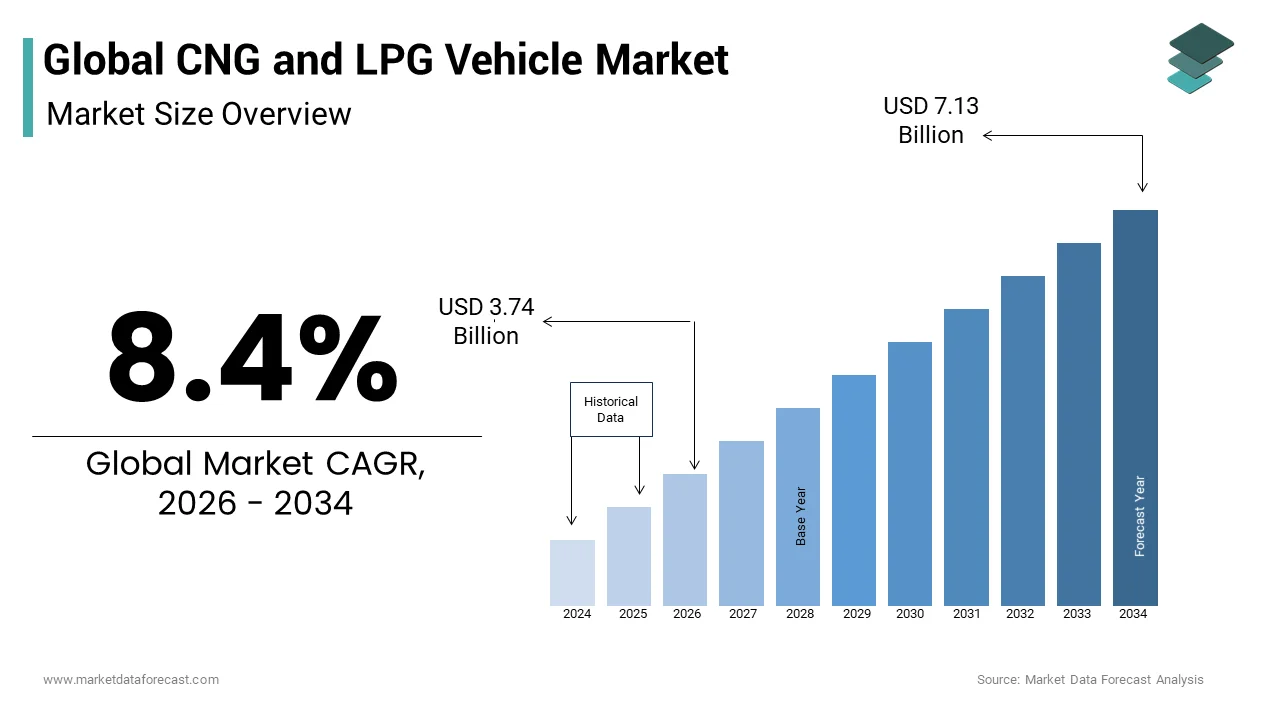
- Market Valuation: Valued at USD 3.45 billion in 2025, reaching USD 3.74 billion in 2026, and projected to scale up to USD 7.13 billion by 2034, registering a solid CAGR of 8.40% (2026–2034).
- Primary Growth Drivers: Long-term fuel cost savings over gasoline/diesel, escalating demand for eco-friendly transport to combat urban air pollution, stricter global emissions regulations, and supportive government incentives/subsidies.
Key Market Segment Metrics (2026–2034)
| Category | Leading Segment Position | Core Focus / Alternative Segment |
|---|---|---|
| By Fuel Type | CNG (dominated by lower emissions, wider refueling station availability, and strong alignment with clean regulations) | LPG (Liquefied Petroleum Gas) |
| By Vehicle Type | Passenger Cars (driven by consumer adoption for daily commuting, cost-efficiency, and urban eco-friendliness) | Commercial Vehicles |
| By Application | Urban Transportation (preferred for public transit, short commutes, and compliance with strict city limits) | Long-Haul and Logistics |
| By End-User | OEMs (Original Equipment Manufacturers, leading via integrated, optimized, and warranted factory-fitted solutions) | Aftermarket Conversion Kits |
| By Region | Asia-Pacific (led by strong national CNG infrastructure and government incentives in countries like India) | North America, Europe, Latin America, and Middle East & Africa |
Major Market Players & Market Structure
Market Structure: Highly competitive global landscape comprising major multinational automotive conglomerates, specialized fuel-system providers, and alternative energy infrastructure partners advancing sustainable propulsion options.
Key Companies: Ford, General Motors (GM), Toyota, Volkswagen Group, Fiat Chrysler Automobiles (Stellantis), Hyundai, IVECO, Cummins, Honda, Mercedes-Benz (Daimler AG), Volvo Group, Scania, Tata Motors, Landi Renzo, Westport Fuel Systems, Agility Fuel Solutions, Clean Energy Fuels, and Quantum Fuel Systems (Hexagon Composites).
 Download Free Sample Report
Global CNG and LPG Vehicle Market Size
The global CNG and LPG vehicle market size was valued at USD 3.45 billion in 2025 and is anticipated to reach a valuation of USD 3.74 billion in 2026 and USD 7.13 billion by 2034, growing at a CAGR of 8.40% from 2026 to 2034.
MARKET OVERVIEW
CNG and LPG vehicles are automobiles engineered or modified to run on alternative gaseous fuels instead of traditional petrol or diesel. They are highly popular globally as budget-friendly and environmentally conscious transportation choices. These vehicles utilize specialized storage tanks and fuel delivery systems to manage gaseous or liquid hydrocarbons under high pressure ensuring safe and efficient energy transfer to internal combustion engines. According to the International Energy Agency, global natural gas consumption reached approximately 4,239 billion cubic meters in 2023, driven primarily by industrial demand and power generation transitions in emerging markets. As per the United States Department of Energy, natural gas powers roughly 23 million vehicles worldwide, providing an efficient alternative fuel option for high-mileage, centrally fueled commercial fleets. According to the European Environment Agency, compressed natural gas vehicles reduce carbon dioxide emissions by an average of 20% to 30% when directly compared to conventional diesel alternatives. As per the Global LPG Partnership, the organization partners with eight developing nations, including Kenya, Uganda, Tanzania, Ghana, Cameroon, Rwanda, South Africa, and Nigeria, to plan national policy reforms and scale up clean energy infrastructure investments. These vehicles require distinct maintenance protocols due to different combustion characteristics and tank inspection requirements. Government incentives such as tax rebates and reduced registration fees further stimulate demand in emerging economies where air quality concerns are paramount. The market dynamics are heavily influenced by fluctuating fossil fuel prices and geopolitical stability affecting gas supply chains.
MARKET DRIVERS
Significant Cost Advantage Over Conventional Fuels Drives Adoption
The substantial economic benefit of operating vehicles on compressed natural gas and liquefied petroleum gas is propelling the CNG and LPG vehicle market. This trend is particularly visible among commercial fleet operators and cost conscious consumers. As per the Ministry of Petroleum and Natural Gas, compressed natural gas retail networks have scaled efficiently across domestic commuter corridors, offering a cost-saving margin of 30% to 50% relative to standard gasoline options. This price differential is especially pronounced in regions with abundant domestic natural gas reserves such as North America and the Middle East where government subsidies further enhance affordability. According to the Society of Motor Manufacturers and Traders, automotive supply chains experienced a 2% decline in passenger electric vehicle registrations year-over-year, prompting auto operators to diversify fleets with hybrid and traditional combustion platforms. Liquefied petroleum gas offers similar economic advantages with prices typically tracking below crude oil derivatives due to its status as a byproduct of natural gas processing and crude refining. As per the International Monetary Fund, the targeted execution of uniform carbon pricing frameworks and realigned energy taxation schedules remains the most economically efficient approach to lower overall energy consumption. According to Alliance Fleet Solutions, routine fuel allocations consume up to 60% of an average fleet's operational budget, forcing fleet managers to manage sudden fluctuations in diesel costs. The stability of natural gas prices compared to volatile crude oil markets provides predictable budgeting capabilities for logistics companies. This economic rationale drives sustained demand despite higher initial vehicle acquisition costs.
Stringent Environmental Regulations and Emission Reduction Mandates
Government imposed environmental standards and aggressive decarbonization targets further accelerate the growth of the CNG and LPG vehicle market. This compels automotive manufacturers and consumers to adopt cleaner fuel alternatives such as compressed natural gas and liquefied petroleum gas. The European Union has mandated a 55 percent reduction in greenhouse gas emissions by 2030 compared to 1990 levels forcing member states to promote low carbon transportation solutions. According to the World Health Organization, ambient and household air pollution triggers roughly 7 million premature deaths annually, prompting major municipal administrations to scale down vehicle emissions. Compressed natural gas vehicles emit negligible amounts of sulfur oxides and particulate matter making them compliant with stringent Euro 6 and Bharat Stage 6 emission norms. As per the California Air Resources Board, statewide heavy-duty transportation rules mandate a full phase-out of traditional diesel fleets, though recent legal adjustments withdrew specific rules for commercial harbor craft and refrigeration transport units. According to alternative fuel assessments published by Springer Nature, liquefied petroleum gas combustion emits 15% less carbon monoxide than conventional gasoline engines while lowering ozone-forming potential. As per the United Nations Environment Programme, urban mass transit sectors emit approximately 25% of all transport-related black carbon, prompting global partnerships to transition toward soot-free engine designs and alternative fuel systems. Regulatory bodies offer purchase incentives and toll exemptions for clean fuel vehicles accelerating their market penetration. Automakers respond by expanding their compressed natural gas and liquefied petroleum gas model portfolios to meet corporate average fuel economy standards. These policy driven mandates create a structured demand environment that supports long term market growth independent of short term fuel price fluctuations.
MARKET RESTRAINTS
Limited Refueling Infrastructure Availability Hinders Expansion
The scarcity of dedicated refueling stations is restricting the expansion of the CNG and LPG vehicle market. This limits consumer confidence and vehicle adoption rates, particularly in rural and suburban areas. According to the International Gas Union, global alternative energy expansion included approximately 29,000 active compressed natural gas and liquefied natural gas refueling stations as of 2024, showing heavy deployment density within Asian trade markets. But the infrastructure gap is most acute in developing regions where investment capital is limited and land acquisition for new stations faces bureaucratic hurdles. As per the American Public Gas Association, municipal utilities form localized public-private partnerships to construct shared natural gas fueling hubs, which stabilize municipal operational budgets by delivering fuel at rates substantially lower than commercial diesel. Liquefied petroleum gas infrastructure is more widespread but still lacks uniform coverage in many Asian and African nations where distribution networks are fragmented. The absence of standardized refueling nozzles and safety protocols across different countries complicates cross border travel for compressed natural gas vehicle owners. Consumers hesitate to invest in alternative fuel vehicles when they cannot guarantee convenient access to fuel during long distance trips. The chicken and egg dilemma persists as station operators wait for sufficient vehicle density to justify investment while consumers wait for adequate station coverage before purchasing vehicles. Government grants often fail to cover the full capital expenditure required for high pressure compression equipment slowing down network expansion. This infrastructural deficit remains the most cited reason for low consumer uptake in surveys conducted by automotive industry analysts.
High Initial Vehicle Conversion and Acquisition Costs
Alternative fuel vehicles cost more standard models upfront, which further hampers the growth of the CNG and LPG vehicle market. This high initial price discourages budget-conscious buyers and small businesses from switching, even though they would save money on fuel in the long run. According to Kelley Blue Book, certified conversion of a standard gasoline engine to a compressed natural gas configuration requires a baseline financial investment starting around $6,000 and climbing up to $12,000 depending on specific engine architectures. As per the Transport Project, retail infrastructure networks expanded with a two percent year-over-year increase in operational compressed natural gas stations, of which 51 percent directly dispense renewable natural gas to heavy-duty fleet operations. According to the National Renewable Energy Laboratory, municipal and commercial operators utilize the Vehicle and Infrastructure Cash-Flow Evaluation tool to analyze corporate investments, petroleum displacement metrics, and long-term infrastructure payback periods. Liquefied petroleum gas conversion kits are cheaper but still require professional installation and certification adding to the total expense. Small fleet operators with limited capital budgets struggle to justify the initial outlay even when projected savings are clear. The resale value of compressed natural gas vehicles remains uncertain in secondary markets due to perceived complexity and limited buyer pools. Insurance premiums for compressed natural gas vehicles are often higher due to perceived risks associated with high pressure gas storage. These financial barriers restrict market growth to large commercial entities and government fleets that can absorb initial costs and benefit from bulk purchasing power. Without substantial subsidies or financing options mass market adoption remains elusive.
MARKET OPPORTUNITIES
Expansion into Heavy Duty Transportation and Logistics Fleets
The increasing adoption of compressed natural gas in heavy duty trucks, buses, and waste management vehicles offers a significant opportunity for the growth of the CNG and LPG vehicle market. This expansion is due to the high fuel consumption and environmental impact of these segments. According to the American Trucking Associations, the commercial trucking fleet consumes approximately 50 billion gallons of diesel fuel annually, driving logistics networks across the domestic freight sector. Compressed natural gas engines offer comparable torque and power output to diesel units while producing significantly lower noise and vibration levels making them ideal for urban delivery and refuse collection operations. As per the International Council on Clean Transportation, conventional natural gas-powered heavy-duty trucks and buses provide marginal lifecycle climate benefits, reducing greenhouse gas emissions by 4% to 18% compared to their diesel counterparts. Major logistics companies such as UPS and FedEx have committed to deploying thousands of compressed natural gas trucks in their last mile delivery fleets to meet sustainability goals. The scalability of compressed natural gas refueling depots at central fleet locations mitigates the public infrastructure shortage issue as vehicles return to base daily. Government grants specifically targeting heavy duty vehicle electrification and alternative fuel adoption provide financial support for fleet modernization. The technical maturity of compressed natural gas engine technology ensures reliability and ease of maintenance for fleet managers. This segment offers higher volume sales potential per customer compared to passenger cars driving revenue growth for original equipment manufacturers and conversion kit suppliers.
Integration of Renewable Natural Gas and Bio LPG Sources
The emergence of renewable natural gas and bio-derived liquefied petroleum gas creates a compelling prospect for the CNG and LPG vehicle market. Consequently, compressed natural gas and liquefied petroleum gas vehicles can now be positioned as truly sustainable, zero-carbon transportation solutions. According to the Coalition for Renewable Natural Gas, the domestic production and transport utilization of renewable natural gas reached approximately 531 million gallons of gasoline equivalent in 2023, expanding the volume of low-carbon fuels inside regional supply chains. When compressed natural gas vehicles operate on renewable natural gas they achieve net negative carbon emissions because the methane captured would otherwise escape into the atmosphere as a potent greenhouse gas. As per the European Biogas Association, utilizing bio-LPG derived from organic waste streams and specialized production processes offers an average greenhouse gas reduction of up to 80% when compared to traditional fossil-based LPG alternatives. This environmental credential allows compressed natural gas and liquefied petroleum gas vehicles to qualify for advanced clean fuel credits and carbon trading revenues enhancing their economic viability. According to the European Council, newly enacted light-duty vehicle standards enforce a complete 100% reduction in average fleet emissions for passenger cars and vans starting in 2035, accelerating the deployment of zero-emission fleets across international markets. The circular economy model of converting waste into fuel aligns with corporate sustainability mandates and government climate strategies. Utilities and waste management companies are investing in anaerobic digestion facilities to produce renewable natural gas locally reducing transportation costs. This synergy between waste management and transportation sectors opens new revenue streams and partnerships. The ability to drop in renewable gases into existing infrastructure without modification accelerates adoption and enhances the green image of compressed natural gas and liquefied petroleum gas technologies.
MARKET CHALLENGES
Technological Complexity and Maintenance Skill Gaps
The specialized nature of CNG and LPG vehicle systems limits the availability of maintenance expertise and service centers, which slows down the expansion of the global market. As a result, owners frequently face longer vehicle downtimes and elevated repair costs. As per the National Institute for Automotive Service Excellence, technicians maintain industry competency by obtaining specialized credentials such as the Light Vehicle Compressed Natural Gas Technician (F1) certification to validate system repair skills. The shortage of skilled labor means that owners must rely on dealership service centers which are often fewer in number and charge premium rates for specialized diagnostics and repairs. The high pressure storage tanks require periodic hydrostatic testing every 3 to 5 years which adds to the lifetime ownership cost and logistical burden for users. Improper maintenance of gas injectors and pressure regulators can lead to inefficient combustion and increased emissions negating the environmental benefits of these vehicles. The lack of standardized diagnostic tools across different vehicle manufacturers complicates troubleshooting processes for mechanics. Training programs for gas vehicle maintenance are not widely available in vocational schools creating a pipeline issue for future technicians. Consumers report frustration with long wait times for service appointments and limited availability of spare parts for older compressed natural gas models. This service ecosystem weakness discourages potential buyers who prioritize convenience and reliability. The perceived hassle of owning a gas vehicle will remain a barrier to mainstream acceptance. This skepticism will persist until the service network expands and technical training becomes more accessible.
Safety Perceptions and Public Misconceptions
Persistent public misconceptions regarding the safety of high-pressure vehicle gas tanks pose a major psychological barrier to the CNG and LPG vehicle market. This fear remains a hurdle despite extensive statistical evidence proving their excellent safety record. According to the National Fire Protection Association, code enforcement bodies deploy updated NFPA 52 safety rules to establish mandatory clearance distances and ventilation minimums for compressed natural gas fueling hubs. However high profile incidents involving gas explosions in other contexts create undue fear among consumers who associate natural gas with household accidents rather than automotive engineering standards. Liquefied petroleum gas is heavier than air and can pool in low areas if leaked raising concerns about ignition risks in enclosed spaces such as parking garages. The media often amplifies rare accidents involving alternative fuel vehicles skewing public perception away from objective risk assessments. Insurance companies sometimes classify compressed natural gas vehicles as higher risk leading to increased premiums that further deter buyers. Public education campaigns by industry groups have had limited reach compared to widespread informal misinformation on social media platforms. Potential buyers frequently cite safety concerns as their primary hesitation in market surveys even when presented with factual data. The visual presence of large cylindrical tanks in vehicle trunks also raises aesthetic and space utilization concerns for family car buyers. Overcoming these deeply ingrained perceptions requires sustained effort from manufacturers and regulators to demonstrate the robustness of modern tank designs and safety valves.
REPORT COVERAGE
| REPORT METRIC | DETAILS |
| Market Size Available | 2025 to 2034 |
| Base Year | 2025 |
| Forecast Period | 2026 to 2034 |
| CAGR | 8.4% |
| Segments Covered | By Fuel, Vehicle, Application, End-User, and Region. |
| Various Analyses Covered | Global, Regional and Country Level Analysis, Segment-Level Analysis, DROC, PESTLE Analysis, Porter’s Five Forces Analysis, Competitive Landscape, Analyst Overview of Investment Opportunities |
| Regions Covered | North America, Europe, APAC, Latin America, Middle East & Africa |
| Market Leaders Profiled | Ford, General Motors (GM), Toyota, Volkswagen Group, Fiat Chrysler Automobiles (now part of Stellantis), Hyundai, IVECO (part of CNH Industrial), Cummins, Honda, Mercedes-Benz (Daimler AG), Volvo Group, Scania (a division of Volkswagen Truck & Bus), Tata Motors, Landi Renzo, Westport Fuel Systems, Agility Fuel Solutions, Clean Energy Fuels, Quantum Fuel Systems (Now part of Hexagon Composites), and Others. |
SEGMENT ANALYSIS
By Fuel Insights
Compressed Natural Gas
The compressed natural gas segment led the CNG and LPG vehicle market and captured a significant share in 2025. Its widespread availability, extensive infrastructure development in key emerging economies, and superior environmental credentials for heavy-duty applications have contributed to the leading position of this segment. The main drivers behind this segment's growth are aggressive government policies and substantial public investment in refueling infrastructure, particularly in the Asia-Pacific and Latin America regions. As per the Ministry of Petroleum and Natural Gas, India expanded its active alternative fuel retail infrastructure to over 8,600 operational compressed natural gas stations by 2026. This state backed infrastructure expansion reduces range anxiety and encourages fleet operators to transition from diesel to cleaner alternatives. According to the Ministry of Transport, China scaled its eco-friendly municipal transit networks so that more than 80 percent of its active public bus fleet consists of new energy vehicles. According to the International Energy Agency, annual global spending on electrical grid infrastructure remained historically flat before rising to an estimated $400 billion by 2024 to support clean power integrations. These policy driven initiatives create a favorable ecosystem where compressed natural gas vehicles benefit from priority lane access reduced tolls and tax exemptions. The centralized nature of natural gas distribution allows for easier regulatory oversight and quality control compared to decentralized liquefied petroleum gas supply chains. Municipalities prefer compressed natural gas for public transportation due to its lower noise pollution and zero particulate emissions which align with urban livability goals. The long term stability of natural gas prices compared to volatile crude oil markets provides budget certainty for public transit authorities. This strong institutional backing ensures that compressed natural gas remains the preferred alternative fuel for high volume commercial and public transport segments.
Compressed natural gas offers distinct environmental advantages over liquefied petroleum gas and diesel in heavy duty applications making it the fuel of choice for trucks buses and municipal vehicles. According to the United States Environmental Protection Agency, a complete repeal of federal greenhouse gas emission standards for new commercial trucks took effect in 2026, though strict regional smog-forming pollutant metrics remain active. The drastic reduction in harmful pollutants makes compressed natural gas ideal for meeting stringent Euro VI and Bharat Stage VI emission norms that are increasingly enforced globally. As per the California Air Resources Board, utilizing organic fuel options like renewable natural gas derived from food and green waste streams delivers a lifecycle climate benefit of up to a 125 percent emission reduction. The environmental credential allows logistics companies to meet corporate sustainability targets and qualify for green financing options. Compressed natural gas combustion is cleaner resulting in less engine wear and longer oil change intervals which lowers maintenance costs for fleet operators. The absence of sulfur in natural gas prevents the formation of acid rain contributing to broader environmental protection goals. Cities with severe smog problems such as Delhi and Beijing have prioritized compressed natural gas for their entire public bus fleets to improve air quality indices. The ability to blend renewable natural gas into existing compressed natural gas supplies further enhances its carbon neutrality profile. These environmental benefits drive regulatory preference and consumer adoption in sectors where emission reductions are critical for operational licenses and public health.
Liquefied Petroleum Gas
The liquefied petroleum gas segment is estimated to register the fastest CAGR of 7.8% during the forecast period, owing to its ease of retrofitting, lower conversion costs, and growing popularity in the passenger car segment. This rapid growth is largely fueled by the low cost and simplicity of converting existing gasoline vehicles using aftermarket kits, which appeals to price-sensitive individual consumers. According to Liquid Gas Europe, consumer automotive repair channels demand typical conversion investments between €1,500 and €3,500 to equip traditional passenger vehicles with dual-fuel autogas systems. The affordability enables millions of private car owners to switch to cheaper fuel without purchasing a new vehicle extending the life of older assets. As per the Italian Regulatory Authority for Energy, Networks and Environment, domestic policy integrations focus on scaling up the nation's organic bio-LPG and biomethane fuel output to hit a target of 6 million tonnes by the next decade. The modular nature of liquefied petroleum gas kits allows for quick installation often completed within a day minimizing vehicle downtime. This ease of adoption is particularly attractive in regions with high gasoline taxes where the payback period for conversion can be less than two years. The widespread availability of skilled technicians for liquefied petroleum gas installations further supports market growth as service barriers are low. Unlike compressed natural gas which requires high pressure tanks and complex plumbing liquefied petroleum gas systems operate at lower pressures making them safer and easier to maintain for independent garages. This democratization of alternative fuel technology drives volume growth in the passenger car segment where individual ownership dominates.
Liquefied petroleum gas offers superior energy density and refueling convenience compared to compressed natural gas contributing to its rapid adoption in regions with established distribution networks. According to the World LPG Association, standard autogas formulations exhibit a superior energy density of approximately 25 megajoules per liter compared to the lower volumetric yield of compressed natural gas. The efficiency is crucial for passenger cars where trunk space is limited and weight penalties must be minimized. The refueling process for liquefied petroleum gas is similar to gasoline taking only a few minutes and utilizing widely available pumps at existing service stations. In countries like Poland and Turkey liquefied petroleum gas is available at nearly every fuel station creating a seamless user experience that eliminates range anxiety. According to the Polish Chamber of Liquid Fuels, regional energy networks maintain approximately 7,400 active retail autogas stations supplying fuel to a domestic alternative vehicle fleet exceeding 3.4 million cars. The liquid state of liquefied petroleum gas at moderate pressure simplifies storage and transport logistics reducing infrastructure costs for suppliers. Consumers appreciate the flexibility of switching between gasoline and liquefied petroleum gas seamlessly which provides peace of mind during long trips. This combination of performance convenience and accessibility makes liquefied petroleum gas an attractive option for daily commuters and leisure drivers alike driving steady growth in the segment.
By Vehicle Insights
Commercial Vehicles
The commercial vehicles segment maintained dominance in the CNG and LPG vehicle market and accounted for a substantial share in 2025. Factors such as high mileage accumulation, intense cost sensitivity, and regulatory pressure faced by logistics and public transport operators propel the dominance of this segment. Moreover, the market position of these vehicles is driven by the compelling economic case for switching to compressed natural gas or liquefied petroleum gas, given the high annual mileage these vehicles accumulate. According to the American Transportation Research Institute, the industry-average operating cost for line-haul freight networks reached a record $2.336 per mile, with escalating repairs and driver benefits significantly impacting corporate logistics margins. As per the Ministry of Petroleum and Natural Gas, commercial logistics companies executing a strategic transition to compressed natural gas secure a 20% to 40% fuel cost reduction compared to standard diesel. This financial incentive is critical for logistics companies operating on thin margins where even small percentage improvements in efficiency translate to significant profit gains. According to Cummins, utilizing compressed natural gas across regional distribution lines provides an average fuel cost baseline of $2.99 per diesel gallon equivalent. As per The Transport Project, specialized high-speed municipal transport routes show that operating electric buses generates an estimated $0.40 to $0.45 higher cost per mile than running compressed natural gas units. Fleet managers prioritize total cost of ownership models where the higher initial investment in compressed natural gas vehicles is offset by lower fuel and maintenance costs within three to four years. The predictability of natural gas prices allows for accurate budgeting and financial planning unlike volatile diesel markets. This economic logic makes commercial fleets the early adopters and primary drivers of alternative fuel vehicle demand globally.
Strict government regulations mandating the use of clean fuels in public transportation and municipal services drive the widespread adoption of compressed natural gas and liquefied petroleum gas commercial vehicles. According to the European Parliament, newly amended greenhouse gas regulations specify that 90% of all newly registered urban transit buses inside member states must achieve complete zero-emission metrics by 2030. Many cities in China and India have banned diesel buses from central business districts forcing public transport operators to replace their fleets with compressed natural gas alternatives. As per the Delhi Transport Corporation, municipal transit networks executed aggressive fleet modernization by phasing out remaining low-floor compressed natural gas buses and adding 2,517 factory-built electric buses to regional transit routes. These regulatory requirements create a guaranteed demand stream for commercial vehicle manufacturers specializing in alternative fuel platforms. Government subsidies often cover the incremental cost of compressed natural gas buses making them financially viable for public agencies. The social license to operate for public transport providers is increasingly tied to their environmental performance making compliance with clean fuel mandates essential for contract renewals. Waste management and refuse collection vehicles are also subject to strict noise and emission limits in residential areas favoring quiet and clean compressed natural gas engines. This regulatory push ensures that the commercial vehicle segment remains the largest consumer of alternative fuel technologies.
Passenger Cars
The passenger cars segment is anticipated to witness the fastest CAGR of 6.5% from 2026 to 2034 due to rising consumer environmental awareness, increasing gasoline prices, and improved availability of factory built models.
Growth in this segment is propelled by increasing consumer consciousness regarding environmental impact and personal health concerns related to air pollution. According to sources, intent to purchase conventional internal combustion vehicles declined to 62% in mature western markets as alternative buyer options gained market share. The shift in consumer preference is driving demand for factory built compressed natural gas and liquefied petroleum gas cars that offer verified performance and warranty coverage. Younger demographics in urban areas are particularly motivated to choose cleaner fuels to contribute to local air quality improvement. As per the World Health Organization, public health agencies monitor ambient and particulate toxicity in crowded urban environments to implement targeted traffic management interventions. Automakers are responding by launching dedicated compressed natural gas and liquefied petroleum gas models in entry level and mid size segments catering to this eco conscious segment. Marketing campaigns emphasizing the green credentials of these vehicles resonate well with modern buyers who view their car choice as a statement of values. The availability of online calculators showing carbon footprint reductions further educates consumers and drives interest. This cultural shift toward sustainability is transforming passenger cars from purely economic decisions to ethical choices accelerating market penetration.
The introduction of factory built compressed natural gas and liquefied petroleum gas passenger cars by major automakers is removing previous barriers related to safety concerns and warranty voidance driving segment growth. According to Maruti Suzuki India, consumer alternative energy traction accelerated sharply with quarterly factory-fitted compressed natural gas model volumes hitting 220,000 units. Factory installed systems are integrated into the vehicle design ensuring optimal weight distribution crash safety and aesthetic appeal which aftermarket conversions often compromise. As per the World Liquid Gas Association, automotive manufacturers updated regional line-ups in select European trade blocks by launching innovative tri-fuel configurations that integrate a 40kW electric motor alongside autogas and gasoline reserves. This parity in features and reliability makes alternative fuel cars attractive to mainstream buyers who previously hesitated due to perceived inferiority. The extension of full manufacturer warranties to compressed natural gas and liquefied petroleum gas components eliminates the risk of costly repairs for consumers. Dealerships are trained to service these vehicles properly ensuring a consistent customer experience. The availability of financing options specifically tailored for factory built alternative fuel cars further lowers the entry barrier. This professionalization of the product offering is expanding the customer base beyond early adopters to the general mass market.
By Application Insights
Urban Transportation
In 2025, the urban transportation segment held the majority share in the CNG and LPG Vehicle Market because of the concentration of traffic congestion air quality issues and public transit dependencies in metropolitan areas.
The foremost factor securing this segment's leading position is the urgent need to combat severe air pollution in densely populated cities where vehicle emissions are a primary contributor to smog and health hazards. According to the World Bank, the cumulative global economic burden generated by the healthcare damages of fine particulate air pollution totals approximately $8.1 trillion annually. Compressed natural gas buses and taxis produce negligible particulate matter and lower nitrogen oxides making them ideal for stop and go urban driving conditions where emissions are highest. As per Transport for London, the Ultra Low Emission Zone enforces a mandatory standard daily tariff of £12.50 across all London boroughs for non-exempt vehicles that fail to meet strict Euro emission thresholds. According to the Asian Development Bank, international financing bodies collaborated with regional developers to deliver a 3.9 billion Thai baht green loan for procuring up to 1,200 zero-emission electric buses to modernize public transit in Bangkok. The health benefits of reduced pollution translate into lower healthcare costs for municipalities providing a strong economic rationale for these transitions. Urban fleets operate at low speeds and frequent idle times where compressed natural gas engines perform efficiently and quietly enhancing the urban living experience. The visibility of clean buses and taxis also serves as a public education tool encouraging private citizens to consider alternative fuels. This direct link between fuel choice and public health sustains the leadership of the urban transportation segment.
The high frequency and intensive usage patterns of public transportation systems in urban areas make them ideal candidates for compressed natural gas and liquefied petroleum gas adoption due to predictable refueling routines. According to studies, standard city route deployment subjects public transit buses to average daily shifts ranging from 200 to 400 kilometers. Centralized depots allow for the installation of dedicated compressed natural gas refueling stations eliminating the need for public infrastructure and reducing operational complexity. As per the New York Metropolitan Transportation Authority, regional clean transport frameworks mandate that the agency's entire 5,800-unit municipal bus fleet must achieve full zero-emission status by 2040. The depot based model minimizes range anxiety and maximizes vehicle utilization rates. As per sources, public transport networks in major emerging hubs prioritize compressed natural gas and battery electrification models over autogas configurations to achieve localized tailpipe emission reductions. The high visibility of these vehicles in urban settings normalizes the use of alternative fuels for the general public. Municipal contracts often specify the use of clean fuels for public service vehicles creating a stable and recurring revenue stream for fuel suppliers. This operational efficiency and contractual stability cement the position of urban transportation as the leading application segment.
Long Haul and Logistics
The long haul and logistics segment is on the rise and is expected to be the fastest growing segment in the market by witnessing a CAGR of 8.2% over the forecast period. This swift expansion is fuelled by the expansion of e commerce cross border trade and the need for sustainable supply chain solutions.
The explosive growth of e commerce is driving demand for compressed natural gas and liquefied petroleum gas vehicles in the logistics sector as companies seek to reduce the carbon footprint of last mile deliveries. According to research, the global retail e-commerce landscape reached an estimated valuation of $5.8 trillion, driving increased regional fulfillment activity across the commercial shipping landscape. Major logistics players like Amazon and DHL have committed to deploying tens of thousands of alternative fuel delivery vans to meet their net zero targets. Compressed natural gas vans offer the range and payload capacity needed for efficient urban deliveries while producing lower emissions than diesel equivalents. As per the National Retail Federation, consumer retail supply chains adapt to localized inventory requirements by utilizing specialized same-day shipping corridors to fulfill urban demand. These vehicles operate on fixed routes allowing for strategic placement of refueling infrastructure along delivery corridors. The brand value associated with green logistics drives consumer preference for companies that demonstrate environmental responsibility. The scalability of compressed natural gas fleets allows logistics companies to rapidly expand their operations without facing the charging infrastructure constraints of electric vehicles. This alignment with digital commerce trends fuels the rapid growth of the long haul and logistics segment.
Increasing cross border trade and regional economic integration are driving the adoption of compressed natural gas and liquefied petroleum gas trucks for long haul freight transportation across continental corridors. According to the World Trade Organization, macroeconomic barriers and a widespread manufacturing slowdown restricted global merchandise trade volume growth to a marginal 0.8%. As per the European Parliament, revised Trans-European Transport Network regulations dictate the mandatory deployment of publicly accessible electric charging hubs and hydrogen refueling points along primary highway corridors. Trucks operating on these routes benefit from a growing network of liquefied natural gas refueling stations located at major border crossings and rest stops. Long haul trucks benefit from the lower cost of natural gas over long distances where fuel expenses constitute a major portion of operational costs. The durability of compressed natural gas engines under continuous load conditions makes them reliable for intercity freight. Government incentives for green freight corridors encourage logistics companies to invest in alternative fuel trucks. This regional cooperation and trade expansion create a robust growth environment for the long haul and logistics application segment.
REGIONAL ANALYSIS
North America Market Analysis
North America remained the largest player in the CNG and LPG Vehicle Market and occupied a commanding share in 2025. This supremacy of the region’s market was supported by abundant natural gas reserves and a strong focus on commercial fleet electrification and alternative fuels. The region benefits from the shale gas boom which has kept natural gas prices low and stable making compressed natural gas an economically attractive option for trucking and public transit. According to the US Energy Information Administration, domestic energy output reached unprecedented highs as dry natural gas production expanded by more than 4% year-over-year to a record 39 trillion cubic feet. The domestic abundance reduces geopolitical risks and supports energy independence goals. As per the U.S. Environmental Protection Agency, newly implemented Phase 3 greenhouse gas standards enforce strict emission reduction targets for vocational trucks and tractors starting with model year 2027. According to the American Public Transportation Association, alternative fuel models and hybrid-electric configurations account for more than 41 percent of active public transit bus fleets. Canada is also expanding its liquefied petroleum gas infrastructure to support rural heating and transportation needs. The presence of major original equipment manufacturers like Ford and General Motors who offer factory built compressed natural gas trucks further stimulates market growth. Government grants under the Infrastructure Investment and Jobs Act provide funding for alternative fuel corridors enhancing refueling accessibility. The mature regulatory framework and strong industrial base position North America as a key market for technological innovation and fleet modernization.
Europe Market Analysis
Europe followed closely behind in the CNG and LPG vehicle market and held a noteworthy share in 2025. This growth of the European market was propellled by ambitious climate targets and a strong policy framework supporting decarbonization of the transport sector. The European Green Deal aims to reduce greenhouse gas emissions by 55 percent by 2030 creating a favorable environment for low carbon fuels like compressed natural gas and liquefied petroleum gas. According to the European Alternative Fuels Observatory, consumer adoption networks expand infrastructure support for a regional fleet that exceeds 10 million active liquefied petroleum gas vehicles. These countries have well established refueling networks and consumer incentives that sustain market demand. According to European Biogas Association documentation, transport operations increasingly absorb compressed and liquefied biomethane directly into standard distribution networks because the renewable gas mirrors fossil natural gas molecules perfectly. As per the Federal Ministry for Digital and Transport, specialized municipal transit funding pools dedicate up to €500 million to exclusively accelerate the rollout of battery-electric and hydrogen fuel cell buses. Strict low emission zones in cities like Paris and Madrid restrict access for high polluting vehicles driving demand for cleaner alternatives. The region is also a hub for research and development in hydrogen and synthetic fuels which complements the natural gas ecosystem. The strong emphasis on circular economy principles supports the production of bio LPG from waste materials. This policy driven approach ensures steady growth despite the rising competition from battery electric vehicles.
Asia Pacific Market Analysis
Asia-Pacific continues to expand rapidly in the CNG and LPG vehicle market because of swift urbanization, increasing vehicle ownership, and severe air quality challenges in major metropolitan areas. China and India are the primary drivers of growth with governments implementing aggressive policies to promote natural gas vehicles as a bridge to electrification. According to the China Association of Automobile Manufacturers, automotive supply networks accelerated domestic output as total annual industrial auto vehicle sales surpassed 30 million units. As per the Ministry of Petroleum and Natural Gas, domestic policy integrations focus on scaling up the nation's alternative energy mix to hit a structural target of 15% natural gas allocation by 2030. According to sources, consumer clean fuel adoption in India accelerated sharply with the domestic compressed natural gas vehicle population surging to 7.5 million units. Thailand and Indonesia are also expanding their liquefied petroleum gas markets due to domestic production capabilities and subsidy programs. The region benefits from lower labor and manufacturing costs making aftermarket conversions affordable for individual consumers. Rising disposable incomes are leading to increased private car ownership driving demand for cost effective fuel alternatives. The lack of widespread electric charging infrastructure in rural areas keeps compressed natural gas and liquefied petroleum gas relevant for broader mobility needs. This combination of policy support economic factors and environmental urgency positions Asia Pacific as the global growth engine for the market.
Latin America Market Analysis
Latin America has grown steadily in the CNG and LPG vehicle market. Within the region, Brazil and Argentina are leading adoption due to their domestic natural gas production and strong government incentives. The region faces economic volatility but maintains a strong demand for cost effective transportation solutions. According to the National Agency of Petroleum, Natural Gas and Biofuels, regional energy extraction networks expanded domestic natural gas production volumes to hit 161 million cubic meters per day. As per the Government of Argentina, regional utility regulatory frameworks prioritize the phased elimination of energy price controls to align wholesale natural gas tariffs with international parity benchmarks. According to the Inter-American Development Bank, multilateral financing portfolios prioritize the direct capitalization of regional climate mitigation strategies and clean electrical grid integrations to achieve net-zero urban development goals. As per the Mexico City Ministry of Mobility, municipal transit authorities prioritize the deployment of zero-emission battery-electric and high-capacity articulated bus fleets to modernize the Metrobús mass transport infrastructure. The region benefits from proximity to major natural gas producers in North America ensuring stable supply chains. However infrastructure gaps in rural areas limit widespread adoption outside major cities. Economic instability can impact investment in new refueling stations slowing down network expansion. Despite these challenges the strong economic case for compressed natural gas in high mileage applications sustains market activity. The cultural acceptance of converted vehicles and a robust aftermarket service industry support continued growth in the segment.
Middle East & Africa Market Analysis
The Middle East and Africa region maintains a unique position in the CNG and LPG Vehicle Market owing to vast natural gas reserves and gradual efforts to diversify energy consumption in the transport sector. Countries like Iran Egypt and Qatar have large domestic natural gas industries and are promoting compressed natural gas vehicles to reduce gasoline subsidies and improve air quality. According to the Iranian CNG Association, national alternative fuel infrastructure supports an active domestic transportation pool containing approximately 4.5 million dual-fuel vehicles. As per the Ministry of Petroleum and Mineral Resources, national clean transit initiatives focus on the localized production and supply of dual-fuel gasoline-CNG passenger vehicles to realign regional fuel consumption patterns. According to the United Arab Emirates Ministry of Energy and Infrastructure, national clean transport targets enforce the rapid expansion of a nationwide electric vehicle charging infrastructure to support a 50% EV fleet penetration goal by mid-century. In Africa, as per the Department of Mineral Resources and Energy, regional energy security frameworks prioritize the roll-out of targeted financial grants to accelerate the adoption of liquefied petroleum gas for domestic household thermal needs. However limited infrastructure and financial constraints hinder rapid adoption in many African nations. The region potential is significant due to resource availability but requires substantial investment in distribution networks and vehicle manufacturing capabilities to realize growth.
COMPETITIVE LANDSCAPE
The competition in the CNG and LPG Vehicle Market is characterized by a mix of established automotive giants and specialized regional manufacturers who leverage local policy support and infrastructure advantages. Major global players compete on technology innovation offering advanced engine management systems and hybrid configurations that maximize fuel efficiency and minimize emissions. Regional leaders often dominate specific markets like India and Iran due to strong government mandates and extensive refueling networks that create high entry barriers for outsiders. The market sees intense rivalry in the commercial vehicle segment where total cost of ownership and durability are primary decision factors for fleet operators. Price competition remains sharp in the passenger car segment as manufacturers strive to make factory fitted models affordable for mass market consumers. Innovation in tank materials and design helps companies differentiate their products by offering lighter weight and greater storage capacity. After sales service quality and availability of spare parts also play a critical role in brand loyalty and customer retention. The threat from battery electric vehicles pushes gas vehicle makers to highlight the faster refueling times and lower upfront costs of their products. Strategic alliances with fuel suppliers and infrastructure developers are essential for maintaining competitiveness. This dynamic environment drives continuous improvement in vehicle performance and user experience.
KEY MARKET PLAYERS
These are the market players that are dominating the global CNG and LPG vehicle market.
- Ford, General Motors (GM)
- Toyota
- Volkswagen Group
- Maruti Suzuki India Limited
- Fiat Chrysler Automobiles (now part of Stellantis)
- Hyundai
- IVECO (part of CNH Industrial)
- Cummins
- Honda,
- Mercedes-Benz (Daimler AG)
- Volvo Group
- Scania (a division of Volkswagen Truck & Bus)
- Tata Motors
- Ford Motor Company
- Landi Renzo
- Westport Fuel Systems,
- Agility Fuel Solutions
- Clean Energy Fuels
- Quantum Fuel Systems (Now part of Hexagon Composites)
Top Players In The Market
- Maruti Suzuki India Limited stands as a pivotal force in the global compressed natural gas vehicle segment by offering a wide range of factory fitted models that cater to mass market consumers. The company has consistently innovated its Smart Hybrid technology which integrates seamlessly with compressed natural gas systems to enhance fuel efficiency and reduce emissions. Recent initiatives include the launch of multiple new variants across its sedan and hatchback portfolio specifically designed for urban commuting needs. Maruti Suzuki has expanded its dealer network to include specialized service centers equipped with trained technicians for compressed natural gas maintenance. This strategic focus on after sales support builds consumer trust and encourages wider adoption. The company actively collaborates with government bodies to promote cleaner mobility solutions through awareness campaigns. By maintaining competitive pricing and ensuring high reliability Maruti Suzuki continues to drive volume growth in the entry level segment. Its commitment to localized manufacturing helps keep costs low while meeting stringent emission norms. These efforts solidify its reputation as a leader in affordable clean transportation solutions for emerging economies.
- Volkswagen AG contributes significantly to the liquefied petroleum gas and compressed natural gas market through its diverse brand portfolio including Audi Skoda and SEAT which offer dedicated alternative fuel models. The company has invested heavily in developing efficient internal combustion engines that are optimized for gaseous fuels reducing carbon footprints without compromising performance. Volkswagen recently introduced updated TGI models in Europe featuring larger tank capacities and improved refueling convenience to address range anxiety. The automaker is also exploring synthetic fuels and bio LPG options to further decarbonize its fleet offerings. Strategic partnerships with energy providers ensure robust refueling infrastructure development across key European markets. Volkswagen leverages its modular platform strategy to integrate gas tanks without sacrificing interior space or cargo capacity. This engineering excellence appeals to environmentally conscious consumers who are not yet ready to switch fully to electric vehicles. The company’s strong brand presence and extensive dealership network facilitate easy access to information and service for gas vehicle owners. These actions reinforce its position as a versatile player in the transition toward sustainable mobility.
- Ford Motor Company plays a crucial role in the commercial vehicle segment by offering robust compressed natural gas options for its popular F Series trucks and Transit vans. The company focuses on providing durable and high performance vehicles that meet the demanding needs of fleet operators and municipal services. Ford recently expanded its QVM program which includes certified upfitters for compressed natural gas conversions ensuring quality and warranty protection for customers. The automaker collaborates with fuel suppliers to develop refueling infrastructure at major logistics hubs and distribution centers. Ford’s investment in telematics allows fleet managers to monitor fuel usage and optimize routes for maximum efficiency with gaseous fuels. The company emphasizes total cost of ownership benefits highlighting significant savings on fuel and maintenance for high mileage users. By integrating compressed natural gas capabilities into its mainstream commercial lineup Ford makes alternative fuels accessible to a broader audience. Its global supply chain and manufacturing expertise enable scalable production of these specialized vehicles. These strategic moves strengthen its leadership in the sustainable commercial transportation sector.
Top Strategies Used By Key Market Participants
Key players in the CNG and LPG Vehicle Market primarily focus on expanding their product portfolios with factory fitted models to ensure safety and reliability for consumers. Companies invest heavily in research and development to improve engine efficiency and reduce emissions further enhancing the environmental appeal of gaseous fuels. Strategic partnerships with energy providers and infrastructure developers are common to address the critical issue of refueling availability and range anxiety. Manufacturers also engage in aggressive marketing campaigns to educate consumers about the cost benefits and environmental advantages of compressed natural gas and liquefied petroleum gas vehicles. Expanding service networks with trained technicians ensures proper maintenance and builds long term customer trust. Many firms are exploring renewable natural gas and bio LPG integration to future proof their offerings against stricter carbon regulations. Collaborations with government agencies help secure subsidies and incentives that lower the total cost of ownership for buyers. These combined strategies aim to overcome barriers to adoption and sustain growth in a competitive automotive landscape.
MARKET SEGMENTATION
This research report on the global CNG and LPG vehicle market has been segmented and sub-segmented into the following categories.
By Fuel
- CNG
- LPG
By Vehicle
- Passenger Cars
- Commercial Vehicle
By Application
- Urban Transportation
- Long-Haul and Logistics
By End-User
- OEM (Original Equipment Manufacturer)
- Aftermarket
By Region
- North America
- Europe
- Asia Pacific
- Latin America
- Middle East & Africa