- Product Description Description
- Table of Contents TOC
- List of Table & Figure LOT
- Get Free Sample PDF Sample PDF
Market Size, 2025
$1.99 BnMarket Estimate, 2026
$2.10 BnMarket Forecast, 2034
$3.25 BnCAGR, 2026–2034
5.6%Global Cone Crushers Market Size, Growth, Trends & Forecast (2026–2034)
The global cone crushers market size was valued at USD 1.99 billion in 2025, is anticipated to reach USD 2.10 billion in 2026, and is projected to scale up to USD 3.25 billion by 2034, registering a compound annual growth rate (CAGR) of 5.6% during the forecast period from 2026 to 2034. Driven by rapid global urbanization, surging infrastructure investments, and increasing demand for manufactured sand, the market continues steady expansion across mining and construction sectors.
Key Executive Metrics (At-a-Glance)
- 2025 Base Valuation: USD 1.99 Billion
- 2026 Current Valuation: USD 2.10 Billion
- 2034 Forecast Valuation: USD 3.25 Billion
- Compound Annual Growth Rate (CAGR): 5.6% (2026–2034)
- Dominant Type Segment: Hydraulic Cone Crushers (led by high crushing efficiency, automated adjustments, and overload protection)
- Dominant Offering Segment: Stationary Cone Crushers (commanded the leading share due to high capacity and long-term durability in fixed industrial plants)
- Dominant End-User Application Segment: Mining and Metallurgy (accounted for the largest share driven by global demand for copper, iron ore, gold, and lithium)
- Fastest-Growing Offering Segment: Mobile Cone Crushers (witnessing the fastest CAGR due to on-site flexibility and rapid deployment)
- Dominant Regional Market: North America (anchored by robust infrastructure renewal, advanced automation, and mature mining operations)
Core Market Drivers
- Surging Global Infrastructure Development: Massive investments in transportation networks, smart cities, and urban facilities creating sustained demand for high-quality aggregates.
- Escalating Demand for Manufactured Sand: Strict environmental bans on natural river sand extraction driving the adoption of crushed stone sand processed by cone crushers.
Primary Market Restraints & Challenges
- High Initial Capital Investment: Substantial upfront expenditures for advanced hydraulic units and strict environmental compliance systems posing barriers for small and medium operators.
Global Cone Crushers Market Segmentation Breakdown
| Segment Category | Leading Sub-Segment | Fastest-Growing Sub-Segment |
|---|---|---|
| By Type | Hydraulic Cone Crushers | Symons Cone Crushers (Steady emerging market growth) |
| By Offering | Stationary Cone Crushers | Mobile Cone Crushers (Fastest CAGR) |
| By End-User Application | Mining and Metallurgy | Construction and Demolition (Fastest CAGR) |
| By Region | North America | Asia-Pacific (Rapid urban expansion & mining) |
Major Industry Players Profiled
Key enterprises shaping the competitive global cone crushers market include Sandvik AB, Terex Corporation, McCloskey International, The Weir Group PLC, Shanghai Shibang Machinery Co., Zhejiang MP Mining Equipment, Henan Liming Heavy Industry Science & Technology, Northern Heavy Industries Group, and Puzzolana.
Global Cone Crushers Market Size
The global cone crushers market size was valued at USD 1.99 billion in 2025 and is anticipated to reach USD 2.10 billion in 2026 to reach USD 3.25 billion by 2034, growing at a CAGR of 5.6% during the forecast period 2026 to 2034.
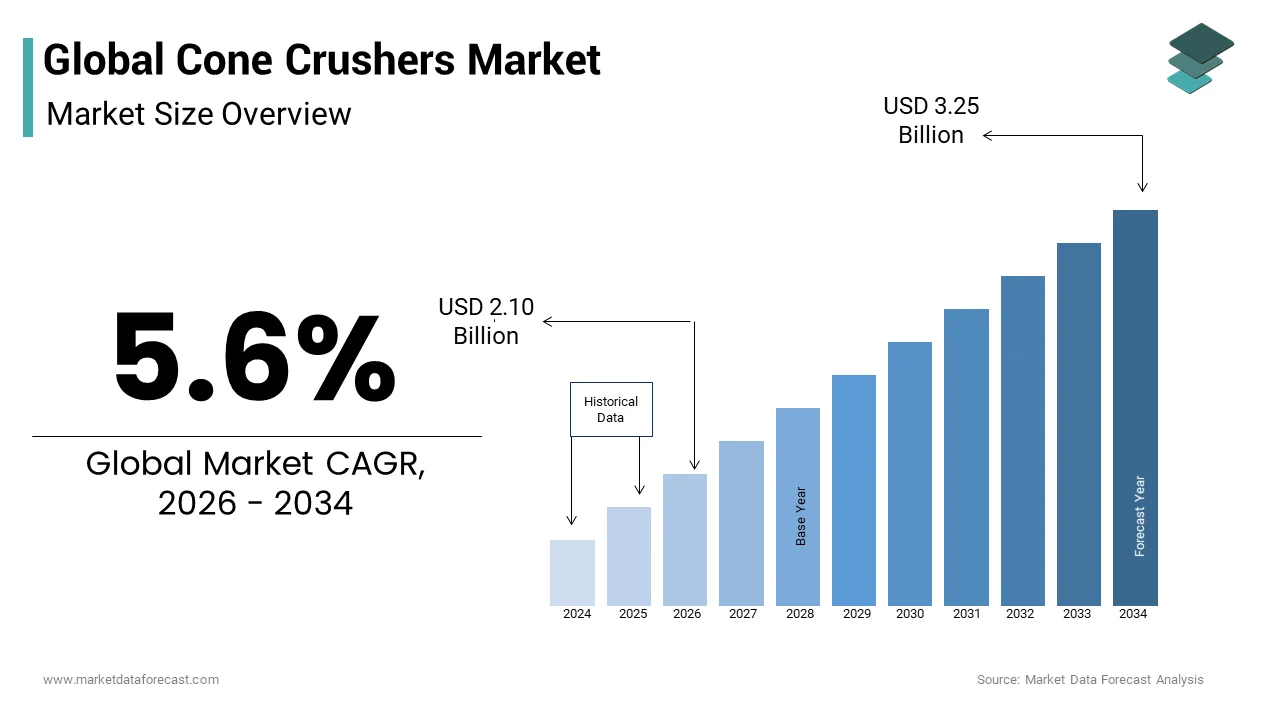
Cone crushers comprises heavy-duty machinery designed for secondary and tertiary crushing stages in mining, quarrying, and aggregate production industries. These machines utilize a gyrating mantle within a concave bowl to compress and fracture rock materials into smaller, uniform particles suitable for construction and industrial applications. The global demand for infrastructure development and urbanization drives the necessity for high-quality aggregates, positioning cone crushers as essential components in modern processing plants. According to the United Nations Department of Economic and Social Affairs, approximately 68% of the world population is projected to live in urban areas by 2050, necessitating massive expansion in housing, transportation, and public utilities. This demographic shift directly correlates with increased consumption of construction materials such as concrete and asphalt. As per the International Energy Agency, the cement industry accounts for roughly 7% of global carbon dioxide emissions, prompting a shift toward more efficient crushing technologies that reduce energy consumption per ton of produced aggregate. Furthermore, the depletion of easily accessible natural sand reserves has led to a surge in manufactured sand production, where cone crushers play a pivotal role in shaping particle geometry. Regulatory frameworks in regions like Europe and North America are increasingly stringent regarding noise pollution and dust emissions from quarry operations, compelling manufacturers to integrate advanced suppression systems and enclosed designs. The transition toward automated and remote-monitored crushing circuits enhances operational safety and efficiency, aligning with Industry 4.0 standards. These factors collectively establish a robust foundation for the cone crushers market, which is emphasizing the critical interplay between technological innovation, environmental compliance, and global infrastructure needs.
MARKET DRIVERS
Surging Global Infrastructure Development and Urbanization
The unprecedented pace of global infrastructure development is majorly propelling the expansion of the cone crushers market due to government initiatives to upgrade transportation networks, energy grids, and urban facilities. Developing economies in Asia Pacific and Africa are investing heavily in road construction, railway expansion, and airport modernization to support economic growth and connectivity. According to the World Bank, global infrastructure investment needs are estimated to reach 94 trillion dollars by 2040, creating a sustained demand for high-quality aggregates. As per the Asian Development Bank, Asia requires an annual investment of 1.7 trillion dollars in infrastructure through 2030 to maintain its growth momentum, significantly boosting the quarrying and mining sectors. Cone crushers are preferred in these applications due to their ability to produce cubical-shaped aggregates with low fines content, which are essential for high-strength concrete and durable road surfaces. The rise of smart cities and sustainable urban planning further amplifies the need for precise material grading, which modern hydraulic cone crushers deliver efficiently. Additionally, the rehabilitation of aging infrastructure in developed nations such as the United States and Germany contributes to steady equipment procurement. The Bipartisan Infrastructure Law in the United States allocates 1.2 trillion dollars for rebuilding roads and bridges, directly stimulating domestic aggregate production. Consequently, the continuous flow of capital into civil engineering projects ensures a robust and expanding market for reliable and high-capacity crushing solutions.
Increasing Demand for Manufactured Sand and Aggregates
The growing scarcity of natural river sand and stringent environmental regulations protecting water bodies have accelerated the adoption of manufactured sand, which is further boosting the global market expansion. Traditional sand extraction causes ecological damage and is increasingly banned or restricted in many countries, forcing the construction industry to rely on crushed stone sand as a viable alternative. According to the United Nations Environment Programme, sand is the second most consumed natural resource after water, with global usage exceeding 50 billion tons annually, leading to severe environmental degradation. As per the Indian Ministry of Environment, Forest and Climate Change, several states have imposed complete bans on river sand mining, mandating the use of manufactured sand in all government construction projects. Cone crushers are instrumental in this transition because they can process hard rocks like granite and basalt into fine, well-graded particles that mimic the properties of natural sand. The superior particle shape and gradation control offered by modern cone crushers enhance the workability and strength of concrete, making them indispensable for high-rise buildings and infrastructure projects. Furthermore, the cost-effectiveness of producing sand locally from quarry waste reduces logistics expenses and carbon footprints associated with long-distance transportation. This structural shift in raw material sourcing ensures that cone crushers remain central to aggregate production strategies, supporting both environmental sustainability and construction quality standards globally.
MARKET RESTRAINTS
High Initial Capital Investment and Operational Costs
The substantial financial burden associated with acquiring and maintaining advanced cone crushers acts as a significant barrier to entry for small and medium-sized quarry operators. High-performance hydraulic cone crushers equipped with automation features and robust wear-resistant materials require considerable upfront capital, often ranging from hundreds of thousands to millions of dollars depending on capacity. According to the International Finance Corporation, access to affordable financing remains a critical challenge for small enterprises in the mining sector, particularly in developing regions where interest rates are high. As per the Society for Mining, Metallurgy and Exploration, the total cost of ownership includes not only the purchase price but also ongoing expenses for electricity, wear parts replacement, and specialized maintenance labor. The volatility in energy prices further exacerbates operational costs, as crushing is an energy-intensive process. Small operators often struggle to achieve the economies of scale necessary to justify such investments, limiting their ability to compete with larger integrated producers. Additionally, the complexity of modern hydraulic systems requires skilled technicians for troubleshooting and repair, adding to labor costs. Budgetary constraints force many smaller entities to rely on outdated or less efficient equipment, which may not meet current environmental or productivity standards. Until financing options become more accessible and operational efficiencies improve, the high capital threshold will continue to restrain market penetration among smaller industry participants.
Stringent Environmental Regulations and Noise Pollution Controls
The implementation of rigorous environmental regulations regarding noise, dust, and vibration poses a significant restraint on the cone crushers market, particularly in densely populated areas. Quarrying and crushing operations are inherently noisy and generate substantial particulate matter, drawing scrutiny from regulatory bodies and local communities. According to the European Environment Agency, noise pollution is one of the top environmental health risks in Europe, leading to strict limits on industrial sound levels during day and night operations. As per the United States Environmental Protection Agency, facilities must comply with the Clean Air Act requirements for particulate matter emissions, necessitating the installation of expensive dust suppression systems and enclosed crushing chambers. Compliance with these standards increases the initial cost of equipment and requires continuous monitoring and maintenance. Non-compliance can result in hefty fines, operational shutdowns, and reputational damage, discouraging new entrants and limiting expansion plans for existing players. In urban fringes where aggregate demand is high, zoning laws often prohibit heavy industrial activities, forcing quarries to relocate to remote areas where logistics costs are higher. The need for acoustic enclosures and advanced filtration systems adds complexity to crusher design and reduces overall efficiency. These regulatory hurdles create a challenging operating environment, compelling manufacturers to innovate constantly while balancing cost and compliance, thereby slowing down the adoption rate in sensitive regions.
MARKET OPPORTUNITIES
Integration of IoT and Smart Automation Technologies
The incorporation of Internet of Things sensors and artificial intelligence into cone crushers presents a promising opportunity for the cone crushers market. Smart crushers equipped with real-time monitoring capabilities can track parameters such as pressure, temperature, vibration, and wear status, allowing operators to optimize performance and prevent unexpected failures. According to McKinsey and Company, the adoption of digital technologies in the mining and metals industry can increase productivity by up to 20% and reduce maintenance costs by 15%. As per the Industrial Internet Consortium, predictive maintenance algorithms can extend the lifespan of critical components by identifying early signs of degradation before catastrophic failure occurs. This technology enables remote operation and centralized control of multiple crushing units, reducing the need for on-site personnel and improving safety. Manufacturers can offer value-added services such as data analytics platforms and subscription-based monitoring, creating new revenue streams beyond hardware sales. The ability to adjust crusher settings automatically based on feed material characteristics ensures consistent product quality and maximizes throughput. Furthermore, integration with enterprise resource planning systems facilitates better inventory management and supply chain coordination. By embracing smart automation, cone crusher manufacturers can differentiate their products in a competitive market, appealing to large mining companies seeking to digitize their operations and achieve greater operational excellence.
Expansion into Recycling and Circular Economy Applications
The growing emphasis on circular economy principles and sustainable construction practices offers a lucrative opportunity for cone crushers in the recycling sector. Construction and demolition waste represents a significant portion of global waste streams, and recycling this material into reusable aggregates reduces landfill usage and conserves natural resources. According to the European Commission, the construction sector generates approximately 35% of all waste in the European Union, highlighting the urgent need for effective recycling solutions. As per the Waste and Resources Action Programme in the United Kingdom, recycled aggregates can replace up to 30% of virgin materials in concrete production without compromising structural integrity. Cone crushers are ideal for processing concrete rubble and asphalt due to their ability to handle varied feed sizes and produce high-quality end products. The development of specialized mobile cone crushers allows for on-site recycling, reducing transportation costs and carbon emissions associated with waste haulage. Governments are introducing incentives and mandates for using recycled materials in public projects, driving demand for efficient recycling equipment. Manufacturers can capitalize on this trend by designing crushers with enhanced contamination separation features and robust wear protection for abrasive recycled materials. This shift toward sustainable resource management positions cone crushers as key enablers of the circular economy, opening new markets in urban redevelopment and waste management industries.
MARKET CHALLENGES
Volatility in Raw Material Prices and Supply Chain Disruptions
The cone crushers market faces significant challenges due to fluctuations in the prices of raw materials such as steel, copper, and rare earth elements used in motors and hydraulics. These commodities are subject to global market dynamics influenced by geopolitical tensions, trade policies, and supply chain bottlenecks. According to the World Bank, metal prices experienced significant volatility in recent years, with steel prices rising by over 50% during peak demand periods, directly impacting production costs for heavy machinery manufacturers. As per the Institute for Supply Management, supply chain disruptions caused by logistical delays and component shortages have extended lead times for critical parts such as hydraulic pumps and electronic controllers. Manufacturers struggle to pass these increased costs onto customers who operate on fixed budget contracts, leading to margin erosion. The unpredictability of raw material availability forces companies to hold higher inventory levels, tying up capital and increasing storage costs. Additionally, reliance on specific suppliers for specialized components creates vulnerability to single-point failures. These economic pressures challenge the financial stability of manufacturers, requiring strategic adjustments in sourcing, pricing, and production planning. Until supply chains stabilize and raw material prices normalize, the industry will face continued uncertainty in cost management and profitability.
Shortage of Skilled Labor for Operation and Maintenance
The increasing complexity of modern cone crushers has created a significant skills gap, as the industry struggles to find workers capable of operating, maintaining, and troubleshooting sophisticated hydraulic and electronic systems, which is further challenging the global market expansion. Traditional quarrying roles required mechanical aptitude, but contemporary equipment demands proficiency in digital interfaces, sensor diagnostics, and automated control systems. According to the International Labour Organization, the mining and quarrying sector faces a growing shortage of skilled technicians, particularly in rural areas where educational opportunities for technical training are limited. As per the National Stone, Sand and Gravel Association in the United States, many operators report difficulties in recruiting staff who can manage advanced automation features and perform preventive maintenance effectively. This skills mismatch leads to increased downtime, reduced efficiency, and higher operational risks when machines are operated incorrectly. Training programs are often costly and time-consuming, placing additional burdens on employers who must balance production schedules with workforce development. The aging workforce in many traditional mining communities exacerbates this issue, as older workers may be less adaptable to new technologies. Without a sufficient pool of qualified personnel, quarry owners hesitate to invest in advanced equipment, fearing that they will not be able to utilize it effectively. This labor constraint hinders the full realization of automation benefits and slows the adoption of innovative crushing solutions.
REPORT COVERAGE
| REPORT METRIC | DETAILS |
| Market Size Available | 2025 to 2034 |
| Base Year | 2025 |
| Forecast Period | 2026 to 2034 |
| CAGR | 5.6% |
| Segments Covered | By Type, offering, Application, and Region |
| Various Analyses Covered | Global, Regional & Country Level Analysis, Segment-Level Analysis, DROC, PESTLE Analysis, Porter’s Five Forces Analysis, Competitive Landscape, Analyst Overview on Investment Opportunities |
| Regions Covered | North America, Europe, APAC, Latin America, Middle East & Africa |
| Market Leaders Profiled | McCloskey International, Terex Corporation, Shanghai Shibang Machinery Co., Zhejiang MP Mining Equipment, The Weir Group PLC, Henan Liming Heavy Industry Science & Technology, Northern Heavy Industries Group, Northern Heavy Industries Group, Sandvik AB, Puzzolana, and Others. |
SEGMENTAL ANALYSIS
By Type Insights
The hydraulic cone crushers segment accounted for the leading share of the global market in 2025 due to their superior efficiency, automated adjustment capabilities, and ability to handle hard and abrasive materials with minimal downtime. Unlike traditional spring-based systems, hydraulic crushers utilize a hydraulic cylinder to adjust the discharge opening and provide overload protection, ensuring consistent product quality and operational safety. According to the Society for Mining, Metallurgy and Exploration, hydraulic systems can improve crushing efficiency by up to 30% compared to mechanical alternatives by maintaining optimal chamber settings automatically. As per the International Journal of Mineral Processing, the adoption of hydraulic technology reduces wear on components such as mantles and concaves, lowering maintenance costs by approximately 20% over the equipment lifecycle. The ability to clear blocked chambers quickly without manual intervention significantly enhances productivity in high-volume mining operations. Furthermore, modern hydraulic crushers are integrated with digital control systems that allow for real-time monitoring of pressure and temperature, enabling predictive maintenance and reducing unexpected failures. The versatility of hydraulic models to operate in both secondary and tertiary crushing stages makes them indispensable for complex aggregate production lines. Major manufacturers prioritize hydraulic designs in their new product launches, reflecting industry preference for automation and reliability. This technological advantage, combined with lower total cost of ownership, solidifies the dominance of hydraulic cone crushers in contemporary quarrying and mining applications worldwide.
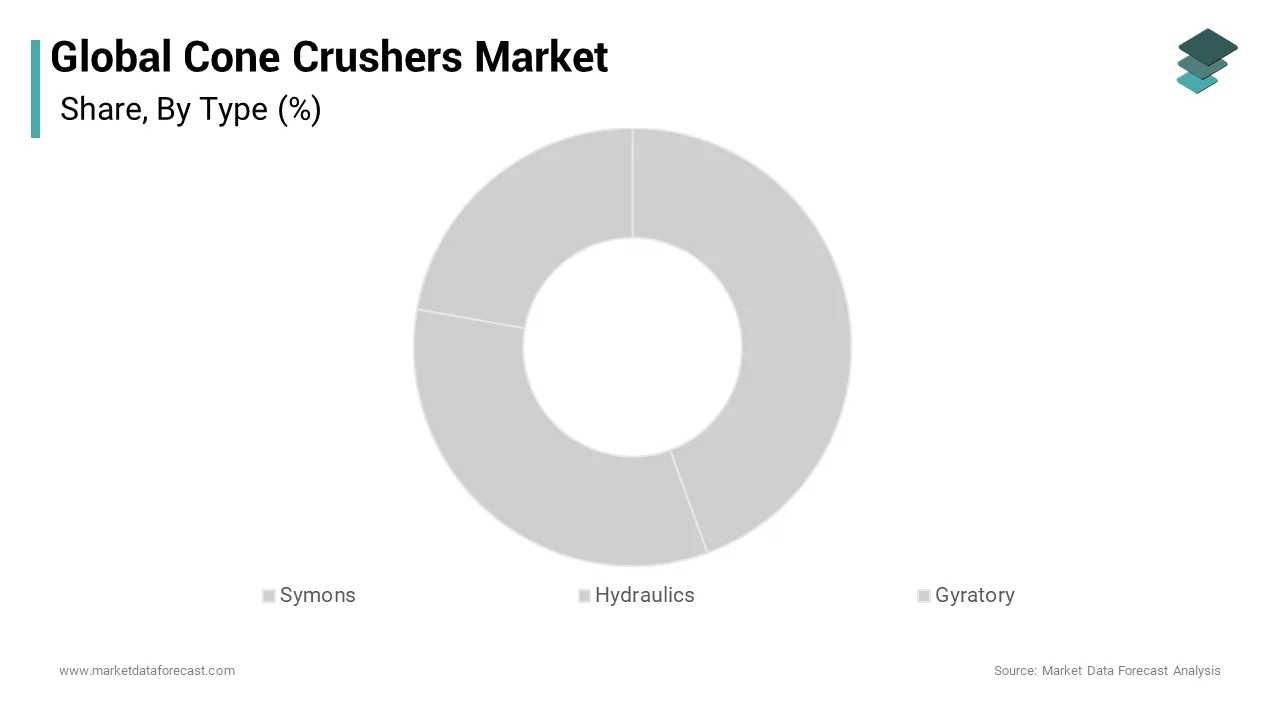
On the other end, the symons cone crusher segment is experiencing steady growth, particularly in emerging markets and smaller-scale operations over the forecast period due to its proven reliability, lower initial cost, and ease of maintenance. Although considered older technology compared to hydraulic models, Symons crushers remain highly effective for specific applications where extreme automation is not required. According to the National Stone, Sand and Gravel Association, many small-to-medium-sized quarries prefer Symons crushers due to their robust mechanical design and widespread availability of spare parts. As per the Indian Bureau of Mines, the extensive installed base of Symons crushers in India and Southeast Asia supports a strong aftermarket demand for replacements and upgrades. The simplicity of the spring release mechanism allows for easier troubleshooting by local technicians who may lack specialized training in hydraulic systems. Additionally, the lower capital expenditure makes Symons crushers an attractive entry point for new operators entering the aggregate business. Recent innovations have modernized Symons designs with improved sealing and lubrication systems, extending their service life and enhancing performance. The segment benefits from the retrofitting of existing plants where operators seek to replace worn units with familiar and cost-effective solutions. This combination of affordability, familiarity, and continuous incremental improvements ensures that Symons cone crushers maintain a relevant and growing presence in the global market.
By Offering Insights
The stationary cone crushers segment dominated the market by commanding for the leading share of the global market in 2025 due to their high capacity, durability, and suitability for large-scale mining and long-term quarry operations. These units are designed for fixed installation within processing plants, allowing for integration with extensive conveyor systems, screening stations, and storage facilities. According to the World Mining Congress, stationary crushers handle over 70% of global mineral extraction volumes, reflecting their critical role in industrial-scale production. As per the Cement and Concrete Research Foundation, large infrastructure projects require consistent supply of aggregates from established quarries, which rely on stationary plants for uninterrupted output. The robust construction of stationary crushers enables them to process massive tonnages of hard rock efficiently, achieving economies of scale that mobile units cannot match. Their fixed nature allows for optimized plant layout and energy distribution, reducing operational costs per ton. Furthermore, stationary plants are often equipped with advanced automation and dust suppression systems that are difficult to implement on mobile units. The longevity of stationary installations, often exceeding 15 years, provides a stable return on investment for mining companies. Government approvals for permanent quarry sites also favor stationary setups due to their controlled environmental impact. This entrenched position in heavy industry ensures that stationary cone crushers remain the backbone of global aggregate and mineral production.
However, the mobile cone crushers segment is expected to witness the fastest CAGR in the global market over the forecast period owing to the increasing demand for flexibility, rapid deployment, and on-site recycling capabilities in construction and urban development projects. Mobile units are mounted on tracked or wheeled chassis, which is allowing them to be transported easily between job sites and set up quickly without extensive foundation work. According to the European Construction Industry Federation, the use of mobile crushing equipment has increased by 15% annually in Europe due to strict regulations on transporting waste materials and the rise of urban demolition projects. As per the Associated General Contractors of America, mobile crushers reduce logistics costs by up to 40% by processing material directly at the source, eliminating the need for haulage to distant fixed plants. The growing trend of contract crushing services, where operators move equipment to client sites, further boosts demand for versatile mobile units. Advances in hydraulic tracking and remote control technologies have enhanced the maneuverability and safety of mobile crushers, making them suitable for confined spaces. Additionally, the emphasis on sustainable construction practices encourages on-site recycling of concrete and asphalt, a task ideally suited for mobile crushers. The ability to respond quickly to changing project requirements and regulatory constraints positions mobile cone crushers as the preferred choice for dynamic and short-term operations.
By End-User Application Insights
The mining and metallurgy segment dominated the market by accounting for the leading share of the market in 2025. The leading position of mining and metallurgy segment in the global market can be credited to the relentless global demand for metals such as copper, iron ore, gold, and lithium. Cone crushers are essential in comminution circuits for reducing run-of-mine ore to manageable sizes for further grinding and processing. According to the United States Geological Survey, global mine production of copper reached 21 million tons in recent years, requiring extensive crushing infrastructure to handle low-grade ores efficiently. As per the International Council on Mining and Metals, the industry is investing heavily in automation and efficiency to cope with declining ore grades and deeper mining operations. Hydraulic cone crushers are preferred in this sector for their ability to handle hard and abrasive rocks while maintaining high throughput. The expansion of mining activities in regions like Australia, Chile, and Africa drives substantial equipment procurement. Furthermore, the transition toward electric vehicles has spurred demand for battery metals, leading to new mine developments that require modern crushing solutions. Regulatory pressures to minimize environmental impact also push mining companies toward efficient and enclosed crushing systems. The capital-intensive nature of mining ensures long-term contracts for equipment suppliers, stabilizing demand. This critical reliance on size reduction for value extraction cements the mining sector as the primary driver of the cone crushers market.
However, the construction and demolition segment is predicted to record the fastest CGAR in the global market during the forecast period owing to the urbanization, infrastructure renewal, and stringent waste management regulations. The need to recycle construction debris into reusable aggregates has surged, creating a vibrant market for mobile and stationary cone crushers capable of processing concrete and asphalt. According to the European Environment Agency, construction and demolition waste accounts for approximately 35% of all waste generated in the European Union, prompting mandates for higher recycling rates. As per the National Demolition Association in the United States, the demolition industry is growing at a rate of 6% annually, driven by the redevelopment of aging urban infrastructure. Cone crushers are ideal for producing high-quality recycled aggregates that meet strict specifications for road base and concrete production. The rise of green building certifications encourages the use of recycled materials, further boosting demand. Urban construction projects often have limited space and noise restrictions, favoring compact and quiet mobile crushing solutions. Government incentives for circular economy practices accelerate the adoption of on-site recycling technologies. The versatility of cone crushers in handling varied demolition waste makes them indispensable for modern construction firms. This convergence of regulatory pressure, environmental awareness, and economic benefit drives the rapid expansion of the construction and demolition segment.
REGIONAL ANALYSIS
North America Market Analysis
North America accounted for the largest share of the global market in 2025 and is poised to maintain its market leadership in the coming years due to ongoing infrastructure renewal and advanced technological integration in mining operations, advanced technological adoption and a mature mining industry. The United States and Canada are key contributors, with substantial investments in infrastructure renewal and mineral extraction. According to the United States Geological Survey, the value of mineral production in the United States exceeded 90 billion dollars recently, supporting robust demand for heavy crushing equipment. The Bipartisan Infrastructure Law allocates 1.2 trillion dollars for transportation and utility projects, driving aggregate production and equipment sales. As per the Canadian Institute of Mining, Canada is a global leader in potash, uranium, and gold production, requiring high-capacity stationary crushers for remote operations. The region leads in the integration of IoT and automation in crushing plants, enhancing efficiency and safety. Strict environmental regulations promote the use of enclosed and low-emission crushers, particularly in urban quarries. The presence of major manufacturers and service providers ensures strong after-sales support and parts availability. The shift toward sustainable mining practices and recycling in construction further stimulates market growth. North America’s focus on innovation and regulatory compliance positions it as a hub for advanced crushing technologies, influencing global trends and standards.
Europe Market Analysis
Europe is expected to experience steady growth as the region focuses on upgrading its existing industrial infrastructure and adopting green construction standards. Europe represents a mature and highly regulated market for cone crushers, driven by stringent environmental standards and a strong focus on circular economy principles. Countries such as Germany, Sweden, and Finland are leaders in manufacturing and adopting advanced crushing technologies. According to Eurostat, the European Union generates over 800 million tons of construction waste annually, driving significant demand for mobile recycling crushers. As per the European Aggregates Association, the industry is transitioning toward sustainable production methods, including electrification and noise reduction. The Green Deal initiative promotes resource efficiency, encouraging the use of recycled aggregates in construction. Strict noise and dust emission limits compel operators to invest in modern, enclosed crushing systems. The region is also a hub for research and development in crushing efficiency and automation. Major European manufacturers export globally, leveraging their reputation for quality and reliability. The aging infrastructure in Western Europe requires continuous maintenance and reconstruction, sustaining demand for aggregate production equipment. Eastern Europe is seeing growth due to increased infrastructure investment and mining activities. Europe’s commitment to sustainability and technological excellence ensures a steady demand for high-performance and environmentally compliant cone crushers.
Asia Pacific Market Analysis
Asia-Pacific is likely to continue its rapid expansion over the next few years as governments accelerate large-scale industrial and urban development projects. The Asia-Pacific region is the largest and fastest-growing market for cone crushers, fueled by rapid urbanization, industrialization, and massive infrastructure development. China, India, and Australia are the primary drivers, with China being the world’s largest consumer of cement and aggregates. According to the Asian Development Bank, Asia needs to invest 1.7 trillion dollars annually in infrastructure through 2030, creating immense demand for crushing equipment. As per the Indian Ministry of Mines, the government is promoting private participation in mining to boost domestic mineral production, leading to increased equipment procurement. Australia’s robust mining sector, particularly in iron ore and lithium, drives demand for large stationary crushers. The region is witnessing a shift from manual to automated crushing operations to improve safety and efficiency. Rapid urban expansion in Southeast Asia increases the need for construction aggregates and recycling solutions. Government initiatives to ban river sand mining in countries like India and Vietnam accelerate the adoption of manufactured sand technologies using cone crushers. The presence of local manufacturers alongside global players creates a competitive market with diverse offerings. Asia-Pacific’s dynamic growth trajectory and vast resource base make it the central engine of the global cone crushers market.
Latin America Market Analysis
Latin America is expected to see moderate growth driven by continued investment in its vast mining resources and a slow but steady push toward modernizing regional infrastructure. Latin America presents a developing yet significant market for cone crushers, dominated by the mining sectors in Chile, Peru, and Brazil. The region is rich in copper, iron ore, and lithium, attracting substantial foreign investment in mining infrastructure. According to the Economic Commission for Latin America and the Caribbean, mining exports account for a significant portion of regional GDP, driving continuous equipment upgrades. As per the Chilean Copper Commission, Chile remains the world’s largest copper producer, requiring high-capacity and reliable crushing systems for large-scale operations. Brazil’s iron ore industry also contributes significantly to demand, with major miners investing in automation and efficiency. The construction sector is growing in urban centers, increasing demand for aggregates and mobile crushers. Political and economic stability varies across countries, impacting investment cycles, but the long-term potential remains strong. Environmental regulations are becoming stricter, prompting adoption of cleaner technologies. The remoteness of many mining sites favors durable and low-maintenance equipment. Local distribution networks are expanding to provide better service and support. Latin America’s resource wealth and ongoing industrialization ensure a steady demand for robust and efficient cone crushers, particularly in the mining sector.
Middle East and Africa Market Analysis
The Middle East and Africa are projected to undergo significant growth as countries advance their diversification agendas through massive construction and mining initiatives. The Middle East and Africa region shows gradual but steady growth in the cone crushers market, driven by infrastructure development in the Gulf states and mining expansion in Africa. Countries like Saudi Arabia and the United Arab Emirates are investing heavily in mega projects such as NEOM, driving demand for aggregates and crushing equipment. According to the World Bank, infrastructure investment in the Middle East is rising to diversify economies away from oil dependence. As per the African Minerals Development Centre, Africa holds significant reserves of gold, platinum, and diamonds, with mining activities expanding in South Africa, Ghana, and Tanzania. The construction boom in urban areas requires local aggregate production, favoring mobile and stationary crushers.
COMPETITIVE LANDSCAPE
The competition in the cone crushers market is intense and characterized by the presence of established multinational corporations alongside specialized regional manufacturers. Large global players leverage their extensive resources broad product portfolios and advanced research capabilities to dominate the high end segment of automated and large capacity crushers. These companies compete on technology leadership reliability and comprehensive service support. Specialized firms often focus on niche applications such as mobile recycling or specific mineral processing offering customized solutions that address unique customer requirements. The market sees frequent consolidation as larger entities acquire innovative startups to expand their technological offerings and geographic reach. Price competition is moderate in premium segments but intensifies in entry level categories where numerous suppliers exist. Intellectual property protection plays a crucial role with companies vigorously defending patents related to hydraulic systems and chamber designs. Customer loyalty is driven by equipment durability operational efficiency and responsive technical assistance. As sustainability becomes a priority competitors must demonstrate energy efficiency and reduced environmental impact. The shift toward digitalization encourages collaboration between equipment suppliers and software providers creating new competitive dynamics. Manufacturers must balance innovation with cost effectiveness to retain market share in an increasingly demanding global landscape.
KEY MARKET PLAYERS
Major Key Players in the Global Cone Crushers Market are
- Terex Corporation
- Metso Corporation
- McCloskey Equipment
- ThyssenKrupp AG
- Sandvik AB
- Keestrack NV
- Westpro Machinery Inc.
- Puzzolana Machinery Fabricators LLP
- Astec Industries Inc.
- Sandvik AB
- others.
Top Players In The Market
- Metso Corporation stands as a global leader in sustainable technologies for aggregates and mining industries with a comprehensive portfolio of cone crushers. The company leverages its expertise in hydraulic systems to produce high efficiency equipment that reduces energy consumption and wear. Recently Metso has integrated advanced digital monitoring tools into its crushers to enable predictive maintenance and remote operation. They have expanded their service network in emerging markets to provide faster technical support and spare parts availability. By focusing on lifecycle services Metso ensures long term customer relationships and operational reliability. Their commitment to sustainability drives the development of electric and hybrid crushing solutions. This strategic approach solidifies their position as a key enabler of efficient and environmentally responsible mineral processing operations worldwide.
- Sandvik Mining and Rock Solutions is a prominent player known for its robust and innovative cone crusher designs tailored for demanding applications. The company offers a wide range of stationary and mobile crushers that deliver superior productivity and product quality. Sandvik recently launched new generation hydraulic cone crushers with enhanced automation features and improved chamber geometry. They have strengthened their market position by investing in research and development centers focused on material science and wear resistance. The corporation actively collaborates with mining companies to optimize crushing circuits for maximum efficiency. By providing comprehensive training and simulation tools Sandvik empowers operators to achieve optimal performance. Their emphasis on durability and technological advancement reinforces their reputation as a trusted partner in the global aggregates and mining sectors.
- Terex Corporation contributes significantly to the cone crushers market through its Powerscreen and Finlay brands which specialize in mobile and portable crushing solutions. The company focuses on delivering flexible and easy to transport equipment suitable for construction demolition and quarrying applications. Terex recently introduced new mobile cone crushers with integrated screening and conveying systems to streamline on site processing. They have expanded their manufacturing capabilities to meet growing demand for compact and efficient machines. The company prioritizes customer support by offering extensive warranty programs and rapid response service teams. By leveraging digital platforms for fleet management Terex enhances operational visibility for clients. Their focus on mobility and versatility enables customers to adapt quickly to changing project requirements strengthening their competitive edge in the dynamic crushing equipment industry.
Top Strategies Used By Key Market Participants
Key players in the cone crushers market primarily focus on technological innovation and product differentiation to enhance efficiency and automation. Companies invest heavily in research and development to create smart crushers equipped with IoT sensors and AI driven analytics for predictive maintenance. Strategic partnerships with mining and construction firms allow manufacturers to tailor solutions to specific operational needs and improve user experience. Expansion into emerging markets through local assembly and distribution networks helps companies capture growth opportunities in regions with rising infrastructure investment. Mergers and acquisitions are frequently employed to acquire specialized technologies and broaden product portfolios. Sustainability initiatives drive the development of energy efficient and low emission equipment to comply with environmental regulations. Additionally manufacturers emphasize comprehensive after sales support and training programs to ensure optimal equipment performance and customer loyalty. These strategies enable companies to maintain competitiveness and address the evolving demands of the global mining and aggregates industry effectively.
MARKET SEGMENTATION
This research report on the global cone crushers market has been segmented and sub-segmented based on type, offering, application, and region.
By Type
- Symons
- Hydraulics
- Gyratory
By Offering
- Mobile Crusher
- Portable Crusher
- Stationary Crusher
By Application
- Mining and Metallurgy
- Aggregate Processing
- Construction
- Others
By Region
- North America
- Europe
- Asia Pacific
- Latin America
- Middle East and Africa