- Product Description Description
- Table of Contents TOC
- List of Table & Figure LOT
- Get Free Sample PDF Sample PDF
Market Size, 2025
$0.77 BnMarket Estimate, 2026
$0.80 BnMarket Forecast, 2034
$1.08 BnCAGR, 2026–2034
3.88%Executive Summary: Global Industrial Motor Market
- Market Scope: Comprehensive market evaluation of the global industrial motor sector, analyzing efficiency levels (IE1 through IE4, DC, others), applications (compressors, pumps & fans, conveyors, crushers, extruders), motor types (DC brushed, BLDC, stepper, traction), end-use sectors (commercial HVAC, F&B, mining, utilities, others), and regional performance across Asia-Pacific, North America, Europe, Latin America, and the Middle East & Africa.
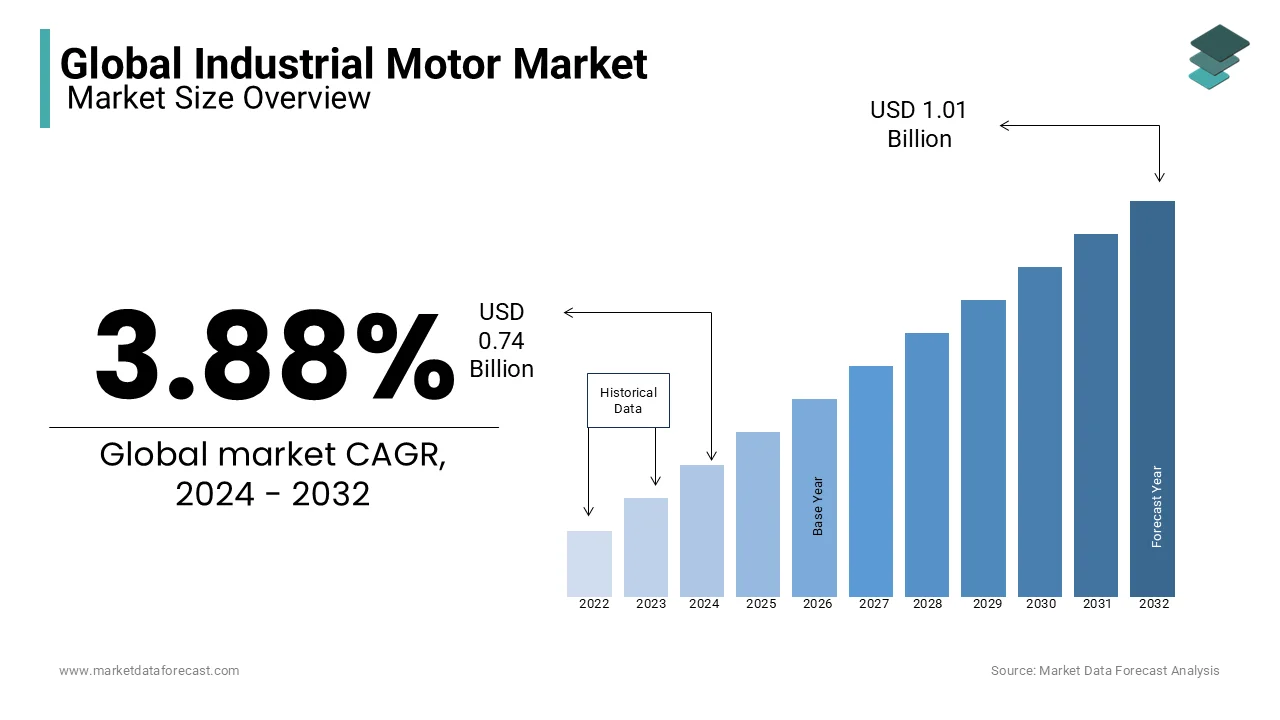
- Market Valuation: Valued at USD 0.77 billion in 2025, reaching USD 0.80 billion in 2026, and projected to expand up to USD 1.08 billion by 2034, registering a steady CAGR of 3.88% throughout the forecast period from 2026 to 2034.
- Primary Growth Drivers: Rapid industrial automation and manufacturing digitalization, stringent global energy-efficiency regulations compelling upgrades to high-efficiency motor systems, and the integration of Industry 4.0/IoT capabilities for predictive maintenance.
Key Market Segment Metrics
| Category | Leading Segment (Base Year Position) | Fastest-Growing / High-Impact Segment |
|---|---|---|
| By Efficiency, Application, & End-Use | Pumps & Fans (largest application segment due to heavy energy consumption) & Utilities Sector (dominant end-use segment driven by power generation and water infrastructure) | IE4 Efficiency Segment (highest standard with >96% efficiency, propelled by rigorous regulatory frameworks in the EU and surging adoption in countries like India) & BLDC Motors |
| By Region | Asia-Pacific (leading regional powerhouse, driven by rapid industrialization, manufacturing hubs in China and India, and surging IE4 upgrades) | North America & Europe (high-value markets heavily shaped by strict energy standards, technological innovation, and advanced manufacturing capabilities) |
Major Market Players & Market Structure
Market Structure: A consolidated global marketplace featuring major electrical engineering conglomerates and automation leaders investing heavily in smart motor technologies, data analytics integration, and high-efficiency standard compliance.
Key Companies: ABB Limited, Siemens Aktiengesellschaft, WEG SA, Nidec Corporation, Regal Beloit Corporation, CG Power and Industrial Solutions Limited, Toshiba Corporation, TECO Electric & Machinery Co. Ltd., Hyosung Corporation, and Shandong Huali Electric Motor Group Co. Ltd.
Global Industrial Motor Market Size
The global industrial motor market size was valued at USD 0.77 billion in 2025 and is anticipated to reach USD 0.80 billion in 2026 to reach USD 1.08 billion by 2034, growing at a CAGR of 3.88% during the forecast period from 2026 to 2034.
An industrial motor is an electric motor that is used in industrial settings, where robust performance is essential. Specifically engineered to do heavy-duty applications, these motors convert electrical energy into mechanical motion. It is found in manufacturing and processing environments, where the power of diverse machinery like conveyor systems, pumps, compressors, and fans is crucial to industrial operations. Induction motors, synchronous motors, and direct current (DC) motors are the common types, each suited for specific tasks.
MARKET DRIVERS
The growth of the global industrial motor market is mainly driven by the adoption of automation in industries.
As automation becomes highly essential to manufacturing processes, the demand for industrial motors has risen. These motors play a very important role in powering automated machinery and processes, also enhancing their operational efficiency and overall productivity. However, the imperative for precision, reliability, and energy efficiency in automated systems has further helped in the market's expansion. As a result, with ongoing advancements in motor technologies and a global trend toward industrialization, the industrial motor market is poised for sustained growth, catering to the evolving needs of modern, automated industries.
The energy efficiency regulations are further promoting the growth of the global industrial motors market. With a growing emphasis on sustainable practices, industries worldwide are prioritizing the adoption of energy-efficient motors. This shift in has regulatory landscape, marked by stringent standards, compels industries to upgrade their motor systems with energy efficiency requirements. However, these energy-efficient motors not only align with environmental goals but also offer good economic benefits through reduced energy consumption and operating expenses. As a result, industries recognize the dual advantage of cost savings and environmental responsibility, and the market for energy-efficient industrial motors continues to expand.
The industrial motor market is undergoing a transformative opportunity, which is the integration of Industry 4.0 technologies. The convergence of the IoT and artificial intelligence has paved the way for smart and connected industrial motors. These intelligent motors serve as data-centric assets by providing real-time insights for predictive maintenance and rising operational efficiency. By leveraging advanced sensors and connectivity features, these motors enable bold identification of potential issues, reducing downtime and enhancing overall reliability.
MARKET RESTRAINTS
High initial costs are a pivotal restraint for the downfall of the market's growth. The substantial investment required for acquiring and implementing these cutting-edge systems can be an obstacle, especially for smaller enterprises operating on tight budgets. While these advanced motors promise long-term energy savings and operational efficiencies, the initial financial burden may affect the widespread adoption. However, overcoming this hurdle necessitates strategic measures such as programs, subsidies, or financing options to make energy-efficient motor technologies more accessible to a broader range of industries.
The industrial motor market confronts a noteworthy challenge in the form of limited awareness and education. Some businesses may not fully grasp how these technologies can profoundly enhance their operational efficiency and reduce long-term costs. Bridging this knowledge gap is most important for the broader adoption of energy-efficient motors. However, initiatives focused on education and awareness, including seminars, industry conferences, and targeted marketing campaigns, are essential. Therefore, collaborative efforts between manufacturers, industry associations, and regulatory bodies can play a pivotal role in diffusing information about the economic and environmental advantages of energy-efficient motors.
REPORT COVERAGE
| REPORT METRIC | DETAILS |
| Market Size Available | 2025 to 2034 |
| Base Year | 2025 |
| Forecast Period | 2026 to 2034 |
| CAGR | 3.88% |
| Segments Covered | By Efficiency, Application, Motor Type, End Use, and Region |
| Various Analyses Covered | Global, Regional & Country Level Analysis, Segment-Level Analysis, DROC, PESTLE Analysis, Porter’s Five Forces Analysis, Competitive Landscape, Analyst Overview on Investment Opportunities |
| Regions Covered | North America, Europe, APAC, Latin America, Middle East & Africa |
| Market Leaders Profiled | Shandong Huali Electric Motor Group Co., Ltd, CG Power and Industrial Solutions Limited, Regal Beloit Corporation, Nidec Corporation, Hyosung Corporation, Toshiba Corporation, TECO Electric & Machinery Co., Ltd, WEG SA, Siemens Aktiengesellschaft, ABB Limited, and Others. |
SEGMENTAL ANALYSIS
By Efficiency Insights
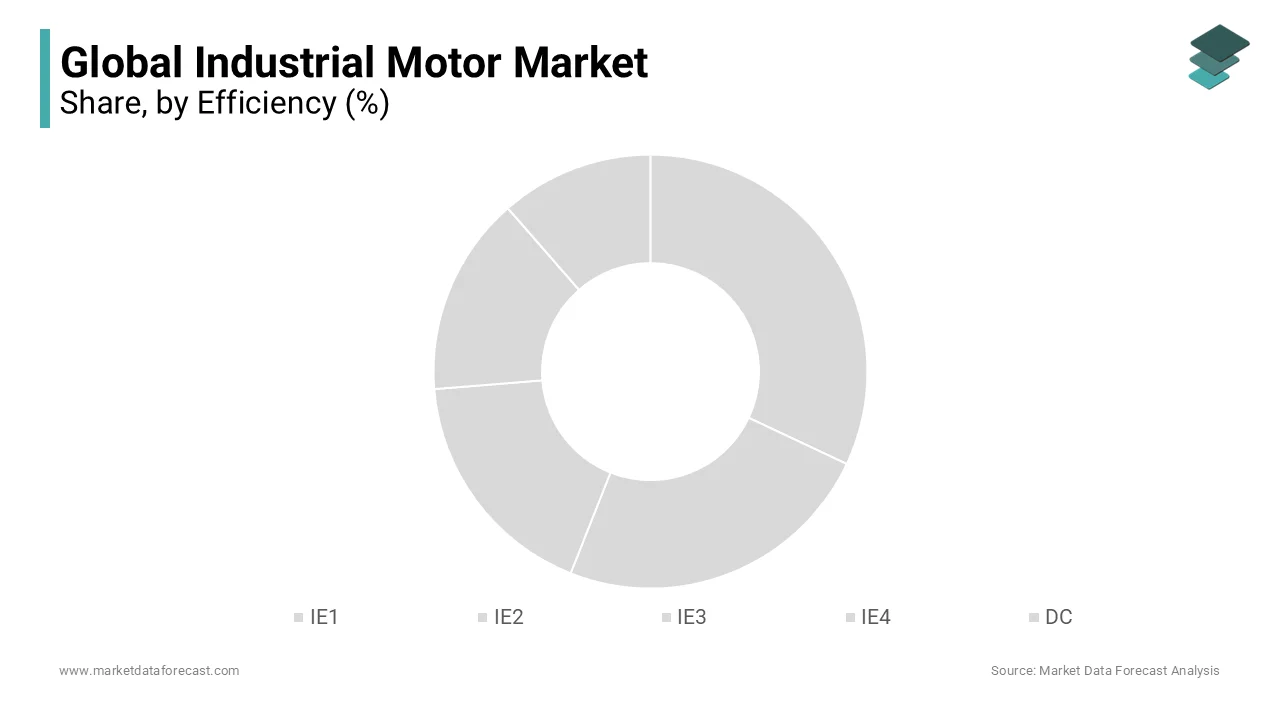
The IE4 segment is expected to lead under this category of the industrial motor market. These motors represent the highest standard currently available, with efficiencies exceeding 96 per cent and lower energy losses compared to IE3 motors. In addition, the market share is increasing due to favourable regulations and policies. For instance, with industries worldwide facing pressure on energy consumption and reducing carbon emissions, the EU in February 2024 introduced an extensive framework aimed at improving the efficiency of electric motors used in various industrial processes. This phased approach has been steadily raising the minimum efficiency standards for new motors, while also widening the scope of machines and applications that fall under these regulations.
By Application Insights
Pumps & fans are the largest segment of the industrial motor market. One of the key drivers of this segment is technological advancements. Continuous innovations in pump technology enhance their performance. Modern pumps are designed to consume less energy while delivering higher performance, which is critical in lowering operation costs. Moreover, the incorporation of sensors and automation allows for real-time monitoring and control of their operations, improving reliability and decreasing downtime, ultimately expanding the segment’s market size.
By Motor Insights
DC brushless motors (BLDC) are currently the trend in the industrial motor market. Moreover, the market growth of the segment can be credited to the escalating demand for this type of motor in electric vehicles, industrial automation, and consumer electronics. Apart from these, drone manufacturers are turning to BLDC motors. It is because of their excellent power-to-weight ratio, which allows for longer flight times and faster speeds, and at the same time, maintains great manoeuvrability. Consumer electronics are another extensive user of this motor type.
By End-Use Insights
Utilities are the biggest end-user in the industrial motor market. Its diverse applications in this sector are among the major propellers of the market size of this segment. These motors are integral to various processes within the utilities sector, including electric power generation, water and wastewater treatment, and HVAC systems. Further, globally, this segment stands out as one of the largest consumers of electricity. It uses a significant share of that energy in electric motors. Additionally, the progressive adoption of advanced motor technologies, like Variable Frequency Drives (VFDs), improves performance and efficiencies.
REGIONAL ANALYSIS
Asia Pacific Market Analysis
stands as a powerhouse for the Industrial Motor Market growth. Due to the rapid industrialization, extensive manufacturing activities, and infrastructure development in countries contributes to the dominance of this region. The demand for these motors in industries such as automotive, electronics, and heavy machinery is particularly high. In addition, this region is going through a rapid growth in the adoption of IE4 motors. Also, countries like China and India are ramping up their efforts to promote energy efficiency through initiatives. For instance, in India, there has been a notable increase in the sale of IE4 motors, with a reported surge of more than 100 per cent in 2023. So, we can say that the region’s quick industrialisation and urbanisation are some of the key drivers of its progress. Besides this, the Asian automotive industry today is a global powerhouse, which is leading in the development of EVs, advancements in battery technologies, hydrogen-powered vehicles, and self-driving systems.

North America Market Analysis
is the second significant player in the industrial motor market. The region is identified by its advanced manufacturing capabilities and industries, technological innovations, and a focus on energy efficiency. In addition, the region also focuses on energy standards and guidelines encouraging the acceptance of more productive motor technologies, such as IE3 and IE4 motors. As a result, it expands the APAC market size. Additionally, the United States and Canada are the main players in this business on the continent. Also, the presence of major manufacturing industries, comprising aerospace and automotive, ultimately fuels the demand for high-performance motors.
Europe Market Analysis
industrial motor market has a well-established industrial base. The demand for these motors is robust across various sectors, including manufacturing, automotive, and renewable energy. Further, the continent prioritises energy efficiency and sustainability, driving the application of advanced motor technologies. Besides this, the region’s favourable regulatory framework is taking this market forward. Recent legislation has been implemented, which stipulates that all the new non-Ex eb 3-phase, 2-6 pole, single-speed electric motors in the range of 75 kW to 200 kW must comply with IE4 standards. Moreover, most ATEX motors are required to have at least an IE3 rating, and all single-phase motors should meet a minimum efficiency of IE2.
Latin America also exhibits a growing demand for industrial motors, driven by infrastructure projects, mining activities, and manufacturing.
The Middle East and Africa region is propelled by investments in infrastructure, oil and gas projects, and mining activities. The region's industrial motor market is influenced by the energy sector and ongoing development projects.
KEY MARKET PLAYERS
Companies playing a notable role in the global industrial motors market include
- Shandong Huali Electric Motor Group Co. Ltd.
- CG Power and Industrial Solutions Limited
- Regal Beloit Corporation
- Nidec Corporation
- Hyosung Corporation
- Toshiba Corporation
- TECO Electric & Machinery Co. Ltd.
- WEG SA
- Siemens Aktiengesellschaft
- ABB Limited.
RECENT MARKET NEWS
- In 2023, GE has been involved in the development of intelligent motor technologies, leveraging sensors and data analytics to enable predictive maintenance and improve overall system efficiency.
- In 2023, Rockwell Automation has been incorporating smart technologies into its motor offerings. Their solutions often focus on connectivity and data analytics for better system management.
- In 2023, Schneider Electric has been incorporating smart technologies into its motor products, aiming to improve efficiency and reliability through advanced monitoring.
MARKET SEGMENTATION
This research report on the global industrial motor market has been segmented and sub-segmented based on efficiency, application, motor type, end-use, and region.
By Efficiency
- IE1
- IE2
- IE3
- IE4
- DC
- Others
By Application
- Compressors
- Pumps & Fans
- Conveyors
- Crushers
- Extruders
- Others
By Motor Type
- DC Brushed Motor
- DC Brushless Motor
- Stepper Motor
- Traction Motor
By End-Use
- Commercial HVAC
- F & B Manufacturing
- Mining
- Utilities
- Others
By Region
- North America
- Europe
- Asia Pacific
- Latin America
- The Middle East and Africa