- Product Description Description
- Table of Contents TOC
- List of Table & Figure LOT
- Get Free Sample PDF Sample PDF
Market Size, 2025
$158.08 BnMarket Estimate, 2026
$185.71 BnMarket Forecast, 2034
$673.83 BnCAGR, 2026–2034
17.48%Executive Summary: Consumer IoT Market
- Market Scope: Comprehensive global consumer IoT market analysis covering component structures, node types, end-user application verticals, regional leadership frameworks, and advanced connectivity trends like 5G and edge computing.
- Market Valuation: Valued at USD 158.08 billion (2025), estimated at USD 185.71 billion (2026), and projected to reach USD 673.83 billion by 2034, registering a robust CAGR of 17.48% (2026–2034).
- Primary Growth Drivers: Increasing internet penetration, rising disposable incomes, widespread adoption of smart devices, proliferation of voice-controlled assistants, AI-powered analytics, and the expansion of healthcare through remote patient monitoring.
Key Market Segment Metrics (2026–2034)
| Category | Leading Segment (2025 Position) | Fastest-Growing Segment |
|---|---|---|
| By Component | Node Component (accounts for a leading global market share) | Edge computing and AI-powered personalized analytics modules |
| By End User / Application | Wearable Devices, Consumer Electronics, Home Automation, and Healthcare | Remote patient monitoring, chronic disease management, and smart automotive in-car infotainment |
| By Region | North America (identified as the leading region driven by high device demand and digitization) | Developing economies expanding via rising internet penetration and smart infrastructure adoption |
Major Market Players & Market Structure
Market Structure: Highly competitive global technology and semiconductor landscape featuring major hardware and software titans collaborating on IoT development kits, edge intelligence, automotive sensors, and enterprise cloud-to-edge service integration.
Key Companies: Qualcomm Technologies Inc., Texas Instruments Incorporated, NXP Semiconductors, Intel Corporation, STMicroelectronics, IBM Corporation, General Electric, Symantec Corporation, TE Connectivity, Schneider Electric, Cisco, Amazon.com Inc., Apple Inc., Google, LG Electronics, Samsung, Sony Corporation, Microsoft, AT&T Intellectual Property, Honeywell International Inc., and Hewlett Packard Enterprise Development LP.
Global Consumer IoT Market Size
The global consumer IoT market was worth USD 158.08 billion in 2025. The global market is predicted to reach USD 185.71 billion in 2026 and USD 673.83 billion by 2034, registering a CAGR of 17.48% from 2026 to 2034.
Consumer IoT is a broad term used to refer to a variety of personal devices, such as smartphones, wearable devices, fashion items, and home appliances connected to the Internet. The consumer Internet of Things (IoT) differs from the Internet of Things primarily in the type of devices and the applications for which it is used.
The consumer Internet of Things is no longer a new thing. Technology has the capacity to transform every corner of the world. From home to office, drawer to shoe cabinet, the consumer Internet of Things has changed the way we do our daily work. Adding sensors and other features to products is now normal. Better control of products, better business insights, tracking of resources, streamlining of operations, and better interaction with people, systems and environments are some of the benefits of IoT for consumers. In short, the consumer Internet of Things is useful to both the homeowner looking for a connected life and the business owner who wants to run their office. The utility is helpful in increasing the comfort and lifestyle of each person.
The growing penetration of consumer internet and the adoption of smart devices are likely to drive the growth of the global consumer IoT market. The growing awareness of fitness coupled with rising disposable income in developing economies, are some of the key factors which are also positively increasing the growth of this market. Growing consumer preferences for improved lifestyle and greater convenience are likely to be driving the developments in the global consumer IoT market in the near future.
MARKET TRENDS
The global consumer IoT market is expected to experience significant growth owing to the increasing adoption during the forecast period. The increasing number of internet users is likely due to the increase in disposable income and lifestyle in developing and developed economies bodes well for the growth of the global consumer IoT market in the near future. The growth of network infrastructure is also foreseen to accelerate the expansion of the global consumer IoT market in the predicted period.
The rise of connected devices and the increasing number of internet penetrations are likely other factors that are positively supporting the growth of the global consumer IoT device. Rapid use of connecting devices is expected to generate a large volume of data, which is another factor driving market growth for the foreseeable future.
A diverse set of smart devices coupled with embedded sensors to develop the fabric and unstructured data of the global consumer IoT market is another key factor that is expected to drive the growth of the global consumer IoT market in coming years.
MARKET DRIVERS
The growing number of Internet users and the growing adoption of smart devices and multimedia are expected to drive market growth.
Greater comfort and ease of living with conventional IoT is also likely to drive market growth. With the increase in the number of connected devices, the consumer IoT service provider is launching various custom services. Key executives are putting more emphasis on wireless technologies to meet growing demand. The growing adoption of IoT for consumers around the world is increasing the volume of data. These huge volumes of data are one of the factors likely to drive the global consumer IoT market in the near future.
MARKET RESTRAINTS
Data privacy risks and breaches associated with consumer IoT are supposed to restrain market growth High power consumption of connected devices is also foreseen to slow market growth.
REPORT COVERAGE
| REPORT METRIC | DETAILS |
| Market Size Available | 2025 to 2034 |
| Base Year | 2025 |
| Forecast Period | 2026 to 2034 |
| CAGR | 17.48% |
| Segments Covered | By Node Component, Network Infrastructure, Solution and Service, and Region |
|
Various Analyses Covered | Global, Regional, & Country Level Analysis, Segment-Level Analysis, DROC, PESTLE Analysis, Porter’s Five Forces Analysis, Competitive Landscape, Analyst Overview on Investment Opportunities |
| Regions Covered | North America, Europe, APAC, Latin America, Middle East & Africa |
|
Market Leaders Profiled | Qualcomm Technologies Inc., Texas Instruments Incorporated, NXP Semiconductors, Intel Corporation, STMicroelectronics, IBM Corporation, General Electric, Symantec Corporation, TE Connectivity, Schneider Electric, Cisco, Amazon.com Inc., Apple Inc., Google, LG Electronics, Samsung, Sony Corporation, Microsoft, AT&T Intellectual Property, Honeywell International Inc., and Hewlett Packard Enterprise Development LP and Others. |
SEGMENTAL ANALYSIS
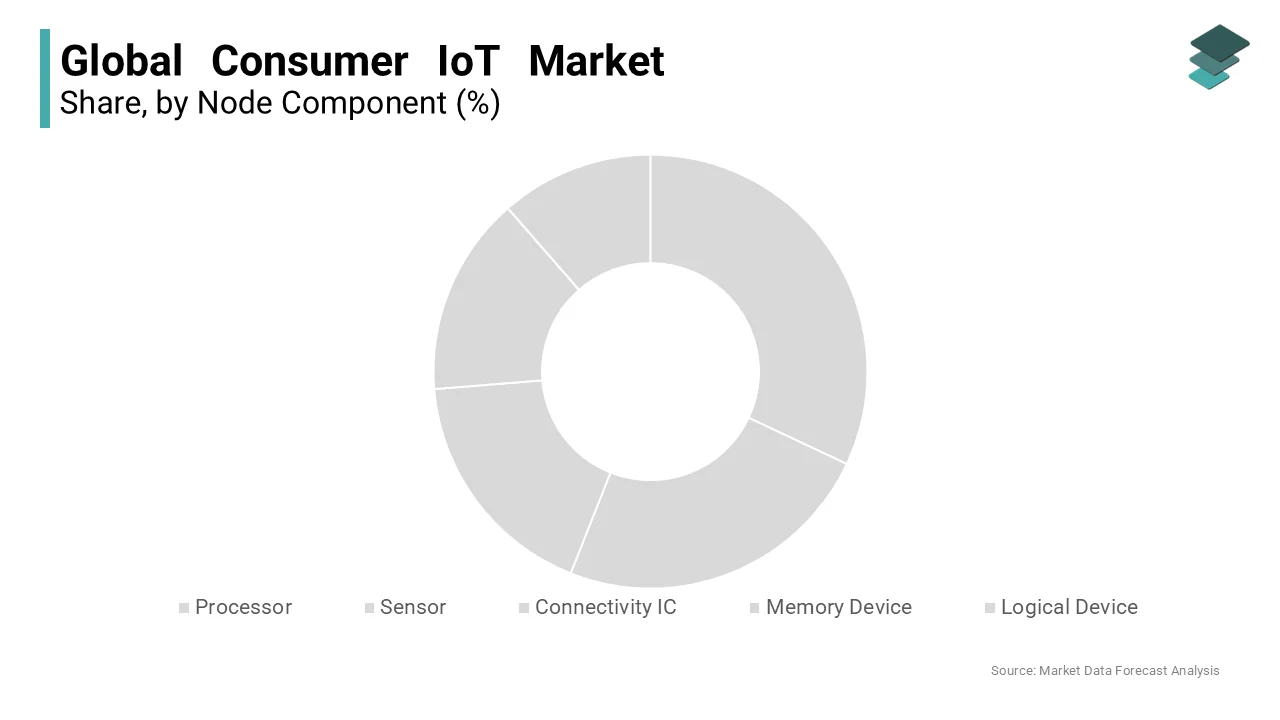
By Node Component Insights
REGIONAL ANALYSIS

Geographically, North America is likely to experience significant growth during the evaluation period. Another factor likely to drive the growth of the global consumer IoT market is the increasing demand for end-user devices. Another trend that is positively driving growth in this region is the growing demand and use of these applications. Also, the growth of this market in this region depends mainly on the increasing number of chronic cases and the increasing number of diabetes cases and the simple procedure of the conventional IoT market in the near future. The surge in the implementation of smart connected devices and augmented digitization are supposed to fuel the developments in the North American market.
KEY MARKET PLAYERS
Some of the main competitors currently working in the global consumer IoT market are Qualcomm Technologies Inc., Texas Instruments Incorporated, NXP Semiconductors, Intel Corporation, STMicroelectronics, IBM Corporation, General Electric, Symantec Corporation, TE Connectivity, Schneider Electric, Cisco, Amazon.com Inc., Apple Inc., Google, LG Electronics, Samsung, Sony Corporation, Microsoft, AT&T Intellectual Property, Honeywell International Inc., Hewlett Packard Enterprise Development LP., and others.
RECENT MARKET HAPPENINGS
-
In February 2018, Qualcomm Technologies Inc. published the launch of its novel Internet of Things (IoT) development kits that are based on the QCA4020 and QCA4024 systems on a chip (SoC).
-
In April 2018, TE Connectivity launched sensor and connectivity solutions for the global automotive industry. Sensor solutions enable autonomous driving and mobility.
-
In January 2018, IBM announced a strategic partnership with Salesforce (US), the world leader in customer relationship management (CRM). The partnership will bring together IBM Cloud and Watson services with Salesforce Quip and Salesforce Service Cloud Einstein to enable businesses to collaborate and connect more effectively with their customers.
MARKET SEGMENTATION
This research report on the global consumer IoT market has been segmented and sub-segmented based on the node component, network infrastructure, solution and service, and end user.
By Node Component
-
Processor
-
Sensor
-
Connectivity IC
-
Memory Device
-
Logical Device
By Network Infrastructure
-
Server
-
Storage Room
-
Ethernet Switch and Routing
-
Bridge
By Solution and Service
-
Platform and Software Solution
-
Professional and Managed Services
By End-User
-
Portable Devices
-
Consumer Electronics
-
Healthcare
-
Home Automation
-
Automotive
-
Information and Entertainment On Board
-
Traffic Management
By Region
-
North America
-
The United States
-
Canada
-
Rest of North America
-
-
Europe
-
The United Kingdom
-
Spain
-
Germany
-
Italy
-
France
-
Rest of Europe
-
-
The Asia Pacific
-
India
-
Japan
-
China
-
Australia
-
Singapore
-
Malaysia
-
South Korea
-
New Zealand
-
Southeast Asia
-
-
Latin America
-
Brazil
-
Argentina
-
Mexico
-
Rest of LATAM
-
-
The Middle East and Africa
-
Saudi Arabia
-
UAE
-
Lebanon
-
Jordan
-
Cyprus
-