- Product Description Description
- Table of Contents TOC
- List of Table & Figure LOT
- Get Free Sample PDF Sample PDF
Market Size, 2025
$7.26 BnMarket Estimate, 2026
$8.36 BnMarket Forecast, 2034
$17.55 BnCAGR, 2026–2034
9.71%Executive Summary: Global Control Valves Market
- Market Scope: Comprehensive market evaluation of the global control valves sector, analyzing classifications by type (ball, butterfly, globe, diaphragm valves), operation modes (pneumatic, hydraulic, electrical, manual), vertical applications (oil & gas, power, water management, chemicals, pharmaceuticals), and regional procurement dynamics.
- Market Valuation: Valued at USD 7.26 billion in 2025, reaching USD 8.36 billion in 2026, and projected to expand up to USD 17.55 billion by 2034, registering a strong CAGR of 9.71% throughout the forecast period from 2026 to 2034.
- Primary Growth Drivers: Rapidly growing industrial automation and smart manufacturing; increasing emphasis on fluid process efficiency and plant safety across heavy process industries; stringent environmental regulations; and heavy investments in infrastructure and power sector distribution networks.
Key Market Segment Metrics
| Category | Leading Segment (Base Year Position) | Fastest-Growing / High-Impact Segment |
|---|---|---|
| By Type, Operation & Application | Ball Valves (leading type with tight shutoff versatility) & Pneumatic Operation (dominant operation mode) & Oil & Gas (leading application across upstream, midstream, and downstream operations). | Butterfly Valve segment (for compact, large-diameter applications) & Electrical Control Valves (driven by renewable energy integration and automated infrastructure upgrades). |
| By Region / Country | Asia-Pacific (dominant regional market commanding over 31% share, heavily backed by manufacturing, infrastructure, and power sector spending in China and India) | North America & Europe (prominent expansion fueled by electrical control valve investments, energy transitions, and advanced factory automation). |
Major Market Players & Market Structure
Market Structure: A highly consolidated, globally competitive industrial automation market driven by specialized flow-control engineering corporations focusing on smart valve diagnostics, regulatory certifications, and technological R&D.
Key Companies: Emerson Electric Co., Flowserve Corporation, Crane Co., Metso Corporation, KSB SE & Co. KGaA, KITZ Corporation, Samson Aktiengesellschaft, Velan Inc., Alfa Laval Corporate AB, and Schlumberger Ltd.
Global Control Valves Market Size
The global control valves market size was valued at USD 7.26 billion in 2025 and is anticipated to reach USD 8.36 billion in 2026 to reach USD 17.55 billion by 2034, growing at a CAGR of 9.71% from 2026 to 2034.
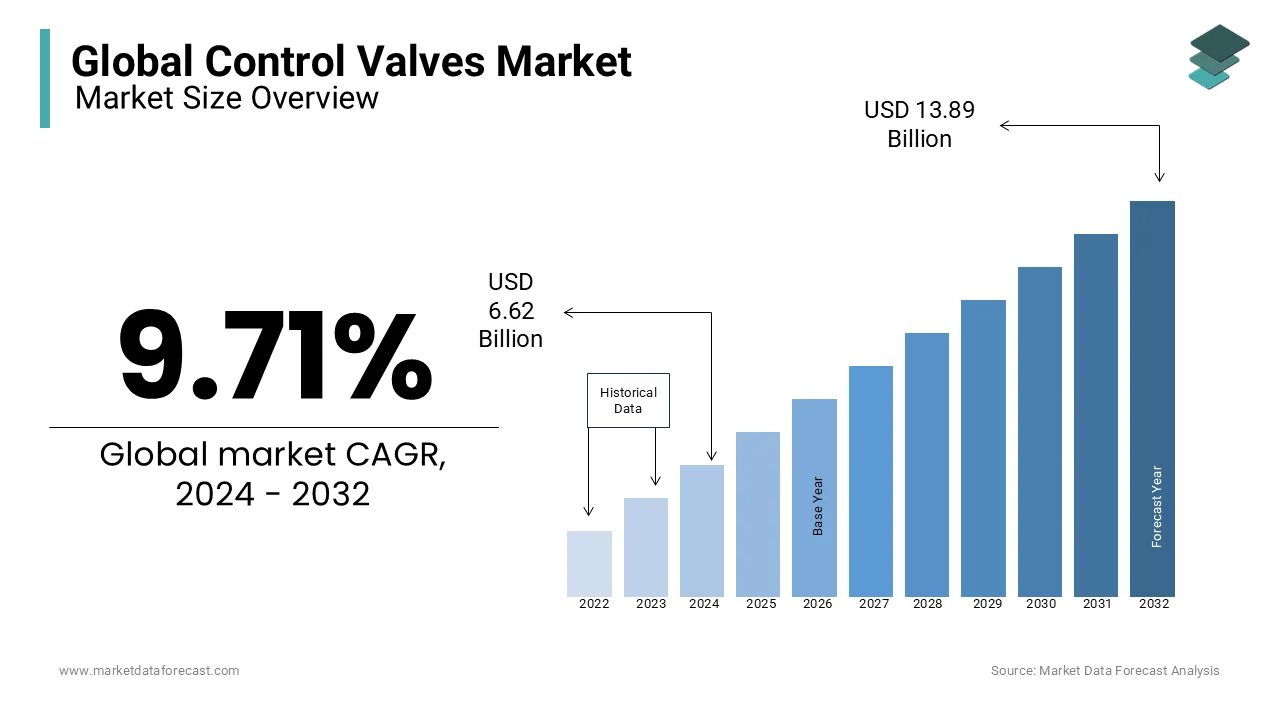
Typical process plants have a slew of loops that mechanically control process variables, including temperature, pressure, and flow. Control valves are used to govern liquid flow, guaranteeing operational efficiency and reducing downtime in industrial facilities. In industries such as oil and gas, water management, chemicals, power generation, automotive, mining, pharmaceuticals, and food and beverages, control valves are used to adjust process factors like flow, temperature, pressure, and fluid level. Control valves are critical for increasing efficiency, safety, and profitability in these process industries. Furthermore, control valve manufacturers are always conducting research and development to ensure that their products meet evolving industry standards.
MARKET DRIVERS
Rapidly growing industrial automation, increasing emphasis on process efficiency, rise in smart manufacturing, technological advancements, stringent environmental regulations, and growing investments in the development of the infrastructure in several countries are primarily propelling the global control valves market.
The growing usage of control valves in several industries is fuelling the growth rate of the global market. Applications in the pharmaceutical, mining, chemicals, and other sectors will continue to increase because of recent technical advancements that work in tandem with control valves. The healthcare and pharmaceutical industries are at the forefront of the pandemic's battle against COVID-19 because of its rapid spread. The production of critical medical devices required to treat COVID-19 patients is rising. Control valves are used in the production of a variety of medical equipment, and several major industrial firms have jumped at the chance to help in the battle against the pandemic.
Companies are progressively investing in research and development for autonomous components that are provided to the pharmaceutical sector, such as solenoid valves. Pharmaceutical businesses are also striving to build advanced fluid handling systems, such as automated sanitizer dispensers and liquid soap dispensers, which necessitate the use of valves. As a result, the control valves market is expected to rise in response to rising healthcare device manufacturing and increased R&D spending in the pharmaceutical industry.
MARKET RESTRAINTS
High initial costs of control valve systems are majorly hampering the global market growth. Long replacement cycles for existing valves, a lack of skilled workforce for valve maintenance, and challenges in the standardization of valve specifications are further impeding the global market growth. Certain criteria and requirements must be followed by the manufacturers of valves. In terms of valve certifications and rules, various areas have distinct policies and certifications. Because valves may be used in a variety of sectors, including oil & gas, food & beverage, pharmaceuticals, energy & power, water & wastewater treatment, building & construction, chemicals, and pulp & paper, this factor produces demand diversity. However, such variation is impeding the valve market's growth since industry participants must adapt the same product to regional legislation, making it difficult for valve makers to obtain an optimal cost of installation. To address this problem, they will need to invest resources in establishing production sites throughout the world, which would necessitate extra money.
REPORT COVERAGE
| REPORT METRIC | DETAILS |
| Market Size Available | 2025 to 2034 |
| Base Year | 2025 |
| Forecast Period | 2026 to 2034 |
| CAGR | 9.71% |
| Segments Covered | By Type, Operation, Application, and Region |
| Various Analyses Covered | Global, Regional & Country Level Analysis, Segment-Level Analysis, DROC, PESTLE Analysis, Porter’s Five Forces Analysis, Competitive Landscape, Analyst Overview on Investment Opportunities |
| Regions Covered | North America, Europe, APAC, Latin America, Middle East & Africa |
| Market Leaders Profiled | Crane Co., Alfa Laval Corporate AB, Emerson Electric Co., Flowserve Corporation, Schlumberger Ltd, Metso Corporation, KSB SE & Co. KGaA, KITZ Corporation, Samson Aktiengesellschaft, Velan Inc., and Others. |
SEGMENTAL ANALYSIS
By Type Insights
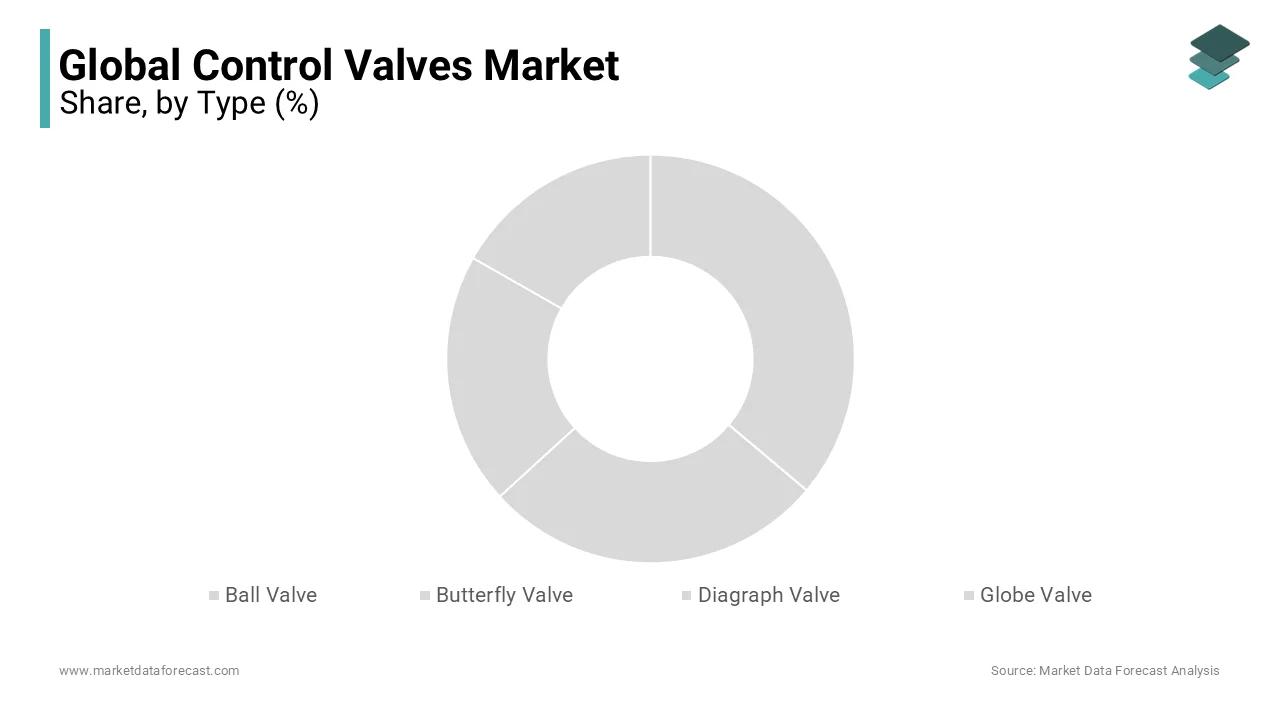
Based on type, the ball valve segment led the market in 2023 and accounted for 31.4% of the global market share. The ball valve segment is promising and is expected to account for a substantial share of the global market during the forecast period. The demand for ball valves is growing exponentially due to their tight shutoff capabilities, versatility, and applications in various industries, which is one of the major factors propelling the growth of the ball valve segment in the global market. The growing number of water treatment projects is further favoring segmental growth.
The butterfly valve segment is expected to account for a considerable share of the worldwide market during the forecast period. The compact design, low maintenance, and suitability for large-diameter applications of butterfly valves are fuelling their adoption in their industries and are primarily boosting the growth of the butterfly valve segment in the global market.
By Operation Insights
Based on operation, the pneumatic segment was the largest in the global market and held 41.8% of the global market share in 2023. The pneumatic segment is also estimated to witness healthy growth during the forecast period. Pneumatic control valves are known for their fast response, simplicity, and reliability in fluid control systems. The growing demand for precise process control and rising industrial automation are further contributing to the growth of the segment in the worldwide market.
On the other hand, the hydraulic segment is another prominent segment and is predicted to capture a substantial share of the global market during the forecast period. The usage of hydraulic control valves in several applications has increased significantly in recent years due to the high force, durability, and precise control that hydraulic control valves offer in heavy-duty industries, which is one of the major factors propelling the growth of the hydraulic control valve segment in the global market.
By Application Insights
Based on application, the oil and gas segment dominated the control valves market in 2023, accounting for 24.1% of the global market share, and is expected to register notable growth during the forecast period. Control valves are essential for upstream, midstream, and downstream operations in the oil and gas industry, which is majorly driving the growth of the oil and gas segment in the global market.
The electric power segment is expected to hold a considerable share of the worldwide market during the forecast period, owing to the rapid expansion of power generation capacity, rising emphasis on energy efficiency, and the integration of renewable energy sources.
REGIONAL ANALYSIS
Asia Pacific Market Analysis
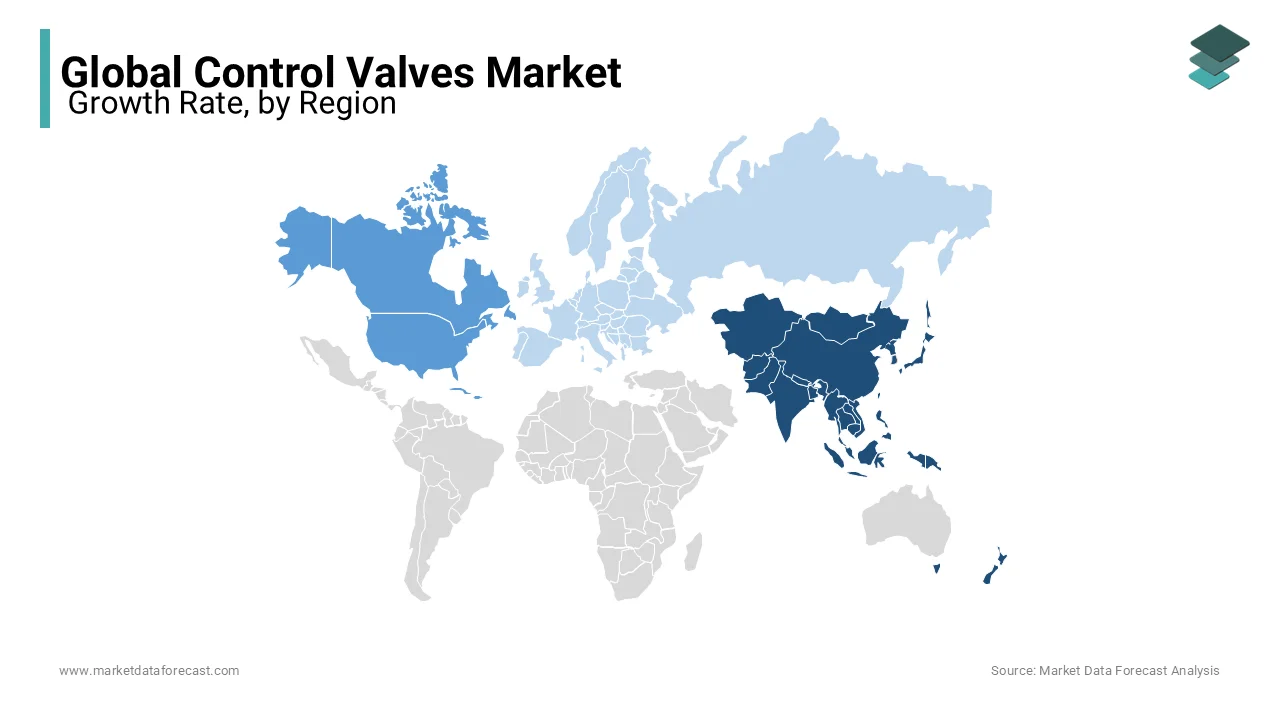
The Asia-Pacific region was the largest regional segment in the global market and accounted for 31.4% of the worldwide market in 2025. The control valves market is dominated by the Asia Pacific, which will be cemented by demand from India, China, Japan, South Korea, and other countries. The Asia Pacific will see significant demand for control valves during the forecast period, fueled by strong power sector demand in India and China. Over the next 10 years, the Indian government has set up USD 42 billion in the Union Budget 2021-22 for a redesigned and reform-based new electricity distribution sector program. The India Brand Equity Foundation shared this information IBEF) This indicates that control valve manufacturers in India have a lot of room for expansion.
North America Market Analysis
The North American region had a substantial share of the global market in 2025 and is expected to register promising growth during the forecast period, owing to the increased investment in the installation of electric control valves. While sales of hydraulic and pneumatic control valves are projected to continue healthily, sales of electrical control valves are expected to increase. To some extent, the energy situation in North America will give prospects for robust market growth. The growing emphasis on renewable energy will create very appealing sales prospects in the region.
Europe Market Analysis
Europe is estimated to witness prominent growth in the global market during the forecast period. Germany, the United Kingdom, and France are likely to lead the European control valves market in terms of growth. Mining growth will offer very profitable expansion opportunities in the region.
KEY MARKET PLAYERS
Companies playing a major role in the global control valves market include
- Crane Co.,
- Alfa Laval Corporate AB
- Emerson Electric Co.
- Flowserve Corporation
- Schlumberger Ltd
- Metso Corporation
- KSB SE & Co. KGaA
- KITZ Corporation
- Samson Aktiengesellschaft,
- Velan Inc.
RECENT MARKET NEWS
- Emerson launched the ASC Series 158 Gas Valve and Series 159 Motorized Actuator in February 2020. The new devices, which are specifically developed for burner-boiler applications, provide OEMs, distributors, contractors, and end-users a novel combustion safety shutdown valve option that enhances both flow and control while also boosting safety and dependability.
- Curtiss-Wright Corporation has agreed to purchase Dyna-Flo Control Valve Services (Dyna-Flo) shares for CAD 81 million (USD 62 million) in cash in February 2020. For the chemicals, petrochemicals, and oil and gas industries, Dyna-Flo designs and manufactures linear and rotary control valves, isolation valves, actuators, and level and pressure control systems.
MARKET SEGMENTATION
This research report on the global control valves market has been segmented and sub-segmented based on type, operation, application, and region.
By Type
- Ball Valve
- Butterfly Valve
- Diagraph Valve
- Globe Valve
- Others
By Operation
- Pneumatic Control Valve
- Hydraulic Control Valve
- Electrical Control Valve
- Manual Control Valve
By Application
- Electrical Power
- Oil & Gas
- Water & Wastewater
- Automotive
- Pharmaceuticals
- Mining
- Chemicals
- Food & Beverages
- Others
By Region
- North America
- Europe
- The Asia Pacific
- Latin America
- The Middle East and Africa