- Product Description Description
- Table of Contents TOC
- List of Table & Figure LOT
- Get Free Sample PDF Sample PDF
Market Size, 2025
$7.24 BnMarket Estimate, 2026
$7.47 BnMarket Forecast, 2034
$9.57 BnCAGR, 2026–2034
3.15%Executive Summary: Global Conveyor Belts Market
- Market Scope: In-depth overview of the global conveyor belts market, covering belt types, materials, installation formats, end-user industry verticals, and regional growth distribution.
- Market Valuation: Valued at USD 7.24 billion in 2025, expected to advance to USD 7.47 billion in 2026, and projected to scale up to USD 9.57 billion by 2034, registering a CAGR of 3.15% during the forecast period from 2026 to 2034.
- Primary Growth Drivers: Accelerating industrial automation across manufacturing lines, rapid growth in e-commerce and warehousing logistics, and the push toward energy-efficient, sustainable material handling solutions.
Key Market Segment Metrics (2026–2034)
| Category | Leading Segment / Position | Growth Dynamics & Outlook |
|---|---|---|
| By Belt Type | Medium-weight Conveyor Belts | Leads market share and is anticipated to hit the highest growth trajectory due to versatile industrial applications. |
| By Operation | Automatic Systems (vs. Manual) | Automatic solutions gain extensive traction, while manual systems register a notable CAGR as part of targeted operational expansions. |
| By End-User Industry | Chemicals, Oils, and Gases | Dominates overall demand backed by heavy bulk material transport requirements and rigorous industrial processing needs. |
| By Region | Asia-Pacific | Leads regional market share driven by rapid industrialization, mining activities, and manufacturing automation in China and India. |
Major Market Players & Market Structure
Market Structure: Highly competitive landscape comprising major global belting manufacturers and automated system integrators investing in smart sensor tech, single-ply high-temperature durability, and expanded assembly footprints.
Key Companies: Intralox, Fives, Bando Chemical Industries, Ltd., Volta Belting Technology Ltd., and Fenner (Fenner Dunlop).
Global Conveyor Belts Market Size
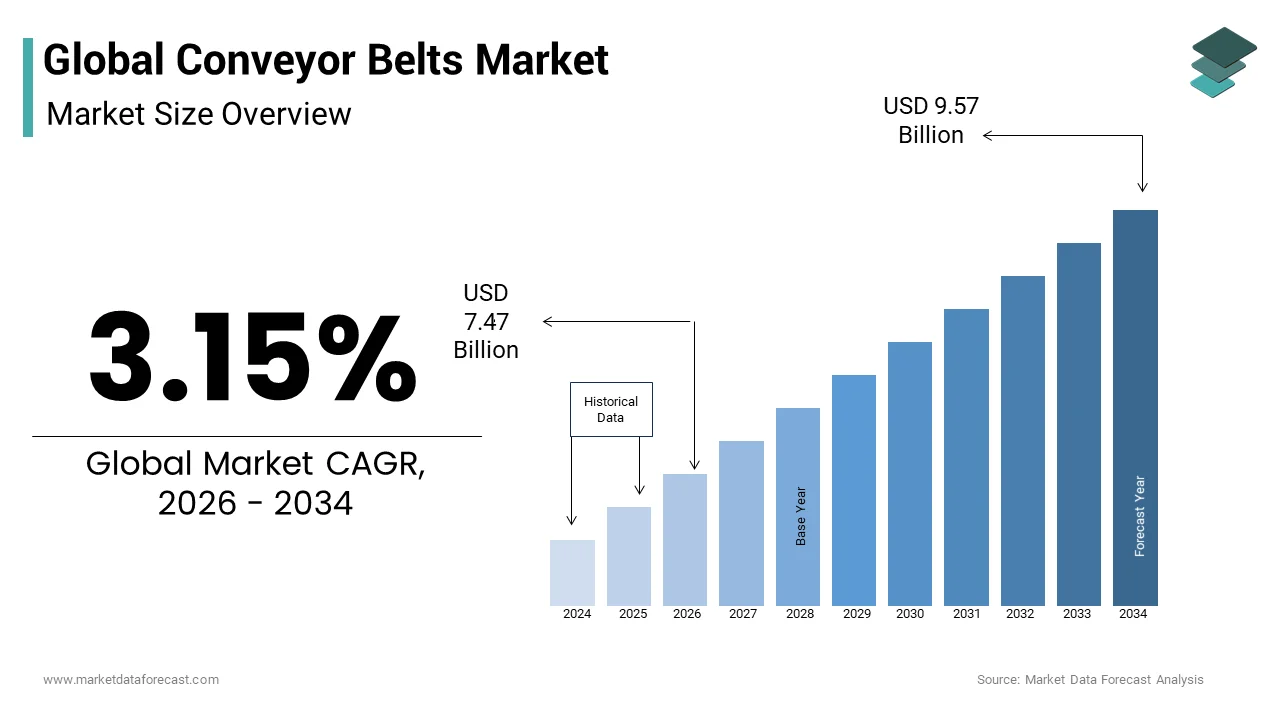
The global conveyor belts market size was valued at USD 7.24 billion in 2025 and is anticipated to reach USD 7.47 billion in 2026 to reach USD 9.57 billion by 2034, growing at a CAGR of 3.15% during the forecast period from 2026 to 2034.
Current Scenario of the Global Conveyor Belts Market
A conveyor belt is a mechanical device that is used to move objects from one place to another. It consists of a long, continuous belt that rotates around two or more pulleys. The belt is made of strong, durable material, such as rubber or PVC, and is used to transport a variety of objects, including boxes, packages, and raw materials. They can be used in a variety of applications, such as for sorting and assembling products in a manufacturing plant, for transporting materials in a mining operation, or for carrying packages and bags in a shipping and receiving center. The growth of these industries is driving the demand for the conveyor belt market, as they provide an efficient and cost-effective method for handling and transporting materials. In recent years, advancements in technology have led to the development of smart conveyor belts, which are equipped with sensors and control systems to monitor and optimize their performance. These smart conveyor belts are becoming increasingly popular due to their ability to improve production efficiency and reduce operational costs. Overall, they play a critical role in many industries, making it easier and faster to transport goods and materials.
MARKET DRIVERS
The growing trend towards industrial automation has led to an increased demand for the conveyor belt market, as they play a crucial role in automating various manufacturing processes.
Conveyor belts are used to move materials and products from one place to another in a safe, efficient, and cost-effective manner. They are widely used in industries such as automotive, food and beverage, pharmaceuticals, and electronics, among others.
The e-commerce and logistics industries have been growing rapidly in recent years, which is directly propelling the growth rate of the market. Conveyor belts are used in warehouses and distribution centers to sort, transport, and handle packages and products, making them essential components of these industries.
Sustainability has become a major concern for many industries, and conveyor belts are seen as a more sustainable solution as compared to traditional methods of transportation. Conveyor belts are energy-efficient, reduce the need for manual labor, and reduce the carbon footprint of transportation and logistics operations. Hence, the rising demand for sustainable solutions is likely to bolster the growth rate of the conveyor belts market.
The development of new materials, such as lightweight and durable plastics, has led to the production of conveyor belts that are lighter, more durable, nd require less maintenance. The use of advanced technologies, such as sensors and automation, has also improved the efficiency and safety of conveyor systems, further driving the demand for the conveyor belt market.
MARKET RESTRAINTS
Conveyor belts require regular maintenance and repairs, which can result in high maintenance costs, especially for older conveyor systems. High cost for maintenance and repairs is a major restraining factor for the conveyor belts market growth.
Conveyor belts are designed to handle specific types of products and materials, and their performance can be affected if they are used for other types of products or materials.
Conveyor belts can pose safety risks, such as entrapment, and can also lead to repetitive stress injuries for workers who operate and maintain them. These concerns are slightly hindering the demand of the market.
Governments around the world are imposing stringent regulations on the use of conveyor belts in various industries, including mining and manufacturing, to protect workers and the environment. Conveyor belts' market shares can be limited by the technology used in their design and operation, which can restrict their ability to handle certain types of materials or products.
REPORT COVERAGE
| REPORT METRIC | DETAILS |
| Market Size Available | 2025 to 2034 |
| Base Year | 2025 |
| Forecast Period | 2026 to 2034 |
| CAGR | 3.15% |
| Segments Covered | By Type, Belt Type, Material, installation, End-user Industry, and Region |
| Various Analyses Covered | Global, Regional & Country Level Analysis, Segment-Level Analysis, DROC, PESTLE Analysis, Porter’s Five Forces Analysis, Competitive Landscape, Analyst Overview on Investment Opportunities |
| Regions Covered | North America, Europe, APAC, Latin America, Middle East & Africa |
| Market Leaders Profiled | Intralox, Fives, Bando Chemical Industries, Volta Belting Technology, Fenner, and Others. |
SEGMENT ANALYSIS
By Type Insights
Medium-weight conveyor segment is leading with the highest shares of the market. Medium-weight conveyor segment is likely to hit the highest growth rate in the coming years.
By End-use Insights
The chemicals, oils, and gases segment is ruling with the dominant shares of the conveyor belt market.
By Operation Insights
The automatic segment is gaining traction over the shares of the market, whereas the manual segment is expected to hit the highest CAGR during the forecast period.
REGIONAL ANALYSIS
The Asia-Pacific region is dominating the highest shares of the conveyor belt market due to the increasing industrialization and urbanization in countries such as China, India, and Japan.
The region is also a major producer of raw materials, such as coal and iron ore, which are transported using the conveyor belt market. China is the largest market for the conveyor belt market in Asia-Pacific, driven by the growth of industries such as mining, food and beverage, and electronics. India is also witnessing an increasing demand for automation in the manufacturing sector, which has boosted the demand for the conveyor belt market.
On the other hand, the North American and European regions are following Asia-Pacific in holding the shares of the conveyor belt market. The introduction of innovative technologies is setting new growth opportunities for the market to grow in North America.
KEY MARKET PLAYERS
Major Key Players in the Global Conveyor Belts Market are
- Intralox
- Fives
- Bando Chemical Industries, Ltd.
- Volta Belting Technology Ltd.
- Fenner
- Others.
RECENT MARKET NEWS
- In 2022, Fenner Dunlop Conveyor Belting launched a new high-temperature resistant conveyor belt that combines a single-ply fabric with a new ‘high-performance rubber compound’ for extreme environments. "OptimaHeat Xtreme" features an amazingly tough, patented super-flexible single-ply fabric. The carcass is claimed to avoid the problem of delamination caused by impact, trough transitions, and flexing around pulleys, which is common in conventional multi-ply high heat-resistant belts.
- In 2022, Intralox doubled its footprint to over 400,000 square feet, increased its belting output by 50%, and created 425 direct jobs as Intralox expands its molding and assembly operations. The expansion of $60 million made in 2021 will also allow Intralox to double its raw material inventory storage, which is critical for risk mitigation against material shortages.
MARKET SEGMENTATION
This research report on the global conveyor belts market has been segmented and sub-segmented based on type, end-use, and region.
By Type
- Flat Belts
- Modular Belts
- Cleated Belts
- Roller Conveyors
- Overhead Conveyors
- Pallet Conveyors
- Bucket Conveyors
- Crescent Conveyors
- Cable Conveyors
- Chain Conveyors
- Floor Conveyors
By Belt Type
- Lightweight
- Medium-weight
- Heavy-weight
By Material
- Rubber
- PVC
- Fabric
- Metal-reinforced Rubber
- Polymers
- Metals
By Installation Type
- Stationary
- Portable
By End User Industry
- Automotive
- Food & Beverage
- Mining
- Logistics & Distribution
- Retail
- Electronics
- Aerospace
- Pharmaceuticals
- Poultry & Dairy
- Cement & Steel
- Power Plants
- Others
By Region
- North America
- Europe
- Asia-Pacific
- Latin America
- The Middle East and Africa