- Product Description Description
- Table of Contents TOC
- List of Table & Figure LOT
- Get Free Sample PDF Sample PDF
Market Size, 2025
$3.80 BnMarket Estimate, 2026
$3.96 BnMarket Forecast, 2034
$5.46 BnCAGR, 2026–2034
4.1%Executive Summary: Global Rubber Conveyor Belt Market
- Market Scope: Comprehensive global rubber conveyor belt market analysis covering material reinforcements, duty-class applications, end-use mining and manufacturing sectors, and regional growth dynamics.
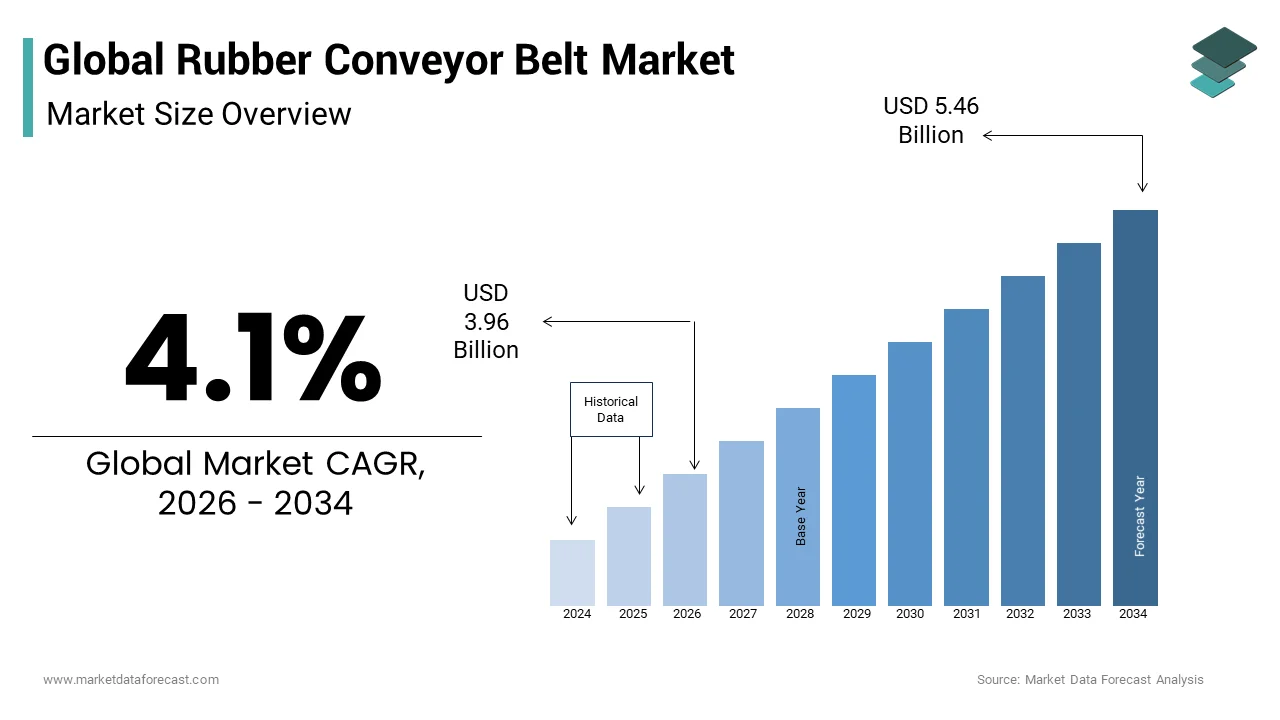
- Market Valuation: Valued at USD 3.80 billion in 2025, anticipated to reach USD 3.96 billion in 2026, and projected to scale up to USD 5.46 billion by 2034, expanding at a steady CAGR of 4.1% over the forecast period from 2026 to 2034.
- Primary Growth Drivers: Intensifying industrial competition and automated manufacturing activities, expanding infrastructure projects and global construction overhauls, and surging demand for heavy-duty material transport in surface and hard-rock mining sectors. Key operational challenges include high initial setup expenditures and continuous maintenance costs in heavy lifting setups.
Key Market Segment Metrics (2026–2034)
| Category | Leading Segment (Base Position) | Fastest-Growing Segment |
|---|---|---|
| By Material | Fibre / Textile-Reinforced Belts (projected to generate massive utility sales due to high abrasion, cold, and fire resistance) | Steel-Reinforced and Performance Textile variants |
| By Application | Medium-Sized / Medium-Weight Belts (capturing over 45%–50% of market share, vital for smooth small-to-mid manufacturing operations) | Medium-weight and lightweight logistics belts |
| By End-Use Industry | Mining and Metallurgy (a dominant consumer driven by continuous bulk raw material transport requirements) | Mining and Coal segments in emerging economies (India and China) |
| By Region / Country | Asia-Pacific (projected to reach USD 2.5 billion, anchored by high production potential, mining scale, and expanding e-commerce warehousing) | Asia-Pacific (led by rapid industrialization in China, India, and Indonesia) |
Major Market Players & Market Structure
Market Structure: Highly consolidated global industrial manufacturing ecosystem featuring multinational rubber engineering leaders competing on tensile strength, multi-piston press capacities, heat/flame resistance, and long-term supply synergies.
Key Companies: ContiTech AG, Bridgestone Corporation, Fenner Group Holdings Limited (Fenner Dunlop), SIG Societa Italiana Gomma, Oxford Rubbers, LUTZE, ARTEGO, Garlock, Trelleborg, and Bando Chemical Industries.
Global Rubber Conveyor Belt Market Size
The global rubber conveyor belt market size was USD 3.80 billion in 2025 and is anticipated to reach USD 3.96 billion in 2026 to reach USD 5.46 billion by 2034, growing at a CAGR of 4.1% during the forecast period from 2026 to 2034.
Rubber conveyor belts are commonly used in industries such as surface mining and hard rock mining to transport heavy rocks and loads. The product is primarily used for materials, carrying loads, parts, or components that have been smeared with heavy oil or machinery oil-treated coal, and these transportation belts are made of highly flame-resistant materials.
MARKET DRIVERS
Several factors contribute to the growth of the global rubber conveyor belt market. One of the main drivers behind the growth of the rubber conveyor belt market is fierce competition and increased industrial activity in the manufacturing industry.
This situation also applies to other major end-user application industries such as mining, energy, and manufacturing. These application industries need state-of-the-art machines and systems to withstand intensifying competition in their respective segments. In addition, we need high-end technology and practices to keep our business up to date. These high-end technologies and practices help minimize cost and effort, optimize production time, and maximize productivity. Rubber conveyor belts help these industries get their work done easily. This has increased their demand and thus contributed to the overall development of the global rubber conveyor belt market.
In addition, significant progress has been made regarding overhauls or upgrades of domestic infrastructure and other construction activities around the world. These belts also help develop the global rubber conveyor belt market, as they help move materials from one place to another easily.
MARKET RESTRAINTS
However, rising initial set-up costs and increased maintenance costs in heavy lifting industries are among the major factors restraining market growth and will further challenge the rubber conveyor belts market during the forecast period.
REPORT COVERAGE
| REPORT METRIC | DETAILS |
| Market Size Available | 2024 to 2033 |
| Base Year | 2024 |
| Forecast Period | 2025 to 2033 |
| CAGR | 4.1% |
| Segments Covered | By Material, Application, End-use Industry, and Region |
| Various Analyses Covered | Global, Regional & Country Level Analysis, Segment-Level Analysis, DROC, PESTLE Analysis, Porter’s Five Forces Analysis, Competitive Landscape, Analyst Overview on Investment Opportunities |
| Regions Covered | North America, Europe, APAC, Latin America, Middle East & Africa |
| Market Leaders Profiled | ContiTech AG, Bridgestone Corporation, Fenner Group Holdings Limited, SIG Societa Italiana Gomma, Oxford Rubbers, LUTZE, ARTEGO, Garlock, Trelleborg, Bando, and Others. |
SEGMENTAL ANALYSIS
By Material Insights
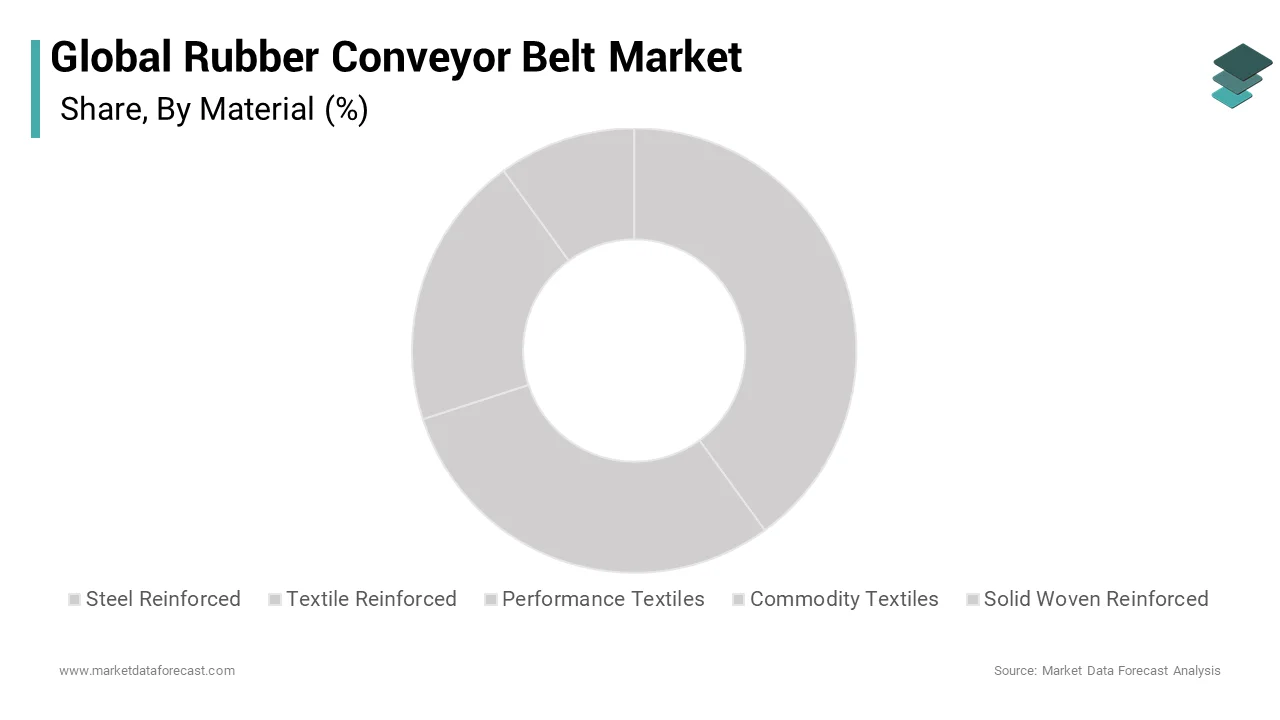
The fibre-reinforced conveyor belt market is expected to generate more than US $ 3.5 billion in sales. Textile-reinforced conveyor belts have many advantages, such as high abrasion resistance, fire resistance, low wind resistance, cold resistance, and frost resistance. In addition, fibre-reinforced belts save on short transportation routes compared to other reinforced conveyor belts. Textile-reinforced conveyor belts are widely used in mining, metalworking, recycling, cement construction, and power plants. The market is further divided into commodity textiles and performance textiles. Utility textiles are widely used due to their availability, high-quality materials, and low cost.
By Application Insights
The midsize segment is expected to gain more than 50% of the rubber conveyor belt market share. The consumption of rubber conveyor belts by small businesses has increased in recent years, and demand from small manufacturing units can stimulate market demand.
In emerging markets such as India, Indonesia, and Mexico, the potential for medium-sized products is enormous, with significant growth expected as the region produces the majority of lightweight and medium-sized products. The introduction of a medium-sized rubber conveyor belt has made workability and smooth operation possible. In 2020, medium-sized rubber conveyor belts accounted for almost 45% of the volume share.
By End-use Industry Insights
The mining segment is projected to account for 20 million square meters of demand by 2027. The mining industry has become a major consumer of conveyor belts, as the need for continuous supply is driven by higher exchange rates. The rubber conveyor belt market revenue from the mining industry is expected to grow by about 3.5% by 2027. Increasing global consumption of construction metals, including steel, is boosting industry profits. India and China report the highest growth rates in the rubber conveyor belt industry.
REGIONAL ANALYSIS
The Asia Pacific rubber conveyor belt market is estimated to be worth US$2.5 billion by 2027. This is mainly due to the large production potential in all sectors of the region. The Asia-Pacific mining sector has shown significant growth potential, resulting in increased demand for mining conveyor belts. However, increased investment by major manufacturers will take the market to a higher level.
The ongoing pandemic has slowed the industry with blockades in various Asian countries. Despite the forced lockdown, the e-commerce market is growing significantly due to the need for rubber conveyor belts to move goods within the warehouse. This should be a good sign for industry statistics.
KEY MARKET PLAYERS
Major Key Players in the Global Rubber Conveyor Belt Market are
- ContiTech AG
- Bridgestone Corporation
- Fenner Group Holdings Limited
- SIG Societa Italiana Gomma
- Oxford RubbersLUTZE,
- ARTEGO
- Garlock
- Trelleborg
- Bando
RECENT MARKET NEWS
- Stanmore Coal expects to make up for lost coal production due to wet weather in January-March by leveraging synergies between its existing Queensland operations and those acquired last week through BHP's 80 percent stake in BHP Mitsui Coal (BMC) coking and thermal coal joint venture.
- Fenner Dunlop Announces $23.5 Million Plant Expansion in Kwinana - Fenner Dunlop and Siempelkamp collaborated to commission the third line, which includes the world's finest multi-piston press and related equipment, extending their long-standing relationship in the production of high-quality conveyor belts. The addition of the second press line will increase the plant's capacity by 50%. Work on the site is scheduled to begin in March 2021 and conclude in December 2021. The new press line will go into full production in January 2022.
MARKET SEGMENTATION
This research report on the global rubber conveyor belt market has been segmented and sub-segmented based on material, application, end-use industry, and region.
By Material
- Steel Reinforced
- Textile Reinforced
- Performance Textiles
- Commodity Textiles
- Solid Woven Reinforced
By Application
- Lightweight
- Medium weight
- Heavyweight
By End-use Industry
- Mining
- Coal
- Metals
- Others
By Region
- North America
- Europe
- Asia-Pacific
- Latin America
- The Middle East and Africa