- Product Description Description
- Table of Contents TOC
- List of Table & Figure LOT
- Get Free Sample PDF Sample PDF
Market Size, 2025
$14.5 BnMarket Estimate, 2026
$15.94 BnMarket Forecast, 2034
$33.91 BnCAGR, 2026–2034
9.9%Global Clostridium Botulinum Market Size, Growth, Trends & Forecast (2026–2034)
The global Clostridium botulinum market size was valued at USD 14.50 billion in 2025, stands at USD 15.94 billion in 2026, and is projected to reach USD 33.91 billion by 2034, growing at a compound annual growth rate (CAGR) of 9.9% from 2026 to 2034. Fueled by a rising surge in cosmetic aesthetic procedures, an escalating demand for therapeutic and antitoxin treatments for botulism, and active research and development into novel bio-pharmaceutical applications, the market demonstrates robust worldwide expansion.
Key Executive Metrics (At-a-Glance)
- 2025 Base Valuation: USD 14.50 Billion
- 2026 Current Valuation: USD 15.94 Billion
- 2034 Forecast Valuation: USD 33.91 Billion
- Compound Annual Growth Rate (CAGR): 9.9% (2026–2034)
- Regional Highlights: North America leads the global market driven by advanced healthcare infrastructure and high adoption of aesthetic procedures, with Asia-Pacific anticipated to register the fastest CAGR.
Core Market Drivers & Growth Triggers
- Aesthetic & Therapeutic Demand: Flourishing popularity of cosmetic procedures utilizing botulinum toxin alongside expanded therapeutic indications for chronic disorders.
- Rising Botulism Awareness & R&D: Growing clinical emphasis on food safety, hygiene practices, and advanced therapeutic countermeasures against botulism cases.
Primary Market Restraints & Challenges
- High Costs & Strict Regulations: Expensive R&D, treatment, and prevention projects compounded by stringent regulatory approval frameworks.
- Awareness Gaps: Low disease awareness and understanding in developing or underdeveloped regions restricting broader market penetration.
Global Clostridium Botulinum Market Segmentation Breakdown
| Segment Category | Dominant / Leading Segment | Fastest-Growing / High-Potential Segment |
|---|---|---|
| By Product Type | Botulinum Toxin Type A | Botulinum Toxin Type A (fastest CAGR) & Type B (healthy growth) |
| By Application | Aesthetic Segment | Therapeutics Segment |
| By Distribution Channel | Hospitals | Clinics & Retail Pharmacies |
| By Region | North America | Asia-Pacific (fastest CAGR) |
Major Industry Players Profiled
Key market participants shaping the global Clostridium botulinum landscape include XOMA Ltd., AlphaVax, Inc., Cangene Corporation, Morphotek, Inc., DynPort Vaccine Company LLC, Emergent BioSolutions, Inc., and Molecular Targeting Technologies, Inc.
Global Clostridium Botulinum Market Size
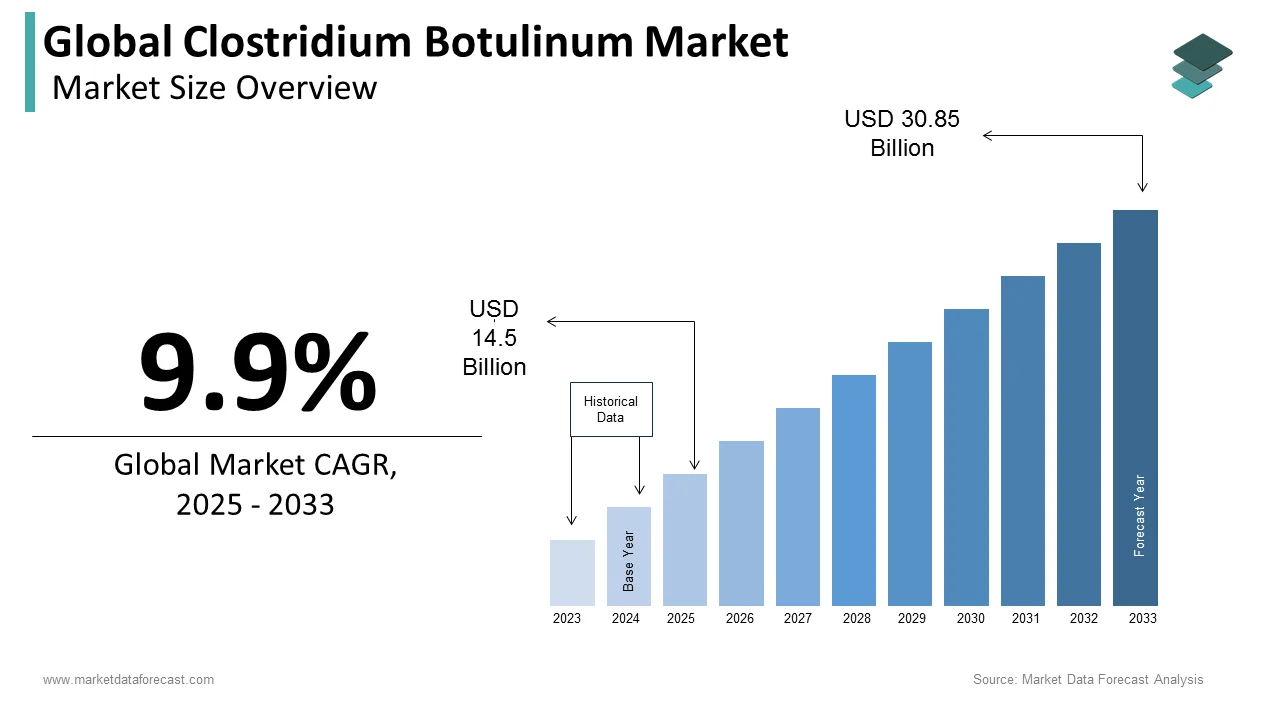
The size of the global clostridium botulinum market was worth USD 14.5 billion in 2025. The global market is anticipated to grow at a CAGR of 9.9% from 2026 to 2034 and be worth USD 33.91 billion by 2034 from USD 15.94 billion in 2026.
MARKET DRIVERS
The growing number of botulism cases is one of the major factors driving the growth of the Clostridium botulinum market.
Clostridium botulinum is a bacterium that produces a neurotoxin, which can cause botulism, and botulism is a rare disease but potentially life-threatening. The demand for antitoxins and therapeutics to treat botulism patients has been growing at a good pace in the last few years due to the growing patient population suffering from botulism. The rising emphasis on food safety and hygiene practices worldwide contributes to the growth of the clostridium botulinum market.
The lack of cleanliness in some areas of the world, increased awareness about disease and treatments, increased R&D practices, and the availability of efficient solutions for botulism drive the growth of the clostridium botulinum market. Besides, the disease is getting irradiated slowly owing to solid efforts by WHO and CDC. The growing population worldwide, rising preference for minimally invasive or non-invasive surgeries and increasing investments for R&D activities further propel the global clostridium botulinum market growth. Growing incidences of botulism and increasing awareness regarding the diverse toxic bacteria favor the growth rate of the clostridium botulinum market. The growing number of government measures supporting R&D in the clinical healthcare sector and improved advanced treatment facilities support the market growth.
The increasing number of epidemic diseases, growing healthcare expenditure, and key market participants' interest in setting up their research centers are a big plus to the market growth. For instance, in 2016, Ipsen S.A. received U.S FDA approval for its Dysport injection, which treats children aged two years and above for pediatric lower limb (PLL) used in adults. In 2017, around 7.2 million botulinum injections were used in the United States for cosmetic procedures. The growing number of cosmetic aesthetic procedures successfully intensifies the market growth during the forecast period.
MARKET RESTRAINTS
High costs associated with R&D projects, treatment and prevention and government austerity majorly hinder the growth of the clostridium botulinum market. Stringent regulatory requirements and poor awareness and understanding of the disease further hamper the market’s growth rate.
REPORT COVERAGE
| REPORT METRIC | DETAILS |
| Market Size Available | 2025 to 2034 |
| Base Year | 2025 |
| Forecast Period | 2026 to 2034 |
| Segments Covered | By Product Type, Application, End-User, and Region |
| Various Analyses Covered | Global, Regional & Country Level Analysis, Segment-Level Analysis; DROC, PESTLE Analysis; Porter’s Five Forces Analysis, Competitive Landscape, Analyst Overview of Investment Opportunities |
| Regions Covered | North America, Europe, Asia Pacific, Latin America, Middle East & Africa |
| Market Leaders Profiled | XOMA Ltd., AlphaVax, Inc., Cangene Corporation, Morphotek, Inc., DynPort Vaccine Company LLC, Emergent BioSolutions, Inc., Molecular Targeting Technologies, Inc., and many others. |
SEGMENTAL ANALYSIS
By Product Type Insights

Based on product type, the botulinum toxin types A segment is expected to lead the global clostridium botulinum market and is also predicted to witness the fastest CAGR during the forecast period. As per CDC, in 2016, in the United States, 102 botulinum cases were caused by the toxin Type A. The Botulinum toxin type A is a widely used toxin for therapeutic purposes.The botulinum toxin type B is expected to grow at a healthy CAGR during the forecast period. The growing awareness of botulinum toxin type B and the increasing number of clinical trials drive the segmental growth.
By Application Insights
Based on the application, the aesthetic segment is predicted to hold the major share of the global market during the forecast period. Aesthetic applications are used in the cosmetic industry for bettering facial appearance and reduce aging symptoms. Growing R&D actions are broadening the usage of botulinum toxin (BOTOX) among different indications. As per the International Society of Plastic Surgery 2018, estimated growth in BOTOX procedures rose by 17.4% in 2018 compared to 2017. People's issues about their looks are flourishing in both the developed and developing countries of the world.
By Distribution Channel Insights
Based on the distribution channel, the hospital segment is expected to account for the global market share during the forecast period. The growing prevalence of Clostridium Botulinum infections, the availability of advanced medical technologies in hospitals and the ability to provide comprehensive medical care to patients primarily drive the growth of the hospital segment.The clinics segment held the second largest share of the global market in 2024 and is estimated to grow at a healthy CAGR during the forecast period owing to factors such as the rising demand for outpatient services, increasing awareness about Clostridium Botulinum infections, and the ability to provide specialized care in a more focused setting.The retail pharmacies segment is expected to grow at a steady CAGR during the forecast period due to factors such as the increasing prevalence of Clostridium Botulinum infections, the ease of access to medications, and the rising demand for self-care and over-the-counter products.North America
REGIONAL ANALYSIS
North America Clostridium Botulinum Market Analysis
Geographically, the global Clostridium botulinum market was dominated by North America, followed by Europe. However, the Asia Pacific is a lucrative market expected to grow at a high CAGR. Technological advancements in healthcare, the growing prevalence of Clostridium Botulinum infections, and the presence of well-established healthcare infrastructure in North America majorly propel the growth of the North American Clostridium botulinum market. The stringent regulatory framework, the growing aging population and the increasing demand for advanced medical treatments further drive the regional market growth. The U.S. led the market in North America in 2024 and is expected to grow at a healthy CAGR during the forecast period owing to factors such as increasing healthcare expenditure and the rapidly growing pharmaceutical industry in the U.S.

Europe Clostridium Botulinum Market Analysis
Europe held a notable share of the global market in 2024 and is anticipated to register a healthy CAGR during the forecast period. The growing number of initiatives from the European governments to improve the healthcare infrastructure, rising awareness about Clostridium Botulinum infections, increasing number of advancements in medical research and innovation and growing healthcare expenditure primarily boost the clostridium botulinum market growth in Europe. The presence of well-established pharmaceutical companies and growing aging population and associated health concerns in Europe further propel the European market growth.
Asia Pacific Clostridium Botulinum Market Analysis
Asia Pacific is predicted to witness the fastest CAGR in the global market among all the regions during the forecast period owing to the growing number of improvements in healthcare infrastructure in the Asia Pacific countries, increasing disposable income and expenditure on healthcare and increasing emphasis on public health initiatives. The growing prevalence of foodborne diseases and the expansion of pharmaceutical companies in the Asia Pacific region further fuel the growth rate of the Asia Pacific clostridium botulinum market.
KEY MARKET PLAYERS
The top companies dominating the Global Clostridium Botulinum Market profiled in this report are
- XOMA Ltd.
- AlphaVax, Inc.
- Cangene Corporation
- Morphotek, Inc.
- DynPort Vaccine Company LLC
- Emergent BioSolutions, Inc.
- Molecular Targeting Technologies, Inc.
MARKET SEGMENTATION
This research report on the global Clostridium botulinum market has been segmented and sub-segmented into the following categories.
By Product Type
- Botulinum Toxin Type A
- Botulinum Toxin Type B
By Application
- Aesthetic
- Therapeutics
By Distribution Channel
- Hospitals
- Clinics
- Retail Pharmacies
By Region
- Europe
- Asia Pacific
- Latin America
- The Middle East and Africa