- Product Description Description
- Table of Contents TOC
- List of Table & Figure LOT
- Get Free Sample PDF Sample PDF
Market Size, 2025
$79.08 BnMarket Estimate, 2026
$82.32 BnMarket Forecast, 2034
$113.53 BnCAGR, 2026–2034
4.1%Executive Summary: Global Cotton Processing Market
- Market Scope: Comprehensive global evaluation of the cotton processing industry covering product variants, core application segments, ginning and spinning operation types, automation tiers, and regional market performance.
- Market Valuation: Valued at USD 79.08 billion (2025), estimated at USD 82.32 billion (2026), and projected to reach USD 113.53 billion by 2034, registering a steady CAGR of 4.1% (2026–2034).
- Primary Growth Drivers: Escalating demand for processed cotton and yarn from textile and clinical sectors, expanding utilization of cottonseed as nutritious animal feed, and the introduction of advanced, high-efficiency automated machinery by plant manufacturers.
Key Market Segment Metrics (2026–2034)
| Category | Leading Segment (2025 Position) | Fastest-Growing Segment |
|---|---|---|
| By Product Type | Lint segment (commanding the largest share as cleaned fibers extracted via ginning form the bedrock of textile production) | Cottonseed byproducts (expanding due to multi-industry demand for animal feed and vegetable oil options) |
| By Application | Textiles and apparel (maintaining historic dominance since raw cotton has no immediate substitute in large-scale weaving) | Medical & surgical goods (surging due to strict healthcare hygiene standards and rising medical applications) |
| By Type & Operation | Spinning and ginning equipment (anchoring core yarn preparation and fiber-seed separation workflows) | Automatic operations (experiencing fastest growth driven by technology integration to optimize factory throughput) |
| By Region / Country | Asia-Pacific (leading regional market led by large-scale textile operations in China, India, and Pakistan) | Latin America and MEA (expanding steadily backed by emerging processing setups in Brazil, Egypt, and developing trade routes) |
Major Market Players & Market Structure
Market Structure: Consolidated industrial machinery market characterized by key international engineering firms specializing in ginning systems, spinning technology, high-speed automated processing plants, and localized service hubs.
Key Companies: Lummus Corp, Bajaj Steel Industries Limited, Nipha Exports Private Limited, Shandong Swan Cotton Industrial Machinery Stock Co., Ltd., Cherokee Fabrication, Rieter, and Toyota Industries.
Global Cotton Processing Market Size
The global cotton processing market size was valued at USD 79.08 billion in 2025 and is anticipated to reach USD 82.32 billion in 2026 from USD 113.53 billion by 2034, growing at a CAGR of 4.1% from 2026 to 2034.
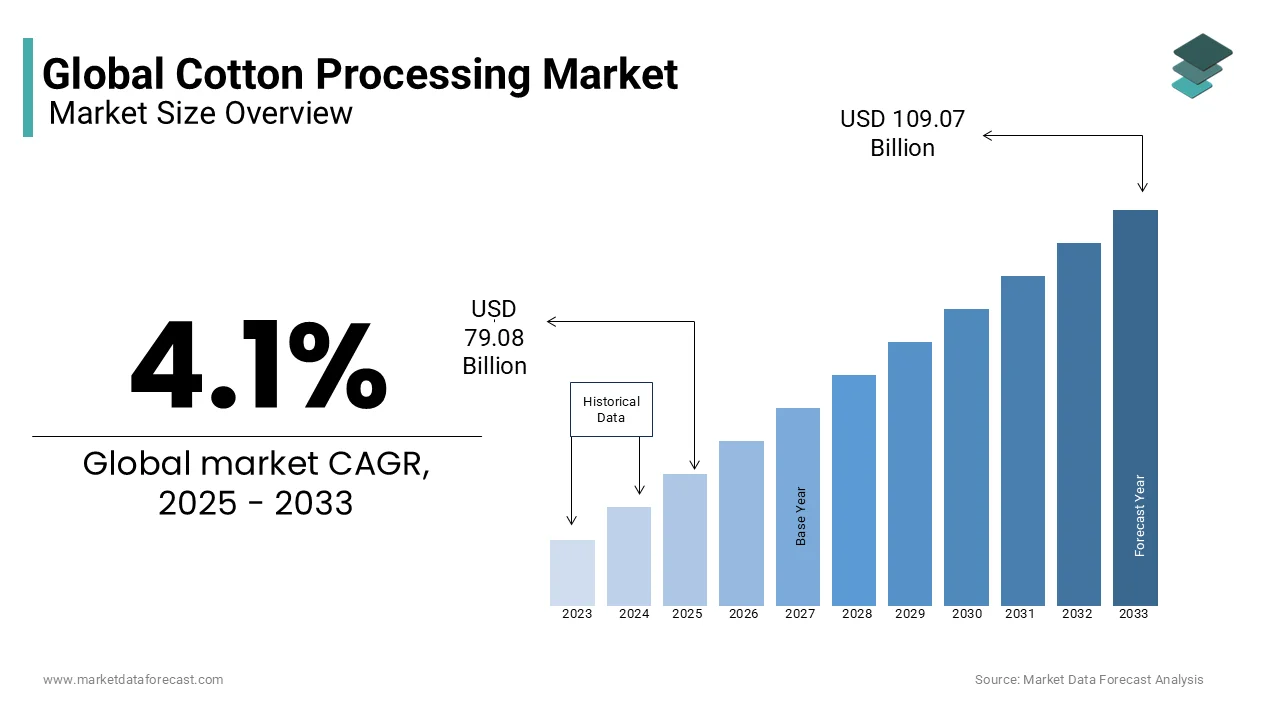
Global cotton processing is an innovation used to reduce dampness and improve the fiber quality for different applications, for example, textiles, clinical and consumer goods, and others, so as to develop better quality items.
The market is probably going to be driven by the rising interest in processed cotton, particularly from the cotton textile and clinical and surgical business sectors. Raw cotton is adopted as a crude element in textile manufacturing, and there are no alternatives to this. Thus, the textile portion has represented the biggest portion of the worldwide cotton processing market since 2021.
MARKET DRIVERS
Rising interest in cotton in different applications, for example, textiles and consumer goods, is a central point expected to drive the development of the global cotton processing market over the estimated time frame. Also, the expanding adoption of cottonseed as a feed for animals, which increases interest in cotton processing, is another factor foreseen to fuel the development of the objective market in the coming years. Also, developing interest in woolen and acrylic items supports interest for long staple shafts and expanding adoption of cotton processing types of equipment for high efficiency in less time are among certain elements assessed to drive the development of the likely market over the conjecture time frame.
However, quality concerns because of contamination of the equipment,t which may hamper interest in cotton processing andthe control development of the cotton processing market over the long-term.
REPORT COVERAGE
| REPORT METRIC | DETAILS |
| Market Size Available | 2025 to 2034 |
| Base Year | 2024 |
| Forecast Period | 2026 to 2034 |
| CAGR | 4.1% |
| Segments Covered | By Product, Application, Type, Operation, and Region. |
| Various Analyses Covered | Global, Regional & Country Level Analysis, Segment-Level Analysis, DROC, PESTLE Analysis, Porter’s Five Forces Analysis, Competitive Landscape, Analyst Overview of Investment Opportunities |
| Regions Covered | North America, Europe, APAC, Latin America, Middle East & Africa |
| Market Leaders Profiled | Lummus Corp (US), Bajaj Steel Industries Limited (India), Nipha Exports Private Limited (India), Shandong Swan Cotton Industrial Machinery Stock Co., Ltd. (China), Cherokee Fabrication (US), Reiter (Switzerland), Toyota Industries (Japan), and Others. |
SEGMENTAL ANALYSIS
By Product Insights
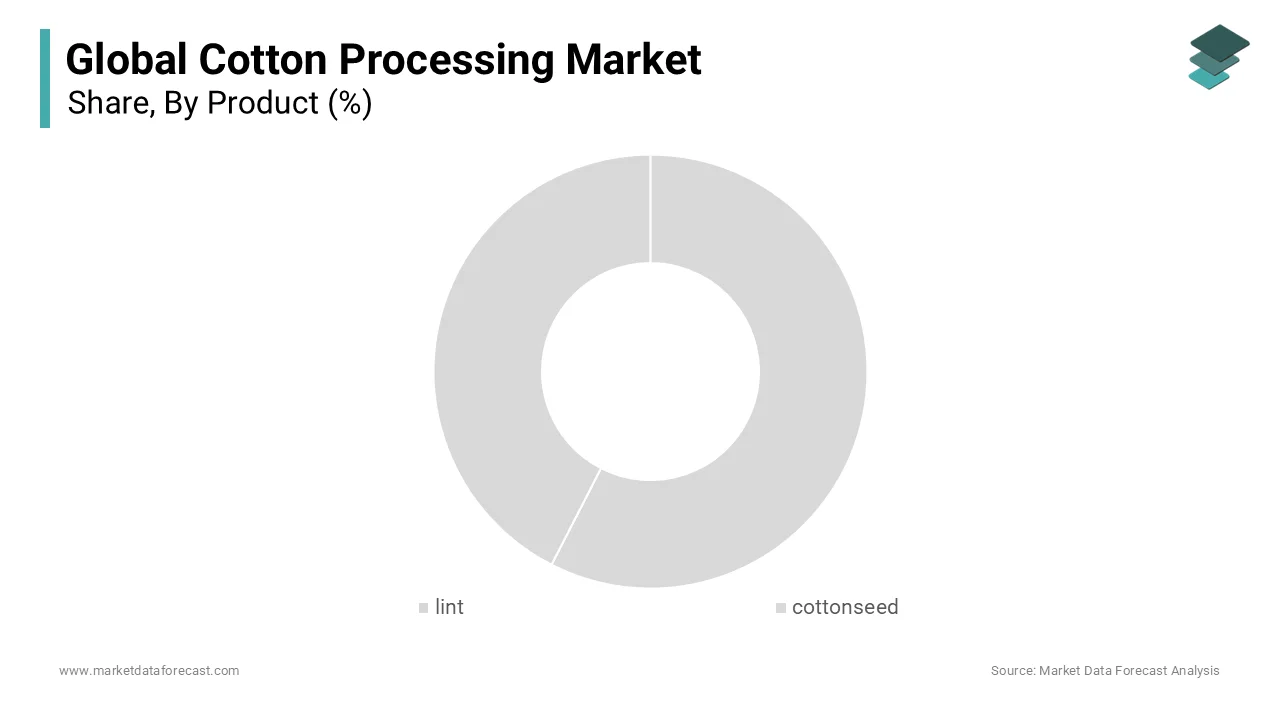
The lint section is assessed to represent the biggest portion of the cotton processing market in 2020. Lint is the fiber extracted from cotton seeds through the ginning cycle. The ascent in urbanization and change in the lifestyle of purchasers have prompted an expansion in the interest for textiles, which is expected to drive the development of the lint portion further.
By Application Insights
The textiles section is expected to be the quickest-developing segment in the cotton processing market from 2025 to 2033. This is because of the rising per capita income and changing inclinations of purchasers, which is driving the market development.
By Type Insights
The spinning fragment is expected to be the predominant market in the cotton processing market from 2025 to 2033. This is because of the expanding yarn utilization in the textile, clinical surgical, and consumer merchandise areas.
By Operation Insights
The automatic fragment is expected to be the quickest developing portion in the cotton processing market from 2025 to 2033. This is because of the presentation of trend-setting innovations by machine manufacturers for expanding the profitability of factories.
REGIONAL ANALYSIS
In view of the region, the worldwide cotton processing business can be segmented into five fundamental areas: North America, Europe, Asia Pacific, Latin America, and the Middle East and Africa. The Asia Pacific is expected to overwhelm the cotton processing market throughout the forecast period. A few elements impacting this strength in the market include the rising textile industry, consumer goods, and animal feed. Rising interminable sicknesses and mishaps, alongside expanding cleanliness concerns among buyers, have led to the application of processed cotton. Additionally, the mechanical advancement to build profitability is foreseen to push the market. China, Pakistan, and India are foreseen to drive the territorial income in the coming years. Likewise, there is a huge interest in cotton because of the thriving workmanship industry in nations; for example, India and China will multiply the cotton processing market requests in the years ahead.

Presentation of new advancements in cotton processing in nations, for example, the U.S. and Canada, will accelerate cotton processing market development in the years ahead. With quickly extending textiles and cotton enterprises in nations, for example, Brazil and Egypt, all things considered, Latin America and the Middle East and African business sectors will observe rising development in the expected years.
KEY MARKET PLAYERS
Key players recognized in the cotton processing market include
- Lummus Corp (US)
- Bajaj Steel Industries Limited (India)
- Nipha Exports Private Limited (India)
- Shandong Swan Cotton Industrial Machinery Stock Co., Ltd. (China)
- Cherokee Fabrication (US)
- Reiter (Switzerland)
- Toyota Industries (Japan).
RECENT MARKET NEWS
- In November 2018, Rieter (Switzerland) updated its end spinning item portfolio by presenting spinning machines, G 37 and G 38. The organization additionally presented two new compact spinning machines, K 47 and K 48. This would fortify the organization's item portfolio.
- In May 2018, the Swiss Rieter AG organization, a subsidiary of Rieter, worked together with the Uzbek Textile Industry Association (Uzbekistan) and launched a textile engineering venture. With this coordinated effort, Rieter AG would supply Uzbekistan with the most recent model of the Air Jet spinning gear.
- In April 2017, Rieter (Switzerland) opened an assistance branch in Kahramanmaraº, Turkey, to offer superior support to its clients in Southeast Turkey.
- In November 2017, Bajaj Steel Industries Limited (India) got an agreement of opening three cotton ginning production lines from Cotton, Spinning, Weaving, and Garments Holding Company (Egypt). This processing plant would be founded on rotobar ginning innovation and would help BajajSteell to extend its business in Egypt.
- In April 2015, Rieter (Switzerland) began operations through its Application and Research Center for Spinning Technology in China. This development would fortify its situation in the Chinese textile industry.
- In 2013, Shandong Swan Cotton Industrial Machinery Stock Co., Ltd. (China) moved its central command to Jinan Yaoshan Industrial Park for better activity of the organization, as this would expand its productivity to associate with its different subsidiaries.
MARKET SEGMENTATION
This research report on the global cotton processing market is segmented and sub-segmented into the following categories.
By Product
- lint
- cottonseed
By Application
- textiles
- medical & surgical
- feed
- consumer goods
- others
By Type
- spinning
- ginning
By Operation
- automatic
- semi-automatic
By Region
- North America
- Europe
- Asia Pacific
- Latin America
- Middle East and Africa