- Product Description Description
- Table of Contents TOC
- List of Table & Figure LOT
- Get Free Sample PDF Sample PDF
Market Size, 2025
$58.92 BnMarket Estimate, 2026
$62.87 BnMarket Forecast, 2034
$105.62 BnCAGR, 2026–2034
6.7%Executive Summary: Global Crane Rental Market
- Market Scope: Comprehensive analysis of the global crane rental market covering crane types, weightlifting capacities, end-use industry verticals, regional trends, and rental vs. purchase economics.
- Market Valuation: Valued at USD 58.92 billion (2025), estimated at USD 62.87 billion (2026), and projected to reach USD 105.62 billion by 2034, registering a CAGR of 6.7% (2026–2034).
- Primary Growth Drivers: High infrastructure spending (such as airport, port, and motorway development), rapid urbanization, smart city projects, and the cost-efficiency of renting heavy equipment rather than purchasing.
Key Market Segment Metrics (2026–2034)
| Category | Leading Segment (2025 Position) | Fastest-Growing Segment |
|---|---|---|
| By Type | Mobile Cranes (occupying the largest share due to high versatility and widespread adoption in construction and transportation) | Mobile & Specialized Heavy-Lift Cranes |
| By Weightlifting Capacity | Low to Low-Medium Weight Capacity Segments (accounting for the largest portion of rental business activity) | Heavy & Extreme Heavy Capacity Segments (driven by massive industrial and modular construction projects) |
| By End-Use Industry | Building & Construction (dominant consumer category spanning commercial, residential, and infrastructure works) | Energy, Wind Power, and Oil & Gas Sectors |
| By Region | Asia-Pacific (leading global market share fueled by massive economic infusions, smart cities, and urbanization in India, China, and Southeast Asia) | Asia-Pacific and Middle East & Africa |
Major Market Players & Market Structure
Market Structure: Highly competitive landscape featuring global specialized heavy-lift providers and regional equipment rental firms competing on fleet scale, safety standards, and customized modular rigging capabilities.
Key Companies: Sarens NV (Belgium), Mammoet (Netherlands), ALL Erection & Crane Rental Corp. (US), Lampson International LLC (US), Action Construction Equipment Ltd. (India), Maxim Crane Works, L.P. (US), ALE (US), Sanghvi Movers Limited (India), and Deep South Crane and Rigging (US).
Global Cranes Rental Market Size
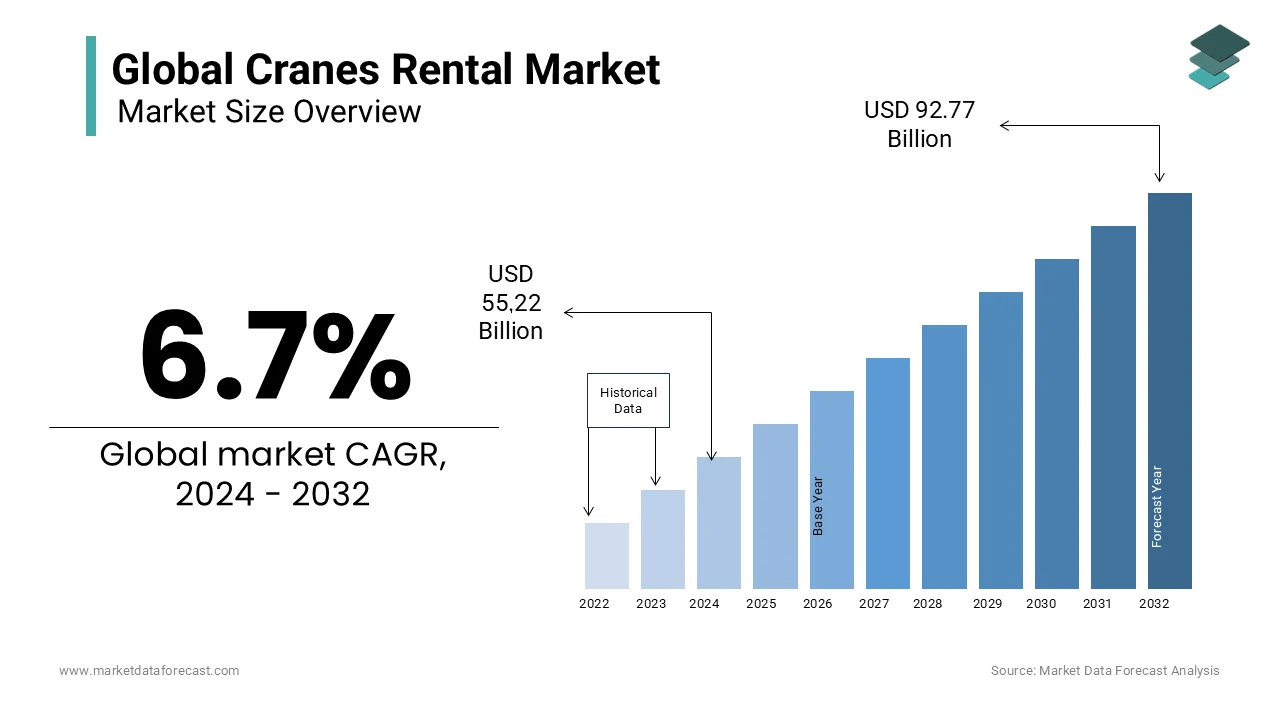
The global crane rental market was valued at USD 58.92 billion in 2025 and is anticipated to reach USD 62.87 billion in 2026 and USD 105.62 billion by 2034, growing at a CAGR of 6.7% during the forecast period from 2026 to 2034.
Current Scenario of the Global Crane
CRental is becoming a common sight in modern constructions such as large commercial and residential zones, and their optimum production speeds are often required. Cranes are commonly used in the transportation industry, shipyards, and freight depots. Cranes are also a common element of the manufacturing business, where combining heavy equipment in one location for a single purpose sometimes needs crane rental.
MARKET DRIVERS
The huge influx will occur in the coming years, resulting in significant building of airports, ports, and motorways, among other projects.
The usage of cranes on a rental basis rather than purchasing them, together with increased investments in various end-use industries such as building and construction, transportation, and oil and gas, among others, is fuelling crane rental market growth. The global crane market is projected to be fuelled by new trends in developing economies for the construction of new projects. For instance, India's finance minister, Nirmala Sitharaman, announced a $1.4 trillion infusion into the economy to enhance the country's infrastructure. During the forecast period, the global crane market will experience significant growth in terms of volume, scale, and intensity, particularly in the Asia Pacific region.
During the forecast period, Asia-Pacifiregion c is expected to be a critical region, with a high demand for rental cranes due to increased development and construction activities.
Government initiatives, construction spending, and favorable policies are all essential factors driving the global crane rental market forward. Furthermore, the growing popularity of mobile cranes is a key factor in propelling the crane industry.
The factors driving demand for Cranest in the Rental Market expansion are rapid urbanization and increased building and infrastructure development in emerging countries because of a growing focus on smart city development. Increased investment in transportation, commercial infrastructure, and energy also contributes to a rise in the demand for rental equipment to meet seasonal needs. With the simple availability of customized construction equipment, the desire to hire equipment as needed will rise, boosting the demand for crane rentals.
MARKET RESTRAINTS
The lack of skilled and qualified crane operators is one of the primary problems limiting the crane rental share. One of the industry's major issues is providing sufficient training to crane operators. Leading crane rental companies, on the other hand, are focusing on providing regular training programs for operators to overcome this difficulty. This is predicted to drastically reduce occupational accidents and catastrophes.
REPORT COVERAGE
| REPORT METRIC | DETAILS |
| Market Size Available | 2025 to 2034 |
| Base Year | 2025 |
| Forecast Period | 2026 to 2034 |
| CAGR | 6.7% |
| Segments Covered | By Type, End-use, Weightlifting, and Region |
| Various Analyses Covered | Global, Regional & Country Level Analysis, Segment-Level Analysis, DROC, PESTLE Analysis, Porter’s Five Forces Analysis, Competitive Landscape, Analyst Overview on Investment Opportunities |
| Regions Covered | North America, Europe, APAC, Latin America, Middle East & Africa |
| Market Leaders Profiled | Sarens NV (Belgium), Mammoet (Netherlands), ALL Erection & Crane Rental Corp. (US), Lampson International LLC (US), Action Construction Equipment Ltd. (India), Maxim Crane Works, L.P. (US), ALE (US), Sanghvi Movers Limited (India), Deep South Crane and Rigging (US) |
SEGMENTAL ANALYSIS
By Type Insights
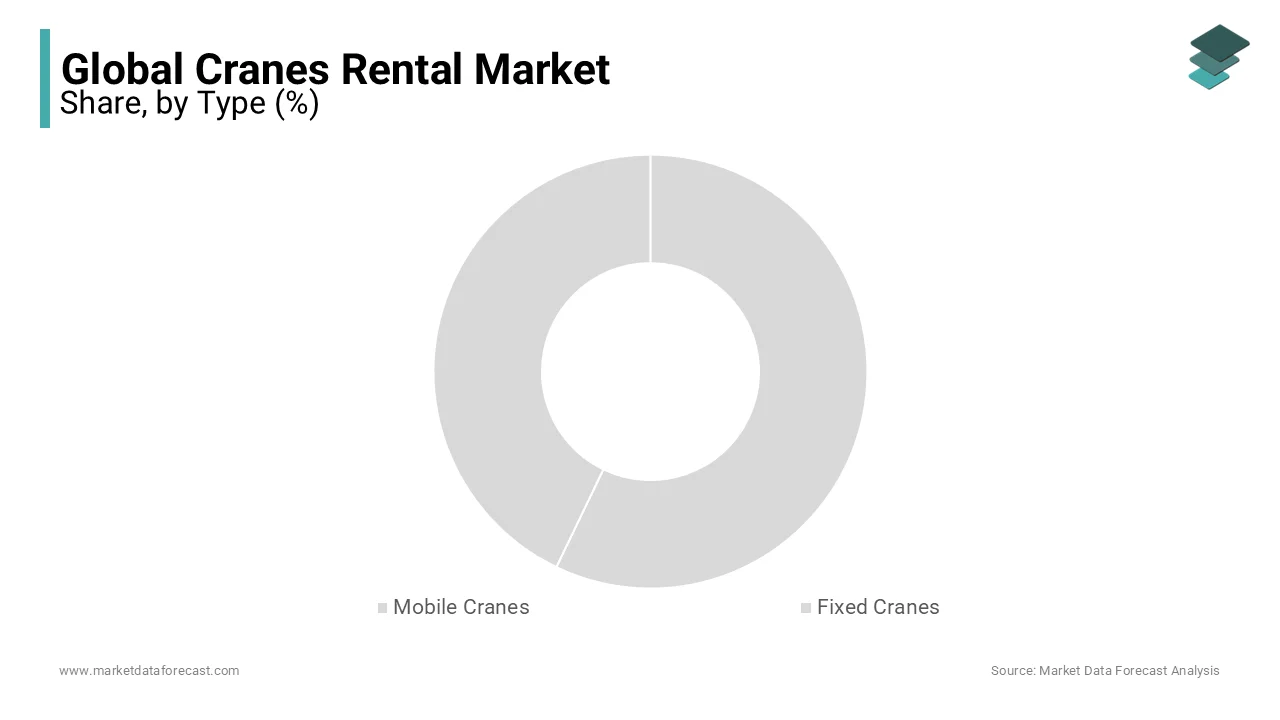
Based on type, Mobile cranes are likely to occupy the largest share in the crane market during the outlook period due to their wide acceptance in various end-use industries like building & construction, and transportation.
By Weightlifting Capacity Insights
By weightlifting capacity, the Lthe weight segment accounted for the largest portion of the rental business and will have prominent growth over the determined period. This growth is contributing to the increase in various types of activities for construction, repairs, and maintenance around the globe, which is predicted to drive the market boom.
By End-Use Industry Insights
By end-use industry, the market is isolated or divided into building & construction, marine & offshore, mining & excavation, oil & gas, transportation, industrial, and municipal. Building & construction, consistent with commercial & residential buildings and infrastructure, is an important consumer in the market.
REGIONAL ANALYSIS
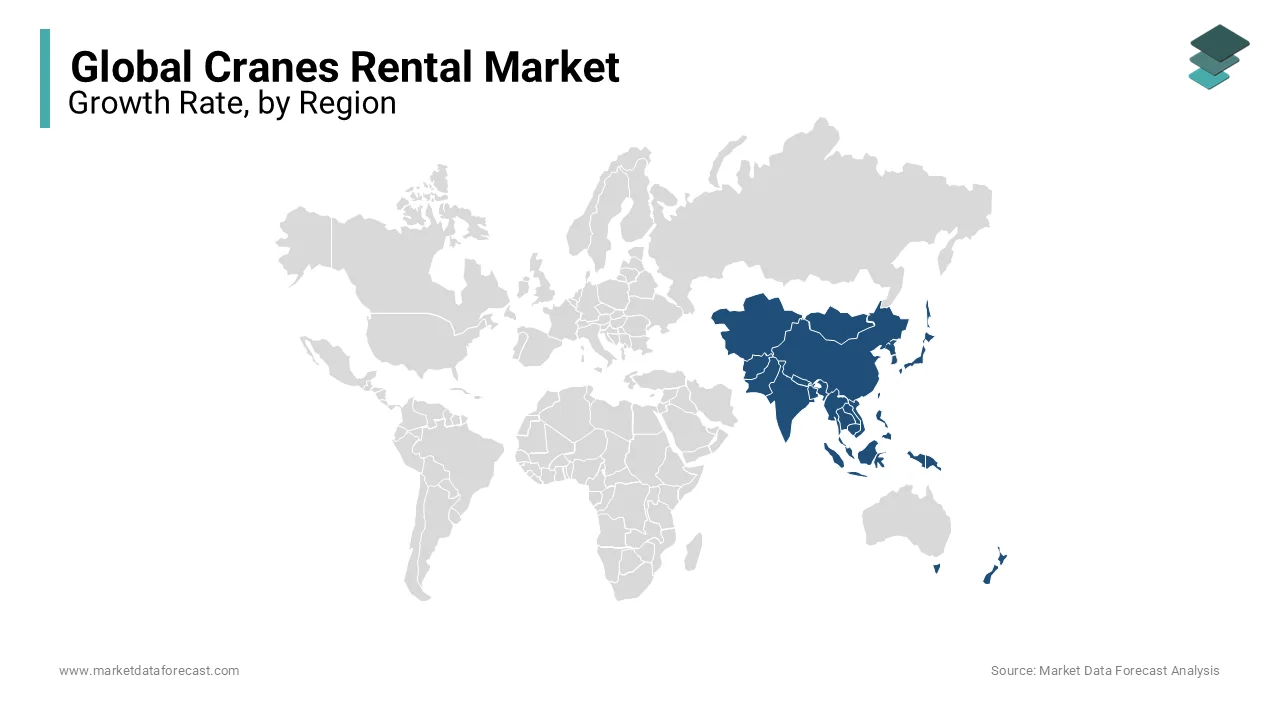
The Asia Pacific region leads the global cranes market, which is estimated to grow at a significant rate due to the increasing demand for cranes on a rental basis in countries like China, Japan, India, Australia, and other countries. Furthermore, rising population levels and increasing investments from domestic & foreign investors are expected during the conjecture period to drive the growth of the APAC cranial market.
KEY MARKET PLAYERS
Companies playing a major role in the global crane market include
- Sarens NV (Belgium)
- Mammoet (Netherlands)
- ALL Erection & Crane Rental Corp. (US)
- Lampson International LLC (US)
- Action Construction Equipment Ltd. (India)
- Maxim Crane Works, L.P. (US)
- ALE (US)
- Sanghvi Movers Limited (India)
- Deep South Crane and Rigging (US).
RECENT MARKET NEWS
- Mammoet Introduces Sk6,000 Crane to Improve FPSO Modularization Strategies- 6,000t Crane Capacity Allows Modules to Be Built Bigger Than Ever Before.
- Sarens Provides Wind Clients with Transportation, Crane, and Installation Services - Sarens has always been well-equipped to deliver global crane services ranging from 50 to 3.200 tonnes. Sarens began creating its in-house installation team a few years ago, anticipating changes in the wind business, and strengthened its transportation capabilities by cooperating with major transportation companies across several locations.
MARKET SEGMENTATION
This research report on the global crane rental market has been segmented and sub-segmented based on type, end-use, weight lifting, and region.
By Type
- Mobile Cranes
- Fixed Cranes
By Weightlifting Capacity
- Low
- Low-Medium
- Heavy
- Extreme Heavy
By End-Use Industry
- Building & Construction
- Marine & Offshore
- Mining & Excavation
- Oil & Gas
- Transportation
- Others (Industrial and Municipal)
By Region
- North America
- The United States
- Canada
- Rest of North America
- Europe
- The United Kingdom
- Spain
- Germany
- Italy
- France
- Rest of Europe
- The Asia Pacific
- India
- Japan
- China
- Australia
- Singapore
- Malaysia
- South Korea
- New Zealand
- Southeast Asia
- Latin America
- Brazil
- Argentina
- Mexico
- Rest of LATAM
- The Middle East and Africa
- Saudi Arabia
- UAE
- Lebanon
- Jordan
- Cyprus