Global Cross Laminated Timber (CLT) Market Size, Share, Trends & Growth Forecast Report – Segmented By Bonding Technology (Adhesive Bonded, Mechanically Fastened), Application and Region (North America, Europe, Asia Pacific, Latin America, and Middle East & Africa) - Industry Analysis From 2025 to 2033
Global Cross Laminated Timber (CLT) Market Summary
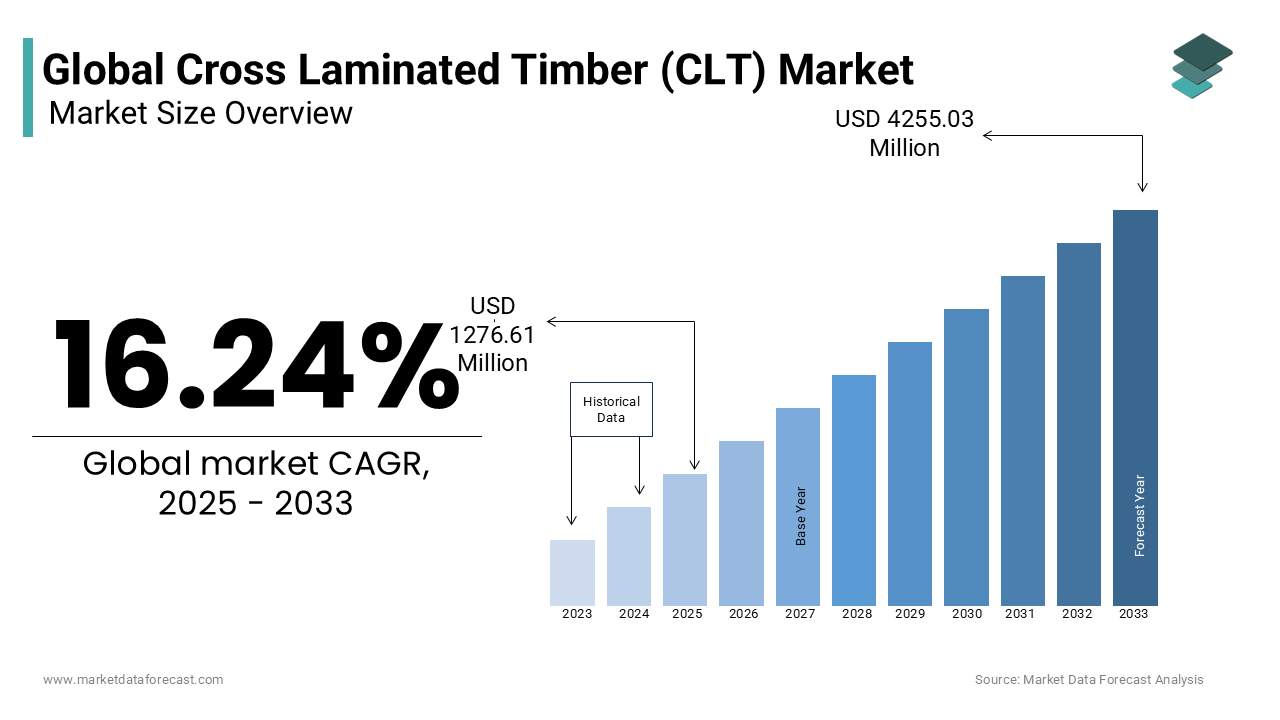
The global cross laminated timber (CLT) market was valued at USD 1,098.25 million in 2024, is estimated to reach USD 1,276.61 million in 2025, and is projected to reach USD 4,255.03 million by 2033, growing at a CAGR of 16.24% from 2025 to 2033. The growth of the CLT market is driven by rising demand for sustainable construction materials, increasing adoption of green building practices, and the superior strength, flexibility, and eco-friendliness of CLT compared to traditional construction materials.
Key Market Trends
- Growing preference for eco-friendly construction with low carbon footprint.
- Increasing usage of CLT in modular and prefabricated housing.
- Rising investments in multi-story wooden buildings across Europe and North America.
- Ongoing advancements in adhesive and manufacturing technologies.
- Strong government support for sustainable construction initiatives.
Segmental Insights
- Based on bonding technology, the adhesive-bonded segment dominated the CLT market, capturing a significant share in 2024.
- Based on application, the residential buildings segment was the largest, accounting for 58.3% of the market share in 2024.
Regional Insights
- Europe was the top performer in the global CLT market, holding 45.3% of the share in 2024, supported by strict environmental regulations and growing adoption of timber-based construction.
- North America is experiencing rapid growth, driven by the rising adoption of mass timber in sustainable housing and commercial projects.
- Asia-Pacific is expected to expand steadily due to urbanization and increasing investment in sustainable infrastructure.
- Latin America and the Middle East & Africa are emerging regions showing gradual adoption of CLT in construction.
Competitive Landscape
Prominent players in the global cross laminated timber (CLT) market include Stora Enso, Mayr-Melnhof Holz, Binderholz GmbH, KLH Massivholz, HASSLACHER Holding, Pfeifer Group, Mercer Mass Timber, SmartLam, Nordic Structure, Kalesnikoff, XLAM Industrie, Schilliger Holz, Eugen Decker Holzindustrie, Vaagen Timbers, and Metsä Wood. These companies are focusing on capacity expansion, partnerships with construction firms, and sustainable product innovations to strengthen their market position.
Global Cross Laminated Timber (CLT) Market Size
The cross laminated timber (CLT) market was valued at USD 1098.25 million in 2024, is estimated to reach USD 1276.61 million in 2025, and is projected to reach USD 4255.03 million by 2033, growing at a CAGR of 16.24% from 2025 to 2033.
The cross laminated timber (CLT) is the ecosystem of engineered wood products composed of orthogonally stacked lumber layers bonded with structural adhesives, forming rigid, load-bearing panels used in walls, floors, and roofs for mid- to high-rise construction.
MARKET DRIVERS
Global Push for Net-Zero Carbon Construction
The construction industry is under increasing pressure to reduce embodied carbon, driving widespread adoption of cross laminated timber in public and private developments. According to the Global Alliance for Buildings and Construction, the building sector was responsible for 37% of global final energy-related CO₂ emissions in 2022, with materials like concrete and steel contributing disproportionately. In 2023, the UK government mandated whole-life carbon assessments for all public projects over £25 million, directly incentivizing CLT use. Similarly, California’s Buy Clean California Act sets maximum global warming potential (GWP) limits for structural materials, favoring mass timber. Cities like Vancouver and Vienna have already approved CLT high-rises exceeding 20 stories, which cite lifecycle carbon savings.
Acceleration of Off-Site and Prefabricated Construction
The global shift toward modular and off-site construction is given its compatibility with precision manufacturing and rapid assembly, which is leveraging the growth of the laminated timber (CLT) market. According to McKinsey & Company, off-site construction can reduce project timelines by 20–50% and cut on-site labor by up to 80%, with CLT panels arriving pre-cut, pre-drilled, and ready for crane installation. In Japan, where labor shortages are acute, 40% of new multi-family residential units now incorporate prefabricated timber systems, as per the Japan Prefabricated Housing Association. Additionally, the U.S. National Institute of Building Sciences notes that CLT construction generates 75% less construction waste than concrete equivalents.
MARKET RESTRIANTS
Limited Availability of Certified Sustainable Timber Feedstock
The limited supply of sustainably managed softwood timber meeting certification standards such as FSC or PEFC is hindering the growth of cross laminated timber (CLT) market. According to the Food and Agriculture Organization, only 16% of global forests are under formal sustainable management plans, with major softwood-producing regions like British Columbia and Scandinavia prioritizing existing pulp and sawmill operations. In 2023, the Canadian Wood Council reported that 60% of western hemlock and spruce-pine-fir (SPF) harvests were allocated to traditional lumber and pulp, leaving insufficient volume for mass timber expansion. Moreover, certification bottlenecks delay new mill approvals—Austria’s Federal Forests took 18 months to secure PEFC chain-of-custody certification for a new CLT facility in 2022. In the U.S. Southeast, where loblolly pine is abundant, the lack of dedicated CLT-grade sorting infrastructure limits feedstock quality.
High Initial Capital Investment for CLT Manufacturing Facilities
Establishing a CLT production plant requires significant capital outlay, deterring widespread industrial adoption in emerging economies which additionally hinders the growth of the laminated timber (CLT) market. According to Wood Resources International, constructing a medium-scale CLT facility with an annual capacity of 50,000 cubic meters costs between USD 40 million and USD 70 million, including presses, CNC machining, and adhesive systems. In India and Brazil, where construction demand is rising, no commercial CLT plants existed until 2023 due to financial and technical barriers. The U.S. Department of Commerce notes that CLT production lines require specialized workforce training and rigorous quality control, adding to operational costs.
MARKET OPPORTUNITIES
Urban High-Rise Timber Buildings and Hybrid Structural Systems
The approval of tall timber buildings is unlocking transformative opportunities for CLT in dense urban environments. As per the Council on Tall Buildings and Urban Habitat, over 1,000 mass timber buildings exceeding eight stories have been completed or are under construction globally, with projects like Mjøstårnet in Norway (18 stories) and Ascent MKE in Milwaukee (284 feet) demonstrating structural viability. Hybrid systems combining CLT with steel or concrete cores are gaining traction, offering seismic resilience and design flexibility. In 2023, the City of Paris approved a 100-meter timber office tower, citing a 60% reduction in embodied carbon.
Integration with Digital Design and Building Information Modeling (BIM)
The synergy between CLT and digital construction technologies is revolutionizing architectural precision and construction efficiency, which is cross laminated timber (CLT) market. CLT panels are ideally suited for Building Information Modeling (BIM), allowing architects to design, simulate, and fabricate components with millimeter accuracy. In Germany, the “Bauteilfertigung” initiative links BIM models directly to CNC machines, enabling fully automated CLT panel production. The Norwegian firm Moelven completed a 12-story student housing project using only digital workflows, reducing rework by 90%. Additionally, digital twin technology allows real-time monitoring of CLT buildings for structural performance and moisture levels, enhancing long-term durability.
MARKET CHALLENGES
Fire Safety Perception and Regulatory Hurdles
The growing regulatory hurdles is likely to degrade the growth of cross laminated timber (CLT) market. According to the National Research Council of Canada, CLT panels can withstand fire exposure for up to two hours without structural failure, outperforming unprotected steel. However, high-profile incidents like the 2017 Grenfell Tower fire in London have led to stringent, often inconsistent fire codes. The U.S. International Code Council permits CLT in high-rises but mandates extensive sprinkler systems and non-combustible cladding, increasing costs. Fire modeling standards vary across jurisdictions, requiring separate certifications for each market.
Skilled Labor Shortage in Timber Construction and On-Site Assembly
The transition to CLT-based construction demands a specialized workforce trained in precision handling, crane-assisted assembly, and digital blueprint interpretation skills, which are currently in short supply, and is another factor hampering the growth of cross laminated timber (CLT) market. According to the European Construction Industry Federation, 43% of EU construction firms reported difficulties in hiring workers with advanced timber framing expertise in 2023.
REPORT COVERAGE
| REPORT METRIC | DETAILS |
| Market Size Available | 2024 to 2033 |
| Base Year | 2024 |
| Forecast Period | 2025 to 2033 |
| Segments Covered | By Bonding Technology, Application and Region |
| Various Analyses Covered | Global, Regional, & Country Level Analysis; Segment-Level Analysis, Drivers, Restraints, Opportunities, Challenges, PESTLE Analysis, Porter’s Five Forces Analysis, Competitive Landscape, Analyst Overview of Investment Opportunities |
| Regions Covered | North America, Europe, Asia Pacific, Latin America, Middle East, and Africa |
| Key Market Players | Tora Enso, Mayr-Melnhof Holz, Binderholz GmbH, KLH Massivholz, HASSLACHER Holding, Pfeifer Group, Mercer Mass Timber, SmartLam, Nordic Structures, Kalesnikoff, XLAM Industrie, Schilliger Holz, Eugen Decker Holzindustrie, Vaagen Timbers, and Metsä Wood. |
SEGMENTAL ANALYSIS
By Bonding Technology Insights
The adhesive bonded segment dominated the cross laminated timber (CLT) market by capturing a significant share in 2024 with the superior structural integrity, dimensional stability, and seamless surface finish achieved through industrial-grade adhesives such as polyurethane (PUR) and phenol-resorcinol-formaldehyde (PRF). The technology is fully compatible with automated CNC manufacturing, enabling precision tolerances within ±0.2 mm, as required in BIM-driven construction. In Austria and Germany, where over 70% of mass timber buildings use adhesive-bonded CLT, building codes such as DIN EN 16351 explicitly certify its long-term durability.
The mechanically fastened segment is likely to grow with an expected CAGR of 14.2% during the forecast period with the rising interest in demountable, reusable, and non-chemical structural systems that align with circular economy principles. According to the Ellen MacArthur Foundation, buildings account for 36% of global waste, which is prompting cities like Amsterdam and Copenhagen to mandate design-for-disassembly in public construction. The University of British Columbia’s Tallwood House retrofit project used mechanical joints to replace damaged panels without compromising structural integrity.
By Application Insights
The residential buildings segment was the largest by capturing 58.3% of cross laminated timber (CLT) market share in 2024 with the rapid adoption of CLT in mid-rise apartments, multi-family housing, and urban infill developments in regions facing housing shortages and labor constraints. In Austria, over 40% of new multi-family residential units constructed in 2023 utilized CLT, according to the Austrian Wood Innovation Agency, driven by faster build times and lower on-site noise pollution. Additionally, CLT’s thermal mass and acoustic insulation properties enhance occupant comfort, making it a preferred choice for premium urban housing where quality and speed of delivery are paramount.
The non-residential buildings segment is projected to register a CAGR of 13.6% during the forecast period with the increasing use of CLT in offices, educational institutions, healthcare facilities, and cultural buildings seeking low-carbon structural solutions. In 2023, the European Commission mandated that all new public buildings funded by EU programs must meet strict embodied carbon thresholds, favoring CLT. The University of Cambridge completed a 10,000 m² research facility entirely in CLT, reducing construction emissions by 62% compared to steel. Similarly, Microsoft’s new campus in Redmond incorporates hybrid CLT structures to meet its carbon-negative pledge.
REGIONAL ANALYSIS
Europe Cross Laminated Timber (CLT) Market Insights
Europe was the top performer in the cross laminated timber (CLT) market by holding 45.3% of share in 2024. Austria, Germany, and Switzerland lead in CLT production and innovation, with Austria alone operating over 20 industrial CLT plants. According to the Austrian Wood Research Institute, CLT production in Central Europe reached 1.2 million cubic meters in 2023, with exports growing by 18% year-on-year. The European Union’s Green Deal and Construction Products Regulation are accelerating demand by incentivizing low-carbon materials. Countries like France and the Netherlands have introduced tax breaks for timber-based public buildings.
North America Cross Laminated Timber (CLT) Market Insights
North America market growth is likely to grow with 32.1% of share in 2024. The United States and Canada are transitioning from early adopters to mainstream implementers, driven by updated building codes and federal sustainability mandates. The 2021 International Building Code now permits CLT buildings up to 18 stories, unlocking high-rise potential in cities like Portland, Minneapolis, and Toronto. According to the Canadian Wood Council, CLT usage in non-residential construction grew by 37% in 2023, with projects like the University of British Columbia’s Brock Commons Tallwood House setting performance benchmarks.
Asia Pacific Cross Laminated Timber (CLT) Market Insights
The Asia Pacific CLT market held 18.2% of sthe hare in 2024. Japan, South Korea, and Australia are leading the adoption, driven by seismic resilience needs, urban density, and sustainability commitments. According to Japan’s Forestry Agency, CLT production tripled between 2020 and 2023, with over 1,200 CLT buildings completed. Additionally, China is piloting CLT in eco-city developments such as Xiong’an New Area, signaling a strategic shift toward low-carbon urbanization.
Latin America Cross Laminated Timber (CLT) Market Insights
Latin America market is expected to grow steadily during the forecast period. Chile stands out as a regional leader by leveraging its well-managed radiata pine plantations and advanced wood-processing infrastructure. Brazil and Colombia are exploring CLT for social housing, where rapid assembly and low environmental impact are important. However, limited manufacturing capacity and a lack of specialized design expertise hinder scalability.
Middle East & Africa Cross Laminated Timber (CLT) Market Insights
Middle East & Africa market is likely to have prominent opportunities in the coming years. The United Arab Emirates and Saudi Arabia are beginning to explore CLT as part of their sustainable urbanization visions. Saudi Arabia’s NEOM and the UAE’s Masdar City are evaluating mass timber for low-carbon infrastructure.
COMPETETIVE LANDSCAPE
KEY MARKET PLAYERS
Some of the companies that are playing a dominating role in the cross laminated timber (CLT) market include
- Stora Enso
- Mayr-Melnhof Holz
- Binderholz GmbH
- KLH Massivholz
- HASSLACHER Holding
- Pfeifer Group
- Mercer Mass Timber
- SmartLam
- Nordic Structure
- Kalesnikoff
- XLAM Industrie
- Schilliger Holz
- Eugen Decker Holzindustrie
- Vaagen Timbers
- Metsä Wood
The cross laminated timber market is characterized by a competitive landscape where technological credibility, regulatory influence, and sustainability outweigh sheer scale. While European manufacturers dominate production, competition in the Asia Pacific is increasingly defined by the ability to navigate diverse building codes, seismic requirements, and cultural preferences for material performance. Differentiation arises not from price but from technical support, fire and structural certification, and integration with digital construction workflows. Local partnerships with architects, engineers, and policymakers are important for market entry, as is the capacity to deliver carbon accounting and lifecycle data. Emerging domestic producers in Japan and Australia are challenging imports with regionally adapted solutions.
Top Players in the Cross Laminated Timber Market
Stora Enso Oyj
Stora Enso has emerged as a transformative force in the Asia Pacific cross laminated timber (CLT) landscape through its innovation in renewable construction materials and strategic regional partnerships. The company supplies high-performance CLT panels from its European production facilities to key markets such as Japan, Australia, and South Korea, where demand for low-carbon buildings is accelerating. Stora Enso also launched a digital twin platform enabling real-time tracking of CLT panel fabrication and delivery, enhancing project coordination for developers. Its “Build It With Wood” initiative supports AEC professionals across the region with technical design tools and lifecycle assessments.
Metsä Wood (Part of Metsä Group)
Metsä Wood has established a strong foothold in the Asia Pacific CLT market by delivering premium, FSC-certified Kerto® LVL and CLT solutions tailored to seismic resilience and rapid construction needs. The company’s engineered wood products are increasingly specified in educational, commercial, and public infrastructure projects across Japan, New Zealand, and Singapore. In 2023, Metsä Wood supplied CLT panels for a net-zero primary school in Christchurch, showcasing fire safety, thermal performance, and short construction timelines. It has also partnered with Singapore’s Building and Construction Authority to promote timber use in high-rise urban developments under the city-state’s Green Mark Scheme.
KLH Massivholz GmbH
KLH, an Austrian pioneer in solid timber engineering, has significantly influenced the Asia Pacific CLT market through high-profile projects and technical collaboration with regional developers and regulators. The company’s CLT panels, known for their dimensional stability and fire resistance, have been used in landmark buildings across Japan and Australia, including a carbon-negative office complex in Tokyo and a multi-family residential tower in Sydney. In 2023, KLH partnered with the University of Tokyo to conduct full-scale fire and seismic testing of hybrid CLT-concrete systems, contributing data that informed Japan’s updated building codes. It also supplied CLT for a modular hospital expansion in New Zealand, completed in under six weeks. KLH’s emphasis on certification, traceability, and performance validation has made it a trusted supplier for projects requiring rigorous compliance.
Top Strategies Used by the Key Market Participants
Key players in the cross laminated timber market are prioritizing sustainable sourcing and carbon transparency by ensuring full traceability from forest to construction site. Companies are investing in digital tools such as BIM libraries, CNC compatibility, and blockchain-based material passports to streamline design and approval processes. Strategic partnerships with architectural firms, universities, and government bodies are accelerating code acceptance and technical validation. Expansion into high-growth regions is being supported by localized technical service teams and training programs. Firms are also advancing adhesive technologies to reduce emissions and improve recyclability.
MARKET SEGMENTATION
The research report on the cross laminated timber (CLT) market has been segmented and sub-segmented based on categories.
By Bonding Technology
- Adhesive Bonded
- Mechanically Fastened
By Application
- Residential Buildings
- Non-Residential Buildings
- Others
By Region
- North America
- Europe
- Asia-Pacific
- Latin America
- Middle East and Africa
Frequently Asked Questions
What is Cross Laminated Timber (CLT)?
CLT is an engineered wood product made by stacking layers of lumber at right angles and bonding them with adhesives to form large, strong, and stable panels.
What are the key drivers for the CLT market growth?
Rising demand for sustainable construction materials, reduced carbon footprint, faster construction timelines, and government support for green building practices
Which regions dominate the CLT market?
Europe is the largest market, followed by North America, with Asia-Pacific growing rapidly due to increasing adoption of sustainable construction.
Who are the leading players in the CLT market?
Major players include Stora Enso, Mayr-Melnhof Holz, Binderholz GmbH, KLH Massivholz, HASSLACHER Holding, Pfeifer Group, Mercer Mass Timber, and SmartLam.
What challenges does the CLT market face?
High production costs, lack of awareness in some regions, and regulatory hurdles in building codes.
What is the future outlook for the CLT market?
The market is expected to grow significantly, driven by eco-friendly construction demand, advancements in mass timber technology, and wider acceptance in urban projects.
Related Reports
Access the study in MULTIPLE FORMATS
Purchase options starting from
$ 2500
Didn’t find what you’re looking for?
TALK TO OUR ANALYST TEAM
Need something within your budget?
NO WORRIES! WE GOT YOU COVERED!
Call us on: +1 888 702 9696 (U.S Toll Free)
Write to us: sales@marketdataforecast.com