- Product Description Description
- Table of Contents TOC
- List of Table & Figure LOT
- Get Free Sample PDF Sample PDF
Market Size, 2025
$110.13 BnMarket Estimate, 2026
$119.16 BnMarket Forecast, 2034
$223.85 BnCAGR, 2026–2034
8.20%Global Cyber-Physical Systems Market Size
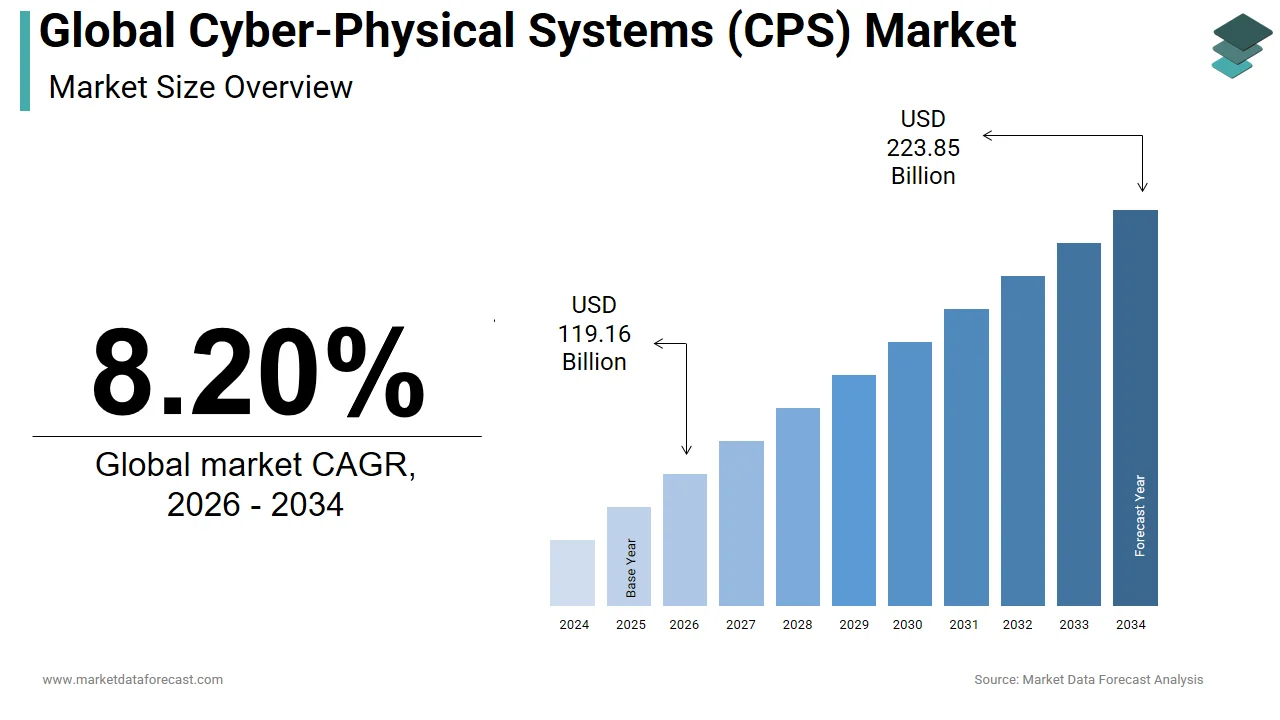
The size of the cyber-physical systems market was valued at USD 110.13 billion in 2025. This market is expected to grow at a CAGR of 8.20% from 2026 to 2034 and be worth USD 223.85 billion by 2034 from USD 119.16 billion in 2026.
Cyber-physical systems are embedded with processors, actuators, and sensors for sensing and interacting with the physical world. Cyber-Physical System is not entirely embedded; it needs input and output and interacts with the environment. These systems are mainly seen in robotics and sensor work. These systems are widely used in many products worldwide and in advanced manufacturing tools. The Industry 4.0 revolution comprises cloud computing, cognitive computing, and cyber-physical systems. This revolution led to automation and the exchange of information in manufacturing. This revolution launched the concept of smart factories, where cyber-physical systems monitor and maintain a virtual copy of these physical processes by communicating and cooperating with humans using the Internet. This helps reduce manual errors, driving the adoption of cyber-physical systems in manufacturing units.
MARKET DRIVERS
Demand for the adoption of technology advancements by entrepreneurs
The cyber-physical systems work with advancements in technology, where most global products are run by these systems, driving the cyber-physical systems market. Rapid technological developments are urging many countries and manufacturers to adopt these systems, which reduce manual work by giving accurate results. The manual errors are decreased with a decrease in time and cost to the manufacturers. Cyber-physical systems have applications in various sectors: telemedicine and remote diagnostics in the healthcare sector and smart grid for the energy sector. These systems interact with the physical world by linking it with information technology, which improves the productivity and quality of work that influences the sector's revenue. All these factors increase the scope of the market growth. The adoption of cyber-physical systems has increased in sectors like farming, power, healthcare, and manufacturing due to the massive automation activities, and nanomanufacturing was gaining the interest of the manufacturers to implement in the manufacturing sector.
Merge of Artificial Intelligence with Cyber-Physical Systems
Cyber-physical systems integrated with artificial intelligence will boost market growth. AI has various applications in many sectors; when combined with cyber-physical systems, productivity is massive. This significantly prompts market growth where AI works in remote areas, and CPS works in computation and physical environments. Finance, automation, education, healthcare, and several other sectors use AI and CPS, and merging two techniques leads to the industry's market value.
Innovative techniques in the production
The manufacturing units need innovative techniques to increase the market size where the cyber-physical systems work effectively for real-world solutions. The research and development sector will increase the cyber-physical systems market growth by increasing the market share of the key players and companies. This increases the market revenue share.
MARKET RESTRAINTS
The major restraining factor for the market's growth is the cyber-physical systems' open system. Open systems have a higher chance of cyber threats than closed systems. The arrangement needs a cloud-based server, often prone to cyberattacks and data breaches. These factors raise security issues related to the data in the cyber-physical systems. Another restraining factor was the cost of research and development activities. The research and development costs had increased rapidly due to the disruptions formed by the Pandemic, as the demand from the consumers and the emerging nations was increased. The investors must bring innovative ideas into the market to survive in the competitive industry and to gain a customer base.
REPORT COVERAGE
| REPORT METRIC | DETAILS |
| Market Size Available | 2025 to 2034 |
| Base Year | 2025 |
| Forecast Period | 2026 to 2034 |
| CAGR | 8.2% |
| Segments Covered | By Component, Application, and Region. |
|
Various Analyses Covered | Global, Regional & Country Level Analysis, Segment-Level Analysis, DROC, PESTLE Analysis, Porter’s Five Forces Analysis, Competitive Landscape, Analyst Overview on Investment Opportunities |
| Regions Covered | North America, Europe, APAC, Latin America, Middle East & Africa |
|
Market Leaders Profiled | IBM Corporation, Microsoft Corporation, Dell EMC, Honeywell International Inc., Hitachi Vantara, Hewlett Packard Enterprise, Schneider Electric, SAP SE, Oracle, and VMware Inc. |
SEGMENTAL ANALYSIS
By Component Insights
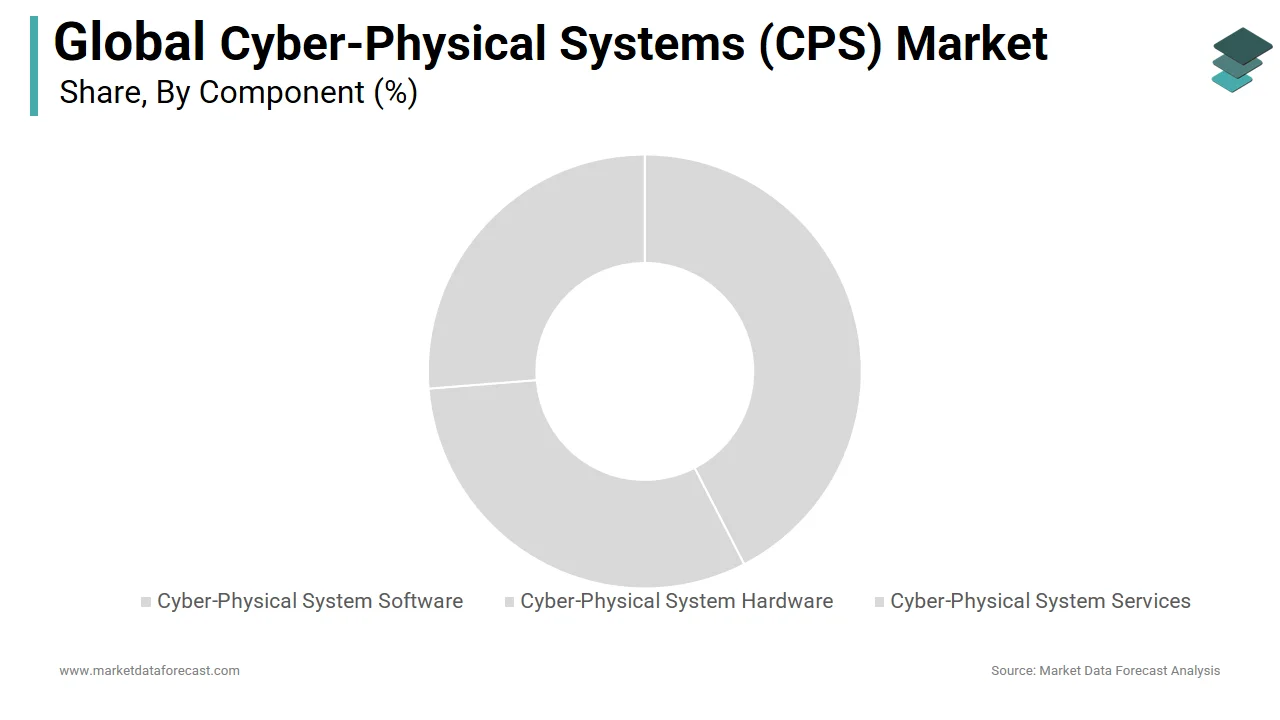
The cyber-physical system hardware dominated the global market and is projected to lead the market during the forecast period—the reduced costs of sensors and various network systems. Cyber-physical system key components such as monitoring devices, computing units, memory units, sensors, and actuators are available with reduced costs, which was adopted by many sectors with natural support for mobility will boost the market growth in this segment. The declining prices of hardware components of CPS were driving the demand for market growth.
By Application Insights
The energy & utility segment held a significant share of the cyber-physical systems market. This was due to the smart grid technology, which enables the effective management and distribution of energy sources such as wind and solar. The smart grid technology connects a variety of distributed energy resource assets to the power grid. The smart grid uses information and communication technology in an automated manner that improves efficiency, economics, sustainability, and electricity distribution. The information regarding the behaviors of suppliers and consumers was collected by intelligent grid technology. This helps optimize the energy by eliminating the usage of surplus energy. The manufacturing sector was projected to dominate with a higher growth rate in the forecast period as the adaption of cyber-physical systems in manufacturing was high due to eliminating errors and fixing problems, saving cost and time. The growing advancement, like artificial intelligence with CPS in manufacturing, was influencing the cyber-physical systems market value.In the Automotive sector, cyber-physical systems prominently use Electronic Control Units in cars, which take part in various mechanical subsystems such as brakes, engine, suspension, and steering. Adopting cyber-physical systems embedded in cars is expected to propel the market growth.
REGIONAL ANALYSIS
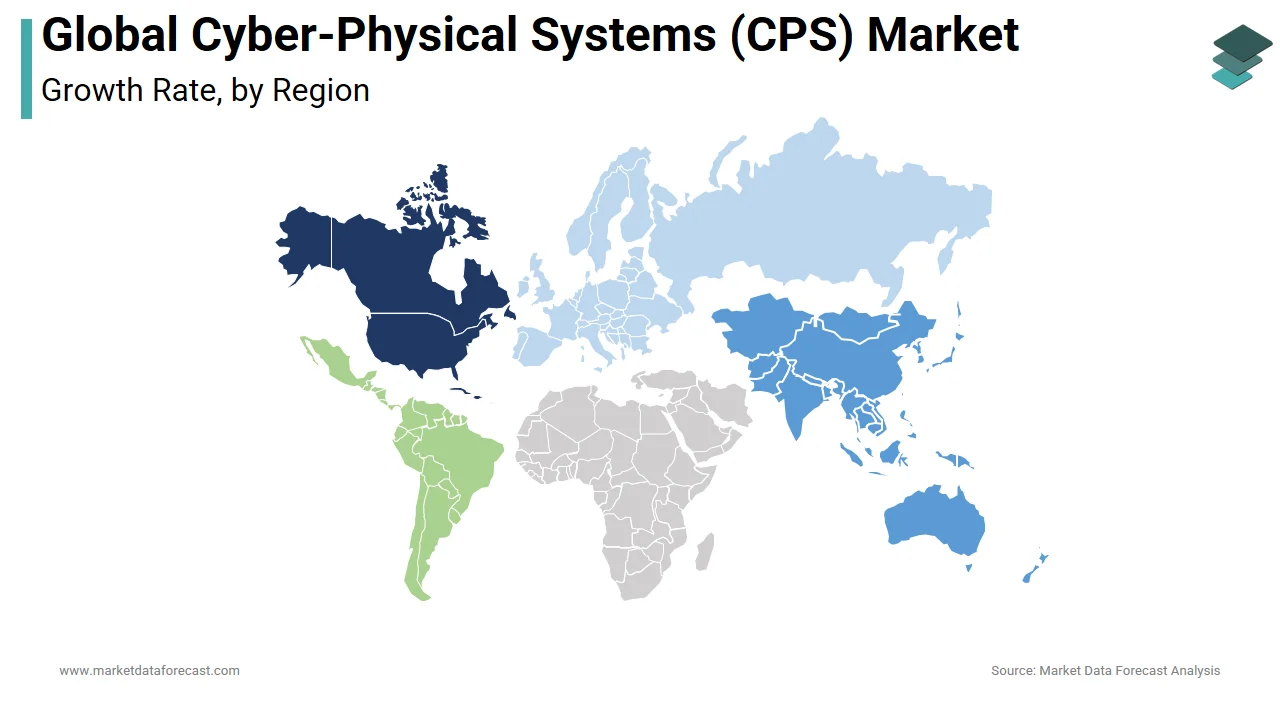
North American region dominated the market during the forecast period, due to its increasing innovations in the cyber-physical systems market. The increasing number of key players in the U.S encourages regional growth in the market. The developed nations are leading the market, such as U.S and Canada, due to the increasing number of applications such as in healthcare, smart grids, industry 4.0 revolution, and other industries. U.S nation witness developed infrastructure for the automation, transport sector, and healthcare. Increasing advancement in technology in developed countries, such as IoT and AI, was propelling the market growth in North America.Europe was holding the secondary dominant share in Germany's cyber-physical systems market value. The demand for cyber-physical systems in the German market was high due to the developing infrastructure for energy and utility, manufacturing, and automotive sectors. According to the Federal Ministry of Economics and Technology, the German Government heavily invested in Industry 4.0 applications and advanced technologies in various sectors will boost the market growth in the forecast period in Germany.Asia-Pacific is projected to register prominent growth in the forecast period as China holds the world's largest economy due to low-cost labor and raw materials. Robust infrastructure, a high consumer base, and a wide range of manufacturing sectors boost market demand in the upcoming years.
KEY MARKET PLAYERS
IBM Corporation, Microsoft Corporation, Dell EMC, Honeywell International Inc., Hitachi Vantara, Hewlett Packard Enterprise, Schneider Electric, SAP SE, Oracle, and VMware Inc.
RECENT MARKET HAPPENINGS
-
In July 2022, the U.S.-based National Institute of Standards and Technology (NIST) developed encryption tools that protect against attacks by quantum computers. Quantum computers break the privacy protection security in digital systems we use daily, such as online shopping and social media. The selected encryption algorithms will become part of NIST's quantum cryptographic standard, which is yet to be finalized.
-
In September 2021, IIT Guwahati introduced a center for cyber-physical systems aimed at creating innovative technologies. According to the reports, the Indian Government was developing nearly five technologies yearly; this move will help boost India's cyber-physical systems market demand.
MARKET SEGMENTATION
This research report on the global cyber-physical systems market has been segmented and sub-segmented based on the component, application, and region.
By Component
- Cyber-Physical System Software
- Cyber-Physical System Hardware
- Cyber-Physical System Services
By Application
- Healthcare
- Aerospace & Defence
- Energy & Utility
- Consumer Electronics
- Automotive
- Manufacturing
By Region
- North America
- Europe
- Asia-Pacific
- Latin America
- Middle East and Africa