- Product Description Description
- Table of Contents TOC
- List of Table & Figure LOT
- Get Free Sample PDF Sample PDF
Market Size, 2025
$648.80 BnMarket Estimate, 2026
$678.58 BnMarket Forecast, 2034
$971.68 BnCAGR, 2026–2034
4.59%Global Dairy Market Size, Growth, Trends & Forecast (2026–2034)
The Global Dairy Market size was calculated to be USD 648.80 billion in 2025, is estimated to reach USD 678.58 billion in 2026, and is projected to expand to USD 971.68 billion by 2034, registering a compound annual growth rate (CAGR) of 4.59% during the forecast period from 2026 to 2034. Driven by surging demand for protein-rich diets in emerging economies, expanding urban retail and cold-chain infrastructure, and continuous product innovation in functional dairy, the market continues to expand across diverse regions.
Key Executive Metrics (At-a-Glance)
- 2025 Base Valuation: USD 648.80 Billion
- 2026 Current Valuation: USD 678.58 Billion
- 2034 Forecast Valuation: USD 971.68 Billion
- Compound Annual Growth Rate (CAGR): 4.59% (2026–2034)
- Leading Region: Europe (holding a dominant 31.3% share in 2025 backed by deep dairy traditions and advanced production systems)
- Key Growth Hubs: Asia-Pacific (led by India and China) and North America (focusing on high-protein and functional variations)
Core Market Drivers
- Protein-Rich Diets: Growing emphasis on high-protein nutrition and school feeding programs in developing and emerging economies.
- Retail & Cold-Chain Expansion: Proliferation of modern supermarkets, hypermarkets, and e-grocery networks improving perishable dairy availability.
Primary Market Restraints & Challenges
- Lactose Intolerance & Dietary Shifts: High global prevalence of lactose intolerance prompting consumers to pivot toward plant-based alternatives.
- Environmental Impact & Input Costs: Methane emissions from livestock, stringent regulatory climate constraints, and persistent price volatility in feed and energy.
Market Segmentation: Largest and Fastest-Growing Segments
| Segment Category | Largest Segment | Fastest-Growing Segment |
|---|---|---|
| By Category | Milk (35.7% share in 2025) | Yogurt (CAGR of 7.4%) |
| By Distribution Channel | Off-Trade (Dominant market share in 2025) | On-Trade (CAGR of 6.9%) |
| By Region | Europe (31.3% share in 2025) | Asia-Pacific |
Major Industry Players Profiled
Key market participants shaping the global dairy landscape include Nestlé S.A., Danone S.A., Arla Foods amba, FrieslandCampina, Fonterra Co-operative Group Limited, Lactalis Group, Saputo Inc., Dean Foods, Amul (GCMMF), Dairy Farmers of America Inc., Yili Group, Mengniu Dairy, and Parmalat S.p.A..
Global Dairy Market Size
The global dairy market size was calculated to be USD 648.80 billion in 2025 and is anticipated to be worth USD 971.68 billion by 2034, from USD 678.58 billion In 2026, growing at a CAGR of 4.59% during the forecast period.
Dairy is milk and milk-derived products such as cheese, yogurt, butter, and powdered milk, which serve as a fundamental component of global nutrition. As per the Food and Agriculture Organization (FAO) of the United Nations, more than 80% of the world's population consumes dairy, with per capita availability varying significantly by region. Also, worldwide milk production surged to 965.7 million metric tons. India remains the largest milk producer, contributing a portion of total global output, according to a study. The market plays an important role in rural livelihoods, supporting millions of smallholder dairy farmers globally, as research. Increasing urbanization, rising incomes, and government nutrition programs continue to shape consumption patterns.
MARKET DRIVERS
Rising Demand for Protein-Rich Diets in Emerging Economies
The growing emphasis on high-protein nutrition in developing nations has increased dairy consumption is driving the growth of dairy market. According to the study, protein-energy malnutrition affects millions of children under five globally. In India, the milk-related campaign Operation Flood contributed to a significant increase in per capita milk availability. In sub-Saharan Africa, school milk programs in Kenya and Nigeria have expanded access, with Kenya distributing significant liters of fortified milk to primary schools, as per the research. The integration of milk into breakfast routines and fortified weaning foods has further embedded dairy into daily nutrition, particularly among youth and expectant mothers.
Expansion of Urban Retail Infrastructure and Cold-Chain Accessibility
The proliferation of modern retail formats and refrigerated distribution networks has significantly enhanced dairy product availability in urban and semi-urban areas. According to the International Dairy Federation (IDF), a notable portion of milk sold in China now passes through supermarkets and e-grocery platforms, a shift from traditional wet markets. In Southeast Asia, countries like Indonesia and the Philippines have witnessed an annual growth in cold-chain capacity since 2020, enabling the sale of perishable items such as fresh cheese and probiotic yogurt, as per the study. In India, the expansion of organized retail chains like Reliance Fresh and BigBasket has increased shelf space for branded dairy products, including flavoured milk and lactose-free variants.
MARKET RESTRAINTS
Increasing Prevalence of Lactose Intolerance and Dietary Avoidance
The rising prevalence is lactose intolerance is hampering the growth of dairy market.
Lactose intolerance affects a significant portion of the global population by limiting dairy consumption. According to the U.S. National Institutes of Health (NIH), up to 68% of the world’s population has a reduced ability to digest lactose after infancy, with prevalence exceeding 90% in East Asian populations. In China, millions of adults avoid dairy due to digestive discomfort, as per research. Similarly, in South Korea, only limited percentage of adults consume milk regularly, largely due to genetic lactase deficiency. This biological constraint has fueled the rise of plant-based alternatives, with almond, soy, and oat milk capturing a portion of the total milk market in urban centers.
Environmental Impact and Methane Emissions from Livestock
The increasing concern over the environmental impact and methane emissions from livestock is restricting the growth of dairy market. A single lactating cow emits between 250 and 500 liters of methane daily, a gas with 28 times the global warming potential of CO₂ over a 100-year period, as stated by the U.S. Environmental Protection Agency (EPA). In New Zealand, agriculture contributes 50%of national emissions, primarily from dairy farming, according to the study. These environmental burdens are driving regulatory restrictions, consumer backlash, and investor divestment by compelling dairy producers to adopt costly mitigation strategies such as feed additives and manure management systems.
MARKET OPPORTUNITIES
Fortification of Dairy Products to Address Micronutrient Deficiencies
The use of dairy products to address micronutrient deficiencies is providing an opportunity for the expansion of dairy market. As per the World Health Organization (WHO), over 2 billion people globally suffer from iron, vitamin A, and iodine deficiencies, conditions that can be mitigated through food fortification. In India, the Food Safety and Standards Authority (FSSAI) mandates the fortification of milk with vitamin A and D, reaching over 300 million consumers through public distribution and school feeding programs. In Latin America, government-backed programs in Brazil and Mexico distribute fortified milk to low-income families.
Growth of Functional and Probiotic Dairy Products
The surging demand for gut health and immune-boosting foods provides is additionally expanding the growth of dairy market. In Japan, the Foods for Specified Health Use (FOSHU) program has approved many probiotic dairy products, with significant annual sales. In the U.S., sales of Greek yogurt and kefir grew in 2023, driven by fitness-conscious consumers, according to the International Dairy Foods Association (IDFA). Companies like Danone and Yakult have invested heavily in strain-specific formulations, linking particular probiotics to digestive and immune benefits. This science-backed differentiation enables premium pricing and brand loyalty by transforming dairy from a commodity into a health-integrated food category.
MARKET CHALLENGES
Price Volatility and Input Cost Fluctuations in Milk Production
The dairy farmers face persistent instability due to fluctuations in feed, energy, and labor costs, which is restricting the growth of dairy market. It directly affects the pricing and supply consistency of mrket. According to the U.S. Department of Agriculture (USDA), the cost of dairy feed primarily corn and soy increased in 2022 due to global grain market disruptions, squeezing farm margins. In the European Union, energy prices surged in 2023, impacting refrigeration and processing costs, as per study. In New Zealand, a major export hub, the Fonterra Cooperative Group revised its milk payout forecast three times in 2023 due to volatile global demand and freight rates. These instabilities discourage long-term investment, particularly among smallholders, and lead to supply shortages during downturns.
Antimicrobial Resistance and Animal Health Management in Intensive Farming
The use of antibiotics in dairy farming to prevent mastitis and other infections has raised concerns about antimicrobial resistance (AMR), which challenges the growth of dairy market. According to the World Organisation for Animal Health (WOAH), a notable share of antibiotics sold globally are used in livestock, with dairy farms contributing significantly in intensive systems. In India, a 2023 study found resistant strains of Staphylococcus aureus in a portion of milk samples from urban dairies. The European Medicines Agency (EMA) reported that a portion of bovine isolates in the EU showed resistance to third-generation cephalosporins in 2023. Regulatory bodies are now imposing stricter limits on antibiotic use which requires withdrawal periods and residue testing. Compliance increases operational complexity and costs, particularly for small-scale producers lacking veterinary oversight.
REPORT COVERAGE
| REPORT METRIC | DETAILS |
| Market Size Available | 2025 to 2034 |
| Base Year | 2025 |
| Forecast Period | 2026 to 2034 |
| CAGR | 4.59% |
| Segments Covered | By Category, Distribution Channel, and Region |
| Various Analyses Covered | Global, Regional & Country Level Analysis; Segment-Level Analysis; DROC, PESTLE Analysis; Porter’s Five Forces Analysis; Competitive Landscape; Analyst Overview of Investment Opportunities |
| Regions Covered | North America, Europe, APAC, Latin America, Middle East & Africa |
| Market Leaders Profiled | Nestlé S.A., Danone S.A., Arla Foods amba, FrieslandCampina, Fonterra Co-operative Group Limited, Lactalis Group, Saputo Inc., Dean Foods, Amul (GCMMF), Dairy Farmers of America Inc., Yili Group, Mengniu Dairy, Parmalat S.p.A. |
SEGMENTAL ANALYSIS
By Category Insights
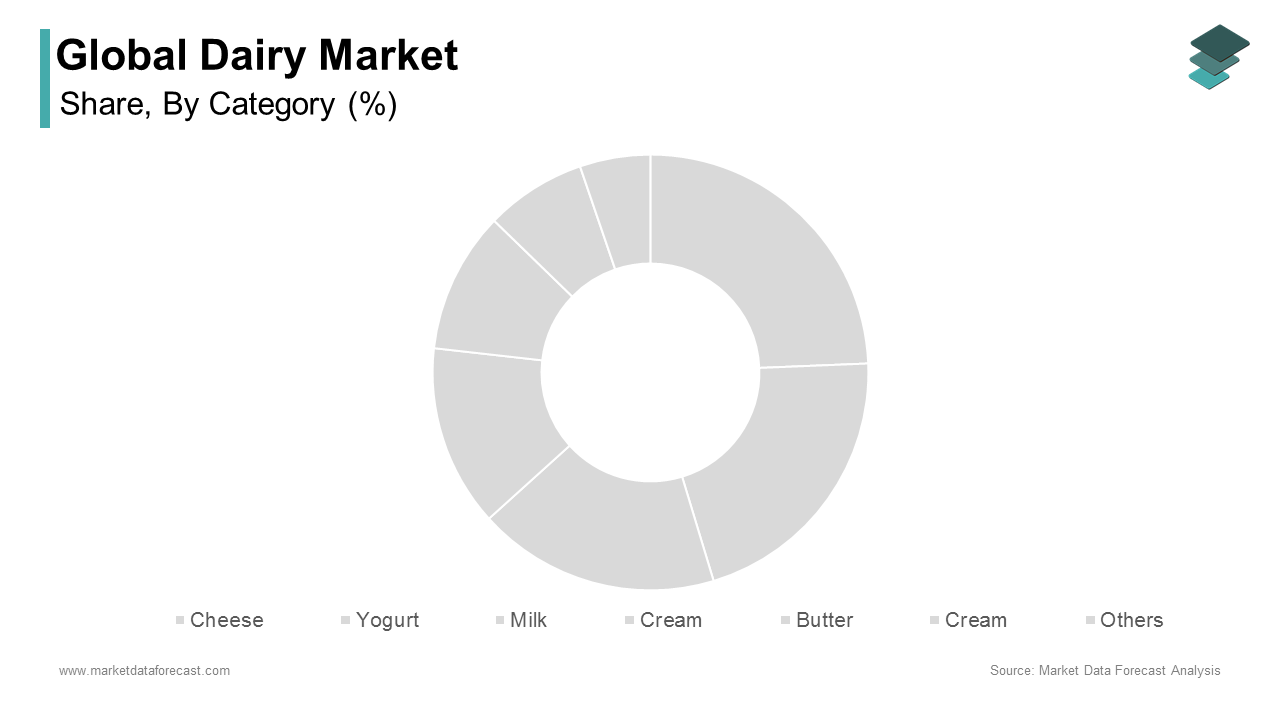
The Milk segment dominated the dairy market by capturing 35.7% of the global market share in 2025. The growth of the milk segment is driven by its role as a foundational dietary staple across diverse cultures and age groups. In India, the world’s largest milk producer, per capita availability reached 459 grams per day in FT 2022-23, with a significant percentage of households consuming milk daily, according to the research. The integration of milk into government nutrition programs further entrenches its consumption. Apart from these, urbanization and rising incomes in Africa and Southeast Asia have increased demand for packaged and fortified milk. Pasteurized and UHT milk now dominate retail shelves by ensuring longer shelf life and broader distribution, particularly in regions with limited refrigeration infrastructure.
The Yogurt segment is predicted to witness the highest CAGR of 7.4% from 2023 to 2030. The growth of the yogurt segment can be attributed to the increasing consumer awareness of gut health and the functional benefits of probiotics. In Japan, a notable share of adults consume yogurt daily, with significant sales of probiotic-enriched variants annually, as per study. In the U.S., Greek yogurt accounts for a portion of all yogurt sales, driven by its high protein content and appeal to fitness-oriented consumers, according to the International Dairy Foods Association (IDFA). Innovations in plant-based and low-sugar formulations are further broadening its demographic reach by positioning yogurt as a dynamic growth engine in the global dairy market.
By Distribution Channel Insights
The Off-Trade segment led the dairy market by capturing a significant share in 2025. The growth of the off-trade segment is driven by the habitual, at-home consumption of dairy products such as milk, yogurt, butter, and cheese, which are primarily purchased through supermarkets, hypermarkets, and e-grocery platforms. In China, off-trade dairy sales grew in 2023, with online grocery platforms like Alibaba’s Freshippo and JD.com accounting for a portion of packaged milk and yogurt transactions, according to research. In Europe, self-service retail channels distribute a notable share of fresh dairy, supported by efficient cold-chain logistics. Apart from these, private-label dairy products in off-trade outlets have gained traction by offering cost-effective alternatives without compromising quality. The convenience of bulk purchasing, home delivery, and promotional bundling further strengthens consumer preference for off-trade. This makes it the primary conduit for dairy consumption worldwide.
The On-Trade segment is estimated to register the fastest CAGR of 6.9% over the forecast period owing to the rising popularity of dairy-integrated culinary experiences, particularly in urban centers. In the U.S., a significant share of cheese consumption occurs in restaurants, with pizza, grilled cheese, and gourmet cheese boards driving demand, as per study. Coffee culture has notably boosted on-trade dairy use. Like, the global business of specialty coffee expanded considerably in 2023, consumes large metric tons of milk annually, according to the International Coffee Organization. In India, cafes and quick-service chains are incorporating paneer, lassi, and milk-based desserts into menus, attracting younger demographics.
REGIONAL ANALYSIS
Europe Dairy Market Insights
Europe was the top performer in the dairy market with 31.3% of share in 2025. The domination of Europe in the global market is primarily driven by the deep-rooted dairy traditions, high per capita consumption, and advanced production systems. In Germany, the average citizen consumes 46 liters of milk and 23.8 kilograms of cheese annually, according to Germany’s Federal Ministry of Food and Agriculture. France produces approximately 1.9 million metric tons of cheese each year, including 46 protected designation of origin (PDO) varieties, as per the study. The EU’s Common Agricultural Policy (CAP) supports millions of dairy farmers, ensuring supply stability. Apart from these, sustainability initiatives such as carbon-neutral dairies in Denmark and Sweden are setting global benchmarks.
North America Dairy Market Insights
North America dairy market was ranked second by capturing 25.4% of the global share in 2025. The United States serving as the dominant force in production and consumption. The U.S. produces over 100 billion pounds of milk each year, primarily from large-scale operations in California, Wisconsin, and Idaho. Cheese is the fastest-growing dairy category, with mozzarella and cheddar demand driven by pizza chains and processed foods. The National Dairy Council reports that over 80% of American households purchase yogurt. Innovation in lactose-free, high-protein, and organic dairy has helped maintain relevance. Canada complements the regional market with strong domestic cooperatives like Agropur and Saputo, emphasizing quality and export readiness.
Asia Pacific Dairy Market Insights
Asia Pacific is expected to be the most lucrative region in the global dairy market. Factors such as urbanization, rising incomes, and changing dietary habits are majorly propelling the dairy market growth in Asia Pacific. India, the world’s largest milk producer, contributes over 23% of global output, with milk consumption deeply embedded in cultural and religious practices. The country’s cooperative model, led by Amul, reaches millions of farmers, as per study. Meanwhile, Southeast Asian nations like Indonesia and Vietnam are witnessing a surge in flavored milk and dairy-based beverages which is supported by modern retail expansion and Western culinary influence.
Latin America Dairy Market Insights
Latin America grew steadily in the global dairy market, with Brazil and Argentina serving as key production and consumption hubs. Brazil produces over 35 billion liters of milk annually, with 60% processed into cheese, particularly Minas and Parmesan-style varieties, as reported by the Brazilian Institute of Geography and Statistics (IBGE). Argentina’s per capita dairy consumption is strong, one of the highest in the region, supported by strong domestic cattle ranching. Moreover, the rise of coffee shop culture in Colombia and Mexico has increased demand for milk in lattes and cappuccinos, boosting on-trade sales. However, cold-chain limitations in rural areas restrict access to perishable dairy. Government nutrition programs and expanding supermarket penetration are driving steady growth, particularly in urban centers across the Andean and Southern Cone regions, despite challenges.
Middle East and Africa Dairy Market Insights
Middle East & Africa is likely to grow in the global dairy market, with North Africa and the Gulf Cooperation Council (GCC) nations leading in structured consumption. In Saudi Arabia, per capita annual dairy consumption is significant, with government investments in large-scale dairy farms like Almarai producing millions of liters daily. Egypt relies heavily on imports, bringing in metric tons of milk powder annually to meet domestic demand, as stated by the Egyptian Ministry of Supply. In sub-Saharan Africa, Kenya and South Africa have developed formal dairy sectors, with Kenya producing notable liters of milk in 2023, according to the Kenya Dairy Board. However, informal markets dominate, with a significant share of milk traded through unregulated channels. Rising urbanization and youth-driven demand for yogurt and flavored milk are creating opportunities for formalization and modernization across the region.
LEADING PLAYERS IN THE DAIRY MARKET
Nestlé S.A.
Nestlé plays a transformative role in the Asia Pacific dairy market by integrating nutrition science with mass-scale production and distribution. The company offers a wide portfolio of dairy products, including fortified milk, infant formula, yogurt, and coffee creamers, tailored to regional tastes and dietary needs. It has expanded its chilled dairy network in India and Vietnam, investing in cold-chain infrastructure to ensure product integrity. The company also partners with smallholder farmers to improve milk quality and traceability through its Nestlé Cocoa Plan model, adapted for dairy sourcing. Its focus on fortified, science-backed formulations positions it as a leader in functional dairy across the region.
Fonterra Co-operative Group
Fonterra, headquartered in New Zealand, is a pivotal supplier of dairy ingredients and branded products across Asia Pacific, leveraging its high-quality pasture-based milk supply. The company exports over 95% of its production, with China, Southeast Asia, and the Middle East as key destinations for its whole milk powder, cheese, and butter. It strengthened partnerships with foodservice providers in Thailand and Malaysia, supplying mozzarella for pizza chains. The company’s investment in carbon footprint reduction and sustainable farming practices enhances its credibility with environmentally conscious Asian consumers and retailers demanding ethical sourcing.
Amul (Gujarat Cooperative Milk Marketing Federation)
Amul is a cornerstone of India’s organized dairy sector and a dominant force in South Asia’s consumer dairy landscape. Amul’s product range includes pasteurized milk, butter, cheese, yogurt, and flavored milk, widely available through its large number of retail outlets. It also expanded its e-commerce presence via partnerships with BigBasket and Swiggy Instamart. Amul’s iconic branding and price competitiveness have made it a household name, while its R&D center in Anand drives innovation in shelf-stable and functional dairy products with its position in one of the world’s fastest-growing dairy market.
TOP STRATEGIES USED BY KEY MARKET PARTICIPANTS
Key players in the dairy market are deploying integrated strategies to maintain competitiveness amid evolving consumer preferences and supply chain complexities. Vertical integration is widely adopted, with companies securing milk supply through farmer cooperatives or direct contracts to ensure quality and traceability. Product innovation focuses on functional benefits, including probiotics, high protein, lactose-free formulations, and fortified micronutrients to align with health trends. Sustainability initiatives, such as methane reduction, water conservation, and carbon-neutral dairies, are becoming central to brand positioning. Expansion into emerging markets is pursued through localized product development and joint ventures. Digital transformation enhances distribution, with AI-driven demand forecasting and e-commerce integration improving efficiency.
KEY MARKET PLAYERS AND COMPETITION OVERVIEW
Major Players of the global dairy market include Nestlé S.A., Danone S.A., Arla Foods amba, FrieslandCampina, Fonterra Co-operative Group Limited, Lactalis Group, Saputo Inc., Dean Foods, Amul (GCMMF), Dairy Farmers of America Inc., Yili Group, Mengniu Dairy, and Parmalat S.p.A.
Competition in the dairy market is intensifying as multinational corporations, regional cooperatives, and private-label brands vie for consumer loyalty across diverse geographies. Incumbents face push from plant-based alternatives, yet dairy maintains strong cultural and nutritional relevance, particularly in developing economies. Differentiation is achieved through product functionality, brand trust, and supply chain transparency. In Asia Pacific, local players dominate fresh and traditional dairy, while global firms lead in processed and fortified segments. Price sensitivity remains high in rural markets, whereas urban consumers prioritize quality, convenience, and health claims. Regulatory standards for labeling, fortification, and animal welfare are shaping competitive boundaries.
RECENT HAPPENINGS IN THE MARKET
- In June 2023, Amul introduced lactose-free milk in major Indian cities, utilizing enzymatic hydrolysis technology to cater to digestive-sensitive consumers and expand its health-focused product range.
MARKET SEGMENTATION
This research report on the global dairy market has been segmented and sub-segmented based on category, distribution channel and region.
By Category
- Cheese
- Yogurt
- Milk
- Cream
- Butter
- Cream
- Others
By Distribution Channel
- Off-Trade
- On-Trade
By Region
- North America
- Europe
- Asia-Pacific
- Latin America
- Middle East and Africa