- Product Description Description
- Table of Contents TOC
- List of Table & Figure LOT
- Get Free Sample PDF Sample PDF
Market Size, 2025
$31.15 BnMarket Estimate, 2026
$32.97 BnMarket Forecast, 2034
$51.92 BnCAGR, 2026–2034
5.84%Global Dates Market Size, Growth, Trends & Forecast (2026–2034)
The Global Dates Market size was calculated to be USD 31.15 billion in 2025, is estimated to reach USD 32.97 billion in 2026, and is projected to expand to USD 51.92 billion by 2034, registering a compound annual growth rate (CAGR) of 5.84% during the forecast period from 2026 to 2034. Driven by increasing demand for natural sweeteners, clean-label functional foods, and traditional festive consumption spikes, the market is witnessing robust global diversification.
Key Executive Metrics (At-a-Glance)
- 2025 Base Valuation: USD 31.15 Billion
- 2026 Current Valuation: USD 32.97 Billion
- 2034 Forecast Valuation: USD 51.92 Billion
- Compound Annual Growth Rate (CAGR): 5.84% (2026–2034)
- Leading Region: Middle East & Africa (holding a dominant 52.6% share as the primary cultivation and export hub)
- Key Growth Hubs: Asia Pacific and North America (accelerating via e-commerce and health-focused snack adoption)
Core Market Drivers
- Natural Sweeteners Demand: Rising preference for low-glycemic, nutrient-dense date syrups, pastes, and whole fruits in clean-label food manufacturing.
- Cultural & Festive Significance: Predictable annual surges in consumption across global Muslim communities during Ramadan and iftar traditions.
Primary Market Restraints & Challenges
- Post-Harvest Losses: Inadequate drying, microbial spoilage, and poor cold-chain logistics in traditional regions diminishing export volumes.
- Climate Vulnerability: Extreme heat, water scarcity in major basins, and invasive pests like the red palm weevil threatening long-term crop yields.
Market Segmentation: Largest and Fastest-Growing Segments
| Segment Category | Largest Segment | Fastest-Growing Segment |
|---|---|---|
| By Nature | Conventional (Dominant share by volume in 2025) | Organic Dates (CAGR of 10.7% from 2025–2031) |
| By Type | Deglet Noor (45.5% of global exports in 2025) | Medjool (CAGR of 9.4% from 2026–2034) |
| By Distribution Channel | Supermarkets / Hypermarkets (Leading retail channel) | Online Stores (CAGR of 12.9% from 2026–2034) |
| By Region | Middle East & Africa (52.6% share) | Asia Pacific & Latin America |
Major Industry Players Profiled
Key market participants shaping the global dates industry include Al Foah, Al Barakah Dates Factory, Atul Rajasthan Date Palm Ltd, Hadiklaim Date Growers, Maghadi Dates, Natural Delights, Desert Valley Dates, Al Mohamadia Dates, Al Qassim Dates Factory, Ario Date Company, Emirates Dates, Haifa Dates, Lion Dates Impex Pvt Ltd, Nakheel Alya, and Saudi Dates.
Global Dates Market Size
The global dates market size was calculated to be USD 31.15 billion in 2025 and is anticipated to be worth USD 51.92 billion by 2034 from USD 32.97 billion In 2026, growing at a CAGR of 5.84% during the forecast period.
The dates market covers the cultivation, processing, and global trade of Phoenix dactylifera fruit, a nutrient-dense, naturally sweet drupe that has served as a dietary staple in arid regions. According to UNESCO, the traditional oasis agroecosystem, integral to date farming in regions like Tunisia, Iran, and Saudi Arabia, supports biodiversity and water conservation in hyper-arid climates. The World Health Organization recognizes dates as a rich source of dietary fiber, potassium, and antioxidants. With rising interest in natural sweeteners and functional foods, the role of dates is expanding beyond traditional consumption into health-focused and industrial applications, reshaping their global significance.
MARKET DRIVERS
Increasing Demand for Natural Sweeteners in Health-Conscious Diets
The shift toward clean-label and sugar-reduced food products has elevated dates as a preferred natural sweetener in functional foods and beverages. Global demand for natural sweeteners grew, with dates increasingly replacing refined sugar in energy bars, dairy alternatives, and baked goods. Like, date syrup are a low-glycemic index sweetener (GI ~42–55), making it suitable for certain type of diets. In the United States, many of new plant-based product launches in 2023 included date-derived ingredients. Additionally, a clinical study published in Nutrition Journal found that daily consumption of Medjool dates improved bowel regularity in 96% of participants due to high fiber content (6.7 g per 100 g). These health attributes are driving integration into wellness-oriented product formulations worldwide.
Cultural and Religious Significance During Ramadan and Festive Seasons
The ritual consumption of dates during Ramadan significantly amplifies seasonal demand across Muslim-majority nations and diaspora communities. Like, large number of Muslims globally observe Ramadan, with the tradition of breaking fast (iftar) with dates creating a predictable annual spike in consumption. Also, Gulf Cooperation Council countries import significant metric tons of dates annually in the months preceding Ramadan, with per capita consumption increasing during the holy month. In Indonesia, which has a large Muslim population, it distributed date packs for iftar programs. Supermarkets report date sales surging in the weeks before Ramadan. This deep-rooted cultural practice ensures consistent, high-volume demand, anchoring the market’s stability and predictability.
MARKET RESTRAINTS
Post-Harvest Losses Due to Improper Drying and Storage Conditions
A significant portion of date production is lost after harvest due to inadequate drying, pest infestation, and microbial spoilage. Like, post-harvest losses in dates are high in major producing countries such as Iraq, Pakistan, and Sudan. In rural Iran, as per the Agricultural Research, Education and Extension Organization, traditional sun-drying methods expose dates to dust, insects, and rain, leading to mold growth and aflatoxin contamination. The International Centre for Advanced Mediterranean Agronomic Studies found that improper storage in humid environments increases moisture content beyond 15%, triggering fermentation and reducing shelf life. Additionally, lack of cold chain infrastructure in North African exporters results in quality degradation during transit. These inefficiencies diminish export potential, compromise food safety, and reduce farmer profitability, constraining market scalability.
Limited Mechanization in Harvesting and Processing
The labor-intensive nature of date farming, particularly harvesting and quality sorting, hampers productivity and increases operational costs. For instance, most of date palm harvesting in Egypt, Saudi Arabia, and Algeria is performed manually, often at some heights, posing safety risks and limiting scalability. According to studies, harvesting alone accounts a notable share of total production costs in traditional farms. In Morocco, a single skilled climber can harvest only limited number of trees per day, insufficient for large plantations. Mechanized harvesters remain underdeveloped due to the fragility of fruit clusters and tree structure, with only some of farms in the UAE adopting semi-automated systems. This reliance on manual labor restricts yield optimization and impedes cost-competitive production in global markets.
MARKET OPPORTUNITIES
Expansion of Date-Based Ingredients in Food Manufacturing
The growing use of date paste, syrup, and powder as natural sweeteners and binders in processed foods presents a high-growth opportunity. Like, the number of global food and beverage products featuring dates as an ingredient increased between 2021 and 2023, particularly in energy bars, plant-based meats, and organic confectionery. The American Bakers Association showcases that date paste improves moisture retention and shelf life in gluten-free products, reducing the need for synthetic additives. Additionally, startups in California and the UAE are commercializing date-derived caramel and flavor enhancers, expanding applications beyond sweetness. As clean-label trends accelerate, the industrial transformation of dates into value-added ingredients is unlocking new revenue streams and reducing dependency on raw fruit exports.
Development of Organic and Geographical Indication (GI)-Labeled Date Varieties
The premiumization of dates through organic certification and geographical branding is creating high-margin market segments. Also, global sales of organic dried fruits, including dates, surged significantly, with Europe and North America as major markets. In Tunisia, the National Institute of Origin and Quality has granted GI status to Deglet Nour dates from Tozeur, enabling price premiums in export markets. Saudi Arabia’s Ministry of Environment, Water and Agriculture has certified hectares of date farms under its National Organic Program, targeting exports to Japan and South Korea. These initiatives enhance traceability, support farmer incomes, and position dates as premium, differentiated commodities in competitive global markets.
MARKET CHALLENGES
Climate Vulnerability of Date Palm Cultivation in Arid Zones
Despite their drought tolerance, date palms are increasingly threatened by extreme climatic shifts, including rising temperatures, water scarcity, and sandstorms. Like the Middle East has warmed faster than the global average since 1980, affecting fruit development and yield stability. Also, sustained temperatures above 48°C during pollination reduce fruit set in local varieties. In Iraq, the Ministry of Water Resources indicates that reduced Tigris and Euphrates flow has forced a decline in irrigated date farms since 2010. Additionally, prolonged droughts have led to widespread palm mortality. These environmental stressors are undermining long-term production sustainability, particularly in regions already facing water stress and soil salinization.
Pests and Diseases Threatening Date Palm Productivity
Date palm cultivation is increasingly vulnerable to invasive pests and pathogens that compromise yield and quality. The red palm weevil (Rhynchophorus ferrugineus) infests large number of palm trees annually. In Egypt, weevil damage results in significant annual losses. Additionally, Bayoud disease, a fungal infection, has wiped out a portion of date palms in Morocco and Algeria. Early detection remains difficult due to internal larval feeding, and chemical treatments are often ineffective or environmentally harmful. The International Center for Biosaline Agriculture is developing pheromone traps and biocontrol agents, but adoption remains limited. Without scalable, eco-friendly pest management, crop losses threaten both smallholder livelihoods and export supply chains.
REPORT COVERAGE
| REPORT METRIC | DETAILS |
| Market Size Available | 2025 to 2034 |
| Base Year | 2025 |
| Forecast Period | 2026 to 2034 |
| CAGR | 5.84% |
| Segments Covered | By Nature, Type, Distribution Channel and Region |
| Various Analyses Covered | Global, Regional & Country Level Analysis; Segment-Level Analysis; DROC, PESTLE Analysis; Porter’s Five Forces Analysis; Competitive Landscape; Analyst Overview of Investment Opportunities |
| Regions Covered | North America, Europe, APAC, Latin America, Middle East & Africa |
| Market Leaders Profiled | Al Foah, Al Barakah Dates Factory, Atul Rajasthan Date Palm Ltd, Hadiklaim Date Growers, Maghadi Dates, Natural Delights, Desert Valley Dates, Al Mohamadia Dates, Al Qassim Dates Factory, Ario Date Company, Emirates Dates, Haifa Dates, Lion Dates Impex Pvt Ltd, Nakheel Alya, Saudi Dates |
SEGMENTAL ANALYSIS
By Nature Insights
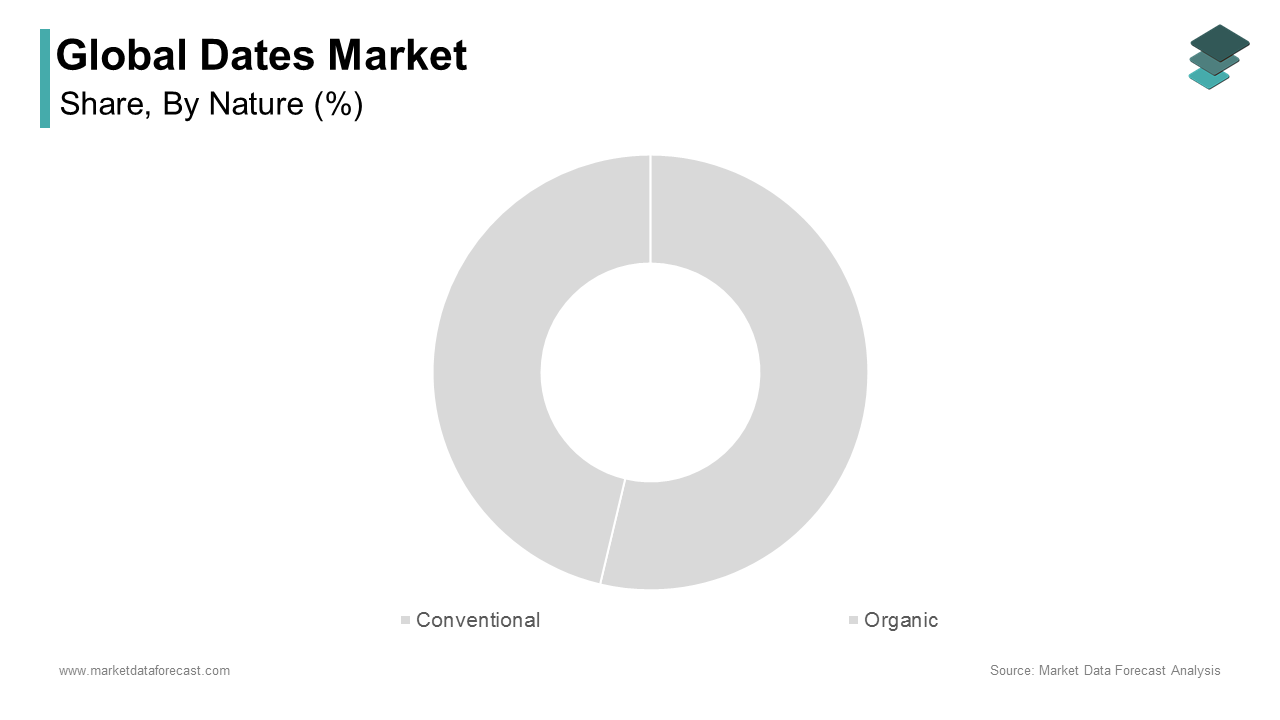
The conventional dates segment dominated the global market by volume in 2025. This dominance is primarily sustained by large-scale production in traditional growing regions such as Egypt, Saudi Arabia, and Iran, where irrigation infrastructure and established farming practices favor high-yield, non-certified cultivation. Like, Egypt is a top producer of dates and conventional methods prevail, benefiting from government-supported inputs and export logistics. In the United Arab Emirates, conventional farms account for a notable share of cultivated date palms. Additionally, the affordability and consistent availability of conventional dates make them the preferred choice for bulk retail and industrial processing, particularly in food manufacturing and bakery sectors across Asia and Africa.
The organic dates segment is expanding at a CAGR of 10.7% from 2025 to 2031. It is driven by rising consumer demand for pesticide-free, sustainably produced food products. According to the study, global organic dried fruit sales surpassed surged in recent years. Also, organic date imports grew, particularly from Tunisia and Saudi Arabia, where desert farming conditions naturally limit chemical use. Moreover, certified organic dates command a price premium over conventional variants in natural food stores. Additionally, the Gulf Cooperation Council aims to certify some of date farms by 2030, enhancing export eligibility to premium markets in North America and Europe, where clean-label trends are reshaping purchasing behavior.
By Type Insights
The Deglet Noor segment constituted an estimated 45.5% of global date exports by volume in 2025. Native to Algeria, this semi-dry, light-colored variety is prized for its firm texture, long shelf life, and suitability for industrial processing and retail packaging. Tunisia, a key exporter of Deglet Noor, shipped significant metric tons in 2023. The variety’s low moisture content makes it ideal for milling into date powder and syrup, widely used in health foods and natural sweeteners. In the United States, Deglet Noor accounts for a notable share of domestic production. Its versatility, ease of pitting, and resistance to spoilage during transit have solidified its position as the most commercially viable date cultivar in international trade.
The Medjool segment is growing at a CAGR of 9.4% from 2026 to 2034 which is fueled by its premium positioning as the “king of dates” in gourmet, health, and luxury food markets. Like, Medjool exports by Israel surged. In the United States, some states have expanded Medjool cultivation, responding to strong demand. The American Heart Association recognizes Medjool dates as a heart-healthy snack due to high potassium and antioxidant content, reinforcing their appeal among wellness consumers. Besides, the rise of social media food culture has amplified visibility, with Medjool dates frequently featured in recipes for energy balls, plant-based desserts, and charcuterie boards, accelerating mainstream adoption.
By Distribution Channel Insights
The supermarkets and hypermarkets segment was the leading distribution channel in the market. This dominance is due to widespread consumer access, consistent product availability, and integration into mainstream grocery shopping routines. In the Gulf Cooperation Council countries, many date purchases occur in large retail chains, especially during Ramadan. In Europe, retailers like Tesco and E.Lecler stock multiple varieties across dedicated dried fruit aisles, often featuring promotional bundles. The U.S. Grocery Manufacturers Association shows that branded date packs from companies like Sunsweet and Al Foah achieve higher visibility and turnover in supermarket environments due to prime shelf placement and loyalty program inclusion. Additionally, private label offerings by major chains have increased affordability and consumer trial, reinforcing the channel’s centrality in both conventional and premium date distribution.
The online stores segment is expanding at a CAGR of 12.9% from 2026 to 2034 which is driven by digital adoption, e-commerce logistics improvements, and demand for specialty and organic date variants. According to the United Nations Conference on Trade and Development, online food sales in the Middle East and North Africa grew rapidly. In India, e-commerce companies reported an increase in premium date sales. Also, direct-to-consumer brands have leveraged Shopify and Instagram to reach health-conscious buyers, offering subscription models and recipe integration. Additionally, blockchain-enabled traceability and QR-coded origin verification on e-commerce platforms are enhancing consumer trust, accelerating the shift from physical to digital retail, especially in urban and diaspora markets.
REGIONAL ANALYSIS
Middle East & Africa Dates Market Insights
Middle East & Africa holds a 52.6% share of the global dates market and is serving as both the historical and contemporary epicenter of cultivation and cultural significance. Saudi Arabia, Egypt, and Iran collectively produce significant metric tons annually. The region’s arid climate and centuries-old oasis farming systems provide ideal conditions for high-quality date palm cultivation. The UAE’s Date Palm Genetic Resource Center has invested in tissue culture and high-yield cloning to modernize production. Additionally, governments are promoting value-added processing and export diversification, positioning the region not only as a supplier but also as an innovator in premium, functional, and organic date products for global markets.
Asia Pacific Dates Market Insights
Asia Pacific is experiencing rapid growth in consumption, particularly in India, China, and Southeast Asia. India imports substantial metric tons annually to meet rising demand from urban, health-conscious consumers. Also, some Indian households now include dates in daily diets for energy and iron supplementation, especially among pregnant women. In China, it recorded an increase in date imports, driven by popularity in functional snacks and traditional medicine. With e-commerce platforms like Alibaba and Flipkart boosting accessibility, and halal food markets expanding, Asia Pacific is emerging as a critical growth frontier for Middle Eastern exporters.
Europe Dates Market Insights
Europe is characterized by stable consumption and a strong preference for organic, GI-labeled, and specialty varieties. The region is a major market, with France, Germany, and the UK as top destinations. In Germany, a notable share of dates sold are organic or fair-trade certified, reflecting ethical consumption trends. UK also saw an annual growth in plant-based snack sales, with dates as a key ingredient. Additionally, the EU’s strict regulations on pesticide residues and aflatoxin levels have incentivized exporting countries to improve post-harvest handling. With high disposable income and wellness-driven diets, Europe remains a high-value market for premium date products.
North America Dates Market Insights
North America represents a niche but expanding consumer base in the market, with the United States leading in both domestic production and premium imports. California produces large metric tons annually, primarily Medjool and Deglet Noor. The U.S. Department of Health and Human Services recognizes dates as a nutrient-dense food, contributing to their inclusion in WIC and school nutrition programs. Also, dates are featured in some of new energy bar launches. E-commerce and subscription models are expanding reach beyond ethnic grocers, positioning dates as a mainstream functional food in health food stores and digital marketplaces.
Latin America Dates Market Insights
Latin America is an emerging region in the global dates market, with Brazil, Mexico, and Chile showing increasing interest due to dietary diversification and wellness trends. Date imports grew in the region, particularly in organic and pitted forms for use in vegan and gluten-free products. In Mexico, it promotes dates as a natural iron source to combat anemia, especially among women and children. Supermarkets are dedicating shelf space to imported dates, while local startups are developing date-based energy snacks. Though consumption remains low, rising urbanization, exposure to global food trends, and investment in halal infrastructure are laying the foundation for future market expansion.
LEADING PLAYERS IN THE DATES MARKET
Al Foah Company (UAE)
Al Foah, the world’s largest date producer and exporter, has significantly expanded its footprint in the Asia Pacific market through strategic partnerships and premium branding initiatives. Based in the UAE, the company operates over 14,000 hectares of date farms and leverages advanced irrigation and post-harvest technologies to ensure consistent quality. In 2023, Al Foah launched a dedicated export corridor to India and Southeast Asia, supplying Medjool and Deglet Noor varieties to premium supermarkets and e-commerce platforms like BigBasket and RedMart. The company also introduced vacuum-sealed, ready-to-eat packs tailored to urban consumers in Singapore and Australia, emphasizing convenience and hygiene. By collaborating with nutritionists in India to promote dates as a natural energy booster, Al Foah is reinforcing its presence beyond traditional retail and aligning with regional wellness trends, strengthening its position as a global leader in date innovation and distribution.
Ziyad Brothers Group (Saudi Arabia)
Ziyad Brothers Group has established a strong presence in the Asia Pacific region by positioning its dates as premium, health-focused products in high-income urban markets. The company has expanded distribution through partnerships with major retailers in Japan, South Korea, and Australia, including AEON, Lotte, and Woolworths, offering certified organic and pitted date variants. In 2022, Ziyad launched a halal-certified date bar line in collaboration with a Sydney-based health food brand, targeting fitness and plant-based consumers. The company also invested in cold-chain logistics to maintain freshness across long-haul shipments to Southeast Asia. Additionally, Ziyad participated in the Food & Hotel Asia 2023 exhibition to showcase its GI-labeled Ajwa and Sukkari dates, enhancing brand recognition. By aligning with clean-label and functional food trends, Ziyad is successfully transitioning from a traditional exporter to a lifestyle-oriented global brand.
Sunsweet Growers Inc. (USA)
Sunsweet, a leading global dried fruit cooperative, has strengthened its influence in the Asia Pacific dates market by leveraging its expertise in processing, branding, and health positioning. Although based in California, the company has expanded its reach in Japan, South Korea, and India by promoting dates as a natural sweetener and digestive health aid. In 2023, Sunsweet introduced single-serve, resealable date pouches in convenience stores across Tokyo and Seoul, catering to on-the-go consumers. The company also partnered with Indian wellness platforms like HealthKart to offer subscription-based deliveries of its pitted and organic dates. By funding clinical research on the fiber benefits of dates and publishing findings in nutrition journals, Sunsweet has built scientific credibility. Its investment in sustainable packaging and carbon footprint labeling further resonates with environmentally conscious consumers in Australia and New Zealand, reinforcing its premium positioning.
TOP STRATEGIES USED BY KEY MARKET PARTICIPANTS
Key players in the dates market are employing a mix of premium branding, value-added processing, and digital engagement to capture evolving consumer demand. Companies are investing in organic certification, geographical indication labeling, and blockchain traceability to enhance product authenticity and consumer trust. Expansion into functional food applications—such as date-based energy bars, syrups, and plant-based meat binders—is enabling diversification beyond raw fruit sales. Firms are strengthening e-commerce presence through direct-to-consumer models, subscription services, and social media marketing to target health-conscious urban demographics. Strategic partnerships with retailers, nutritionists, and wellness platforms are improving market penetration. Additionally, investments in post-harvest technology, cold-chain logistics, and sustainable packaging are improving shelf life and reducing waste, ensuring consistent quality across international supply chains.
KEY MARKET PLAYERS AND COMPETITION OVERVIEW
Major Players of the Dates Market include Al Foah, Al Barakah Dates Factory, Atul Rajasthan Date Palm Ltd, Hadiklaim Date Growers, Maghadi Dates, Natural Delights, Desert Valley Dates, Al Mohamadia Dates, Al Qassim Dates Factory, Ario Date Company, Emirates Dates, Haifa Dates, Lion Dates Impex Pvt Ltd, Nakheel Alya, Saudi Dates
The competitive landscape of the dates market is evolving from a commodity-driven trade to a brand- and value-centric ecosystem. While traditional producers in the Middle East dominate volume, private labels and health-focused brands from North America and Europe are capturing premium segments through innovation and marketing. Competition is intensifying as companies differentiate through organic certification, origin storytelling, and functional health claims. In Asia Pacific, local distributors and e-commerce platforms are gaining influence, reshaping distribution dynamics. Small-scale producers face challenges in meeting international quality standards, while larger players leverage vertical integration and R&D to secure supply and enhance product offerings. Long-term competitiveness hinges on the ability to balance traditional cultivation with modern branding, sustainability, and responsiveness to shifting dietary preferences in both mature and emerging markets.
RECENT HAPPENINGS IN THE MARKET
- In March 2025, Al Foah launched a blockchain-traceable date line for the Indian market, allowing consumers to scan QR codes and view farm origin, harvest date, and quality testing results, enhancing transparency and building trust in premium retail channels.
- In July 2023, Ziyad Brothers Group introduced a new line of ready-to-blend date powder in Malaysia and Indonesia, designed for smoothies and plant-based baking, targeting young urban consumers and fitness enthusiasts through influencer marketing campaigns.
- In January 2025, Sunsweet partnered with a leading Japanese supermarket chain, Ito Yokado, to introduce refrigerated date snack packs in 500 stores, combining freshness preservation with convenience to expand beyond ambient dried fruit aisles.
- In May 2025, Al Foah inaugurated a regional distribution hub in Colombo, Sri Lanka, to streamline logistics across South and Southeast Asia, reducing delivery times by 40% and improving product freshness for island nations.
- In September 2023, Ziyad Brothers Group secured halal and organic certifications from Japan’s Agricultural Standards body, enabling entry into premium health food stores in Tokyo and Osaka, marking a strategic shift toward high-value Asian markets.
MARKET SEGMENTATION
This research report on the global dates market has been segmented and sub-segmented based on nature, type, distribution channel and region.
By Nature
- Conventional
- Organic
By Type
- Medjool
- Barhi
- Zahidi
- Deglet Noor
- Others
By Distribution Channel
- Supermarkets/Hypermarkets
- Specialty Stores
- Online Stores
- Others
By Region
- North America
- Europe
- The Asia Pacific
- Latin America
- The Middle East and Africa