- Product Description Description
- Table of Contents TOC
- List of Table & Figure LOT
- Get Free Sample PDF Sample PDF
Market Size, 2025
$9.48 BnMarket Estimate, 2026
$10.02 BnMarket Forecast, 2034
$15.64 BnCAGR, 2026–2034
5.72%Executive Summary: Global Dried Fruits Market
- Market Scope: Comprehensive global dried fruits market analysis covering product types (raisins, berries), application segments (snacks, breakfast cereals), regional leadership frameworks, freeze-dried innovations, and clean-label trends.
- Market Valuation: Valued at USD 9.48 billion (2025), estimated at USD 10.02 billion (2026), and projected to reach USD 15.64 billion by 2034, registering a robust CAGR of 5.72% (2026–2034).
- Primary Growth Drivers: Rising demand for natural snacks, integration of dried fruits into plant-based and functional foods, expanding e-commerce direct-to-consumer channels, and health consciousness regarding clean-label alternatives.
Key Market Segment Metrics (2026–2034)
| Category | Leading Segment (2025 Position) | Fastest-Growing Segment |
|---|---|---|
| By Product Type | Raisins (dominated with an estimated 32.6% share in 2025) | Berries segment (projected to expand at a CAGR of 9.8% from 2026 to 2034) |
| By Application | Snacks (commanded 41.8% of total demand in 2025) | Breakfast cereals (the fastest-growing application with a projected CAGR of 8.6% through 2034) |
| By Region | North America (led the global market with a 30.4% share in 2025 due to retail infrastructure) | Asia-Pacific (emerging as a high-growth frontier supported by urbanization and dietary transitions) |
Major Market Players & Market Structure
Market Structure: Highly competitive global dried fruit and snacking landscape featuring agricultural processing giants and established brand leaders collaborating on vertical integration, blockchain traceability, and organic product lines.
Key Companies: Ocean Spray Cranberries Inc., Sunbeam Foods Pvt Ltd, Olam International, Arimex Ltd, National Raisin Company, Sun-Maid, SUNSWEET, Amsterdam Commodities N.V, Al Foah, Bergin Fruit and Nut Company, Angas Park, Murray River Organics, Red River Foods, Geobres, Kiantama Oy, and Traina Foods.
Global Dried Fruits Market Size
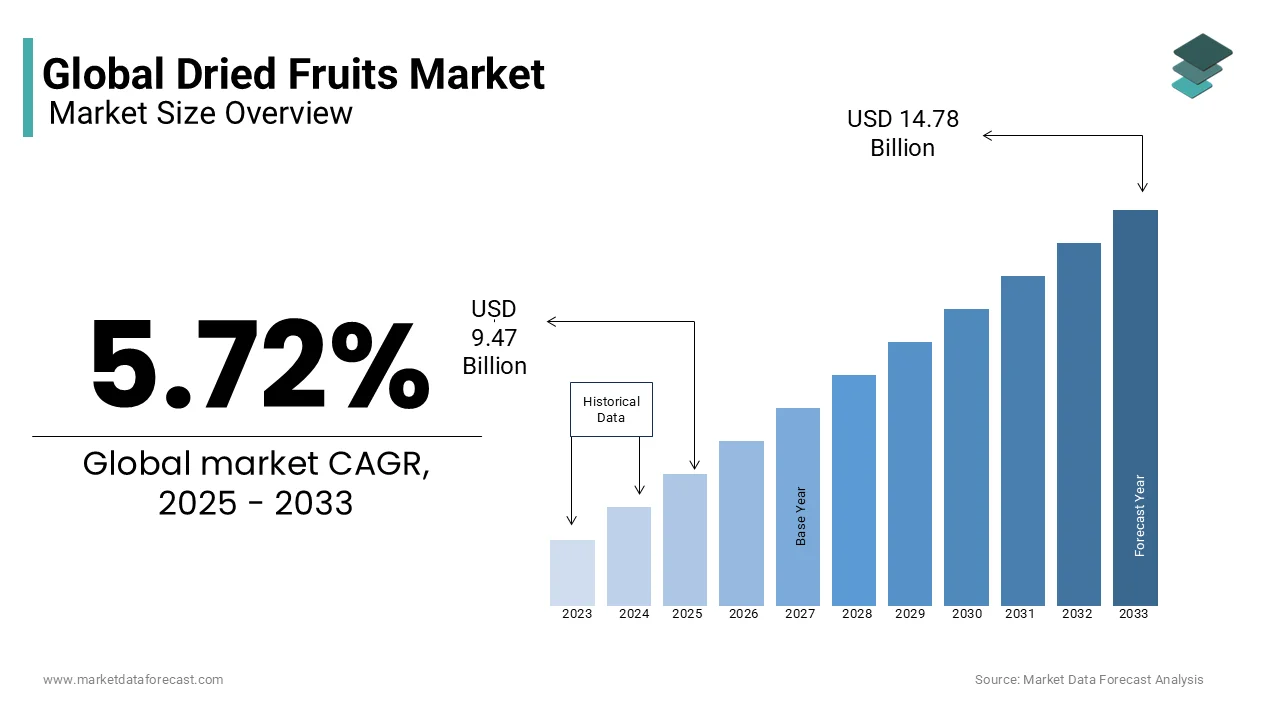
The global dried fruits market size was worth USD 9.48 billion in 2025. The global market is projected to register a CAGR of 5.72% from 2026 to 2034 and be worth USD 15.64 billion by 2034 from USD 10.02 billion in 2026.
Dried Fruits are dehydrated fruit products, ranging from raisins, dates, and figs to apricots, prunes, and cranberries, preserved through natural sun-drying or advanced dehydration techniques to extend shelf life while retaining nutritional value. These products are integral to global diets due to their concentrated energy content, natural sweetness, and functional properties in culinary and health applications. Unlike processed snacks, dried fruits are increasingly perceived as clean-label, minimally processed alternatives rich in dietary fiber, antioxidants, and essential micronutrients such as potassium and iron.
The World Health Organization emphasizes that increased fruit consumption, including dried forms, is linked to reduced risks of cardiovascular diseases and certain cancers, reinforcing their role in preventive nutrition. Regulatory frameworks in regions like the European Union and North America now recognize specific health claims for dried fruits, such as the contribution of prunes to normal bowel function, further legitimizing their inclusion in balanced diets.
MARKET DRIVERS
Rising Global Demand for Natural and Clean-Label Snacks
The growing consumer preference for minimally processed, chemical-free food products has significantly elevated the demand for dried fruits as a clean-label snack alternative. A notable share of U.S. consumers in 2023 actively avoided products with artificial preservatives, flavors, or added sugars, favoring whole-food-based options. Dried fruits, inherently free from synthetic additives when unprocessed, align perfectly with this shift. The trend is equally strong in Asia-Pacific, where urban consumers in countries like South Korea and Australia are increasingly scrutinizing food labels due to rising health literacy. Additionally, as per the Global Food Research Program at the University of North Carolina, snacks labeled “natural” experienced a higher purchase intent compared to conventional counterparts. Food manufacturers are reformulating snack bars, cereals, and trail mixes with dried fruits to replace refined sugars and synthetic binders, leveraging their natural sweetness and binding properties. This transition is further supported by retail chains like Whole Foods Market and Tesco, which have introduced private-label clean-label snack lines dominated by dried fruit blends, signaling a structural shift in consumer expectations.
Expanding Use of Dried Fruits in Functional Foods and Plant-Based Diets
Dried fruits are increasingly integrated into functional food formulations and plant-based dietary regimens due to their nutrient density and role in enhancing texture and flavor without artificial inputs. Dried fruits such as dates and figs serve as natural sweeteners and fat substitutes in vegan baked goods, reducing reliance on refined sugar and palm oil. The European Food Safety Authority has acknowledged that polyphenols in dried plums and apricots contribute to antioxidant defenses, enabling health claims on fortified products. In clinical nutrition, date paste is being used in energy-dense formulations for malnourished children. Additionally, sports nutrition brands are incorporating dried fruit blends into energy bars and gels for rapid carbohydrate delivery. With the global plant-based food market expanding rapidly, dried fruits are transitioning from traditional snacks to essential ingredients in next-generation food innovation.
MARKET RESTRAINTS
Post-Harvest Losses and Inefficient Drying Practices in Key Producing Regions
A significant portion of global dried fruit production is undermined by inadequate post-harvest infrastructure, particularly in major producing countries such as Iran, Turkey, and India. As per the Food and Agriculture Organization, up to 30% of harvested fruits intended for drying are lost due to poor handling, contamination, and suboptimal drying conditions. In rural areas of Afghanistan and Pakistan, where sun-drying remains the primary method, exposure to dust, insects, and microbial pathogens compromises product safety and shelf life. Aflatoxin contamination in dried figs and apricots from Central Asia has triggered import bans in the European Union. These quality issues not only limit export potential but also reduce farmer incomes and discourage investment in quality improvement. Furthermore, lack of cold chain integration and storage facilities results in seasonal glut and price volatility. Without scalable, hygienic drying technologies and farmer training programs, the sector remains vulnerable to supply disruptions and reputational damage, constraining its ability to meet international food safety standards.
High Sugar Content and Associated Health Concerns in Western Markets
Dried fruits face growing scrutiny in health-conscious markets due to their high natural sugar concentration, which can mislead consumers about caloric density and glycemic impact. This has led to regulatory actions, including front-of-pack warning labels in countries like Chile and Mexico, where dried fruit blends with added sugar are now classified under high-sugar categories. Additionally, the International Diabetes Federation points out that global diabetes prevalence has risen to millions of adults, increasing sensitivity to carbohydrate-rich foods. While unsweetened varieties exist, consumer preference for palatability often drives demand for sweetened options, creating a paradox between perceived healthfulness and metabolic impact. Until clearer labeling and consumer education are implemented, this nutritional ambiguity will continue to limit market expansion in weight-conscious and diabetic populations.
MARKET OPPORTUNITIES
Innovation in Value-Added Dried Fruit Products and Functional Blends
The dried fruits market is witnessing a transformation through the development of value-added formats such as freeze-dried fruit crisps, fortified blends, and functional snack combinations tailored to specific health needs. Companies are now launching antioxidant-rich blends of goji berries, golden berries, and mulberries marketed for immune support, aligning with post-pandemic wellness trends. Additionally, dried fruits are being incorporated into probiotic-enriched snack bars and children’s nutrition pouches, leveraging their natural sweetness to mask bitter functional ingredients. Private-label retailers such as Aldi and Lidl have introduced premium dried fruit lines with added seeds, nuts, and spices, targeting the gourmet and wellness segments. With R&D focusing on texture modulation, flavor layering, and nutrient enhancement, the sector is moving beyond bulk commodities toward differentiated, high-margin offerings with strong consumer appeal.
Expansion of E-Commerce and Direct-to-Consumer Sales Models
The proliferation of digital retail platforms has created a transformative opportunity for dried fruit suppliers to reach global consumers with niche, premium, and organic offerings. Online marketplaces such as Amazon, iHerb, and Thrive Market have enabled small-scale producers to bypass traditional distribution bottlenecks and access urban consumers in North America, Europe, and Southeast Asia. Subscription-based models offering curated dried fruit boxes have gained traction. Social commerce, particularly through Instagram and TikTok, has empowered brands to educate consumers on sourcing, benefits, and usage, driving engagement and conversion. Additionally, blockchain-enabled traceability allows consumers to verify origin and farming practices, enhancing trust in premium and organic variants. This digital shift not only broadens market reach but also enables real-time feedback, rapid product iteration, and stronger brand-consumer relationships, positioning e-commerce as a key growth engine.
MARKET CHALLENGES
Climate Change and Water Scarcity Impacting Fruit Cultivation
The sustainability of dried fruit production is increasingly threatened by climate variability and diminishing water resources in key growing regions. As per the Intergovernmental Panel on Climate Change, Mediterranean and Central Asian zones, major producers of figs, dates, and apricots, are experiencing prolonged droughts and rising temperatures, reducing fruit yield and quality. In California, which produces most of U.S. raisins, water allocation for agriculture dropped in 2022 due to reservoir shortages, forcing farmers to fallow vineyards. Similarly, in Iran, prolonged droughts have reduced pistachio and date harvests, indirectly affecting dried fruit supply chains due to shared irrigation systems. Unpredictable flowering cycles and increased pest infestations due to warmer winters further compound production risks. These environmental pressures not only elevate input costs but also threaten long-term sourcing stability for global brands. Without investment in drought-resistant cultivars, drip irrigation, and sustainable water management, the industry faces escalating volatility in both volume and pricing, undermining supply chain resilience.
Stringent Food Safety Regulations and Export Barriers
Dried fruit exporters face mounting challenges due to increasingly rigorous food safety standards imposed by importing countries, particularly in Europe and North America. Sulfur dioxide, commonly used to preserve color in golden raisins and apricots, is restricted in the EU to 10–2,000 mg/kg depending on the product, and non-compliance results in shipment rejections. These regulatory hurdles require exporters to invest in advanced testing labs, Good Agricultural Practices (GAP), and Hazard Analysis and Critical Control Points (HACCP) certification, costs that small producers often cannot bear. Additionally, the Codex Alimentarius Commission continues to revise maximum residue limits, creating a moving compliance target. The lack of harmonized global standards forces companies to reformulate or reprocess products for different markets, increasing operational complexity and delaying market entry, ultimately limiting growth for emerging producers.
REPORT COVERAGE
| REPORT METRIC | DETAILS |
| Market Size Available | 2025 to 2034 |
| Base Year | 2025 |
| Forecast Period | 2026 to 2034 |
| CAGR | 5.72% |
| Segments Covered | By Type, Application, and Region |
| Various Analyses Covered | Global, Regional, & Country Level Analysis; Segment-Level Analysis; DROC, PESTLE Analysis; Porter’s Five Forces Analysis; Competitive Landscape; Analyst Overview of Investment Opportunities |
| Regions Covered | North America, Europe, APAC, Latin America, Middle East & Africa |
| Market Leaders Profiled | Ocean Spray Cranberries Inc. (U.S.), Sunbeam Foods Pvt Ltd (Australia), Olam International (Singapore), Arimex Ltd (Lithuania), National Raisin Company (U.S.), Sun-Maid (U.S.), SUNSWEET (U.S.), Amsterdam Commodities N.V (Netherlands) |
SEGMENTAL ANALYSIS
By Type Insights
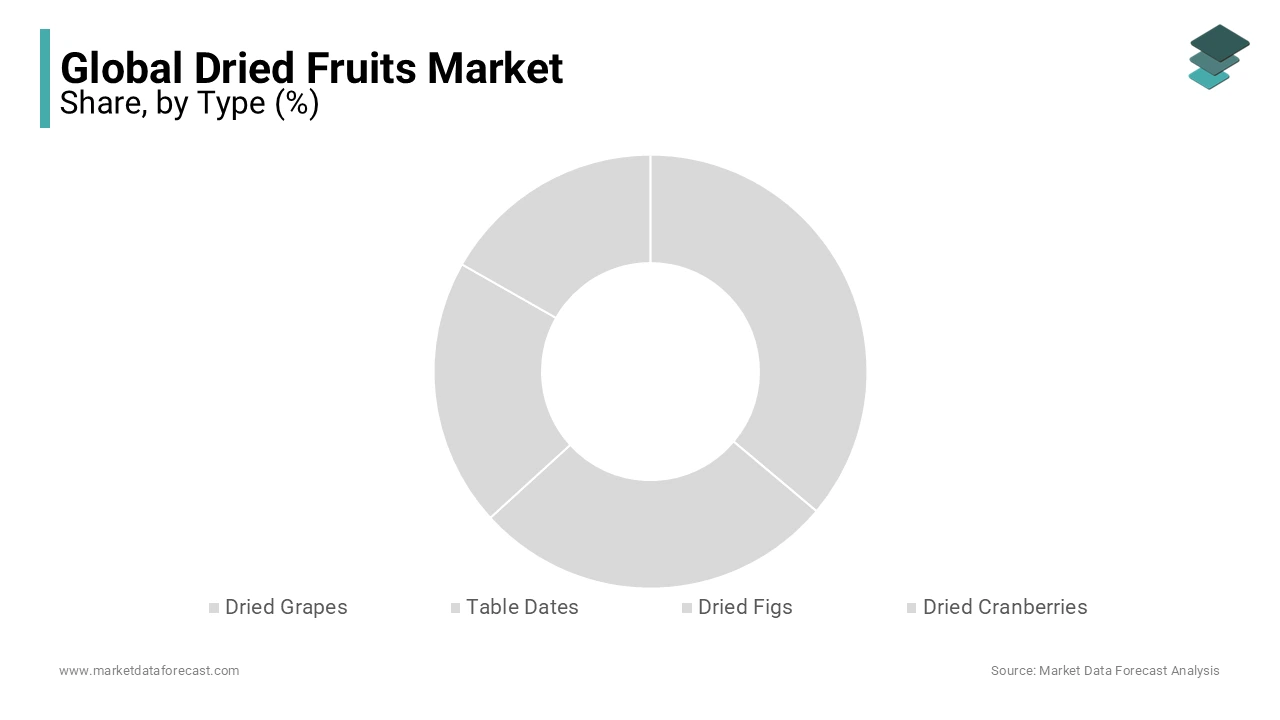
The raisins segment dominated the global dried fruits market by capturing an estimated 32.6% share in 2025. This lead position is due to its widespread availability, affordability, and deep integration into both culinary and snack applications across diverse cultures. Raisins are produced primarily from Thompson Seedless grapes, with California, Turkey, and South Africa serving as the largest cultivation hubs. The crop’s adaptability to mechanical harvesting and large-scale drying infrastructure ensures consistent volume and cost efficiency. Raisins are also a staple in traditional diets, integral to Middle Eastern rice dishes, South Asian sweets, and European baked goods, ensuring sustained demand. The World Health Organization recognizes raisins as a rich source of iron and polyphenols, contributing to their inclusion in fortified food programs for anemia prevention. In school nutrition initiatives across India and Brazil, raisins are increasingly used as non-perishable energy sources due to their shelf stability and caloric density. These multifaceted uses—spanning home cooking, industrial processing, and public health nutrition—solidify raisins as the cornerstone of the dried fruit category.
The berries segment is the fastest-growing in the dried fruits market and is projected to expand at a CAGR of 9.8% from 2026 to 2034. This surge is driven by rising consumer demand for antioxidant-rich, functional foods linked to longevity and cognitive health. Dried blueberries, cranberries, goji berries, and açai berries are particularly valued for their high anthocyanin and flavonoid content. Freeze-drying technology has preserved up to 95% of the original nutrient profile in berries, making them viable for inclusion in premium snack blends, breakfast cereals, and nutraceuticals. In Japan, dried goji berries are incorporated into functional beverages and elderly nutrition products, supported by government-backed aging-in-place initiatives. Additionally, social media influence has amplified demand, with TikTok campaigns showcasing berry-based smoothie bowls and immunity boosters. This convergence of scientific validation, technological advancement, and digital engagement positions dried berries at the forefront of the functional food revolution.
By Application Insights
The snacks segment led the dried fruits market by commanding a 41.8% of total application-based demand in 2025. This dominance is fueled by the global shift toward convenient, on-the-go eating habits and the rising perception of dried fruits as healthy alternatives to processed confectionery. Urban consumers, particularly millennials and Gen Z, are increasingly replacing candy and chocolate bars with dried fruit pouches, trail mixes, and single-serve packs. Moreover, the rise of workplace wellness programs and school nutrition policies in countries like Australia and Canada has led to institutional procurement of dried fruit packs. Additionally, private-label retailers such as Costco and Waitrose have expanded their organic dried fruit snack lines, capitalizing on premiumization trends. With e-commerce platforms offering subscription models and curated snack boxes, the accessibility and variety of dried fruit snacks continue to grow, reinforcing their position as a dominant application channel.
The breakfast cereals segment is the fastest-growing application and is projected to grow at a CAGR of 8.6% through 2034. This growth is driven by the increasing formulation of ready-to-eat (RTE) cereals with natural inclusions to enhance flavor, texture, and nutritional value. Cereal manufacturers are reformulating products to meet clean-label demands, replacing high-fructose corn syrup and artificial flavors with dried fruits like raisins, cranberries, and diced apricots. Additionally, plant-based and gluten-free cereal lines, such as those by Nature’s Path and Jordansare leveraging dried fruits to improve taste without compromising on health claims. With breakfast increasingly recognized as a critical meal for metabolic health, the integration of nutrient-dense dried fruits into morning routines is becoming a strategic focus for food innovators.
REGIONAL ANALYSIS
North America Market Analysis
North America led the global dried fruits market at 30.4% in 2025 which is driven by high health consciousness, robust retail infrastructure, and strong consumer demand for natural snacks. The United States is the primary contributor, with per capita consumption of dried fruits. The prevalence of functional food trends, coupled with widespread adoption of plant-based diets, has elevated demand for unsweetened and organic dried fruit variants. The Food and Drug Administration’s recognition of dried plums for digestive health and raisins for blood pressure management has reinforced their inclusion in daily diets. Major retailers like Kroger and Walmart have expanded private-label dried fruit lines with transparent sourcing and minimal processing claims. The presence of large-scale producers in California ensures supply stability, while digital platforms like Thrive Market and Amazon Fresh facilitate direct access to niche and premium products. With rising diabetes awareness, portion-controlled packaging and low-glycemic blends are gaining traction, reflecting a nuanced consumer approach to natural sugars.
Europe Market Analysis
Europe is characterized by stringent quality standards and a preference for organic and sustainably sourced products. Countries like Germany, the UK, and France lead in consumption, supported by well-established bakery and confectionery industries that incorporate dried fruits into traditional recipes. The European Food Safety Authority regulates maximum levels of mycotoxins and sulfites, ensuring product safety and consumer trust. The Common Agricultural Policy supports Mediterranean producers in Greece, Spain, and Italy, where sun-dried figs and Corinthian raisins are protected under geographical indication schemes. With strong e-commerce penetration and consumer education, Europe remains a mature yet evolving market.
Asia Pacific Market Analysis
Asia Pacific is emerging as a high-potential region due to urbanization, rising disposable incomes, and growing health awareness. China and India are key growth engines, with urban middle-class populations increasingly adopting Western-style snacking habits. In India, the FSSAI has introduced stricter labeling norms for added sugars, prompting brands to launch no-added-sugar dried fruit packs. Japan’s aging population is driving demand for nutrient-dense, easy-to-consume dried fruits in senior nutrition programs. E-commerce platforms like Alibaba and Flipkart have expanded access to imported and organic variants, while local startups offer ready-to-eat snack boxes. Despite lower per capita consumption compared to the West, the sheer population size and dietary transition position Asia-Pacific as a critical growth frontier.
Middle East Market Analysis
Middle East and Africa collectively represent a notable share of the global market, with the Gulf Cooperation Council (GCC) countries leading due to cultural affinity for dates and government-backed food security initiatives. Saudi Arabia and the UAE produce and consume large quantities of dates. South Africa stands out as a commercial exporter of dried peaches and apricots, meeting EU standards. The World Food Programme uses dried fruits in emergency nutrition kits across conflict zones, highlighting their utility in food aid. With increasing urbanization and supermarket penetration, the region is gradually shifting from traditional markets to branded, packaged products.
Latin America Market Analysis
Latin America holds small share of the global dried fruits market, with Brazil and Mexico driving demand through rising health awareness and culinary innovation. The Pan American Health Organization reports that non-communicable diseases linked to poor diet are increasing, prompting public health campaigns promoting fruit consumption. Traditional dishes like mole in Mexico and brigadeiro in Brazil increasingly incorporate dried fruits for natural sweetness. Chile and Argentina are emerging as exporters of high-quality dried peaches and pears, leveraging temperate climates and advanced agro-processing. However, economic volatility and import dependency for certain varieties limit market expansion. Despite challenges, the region’s rich biodiversity and growing middle class present long-term opportunities for both domestic consumption and export-oriented production.
COMPETITIVE LANDSCAPE
KEY MARKET PLAYERS
The following companies playing a key role in the global dried fruits market are
-
Sunbeam Foods
-
Sun-Maid Growers of California
-
Al Foah
-
Bergin Fruit and Nut Company
-
Angas Park
-
Murray River Organics
-
Red River Foods
-
Geobres
-
Kiantama Oy
-
Traina Foods
TOP STRATEGIES USED BY KEY PLAYERS
One major strategy employed by leading players in the dried fruits market is vertical integration across the supply chain, from farming to processing and packaging. Companies are securing direct relationships with growers or acquiring orchards to ensure consistent quality, traceability, and supply stability. This approach minimizes dependency on third-party suppliers and enhances control over agricultural practices, drying methods, and food safety protocols.
Another key strategy is product differentiation through clean-label, organic, and specialty formulations. Brands are reformulating offerings to exclude sulfites, added sugars, and artificial preservatives, catering to health-conscious consumers. Emphasis is placed on transparent sourcing, non-GMO certification, and functional benefits such as digestive or antioxidant support, allowing companies to command premium positioning.
A third critical strategy is expanding into value-added formats and private-label partnerships. Rather than competing solely on bulk commodities, companies are developing diced, sliced, freeze-dried, or blended products tailored for bakery, snack, and infant nutrition applications. Collaborating with retailers and food manufacturers to co-create exclusive lines strengthens market penetration and brand loyalty in both B2B and B2C channels.
COMPETITION OVERVIEW
The competitive landscape of the dried fruits market is defined by a blend of legacy cooperatives, agile processors, and emerging specialty brands vying for dominance through quality, innovation, and ethical positioning. Established players leverage decades of agricultural expertise, robust distribution networks, and strong brand equity to maintain leadership, particularly in traditional categories like raisins and dates. At the same time, niche producers are gaining traction by focusing on organic, sulfite-free, and single-origin offerings that appeal to discerning consumers seeking transparency and sustainability. The market is increasingly segmented by application, with B2B suppliers competing to meet the exacting standards of food manufacturers in bakery, cereal, and snack industries, while retail brands focus on packaging, convenience, and health claims. Geopolitical factors influence competition, as regions like California, Turkey, and South Africa dominate production, creating both opportunities and vulnerabilities based on climate, trade policies, and regulatory alignment. Private-label expansion by major retailers is intensifying price pressure, pushing manufacturers to innovate beyond commodity status. Digital platforms and e-commerce are reshaping consumer access, enabling direct engagement and personalized offerings. Ultimately, the most competitive players are those that combine agricultural integrity with food science, sustainability, and responsiveness to evolving dietary trends, transforming dried fruits from a traditional staple into a modern functional food ingredient.
TOP PLAYERS IN THE MARKET
- Sun-Maid has long been a cornerstone of the global dried fruits industry, renowned for its cooperative model that empowers family-owned farms and ensures consistent quality. The brand is synonymous with raisins, having shaped consumer perception of dried fruits as wholesome, natural, and nutritious. Through decades of brand stewardship, Sun-Maid has embedded itself in household routines across North America and beyond, serving as a trusted name in pantries and kitchens. Its commitment to sustainable farming, water conservation, and transparent sourcing has set benchmarks for ethical production in the sector. By investing in consumer education and product innovation—such as seedless varieties and unsweetened blends—the company has maintained relevance amid evolving dietary preferences. Sun-Maid also plays a pivotal role in research and development, collaborating with agricultural institutions to improve crop resilience and drying techniques. Its influence extends beyond commerce, contributing to the standardization of food safety practices and promoting the health benefits of dried fruits through public outreach.
- American Almond Company has established itself as a leading processor and distributor of value-added dried fruits, nuts, and custom blends for both retail and industrial clients. Known for its precision in cutting, slicing, and packaging, the company serves as a critical link between raw producers and food manufacturers in bakery, confectionery, and snack sectors. Its expertise lies in consistent quality control, traceability, and large-scale customization, enabling global brands to maintain uniform product standards. American Almond emphasizes operational excellence, employing advanced sorting and pasteurization technologies to meet stringent international food safety requirements. The company has been instrumental in advancing the use of dried fruits in functional food formulations, offering tailored solutions such as oil-free, sulfite-free, and organic-certified options. By maintaining long-term partnerships with growers and investing in supply chain resilience, American Almond ensures reliability in sourcing and delivery. Its role as a B2B enabler has made it a silent yet essential force in shaping the availability and quality of dried fruit ingredients in processed foods worldwide.
- California Natural Products has emerged as a pioneer in organic and aseptic processing within the dried fruits and fruit ingredient space. Specializing in purees, concentrates, and diced dried fruits, CNP caters to premium food and beverage brands seeking clean-label, non-GMO, and sustainably sourced inputs. The company’s commitment to organic certification and eco-conscious manufacturing has positioned it at the forefront of the natural foods movement. Its innovations in flash pasteurization and aseptic packaging preserve flavor and nutrients without preservatives, meeting the demands of health-focused consumers. CNP collaborates closely with organic farms to ensure ethical labor practices and environmental stewardship, reinforcing its reputation for integrity. The company has also led in developing allergen-free and gluten-free fruit solutions for sensitive populations, expanding the applicability of dried fruit derivatives. By aligning with the values of transparency, sustainability, and nutritional integrity, California Natural Products has become a preferred partner for brands aiming to differentiate through purity and quality in a competitive marketplace.
RECENT HAPPENINGS IN THE MARKET
- In March 2023, Sun-Maid launched a regenerative agriculture initiative in partnership with Central Valley farmers to improve soil health and water efficiency, reinforcing its commitment to sustainable raisin production.
- In July 2023, American Almond Company invested in a new automated sorting and packaging facility in New Jersey, enhancing its capacity to deliver consistent, high-purity dried fruit ingredients for industrial clients.
- In October 2023, California Natural Products introduced a certified organic freeze-dried fruit line for the infant nutrition and premium snack sectors, expanding its footprint in clean-label product development.
- In January 2025, Sun-Maid expanded its international distribution by entering a supply agreement with a major grocery chain in Southeast Asia, increasing access to unsweetened and non-GMO raisin variants.
- In May 2025, American Almond Company partnered with a leading plant-based bakery brand to co-develop a custom dried fruit blend free from common allergens, strengthening its role in specialty food innovation.
MARKET SEGMENTATION
This research report on the global dried fruits market has been segmented and sub-segmented based on type, application, and region.
By Type
- Dried Grapes
- Table Dates
- Dried Figs
- Dried Cranberries
- Others
By Application
- Bakery
- Confectionery
- Breakfast cereals
- Snacks
- Others
By Region
- North America
- Europe
- Asia-Pacific
- Latin America
- Middle East and Africa