- Product Description Description
- Table of Contents TOC
- List of Table & Figure LOT
- Get Free Sample PDF Sample PDF
Market Size, 2025
$5.79 BnMarket Estimate, 2026
$6.03 BnMarket Forecast, 2034
$8.39 BnCAGR, 2026–2034
4.21%Executive Summary: Global Defoamers Market
- Market Scope: Comprehensive market analysis of the global defoamers sector covering product formulations, application verticals, regional leadership frameworks, and foam control growth drivers.
- Market Valuation: Valued at USD 5.79 billion (2025), estimated at USD 6.03 billion (2026), and projected to reach USD 8.39 billion by 2034, registering a steady CAGR of 4.21% (2026–2034).
- Primary Growth Drivers: Expansion of biopharmaceutical manufacturing, increasing recycled paper production, rising adoption of bio-based and biodegradable defoamers, and AI-enabled automated foam control systems. Additional opportunities include advanced silicone alternatives and sustainable chemical processing enhancements.
Key Market Segment Metrics (2026–2034)
| Category | Leading Segment (2025 Position) | Fastest-Growing Segment |
|---|---|---|
| By Product Type | Silicone-based defoamers (accounted for the largest market share in 2025) | EO/PO-based defoamers (projected fastest growth due to biodegradability) |
| By Application | Pulp & paper, wastewater treatment, paints & coatings, and food processing | Biopharmaceutical manufacturing and membrane bioreactor applications |
| By Region / Geography | Global industrial manufacturing and chemical processing hubs across North America, Europe, and Asia Pacific | High-growth industrializing markets across Asia Pacific and emerging regions |
Major Market Players & Market Structure
Market Structure: Highly competitive global landscape characterized by manufacturer focus on sustainable, biodegradable, and application-specific formulations, advanced silicone alternatives, and AI-integrated foam management optimization solutions.
Key Companies: Ashland Inc., Kemira Oyj, Dow Corning Corporation, Evonik Industries AG, Wacker Chemie AG, Shin-Etsu Chemical Co., Ltd., BASF SE, Clariant AG, Elementis Plc, KCC Basildon, Bluestar Silicones International, and Air Products and Chemicals.
Global Defoamers Market Size
The global defoamers market size was valued at USD 5.79 billion in 2025 and is expected to reach USD 8.39 billion by 2034 from USD 6.03 billion in 2026. The market is projected to grow at a CAGR of 4.21%.
Defoamers are surface-active chemical agents engineered to destabilise and rupture foam lamellae in liquid process systems by reducing interfacial tension, which suppresses entrained gas accumulation that impedes heat transfer, mixing efficiency, and product uniformity. Unlike generic surfactants, modern defoamers are precisely formulated, spanning silicone, mineral oil, polyglycol, and fatty acid ester chemistries, to function under extreme pH, temperature, and shear conditions without compromising downstream purity. As per research, uncontrolled foaming causes a portion of unplanned downtime in bioreactors and 23% of coating defects in paper mills.
MARKET DRIVERS
Biopharmaceutical Expansion Spurs Defoamer Adoption
The intensification of biopharmaceutical manufacturing, where uncontrolled foaming in mammalian cell culture bioreactors compromises oxygen transfer and cell viability, is driving the growth of the defoamers market. The foam-induced shear stress reduces monoclonal antibody titers in notable litre stirred-tank reactors. To mitigate this, Genentech’s facility deploys silicone-polyether hybrid defoamers, validated under USP <661> for extractables, which preserves batch consistency across 22 global production lines. Simultaneously, the U.S. Food and Drug Administration’s guidance on continuous bioprocessing emphasises foam monitoring with automated antifoam dosing, which triggers a surge in demand for sensor-compatible and low-silicone formulations among CDMOs.
Recycled Paper Pulping Drives Demand for Foam Control
The global expansion of recycled paper pulping, where surfactant-laden post-consumer waste generates persistent foam that disrupts deinking and screening efficiency, is also a growth enabler to the defoamers market. As per the study, Europe’s millions of metric tons of recovered paper required significant metric tons of mineral oil-based defoamers to maintain drainage rates. In India, itemphasisess foam suppression in recovery boilers to prevent carryover-induced tube corrosion, which consumes metric tons of high-temperature silicone defoamers annually. Simultaneously, Brazil’s Suzano SA increased defoamer dosage to handle rising coated paper input, which introduces latex and calcium carbonate stabilisers that exacerbate foam stability.
MARKET RESTRAINTS
Regulatory Limits on Silicone-Based Formulations
The tightening regulatory exclusion of silicone-based formulations in food-contact and pharmaceutical applications due to migration and bioaccumulation concerns is degrading the growth of the efoamers market. Recent regulatory changes in both Europe and the United States are reshaping the defoamer and processing additive landscape. These have tightened limits on silicone use in food and dairy applications, which prompts many producers to reformulate with alternative chemistries despite higher costs. Furthermore, new extractables testing requirements from the U.S. Pharmacopoeia are pushing biopharmaceutical companies to move away from silicone-based materials in favour of plant-derived options, even though these can be less effective.
Membrane Incompatibility Restrains Wastewater Use
Incompatibility with membrane bioreactors in advanced wastewater treatment, where conventional defoamers foul polymeric ultrafiltration membranes and increase transmembrane pressure, which restrains the growth of the defoamers market. In Asia, water utilities are shifting away from silicone-based products after performance issues were linked to membrane fouling, which leads to stricter material standards. Similar shifts are underway in the United States, where new state-level codes limit the use of mineral oil defoamers in wastewater processing to prevent hydrocarbon contamination.
MARKET OPPORTUNITIES
Bio-Based Defoamers Gain Traction in Fermentation
The deployment of enzyme-compatible as well as biodegradable defoamers in industrial-scale fermentation for alternative proteins and precision-fermented dairy opens new opportunities for the defoamers market growth. New production facilities require foam control solutions that work without disrupting sensitive biological processes, and are prompting manufacturers to introduce biodegradable and bio‑based options. Products designed for compatibility with food and biotech systems are gaining traction, which shows strong performance in commercial fermentation setups. Supportive government programs, such as the USDA’s BioPreferred initiative, are further encouraging adoption, prioritising bio‑certified formulations for public procurement.
AI-Integrated Foam Control Expands Market Potential
Digital integration of foam-sensing AI with automated defoamer dosing in continuous chemical reactors paves the way for the expansion of the defoamers market. Advanced monitoring platforms now integrate real-time data on viscosity, gas flow, and foam height to fine-tune antifoam dosing, helping manufacturers cut chemical use while maintaining product quality. Chemical producers are increasingly adopting AI‑driven and neural network tools that reduce waste and improve consistency, particularly in continuous polymer and surfactant processes.
MARKET CHALLENGES
Mechanical Foam-Breaking Systems Reduce Demand
The accelerating substitution by mechanical foam-breaking systems in water-intensive industries, particularly pulp and paper, where rotary vacuum drums and ultrasonic probes eliminate chemical dependence, challenges the rise of the defoamers market. Stora Enso’s mill replaced a portion of chemical defoamers with hydrodynamic foam breakers, which reduces operational costs notable amount annually. Simultaneously, the facility installed resonant frequency ultrasonic arrays that collapse foam lamellae without additives, achieving foam suppression in recycled linerboard production.
Silicone Raw Material Volatility Hampers Growth
The raw material volatility of silicone intermediates, particularly dimethyldichlorosilane, whose pricing is tethered to polysilicon and methanol markets, impedes the growth of the defoamers market. Regional disruptions, such as power shortages affecting monomer production in China, have driven sharp price increases for key silicone grades. as per the tudstudyt the same time, regulatory measures in Europe targeting chlorosilanes could raise compliance costs for producers, adding another layer of uncertainty to the supply chain. Companies without secure sourcing or integrated production are feeling the impact most acutely, as rising input prices and tighter regulations compress margins in competitive markets across emerging economies.
REPORT COVERAGE
| REPORT METRIC | DETAILS |
| Market Size Available | 2025 to 2034 |
| Base Year | 2025 |
| Forecast Period | 2026 to 2034 |
| CAGR | 4.21% |
| Segments Covered | By Product, Application, and Region. |
| Various Analyses Covered | Global, Regional & Country Level Analysis, Segment-Level Analysis, DROC, PESTLE Analysis, Porter’s Five Forces Analysis, Competitive Landscape, Analyst Overview of Investment Opportunities |
| Regions Covered | North America, Europe, APAC, Latin America, Middle East & Africa |
| Market Leaders Profiled | Ashland Inc., Kemira Oyj, Dow Corning Corporation, Evonik Industries AG, Wacker Chemie AG, Shin-Etsu Chemical Co., Ltd., BASF SE, Clariant AG, Elementis Plc, KCC Basildon, Bluestar Silicones International, Air Products and Chemicals, and Others. |
SEGMENTAL ANALYSIS
By Product Insights
In 2025, the silicone-based defoamers segment was the leading segment and held 39.3% of the share, owing to their unparalleled surface activity, thermal stability up to 250°C, and compatibility with high-shear, high-viscosity systems in polymers, coatings, and wastewater. Silicone-tolerant industries are also fuelling the growth of the silicone-based defoamers segment. As per the research, a portion of architectural paint manufacturers specify silicone defoamers to prevent cratering without compromising gloss. In biopharmaceuticals, companies deploy ultra-low-silicone emulsions at ppm to suppress foam in notable leters of bioreactors while meeting USP <661> extractables thresholds.
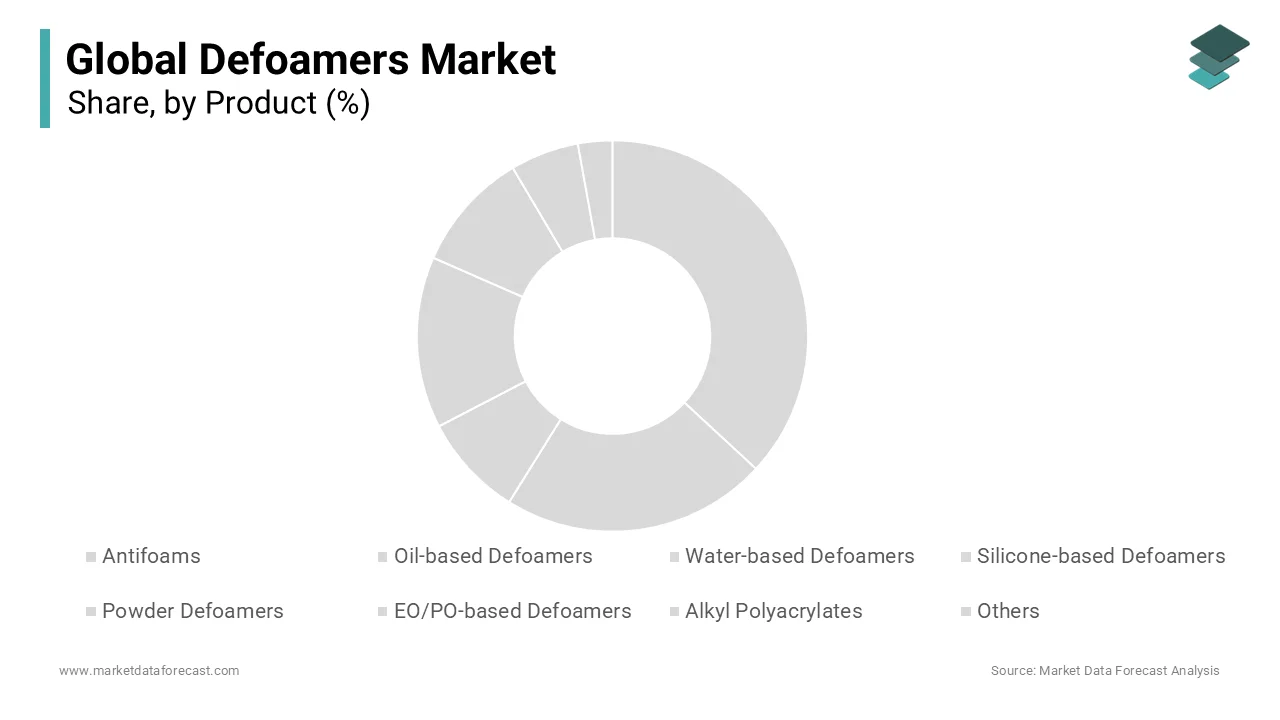
The EO/PO-based defoamers segment is anticipated to witness a CAGR of 8.7% from 2026 to 2034 due to the regulatory displacement of silicones in food, pharmaceuticals, and membrane bioreactors. Their polyether backbone offers superior biodegradability and non-fouling characteristics. As per research, Ethylene oxide and propylene oxide (EO/PO)–based defoamers are gaining wider acceptance in both biopharmaceutical and water treatment applications. Many new contract manufacturing facilities in the biotech sector are standardising these formulations to meet FDA guidelines for continuous processing, where material consistency and cleanability are critical.
By Application Insights
The pulp & paper segment held 27.2% the global defoamers market share in 2025. The growth of the defoamers market is primarily driven by foam suppression in recycled fibre pulping, deinking, and paper machine wet-end systems. Rising recovered paper input, millions of metric tons in Europe in 2023, as per a study, introduces surfactants and latex that stabilise foam, demanding mineral oil or silicone defoamers to maintain drainage rates above 120 CSF. In India, regulations require their use in recovery boilers to prevent damage from carryover, ensuring steady annual consumption at significant volumes.
The biopharmaceuticals segment is likely to experience the fastest CAGR of 11.3% during the forecast period. The rapid growth of the biopharmaceuticals segment is fueled by monoclonal antibody and mRNA vaccine production scaling under continuous bioprocessing mandates. As per the research, foam-induced shear stress reduces cell viability by a portion in stirred-tank reactors, which compels companies to deploy sensor-compatible, low-silicone defoamers validated under USP <661>. Many facilities are turning to automated dosing systems that precisely control usage, helping improve efficiency and reduce unnecessary chemical input. At the same time, stricter guidelines for material safety and extractables are prompting a gradual shift toward alternative formulations that align better with single‑use equipment standards.
REGIONAL ANALYSIS
Europe Market Analysis
Europe was the top performer in the defoamers market by capturing 31.8% of the global market share in 2025. Germany alone consumed notable metric tons of EO/PO defoamers in 2023 for food-contact adhesives and bioreactors, as per the research. Many companies are moving toward non‑silicone formulations to meet updated compliance standards, while others are investing in mechanical systems that offer long‑term cost efficiency. According to a study, this dual shift toward safer chemistries and equipment‑based solutions reflects a broader industry effort to balance regulatory alignment with operational resilience, which signals a steady transformation in how foam management is approached across manufacturing sectors.
Asia Pacific Market Analysis
Asia Pacific was the second-largest share with 29.4% share in 2025 due to China’s textile effluent mandates and India’s Kraft boiler regulations. China emphasised the role of silicone-based products in wastewater management, while India continues to promote their use in energy‑intensive sectors to improve operational performance. According to a study, Thailand is encouraging a switch to alternative formulations in food processing to ensure product safety and export compliance. Together, these efforts highlight a regional trend toward more regulated and performance‑driven foam control practices.
North America Market Analysis
North America defoamers market is likely to have the fastest growth opportunities in the coming years, with the biopharmaceutical innovation and EPA-mandated wastewater compliance. The region’s position is also supported by regulatory precision. Stricter safety and material purity standards are encouraging manufacturers to move away from traditional silicone-based formulations toward chemistries that better align with compliance frameworks. There has been a growing focus on system compatibility and environmental performance, leading to greater adoption of sensor‑friendly, biodegradable, and fluorochemical solutions.
Latin America Market Analysis
Latin America defoamers market growth is likely to grow, with Brazil and Mexico driving consumption through pulp & paper expansion and food-grade compliance. Paper producers, food processors, and beverage manufacturers are exploring alternatives to conventional mineral oil and silicone‑based products to meet stricter export and safety standards. This transition reflects a broader awareness of ingredient purity and environmental compatibility, even when it involves higher production costs.
Middle East & Africa Market Analysis
The Middle East & Africa are likely to expand in the global defoamers market during the forecast period, with Gulf petrochemical and African municipal wastewater projects shaping regional dynamics. Several countries in the Middle East and Africa are steadily advancing toward regulated and performance-oriented foam control practices. Industrialcentress emphasising reliable materials to support large-scale chemical and water treatment operations, while the food processing sector is focusing on safer, residue‑free formulations to meet global export standards.
COMPETITIVE LANDSCAPE
KEY MARKET PLAYERS
Some of the key players dominating the global defoamers market are
- Ashland Inc.
- Kemira Oyj
- Dow Corning Corporation
- Evonik Industries AG
- Wacker Chemie AG
- Shin-Etsu Chemical Co., Ltd.
- BASF SE
- Clariant AG
- Elementis Plc
- KCC Basildon
- Bluestar Silicones International
- Air Products and Chemicals
TOP STRATEGIES USED BY KEY MARKET PLAYERS
Leading defoamer producers prioritise regulatory foresight, developing silicone-free and biodegradable variants ahead of global restrictions. They vertically integrate silicone monomer and polyether synthesis to hedge against feedstock volatility. Strategic partnerships with biopharma and water utilities embed defoamer chemistry into automated dosing systems. Companies deploy AI and real-time foam imaging to optimise dosage and reduce waste. Export-focused players establish regional formulation hubs to tailor emulsion stability and HLB values to local water hardness, temperature, and process shear, which enhances efficacy and customer retention in fragmented end-use markets.
COMPETITION OVERVIEW
The defoamers market is moderately concentrated, with rivalry pivoting on regulatory compliance, application specificity, and digital integration rather than price alone. European and North American players emphasise purity and biodegradability for sensitive sectors, while Asian producers leverage cost efficiency in industrial and wastewater segments. Innovation centres on solving niche pain points, enzyme compatibility in fermentation, membrane non-fouling in MBRs, and dust suppression in powder formats. New entrants face steep barriers due to capital-intensive emulsification systems and stringent extractables certifications. Market leaders increasingly monetise intelligence by offering foam analytics, automated dosing integration, and blockchain traceability, which transform them from chemical suppliers into process optimisation partners under ESG-aligned procurement frameworks.
TOP PLAYERS IN THE MARKET
- BASF continues to strengthen its position in the global defoamers market by focusing on performance, sustainability, and digital integration. The company’s portfolio spans silicone, EO/PO, and polyacrylate chemistries tailored for applications in pharmaceuticals, coatings, and water treatment. Recent developments reflect a shift toward eco-friendly and process-optimised products, including the launch of a biodegradable, silicone‑free formulation now used in precision fermentation.
- Dow Inc. remains a key player in high‑performance silicone and fluorochemical defoamers designed for use in harsh pH and temperature conditions, with a strong presence in the oilfield, pulp, and speciality chemical sectors. Its launch of a low‑extractable silicone emulsion accredited for pharmaceutical bioreactors underscores the company’s focus on precision and compliance in sensitive applications. Upgrades to manufacturing facilities have improved process control by cutting batch variations to minimal levels essential for consistent output.
- Momentive Performance Materials is advancing its defoamer portfolio by focusing on low‑dosage, high‑efficiency formulations for use across food processing, personal care, and industrial coatings. The company’s product introductions show its ability to tailor silicone chemistry for both performance and sustainability. New powder‑based defoamers are proving effective in challenging high‑humidity conditions, while collaborations with biotech and cosmetics firms show growing alignment with specialised end uses. Partnerships that link process compatibility with digital traceability, such as blockchain‑verified silicone batches, reflect how the company is blending material science with transparent supply chain management to meet evolving industry standards.
MARKET SEGMENTATION
This research report on the global defoamers market has been segmented and sub-segmented based on the product, application and region.n
By Product
- Antifoams
- Oil-based Defoamers
- Water-based Defoamers
- Silicone-based Defoamers
- Powder Defoamers
- EO/PO-based Defoamers
- Alkyl Polyacrylates
- Others
By Application
- Paints, Coatings, & Inks
- Adhesives & Sealants
- Personal Care & Cosmetics
- Agriculture
- Food & Beverages
- Household and Industrial or Institutional Cleaning
- Water and Wastewater Treatment
- Pulp & Paper
- Oil and Gas
- Metal Working
- Other Applications
By Regional
- North America
- Europe
- Asia-pacific
- Middle East and Africa
- Latin America