- Product Description Description
- Table of Contents TOC
- List of Table & Figure LOT
- Get Free Sample PDF Sample PDF
Market Size, 2025
$7.69 BnMarket Estimate, 2026
$8.03 BnMarket Forecast, 2034
$11.31 BnCAGR, 2026–2034
4.37%Executive Summary: Global Diesel Power Engine Market
- Market Scope: In-depth global assessment covering operations (standby, prime, and peak shaving), power ratings, end-users, and major geographical regions.
- Market Valuation: Valued at USD 7.69 billion in 2025, estimated at USD 8.03 billion in 2026, and projected to reach USD 11.31 billion by 2034, growing at a compound annual growth rate (CAGR) of 4.37%.
- Primary Growth Drivers: Escalating global electricity demand, rising data center investments, commercial facility expansions, and the critical need for reliable backup power amidst grid instability and power outages.
Key Market Segment Metrics (2026–2034)
| Category | Leading Segment Focus | Fastest-Growing / Key Structural Trends |
|---|---|---|
| By Operation | Standby Systems (holds the major share due to quick-start capabilities, low initial costs, and indispensable emergency backup applications) | Prime & Peak Shaving (vital for continuous operations and remote hybrid systems combining diesel gensets with renewable sources) |
| By Power Rating | Broad Spectrum (ranging from below 0.5 MW up to above 5 MW for large-scale utility and industrial deployments) | Mid-to-High Ratings (0.5–2 MW units experiencing heavy demand from commercial data centers and hospital complexes) |
| By End-User | Industrial & Commercial Sectors (hospitals, manufacturing units, and corporate data centers requiring uninterrupted power) | Commercial Segment (projected to be the fastest-growing market fueled by major tech capital projects and commercial real estate investments) |
| By Region | Asia-Pacific (anticipated to hold the largest market share driven by rapid industrialization, urbanization, and infrastructural growth in China and India) | Developing Off-Grid Markets (expanding hybrid power adoption across parts of Africa and Asia-Pacific to tackle electrification gaps) |
Major Market Players & Market Structure
Market Structure: Highly competitive international landscape dominated by established industrial engineering and power generation equipment manufacturers focusing on reliability and fuel efficiency optimizations.
Key Companies: Caterpillar Inc. (U.S.), Cummins, Inc. (U.S.), MAN SE (Germany), Rolls-Royce Holdings plc (U.K.), Wärtsilä Corp. (Finland), Mitsubishi Heavy Industries, Ltd. (Japan), Volvo Penta (Sweden), Hyundai Heavy Industries Co., Ltd. (South Korea), Doosan (South Korea), Yanmar Co., Ltd. (Japan), Kubota Corporation (Japan), Kohler Co. (U.S.), and others.
 Download Free Sample Report
Global Diesel Power Engine Market Size
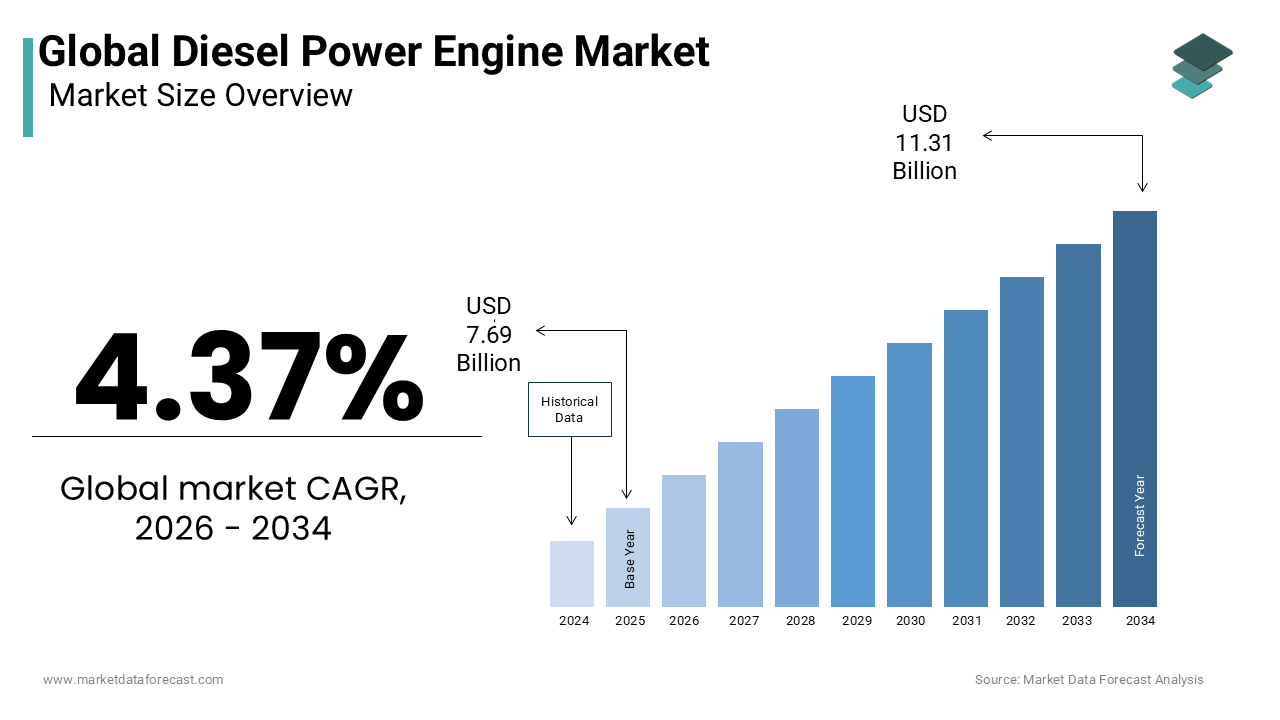
The size of the global diesel power engine market was worth USD 7.69 billion in 2025. The global market is anticipated to grow at a CAGR of 4.37% from 2026 to 2034 and be worth USD 11.31 billion by 2034 from USD 8.03 billion in 2026.
A diesel power engine is an internal combustion engine that burns diesel fuel using heat from compressed air instead of a spark plug. It is also known as a compression-ignition engine. These engines are critical components in heavy-duty trucks, marine vessels, construction equipment and stationary power generation systems due to their superior torque and fuel efficiency. According to the International Energy Agency, the transport sector accounted for 25% of global carbon dioxide emissions from fuel combustion in 2024, highlighting the intense scrutiny faced by diesel technologies. As per the United States Environmental Protection Agency, economy-wide nitrogen oxide emissions have declined significantly, led by a 66% reduction from highway vehicles since 1990, though standards mandated for the 2007 model year required exhaust emissions from on-highway truck engines to be reduced by more than 90%. These metrics clearly show that factories must balance high operations with strict eco-friendly targets. The reliance on diesel for long-haul logistics and remote power generation remains entrenched despite the rise of electrification. Supply chain resilience for critical components such as turbochargers and fuel injection systems dictates market stability. Manufacturers are increasingly integrating digital monitoring tools to optimise engine performance and reduce maintenance costs. This transition reflects a broader industry shift toward smart and sustainable power solutions. The market dynamics are shaped by the interplay of regulatory compliance, operational efficiency and emerging alternative fuel technologies.
MARKET DRIVERS
Unmatched Fuel Efficiency and Torque Requirements in Heavy-Duty Applications Favour Market Growth
Unmatched fuel efficiency and high torque requirements in heavy-duty applications are propelling the diesel power engine market. As per the American Trucking Associations, diesel-powered trucks move approximately 72.7% of all freight tonnage in the United States because no other current technology offers the same combination of range, payload capacity, and refuelling speed. The superior thermal efficiency of diesel engines allows them to convert more fuel energy into useful work compared to gasoline equivalents, which is crucial for long-haul logistics where operating costs are paramount. The Society of Automotive Engineers notes that modern diesel engines achieve thermal efficiencies exceeding 45%, making them indispensable for industries where downtime and fuel consumption directly impact profitability. Construction and mining sectors rely on the high low-end torque of diesel engines to operate heavy machinery under extreme loads without stalling. This mechanical advantage ensures that diesel remains the preferred choice for off-highway equipment despite environmental concerns. Fleet operators prioritise total cost of ownership, which favours diesel due to its longevity and robustness. The lack of viable electric alternatives for heavy long-distance transport sustains this demand. Manufacturers continue to refine combustion processes to extract every drop of efficiency. This operational necessity drives consistent market volume.
Critical Role In Backup Power Generation For Data Centers And Healthcare Facilities Drives Demand
The critical role of diesel engines in backup power generation for data centres and healthcare facilities drives significant demand in the global market. This is owing to their reliability and rapid response capabilities. According to the Uptime Institute, data centre outages continue to edge upward, with one in five major outages costing more than 1,000,000 USD, while broader historical market data from the Ponemon Institute estimates the average cost of downtime at 8,851 USD per minute. Diesel generators provide this immediate power supply within seconds, ensuring continuity for critical operations such as server farms and hospital life support systems. The National Fire Protection Association mandates strict standards for emergency power systems in healthcare facilities, which diesel engines consistently meet due to their proven track record and fuel stability. Unlike battery storage systems, which may degrade over time or have limited discharge durations, diesel generators can run indefinitely as long as fuel is available. This reliability is crucial for mission-critical infrastructure where power loss poses safety risks. The expansion of cloud computing and digital services globally increases the number of data centres requiring robust backup solutions. Regulatory frameworks often require redundant power sources, which diesel technology fulfils effectively. Hospitals and emergency services depend on this assurance for public safety. This institutional reliance creates a stable and recurring demand stream.
MARKET RESTRAINTS
Stringent Emission Regulations And Environmental Policies Restrict Market Expansion
Stringent emission regulations and environmental policies restrict the expansion of the diesel power engine market. These regulations and policies impose costly compliance requirements and limit usage in urban areas. According to the National Emissions Reduction Commitments Directive framework monitored by the European Environment Agency, the European Union has established legally binding national targets requiring a 63% reduction in overall nitrogen oxide emissions by 2030 relative to 2005 levels. The implementation of Euro 7 standards in Europe requires advanced selective catalytic reduction and diesel particulate filters, which increase the initial cost and maintenance complexity of diesel engines. The California Air Resources Board has mandated that all new drayage trucks be zero-emission by 2035, effectively banning new diesel purchases in key logistics hubs. These regulatory pressures make diesel engines less economically attractive compared to emerging electric alternatives for short-haul and urban applications. Companies face penalties for non-compliance, which erode profit margins and discourage investment in new diesel technologies. Municipalities are introducing low-emission zones that restrict diesel vehicle access, reducing their utility for last-mile delivery. The uncertainty regarding future bans creates hesitation among fleet managers. This regulatory headwind limits the addressable market for traditional diesel power units. Innovation is forced toward compliance rather than performance enhancement.
High Initial Costs And Maintenance Complexity Deter Adoption In Price-Sensitive Segments
High initial costs and maintenance complexity deter the adoption of these engines in price-sensitive segments and small-scale operations, which hamper the expansion of the diesel power engine market. As per sources, the implementation of highly sophisticated clean-air architectures adds substantial upfront costs to heavy-duty truck platforms, creating a significant capital hurdle for independent owner-operators and small fleets. The complexity of modern diesel engines requires specialised diagnostic tools and trained technicians for maintenance, which increases operational expenses and downtime. Small enterprises often lack the capital to invest in such sophisticated machinery, preferring cheaper, albeit less efficient, alternatives. The Journal of Engineering for Gas Turbines and Power notes that maintenance intervals for high-pressure common rail systems are shorter and more expensive than older mechanical designs. Fuel quality issues in developing regions can further damage sensitive injection components, leading to costly repairs. This financial burden limits market penetration in emerging economies where cost is the primary decision factor. Retrofitting older engines to meet new standards is often not feasible economically. The total cost of ownership becomes a barrier despite long-term fuel savings. Price-sensitive buyers opt for simpler technologies. This economic constraint restricts market growth in specific demographics.
MARKET OPPORTUNITIES
Integration Of Hybrid Technologies And Range Extenders Creates New Application Avenues
The integration of hybrid technologies and range extenders creates new application avenues for the diesel power engine market. This combination merges diesel efficiency with electric propulsion benefits. According to sources, hybrid commercial vehicles can significantly reduce fuel consumption in urban driving cycles by utilising internal combustion engines at their most optimal efficiency points. This approach allows diesel engines to operate as generators charging batteries that drive electric motors, thus leveraging the high energy density of diesel fuel while minimising emissions. The Society of Automotive Engineers notes that series hybrid architectures are gaining traction in heavy-duty buses and delivery vans where stop-start traffic reduces diesel efficiency. This technology extends the range of electric vehicles beyond the limitations of battery capacity alone, addressing range anxiety for long-distance transport. Manufacturers can repurpose existing diesel engine platforms for hybrid applications, reducing development costs. Governments offer incentives for hybrid commercial vehicles, which stimulate market adoption. This transitional technology bridges the gap between conventional diesel and full electrification. It allows fleet operators to reduce carbon footprints without compromising operational flexibility. The market for hybrid diesel systems is poised for significant growth.
Adoption Of Renewable Diesel and Synthetic Fuels Enhances Sustainability Profile
The adoption of renewable diesel and synthetic fuels enhances the sustainability profile of diesel engines, which is anticipated to accelerate the expansion of these engines in the global market. This shift offers a pathway to decarbonization without replacing existing infrastructure. According to research, renewable diesel production capacity is expected to see substantial expansion driven by policy support and corporate sustainability goals in Europe and North America. These drop-in fuels are chemically identical to petroleum diesel but are produced from biomass or waste oils, allowing them to be used in existing diesel engines without modification. As per sources, renewable diesel can reduce lifecycle greenhouse gas emissions substantially compared to conventional petroleum diesel. This compatibility allows fleet operators to immediately lower their carbon footprint without the high capital expenditure required for electric vehicle conversion. Aviation and marine sectors are also exploring synthetic diesel blends to meet international climate targets. Fuel suppliers are expanding distribution networks for renewable diesel, ensuring availability. This opportunity revitalises the diesel power engine market by aligning it with green energy trends. It provides a practical solution for hard-to-electrify sectors. The demand for compatible engines remains strong.
MARKET CHALLENGES
Rapid Advancement Of Battery Electric Vehicle Technology Threatens Market Relevance
The rapid advancement of battery electric vehicle technology threatens the relevance of the diesel power engine market. This development is particularly visible in light- and medium-duty applications. According to the Environmental Defence Fund, advanced battery-electric vehicle technology is anticipated to provide a comprehensive total cost of ownership edge across the board for heavy-duty vehicle classes starting in 2027. Improvements in energy density allow electric vehicles to achieve ranges previously exclusive to diesel, making them viable for regional haulage. The International Energy Agency forecasts that under current policy frameworks, electric vehicles will represent over 40% of global passenger car sales by 2030, though hitting a 60% market share by 2030 is designated as the threshold necessary to align with net-zero emissions by 2050. Charging infrastructure is expanding rapidly, alleviating range anxiety and enabling wider adoption. Logistics companies are committing to electrify their fleets to meet corporate net-zero targets, displacing diesel units. The silence and smooth operation of electric motors appeal to urban planners and consumers. This technological disruption forces diesel manufacturers to compete on diminishing grounds. The pace of innovation in batteries outstrips incremental improvements in diesel efficiency. This existential threat requires strategic pivots.
Supply Chain Volatility For Critical Components And Raw Materials Disrupts Production
Supply chain volatility for critical components and raw materials disrupts production and increases costs for the diesel power engine market. As per studies, volatile macroeconomic conditions and shifting geopolitical supply constraints trigger severe price fluctuations for copper, rare earth elements, and other critical mineral inputs essential for complex engine wiring and electronics. Semiconductor shortages have delayed the production of engine control units, causing bottlenecks in assembly lines and extending lead times for customers. According to sources, prolonged international shipping route backlogs and maritime bottlenecks drive up generalised logistical freight expenses, disrupting the baseline distribution and availability of industrial machinery components. Manufacturers struggle to maintain just-in-time inventory levels amidst unpredictable supply conditions. Steel and aluminium price spikes further inflate production costs, squeezing profit margins. Dependence on single-source suppliers for specialised parts creates vulnerability to disruptions. These challenges hinder the ability to meet demand and fulfil contracts. Quality control issues may arise from rushed sourcing alternatives. This operational instability complicates long-term planning. Resilience building requires significant investment.
REPORT COVERAGE
| REPORT METRIC | DETAILS |
| Market Size Available | 2025 to 2034 |
| Base Year | 2025 |
| Forecast Period | 2026 to 2034 |
| CAGR | 4.37% |
| Segments Covered | By Operation, Power rating, End-user, and Region. |
| Various Analyses Covered | Global, Regional & Country Level Analysis, Segment-Level Analysis, DROC, PESTLE Analysis, Porter’s Five Forces Analysis, Competitive Landscape, Analyst Overview of Investment Opportunities |
| Regions Covered | North America, Europe, APAC, Latin America, Middle East & Africa |
| Market Leaders Profiled | Caterpillar Inc. (U.S.), Cummins, Inc. (U.S.), MAN SE (Germany), Rolls-Royce Holdings plc. (U.K.),Wärtsilä Corp (Finland), Mitsubishi Heavy Industries, Ltd. (Japan), Volvo Penta (Sweden), Hyundai Heavy Industries Co., Ltd. (South Korea), Doosan (South Korea), Yanmar Co., Ltd. (Japan), Kubota Corporation (Japan), Kohler Co. (U.S.), and Others. |
SEGMENTAL ANALYSIS
By Operation Insights
The standby segment led the diesel power engine market and captured a significant share in 2025. Regulatory mandates for critical infrastructure safety significantly drive the dominance of this segment. As per the National Fire Protection Association, Standard 110 requires that healthcare facilities and emergency response centres maintain backup power systems capable of starting within 10 seconds of a utility failure, which diesel engines uniquely satisfy due to their rapid load acceptance. As per research, thousands of hospitals in the United States must comply with strict reliability standards, ensuring a consistent baseline demand for standby backup generators to protect patient safety. According to European standards consensus, the EN 50341 standard specifies requirements for the design and construction of overhead electrical lines exceeding 1 kV AC, rather than mandating backup power systems for telecommunications and data centres. These legal requirements make standby diesel engines non-negotiable assets for facility managers who prioritise compliance and public safety over cost considerations. The inability of battery storage systems to provide sustained power for extended outages further cements the role of diesel in this segment. Insurance providers often require verified backup power systems to underwrite policies for high-value commercial properties. This regulatory framework creates a captive market where performance reliability is the primary purchasing criterion. Manufacturers focus on engineering engines that meet these precise startup and load criteria. The segment benefits from recurring replacement cycles as ageing units reach end of life. This institutional necessity ensures stable long-term demand.
The increasing frequency of grid instability and natural disasters supports the market leadership of the standby diesel power engine segment by highlighting the need for resilient energy solutions. According to sources, power outages caused by extreme weather events have intensified in frequency and scale across various regions, prompting businesses and households to invest in independent backup power sources. As per studies, ageing electrical transmission and distribution networks contribute to localised blackouts and reliability concerns, making standby generation essential for continuous business operations. Climate change induced storms, hurricanes and wildfires disrupt utility grids for days or weeks, requiring power sources with high energy density and refuelling availability. Diesel fuel remains widely accessible even during disasters, unlike natural gas lines, which may be compromised. Retailers, data centres, and manufacturing plants cannot afford prolonged downtime due to revenue loss and supply chain disruptions. The psychological assurance of having a reliable backup system drives consumer adoption in residential sectors as well. Government grants for disaster preparedness often include subsidies for backup power installations. This trend toward decentralisation and resilience favours diesel technology due to its proven track record. The segment grows as climate risks escalate. Reliability becomes a premium commodity.
The peak shaving segment is predicted to witness the highest CAGR during the forecast period. Rising electricity tariffs and demand-charge penalties accelerate the growth of this segment in the diesel power engine market as industries seek to optimise operational costs. According to sources, demand charges based on peak usage can account for up to 50% of a commercial facility's monthly bill, though U.S. Energy Information Administration data shows that average industrial retail electricity prices decreased overall by roughly 3.3% in 2023. Facilities use diesel generators to supplement grid power during peak demand periods, thereby lowering their maximum recorded load and reducing utility fees. As per studies, time-of-use pricing structures are becoming increasingly prevalent, encouraging large consumers to manage their demand and shift loads away from expensive peak hours. This economic incentive makes the investment in diesel peak shaving systems financially viable, with payback periods often under three years. Manufacturing plants and large commercial buildings utilise automated control systems to seamlessly switch between grid and generator power. This strategy allows companies to maintain production levels without incurring prohibitive energy costs. The volatility of energy markets makes cost containment a strategic priority. Diesel engines offer the flexibility to respond instantly to price signals. This financial driver fuels rapid growth in this operational segment.
The integration of these engines with smart grid technologies enhances operational efficiency and fuels the growth of this segment. As per the International Electrotechnical Commission, smart grid standards enable two-way communication between utilities and consumers, allowing for dynamic load management and real-time pricing adjustments. Diesel generators equipped with advanced digital controllers can automatically respond to grid signals, activating during high-price periods and shutting down when rates drop. The Journal of Modern Power Systems and Clean Energy highlights that hybrid systems combining diesel generators with renewable sources and battery storage optimise energy usage and reduce carbon footprints. This technological synergy allows diesel engines to operate at optimal efficiency points rather than running continuously at partial loads. Utilities offer incentive programs for customers who participate in demand response initiatives using backup generators to stabilise the grid. This creates a new revenue stream for facility owners who lease their generator capacity to the grid operator. The evolution of microgrids further supports this model by enabling localised energy independence. Diesel engines serve as reliable anchors in these complex energy ecosystems. This innovation transforms generators from passive backups into active grid assets.
By Power Rating Insights
The below-0.5 MW segment dominated the diesel power engine market and accounted for a substantial share in 2025. In addition, the proliferation of small- and medium-sized enterprises drives high-volume demand for diesel engines in this segment. As per research, small and medium enterprises constitute approximately 90% of businesses worldwide and contribute significantly to employment and economic activity in both developed and developing nations. These businesses often lack the capital for large-scale power infrastructure and rely on compact diesel generators for backup power and prime power in off-grid locations. According to studies, small and medium-sized enterprises face distinct operational risks during electrical grid failures, which can interrupt production cycles and lead to serious financial losses. Compact diesel engines below 0.5 MW offer an affordable and scalable solution for retail stores, small workshops, and remote offices. Their ease of installation and maintenance makes them accessible to businesses without specialised technical staff. Retailers and distributors stock these units widely, ensuring immediate availability for urgent needs. The modular nature of smaller units allows businesses to expand capacity incrementally as they grow. This segment benefits from a vast customer base across diverse industries. The low entry barrier sustains high sales volumes. It remains the backbone of decentralised power solutions.
Urban construction projects and residential backup needs support the market supremacy of the below 0.5 MW segment. According to the United Nations, urbanisation rates are rising globally, with 68% of the world population projected to live in urban areas by 2050, driving demand for infrastructure development. Construction sites in dense urban environments require compact and quiet diesel generators to power tools and lighting without occupying excessive space or causing noise pollution. Homeowners in suburban areas increasingly install small diesel generators to protect against grid failures caused by severe weather or infrastructure issues. As per sources, supplementary emergency and backup power configurations are increasingly integrated into new home constructions across regions vulnerable to severe weather and grid disruptions. These smaller engines are easier to integrate into residential settings and comply with local noise ordinances. Portable models offer flexibility for recreational vehicles and outdoor events. The convenience and reliability of sub-0.5 MW units make them the preferred choice for individual consumers. This diverse application base ensures consistent demand. The segment thrives on accessibility and versatility
The above-5 MW segment is estimated to register the fastest CAGR from 2026 to 2034 due to the expansion of large-scale data centres and industrial complexes. According to the International Energy Agency, global data centre electricity demand is expected to more than double by 2026, driven primarily by the rapid expansion of artificial intelligence infrastructure. Hyperscale data centres often deploy multiple high-capacity diesel generators in parallel configurations to ensure N+1 or 2N redundancy for mission-critical operations. The Uptime Institute states that tier III and IV data centres mandate robust backup power systems capable of supporting full IT loads for extended durations. Industrial manufacturers such as steel mills and chemical plants also require multi-megawatt power sources to maintain continuous production processes. These large engines offer the high torque and durability needed for heavy industrial applications. Economies of scale make large diesel engines more efficient per kilowatt than smaller units. The centralisation of digital and industrial infrastructure concentrates demand in this high-power segment. Manufacturers focus on developing engines with higher power densities. This trend drives significant revenue growth.
The development of remote mining and oil and gas operations is propelling the expansion of this market segment. According to studies, mineral extraction sites frequently operate in highly isolated geographic locations completely separated from main utility transmission grids, requiring self-sufficient local generation infrastructure. Large diesel engines provide the primary power source for excavation, processing, and transportation equipment in these isolated sites. As per research, the oil and gas sector requires substantial and reliable localised electrical power feeds to maintain drilling, refining, and pipeline logistics in offshore or desert environments. These industries prioritise fuel efficiency and reliability due to the high cost of logistics and downtime. Multi-megawatt diesel engines can run on heavy fuel oil, which is cheaper and more readily available in remote areas. Modular power plants using large diesel engines can be transported and assembled on site quickly. The harsh operating conditions require robust engineering, which specialised manufacturers provide. This sector offers high-value contracts with long service lives. The segment grows as resource extraction expands globally.
By End-User Insights
In 2025, the industrial segment held the majority share in the diesel power engine market because heavy manufacturing and process industries rely on a continuous power supply. As per the United Nations Industrial Development Organisation, the manufacturing sector accounts for 16% of global GDP and requires uninterrupted energy to maintain production lines and avoid costly shutdowns. Industries such as automotive, textiles, and food processing use diesel engines for both prime and backup power to ensure operational continuity. The International Organisation for Standardisation emphasises the importance of power quality and reliability in maintaining product consistency and safety standards. Diesel engines provide the stable frequency and voltage required for sensitive industrial machinery. Factories often operate 24/7, making grid dependence a risk that must be mitigated. The high energy intensity of industrial processes favours the efficiency of large diesel units. Maintenance schedules are aligned with production downtimes, minimising disruption. This sector values durability and long service life over initial cost. The sheer scale of industrial energy consumption sustains market leadership. It remains the largest consumer of diesel power technology.
Regulatory compliance and safety standards mandate robust backup systems in the industrial sector, reinforcing the leading position of diesel power engines. According to research, industrial workplaces must configure specialised emergency infrastructure to maintain critical illumination and protective ventilation routing systems during an active blackout to shield labourers from harm. Chemical and pharmaceutical plants face strict regulations regarding temperature control and pressure management, which require immediate power restoration to prevent hazardous incidents. As per sources, industrial facilities face penalties and administrative enforcement actions for unauthorised pollutant discharges arising directly from secondary mechanism failures during sudden electrical loss. Diesel generators provide the guaranteed start-up time and runtime needed to safely shut down or maintain critical processes. Insurance companies require proof of adequate backup power to cover industrial assets against business interruption claims. This legal and financial imperative drives consistent investment in industrial-grade diesel engines. Companies prioritise certified and tested systems to avoid liability. The segment benefits from mandatory compliance requirements. It ensures steady demand regardless of economic cycles.
The commercial segment is quickly expanding in the diesel power engine market owing to the rapid growth of data centres and telecommunications infrastructure. According to studies, global spending on data centre infrastructure reached 200 billion USD in 2023, with a significant portion allocated to power and cooling systems. Telecommunications companies are expanding 5G networks, which require reliable power at thousands of cell towers and edge computing nodes. As per sources, cellular network uptime remains essential for maintaining subscriber retention and satisfying structural utility benchmarks, encouraging capital allocations toward physical standby generator systems. Commercial entities prioritise brand reputation and service continuity, making power reliability a competitive advantage. Data centres use large arrays of diesel engines to support server racks and cooling systems during grid failures. The shift toward digital services accelerates the construction of new facilities requiring power solutions. This sector offers high growth potential as digitalisation expands. Diesel engines remain the gold standard for commercial backup power. The segment grows in tandem with the digital economy.
The expansion of the retail and hospitality sectors in emerging markets is fueling the upward trajectory of this segment. As per the World Travel and Tourism Council, the travel and tourism sector contributed 9.1% to global GDP in 2023 (amounting to 9.9 trillion USD), following its historical pre-pandemic high of 10.4% of global GDP. Hotels, shopping malls, and restaurants require uninterrupted power for lighting, air conditioning and point-of-sale systems to ensure customer comfort and safety. According to research, unmanaged grid blackouts produce an immediate deflation of merchant earnings and induce lasting negative client sentiment due to disrupted amenities. Commercial establishments in developing regions install diesel generators as primary or backup power sources to mitigate infrastructure deficits. The rise of organised retail chains increases the number of locations requiring standardised power solutions. Franchise models often mandate specific backup power capabilities. This expansion creates a widespread demand for commercial-grade diesel engines. The segment benefits from urbanisation and consumer spending growth. It represents a key area for market penetration.
REGIONAL ANALYSIS
North America Diesel Power Engine Market Analysis
North America was the second-largest player in the diesel power engine market and occupied a noteworthy share in 2025. The region's position in the global market was supported by stringent emission standards and high reliability requirements. According to the U.S. Energy Information Administration, the region accounts for a significant share of global data centre capacity, necessitating robust backup power solutions. The Environmental Protection Agency enforces Tier 4 Final emission standards, which have pushed manufacturers to innovate in after-treatment technologies. The American Trucking Associations notes that diesel trucks move the majority of freight, requiring efficient and compliant engines. Replacement demand for ageing infrastructure supports steady market growth. The shale gas boom has increased demand for power generation in remote drilling sites. Canada’s harsh climate drives demand for reliable heating and power solutions. The market focuses on efficiency and environmental compliance. Innovation in hybrid systems is prominent. North America leads in regulatory enforcement.
Europe Diesel Power Engine Market Analysis
Europe is growing moderately in the diesel power engine market. This growth is being driven by aggressive decarbonization goals and strict emission limits. According to the European Environment Agency, the Euro VI and upcoming Euro VII standards restrict nitrogen oxide and particulate matter emissions, significantly influencing engine design. As per studies, decarbonization policy frameworks promote expanding renewable energy capacity while practical provisions acknowledge a continuing operational reliance on legacy heavy-duty infrastructure and localised emergency backup configurations. Germany and France are key markets for industrial and commercial generators. The region leads in the adoption of renewable diesel fuels to reduce carbon footprints. Urban low-emission zones restrict diesel vehicle usage, but stationary engines remain essential. The market prioritises sustainability and efficiency. Innovation focuses on hybridisation and alternative fuels. Europe sets global benchmarks for environmental standards. The market is mature but evolving rapidly.
Asia Pacific Diesel Power Engine Market Analysis
Asia Pacific was the dominant as well as the fastest-growing region in the diesel power engine market and accounted for a substantial share in 2025. This prominence of the APAC market was propelled by rapid industrialisation and infrastructure development. According to the Asian Development Bank, developing Asia and the Pacific will require approximately 26 trillion USD in infrastructure investment through 2030 (amounting to 1.7 trillion USD annually), with 14.7 trillion USD needed for power and 8.4 trillion USD for transport. China and India are major consumers of diesel engines for construction, mining and transportation. Unreliable grid infrastructure in many countries drives demand for backup and prime power solutions. The Association of Southeast Asian Nations reports rising energy consumption, supporting market expansion. Local manufacturing capabilities are increasing, reducing reliance on imports. The market is price sensitive, but volume is huge. Government initiatives for rural electrification boost demand. Asia Pacific leads in growth rate. It is the centre of global manufacturing.
Latin America Diesel Power Engine Market Analysis
Latin America holds a developing position in the diesel power engine market because of its reliance on hydroelectric power and the need for a backup stability supply. According to sources, climate change is expected to negatively affect regional hydroelectric output through increased streamflow variability and prolonged droughts, creating a clear operational demand for thermal backup power options. Brazil and Mexico are key markets for agricultural and industrial diesel engines. Mining operations in Chile and Peru require robust off-grid power solutions. Political and economic volatility can impact investment, but essential services maintain demand. The region faces challenges with fuel subsidies and import tariffs. Local assembly plants support market presence. The market is driven by resource extraction and agriculture. Latin America offers niche opportunities. Stability is a key concern.
Middle East And Africa Diesel Power Engine Market Analysis
The Middle East and Africa region is an emerging player in the diesel power engine market due to the expansion of oil and gas activities and limited grid access. According to the African Development Bank, nearly 600 million people in Africa live without access to electricity, driving a persistent reliance on stopgap solutions such as off-grid diesel generators. As per studies, Gulf Cooperation Council countries continue to invest heavily in large-scale industrial projects and infrastructure expansion, driving an extensive need for highly reliable localised electrical power feeds. Harsh environmental conditions demand durable and high-performance engines. The region is a major producer of diesel fuel, ensuring availability. Political instability in some areas affects distribution, but essential sectors remain active. South Africa faces load-shedding issues, boosting backup power sales. The market is driven by necessity and resource wealth. Middle East and Africa offer significant potential. Infrastructure gaps create opportunities.
COMPETITIVE LANDSCAPE
Competition in the diesel power engine market is characterized by intense rivalry among established multinational corporations and specialized regional manufacturers. Global leaders leverage their extensive distribution networks and brand reputation to dominate heavy duty and industrial segments. Meanwhile niche players compete on customization and cost effectiveness for specific applications such as marine or remote power generation. Differentiation increasingly hinges on technological advancements in emission control and fuel efficiency rather than price alone. Regulatory pressures regarding carbon emissions force companies to innovate rapidly or face obsolescence. The rise of alternative power sources like battery electric systems creates indirect competition prompting diesel manufacturers to explore hybrid solutions. Strategic alliances with component suppliers ensure access to critical technologies and materials. Service quality and after sales support play crucial roles in retaining customers in this capital intensive industry. Success requires balancing operational excellence with sustainable innovation to meet evolving customer expectations. This dynamic landscape drives continuous improvement and adaptation among market participants who must navigate complex regulatory and economic conditions effectively.
KEY MARKET PLAYERS
Companies playing a prominent role in the global diesel power engine market include
- Caterpillar Inc. (U.S.)
- Cummins, Inc. (U.S.)
- MAN SE (Germany)
- Rolls-Royce Holdings plc. (U.K.)
- Wärtsilä Corp. (Finland)
- Mitsubishi Heavy Industries, Ltd. (Japan)
- Volvo Penta (Sweden)
- Hyundai Heavy Industries Co., Ltd. (South Korea)
- Doosan (South Korea)
- Yanmar Co., Ltd. (Japan)
- Kubota Corporation (Japan)
- Kohler Co. (U.S.)
- Others
Top Players in the Market
Caterpillar Inc.
Caterpillar Inc. is a global leader in diesel power engines providing robust solutions for construction mining and power generation sectors. The company focuses on developing high efficiency engines that meet stringent emission standards while delivering superior performance. Recently Caterpillar expanded its digital services portfolio to offer predictive maintenance solutions for diesel engines enhancing operational uptime for clients. This initiative strengthens customer loyalty and reduces total cost of ownership. The firm also invests heavily in research and development for renewable diesel compatibility ensuring future readiness. These actions reinforce its reputation for reliability and innovation. Caterpillar continues to lead through comprehensive support networks and advanced technology integration. Its commitment to sustainability drives product evolution.
Cummins Inc.
Cummins Inc. plays a pivotal role in the diesel power engine market by offering a diverse range of engines for commercial industrial and residential applications. The company emphasizes fuel efficiency and low emissions through advanced combustion technologies and after treatment systems. Recently Cummins launched new engine platforms designed specifically for hybrid applications bridging the gap between conventional diesel and electrification. This strategic move positions the company as a versatile power solution provider. The firm also expands its manufacturing footprint in emerging markets to improve supply chain resilience. These efforts enhance its global reach and competitiveness. Cummins remains committed to innovation and environmental stewardship. It leverages data analytics to optimize engine performance.
Deere & Company
Deere & Company contributes significantly to the diesel power engine market through its specialized engines for agricultural and construction equipment. The company integrates smart technologies into its engines to improve fuel efficiency and reduce environmental impact. Recently Deere introduced engines compliant with the latest emission regulations in Europe and North America demonstrating its commitment to compliance. The firm also enhances its dealer network to provide better service and support for engine maintenance. These actions strengthen its market position and customer satisfaction. Deere focuses on durability and performance in harsh operating conditions. It continues to innovate in precision agriculture technologies. The company leverages its vertical integration for quality control.
Top Strategies Used by Key Market Participants
Key players in the diesel power engine market prioritize technological innovation to meet stringent emission regulations and improve fuel efficiency. Companies invest heavily in research and development for advanced after treatment systems and hybrid powertrains. Strategic partnerships with technology firms enable the integration of digital monitoring and predictive maintenance capabilities. Geographic expansion into emerging markets allows manufacturers to tap into growing infrastructure and industrial demand. Product diversification includes developing engines compatible with renewable diesel and synthetic fuels to address sustainability concerns. Supply chain optimization ensures resilience against disruptions and cost volatility. Customer centric services such as extended warranties and training programs enhance brand loyalty. Compliance with global environmental standards drives continuous product improvement. These multifaceted strategies collectively strengthen competitive positioning by addressing regulatory economic and operational challenges within the dynamic global business environment.
MARKET SEGMENTATION
This global diesel power engine market research report has been segmented and sub-segmented based on operation, power rating, end-user, and region.
By Operation
- Standby
- Prime
- Peak Shaving
By Power Rating
- Below 0.5 MW
- 0.5-1 MW
- 1.0-2 MW
- 2.0–5 MW
- Above 5 MW
By End-user
- Industrial
- Commercial
- Residential
By Region
- North America
- Europe
- Asia Pacific
- Latin America
- Middle East & Africa