- Product Description Description
- Table of Contents TOC
- List of Table & Figure LOT
- Get Free Sample PDF Sample PDF
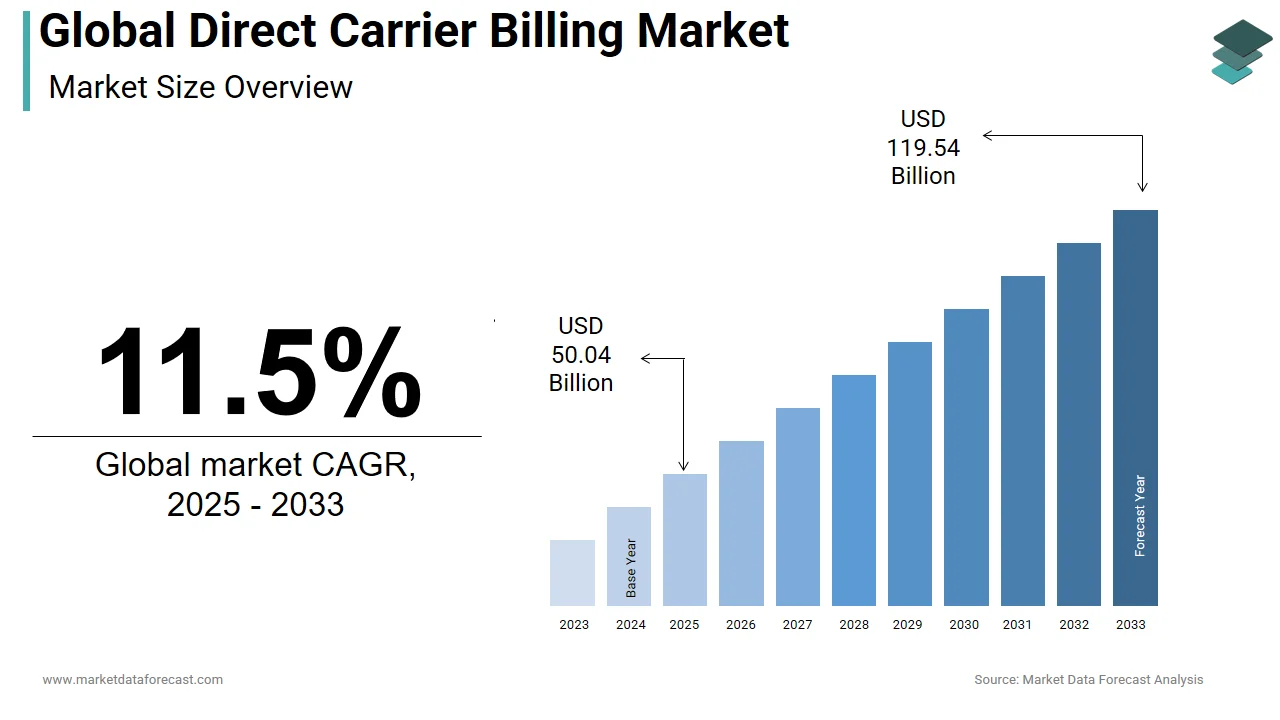
Market Size, 2025
$50.04 BnMarket Estimate, 2026
$55.79 BnMarket Forecast, 2034
$133.29 BnCAGR, 2026–2034
11.5%Global Direct Carrier Billing Market Size
The global direct carrier billing market was worth USD 50.04 billion in 2025. The global market is predicted to reach USD 55.79 billion in 2026 and USD 133.29 billion by 2034, growing at a CAGR of 11.5% during the forecast period.
Direct carrier billing, familiarly known as direct operator billing, encourages the user to purchase by charging payments through their mobile phone carrier bills. This is an online payment method that is available on smartphones. The direct carrier billing method requires a SIM card to make payments. Nowadays, every digital platform is using this method to ensure effective payment methods for customers.
MARKET DRIVERS
There is an ongoing demand for mobile gaming across the world. It is expected that 74% of smartphone users are spending more on gaming, which quietly escalates the demand in the market.
Rising demand for mobile gaming and an increasing number of smartphone users are major factors driving the demand for direct carrier billing in the market. Mobile players can easily purchase their favorite through different payment methods. Many players add the price of the game feature to the carrier bill as it is one of the easiest options available for mobile players. The growing demand for these options is also enhancing the market demand to an extent. The growing prevalence of OTT (Over The Top) content among consumers in recent times is another factor that is propelling the demand of the market. The emergence of high internet speed in developed and developing countries is certainly another major cause for the market to grow enormously. Smartphones are the major key factor for the adoption of OTT platforms everywhere. This is directly influencing the network providers to adopt a direct carrier billing method as a payment option. This is promoting the growth rate of the direct carrier billing market. Many benefits in subscribing to or paying for features or media, even offline, are attracting customers that are leveling up the market demand. The easy availability of smartphones and tablets through online services is also escalating the direct carrier billing market.
MARKET RESTRAINTS
However, a lack of complete knowledge of the payment methods in rural areas is hindering the growth rate of the direct carrier billing market. Increasing fraud activities through hacking are substantially limiting the demand of the market. Also, stringent government rules are hindering the growth of the direct carrier billing market. In underdeveloped countries, the penetration rate of OTT content and other features is very low, which is slowly restricting the demand of the direct carrier billing market. The availability of alternate payment methods is a big challenge for key market players. Also, security concerns among consumers are impeding the growth rate of the direct carrier billing market.
REPORT COVERAGE
| REPORT METRIC | DETAILS |
| Market Size Available | 2025 to 2034 |
| Base Year | 2025 |
| Forecast Period | 2026 to 2034 |
| CAGR | 11.5% |
| Segments Covered | By Type, Platform, End User, and Region. |
|
Various Analyses Covered | Global, Regional, & Country Level Analysis, Segment-Level Analysis, DROC, PESTLE Analysis, Porter’s Five Forces Analysis, Competitive Landscape, Analyst Overview on Investment Opportunities |
| Regions Covered | North America, Europe, APAC, Latin America, Middle East & Africa |
|
Market Leaders Profiled | Bango PLC, Comviva Technologies Limited, Boku, Inc, DIMOCO, Fortumo, NTH Mobile,txtNation Limited, Centili, Infomedia Services Limited, TELECOMING S.A and Others. |
SEGMENTAL ANALYSIS
By Type Insights
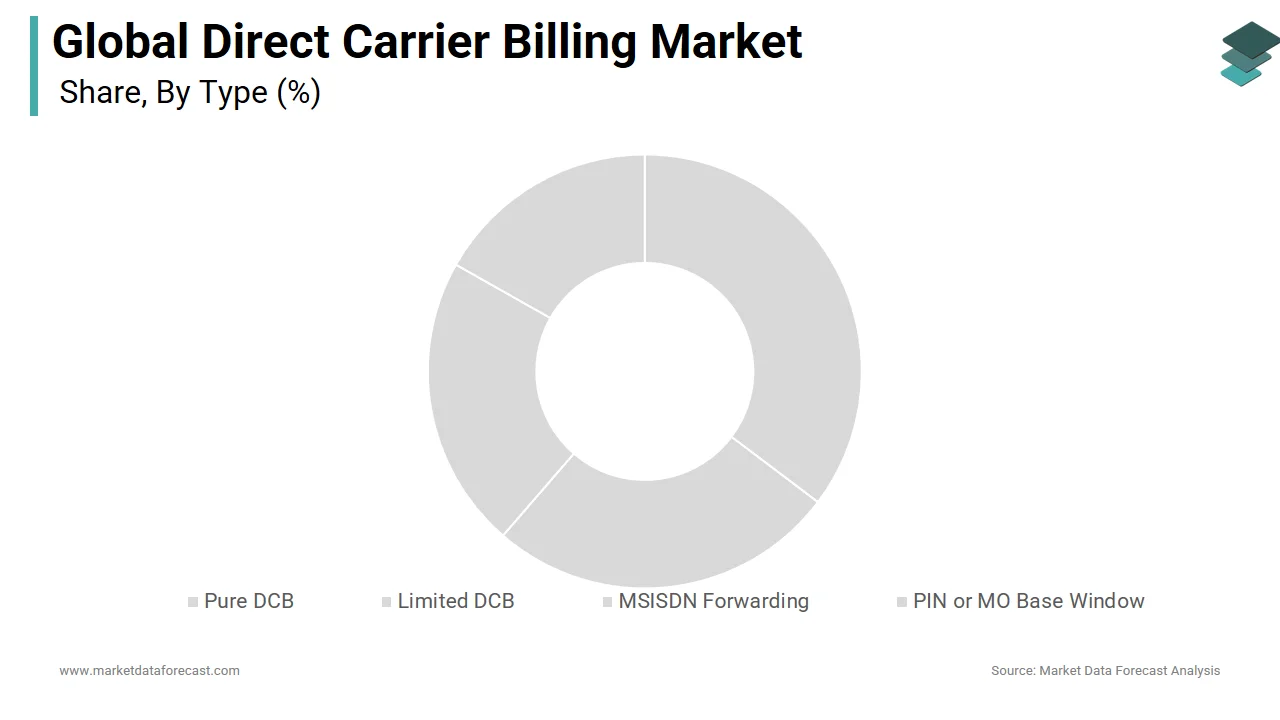
The pure DCB segment is leading with the dominant shares of the market owing to increasing awareness of the benefits included in these payment methods. PIN or MO base window is next in leading the highest shares of the market. Growing customer prevalence for direct carrier billing methods everywhere is promoting the demand of the market. Limited DCB and MSISDN forwarding segments are subjected to prominent growth opportunities in the coming years.
By Platform Insights
The Android platform segment is dominating the shares of the direct carrier billing market. Increasing android-based mobile phones and the increasing prevalence of the adoption of the latest payment methods among customers for various purposes are leveraging the demand of this segment. Also, the iOS platform segment is growing faster during the forecast period due to increasing expenditure on electronic goods.
By End-User Insights
The online media segment is leading with the largest shares of the direct carrier billing market, whereas the apps and games segment is expected to hit the highest CAGR in the near future. The rising usage of smartphones and tablets is the major factor for the growth of these segments.
REGIONAL ANALYSIS
North America is leading with the highest shares of the market. Increasing per capita income and rising disposable income in urban areas are majorly fueling the demand for the direct carrier billing market in North America. Increasing digitalization and consumer’s preference for online payments are accelerating the demand in the market. The presence of key players and quick adoption of the latest technologies are expanding the growth rate of the direct carrier billing market. The increasing prevalence of digital media like Netflix, Amazon Prime, YouTube, and others is likely to fuel the growth rate of the digital carrier billing market. Digital media platforms offer more advantages to users via premium subscriptions that are lavishing the demand of the North American digital carrier billing market.
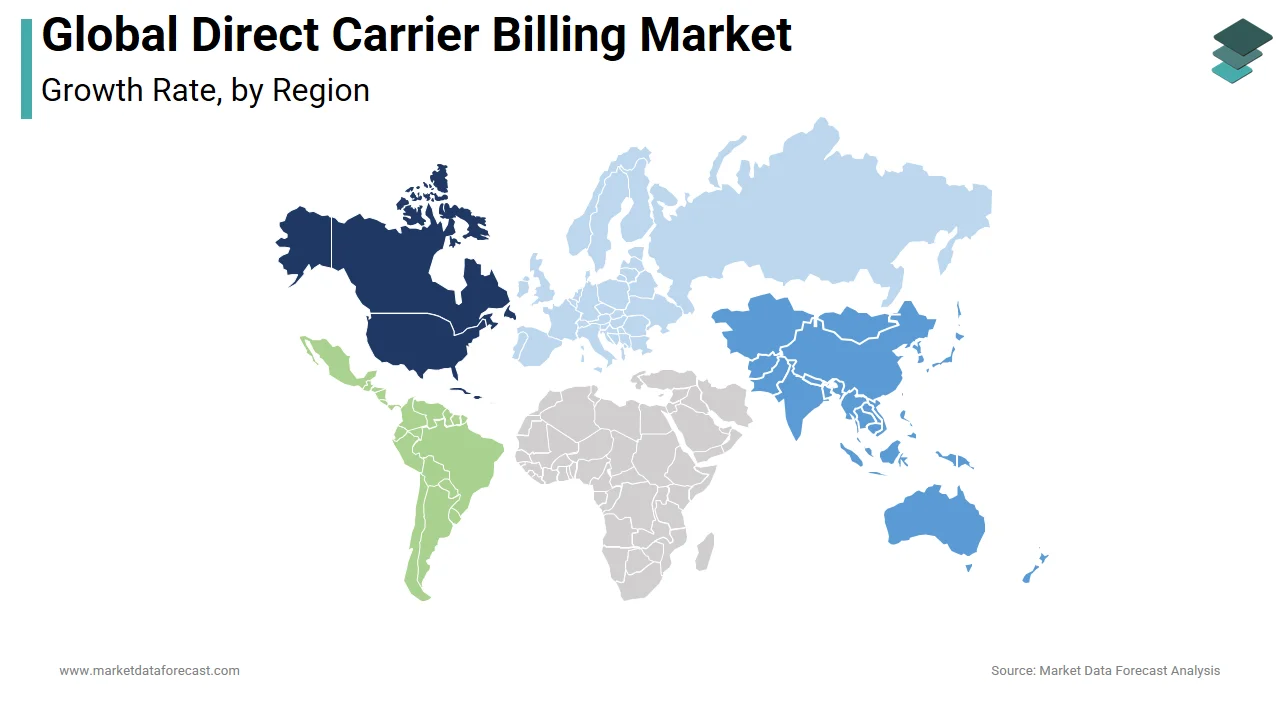
Following North America, Europe's direct carrier billing market is gaining traction over the market shares. Rising income and growing prominence to adopt OTT content are major factors driving the demand of the market. The growing need to provide transparency and lower fraud activities is boosting the growth rate of the market. The Asia Pacific is growing at a faster rate than in the past few years. The emergence of e-commerce in every field is anticipated to surge the demand of the market. Also, the launch of various smartphones with advanced features at affordable prices is increasing the growth rate of the direct carrier billing market. Latin America, Middle East & Africa are expected to have prominent growth opportunities in the coming period.
KEY MARKET PARTICIPANTS
The major companies operating in the global direct carrier billing market include Bango PLC, Comviva Technologies Limited, Boku, Inc., DIMOCO, Fortumo, NTH Mobile, txtNation Limited, Centili, Infomedia Services Limited, and TELECOMING S.A.
RECENT MARKET HAPPENINGS
-
In 2020, Bango and NHN Corp partnered to expand their portfolio. These companies focussed on creating awareness among consumers to gain maximum from the available data.
-
In 2020, iTaxi launched a new ticketing model with the support of direct carrier billing. Centili played a significant role in the technical integration work for this model, which enables customers to charge taxi rides via post-paid plans with play.
-
In 2019, Fortumo agreed to a partnership with Vidio to promote the launch of direct carrier billing services in Indonesia. Fortum’s DCB product was combined with Vidio's direct carrier billing, which is helping digital merchants enable company interaction through mobile operators.
MARKET SEGMENTATION
This research report on the global direct carrier billing market has been segmented and sub-segmented based on the type, platform, end user, and region.
By Type
-
Pure DCB
-
Limited DCB
-
MSISDN Forwarding
-
PIN or MO Base Window
By Platform
-
Android
-
iOS
-
Other Platforms
By End-User
-
Online Media
-
Apps and Games
-
Other End Users
By Region
-
North America
-
The United States
-
Canada
-
Rest of North America
-
-
Europe
-
The United Kingdom
-
Spain
-
Germany
-
Italy
-
France
-
Rest of Europe
-
-
The Asia Pacific
-
India
-
Japan
-
China
-
Australia
-
Singapore
-
Malaysia
-
South Korea
-
New Zealand
-
Southeast Asia
-
-
Latin America
-
Brazil
-
Argentina
-
Mexico
-
Rest of LATAM
-
-
The Middle East and Africa
-
Saudi Arabia
-
UAE
-
Lebanon
-
Jordan
-
Cyprus
-