- Product Description Description
- Table of Contents TOC
- List of Table & Figure LOT
- Get Free Sample PDF Sample PDF
Global Driveline Market Size
The global driveline market size was valued at USD 39.27 billion in 2025 and is anticipated to reach a valuation of USD 45.43 billion in 2026, from USD 145.79 billion by 2034, growing at a CAGR of 15.69% during the forecast period from 2026 to 2034.
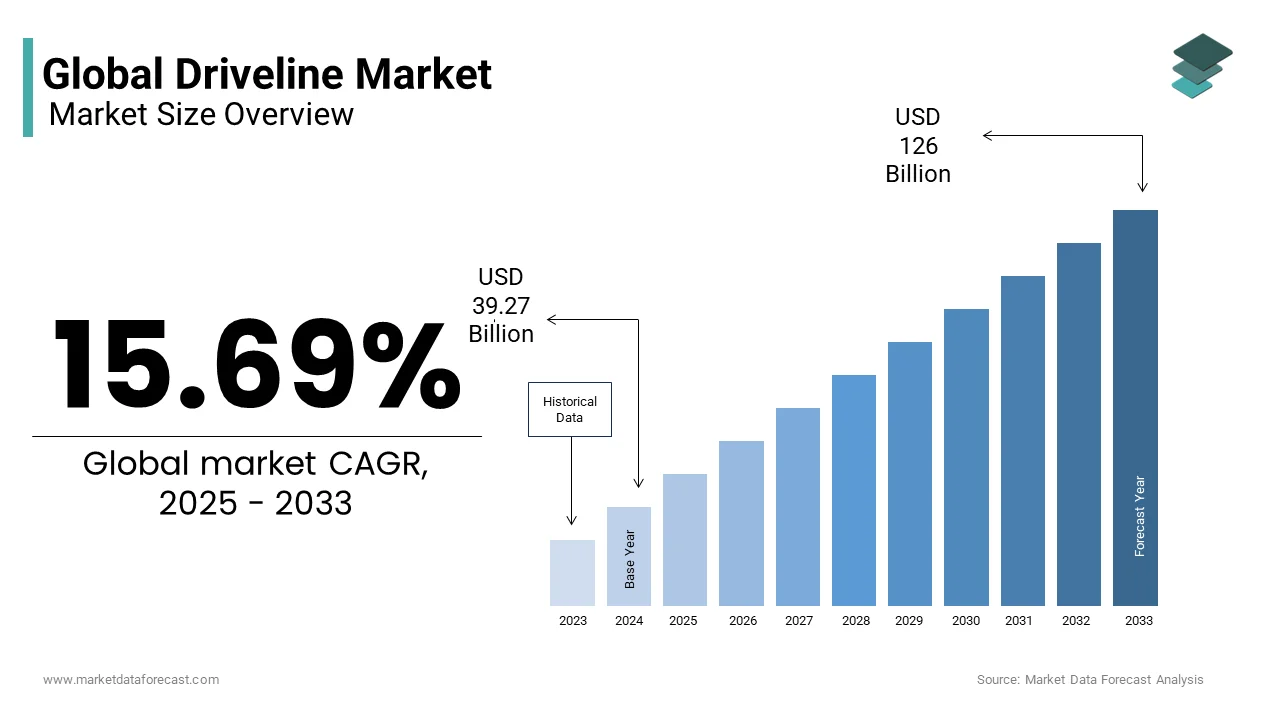
Driveline includes the complex assembly of components responsible for transmitting power from the engine or motor to the driving wheels, including transmissions, drive shafts, differentials, and axles. This critical subsystem determines vehicle performance, efficiency, and handling characteristics, serving as the mechanical backbone of automotive propulsion systems. The global automotive landscape is undergoing a radical transformation as electrification reshapes traditional mechanical architectures into integrated electric drive units. According to the International Energy Agency, global electric car sales reached nearly 14 million in 2023, representing about 18% of all cars sold, which necessitates a fundamental redesign of driveline components to accommodate high torque, instant delivery, and reduced mechanical complexity. As per data from the European Automobile Manufacturers Association, the average weight of new passenger vehicles in Europe has increased by approximately 15% over the last decade due to safety features and electrification, requiring driveline systems to handle greater loads while maintaining efficiency. The shift toward software-defined vehicles means that modern drivelines are no longer purely mechanical but incorporate sophisticated electronic control units that manage power distribution, traction control, and regenerative braking. In Europe, stringent Euro 7 emission standards compel manufacturers to optimize every gram of friction loss within the drivetrain to meet regulatory limits. The integration of advanced materials, such as carbon fiber reinforced polymers and high-strength aluminum alloys, allows for lightweight designs that improve fuel economy without compromising durability. This technological evolution positions the driveline not merely as a transmission mechanism but as an intelligent system central to the energy management and dynamic performance of next-generation mobility solutions.
MARKET DRIVERS
Accelerating Electrification Driving Demand for Integrated Electric Drive Units
The rapid transition from internal combustion engines to battery electric vehicles is fundamentally altering driveline architecture, which is one of the major factors propelling the expansion of the global driveline market. According to BloombergNEF, global annual electric vehicle sales are projected to reach approximately 30 million units by 2030, which is requiring specialized driveline components that combine motors, inverters, and gearboxes into single modules. As per technical analysis from the Society of Automotive Engineers, electric drivetrains eliminate the need for complex multi-speed transmissions, clutches, and exhaust systems, reducing part count by up to 60% compared to conventional vehicles. This simplification drives manufacturers to develop high-efficiency, single-speed reduction gears capable of handling instantaneous torque outputs exceeding 600 Newton meters. The absence of engine idling allows for optimized gear ratios that maximize acceleration and top-speed efficiency. Major automakers are investing heavily in axial flux motors, which offer higher power density and reduced weight compared to traditional radial designs. According to data from the US Department of Energy, advancements in silicon carbide semiconductors have improved inverter efficiency by 5%, directly impacting driveline thermal management requirements. The modular nature of electric drive units enables flexible platform strategies, allowing manufacturers to scale power output for different vehicle segments using common core components. This standardization reduces development costs and accelerates time to market. The need for quiet operation in electric vehicles also demands precise machining and superior noise, vibration, and harshness (NVH) engineering in gear sets, pushing suppliers to adopt advanced manufacturing techniques such as grinding and honing to achieve micron-level tolerances.
Stringent Fuel Efficiency Regulations Mandating Lightweight and Low-Friction Designs
Global governments are enforcing increasingly rigorous fuel economy and emission standards that compel automakers to minimize energy losses within the driveline system, which is further contributing to the global driveline market growth. According to the Environmental Protection Agency, the Corporate Average Fuel Economy (CAFE) standard for light-duty vehicles in the United States requires an average of 49 miles per gallon by 2026, forcing manufacturers to reduce parasitic losses in transmissions and differentials. As per data from the International Council on Clean Transportation, improving driveline efficiency by just 1% can reduce overall vehicle fuel consumption by approximately 0.5%, which is significant when aggregated across millions of vehicles. To achieve these gains, suppliers are developing low-viscosity lubricants and surface coatings that reduce friction in bearings and gears by up to 15%. The adoption of lightweight materials, such as magnesium alloys and composite plastics for housing components, helps reduce overall vehicle mass, thereby lowering the energy required for acceleration. According to research from the Fraunhofer Institute for Manufacturing Engineering and Automation, new manufacturing processes like near-net-shape casting reduce material waste and component weight simultaneously. Two-speed transmissions for electric vehicles are gaining traction as they allow for better optimization of motor efficiency across a wider speed range, improving highway range by up to 10%. These innovations are essential for meeting Euro 7 and China VI emission norms, which limit not only tailpipe emissions but also consider total lifecycle energy usage. The pressure to comply drives continuous investment in simulation tools and testing facilities to validate efficiency improvements under real-world driving conditions.
MARKET RESTRAINTS
High Cost of Advanced Materials and Manufacturing Technologies
The development of next-generation driveline components requires expensive, advanced materials and precision manufacturing processes that significantly increase production costs, which is a significant impediment to the driveline market growth. According to data from the US Geological Survey, the price of rare earth elements used in high-performance permanent magnet motors fluctuated significantly in 2023 due to supply chain constraints affecting profitability. As per industry analysis from Deloitte, the transition to silicon carbide-based power electronics, which are essential for efficient electric drivelines, costs significantly more than traditional silicon-based systems, although prices are expected to decrease with scale. The precision required for manufacturing gears in electric drivetrains demands specialized grinding and honing equipment that represents a substantial capital expenditure for suppliers. Small and medium-sized enterprises struggle to afford these investments, leading to market consolidation where only large players can compete effectively. According to reports from the Bureau of Labor Statistics, labor costs for skilled manufacturing technicians have increased by roughly 3% to 4% annually in recent years, outpacing general inflation. The need for rigorous quality control to ensure zero-defect rates in high-volume production further adds to operational expenses. Any deviation in tolerance can lead to premature failure or excessive noise, which is unacceptable in premium electric vehicles. These financial barriers limit the ability of smaller innovators to enter the market and force established suppliers to pass costs onto automakers who face their own margin pressures. The high initial investment slows down the adoption of cutting-edge technologies in budget vehicle segments where cost sensitivity remains paramount.
Complexity of Integrating Software and Hardware Systems
Modern drivelines are increasingly software-defined, requiring seamless integration between mechanical components and electronic control units, which introduces significant technical complexity and hampering the global market expansion. According to the Society of Automotive Engineers, modern premium vehicles contain over 100 million lines of code, with a substantial portion dedicated to powertrain and driveline management. As per data from McKinsey and Company, software-related issues account for a large percentage of automotive recalls, highlighting the difficulty in ensuring robust performance across diverse operating conditions. The coordination between the battery management system, inverter, motor, and gearbox requires sophisticated algorithms that must be validated through extensive simulation and real-world testing. Any latency or error in communication can lead to inefficient power delivery or safety hazards. The lack of standardized interfaces between different suppliers' components complicates integration efforts, forcing automakers to invest heavily in proprietary middleware. According to reports from the European Association of Automotive Suppliers, the development cycle for software-intensive driveline systems has extended by several months compared to purely mechanical predecessors. Cybersecurity concerns also arise as connected drivelines become potential targets for malicious attacks that could compromise vehicle control. Ensuring functional safety according to ISO 26262 standards requires redundant systems and fail-safe mechanisms that add weight and cost. The shortage of software engineers with automotive expertise further exacerbates the challenge, slowing down innovation and time to market. Manufacturers must balance the flexibility of software updates with the reliability expected from mechanical hardware, creating a delicate engineering equilibrium.
MARKET OPPORTUNITIES
Expansion of All-Wheel Drive Systems in Electric Vehicles
The growing consumer preference for all-wheel drive (AWD) configurations in electric vehicles is a significant opportunity for the global driveline market. According to J.D. Power, over 35% of electric vehicle buyers in North America prefer all-wheel drive models due to improved traction and performance capabilities. As per data from the Alliance for Automotive Innovation, dual-motor setups allow for independent control of front and rear axles, enabling advanced torque vectoring that enhances handling stability and cornering precision. This configuration eliminates the need for heavy mechanical differentials and drive shafts, replacing them with compact e-axles at each end. The modularity of this approach allows manufacturers to offer varying power levels, from single-motor rear-wheel drive to high-performance quad-motor setups. According to industry analysis from Yole Group, the market for e-axles is expected to grow at a compound annual growth rate of approximately 12% through 2030, driven by this trend. The ability to disconnect one motor during cruising improves efficiency by reducing drag and electrical losses, extending driving range. Suppliers are developing integrated inverters and motors that fit within the wheel hub or axle assembly, saving space and weight. This architectural shift opens new revenue streams for companies specializing in compact, high-torque electric motors and power electronics. The versatility of all-wheel drive systems also appeals to luxury and performance segments where dynamic driving characteristics are key selling points.
Development of Two-Speed Transmissions for Enhanced Range and Performance
The introduction of two-speed transmissions for electric vehicles offers a unique opportunity to the global driveline market expansion. According to research from the Argonne National Laboratory, a two-speed gearbox can improve overall driveline efficiency by up to 5%, particularly during high-speed highway driving where single-speed motors operate less efficiently. As per data from ZF Friedrichshafen AG, adding a second gear allows the motor to stay within its optimal efficiency map during cruising while providing a lower gear for maximum acceleration from a standstill. This technology bridges the gap between the simplicity of single-speed units and the complexity of multi-speed automatics found in internal combustion vehicles. The market for such transmissions is nascent but growing as premium electric vehicle manufacturers seek to differentiate their products through superior range and driving dynamics. According to industry reports from Automotive News, several major suppliers are piloting two-speed units for upcoming electric platforms targeting the luxury segment. The ability to shift gears seamlessly enhances the driving experience, making electric vehicles feel more engaging and responsive. This innovation also allows for smaller, lighter motors since the transmission handles the torque multiplication requirements, reducing overall system weight. As battery energy density improvements slow down, driveline efficiency gains become increasingly critical for extending range without adding costly battery capacity.
MARKET CHALLENGES
Supply Chain Volatility for Critical Raw Materials
The significant risks from supply chain disruptions affecting the availability of critical raw materials are primarily challenging the expansion of the global driveline market. According to the World Bank, commodity prices for copper, which is essential for electric motor windings, have experienced significant volatility due to mining delays and rising global demand. As per data from the US Geological Survey, China controls a substantial portion of global rare earth processing capacity, creating strategic vulnerabilities for manufacturers dependent on these materials for permanent magnet motors. Trade tensions and export restrictions can abruptly limit access to neodymium and dysprosium, causing production bottlenecks and price spikes. The just-in-time manufacturing model adopted by many automakers leaves little room for inventory buffers, exacerbating the impact of any supply interruption. According to reports from the Semiconductor Industry Association, shortages of power semiconductors used in inverters have periodically delayed driveline production for some manufacturers. Logistics challenges, including port congestion and freight cost increases, further complicate procurement planning. The lack of diversified sourcing options means that any geopolitical instability in key producing regions immediately affects global production schedules. Manufacturers are forced to redesign components to use alternative materials, which requires extensive revalidation and delays product launches. This structural vulnerability undermines production stability and increases operational costs as companies compete for limited resources in a tight market.
Technical Challenges in Thermal Management of High-Power Density Systems
As electric drivelines become more compact and powerful, managing heat generation becomes a critical technical challenge that impacts performance and longevity, which is further challenging the global market growth. According to data from the Oak Ridge National Laboratory, high-power density motors and inverters generate significant heat during rapid acceleration and sustained high-speed operation, requiring advanced cooling solutions. As per industry analysis from Mahle, traditional air cooling is insufficient for modern electric drivetrains, necessitating the integration of liquid cooling channels directly into motor housings and gearboxes. This adds complexity to the design and manufacturing process, increasing the risk of leaks and failures. The thermal expansion of different materials within the driveline assembly must be carefully managed to maintain precise tolerances and prevent wear. According to reports from the Society of Automotive Engineers, inadequate thermal management can reduce motor efficiency by up to 10% and shorten component lifespan significantly. The integration of cooling systems also adds weight and volume, counteracting some of the benefits of electrification. Suppliers are exploring innovative materials with higher thermal conductivity, such as ceramic composites and advanced polymers, to improve heat dissipation. However, these materials are often expensive and difficult to process at scale. The need for silent operation limits the use of active cooling fans, forcing reliance on passive or liquid systems that must be meticulously engineered. Balancing thermal performance with weight, cost, and reliability remains a persistent engineering hurdle that requires continuous innovation and rigorous testing.
REPORT COVERAGE
| REPORT METRIC | DETAILS |
| Market Size Available | 2025 to 2034 |
| Base Year | 2025 |
| Forecast Period | 2026 to 2034 |
| CAGR | 15.69% |
| Segments Covered | By Architecture, Transmission, Motor Output, Drive, Vehicle, Final Drive, Power Electronics, Material, Component, Distribution Channel, and Region. |
| Various Analyses Covered | Global, Regional, and Country Level Analysis, Segment-Level Analysis, DROC, PESTLE Analysis, Porter’s Five Forces Analysis, Competitive Landscape, Analyst Overview of Investment Opportunities |
| Regions Covered | North America, Europe, APAC, Latin America, Middle East & Africa |
| Market Leaders Profiled | ZF, GKN, BorgWarner, Robert Bosch, Hitachi, Continental AG, Delphi Automotive, Denso Corporation, Valeo, and Others. |
SEGMENTAL ANALYSIS
By Vehicle Insights
The internal combustion engine (ICE) vehicles segment held the dominant share of the global market in 2025 and is likely to remain a significant portion of the global fleet over the forecast period as manufacturers focus on incremental efficiency improvements. ICE vehicles hold the leading position in the driveline market, primarily because of their mature manufacturing ecosystem and widespread consumer acceptance. According to data from the International Organization of Motor Vehicle Manufacturers, millions of internal combustion engine vehicles were produced globally in 2023, ensuring sustained demand for traditional transmissions, differentials, and drive shafts. As per reports from the Society of Automotive Engineers, the extensive refueling infrastructure, with hundreds of thousands of gas stations worldwide, supports the continued dominance of these vehicles, particularly in regions with limited electric charging networks. The lower upfront cost compared to electrified alternatives makes ICE vehicles accessible to a broader demographic in emerging economies where price sensitivity is high. Manufacturers have optimized these drivelines over decades, achieving high reliability and efficiency, which reduces perceived risk for buyers. According to industry analysis from S&P Global Mobility, the aftermarket support for ICE drivelines is robust, with readily available spare parts and skilled technicians ensuring low maintenance costs. This established ecosystem creates a barrier to rapid displacement by newer technologies as consumers prioritize convenience and affordability. The versatility of internal combustion engines across various vehicle segments, from compact cars to heavy-duty trucks, further cements their market leadership. Despite regulatory pressures, the sheer volume of existing fleets and ongoing production in developing nations ensures that ICE drivelines remain the primary revenue source for component suppliers for the foreseeable future.
On the other end, the battery electric vehicles (BEVs) segment is estimated to record a promising CAGR of 23.2% during the forecast period as charging infrastructure expands and battery costs continue to decrease, stringent emission regulations and advancements in battery technology. According to data from the International Energy Agency, global sales of battery electric vehicles reached nearly 14 million units in 2023, representing a significant increase from the previous year. As per reports from BloombergNEF, government incentives, such as tax credits and purchase subsidies in major markets like China, Europe, and the United States, have significantly lowered the total cost of ownership for electric vehicles. The development of integrated electric drive units that combine motors, inverters, and gearboxes into compact modules has simplified manufacturing and reduced production costs. According to technical analysis from the US Department of Energy, improvements in lithium-ion battery energy density have extended driving ranges to over 300 miles, alleviating range anxiety among consumers. Major automakers are committing billions of dollars to electrify their portfolios, with several brands announcing plans to cease ICE production by 2035. This strategic shift drives demand for specialized electric driveline components, such as high-speed reduction gears and e-axles. The superior torque characteristics of electric motors provide enhanced performance, appealing to performance-oriented buyers. As charging infrastructure expands rapidly with millions of public chargers globally, the practicality of BEVs improves further, accelerating adoption rates and driveline market transformation.
By Transmission Insights
The automatic transmissions segment accounted for the largest share of the global market in 2025 and is likely maintain their dominance over the forecast period owing to the increasing demand for convenience and the integration of hybrid systems, superior driving comfort and ease of use compared to manual alternatives. According to data from J.D. Power, over 80% of new vehicles sold in North America and Europe are equipped with automatic transmissions, reflecting strong consumer preference for convenience in urban traffic conditions. As per reports from the Society of Automotive Engineers, modern eight-speed and ten-speed automatic transmissions provide smooth gear shifts and improved fuel efficiency through optimized gear ratios. The integration of advanced electronic control units allows for adaptive shifting strategies that respond to driving styles and road conditions, enhancing performance. According to industry analysis from various market reports, the decline in manual transmission availability in many markets has forced consumers toward automatic options as manufacturers streamline production lines. The rise of hybrid vehicles, which inherently require automatic or continuously variable transmissions to manage power flow between the engine and motor, further boosts demand. Automatic transmissions also facilitate the integration of start-stop systems and coasting functions that improve fuel economy. The perception of automatic transmissions as more premium and technologically advanced appeals to buyers in emerging markets where aspirational purchasing drives sales. Manufacturers continue to refine automatic designs to reduce weight and friction, ensuring they remain competitive against newer transmission technologies while maintaining high reliability standards.
On the other side, the electronic continuously variable transmissions (E-CVT) segment is expected to experience a CAGR of 10.4% during the forecast period due to its ability to keep the engine or motor operating at optimal efficiency levels. According to data from the International Council on Clean Transportation, continuously variable transmissions can improve fuel efficiency by up to 10% compared to traditional stepped gearboxes by eliminating fixed gear ratios. As per reports from major automotive manufacturers who are major proponents of this technology, the seamless acceleration provided by continuously variable transmissions enhances driving comfort and reduces noise, vibration, and harshness (NVH). The integration of electronic controls allows for precise management of the pulley ratio, enabling better coordination with hybrid systems and regenerative braking. According to industry analysis from Yole Group, the adoption of continuously variable transmissions in hybrid vehicles has increased significantly as they provide an ideal interface for managing power split between internal combustion engines and electric motors. The simplicity of the mechanical design compared to multi-speed automatics reduces manufacturing complexity and weight. Advances in belt materials and pulley designs have improved durability, addressing historical concerns about reliability. The trend toward downsized, turbocharged engines benefits from continuously variable transmissions, which can maintain optimal boost pressure and engine speed. As emission standards tighten, the efficiency advantages of continuously variable transmissions make them an attractive option for manufacturers seeking to meet regulatory requirements without complex multi-gear systems.
By Drive Insights
The front-wheel drive (FWD) configurations segment captured 55.9% of the global market share in 2025 and is likely to remain the most common choice for affordable and compact vehicles during the forecast period, primarily because it offers a cost-effective and space-efficient layout for compact and mid-size vehicles. According to data from the European Automobile Manufacturers Association, front-wheel drive configurations eliminate the need for a rear differential and long drive shaft, reducing vehicle weight and manufacturing costs by up to 15%. As per reports from the Society of Automotive Engineers, the transverse engine layout associated with front-wheel drive maximizes interior cabin space, allowing for larger passenger compartments and trunk capacity in smaller footprints. This spatial efficiency is crucial for urban vehicles where exterior dimensions are constrained by parking and maneuverability requirements. According to industry analysis from S&P Global Mobility, the majority of entry-level and family sedans and hatchbacks utilize front-wheel drive due to its proven reliability and lower maintenance requirements. The simpler mechanical architecture reduces the number of components that can fail, lowering warranty claims and service costs. Front-wheel drive also provides adequate traction for most driving conditions, especially when combined with electronic stability control and traction management systems. The widespread availability of skilled technicians for FWD repairs ensures low ownership costs. Manufacturers favor this layout for high-volume models as it allows for platform sharing across multiple vehicle segments, optimizing production efficiency and economies of scale.
On the other end, the all-wheel drive (AWD) segment is estimated to register a CAGR of 8.1% during the forecast period owing to the increasing consumer demand for enhanced traction, safety, and performance in diverse weather conditions. According to data from J.D. Power, all-wheel drive availability in new vehicles in the United States increased to over 40% in 2023, as buyers prioritize safety and capability. As per reports from the Alliance for Automotive Innovation, the rise of sport utility vehicles (SUVs) and crossovers, which predominantly feature all-wheel drive configurations, has fueled market growth. All-wheel drive systems provide superior handling stability and cornering precision by distributing torque to all four wheels, reducing the risk of skidding on wet or icy roads. According to industry analysis from Frost and Sullivan, the integration of electronic all-wheel drive systems in electric vehicles allows for instantaneous torque vectoring, enhancing dynamic performance without mechanical complexity. The popularity of outdoor activities and adventure travel has increased demand for vehicles capable of handling off-road conditions, where all-wheel drive is essential. Manufacturers are developing lightweight, on-demand all-wheel drive systems that engage only when necessary, improving fuel efficiency while maintaining capability. The premium perception of all-wheel drive allows automakers to command higher prices, increasing profit margins. As climate change leads to more unpredictable weather patterns, consumers view all-wheel drive as a necessary safety feature rather than a luxury option.
REGIONAL MARKET ANALYSIS
North America Market Analysis
North America occupied 28.7% of the global market share in 2025 and is expected to maintain its current market position as a hub for high-performance and large-vehicle driveline technology over the next few years. According to data from the Alliance for Automotive Innovation, light truck and SUV sales accounted for over 75% of new vehicle registrations in the United States in 2023, driving demand for robust all-wheel drive and heavy-duty driveline components. As per reports from the National Highway Traffic Safety Administration, strict fuel economy standards compel manufacturers to integrate advanced automatic transmissions and lightweight materials to improve efficiency without sacrificing performance. The region's strong focus on performance vehicles supports demand for high-torque drivelines and sophisticated differential systems. Major suppliers have established a strong manufacturing presence to serve domestic automakers. According to data from Argonne National Laboratory, the adoption of hybrid and electric drivelines is accelerating, with several states implementing zero-emission vehicle mandates. The mature aftermarket sector ensures steady demand for replacement driveline parts. Investment in research and development for autonomous driving technologies integrates advanced driveline control systems, enhancing safety and convenience. The region's high disposable income supports premium vehicle sales where advanced driveline features are standard. Continued investment in charging infrastructure supports the transition to electric drivelines, ensuring long-term market growth.
Europe Market Analysis
Europe is anticipated to lead in technological adoption and sustainability-focused driveline innovations as it continues to navigate its transition to electric mobility over the next few years. According to data from the European Automobile Manufacturers Association, over 20% of new car registrations in the EU in 2023 were fully electric vehicles, requiring specialized electric driveline components. As per the Euro 7 emission standards, automakers are compelled to minimize friction losses and weight in drivelines to meet compliance, leading to the adoption of advanced lubricants and lightweight materials. The region's strong engineering base supports innovation in transmission technologies, such as dual-clutch and continuously variable systems. Key markets like Germany, France, and the United Kingdom have major suppliers leading global technology development. According to data from the European Commission, government incentives for electric vehicles and bans on internal combustion engines in certain cities accelerate market transformation. The emphasis on sustainability promotes circular economy practices in driveline manufacturing and recycling. High fuel prices encourage consumers to choose efficient drivelines, including hybrids and electrics. The dense urban environment favors compact and efficient driveline architectures. Collaboration among European manufacturers and research institutions fosters rapid technological advancement, ensuring the region remains at the forefront of driveline innovation and regulatory compliance.
Asia Pacific Market Analysis
Asia Pacific is expected to remain the largest and fastest-growing regional market due to its massive production base and the rapid adoption of new energy vehicles over the next few years. According to data from the China Association of Automobile Manufacturers, China produced over 25 million vehicles in 2023, with a significant portion featuring advanced automatic and electric drivelines. As per reports from the Japan Automobile Manufacturers Association, Japanese companies lead in hybrid driveline technology, supplying components globally. The rapid urbanization and rising middle class in India and Southeast Asia increase demand.
COMPETITIVE LANDSCAPE
The competitive landscape of the driveline market features intense rivalry among established tier one suppliers and emerging technology firms striving to dominate the transition toward software defined vehicles. Major corporations leverage extensive global networks and deep engineering expertise to offer comprehensive solutions that integrate steering braking and suspension systems for holistic vehicle dynamics control. Innovation centers on developing efficient electric drive technologies that eliminate mechanical links enabling new interior designs and higher levels of automation. Price pressure from automakers forces suppliers to optimize manufacturing efficiency and reduce component costs without compromising reliability or performance. Intellectual property rights regarding control algorithms and power electronics become critical differentiators as companies seek to protect their technological advantages. Strategic partnerships with semiconductor manufacturers ensure stable supply of essential chips amidst global shortages. The entry of new players specializing in electric drivetrains adds complexity as they bundle driveline systems with broader electrification packages. Regulatory compliance across diverse regions requires adaptable platforms that meet varying safety and emission standards. Customer loyalty depends on consistent quality timely delivery and collaborative development capabilities making service excellence as important as product innovation in securing long term contracts.
KEY MARKET PLAYERS
A few of the market players in the global driveline market include
- ZF
- GKN
- BorgWarner
- Aisin Corporation
- Robert Bosch
- Hitachi
- Continental AG
- Delphi Automotive
- Denso Corporation
- Valeo
Top Players in the Global Market
- ZF Friedrichshafen AG stands as a global leader in driveline technology providing comprehensive solutions for transmissions axles and electric drive systems. The company actively supports the transition to electromobility by developing integrated e axle modules that combine motors power electronics and gearboxes. Recent strategic initiatives include significant investments in software defined vehicle architectures to enhance driveline control and efficiency. ZF collaborates closely with major automakers to supply advanced eight speed automatic transmissions and hybrid modules. The firm focuses on sustainability by optimizing manufacturing processes and developing recyclable components. Their commitment to innovation is evident in the expansion of production facilities for electric drivelines ensuring they meet growing global demand. ZF continues to strengthen its position through strategic partnerships and continuous research into next generation propulsion technologies.
- Aisin Corporation maintains a strong presence in the driveline sector by leveraging its expertise in automatic transmissions and hybrid system components. The company specializes in producing high efficiency continuously variable transmissions and electric drive units for a wide range of vehicles. Recent actions include expanding production capacity for electric powertrains to support the rapid growth of battery electric vehicles globally. Aisin invests heavily in lightweight materials and precision manufacturing to improve fuel economy and performance. The corporation emphasizes quality and reliability ensuring its products meet stringent international standards. Strategic collaborations with technology firms enable the integration of advanced control algorithms into driveline systems. Aisin focuses on cost effective solutions that appeal to both premium and mass market segments reinforcing its role as a key supplier in the evolving automotive landscape.
- BorgWarner Inc. is a specialized supplier dedicated to propulsion systems offering innovative driveline solutions including all wheel drive systems and electric boosters. The company distinguishes itself through advanced thermal management technologies and high torque electric motors designed for hybrid and electric applications. Recent strategic moves include acquiring companies with expertise in silicon carbide electronics to enhance inverter efficiency. BorgWarner collaborates with global manufacturers to develop modular e drive systems that reduce weight and complexity. The firm prioritizes sustainability by implementing eco friendly manufacturing practices and designing energy efficient components. Their agile approach to product development allows rapid customization for diverse platforms. BorgWarner focuses on delivering high performance driveline technologies that improve vehicle dynamics and efficiency strengthening its reputation as a critical partner for automakers seeking competitive advantages.
Top Strategies Used By Key Market Participants
Key players in the driveline market primarily focus on accelerating electrification by developing integrated electric drive units that combine motors inverters and gearboxes. Manufacturers invest heavily in research and development to create lightweight compact designs that improve vehicle efficiency and accommodate electric vehicle architectures. Expansion into emerging markets through local production facilities helps reduce costs and mitigate supply chain risks while meeting regional content requirements. Companies prioritize vertical integration by producing critical components such as semiconductors and sensors in house to ensure quality control and protect proprietary technology. Product differentiation through customizable software features allows suppliers to offer tailored solutions that enhance driver experience and brand identity. Sustainability initiatives drive the adoption of recyclable materials and energy efficient manufacturing processes aligning with global environmental regulations. Continuous improvement in functional safety standards ensures compliance with rigorous automotive security protocols building trust among original equipment manufacturers and consumers alike.
MARKET SEGMENTATION
This research report on the global driveline market is segmented and sub-segmented into the following categories.
By Architecture
- Series Driveline
- Parallel Driveline
- Power Split Driveline
- Electric Driveline (EV Driveline)
By Transmission Type
- Automatic Transmission (AT)
- Dual Clutch Transmission (DCT)
- Electronic Continuously Variable Transmission (E-CVT)
- Manual Transmission
- Continuously Variable Transmission (CVT)
By Motor Output
- 45–100 kW
- 101–250 kW
- Above 250 kW
By Drive Type
- Front-Wheel Drive (FWD)
- Rear-Wheel Drive (RWD)
- All-Wheel Drive (AWD)
- Four-Wheel Drive (4WD)
By Vehicle Type
- Passenger Cars
- Commercial Vehicles
- Off-Highway Vehicles
- Hybrid Electric Vehicles (HEV)
- Plug-in Hybrid Electric Vehicles (PHEV)
- Battery Electric Vehicles (BEV)
- Internal Combustion Engine (ICE) Vehicles
By Final Drive
- Differential
- E-Axle
By Power Electronics
- Inverter
- Converter
- Power Control Unit (PCU)
By Material
- Steel
- Aluminum
- Carbon Fiber
By Component
- Engine
- Differential Units
- Driveshafts
- Hub Units
- Propeller Shafts
By Distribution Channel
- Original Equipment Manufacturer (OEM)
- Aftermarket
By Region
- North America
- Europe
- Asia Pacific
- Latin America
- Middle East and Africa