- Product Description Description
- Table of Contents TOC
- List of Table & Figure LOT
- Get Free Sample PDF Sample PDF
Global Electrophysiology Market Size
The global electrophysiology market size was valued at USD 9.90 billion in 2024. The size of the electrophysiology market is projected to be worth USD 22.95 billion by 2033 and USD 10.87 billion in 2025, growing at a CAGR of 9.79% from 2025 to 2033.
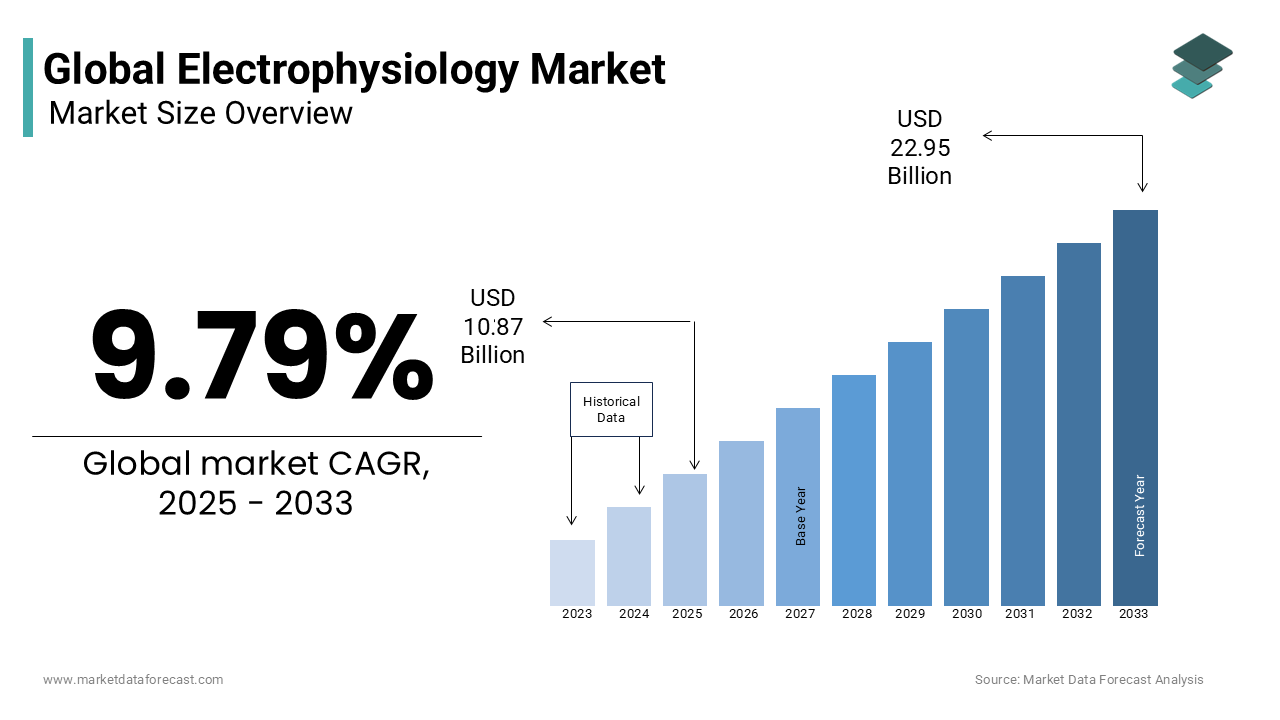
The global electrophysiology market has witnessed significant growth in recent years due to the increasing prevalence of cardiovascular diseases, which primarily enhances the adoption of electrophysiology systems worldwide. According to a research article, “Global epidemiology of atrial fibrillation,” It is considered a growing epidemic and public health challenge, and it is estimated that 6-12 million people worldwide are anticipated to suffer from this condition by 2050. The growing adoption of minimally invasive electrophysiology therapies and the growing knowledge of people regarding the advancements in the healthcare industry are significant factors driving the expansion of electrophysiology systems. The global electrophysiology market is projected to have prominent growth during the forecast period due to growing technological advancements, continuous innovative product launches, and growing government support in developing regions leading to emerging economies, which are all expected to offer market growth opportunities.
MARKET DRIVERS
The increasing prevalence of heart arrhythmias, ophthalmic issues, and epilepsy propels the growth of the global electrophysiology market.
Over the forecast period, the worldwide electrophysiology market is further projected to be boosted by the introduction of new technologies such as cryoablation, laser ablation, ultrasonic ablation, and enhanced mapping technologies. The market is also propelled by the rising prevalence of heart failure (HF) and cardiac arrest cases among millennials related to lifestyle choices such as smoking and excessive alcohol use. In addition, smaller E.P. monitors and smaller stems have increased demand for these devices in the global electrophysiology market, particularly during COVID-19. As a result, the cardiac rhythm and failure divisions are paying close attention to remote monitoring and the programming capabilities of implanted electrophysiology (EP) devices.
The market participants emphasize developing advanced products, which are expected to improve the industry's growth potential. As a result of the rising illness burden worldwide and the acceptance of development activities by organizations, the electrophysiology market is expected to expand in the future. Emerging markets are expected to offer significant growth opportunities for cardiac mapping systems players due to their growing patient population, increasing adoption of cardiac mapping systems, increasing awareness of CVDs, rising disposable incomes, improving healthcare infrastructure, and relatively lenient guidelines compared to developed countries. In addition, growth in atrial fibrillation and the baby boomer generation's elevated risk of targeted illnesses and increased use of EP catheter ablation are driving the market. The market's growth is fueled by significant companies' increased focus on new E.P. technologies and the expansion of E.P. laboratories. Electrophysiology equipment with several modalities, such as cardiac magnetic resonance imaging (CMR), cardiac computed tomography (C.T.), echocardiography, fluoroscopy, and electro-anatomic mapping, allows healthcare practitioners to quickly assess the leading causes of multiple arrhythmia cases. As the prevalence of cardiac arrhythmia continues to rise, electrophysiological devices are expected to gain much traction in the future.
MARKET RESTRAINTS
However, government regulations, the high expense of treating complex arrhythmias, the preference for pharmacological therapies (drugs) over electrophysiological interventions, and a scarcity of qualified and experienced electrophysiologists are expected to restrict the global electrophysiology market expansion. Additionally, the need for more trained experts and tight regulatory rules is further expected to hamper the growth rate of the electrophysiology market. High installation costs and a lack of awareness are considerable challenges to the worldwide electrophysiology market.
REPORT COVERAGE
| REPORT METRIC | DETAILS |
| Market Size Available | 2024 to 2033 |
| Base Year | 2024 |
| Forecast Period | 2025 to 2033 |
| Segments Covered | By Product, Indication, and Region |
| Various Analyses Covered | Global, Regional & Country Level Analysis, Segment-Level Analysis; DROC; PESTLE Analysis; Porter’s Five Forces Analysis, Competitive Landscape, Analyst Overview of Investment Opportunities |
| Regions Covered | North America, Europe, APAC, Latin America, Middle East & Africa |
| Market leaders Profiled | Boston Scientific Corporation (U.S.), GE Healthcare, Abbott Laboratories (U.S.), Biosense Webster, Inc. (U.S.), Microport Scientific Corporation (China), St. Jude Medical, Inc. (U.S.), BIOTRONIK SE & Co. KG (Germany). |
SEGMENTAL ANALYSIS
By Product Insights
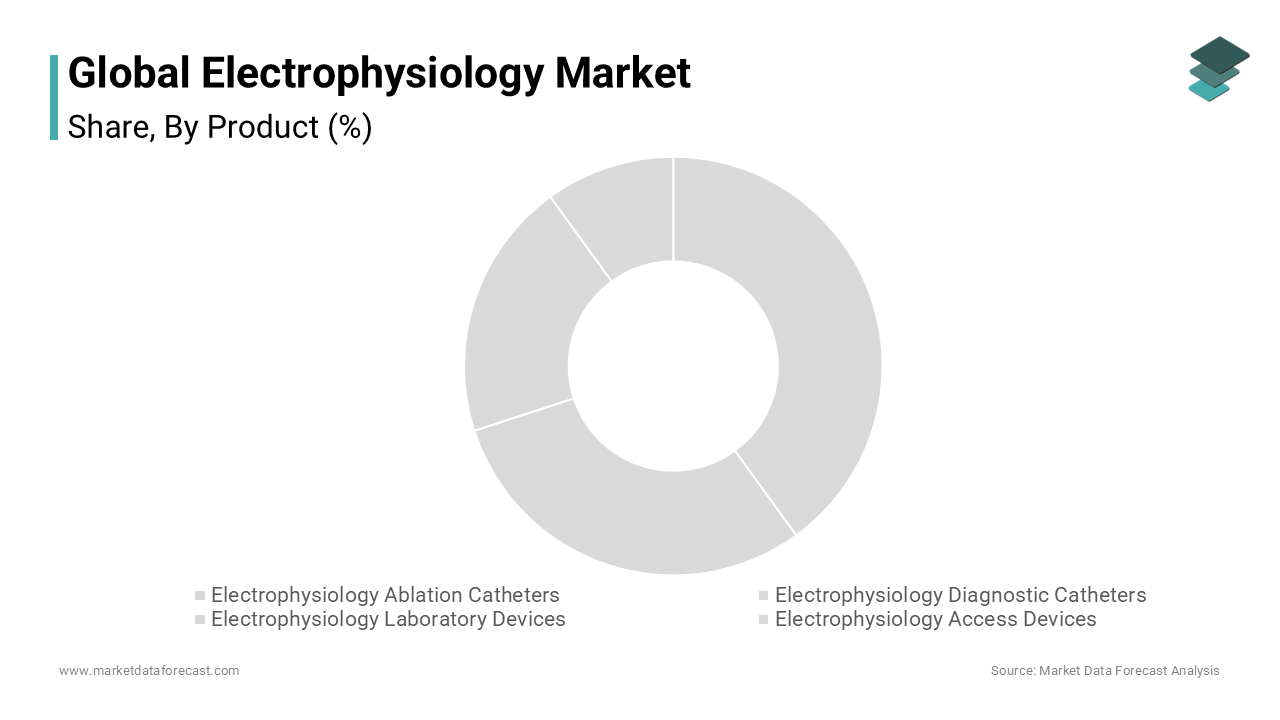
The electrophysiology abnormal catheter segment is anticipated to account for the largest market share in product type. Ablation catheters eliminate abnormal heart tissues that can result in irregular heartbeats. Such machines work based on ablation, a minimally invasive technique that uses catheters to destroy the heart's damaged electrical pathways.
Ablation is a minimally invasive procedure that destroys abnormal heart tissues that cause irregular heart rhythms. Radiofrequency, microwave ablation, and laser ablation are also part of ablation catheters. It is a safe procedure with less risk for treating abnormal cardiac tissue cases. Ablation catheters are the most widely used devices and are expected to maintain a significant market share with advancements in technology. It accounted for a substantial market size in 2024 of the total electrophysiology market. Diagnostic catheters also emerged as the largest segment in EP, with the increased use of this device in the introduction of portable and digital systems.
By Indication Insights
The Atrial Fibrillation segment has been leading the market based on indication. It is expected to show the highest revenue growth during the forecast period as Atrial fibrillation monitoring requires enhanced diagnostic technology to overcome the limitations imposed by conventional techniques.
The atrial fibrillation segment accounted for the largest share in 2024. The growing number of ablation systems associated with atrial fibrillation, the fast-growing aging population worldwide, the expanding pervasiveness of atrial fibrillation, and the improvement of cutting-edge electrophysiology items for early diagnosis of atrial fibrillation will drive the development of this market segment in the coming years.
REGIONAL ANALYSIS
Geographically, the electrophysiology market in North America is dominating, and it is anticipated to continue its stronghold for a few more years. Due to well-established healthcare facilities and the rising cases of arrhythmia, strokes, and heart failure, this region is expected to increase its market share. North America has a significant market share due to increased cardiovascular diseases and large clinical trials validating electrophysiology devices. Heart arrhythmias cause about 40000 deaths per year in Canada. And the key players in the market are also driving the growth in the region.
The electrophysiology market in the Asia Pacific is estimated to grow at a healthy CAGR during the forecast period. In terms of unmet medical needs and rapidly increasing targeted disease occurrence levels, the Asia Pacific Electrophysiology market has significant untapped opportunities. Improving healthcare infrastructure, increasing patient awareness, and increasing regional healthcare expenditure are expected to help the market grow. Asia, especially China, Japan, and India, will witness excessive growth in the forthcoming years. Lifestyle changes, eating habits, increasing stress, smoking, and drinking have resulted in growing health-related issues. Less government intervention is helping the demand for electrophysiology devices in the region.
The electrophysiology market in Europe had a substantial share of the global market in 2024 and is estimated to grow at a promising CAGR during the forecast period, owing to the rising incidence of cardiovascular diseases over the forecast period, since electrophysiological devices have essential applications in identifying heart failure rates. According to the European Society of Cardiology data, more than 6 million cardiovascular illnesses (CVDs) were identified in the European Union, with almost 11 million CVD cases reported in the whole of Europe.
The electrophysiology market in Latin America is driven by technological improvements, an increasing frequency of atrial fibrillation, and rapid expansion in the aging population, which has a higher risk of target illnesses. Also, the increased demand for catheter ablation operations drives market growth.
The electrophysiology market in the Middle East and Africa was worth USD 568.67 million in 2025. It is estimated to be growing at a CAGR of 9.36% to reach USD 1,163.40 million by 2033
KEY MARKET PLAYERS
Some of the notable market players leading the global electrophysiology market profiled in this report are
- Boston Scientific Corporation (U.S.)
- GE Healthcare
- Abbott Laboratories (U.S.)
- Biosense Webster, Inc. (U.S.)
- MicroPort Scientific Corporation (China)
- St. Jude Medical, Inc. (U.S.)
- BIOTRONIK SE & Co. KG (Germany)
- Koninklijke Philips N.V. (The Netherlands)
- Medtronic, Inc. (U.S.)
- Siemens AG (Germany)
RECENT MARKET HAPPENINGS
- In August 2023, Boston Scientific Corporation launched the POLARx cryoablation system, used to treat patients with paroxysmal atrial fibrillation.
- In May 2023, Abbott Laboratories launched a sensor-enabled Tactiflex ablation catheter to treat abnormal heart rhythms.
- In September 2022, Johnson & Johnson launched the OCTARAY mapping system used to treat cardiac arrhythmias.
- In July 2022, X-Trodes, an Israeli start-up, announced its plan to redefine the process of electrophysiology monitoring. X-Trodes developed some new wireless-wearable technologies for monitoring eye movement, brain activities, muscle stimulation, and cardiac monitoring.
- In 2022, Abbott’s EnSite X electrophysiology system with EnSite Omnipolar Technology (O.T.) received its FDA clearance. This system is a new cardiac mapping platform available in the U.S. and Europe.
- In May 2022, BioSig Technologies, Inc., a medical technology company, announced the release of the Company’s national commercial launch campaign. It contributed to various initiatives to boost the launch of the PURE EP System, focused on driving procedural efficiency and efficacy in cardiac electrophysiology.
- In March 2020, Stereotaxis (U.S.) declared FDA approval and introduced the Genesis RMN System in the United States.
- In 2019, Medtronic and EPIX Therapeutics (U.S.) agreed to incorporate EPIX's proprietary catheter-based, temperature-controlled cardiac ablation to treat patients with cardiac arrhythmias into Medtronic's cardiac ablation portfolio.
MARKET SEGMENTATION
This research report on the global electrophysiology market has been segmented and sub-segmented based on the product, indication, and region.
By Product
- Electrophysiology Diagnostic Catheters
- Advanced Electrophysiology Diagnostic Catheters
- Conventional Electrophysiology Diagnostic Catheters
- Ultrasound Electrophysiology Diagnostic Catheters
- Electrophysiology Ablation Catheters
- Radiofrequency (RF) Ablation Catheters
- Cryoablation Electrophysiology Catheters
- Laser Ablation Systems
- Microwave Ablation Systems
- Navigational Advanced Mapping Accessories
- Electrophysiology Laboratory Devices
- Electrophysiology Recording Systems
- 3D Mapping Systems
- Radiofrequency (RF) Ablation Generators
- Electrophysiology X-Ray Systems
- Intracardiac Echocardiography (ICE) Systems
- Electrophysiology Remote Steering Systems
- Access Devices
By Indication
- Atrial Flutter
- Atrial Fibrillation
- Wolff-Parkinson-White Syndrome
- Atrioventricular Nodal Re-entry Tachycardia
- Other Indications
By Region
- North America
- Europe
- Asia Pacific
- Latin America
- The Middle East and Africa