- Product Description Description
- Table of Contents TOC
- List of Table & Figure LOT
- Get Free Sample PDF Sample PDF
Market Size, 2025
$4.42 BnMarket Estimate, 2026
$4.79 BnMarket Forecast, 2034
$9.15 BnCAGR, 2026–2034
8.42%Global Encapsulants Market Size
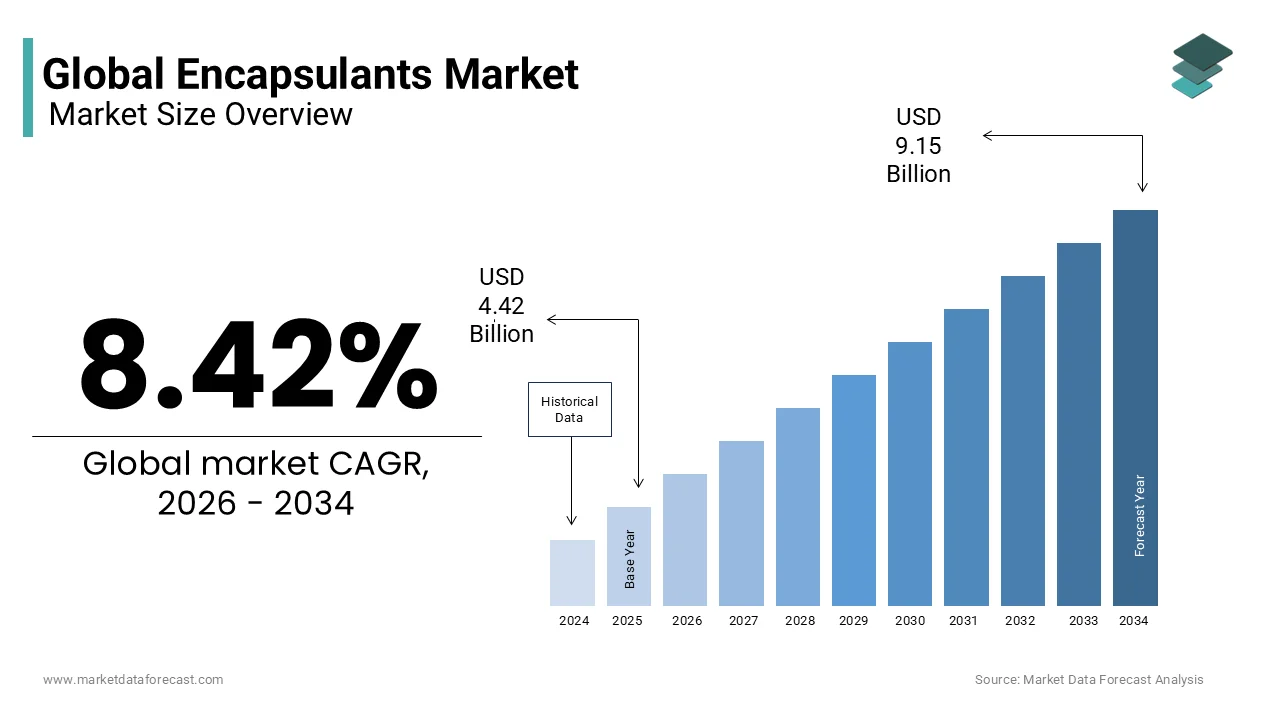
The Global encapsulants market size was valued at USD 4.42 billion in 2025, and is projected to reach USD 9.15 billion by 2034 from USD 4.79 billion in 2026, growing at a CAGR of 8.42%.
MARKET DRIVERS
In the polymerization type segment due to the ease of processing and high reliability, the market demand for encapsulating agents will increase even more. The presence of a large number of companies in the electronics sector and the growing demand for consumer electronics products further strengthen the market for encapsulation agents, led by countries such as China and India. The market growth is mainly due to the growing use of solar encapsulation materials in the construction, automotive, and electronics sectors. The solar encapsulant is a sheet of a thin film that is used as a protective material in a panel or solar module. The sheet protects the solar panel against corrosion, dust, weather, and delamination.
The increasing demand for electronic equipment by consumers and the accumulated reach of technology in everyday life are factors that contribute to the growth of the encapsulation agent market. The rapid growth of the photovoltaic solar panel market offers an opportunity for the encapsulant market. The encapsulants provide insulation against the high voltage current, protecting the interconnections of the circuits of the thermal or mechanical defects that act as growth engines of the market.
MARKET RESTRAINTS
The volatility of commodity prices could restrict the global market for encapsulants. The raw materials necessary for the manufacture of encapsulants come from petroleum-based resins. The fluctuation of crude oil prices could be a significant limitation for the encapsulant market. The reliance on encapsulation materials that may not function properly remains a major obstacle to market growth.
REPORT COVERAGE
| REPORT METRIC | DETAILS |
| Market Size Available | 2025 to 2034 |
| Base Year | 2025 |
| Forecast Period | 2026 to 2034 |
| CAGR | 8.42% |
| Segments Covered | By Chemistry, End-Use, and Region |
| Various Analyses Covered | Global, Regional & Country Level Analysis, Segment-Level Analysis, DROC, PESTLE Analysis, Porter’s Five Forces Analysis, Competitive Landscape, Analyst Overview on Investment Opportunities |
| Regions Covered | North America, Europe, Asia Pacific, Latin America, and Middle East & Africa |
| Market Leaders Profiled | Dow Corning Corporation, HB Fuller, Shin-Etsu Chemical Co., Ltd., Sumitomo Bakelite Co., Ltd., Henkel AG & KGaA Co., Kyocera Corporation, Hitachi Chemical Co., Ltd., Panasonic Corporation, Epic Resins, Electrolube, Materials Processing Systems, Inc., The 3M Company, BASF SE, Resin Technical Systems, Sanyu Rec Co., Ltd., John C. Dolph, Master Bond Inc., ACC Silicones, Dymax Corporation, and others |
SEGMENTAL ANALYSIS
By Chemistry
Based on chemistry, the encapsulating silicone segment is expected to experience increased CAGR growth during the forecast period. The growth of this segment can be attributed to the growing demand for electric vehicles and consumer electronics. Depending on the curing, the environmental curing segment of the encapsulant market is expected to grow at the highest CAGR during the forecast period. The systems of curing to room temperature offer secure processing and high reliability.
By End-Use
In 2024, it was expected that the consumer electronics segment of the encapsulant market would achieve its highest compound annual growth rate (RCAC) between 2025 and 2033. Due to the growth of the semiconductor industry. It is expected that the epoxy segment will dominate the market over the forecast period due to its properties such as strength and durability, adhesion, low shrink cure, compatibility with most materials, corrosion resistance, and durability. Chemicals and good electrical insulation.
REGIONAL ANALYSIS
Asia Pacific (APAC) ruled the Encapsulants Market with a portion of 39.4% in 2024 followed by North America and Europe. The economy of APAC is primarily affected by the financial elements of nations, for example, China and India, however with developing foreign direct ventures for the economic advancement of South East Asia, the current situation is evolving. Nations in South East Asia are going through high development in consumer electronics and transportation ventures, which is supporting the encapsulants business. China was the main provincial market, representing 45% of the complete Asia-Pacific encapsulants market. India is the subsequent significant market after China.
The accessibility of labor at lower rates in these countries likewise attracts producers. Furthermore, the presence of an enormous number of electronics firms and broadening interest in consumer electronics are further boosting the encapsulant market in this locale. The fast turn of events and innovative progressions in the gaming industry is additionally expected to push the development of this worldwide encapsulants market over the gauge time frame. With the advancement of Information and Technology, and the improvement of electronic products based on modern technologies, the worldwide semiconductor market is extending and the demand for encapsulants is expanding.
KEY MARKET PLAYERS
The major key players in the global Encapsulants Market are Dow Corning Corporation, HB Fuller, Shin-Etsu Chemical Co., Ltd., Sumitomo Bakelite Co., Ltd., Henkel AG & KGaA Co., Kyocera Corporation, Hitachi Chemical Co., Ltd., Panasonic Corporation, Epic Resins, Electrolube, Materials Processing Systems, Inc., The 3M Company, BASF SE, Resin Technical Systems, Sanyu Rec Co., Ltd., John C. Dolph, Master Bond Inc., ACC Silicones, Dymax Corporation, and others.
MARKET SEGMENTATION
This research report on the global Encapsulants market has been segmented and sub-segmented based on chemistry, end-use, and region.
By Chemistry
- Epoxy encapsulants
- Urethane encapsulants
- Silicone encapsulants
By End-use
- Consumer electronics
- Energy
- Transportation
- Medicine
By Region
- North America
- Europe
- Asia Pacific
- Latin America
- The Middle East and Africa