- Product Description Description
- Table of Contents TOC
- List of Table & Figure LOT
- Get Free Sample PDF Sample PDF
Market Size, 2025
$1.50 BnMarket Estimate, 2026
$1.56 BnMarket Forecast, 2034
$2.13 BnCAGR, 2026–2034
3.95%Europe Adipic Acid Market Size, Growth, Trends & Forecast (2026–2034)
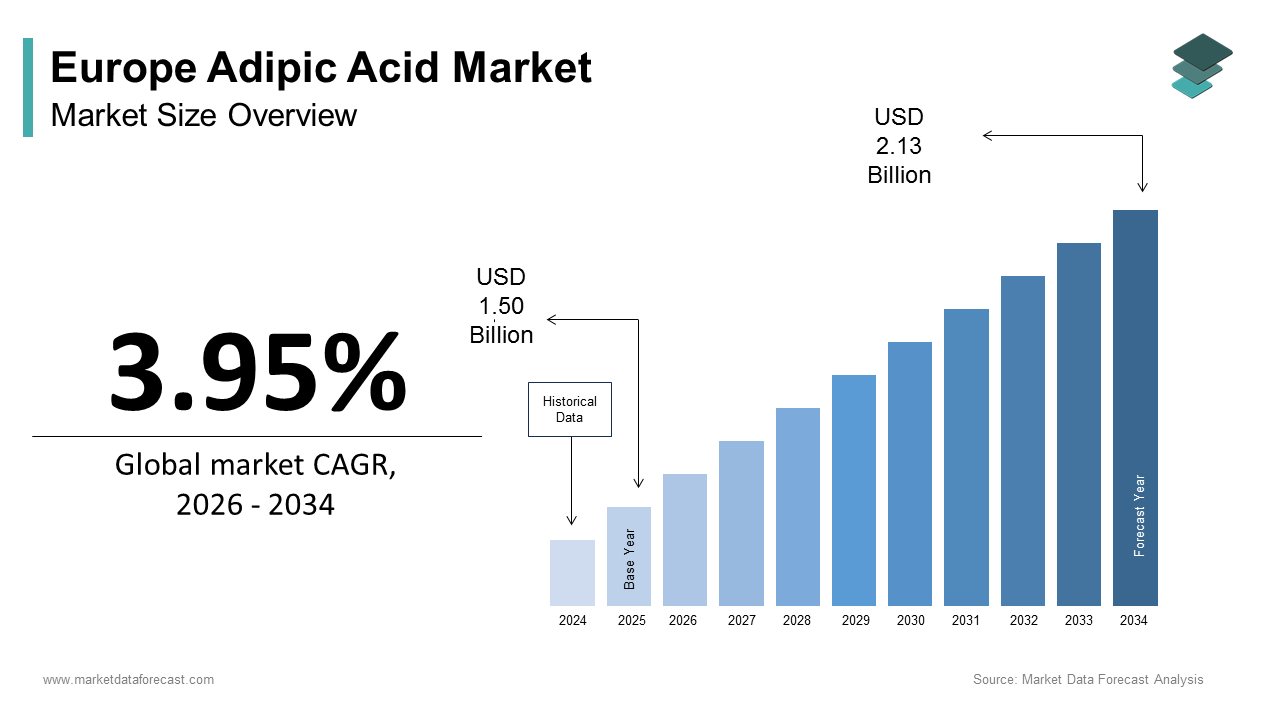
The Europe adipic acid market size was calculated to be USD 1.50 billion in 2025, is anticipated to reach USD 1.56 billion in 2026, and is projected to be worth USD 2.13 billion by 2034, growing at a CAGR of 3.95% during the forecast period from 2026 to 2034. Driven by robust automotive lightweighting strategies, rising nylon 66 demand for engineering plastics, and continuous expansion in textile and polyurethane applications, the market maintains a steady growth trajectory across Europe.
Key Executive Metrics (At-a-Glance)
- 2025 Base Valuation: USD 1.50 Billion
- 2026 Current Valuation: USD 1.56 Billion
- 2034 Forecast Valuation: USD 2.13 Billion
- Compound Annual Growth Rate (CAGR): 3.95% (2026–2034)
- Dominant Application Segment: Nylon 66 Resin (49.4% share in 2024)
- Fastest-Growing Application Segment: Polyurethane (CAGR of 6.12%)
- Dominant End Use Segment: Automotive (40.56% share in 2024)
- Fastest-Growing End Use Segment: Electrical and Electronics (CAGR of 7.44%)
- Dominant Regional Market: Germany (26.5% share in 2024)
Core Market Drivers
- Automotive Lightweighting: Stringent CO2 fleet targets under EU regulations driving massive substitution of metal parts with reinforced nylon 66 components.
- Textile and Flooring Demand: Consistent consumption of nylon 66 fibers in commercial carpets, technical textiles, and interior furnishings meeting strict fire safety standards.
Primary Market Restraints & Challenges
- Environmental Regulations: Mandatory nitrous oxide (N2O) abatement requirements and EU ETS coverage adding significant capital and operating costs.
- Feedstock Volatility: Direct dependence on benzene-derived cyclohexane price fluctuations and limited domestic production capacity exposing the market to supply chain risks.
Europe Adipic Acid Market Classification Breakdown
| Segment Category | Largest Segment | Fastest-Growing Segment |
|---|---|---|
| By Application | Nylon 66 Resin (49.4% share) | Polyurethane (CAGR of 6.12%) |
| By End Use | Automotive (40.56% share) | Electrical and Electronics (CAGR of 7.44%) |
| By Region | Germany (26.5% share) | France & Italy (Advanced Materials & Circular Tech) |
Major Industry Players Profiled
Key market participants include Ascend Performance Materials LLC, Asahi Kasei Corporation, BASF SE, Koch Industries, Inc. (Invista BV), Liaoyang Tianhua Chemical Co., Ltd, Radici Partecipazioni S.p.A., Solvay SA, Sumitomo Chemical Co., Ltd., DOMO Chemicals GmbH, and LANXESS AG.
 Download Free Sample Report
Europe Adipic Acid Market Size
The Europe adipic acid market size was calculated to be USD 1.50 billion in 2025 and is anticipated to be worth USD 2.13 billion by 2034, growing from USD 1.56 billion in 2026 at a CAGR of 3.95% during the forecast period.
Adipic acid is a white crystalline dicarboxylic acid primarily used as a key monomer in the production of nylon 66, polyurethanes, and plasticizers across Europe. Its chemical structure enables high tensile strength, thermal stability, and abrasion resistance in engineering plastics and synthetic fibers. According to the European Chemicals Agency, adipic acid is classified under REACH Annex XIV due to its role as a precursor in certain restricted substances, but remains exempt for polymer applications under strict usage controls. According to Prismane Consulting, the total polyamide 66 capacity in Europe reached around 875000 tonnes in 2022. Adipic acid is a key monomer in nylon 66 production along with hexamethylenediamine. Beyond polymers, adipic acid serves niche roles in food acidulation, pharmaceutical excipients, and controlled release formulations, with the European Food Safety Authority permitting its use as additive E355 under regulated conditions. Industrial emissions of nitrous oxide, a potent greenhouse gas generated during conventional adipic acid synthesis, have drawn regulatory scrutiny, with the European Environment Agency reporting that Europe’s annual N2O emissions in 1990 were about 1.9 million tonnes. Modern European plants now deploy catalytic decomposition units to reduce nitrous oxide emissions in line with the EU Industrial Emissions Directive, ensuring environmental compliance while sustaining essential material supply for automotive textiles and electronics sectors.
MARKET DRIVERS
Robust Demand from Automotive Lightweighting Drives Nylon 66 Consumption
The European automotive industry’s aggressive lightweighting strategy to meet CO2 fleet targets under Regulation EU 2019 631 has intensified demand for high-performance engineering plastics like nylon 66, where adipic acid is a critical building block, which is majorly propelling the growth of the Europe adipic acid market. According to the European Automobile Manufacturers Association, the average passenger car in the EU contains over 150 kilograms of plastic. Nylon 66 is widely used in under-the-hood and structural components due to its heat resistance and mechanical durability. By 2025, the EU mandates a fleet-wide average of 95 grams of CO2 per kilometer, prompting manufacturers like Volkswagen, Stellantis, and BMW to replace metal parts with reinforced nylon 66 in air intake manifolds, radiator end tanks, and electrical connectors. It is generally recognized that replacing metal with plastics reduces vehicle weight and lowers lifetime emissions. Automotive applications consume significant volumes of nylon 66 in Europe, translating into substantial adipic acid demand. This structural shift toward polymer-intensive vehicle design ensures sustained and growing reliance on adipic acid despite electrification trends, which still require thermal and electrical resilience in battery and power electronics housings.
Growth in Textile and Carpet Fiber Applications Supports Steady Consumption
The European textile and flooring sectors continue to generate consistent demand for nylon 66 fibers derived from adipic acid, particularly in technical and durable applications, which is further fuelling the expansion of the Europe adipic acid market. According to the European Carpet and Rug Association, nylon 66 is widely used in commercial carpet tiles installed in EU offices and transport infrastructure due to its superior stain resistance, abrasion performance, and recyclability compared to polypropylene alternatives. The EU produces large volumes of nylon filament yarn with a significant share allocated to carpet and upholstery, as reported by Euratex, the European Apparel and Textile Confederation. Notably, the aviation and rail industries enforce stringent fire safety standards under EN 45545 and FAR 25.853, which nylon 66 meets without halogenated flame retardants, making it the material of choice for seat fabrics and interior linings. Air France, KLM, and Deutsche Bahn have standardized nylon 66 carpets across fleets, citing longer service life than alternatives. Furthermore, the EU Strategy for Sustainable and Circular Textiles promotes chemical recycling of post-industrial nylon waste back into virgin-quality polymer, a process commercially deployed by Aquafil and DOMO Chemicals that still requires adipic acid for repolymerization. This circular loop, combined with performance mandates, sustains adipic acid demand even as fast fashion declines.
MARKET RESTRAINTS
Stringent Environmental Regulations on Nitrous Oxide Emissions Increase Production Costs
The growth of the Europe adipic acid market is restrained by the production of adipic acid via conventional nitric acid oxidation of cyclohexanol, which generates nitrous oxide N2O a greenhouse gas with 265 times the global warming potential of CO2 over a 100-year horizon, as quantified by the Intergovernmental Panel on Climate Change. Although European producers have largely mitigated this issue,ue the regulatory burden remains substantial. According to the European Environment Agency, adipic acid plants were historically responsible for a notable share of the EU’s industrial N2O emissions in the 1990s, which is prompting mandatory abatement under the EU Industrial Emissions Directive. Today, all major European adipic acid facilities operate catalytic thermal or chemical decomposition units that significantly reduce N2O but at considerable capital and operational expense. According to the European Commission, compliance with Best Available Techniques adds extra costs to production. Furthermore, the EU Emissions Trading System includes N2O from adipic acid production under its coverage, requiring facilities to surrender allowances for any residual emissions. As per the European Chemical Industry Council, these regulatory layers have discouraged new capacity investment, with the last greenfield plant in Europe commissioned in 2005. The compliance overhead thus acts as a structural restraint limiting supply flexibility and elevating price volatility in response to feedstock fluctuations.
Volatility in Benzene and Cyclohexane Feedstock Prices Impacts Profitability
Adipic acid production in Europe relies heavily on benzene-derived cyclohexane as the primary hydrocarbon feedstock, linking its economics directly to aromatic crude oil derivatives whose prices fluctuate with geopolitical and refining dynamics, which is further hindering the growth of the Europe adipic acid market. According to Eurostat, benzene prices in the EU rose sharply between 2021 and 2022 due to post pandemic petrochemical demand and Russian supply disruptions following sanctions. Cyclohexane, which represents a major share of adipic acid’s raw material cost, also exhibited strong volatility with monthly price swings reported by the European Petrochemical Association. Unlike integrated Asian producers, European adipic acid manufacturers often lack a captive benzene supply, forcing them to purchase on spot markets. For instance, feedstock costs constitute the majority of total adipic acid production expenses, which is making margins highly vulnerable to crude oil and naphtha price movements. The EU’s Carbon Border Adjustment Mechanism further compounds pressure by imposing costs on imported intermediates but offering limited relief for domestic producers facing energy-intensive conversion processes. This feedstock dependency constrains long term pricing stability and discourages end users from locking into multi-year contracts, thereby fragmenting demand and amplifying market sensitivity to upstream energy shocks.
MARKET OPPORTUNITIES
Development of Bio-Based Adipic Acid Routes Aligns with EU Green Chemistry Goals
Emerging bio-based production pathways for adipic acid offer a significant opportunity for the Europe adipic acid market. Unlike petroleum-derived routes, bio processes using glucose, lignin, or muconic acid as feedstocks eliminate nitrous oxide emissions and reduce lifecycle carbon intensity according to the Joint Research Centre of the European Commission. Companies like Rennovia, formerly and more recently Cathay Biotech, have piloted catalytic conversion of renewable sugars into adipic acid with promising yields in laboratory settings. According to the European Bioplastics Association, bio nylon 66 made from such adipic acid is now technically feasible and compatible with existing polymerization infrastructure. Public funding accelerates this transition with the EU’s Horizon Europe program allocating significant resources in 2023 to circular bio-based monomers, including adipic acid, under the Circular Bio-based Europe Joint Undertaking. Furthermore, the EU Ecolabel for textiles and carpets increasingly favours materials with verified bio content, creating market pull. In 2024, Arkema and BASF announced joint feasibility studies on integrating bio-adipic acid into European nylon supply chains, targeting automotive and sportswear brands committed to Science-Based Targets. This convergence of policy innovation and brand demand positions bio-based adipic acid as a viable near-term complement to fossil routes.
Expansion of Chemical Recycling for Nylon 66 Creates Secondary Demand Channel
The EU’s push toward circular polymers has catalysed investments in chemical recycling technologies that depolymerize post-consumer and post-industrial nylon 66 waste back into caprolactam and hexamethylenediamine, but crucially also require fresh adipic acid for repolymerization to virgin quality specifications. According to the European Recycling Platform, large volumes of nylon carpet and textile waste are generated annually in the EU, with only a small fraction currently recovered due to technical limitations of mechanical recycling. However, chemical recyclers like Aquafil and Gr3n have commercialized hydrolysis and microwave-assisted glycolysis processes that break nylon 66 into monomers, but the recombination step necessitates high-purity adipic acid to meet performance standards for automotive or aerospace reuse. The European Commission’s Packaging and Packaging Waste Regulation and Ecodesign for Sustainable Products Regulation mandate minimum recycled content in textiles and engineering plastics by 2030, which is creating a structural need for this hybrid recycled virgin input model. As per the European Tyre and Rubber Manufacturers Association, tire cord nylon recovery also incorporates adipic acid top-up to stabilize the melt flow index. This emerging circular loop transforms adipic acid from a linear input into a balancing agent inclosed-loop systems, thereby creating a new demand vector insulated from virgin polymer market cycles.
MARKET CHALLENGES
Limited Domestic Production Capacity Constricts Supply Security
The growth of the Europe adipic acid market is primarily challenged by the fact that Europe’s adipic acid production base is highly concentrated and aging, with only three operational plants located in France, Germany, and Belgium supplying the entire EU market, as confirmed by the European Chemical Industry Council. Total annual capacity has remained static for more than a decade due to a lack of new investment. This static supply struggles to absorb demand shocks such as the 2021 automotive rebound, which caused adipic acid spot prices to rise sharply, according to ICIS. Unlike Asia, which added substantial new capacity between 2018 and 2023, Europe relies increasingly on imports primarily from the United States and China to cover deficits. However, geopolitical tensions and the EU’s anti-dumping duties on Chinese adipic acid imposed in 2022 complicate sourcing alternatives. The European Commission’s Critical Raw Materials Act does not yet classify adipic acid as strategic, but industry groups warn that its role in lightweighting and defense applications warrants review. With no new European plant announced and existing assets exceeding 30 years in age, the supply fragility remains a persistent vulnerability, especially as nylon 66 demand grows in electric vehicle and renewable energy components like wind turbine bearings.
Technical Barriers in Bio-Based Route Commercialization Delay Scale-Up
Despite promising lab-scale results, bio-based adipic acid faces significant technical and economic hurdles that impede large-scale commercial deployment in Europe, which is further challenging the expansion of the Europe adipic acid market. The primary challenge lies in achieving cost parity with petroleum routes, which currently produce adipic acid at lower costs while bio alternatives remain significantly more expensive according to techno-economic assessments by the Nova Institute. Key bottlenecks include low fermentation titers of muconic acid, the key biosynthetic intermediate, and the high energy intensity of downstream separation and hydrogenation steps required to convert bio intermediates into polymer-grade adipic acid. Additionally, regulatory approval under REACH for novel bio-based production organisms and impurity profiles can take considerable time, delaying market entry. The European Food Safety Authority has also raised concerns about trace metabolites in bio routes that could affect food contact approvals, though industrial grades are less restricted. Pilot plants such as the one operated by Genomatica in partnership with BASF were discontinued in 2022 due to yield instability at scale. Until catalytic efficiency and purification costs improve through advances in enzyme engineering or electrochemical synthesis, bio-based adipic acid will remain a niche premium offering rather than a mainstream alternative capable of reshaping Europe’s production landscape.
REPORT COVERAGE
| REPORT METRIC | DETAILS |
| Market Size Available | 2025 to 2034 |
| Base Year | 2025 |
| Forecast Period | 2026 to 2034 |
| CAGR | 3.95% |
| Segments Covered | By Application, End Use, And Region |
| Various Analyses Covered | Global, Regional & Country Level Analysis; Segment-Level Analysis; DROC, PESTLE Analysis; Porter’s Five Forces Analysis; Competitive Landscape; Analyst Overview of Investment Opportunities |
| Regions Covered | UK, France, Spain, Germany, Italy, Russia, Sweden, Denmark, Switzerland, Netherlands, Turkey, and the Czech Republic |
| Market Leaders Profiled | Ascend Performance Materials LLC, Asahi Kasei Corporation, BASF SE, Koch Industries, Inc. (Invista BV), Liaoyang Tianhua Chemical Co., Ltd, Radici Partecipazioni S.p.A., Solvay SA, Sumitomo Chemical Co., Ltd., DOMO Chemicals GmbH, and LANXESS AG |
SEGMENTAL ANALYSIS
By Application Insights
The nylon 66 resin segment dominated the market by accounting for 49.4% of the regional market share in 2024. The growth of the nylon 66 resin segment in the Europe adipic acid market is driven by its irreplaceable role in high-performance engineering plastics for automotive electronics and industrial machinery. Unlike fiber grades, nylon 66 resin requires stringent thermal and mechanical properties achieved only through high-purity adipic acid and hexamethylenediamine co-polymerization. According to Plastics Europe, the EU consumed significant volumes of engineering nylon in 2023, with nylon 66 representing the majority share due to its superior heat deflection temperature and chemical resistance. According to the European Automobile Manufacturers Association, nylon 66 resin is widely used in under-the-hood components such as radiator end tanks, air intake manifolds, and sensor housings, where continuous exposure to high temperatures is common. Furthermore, the rise of electric vehicles has expanded demand into battery tray brackets and power electronics enclosures, which must meet UL 94 V0 flammability standards, which is a requirement nylon 66 meets without halogenated additives. As per the German Association of the Automotive Industry, electric vehicles use more nylon 66 than internal combustion models due to added structural and thermal management needs. This performance-driven indispensability ensures nylon 66 resin remains the primary consumption channel for adipic acid across Europe.
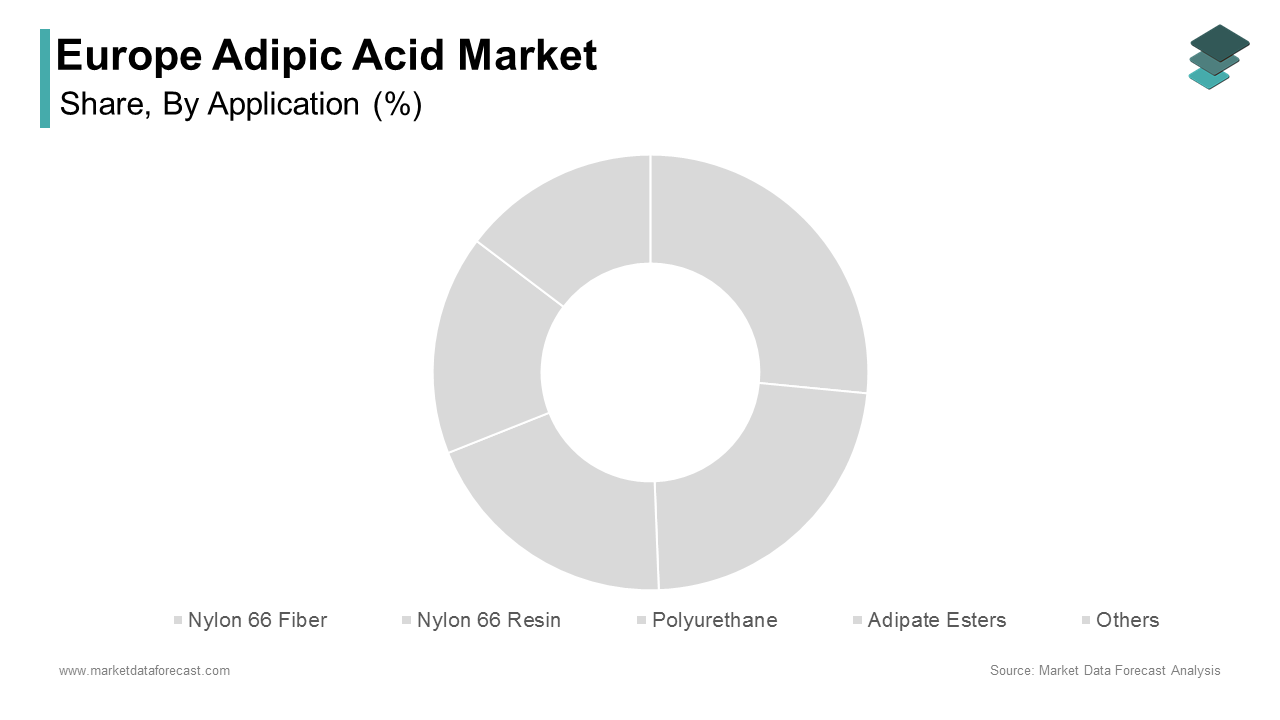
The polyurethane segment is the fastest growing application segment in the Europe adipic acid market and is predicted to register a CAGR of 6.12% over the forecast period. The adipic acid’s role as a chain extender in polyester-based polyurethanes used in high-resilience foams, coatings, and adhesives, where superior hydrolysis resistance is critical, is majorly driving the growth of the polyurethane segment in the regional market. According to the European Polyurethane Insulation Council, demand for polyester polyol-based rigid foams in cold chain logistics and district heating pipes grew in 2023 due to their enhanced durability in humid and high temperature environments compared to polyether alternatives. According to the European Environment Agency, adipic acid-derived polyurethanes are increasingly specified in offshore wind turbine blade bonding, where resistance to saltwater degradation is non-negotiable. In 2024, Covestro and BASF launched new bio-based polyester polyols containing recycled adipic acid for use in automotive seating and footwear, as these sectorsare growing under EU circular economy mandates. According to the European Footwear Association, polyester polyurethane soles are now widely used in premium athletic shoes for abrasion resistance. Additionally, the EU’s Ecodesign for Energy Related Products Directive is tightening insulation standards for appliances, driving adoption of high-performance polyester polyurethane foams in refrigerators and water heaters. These combined industrial and regulatory tailwinds propel polyurethane as the most dynamic adipic acid application frontier.
By End Use Insights
The automotive segment led the market by holding 40.56% of the regional market share in 2024. The dominance of the automotive segment in the Europe adipic acid market is attributed to the structural integration of nylon 66 components across conventional and electric vehicle platforms. As per the European Automobile Manufacturers Association, the average European car contains large volumes of plastics, with nylon 66 accounting for a significant portion, primarily in the engine compartment and transmission systems. The EU’s CO2 fleet emission target of 95 grams per kilometre enforced since 2021 has accelerated metal to plastic substitution, with nylon 66 replacing heavier metals, according to the German Association of the Automotive Industry. In electric vehicles, this trend intensifies as battery enclosures require materials with high dielectric strength and flame retardancy, as these properties are inherent to glass-filled nylon 66. BMW and Stellantis now specify nylon 66 for many structural brackets in their EV platforms, as confirmed by their material roadmaps. Additionally, as per the European Tyre and Rubber Manufacturers Association, nylon 66 cord fabric remains essential in high-performance tires for its dimensional stability under heat. With millions of passenger vehicles produced annually in the EU, Eurostat data showsthat automotive will remain the anchor demand sector for adipic acid despite mobility transitions.
The electrical and electronics segment is a promising segment and is anticipated to record a CAGR of 7.44% over the forecast period, owing to the proliferation of high-power density electronic systems in renewable energy infrastructure, data centers, and electric mobility that require thermally stable insulating and structural components. According to the European Electronics Industry Association, nylon 66 is widely used in connector housings and switchgear in EU-manufactured inverters, transformers, and EV charging stations due to its high CTI rating and UL 94 V0 flammability compliance without additives. According to the International Energy Agency, Europe added substantial solar photovoltaic capacity in 2023, each megawatt requiring nylon 66 in combiner boxes and junction boxes. Similarly, the European Data Centre Association confirms that server rack components and cable management systems increasingly specify glass-reinforced nylon 66 to withstand continuous operation at elevated temperatures. The EU’s Cyber Resilience Act and Ecodesign Directive further mandate durability and repairability, driving material upgrades from lower-grade nylons. With the EU aiming for a significant share of renewable electricity by 2030 and data traffic doubling rapidly, adipic acid demand in this segment is structurally decoupled from consumer cycles and tied instead to energy and digital infrastructure build-out.
REGIONAL ANALYSIS
Germany Adipic Acid Market Analysis
Germany led the market by capturing 26.5% of the Europe adipic acid market share in 2024. The dominating position of Germany in the European market is the continent’s manufacturing core with unmatched demand from automotive engineering and industrial machinery sectors. Home to global OEMs like Volkswagen, BMW, and Siemens, as well as leading chemical producers such as BASF and Evonik, Germany consumes significant volumes of adipic acid annually, primarily for nylon 66 resin used in engine components, electrical connectors, and industrial bearings. According to the German Chemical Industry Association, adipic acid demand grew in 2023 despite economic headwinds due to the accelerated electrification of vehicle platforms and expansion of onshore wind manufacturing. The country’s stringent material safety standards under the Blue Angel ecolabel have also pushed the adoption of high-purity adipic acid grades with lower residual nitric compounds. Furthermore, Germany hosts Europe’s only integrated adipic acid to nylon 66 polymerization complex in Ludwigshafen, operated by BASF, ensuring supply chain resilience. With the National Hydrogen Strategy driving demand for high-pressure, composite piping often reinforced with nylon 66, Germany’s adipic acid consumption is set to deepen its industrial linkage beyond traditional applications.
France Adipic Acid Market Analysis
France accounted for a notable share of the Europe adipic acid market in 2024 and served as both a key production center and diversified end-use market. The country hosts Arkema’s major adipic acid plant in Mont, which supplies not only European nylon producers but also global adipate ester manufacturers for plasticizers. According to the French Federation of Chemical Industries, adipic acid output from this facility is among the largest single sites in Europe. Domestic demand is driven by automotive, aerospace, and construction sectors, with PSA Group and Airbus using nylon 66 extensively in interior components and air ducting. As per the French Environment and Energy Management Agency, the 2023 thermal renovation mandate for public buildings spurred the use of nylon 66 in high-performance window profiles and insulation fasteners. Additionally, France’s leadership in rail transportation, with Alstom’s TGV trains using engineering nylon, creates steady demand. The government’s France 2030 plan allocates substantial funding to advanced materials innovation, including bio-based adipic acid routes, further positioning France as a strategic node in Europe’s chemical value chain.
Italy Adipic Acid Market Analysis
Italy represents a significant share of the Europe adipic acid market, distinguished by its dual strength in high-end textile fiber and automotive manufacturing. The country is Europe’s largest producer of nylon 66 carpet fiber, with companies like Aquafil operating world-leading chemical recycling plants in Ljubljana and Arco that depolymerize fishing nets and textile waste into caprolactam and adipic acid derivatives. According to the Italian Textile and Fashion Federation, EU luxury automotive upholstery widely uses Italian-made nylon 66 yarns prized for color fastness and abrasion resistance. Simultaneously, Italy’s automotive sector, led by Stellantis and Ferrari, consumes significant volumes of nylon 66 resin for under-the-hood and interior trim applications. The Italian National Agency for New Technologies, Energy and Sustainable Economic Development reports that adipic acid demand in engineering plastics grew in 2023, driven by EV platform launches. Italy’s circular economy law mandates recycled content in synthetic textiles by 2026, accelerating integration of recovered adipic acid streams. This unique blend of fashion-grade fiber and performance resin demand makes Italy a specialized yet resilient adipic acid market.
United Kingdom Adipic Acid Market Analysis
The United Kingdom holds a smaller but important share of the Europe adipic acid market, with demand increasingly skewed toward electrical electronics and specialty engineering applications rather than mass automotive production. According to the UK Chemical Industries Association, adipic acid consumption in semiconductor manufacturing equipment and offshore wind power components grew in 2023 as domestic car production declined. Companies like Siemens Energy and GE Renewable UK specify nylon 66 for generator end windings and transformer bobbins due to its arc resistance and dimensional stability. The UK’s departure from the EU has not diminished adipic acid imports but has shifted sourcing toward US and Middle Eastern suppliers under new trade agreements. The Department for Business and Trade notes that the Net Zero Strategy is driving demand for high-performance polymers in grid infrastructure, with National Grid specifying nylon 66 cable ties and insulators for new substations. Additionally,y the UK remains a hub for premium sportswear brands like Adidas and Reebok, which source European-made nylon 66 fibers for performance footwear. This pivot toward high value low volume applications defines the UK’s evolving adipic acid footprint.
Belgium Adipic Acid Market Analysis
Belgium commands a meaningful share of the Europe adipic acid market despite its small size, owing to its role as a chemical logistics and polymer conversion hub. The Port of Antwerp hosts major nylon 66 compounding facilities operated by DOMO Chemicals and Solva,y which import adipic acid and hexamethylenediamine to produce engineered resins for automotive and electronics customers across Europe. According to the Belgian Association for Chemistry and Life Science,s the country processes large volumes of adipic acid annually, with most converted into higher value polymers for export. Belgium’s central location and EU customs union access make it ideal for just-in-time delivery to German, French, and Dutch OEMs. The Flemish Government’s Green Chemistry Charter has incentivized investments in closed-loop water and N2O abatement systems at polymer plants, ensuring environmental compliance. Additionally, the European Battery Alliance has designated Antwerp as a key materials processing zone for EV supply chains, further securing demand for nylon 66 in battery components. Belgium’s market significance lies not in consumption volume but in its irreplaceable role as Europe’s polymer transformation and distribution nexus.
COMPETITION OVERVIEW
Competition in the Europe adipic acid market is defined by a limited number of integrated chemical producers operating under stringent environmental and safety regulations. Unlike commodity markets, where price dominates competition, here it centers on reliability, purity, consistency, and regulatory compliance. The high capital intensity and environmental permitting barriers restrict new entrants, leaving established players like BASF Ascend and DOMO to compete on technical service formulation expertise and supply security rather than cost alone. The market is further shaped by downstream integration as consumers increasingly prefer suppliers who can deliver not just adipic acid but finished nylon compounds tailored to specific applications. Geopolitical dynamics also influence competition with European buyers, diversifying sourcing away from certain regions due to trade tensions and anti-dumping duties. Innovation in abatement technology and circular feedstocks has become a key differentiator as sustainability credentials increasingly influence procurement decisions across automotive and electronics sectors. This concentrated yet technologically dynamic landscape fosters collaboration as much as competition.
KEY MARKET PLAYERS
A few major players of the Europe adipic acid market include
- Ascend Performance Materials LLC
- Asahi Kasei Corporation
- BASF SE
- Koch Industries, Inc. (Invista BV)
- Liaoyang Tianhua Chemical Co., Ltd
- Radici Partecipazioni S.p.A.
- Solvay SA
- Sumitomo Chemical Co., Ltd.
- DOMO Chemicals Gmbh
- LANXESS AG
Top Strategies Used by the Key Market Participants
Key players in the Europe adipic acid market prioritize environmental compliance by deploying advanced nitrous oxide abatement technologies to meet the EU Industrial Emissions Directive standards. They pursue vertical integration by linking adipic acid production with nylon polymerization and compounding to ensure quality control and supply chain resilience. Companies invest in circular economy initiatives, including chemical recycling and bio-based feedstock development, to align with EU Green Deal objectives. Strategic partnerships with automotive and electronics OEMs enable co-development of application-specific grades that meet evolving safety and performance regulations. Additionally, firms enhance logistics efficiency by locating conversion facilities near key customer clusters in Germany, France, and the Benelux region to support just-in-time delivery models.
Leading Players in the Market
- BASF SE is a cornerstone of the Europe adipic acid market, operating one of the continent’s largest integrated production facilities in Ludwigshafen, Germany. The company supplihigh-purityity adipic acid primarily for nylon 66 resin used in automotive engineering and electrical applications across Europe and globally. BASF’s adipic acid operations are fully integrated with its hexamethylenediamine and polyamide value chains, enabling end-to-end control over quality and sustainability. In 2023, the company enhanced its nitrous oxide abatement systems, achieving over 99 percent decomposition efficiency in line with EU Industrial Emissions Directive requirements. BASF also collaborates with automotive OEMs to develop low-emission nylon 66 grades that meet upcoming EU chemical restriction regulations. These initiatives reinforce its global leadership in performance materials while ensuring compliance with Europe’s stringent environmental standards.
- Ascend Performance Materials maintains a strong presence in the Europe adipic acid market through its vertically integrated supply chain and focus on high-performance nylon applications. Although headquartered in the United States, the company operates distribution and compounding centers in the Netherlands and Italy to serve European automotive and electronics customers. Ascend emphasizes circularity by incorporating chemically recycled content into its nylon 66 products without compromising mechanical properties. In 202,4 the company launched a new adipic acid-derived engineering-grade resin specifically designed for electric vehicle battery components that meets UL 94 V0 and CTI 600 standards. Its strategic partnerships with European tier one suppliers and commitment to REACH compliance have solidified its role as a reliable transatlantic supplier in a geopolitically sensitive raw material landscape.
- DOMO Chemicals is a leading European producer of polyamides that relies heavily on adipic acid as a core raw material for its nylon 66 portfolio. Headquartered in Belgium, the company operates compounding plants in Germany, France, and Spain, converting adipic acid-based polymers into tailored engineering resins for automotive, industrial, and consumer applications. DOMO actively participates in the EU’s circular economy initiatives by developing partially bio-based and recycled content nylon grades that still require virgin adipic acid for performance stabilization. In 2023, the company expanded its color and additive masterbatch capabilities to reduce downstream processing steps for customers seeking lightweighting solutions. DOMO’s integration within Europe’s polymer ecosystem and its responsiveness to regulatory shifts position it as a key demand driver for high-quality adipic acid across the region.
MARKET SEGMENTATION
This research report on the Europe adipic acid market has been segmented and sub-segmented based on application, end use, and region.
By Application
- Nylon 66 Fiber
- Nylon 66 Resin
- Polyurethane
- Adipate Esters
- Others
By End Use
- Automotive
- Packaging & Consumer Goods
- Electrical & Electronics
- Textile
- Building & Construction
- Others
By Region
- UK
- France
- Spain
- Germany
- Italy
- Russia
- Sweden
- Denmark
- Switzerland
- Netherlands
- Turkey
- Czech Republic
- Rest of Europe