- Product Description Description
- Table of Contents TOC
- List of Table & Figure LOT
- Get Free Sample PDF Sample PDF
Market Size, 2025
$0.35 BnMarket Estimate, 2026
$0.36 BnMarket Forecast, 2034
$0.54 BnCAGR, 2026–2034
5.09%Europe Agar Agar Market Size, Growth, Trends & Forecast (2026–2034)
The Europe agar agar market size was calculated to be USD 350.90 million in 2025, is anticipated to reach USD 368.76 million in 2026, and is projected to scale up to USD 548.57 million by 2034, registering a compound annual growth rate (CAGR) of 5.09% during the forecast period from 2026 to 2034. Driven by the region's massive shift toward plant-based diets, expanding pharmaceutical applications, and a rising preference for clean-label organic products, the agar agar industry continues to expand steadily across the European continent.
Key Executive Metrics (At-a-Glance)
- 2025 Base Valuation: USD 350.90 Million
- 2026 Current Valuation: USD 368.76 Million
- 2034 Forecast Valuation: USD 548.57 Million
- Compound Annual Growth Rate (CAGR): 5.09% (2026–2034)
- Dominant Form Segment: Powder Form (capturing 60.3% of the market share in 2025, favored for rapid solubility and automated manufacturing)
- Fastest-Growing Form Segment: Flakes (projected to witness the fastest CAGR of 7.2% from 2026 to 2034, propelled by artisanal food production and molecular gastronomy)
- Dominant Application Segment: Food and Beverages (holding 67.5% of the market share in 2025, driven by plant-based dairy and confectionery alternatives)
- Fastest-Growing Application Segment: Pharmaceuticals and Nutraceuticals (experiencing robust growth due to vegan capsules and microbiological culture media)
- Dominant Region: Germany (holding 22.4% of the market share in 2025, backed by a massive food tech ecosystem and robust pharmaceutical sector)
Core Market Drivers
- Surging Demand for Plant-Based and Vegan Food Alternatives: Exponential growth of vegan/vegetarian demographics requiring clean gelling agents to replace animal-derived gelatin.
- Expansion of Pharmaceutical and Biotechnology Applications: Indispensable role of high-grade agar for microbiological culture media, drug delivery systems, and sterile lab environments.
Primary Market Restraints & Challenges
- Heavy Reliance on Imported Raw Materials: Profound dependency on wild-stock seaweed imported from Asia and South America, exposing supply chains to geopolitical and logistical risks.
- Price Instability and Climate Vulnerability: Feedstock fluctuations, rising freight costs, and marine heat waves affecting red algae harvest yields and causing production margin pressures.
- Intense Competition from Alternative Hydrocolloids: Presence of established substitutes like carrageenan, pectin, and guar gum that compete aggressively on price points.
Europe Agar Agar Market Segmentation Breakdown
| Segment Category | Leading Sub-Segment (2025 Base) | Fastest-Growing Sub-Segment (2026–2034) |
|---|---|---|
| By Form | Powder (60.3% share in 2025, ideal for automated manufacturing and lab sterility) | Flakes (7.2% CAGR driven by artisanal cooking, slow food, and molecular gastronomy) |
| By Application | Food and Beverages (67.5% share in 2025, driven by plant-based food adoption) | Pharmaceuticals and Nutraceuticals (driven by vegan capsules and biotech culture media) |
| By Region | Germany (22.4% market share in 2025, backed by food tech and pharma infrastructure) | Europe-wide expansion backed by domestic blue economy aquaculture initiatives |
Major Industry Players Profiled
Key enterprises shaping the competitive Europe agar agar market include Meron Group, Marine Hydrocolloids, Hispanagar S.A., Indesso, Agarindo Bogatama, PT Java Biocolloid, Setexam, B&V srl, Agarmex S.A. de C.V., Fujian Global Ocean Biotechnology Co., Ltd., Qingdao Gather Great Ocean Algae Industry Group Co., Ltd., Shantou Chenghai District Agar Glue Factory, Sobigel, Titan Biotech Ltd., and Neogen Corporation.
 Download Free Sample Report
Europe Agar Agar Market Size
The Europe agar agar market size was calculated to be USD 350.90 million in 2025 and is anticipated to be worth USD 548.57 million by 2034, from USD 368.76 million in 2026, growing at a CAGR of 5.09% during the forecast period.
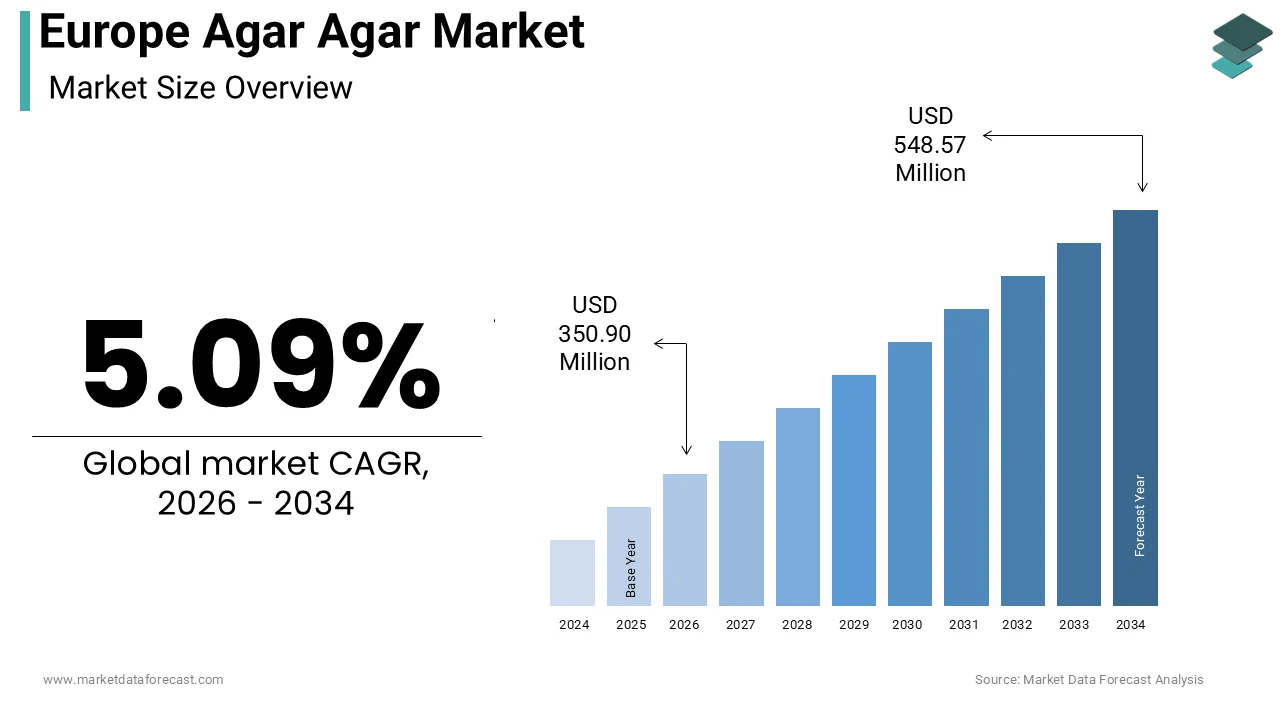
Agar agar functions as a vital hydrocolloid extracted primarily from red algae species such as Gelidium and Gracilaria, serving as an indispensable gelling and stabilizing agent across European food, pharmaceutical, and biotechnology sectors. This natural polysaccharide has secured a dominant position as the preferred alternative to animal-derived gelatin, aligning perfectly with the region's robust shift toward plant-based consumption patterns. The European seaweed sector, a primary source of raw materials for agar, has reached a significant valuation and is poised for steady growth. Industry forecasts indicate a consistent upward trend in market size, driven by increasing applications in food, pharmaceuticals, and sustainable agriculture. Despite this growth, the region remains dependent on imports to meet its needs. Regional farming accounts for only a small fraction of the total harvest collected within the continent, which is itself a minor portion of the vast amount of seaweed produced worldwide each year. The market dynamics are further influenced by the fact that 99% of seaweed production within the European Union currently depends on wild-stock harvesting rather than cultivated farms, creating inherent volatility in raw material availability according to European agricultural reports. Growing consumer interest in plant-based diets across Europe is a major factor driving demand for seaweed-derived ingredients. As the region represents a significant portion of the global vegan food market, manufacturers are increasingly turning to natural sea-based options to provide the necessary texture for animal-free products. Regulatory bodies like the European Food Safety Authority maintain strict oversight on food additives classified under code E406, ensuring purity standards that shape market entry and product formulation strategies. The interplay between limited domestic cultivation capacity and surging demand from the confectionery and dairy alternative segments defines the current operational landscape for agar agar stakeholders in the region.
MARKET DRIVERS
Surging Demand for Plant-Based and Vegan Food Alternatives: Demographic Shifts and Dietary Transformation
The exponential growth of the vegan and vegetarian demographic contributes to the expansion of the Europe agar agar market. This necessitates effective plant-based gelling agents to replace animal-derived gelatin. Europe holds a significant portion of the global market for plant-based alternatives, reflecting a widespread shift in dietary habits across the continent. Although other regions currently lead in total market share, the European sector remains a primary driver of global trends and product innovation. The financial value of the plant-based food industry in Europe has reached substantial levels, following a period of rapid cultural and commercial growth. Long-term economic projections suggest that this market will continue to expand significantly as more consumers incorporate meat-free and dairy-free options into their daily lives. Manufacturers in the confectionery, dairy alternative, and bakery sectors increasingly utilize agar agar due to its ability to provide firm texture and thermal stability without compromising clean label credentials. Retail sales volumes for plant-based foods are witnessing consistent growth in major economies, including France, Germany, Italy, and Spain, where private-label products are accelerating adoption rates, according to retail sector analysis. The functional superiority of agar agar over other hydrocolloids in specific applications, such as vegan jellies and microbial culture media, further cements its position. As the population adhering to flexitarian diets expands, the requirement for versatile texturizers that mimic the mouthfeel of traditional gelatin becomes paramount. This sustained consumer preference for ethically sourced and cruelty-free ingredients ensures that agar agar remains a cornerstone ingredient in the formulation of next-generation plant-based products across the continent.
Expansion of Pharmaceutical and Biotechnology Applications: Critical Role in Life Sciences and Medicine
The escalating utilization of agar agar within the European pharmaceutical and biotechnology industries is among the key factors boosting the growth of the Europe agar agar market. Its unique properties are indispensable for microbiological culture media and drug delivery systems. The substance offers unparalleled purity and sterility, making it the standard substrate for growing bacteria and fungi in laboratory settings throughout the region. As the European biotechnology sector advances, the demand for high-grade agar capable of supporting complex microbial growth without interference has intensified. Pharmaceutical manufacturers rely on agar for capsule production and as a laxative component, benefiting from its non-digestible nature and safety profile approved by regulatory agencies. The broader European seaweed market, which underpins the supply chain for these specialized applications, is reflecting the increasing industrial integration of marine derivatives according to long-term market projections. Research institutions and quality control laboratories require consistent supplies of refined agar to maintain compliance with stringent European pharmacopoeia standards. Furthermore, the development of novel drug delivery mechanisms utilizing agar-based hydrogels opens new avenues for market penetration. The convergence of increased research funding in life sciences and the critical need for reliable culture media ensures that the pharmaceutical segment remains a robust pillar of demand, insulating the market from fluctuations in the food sector alone.
MARKET RESTRAINTS
Heavy Reliance on Imported Raw Materials and Supply Volatility, Geopolitical Risks, and Logistical Dependencies
The region's profound dependency on imported seaweed biomass continues to hamper the expansion of the Europe agar agar market. This exposes the supply chain to geopolitical risks and logistical inconsistencies. Currently, European farmers contribute merely a portion of the global seaweed harvest, forcing the industry to source the vast majority of its raw materials from Asia and South America, according to sources. This reliance creates vulnerability to international trade disruptions, shipping delays, and fluctuating freight costs that directly impact production margins. Since most of the seaweed available in the EU originates from wild stocks rather than controlled aquaculture, the supply is subject to seasonal variations and environmental unpredictability in exporting nations. Import values for seaweeds and algae have shown variability over the years, reflecting the instability of relying on external sources for critical industrial inputs, according to trade data records. Any climatic event or regulatory change in major producing countries like Indonesia or Chile can cause immediate shortages and price spikes within the European market. The lack of a robust domestic cultivation infrastructure means that European processors cannot easily buffer against these external shocks. Consequently, manufacturers face challenges in maintaining consistent inventory levels and stable pricing for their downstream customers, which can stifle long-term planning and investment in agar-based product lines.
Price Instability Linked to Feedstock and Logistics Costs, Economic Fluctuations, and Margin Pressures
Persistent price volatility is a major hurdle hindering the growth of the Europe agar agar market. This is driven by the fluctuating costs of raw seaweed feedstock and the complexities of the global logistics network. The pricing of agar agar powder is intrinsically linked to the seasonal availability of red algae, where poor harvest yields due to weather anomalies can trigger sharp cost increases, according to commodity market analysis. Geopolitical influences and rising aquaculture input costs further exacerbate these financial uncertainties, making it difficult for end-users to forecast expenses accurately. Freight charges constitute a significant portion of the final landed cost, and recent global shipping disruptions have demonstrated how quickly transportation barriers can inflate prices for imported hydrocolloids, according to logistics sector updates. Research indicates that temporary price spikes often occur when supply chains face breakdowns, affecting the competitiveness of agar agar against synthetic or more locally sourced alternatives, as noted by economic observers. This financial unpredictability discourages small and medium-sized enterprises from committing to agar-based formulations, as they lack the purchasing power to hedge against sudden cost surges. Additionally, the high energy requirements for processing raw seaweed into refined agar add another layer of cost sensitivity, particularly in an environment of fluctuating European energy prices. Such economic instability limits market expansion by forcing formulators to consider cheaper, albeit potentially less functional, substitutes to maintain profit margins.
MARKET OPPORTUNITIES
Development of Domestic Seaweed Aquaculture Initiatives, Strategic Localization, and Blue Economy Growth
The strategic expansion of domestic seaweed aquaculture across European coastal waters creates new options for the expansion of the Europe agar agar market. This initiative aims to reduce import dependency and secure a stable raw material supply. Governments and private investors are increasingly funding offshore farming projects to shift the production model from wild harvesting, which accounts for a substantial share of the current EU supply, to sustainable cultivation, as per sources. Establishing local farms in the North Sea and Atlantic regions would mitigate logistics costs and shield the market from international trade volatilities. Roadmaps for the European seaweed industry outline ambitious targets to scale up production capacity significantly between 2024 and 2050, fostering a self-sufficient ecosystem for hydrocolloid extraction according to multiple studies. This localization effort aligns with the European Green Deal, offering potential subsidies and regulatory support for blue economy initiatives. By controlling the cultivation process, producers can ensure higher quality standards and traceability, which are increasingly demanded by premium food and pharmaceutical brands. Successfully scaling these aquaculture operations would not only stabilize prices but also create a circular economy model where seaweed farming contributes to carbon sequestration and water purification.
Innovation in Clean Label and Organic Product Formulations: Consumer Transparency and Natural Ingredient Trends
The rising consumer preference for clean-label and organic products offers a lucrative avenue for the Europe agar agar market growth. As a result, it is poised to displace synthetic additives and controversial hydrocolloids in various food applications. As the plant-based food landscape in Europe grows, with retail volumes increasing in key nations, there is a parallel demand for ingredients that are perceived as natural and minimally processed, according to studies. Agar agar, designated as E406, benefits from its natural origin and absence of chemical modification, making it an ideal candidate for manufacturers seeking to simplify ingredient lists. The trend toward transparency in food labeling drives brands to replace synthetic gelling agents with seaweed-derived alternatives that resonate with health-conscious consumers. Opportunities exist in developing specialized agar blends that offer improved texture and stability for emerging categories such as plant-based meats and dairy-free cheeses. Innovations in processing technologies that enhance the functional properties of agar while maintaining its organic certification will further unlock potential. Companies that invest in research to optimize agar performance in low-sugar and low-fat formulations will be well-positioned to capitalize on this shifting consumer paradigm.
MARKET CHALLENGES
Environmental Vulnerability of Seaweed Cultivation to Climate Change, Ecological Risks, and Harvest Uncertainty
The escalating impacts of climate change are a major limiting factor for the stability of seaweed supplies and the Europe agar agar market. These supplies form the foundation of the agar agar industry. Rising sea surface temperatures and marine heat waves threaten the reproductive capacity and growth rates of red algae species essential for agar production, according to research. Ocean acidification and changes in salinity levels further stress marine ecosystems, altering the biochemical composition of seaweed and potentially affecting the quality of the extracted agar. The short- and long-term environmental effects of large-scale offshore cultivation remain poorly understood, creating uncertainty for investors and farmers alike, according to ecological studies. As climate patterns become more erratic, the predictability of harvest seasons diminishes, complicating supply chain planning for European processors. Adaptation strategies are necessary but require significant capital investment and technological innovation, which may be beyond the reach of smaller operators. Without resilient farming practices and robust environmental monitoring, the entire value chain faces the risk of chronic supply shortages driven by ecological instability.
Intense Competition from Alternative Hydrocolloids and Substitutes, Market Saturation, and Substitute Availability
Competition from a diverse array of alternative hydrocolloids impedes the growth of the Europe agar agar market. These alternatives offer similar functional properties, often at lower price points or with specific technical advantages. Competitors such as carrageenan, pectin, locust bean gum, and guar gum possess established supply chains and are frequently used as cost-effective substitutes in various industrial applications, according to research. The gelatin substitutes market is expanding, with manufacturers actively seeking diverse plant-based options to mitigate reliance on any single ingredient source, as per sources. Innovations in microbial polysaccharides and starch-based thickeners provide additional alternatives that challenge agar's dominance in certain texture profiles. Price sensitivity among food manufacturers drives the substitution of agar with these cheaper alternatives, especially when agar prices spike due to supply constraints, according to studies. Furthermore, some competitors offer superior performance in specific pH ranges or temperature conditions, limiting the applicability of agar in specialized formulations. The presence of blended hydrocolloid systems that combine multiple gums to achieve desired textures further dilutes the demand for pure agar. To maintain market share, agar producers must continuously demonstrate unique value propositions and invest in application-specific research to differentiate their product from this crowded field of substitutes.
REPORT COVERAGE
| REPORT METRIC | DETAILS |
| Market Size Available | 2025 to 2034 |
| Base Year | 2025 |
| Forecast Period | 2026 to 2034 |
| CAGR | 5.09% |
| Segments Covered | By Form, Application, And Region |
| Various Analyses Covered | Global, Regional & Country Level Analysis; Segment-Level Analysis; DROC, PESTLE Analysis; Porter’s Five Forces Analysis; Competitive Landscape; Analyst Overview of Investment Opportunities |
| Regions Covered | UK, France, Spain, Germany, Italy, Russia, Sweden, Denmark, Switzerland, Netherlands, Turkey, and the Czech Republic |
| Market Leaders Profiled | Meron Group, Marine Hydrocolloids, Hispanagar S.A., Indesso, Agarindo Bogatama, PT Java Biocolloid, Setexam, B&V srl, Agarmex S.A. de C.V., Fujian Global Ocean Biotechnology Co., Ltd., Qingdao Gather Great Ocean Algae Industry Group Co., Ltd., Shantou Chenghai District Agar Glue Factory, Sobigel, Titan Biotech Ltd., Neogen Corporation |
SEGMENTAL ANALYSIS
By Form Insights
In 2025, the powder form segment led the Europe agar agar market and held a 60.3% share. The leading position of this segment is attributed to its seamless integration into large-scale automated manufacturing lines where precision and speed are paramount. This segment also leads because of its superior solubility, ease of handling in industrial mixing processes, and versatility across diverse applications ranging from confectionery to microbiology. Industrial food processors and pharmaceutical manufacturers favor powder because it dissolves more rapidly and uniformly than flakes when subjected to high-shear mixing equipment, reducing production cycle times significantly. In the European confectionery sector, which produces millions of tons of gummy candies and jellies annually, the ability to dose exact quantities of powdered agar ensures consistent texture and batch-to-batch reproducibility. The reduced risk of clumping and the elimination of pre-soaking steps required for some flake varieties further enhance its appeal for high-volume producers. Additionally, the compact nature of powder allows for more efficient storage and logistics, lowering warehousing costs for manufacturers who operate on thin margins. As European factories continue to adopt Industry 4.0 technologies, the demand for ingredients that facilitate automated dispensing systems will further solidify the leading position of the powder segment in the regional supply chain. A critical factor sustaining the leadership of the powder form is its indispensable role in the pharmaceutical and biotechnology sectors, where sterility and precise concentration are non-negotiable. Microbiological culture media, essential for diagnostic testing and research across European laboratories, almost exclusively utilize refined agar powder to ensure a homogeneous gel structure that supports accurate microbial growth. The European pharmaceutical landscape requires excipients that meet stringent pharmacopoeia standards, and powdered agar offers the necessary purity levels and particle size consistency for capsule filling and tablet binding. Research suggests that the demand for high-purity agar powder in life science applications is growing in tandem with the expansion of biotech hubs in countries like Switzerland and Sweden. The ability to sterilize powder via autoclaving without losing gelling strength makes it the preferred choice for preparing nutrient agars used in hospital and research settings. Furthermore, the nutraceutical industry leverages powdered agar for creating vegan capsules and fiber supplements, capitalizing on its clean label status. The technical requirement for fine particle distribution in these high-value applications creates a barrier to entry for flake forms, ensuring that powder remains the dominant format for specialized and regulated industries throughout Europe.
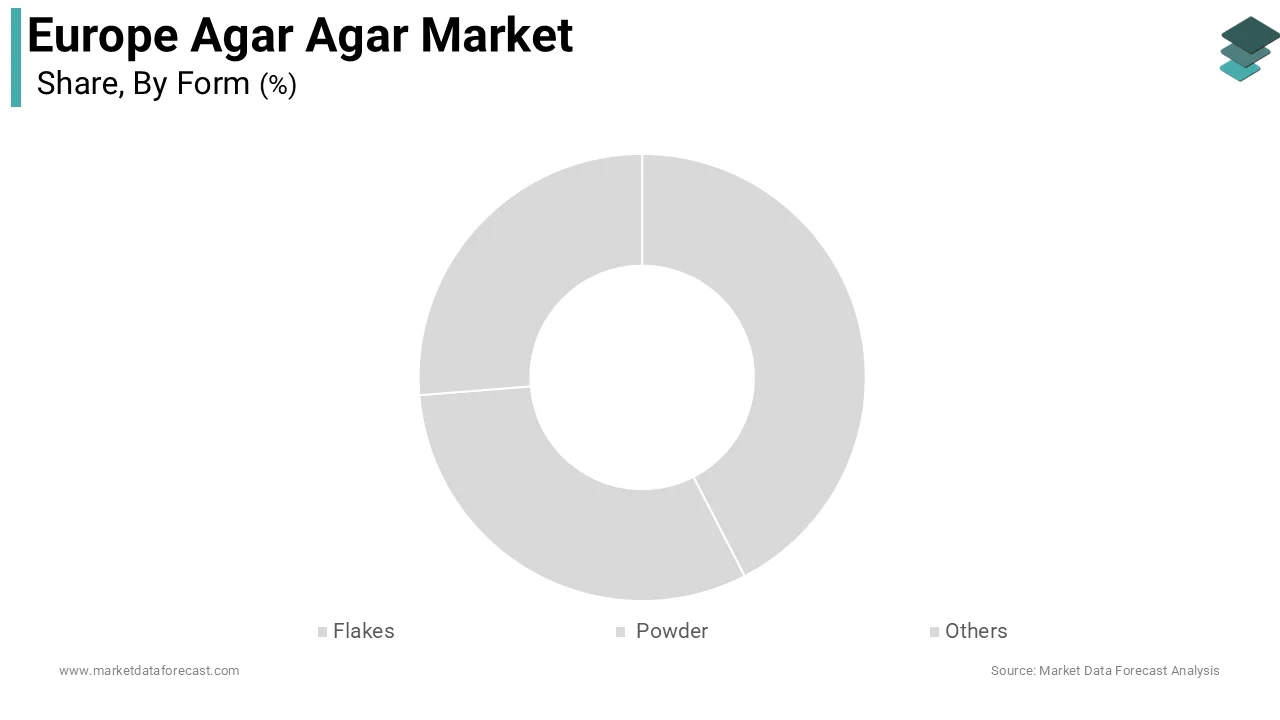
The flakes segment is anticipated to witness the fastest CAGR of 7.2% from 2026 to 2034. This accelerated growth of the segment is propelled by a resurgence in artisanal food production, home cooking trends, and specific culinary applications where the visual texture and slow-release gelling properties of flakes are preferred over powder. Moreover, the rapid expansion of the flakes segment is largely fueled by the booming artisanal food movement and the increasing popularity of home cooking across Europe, where consumers seek authentic and traditional ingredient formats. Unlike powder, which dissolves instantly, agar flakes provide a visual cue and a slower hydration process that appeals to hobbyist bakers and small-batch producers making traditional desserts, jams, and jellies. A study shows that sales of specialty baking ingredients in the United Kingdom and Germany have surged in recent years as consumers engage more frequently in domestic food preparation activities, according to retail market observations. The tactile experience of using flakes aligns with the "slow food" philosophy prevalent in Southern European countries like Italy and Spain, where culinary heritage is highly valued. Small-scale confectioners and boutique patisseries often prefer flakes for specific textures that powder cannot replicate, such as a more delicate mouthfeel in fruit jellies. Additionally, the perception of flakes as a less processed, more natural form resonates with the clean label demands of modern consumers who scrutinize ingredient lists for minimal processing indicators. This shift in consumer behavior toward premium, experiential cooking ingredients is creating a robust niche market that propels the growth rate of the flakes segment ahead of the mature powder category. In addition, this segment is supported by its increasing adoption in molecular gastronomy and the craft brewing industry, where unique textural properties are essential for innovation. Chefs in Europe's vibrant fine dining scene utilize flakes to create spherical gels and transparent garnishes that require controlled gelling kinetics, a feature that powdered agar often compromises due to its rapid dissolution. The craft beer sector, which has seen exponential growth with thousands of new microbreweries launching across the continent, employs agar flakes for yeast propagation and clarification processes where gradual release is beneficial. Research indicates that the number of craft breweries in Europe increased in 2025, driving demand for specialized brewing aids, including agar flakes. The visual appeal of flakes in transparent preparations allows chefs to maintain the aesthetic integrity of avant-garde dishes, making them a staple in high-end culinary establishments. Furthermore, the use of flakes in vegetarian and vegan cheese making is gaining traction among artisanal producers who value the structural integrity provided by the slower melting profile of flakes. These specialized, high-value applications are expanding the user base beyond traditional food manufacturing, contributing significantly to the segment's superior CAGR compared to other forms.
By Application Insights
The Food and Beverages application segment dominated the Europe agar agar market and accounted for a 67.5% share in 2025. This dominance of the segment is credited to the massive scale of the European food processing industry and the widespread substitution of gelatin with agar in response to shifting dietary preferences. The foremost driver for the Food and Beverages segment is the unprecedented expansion of the plant-based dairy and confectionery industries, which rely heavily on agar agar as a primary texturizer and gelling agent. As European consumers increasingly reject animal-derived ingredients, manufacturers are reformulating products like yogurts, puddings, and gummy candies to use agar, which provides the necessary firmness and thermal stability that plant proteins alone cannot achieve. Major food corporations in France and Germany have committed to converting entire product lines to vegan formulations, necessitating vast quantities of agar to maintain sensory quality. In the confectionery sector, the demand for gelatin-free gummies has skyrocketed, with retail sales of vegan sweets growing in key markets over the last five years, as per various sources. The functional versatility of agar allows it to mimic the chewiness of gelatin in gummies while offering a higher melting point, which is crucial for products sold in warmer climates or shipped globally. This structural shift in the food industry from animal-based to plant-based ingredients ensures that the Food and Beverages segment remains the largest consumer of agar agar in the region. Additionally, the segment is helped by the intensifying consumer demand for clean-label products that feature natural and recognizable ingredients. Agar agar, derived from seaweed and classified as a natural hydrocolloid, fits perfectly into the formulation strategies of brands aiming to remove synthetic additives and E-numbers that are perceived negatively by health-conscious shoppers. Regulatory pressure and consumer advocacy in the European Union have forced manufacturers to simplify ingredient decks, leading to a surge in the use of seaweed-based gelling agents in jams, jellies, bakery fillings, and canned fruits. The versatility of agar in low-sugar and low-calorie applications further boosts its adoption, as it allows for the creation of structured foods without adding calories or affecting blood sugar levels. Bakery and dessert manufacturers are increasingly using agar to stabilize fruit preparations and glazes, replacing chemically modified starches. This broad-based adoption across multiple sub-categories of the food industry, driven by the clean label imperative, solidifies the Food and Beverages segment as the undisputed leader in agar agar consumption.
The Pharmaceuticals and Nutraceuticals segment is experiencing robust growth. This is driven by the rising need for vegan capsules, advanced drug delivery systems, and microbiological culture media in a region with a highly developed life sciences infrastructure.
REGIONAL ANALYSIS
Germany Agar Agar Market Analysis
Germany outperformed other countries in the Europe agar agar market and held a 22.4% share in 2025 because of its massive food processing industry and strong pharmaceutical sector. The country's position is also propelled by its status as the largest economy in the EU and a global hub for food technology and innovation. The German food and beverage industry is a voracious consumer of hydrocolloids for producing confectionery, dairy alternatives, and baked goods, according to federal economic data. A key driving factor is the nation's leading role in the vegan movement, with Germany hosting the highest number of vegan products per capita in the world, necessitating extensive use of agar as a gelatin substitute. The presence of major multinational food corporations and a dense network of small to medium-sized artisanal producers creates a diverse demand base. Furthermore, Germany's robust pharmaceutical industry, centered in regions like Hesse and Baden-Württemberg, drives significant demand for high-purity agar for laboratory and medicinal applications. The country's strict regulatory environment regarding food safety also favors established, high-quality suppliers of agar, reinforcing market stability. Continuous investment in food tech startups focusing on plant-based meat and dairy alternatives further cements Germany's dominance, ensuring sustained growth in agar consumption as the nation transitions toward more sustainable food systems.
France Agar Agar Market Analysis
In 2025, France was the next prominent country in the Europe agar agar market and occupied a share of 17.7% share. Its world-renowned culinary traditions and a thriving cosmetics industry are fuelling the growth of the French market. The French market is characterized by a deep integration of agar in both haute cuisine and mass-market food production, reflecting the country's commitment to gastronomic excellence. The food and beverage sector in France, a cornerstone of the national economy, utilizes agar extensively in confectionery, jams, and dairy desserts, with the nation being one of the top producers of jam and jelly products in Europe, according to studies. A big force shaping the French market is the growing popularity of plant-based diets among the French population, with the vegan food market expanding rapidly in urban centers like Paris and Lyon. Additionally, France is a global leader in the cosmetics and personal care industry, where agar is increasingly used as a natural thickening and gelling agent in organic skincare formulations. The demand for clean beauty products has spurred cosmetic manufacturers to replace synthetic polymers with seaweed-derived ingredients. The strong presence of research institutions focused on marine biotechnology also fosters innovation in agar applications, supporting both food and non-food sectors. Government initiatives promoting the blue economy and sustainable sourcing further enhance the market environment, making France a critical growth engine for the regional agar industry.
United Kingdom Agar Agar Market Analysis
The United Kingdom continues to be a major contributor to the Europe agar agar market owing to its aggressive adoption of vegan lifestyles and a dynamic food tech ecosystem. Besides, the UK market status shows a rapid shift in consumer behavior, with the nation boasting one of the highest growth rates for plant-based food sales globally. The British food industry has responded swiftly to this trend, with major retailers and food service providers expanding their vegan offerings, all of which rely heavily on agar for texture and stability, according to research. A primary driver is the strong cultural momentum behind "Veganuary" and year-round plant-based consumption, which has normalized the use of agar in everyday products from supermarket own-labels to restaurant menus. The UK is also a hub for food technology startups developing next-generation meat and dairy analogues, many of which utilize agar as a key functional ingredient. Furthermore, the country's prestigious pharmaceutical and biotechnology sectors contribute to demand for high-grade agar for research and development purposes. Despite post-Brexit trade complexities, the UK maintains robust import channels for seaweed derivatives, ensuring supply continuity. The convergence of consumer activism, retail innovation, and scientific research creates a fertile ground for agar agar market expansion in the United Kingdom.
Italy Agar Agar Market Analysis
Italy is moving ahead steadfastly in the Europe agar agar market due to its immense confectionery industry and the modernization of traditional recipes to meet contemporary dietary needs. Also, the Italian market is unique due to its deep-rooted culinary heritage, where agar is increasingly used to adapt classic desserts and sweets for vegan and vegetarian consumers without compromising authenticity. Italy is one of the largest producers of confectionery and chocolate products in Europe, creating a substantial baseline demand for gelling agents, according to sources. Among these, a major driving factor is the rising awareness of health and wellness among Italian consumers, leading to a surge in demand for low-sugar and plant-based treats that utilize agar for structure. The artisanal gelato and pastry sectors are also experimenting with agar to create stable, dairy-free versions of traditional favorites. Additionally, the Italian pharmaceutical sector, particularly in the north, contributes to the demand for agar in capsule manufacturing and laboratory settings. The government's support for the "Made in Italy" brand encourages the use of high-quality, natural ingredients, benefiting suppliers of premium agar. As Italian manufacturers export their products globally, the need for stable, heat-resistant gelling agents like agar becomes even more critical, sustaining market growth.
Spain Agar Agar Market Analysis
Spain is an emerging player in the Europe agar agar market by leveraging its extensive coastline for emerging seaweed cultivation and a robust food processing sector focused on exports. The Spanish market is evolving from a purely import-dependent model to one that increasingly values local sourcing, although imports still dominate current supply chains. Spain is a major producer of canned vegetables, fruits, and seafood products, industries that utilize agar for glazing, thickening, and stabilizing, contributing significantly to domestic consumption, according to research. A primary driver is the growing interest in the blue economy, with several pilot projects for seaweed farming launched along the Galician and Cantabrian coasts to supply the local hydrocolloid industry. This push for localization aims to reduce reliance on Asian imports and shorten supply chains. The Spanish consumer market is also witnessing a steady rise in vegan and flexitarian demographics, particularly in metropolitan areas like Madrid and Barcelona, driving demand for plant-based food ingredients. Furthermore, Spain's strong tourism and hospitality sector fuels the consumption of agar-containing desserts and beverages in hotels and restaurants. The combination of a strong industrial base, emerging aquaculture initiatives, and shifting dietary patterns positions Spain as a key growth market for agar agar in Southern Europe.
COMPETITION OVERVIEW
The Europe agar agar market features a competitive and fragmented landscape with numerous regional and global participants vying for a share. Market concentration remains low, which enables both established manufacturers and emerging suppliers to compete effectively across diverse application segments. Leading companies differentiate through product quality, technical support, and certification portfolios rather than price alone. Competition intensifies in high-value segments like pharmaceutical-grade agar, where purity standards and regulatory compliance create significant entry barriers. Regional players leverage local sourcing advantages and customer proximity while global firms benefit from scale and diversified supply chains. Innovation in application development and sustainability credentials increasingly influence competitive dynamics. The market also sees collaboration between agar suppliers and food technology firms to co-create solutions for plant-based product developers. This environment encourages continuous improvement in product performance, supply chain transparency, and customer service as companies strive to secure long term partnerships with European manufacturers across food, pharmaceutical, and industrial sectors.
KEY MARKET PLAYERS
A few major players of the Europe agar agar market include
- Meron Group
- Marine Hydrocolloids
- Hispanagar S.A
- Indesso
- Agarindo Bogatama
- PT Java Biocolloid
- Setexam
- B&V srl
- Agarmex S.A. de C.V
- Fujian Global Ocean Biotechnology Co., Ltd
- Qingdao Gather Great Ocean Algae Industry Group Co., Ltd
- Shantou Chenghai District Agar Glue Factory
- Sobigel
- Titan Biotech Ltd
- Neogen Corporation
Top Strategies Used by Key Market Participants
Key players in the Europe agar agar market employ several strategic approaches to consolidate their positions and drive growth. Companies prioritize vertical integration by securing direct relationships with seaweed harvesters to ensure raw material quality and supply stability. Product innovation remains central with firms investing in research to develop specialized agar grades for emerging applications like plant-based meats and clean-label cosmetics. Strategic partnerships with distributors and food technology firms enable broader market reach and application support. Many participants pursue quality certifications, including organic, Kosher, and Halal credentials, to access premium market segments. Capacity expansion through facility upgrades and technology adoption helps meet rising European demand while maintaining cost competitiveness. Sustainability initiatives focusing on eco-friendly harvesting and carbon-neutral processing also feature prominently in corporate strategies to align with European environmental regulations and consumer values.
Leading Players in the Europe Agar Agar Market
- Industrial Roko SA operates as the largest producer of agar agar in Europe, with extensive expertise in seaweed processing and natural hydrocolloid formulation. The company supplies diverse agar grades for food microbiology, pharmaceutical, and technical applications across European markets. Roko has strengthened its position through continuous innovation in hydrocolloid blending technologies and by expanding its product portfolio to include carrageenan, pectin, and gellan gum. Recent strategic actions include investing in sustainable sourcing partnerships with seaweed harvesters and enhancing production capacity at its European facilities. The company actively participates in industry forums to promote seaweed-based ingredients and has launched technical support services to help customers optimize agar applications in plant-based product development.
- Hispanagar S A stands as one of the world's leading manufacturers of purified seaweed extracts with over sixty years of dedicated agar production experience. The Spain-based company processes algae from five continents to deliver bacteriological, pharmaceutical, and food-grade agar to European clients. Hispanagar has reinforced its market position through rigorous quality certifications, including ISO 9001 and IFS Global Markets Food standards. Recent initiatives include expanding its Institute of Applied Research to develop innovative agarose products and collaborating on doctoral research projects to advance marine hydrocolloid science. The company has also enhanced its organic agar certification portfolio to meet rising European demand for clean-label and sustainable ingredients in food and cosmetic formulations.
- Setexam operates as a world-leading agar agar manufacturer based in Morocco with a strategic partnership supplying European markets through distribution allies like Norevo. The company leverages its coastal location near Atlantic seaweed harvesting zones to ensure premium raw material access and consistent supply. Setexam has strengthened its European presence by investing in state-of-the-art extraction technology that delivers customized gel strengths for diverse industrial applications. Recent actions include expanding organic agar production capabilities and developing specialized bacteriological agar grades for European pharmaceutical and research laboratories. The company also focuses on sustainable harvesting practices and traceability systems to align with European regulatory expectations and consumer preferences for ethically sourced marine ingredients.
MARKET SEGMENTATION
This research report on the Europe agar agar market has been segmented and sub-segmented based on form, application & region.
By Form
- Flakes
- Powder
- Others
By Application
- Food & Beverages
- Pharmaceuticals & Nutraceuticals
- Others
By Region
- UK
- France
- Spain
- Germany
- Italy
- Russia
- Sweden
- Denmark
- Switzerland
- Netherlands
- Turkey
- Czech Republic
- Rest of Europe