- Product Description Description
- Table of Contents TOC
- List of Table & Figure LOT
- Get Free Sample PDF Sample PDF
Market Size, 2025
$4.68 BnMarket Estimate, 2026
$5.97 BnMarket Forecast, 2034
$41.66 BnCAGR, 2026–2034
27.49%Europe Agrivoltaics Market Size, Growth, Trends & Forecast (2026–2034)
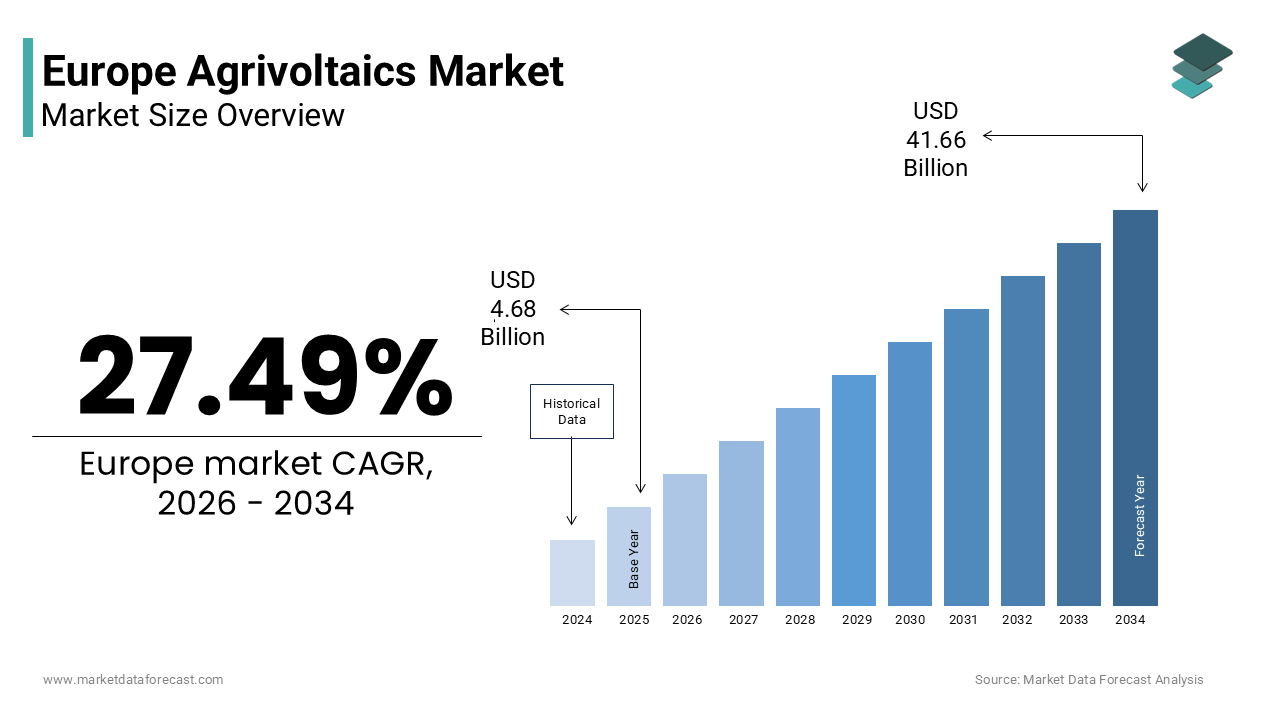
The Europe agrivoltaics market size was valued at USD 4.68 billion in 2025, is anticipated to reach USD 5.97 billion in 2026, and is projected to scale up to USD 41.66 billion by 2034, registering a compound annual growth rate (CAGR) of 27.49% during the forecast period from 2026 to 2034. Driven by EU Green Deal mandates, rising land use competition, strict climate neutrality targets, and the necessity for farmer income diversification, the regional market continues to expand rapidly.
Key Executive Metrics (At-a-Glance)
- 2025 Base Valuation: USD 4.68 Billion
- 2026 Current Valuation: USD 5.97 Billion
- 2034 Forecast Valuation: USD 41.66 Billion
- Compound Annual Growth Rate (CAGR): 27.49% (2026–2034)
- Dominant System Design Segment: Fixed Panel Systems (preferred for lower capital costs and proven structural reliability)
- Dominant Technology Segment: Monofacial Modules (widely implemented due to mature manufacturing ecosystems and predictable yields)
- Fastest-Growing Placement Segment: Greenhouse Integrated Systems (propelled by controlled environment agriculture and year-round yield demands)
- Dominant Country Market: Germany & France (anchored by robust policy frameworks, renewable energy tenders, and agricultural cooperatives)
Core Market Drivers
- EU Renewable Targets & Land Policies: REPowerEU plan goals and strict land preservation frameworks requiring clean energy scale-up without displacing prime agricultural land.
- Economic Resilience & Income Diversification: Protection against agricultural income volatility, providing stable electricity sales revenue and reduced irrigation costs through panel shading.
- Climate Adaptation: Growing needs to shield high-value crops and livestock from extreme heatwaves, water evaporation, and drought conditions.
Primary Market Restraints & Challenges
- High Upfront Capex & Permitting Bottlenecks: Substantial structural investment requirements, complex regulatory approvals, and fragmented zoning laws across member states.
Europe Agrivoltaics Market Segmentation Breakdown
| Segment Category | Leading Sub-Segment (2025 Base) | Fastest-Growing Sub-Segment (2026–2034) |
|---|---|---|
| By System Design | Fixed Panel Systems (market leader due to cost efficiency and simple farm maintenance profiles) | Dynamic Panel Systems (scaling rapidly via intelligent sun-tracking and crop-specific shading control) |
| By Technology | Monofacial Modules (dominant share anchored by established supply chains and financial predictability) | Bifacial Modules (fastest-growing due to dual-side energy generation and enhanced land-use efficiency) |
| By Placement | Ground Mounted Systems (capturing over 70% of installations for open arable farming and pastures) | Greenhouse Integrated Systems (expanding through high-tech horticulture and semi-transparent roof panels) |
| By Region | Germany & France (regional pioneers backed by supportive legislation and dedicated agrivoltaic tenders) | Italy & Spain (high-growth hubs leveraging intense solar irradiance to combat southern water scarcity) |
Major Industry Players Profiled
Key enterprises shaping the competitive European agrivoltaics market include Sun’Agri SAS, Next2Sun Technology GmbH, BayWa r.e. AG, Enel Green Power S.p.A., REM TEC S.r.l., Insolight SA, Akuo Energy SAS, TotalEnergies SE, EDF Renewables, and Trina Solar Co., Ltd..
 Download Free Sample Report
Europe Agrivoltaics Market Size
The Europe agrivoltaics market size was valued at USD 4.68 billion in 2025 and is anticipated to reach USD 5.97 billion in 2026 from USD 41.66 billion by 2034, growing at a CAGR of 27.49% during the forecast period from 2026 to 2034.
Agrivoltaics represents a synergistic integration of agricultural production and photovoltaic energy generation on the same land area, addressing the dual challenges of food security and renewable energy transition. This innovative land use model involves installing solar panels at elevated heights or with specific spacing to allow sunlight penetration for crop growth while generating clean electricity. The European Union has identified agrivoltaics as a critical component of its Green Deal strategy to achieve climate neutrality by 2050 without compromising arable land availability. According to the Joint Research Centre of the European Commission, agrivoltaic systems can potentially cover up to 1% of European agricultural land while contributing significantly to the bloc’s renewable energy targets. As per Eurostat, agriculture occupies approximately 40% of the total land area in the European Union, which is providing a vast theoretical surface for dual use applications. The technology mitigates land use conflicts by enabling farmers to diversify income streams through energy sales while maintaining crop yields. Recent pilot projects across France, Germany, and Italy have demonstrated that certain crops benefit from the microclimate created by solar panels, which reduces heat stress and water evaporation. Regulatory frameworks are evolving to support these installations, with several member states introducing specific tender schemes and subsidies. The market is characterized by collaborations between energy developers, agricultural cooperatives, and technology providers who seek to optimize panel design for specific crop requirements. This convergence of sectors fosters innovation in mounting structures and monitoring systems tailored to European farming practices.
MARKET DRIVERS
Stringent Land Use Policies and Renewable Energy Targets
The European Union’s ambitious renewable energy goals coupled with strict land preservation policies is fuelling the agrivoltaic adoption in Europe and is one of the key factors propelling the European market expansion. The REPowerEU plan aims to increase the share of renewables to 45% by 2030 and requiring rapid deployment of solar capacity without encroaching on protected natural habitats or prime agricultural land. As per the European Environment Agency, land take for urban and infrastructure development has resulted in an average net land take of 540 km² per year in cities and commuting zones, intensifying competition for land resources. Agrivoltaics offers a viable solution by allowing simultaneous use of land for food and energy, thereby satisfying both regulatory mandates. Member states such as France and Germany have introduced legal definitions and specific support mechanisms for agrivoltaics to distinguish them from ground mounted solar farms that may displace farming activities. The European Commission’s Common Agricultural Policy reforms encourage practices that enhance environmental sustainability, providing financial incentives for farmers who adopt dual use systems. This policy alignment reduces regulatory uncertainty and encourages investment from energy developers who previously faced opposition from local communities concerned about land degradation. The requirement to maintain agricultural activity ensures that rural economies remain vibrant while contributing to national energy security. Consequently, the regulatory push creates a favorable environment for market expansion, driving demand for specialized engineering solutions that comply with agricultural standards.
Economic Resilience and Income Diversification for Farmers
Farmers across Europe face increasing economic volatility due to fluctuating commodity prices, rising input costs and extreme weather events, which is making income diversification through agrivoltaics an attractive proposition. The integration of solar energy generation provides a stable and predictable revenue stream that hedge against agricultural risks. According to the European Commission, extreme weather and climate change contribute to significant volatility in agricultural income, which can fluctuate by more than 20% depending on the season and crop type. Agrivoltaic systems allow farmers to sell electricity to the grid or use it for on farm operations such as irrigation and cooling, significantly reducing operational expenses. As per recent industry insights, energy revenues can account for 20% to 50% of total farm income in agrivoltaic setups, providing a financial buffer during poor harvest seasons. Additionally, the shade provided by solar panels can reduce water consumption by 20% to 30% for certain crops, lowering irrigation costs in drought prone regions like Southern Europe. This economic benefit is particularly relevant for small and medium sized farms that struggle to achieve economies of scale in traditional agriculture. Government subsidies and feed in tariffs further enhance the return on investment, making the initial capital expenditure more manageable. The promise of long term contractual income attracts younger generations to farming, addressing the demographic challenge of an aging farmer population in Europe. This financial stability drives adoption as farmers seek sustainable business models that ensure viability in a changing climate.
MARKET RESTRAINTS
High Initial Capital Expenditure and Financing Barriers
The substantial upfront investment required for agrivoltaic systems serves as a significant restraint, which is limiting widespread adoption among smaller agricultural entities. Unlike conventional ground mounted solar farms, agrivoltaic installations require specialized mounting structures that are taller and more robust to accommodate agricultural machinery and withstand environmental loads. According to industry cost analyses, the installation cost of agrivoltaic systems can be 20% to 40% higher than standard solar projects due to these engineering complexities. Farmers often lack the capital reserves to fund such projects and may face difficulties securing loans due to the perceived novelty and risk associated with the technology. Financial institutions frequently lack standardized assessment criteria for agrivoltaic ventures, leading to stringent lending conditions or higher interest rates. The payback period for these investments typically ranges from 8 to 12 years, which may deter farmers accustomed to shorter agricultural cycles. While subsidies exist, they often do not cover the full incremental cost, leaving a funding gap that private investors are hesitant to fill without proven long term performance data. The complexity of structuring power purchase agreements between farmers and energy off takers adds another layer of financial uncertainty. Without accessible financing instruments tailored to the agricultural sector, many potential projects remain unrealized. This financial barrier disproportionately affects smallholder farmers who could benefit most from income diversification, thereby slowing the overall market penetration in fragmented agricultural landscapes typical of many European regions.
Regulatory Ambiguity and Permitting Complexities
Inconsistent regulatory frameworks and lengthy permitting processes across different European countries are further hampering the regional market growth. While the European Union provides overarching guidelines, the implementation of agrivoltaic definitions and approval procedures varies widely among member states, causing confusion and delays. As per the European Solar PV Industry Alliance, permitting times for renewable energy projects can extend up to 5 years in some jurisdictions, with agrivoltaics facing additional scrutiny due to their dual use nature. Authorities often struggle to classify these projects, oscillating between agricultural and industrial zoning regulations, which lead to legal uncertainties and increased compliance costs. In some regions, strict landscape protection laws restrict the visual impact of solar installations, requiring extensive environmental impact assessments that delay project commencement. The lack of harmonized standards for what constitutes genuine agricultural activity under the panels allows for subjective interpretation by local officials, potentially rejecting projects that do not meet arbitrary aesthetic or productivity benchmarks. Developers must navigate a maze of local, regional, and national permits involving agriculture, energy, and environmental departments, each with differing priorities. This bureaucratic fragmentation increases transaction costs and discourages international investors who prefer standardized markets. Until clear and unified permitting pathways are established, the market will continue to face friction that stifles rapid deployment and innovation.
MARKET OPPORTUNITIES
Integration with Precision Agriculture and Smart Farming Technologies
The convergence of agrivoltaics with precision agriculture presents a substantial opportunity for the European agrivoltaics market. Modern agrivoltaic systems can be equipped with sensors and IoT devices that monitor microclimatic conditions, soil moisture, and plant health in real time. According to the European Innovation Partnership for Agricultural Productivity and Sustainability, the adoption of digital technologies in farming can increase resource efficiency by up to 25%. By integrating solar energy generation with smart irrigation and fertilization systems, farmers can optimize input usage based on actual field conditions rather than historical averages. The data collected from agrivoltaic installations can inform adaptive management strategies, such as adjusting panel angles to maximize light exposure for specific growth stages of crops. This synergy creates value added services where technology providers offer comprehensive farm management platforms that bundle energy monitoring with agronomic advice. The potential for automation in harvesting and maintenance under elevated panels also opens avenues for robotics integration, which is addressing labor shortages in the agricultural sector. Furthermore, the consistent power supply from on-site generation supports the operation of energy intensive precision tools without relying on unstable grid connections. This technological integration positions agrivoltaics not just as an energy solution but as a cornerstone of next generation smart farms and is attracting investment from agtech companies seeking to demonstrate holistic sustainability solutions.
Expansion into Climate Resilient Crop Cultivation
Agrivoltaics offers a unique opportunity to cultivate high value crops that are sensitive to extreme weather conditions, thereby enhancing climate resilience in European agriculture. The partial shading provided by solar panels creates a microclimate that protects plants from heat stress, hail, and excessive UV radiation, which are becoming more frequent due to climate change. As per the Intergovernmental Panel on Climate Change, extreme heat events in Europe have increased in frequency and intensity, threatening yields of sensitive crops such as berries, leafy greens, and certain fruits. Agrivoltaic systems can mitigate these risks, allowing farmers to grow premium produce with higher market value and lower spoilage rates. For instance, trials in southern Europe have shown that grapevines under agrivoltaic structures maintain better acidity levels and sugar balance, improving wine quality despite rising temperatures. This adaptation capability opens new market segments for specialty crops that were previously unsuitable for certain regions due to climatic constraints. Additionally, the reduced water evaporation under panels supports the cultivation of water intensive crops in arid areas, expanding the geographic range of viable agriculture. By positioning agrivoltaics as a climate adaptation tool, developers can access funding from climate resilience funds and insurance products that recognize the risk mitigation benefits. This opportunity aligns agricultural productivity with environmental stewardship, creating a compelling value proposition for farmers facing increasing climate volatility.
MARKET CHALLENGES
Technical Compatibility with Agricultural Machinery and Practices
Ensuring that agrivoltaic structures are compatible with existing agricultural machinery and farming practices poses a significant technical challenge for widespread adoption. Standard farm equipment such as tractors, harvesters, and sprayers requires sufficient clearance and maneuverability space, which may be restricted by poorly designed solar arrays. As per the European Committee for Standardization, there is currently a lack of uniform technical standards for the height, spacing, and load bearing capacity of agrivoltaic mounts, leading to site specific engineering solutions that increase costs. Farmers often need to modify or replace their existing machinery to operate efficiently under the panels, incurring additional expenses that may outweigh the benefits. The presence of vertical support posts can interfere with planting patterns and harvesting routes, requiring changes to traditional agronomic practices that farmers may be reluctant to adopt. Furthermore, the maintenance of solar panels, including cleaning and repair, must be coordinated with agricultural activities to avoid damage to crops or equipment. This operational complexity requires careful planning and training, which may be beyond the capacity of smaller farms lacking technical expertise. The risk of mechanical damage to panels from farming operations also raises insurance and liability concerns. Until standardized designs that accommodate a wide range of agricultural machinery are developed and validated, the technical friction will remain a barrier to seamless integration.
Long Term Impact on Soil Health and Biodiversity
Uncertainty regarding the long term effects of agrivoltaic systems on soil health and local biodiversity presents a scientific and ecological challenge that requires rigorous monitoring, which is further challenging the regional market expansion. While initial studies suggest positive effects such as reduced erosion and improved moisture retention, there is limited data on how prolonged shading and altered rainfall patterns affect soil microbial communities and nutrient cycling over decades. As per the European Soil Data Centre, soil health is critical for sustainable agriculture, and any disruption to biological processes could have unintended consequences for crop productivity. The installation of mounting structures involves ground disturbance that may compact soil or disrupt root systems, requiring careful site preparation and restoration measures. Additionally, the change in microclimate may favor certain weed species or pests, altering the ecological balance and potentially increasing the need for interventions. Critics argue that large scale deployment without comprehensive environmental impact assessments could lead to localized biodiversity loss if native habitats are disrupted. The lack of long term longitudinal studies makes it difficult to predict cumulative effects, leading to caution among environmental regulators and conservation groups. Addressing this challenge requires sustained research funding and collaborative monitoring programs involving scientists, farmers, and policymakers to establish best practices that ensure ecological integrity alongside energy production.
REPORT COVERAGE
| REPORT METRIC | DETAILS |
| Market Size Available | 2025 to 2034 |
| Base Year | 2025 |
| Forecast Period | 2026 to 2034 |
| CAGR | 27.49% |
| Segments Covered | By System Design, Technology, Placement and Region. |
| Various Analyses Covered | Global, Regional & Country Level Analysis, Segment-Level Analysis, DROC, PESTLE Analysis, Porter’s Five Forces Analysis, Competitive Landscape, Analyst Overview of Investment Opportunities |
| Regions Covered | UK, France, Spain, Germany, Italy, Russia, Sweden, Denmark, Switzerland, the Netherlands, Turkey, the Czech Republic, and the Rest of Europe. |
| Market Leaders Profiled | Sun’Agri SAS, Next2Sun Technology GmbH, BayWa r.e. AG, Enel Green Power S.p.A., REM TEC S.r.l., Insolight SA, Akuo Energy SAS, TotalEnergies SE, EDF Renewables, and Trina Solar Co., Ltd. |
SEGMENTAL ANALYSIS
By System Design Insights
The fixed panel systems segment commanded for the highest share of the European market in 2025. The dominance of fixed panel systems segment in the European market is attributed to their lower capital expenditure and proven reliability in agricultural settings. These static structures require minimal mechanical components, reducing both initial installation costs and long term maintenance requirements. The simplicity of fixed mounts allows for easier integration with existing farm infrastructure and reduces the risk of mechanical failure in harsh outdoor environments. European farmers prefer these systems because they do not require specialized technical expertise for operation, allowing agricultural staff to manage both crop and energy production without additional training. The robust design of fixed panels ensures longevity, with typical lifespans exceeding 25 years, aligning well with long term agricultural planning cycles. Regulatory frameworks in countries like France and Germany often favor fixed systems in initial tender schemes due to their predictable impact on land use and lower visual intrusion. This regulatory preference accelerates permitting processes, enabling faster project deployment. Furthermore, the static nature of fixed panels provides consistent shading patterns, which simplifies agronomic management for crops that thrive under stable light conditions. The combination of economic viability, operational ease, and regulatory acceptance solidifies the dominance of fixed panel systems in the current market landscape.
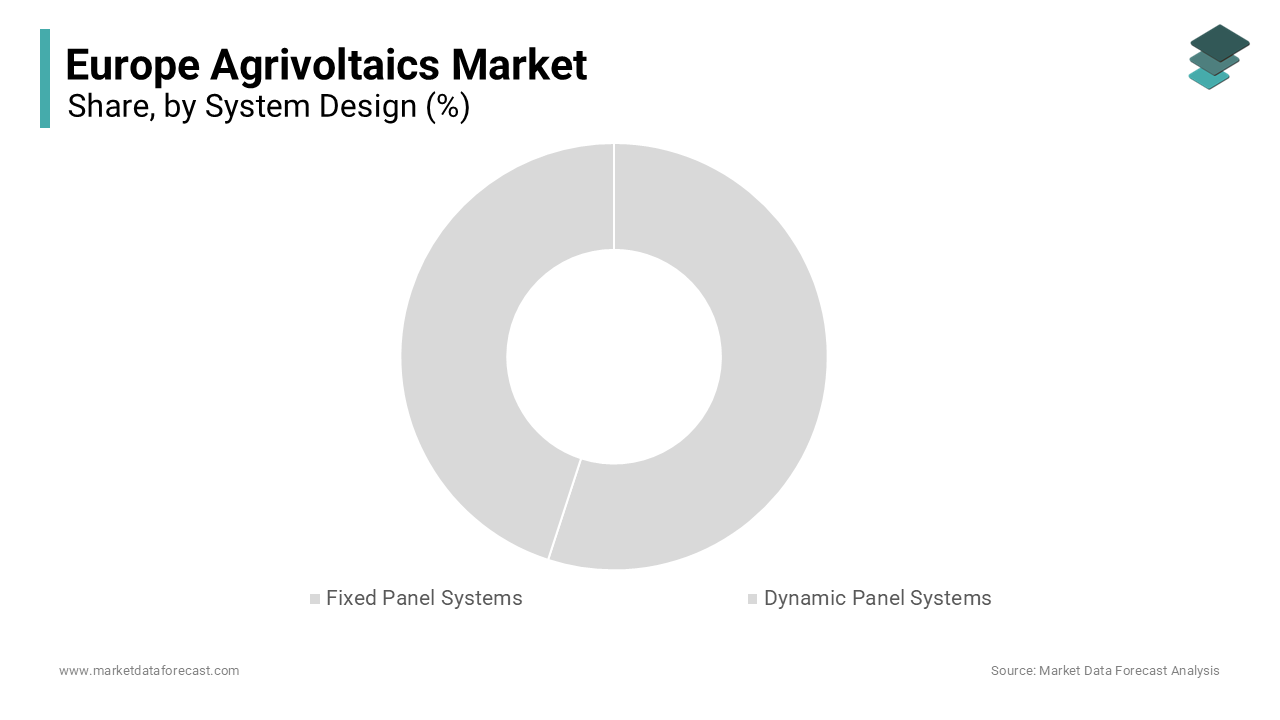
However, the dynamic panel systems segment is the fastest growing segment in the Europe agrivoltaics market and is projected to expand at a CAGR of 19.2% during the forecast period. This accelerated growth is driven by the ability of tracking systems to optimize both energy production and crop health through adjustable shading. Dynamic systems can tilt panels to follow the sun’s path, increasing energy yield by up to 25% compared to fixed installations, as per data from the International Energy Agency Photovoltaic Power Systems Programme. More importantly for agrivoltaics, these systems can be programmed to adjust angles based on real time weather data and crop needs, providing precise control over light exposure. For example, panels can open fully during cloudy days to maximize photosynthesis or close partially during heat waves to reduce plant stress. This flexibility allows farmers to cultivate higher value crops that require specific light conditions, enhancing overall farm profitability. Advances in sensor technology and artificial intelligence enable automated adjustments that minimize labor input while maximizing output. The higher initial cost is offset by increased revenue from both energy and premium produce, which is improving the return on investment over time. As technology costs decline and performance data accumulates, more farmers are adopting dynamic systems to gain a competitive edge. This trend is supported by government incentives that reward high efficiency and smart farming practices, further accelerating market penetration.
By Technology Insights
The monofacial modules segment occupied the largest share of the European market in 2025. The growth of the monofacial modules segment in the European market is attributed to their mature manufacturing ecosystem and lower upfront costs. These traditional solar panels capture sunlight only from the front side, offering a proven and reliable technology that has been used in terrestrial solar projects for decades. The established supply chain ensures consistent quality and timely delivery, reducing project delays. Monofacial panels are generally less expensive than bifacial or translucent alternatives, making them an attractive option for budget conscious agricultural projects. Their simpler construction also means fewer potential points of failure, enhancing long term reliability in rural settings. Farmers and developers appreciate the predictable performance metrics of monofacial modules, which simplify financial modeling and risk assessment. The extensive history of monofacial technology provides a large body of performance data, allowing for accurate yield predictions under various climatic conditions. This track record builds confidence among investors and lenders, facilitating easier access to financing. While they may offer lower energy density per square meter compared to newer technologies, their cost effectiveness and reliability ensure they remain the default choice for many standard agrivoltaic installations, particularly in regions with high direct sunlight.
However, the bifacial modules segment is the fastest growing technology segment in the Europe agrivoltaics market and is expected to record a CAGR of 15.8% over the forecast period owing to their superior energy generation capabilities. These panels capture sunlight from both the front and rear sides, utilizing reflected light from the ground or crop canopy to boost overall power output. According to studies by the Joint Research Centre of the European Commission, bifacial modules can increase energy yield by 10% to 20% compared to monofacial equivalents, which is depending on surface albedo and installation height. This enhanced efficiency allows for greater energy production per unit of land, maximizing the economic return on limited agricultural space. In agrivoltaic settings, the elevated mounting structures typical of these systems create ideal conditions for rear side light capture, especially when combined with reflective ground covers or light colored crops. The higher energy density helps offset the slightly higher initial cost of bifacial panels, improving the overall project economics. Farmers benefit from increased electricity sales or self-consumption, which can significantly contribute to farm income. The technology is particularly effective in regions with high diffuse radiation, such as Northern Europe, where rear side capture compensates for lower direct sunlight. As awareness of these benefits grows and installation expertise spreads, more developers are specifying bifacial modules for new projects, which are driving rapid market expansion.
By Placement Insights
The ground mounted systems segment accounted for the largest share of the European market in 2025. The growth of the ground mounted systems segment in the European market is attributed to their versatility and relative ease of implementation across diverse agricultural terrains. These systems involve installing solar panels on elevated structures directly above the soil, allowing for a wide range of crops and livestock to be cultivated underneath. According to the European Agrivoltaics Association, ground mounted configurations account for over 70% of current installations, as they can be adapted to various field sizes and topographies. The modular nature of ground mounted systems allows for scalable deployment, from small pilot plots to large commercial farms. They do not require existing infrastructure such as greenhouses, making them suitable for open arable land and pastures. The elevation of panels provides sufficient clearance for standard agricultural machinery, ensuring that farming operations can continue with minimal disruption. This flexibility appeals to farmers who wish to retain full control over their land use while adding an energy revenue stream. Ground mounted systems are also easier to maintain and inspect compared to rooftop or greenhouse integrated solutions. The proven track record of these systems in numerous European pilot projects has built confidence among stakeholders, encouraging wider adoption. Regulatory frameworks in many countries are specifically designed to support ground mounted agrivoltaics, providing clear guidelines for installation and operation. This regulatory clarity combined with technical versatility secures the leading position of ground mounted systems.
However, the greenhouse integrated agrivoltaics segment is anticipated to grow at a promising CAGR of 22.5% over the forecast period owing to the rising demand for controlled environment agriculture and year round production. Integrating semi-transparent solar panels into greenhouse roofs allows for simultaneous energy generation and crop protection, optimizing land use in high value horticulture. According to the European Protected Cropping Association, the area of greenhouse cultivation in Europe is expanding as consumers demand fresh produce throughout the year. Agrivoltaic greenhouses reduce energy costs for heating and cooling by generating electricity on site, while the panels provide necessary shading to prevent overheating in summer. This synergy is particularly valuable in Southern Europe where high temperatures can damage sensitive crops. The technology enables precise control over light spectrum and intensity, enhancing crop quality and yield. Advanced greenhouse systems use smart glass technologies that adjust transparency based on light conditions, maximizing photosynthesis while generating power. This level of control appeals to high tech farming operations focused on premium products such as tomatoes, peppers, and flowers. Government subsidies for energy efficient agriculture further incentivize the adoption of agrivoltaic greenhouses. The ability to produce high value crops with lower energy footprints aligns with sustainability goals, driving rapid market growth. As technology improves and costs decline, more commercial growers are transitioning to agrivoltaic greenhouses to enhance competitiveness.
COUNTRY ANALYSIS
Germany Agrivoltaics Market Analysis
Germany dominated the market in Europe in 2025 and is expected to maintain its role as a leader in the European agrivoltaics market for the next few years due to sustained policy support and ongoing technical innovation. Germany holds a pioneering position in the Europe agrivoltaics market, driven by strong policy support and advanced engineering capabilities. The country introduced specific legal definitions for agrivoltaics in its Renewable Energy Sources Act, creating a clear framework for development. According to the German Federal Ministry for Economic Affairs and Climate Action, several pilot projects have been launched to test various system designs on arable land and orchards. German companies are leading in the development of dynamic tracking systems and smart farming integration, leveraging the country’s robust industrial base. The high cost of electricity in Germany makes on farm energy generation particularly attractive for farmers seeking to reduce operational expenses. Research institutions such as the Fraunhofer Institute are actively involved in optimizing crop panel interactions, providing valuable data for commercial deployment. The strong environmental consciousness of German consumers supports the adoption of sustainable farming practices. Government subsidies and tender schemes specifically for agrivoltaics are accelerating project pipelines. The focus on high tech solutions positions Germany as a hub for innovation and export of agrivoltaic technologies. The combination of regulatory clarity, technical expertise, and economic incentives ensures Germany remains a key driver of market growth in Central Europe.
France Agrivoltaics Market Analysis
France is likely to see significant growth in its agrivoltaics market over the next few years as it continues to prioritize energy sovereignty and climate adaptation. France stands as a leader in the Europe agrivoltaics market, characterized by proactive government initiatives and a large agricultural sector. The French government has implemented specific calls for tenders dedicated to agrivoltaic projects, aiming to deploy several gigawatts of capacity by 2030. As per the French Ministry of Ecological Transition, strict criteria ensure that agricultural activity remains primary, preventing land artificialization. French farmers are increasingly adopting agrivoltaics to combat drought and heat stress, particularly in wine growing regions and fruit orchards. The country’s strong cooperative movement facilitates collective investment and knowledge sharing among smallholder farmers. Research programs funded by the National Research Agency are exploring the impact of agrivoltaics on biodiversity and soil health. The aesthetic integration of panels into rural landscapes is a key consideration, influencing design choices. France’s commitment to energy sovereignty and climate resilience drives sustained policy support. The presence of major energy developers and agricultural cooperatives creates a collaborative ecosystem for project development. This supportive environment enables France to maintain a leading role in scaling up agrivoltaic installations across diverse agricultural contexts.
Italy Agrivoltaics Market Analysis
Italy is poised to experience rapid expansion in its agrivoltaics sector over the coming years as it leverages solar energy to address pressing climate and agricultural challenges. Italy occupies a significant position in the Europe agrivoltaics market, leveraging its abundant solar resources and diverse agricultural production. The country faces severe climate challenges including water scarcity and extreme heat, making agrivoltaics an attractive adaptation strategy. According to Legambiente, an Italian environmental association, agrivoltaic projects are gaining traction in southern regions where solar irradiance is highest. Italian farmers are integrating panels with olive groves, vineyards, and vegetable crops to protect yields and reduce irrigation needs. The government’s National Recovery and Resilience Plan includes funding for sustainable agriculture and renewable energy, supporting initial investments. Local manufacturers are developing lightweight and aesthetically pleasing mounting structures suited to Italy’s historic landscapes. The strong tradition of high quality food production drives demand for solutions that enhance rather than compromise crop quality. Regional authorities are streamlining permitting processes to encourage deployment. The combination of climatic necessity and policy support positions Italy as a rapidly growing market for agrivoltaic solutions, particularly in high value horticulture.
Spain Agrivoltaics Market Analysis
Spain is expected to emerge as a major hub for agrivoltaics in the next few years as it scales up sustainable land use strategies to combat increasing aridity. Spain represents a high potential market for agrivoltaics in Europe, driven by its extensive solar resources and large agricultural sector. The country is experiencing increasing frequency of droughts and heatwaves, prompting farmers to seek protective measures. As per the Spanish Ministry for Ecological Transition, agrivoltaics are being explored as a tool for water conservation and climate resilience in arid regions. Pilot projects are underway in Castilla La Mancha and Andalusia, focusing on cereals and olive trees. The low cost of land in rural areas facilitates large scale installations. Spanish energy companies are investing heavily in agrivoltaic research and development, recognizing the strategic value of dual land use. The government is updating regulatory frameworks to accommodate agrivoltaics within its renewable energy targets. The strong export orientation of Spanish agriculture encourages adoption of technologies that improve product quality and sustainability credentials. The favorable climatic conditions for solar generation combined with urgent adaptation needs create a compelling case for rapid market expansion in Spain.
United Kingdom Agrivoltaics Market Analysis
The United Kingdom is likely to see steady growth in its agrivoltaics market over the next few years as it integrates dual land use into its broader net zero and agricultural strategies. The United Kingdom holds an emerging position in the Europe agrivoltaics market, with growing interest driven by energy security concerns and net zero targets. Post Brexit policies emphasize domestic food production and renewable energy independence, creating a favorable context for agrivoltaics. According to the UK Department for Energy Security and Net Zero, several research trials are being conducted to assess the viability of agrivoltaics in the UK’s temperate climate. Farmers are exploring systems for livestock shading and arable crops to mitigate weather variability. The UK’s strong academic sector is contributing to knowledge generation through university led projects. Financial incentives such as the Sustainable Farming Incentive are beginning to recognize the benefits of dual land use. The high value of land in the UK necessitates efficient use, making agrivoltaics an attractive option for maximizing returns. While the market is smaller than in Southern Europe, the focus on innovation and policy development suggests steady growth potential. The integration of agrivoltaics into broader land management strategies is gaining momentum among progressive farmers.
COMPETITIVE LANDSCAPE
The competition in the Europe agrivoltaics market is characterized by a dynamic mix of established renewable energy developers specialized agritech startups and traditional agricultural equipment manufacturers entering the space. Large energy firms leverage their financial strength and project management expertise to scale up installations rapidly while partnering with local farmers to mitigate social resistance. Specialized technology providers compete on innovation offering unique solutions such as vertical bifacial panels or dynamic tracking systems that optimize both energy and crop yields. The market is fragmented with no single dominant player allowing for diverse business models ranging from full service development to technology licensing. Regulatory heterogeneity across European countries creates varying competitive landscapes where local knowledge and political connections are crucial success factors. Collaboration is increasingly common as companies join consortia to share research data and influence policy frameworks. The barrier to entry remains high due to technical complexity and capital requirements but is lowering as standardized solutions emerge. Competitive advantage is increasingly defined by the ability to demonstrate proven agricultural benefits and secure long term off take agreements for both energy and produce.
KEY MARKET PLAYERS
Some of the promising companies that are playing a dominating role in the global dialysis market include
- Sun’Agri SAS
- Next2Sun Technology GmbH
- BayWa r.e. AG
- Enel Green Power S.p.A.
- REM TEC S.r.l.
- Insolight SA
- Akuo Energy SAS
- TotalEnergies SE
- EDF Renewables
- Trina Solar Co., Ltd.
Top Players in the Europe Agrivoltaics Market
BayWa r.e.
BayWa r.e. operates as a leading global developer of renewable energy projects with a strong focus on agrivoltaics across Europe. The company integrates solar power generation with agricultural activities to maximize land use efficiency and support sustainable farming practices. Recently the firm has expanded its portfolio by launching several large scale pilot projects in Germany and the Netherlands that test dynamic tracking systems for various crops. They have strengthened their market position by forming strategic partnerships with local agricultural cooperatives to ensure community acceptance and operational synergy. BayWa r.e. invests heavily in research to optimize panel height and spacing for specific crop requirements such as berries and potatoes. Their commitment to dual land use solutions aligns with European Union sustainability goals and helps farmers diversify income streams. By providing comprehensive services from planning to maintenance they reduce barriers to entry for farmers. This holistic approach enhances their reputation as a trusted partner in the transition toward climate resilient agriculture and renewable energy integration.
Sun'Agri
Sun'Agri is a specialized French company dedicated exclusively to the development and deployment of agrivoltaic solutions tailored for diverse agricultural needs. The company focuses on creating elevated solar structures that allow standard farming machinery to operate underneath while generating clean electricity. Recently Sun'Agri has secured significant funding to expand its operations into Southern Europe where drought mitigation is a critical concern for farmers. They have strengthened their market position by obtaining key certifications that validate the agricultural compatibility of their systems under strict regulatory frameworks. Their innovative designs prioritize water conservation and crop protection from extreme weather events such as hail and heatwaves. Sun'Agri collaborates closely with research institutions to monitor long term impacts on soil health and biodiversity. This evidence based approach builds trust among skeptical stakeholders and policymakers. By offering customized solutions for vineyards orchards and arable land they address specific regional challenges. Their focused strategy positions them as a pioneer in proving the viability of agrivoltaics as a mainstream agricultural practice rather than a niche experiment.
Next2Sun
Next2Sun is a German technology provider specializing in vertical bifacial photovoltaic systems designed specifically for agricultural integration. The company’s unique approach involves installing solar panels vertically between crop rows which minimizes shading impact and allows for unrestricted use of heavy machinery. Recently Next2Sun has partnered with major energy utilities to deploy large scale projects on arable land across Central Europe. They have strengthened their market position by demonstrating that their vertical systems can maintain nearly full agricultural productivity while generating substantial energy yields. Their technology is particularly suited for wide row crops such as corn and potatoes where traditional overhead structures might be obstructive. The company emphasizes ease of installation and low maintenance requirements which appeal to cost conscious farmers. Next2Sun actively participates in industry working groups to help shape technical standards for vertical agrivoltaics. Their distinct technological niche differentiates them from competitors using conventional tilted panels. This specialization allows them to capture specific market segments where land use efficiency and mechanization are paramount concerns for modern farming operations.
Top Strategies Used by Key Market Participants
Key players in the Europe agrivoltaics market employ strategic partnerships with agricultural cooperatives and research institutions to validate technology performance and gain social license. Companies focus on developing modular and adaptable mounting systems that accommodate diverse crop types and farming machinery to ensure broad applicability. Investment in digital monitoring tools allows for real time optimization of light exposure and energy generation enhancing dual productivity. Participants actively engage in policy advocacy to establish clear regulatory definitions and financial incentives that distinguish agrivoltaics from ground mounted solar farms. Diversification into high value crop segments such as viticulture and horticulture helps justify higher initial capital expenditures through premium product quality. Firms also prioritize lifecycle assessments and environmental impact studies to demonstrate ecological benefits and secure green financing. These combined strategies enable participants to navigate regulatory complexities while building trust among farmers and investors in this emerging sector.
MARKET SEGMENTATION
This research report on the Europe agrivoltaics market has been segmented & sub-segmented into the following categories
By System Design
- Fixed Panel Systems
- Dynamic Panel Systems
By Technology
- Monofacial Modules
- Bifacial Modules
By Placement
- Ground-Mounted Systems
- Greenhouse-Integrated Systems
By Country
- United Kingdom
- France
- Spain
- Germany
- Italy
- Russia
- Sweden
- Denmark
- Switzerland
- Netherlands
- Turkey
- Czech Republic
- Rest of Europe