- Product Description Description
- Table of Contents TOC
- List of Table & Figure LOT
- Get Free Sample PDF Sample PDF
Market Size, 2025
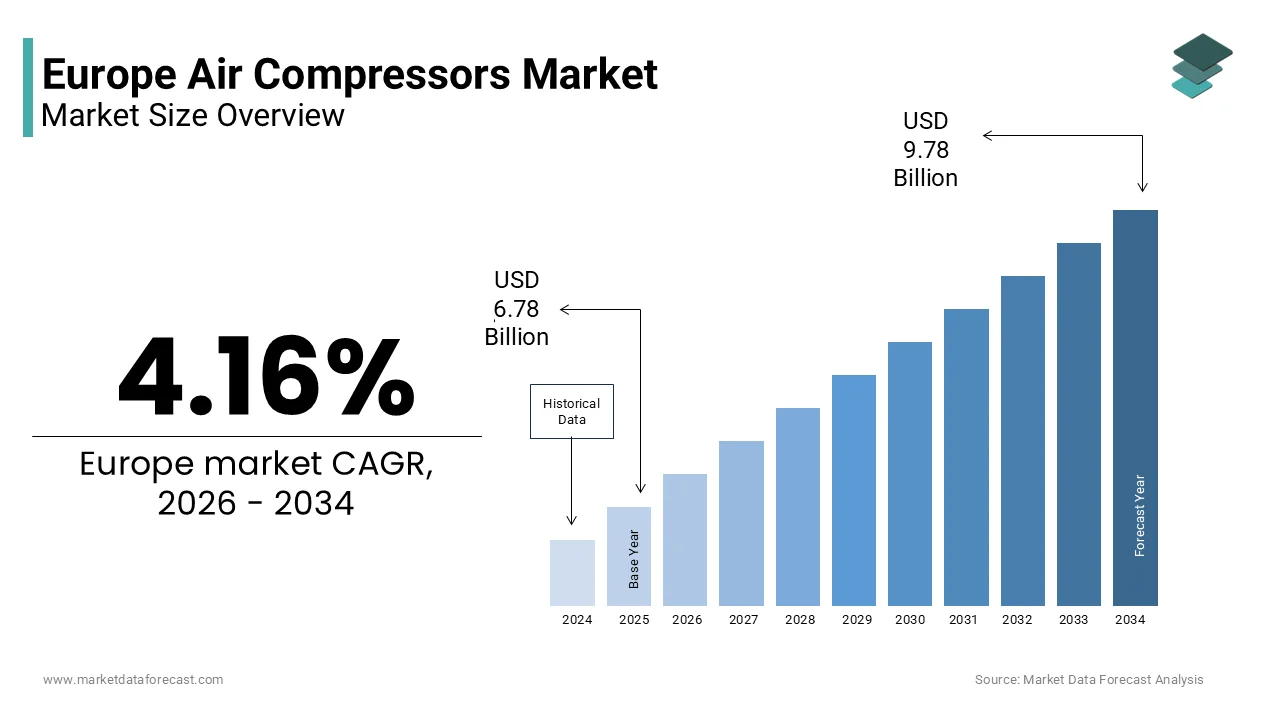
$6.78 BnMarket Estimate, 2026
$7.06 BnMarket Forecast, 2034
$9.78 BnCAGR, 2026–2034
4.16%Europe Air Compressors Market Report Summary
The Europe air compressors market was valued at USD 6.78 billion in 2025 and is estimated to reach USD 7.06 billion in 2026, further projected to reach USD 9.78 billion by 2034, growing at a CAGR of 4.16% during the forecast period. Market growth is driven by increasing demand for energy efficient compressed air systems across manufacturing, automotive, food processing, healthcare, and construction industries. Rising industrial automation, expansion of production facilities, and strict European energy efficiency regulations are encouraging the adoption of advanced compressor technologies. Additionally, technological advancements in oil free systems, variable speed drives, and smart monitoring solutions are enhancing operational efficiency and reducing maintenance costs across industrial applications.
Key Market Trends
- Growing adoption of rotary compressors due to their continuous operation capability, reliability, and suitability for heavy duty industrial applications.
- Increasing demand for stationary compressors in large scale manufacturing plants and centralized compressed air systems.
- Rising focus on energy efficient and low emission compressor systems aligned with European sustainability and carbon reduction goals.
- Integration of IoT enabled predictive maintenance and remote monitoring systems to optimize compressor performance and reduce downtime.
- Expansion of manufacturing activities across automotive, machinery, and metal fabrication industries driving sustained equipment demand.
Segmental Insights
- Based on mode of operation, the rotary compressors segment was the largest in the European air compressors market in 2025. The segment’s dominance is attributed to its ability to provide consistent airflow, lower vibration levels, and high operational efficiency in industrial environments.
- Based on product type, the stationary compressors segment held the majority share of the European air compressors market in 2025. This segment leads due to widespread deployment in large production facilities where stable and centralized compressed air supply is essential.
- Based on application, the manufacturing segment led the European air compressors market in 2025. Demand is driven by automotive production, machinery manufacturing, metal fabrication, and general industrial processes where compressed air powers assembly tools, clamping systems, and material handling equipment.
Regional Insights
- Western European countries continue to dominate the regional market due to strong industrial infrastructure and advanced manufacturing ecosystems. Germany, France, and Italy remain key contributors supported by automotive production, industrial automation, and strict energy efficiency standards. Eastern Europe is witnessing gradual growth driven by expanding manufacturing investments and infrastructure development.
Competitive Landscape
The Europe air compressors market is highly competitive with the presence of established global manufacturers and regional suppliers. Companies are focusing on developing energy efficient systems, oil free technologies, digital control integration, and after sales service expansion to strengthen their market position. Key players operating in the Europe air compressors market include Atlas Copco, BAUER COMP Holding GmbH, Hitachi Industrial Equipment Systems Co. Ltd., Ingersoll Rand, KAESER KOMPRESSOREN, MAT Holding Inc., Hanwha Power Systems Co. Ltd., Sullair LLC, Doosan Portable Power, Sullivan Palatek Inc., ELGi, FS ELLIOT CO. LLC, ZEN AIR TECH Private Limited, Frank Technologies Private Limited, and Oasis Manufacturing.
 Download Free Sample Report
Europe Air Compressors Market Size
The Europe air compressors market size was valued at USD 6.78 billion in 2025 and is projected to reach USD 9.78 billion by 2034 from USD 7.06 billion in 2026, growing at a CAGR of 4.16%.
An air compressor is a mechanical device that converts power, typically electric or diesel, into potential energy stored in pressurized air, which is then used to power tools, machinery, and industrial processes across manufacturing, construction, healthcare, and energy sectors. In Europe, the air compressors market is defined not by consumer trends but by industrial necessity, regulatory mandates on energy efficiency, and the continent’s strategic shift toward decarbonization and circular production systems. According to multiple sources, a vast majority of sectors rely on compressed air, which represents a significant portion of total electricity usage. Additionally, European Union regulations mandate higher energy efficiency standards for electric motors, driving the phase-out of less efficient technologies in industrial applications. Furthermore, the Energy Efficiency Directive requires large enterprises to conduct regular compressed air system audits, with optimization identified as a top priority measure. This policy-driven ecosystem positions air compressors not as optional equipment but as critical instruments of operational efficiency, regulatory compliance, and industrial sustainability.
MARKET DRIVERS
Stringent EU Energy Efficiency Regulations Accelerate Industrial Retrofit Programs
The region’s comprehensive regulatory framework mandating compressed air system optimization has contributed to the growth of the Europe air compressors market. This has become the primary enabler for air compressor upgrades across manufacturing, automotive, and food processing sectors. Under European Commission Ecodesign regulations, new air compressors are required to meet stricter energy efficiency standards, which phases out lower-efficiency, traditional fixed-speed models in favor of, or with, higher-efficiency technology. EU Ecodesign regulations and energy efficiency directives are increasingly setting stringent energy efficiency requirements for both new and, in some contexts, installed industrial compressed air systems to reduce energy consumption. German regulatory bodies are intensifying industrial audits, driving mandatory energy-efficiency retrofits and upgrades for legacy equipment to meet updated environmental standards. Similarly, France’s energy regulator has increased enforcement against energy market misconduct, leading to significant financial penalties for firms manipulating electricity regulations, rather than specific fines for compressor inefficiency. The revised EU Energy Efficiency Directive mandates regular, periodic energy audits for large enterprises, which frequently result in recommendations to adopt variable-speed technology for improved efficiency. These legally binding measures create a predictable and recurring demand stream independent of economic cycles.
Integration of Smart Monitoring and Predictive Maintenance Enhances System Reliability
Air compressors are being transformed from passive energy consumers into intelligent nodes, which fuels the expansion of the Europe air compressors market. This shift is driven by the convergence of the Industrial Internet of Things and asset performance management within predictive maintenance ecosystems. Modern compressors now embed sensors that monitor pressure, temperature, oil quality, and vibration, transmitting real-time data via cellular or Ethernet networks to centralized dashboards for anomaly detection. European industrial compressor installations are increasingly utilizing smart technologies and IoT connectivity for remote diagnostics to enhance operational efficiency. Companies like Atlas Copco and Kaeser have launched cloud-based platforms that correlate compressor performance with production schedules and ambient conditions, enabling proactive adjustments that reduce energy use. Furthermore, Volvo is deploying AI-driven predictive maintenance and sensor systems at its manufacturing sites to minimize downtime, while the Horizon Europe program supports the adoption of digital energy management technologies. This shift from reactive to predictive operations elevates compressor value beyond initial capital cost to continuous operational intelligence and grid resilience.
MARKET RESTRAINTS
High Upfront Investment Deters Small and Medium Enterprises from Upgrading
The elevated purchase price of high-efficiency variable-speed air compressors remains a significant barrier for small and medium enterprises across Southern and Eastern Europe, which hampers the growth of the Europe air compressors market. This is the case despite clear long-term savings. According to research, high installation costs for advanced compressors create significant financial barriers for small businesses. A 2024 survey indicates that only a small minority of metalworking and food processing SMEs have upgraded their equipment due to capital constraints. EU funding programs, such as the Innovation Fund, provide financial support, yet these are often tailored to the capabilities of larger firms with dedicated administrative teams. Furthermore, a shortage of certified auditors across the EU is delaying the deployment of these technologies. Lack of targeted financing and micro-grants ensures that structural barriers will persist, limiting penetration into the vast European SME market.
Lack of Standardized Data Protocols Hinders Cross-Vendor System Integration
The absence of harmonized communication standards across manufacturers impedes the proliferation of smart air compressors and the overall expansion of the Europe air compressors market. This lack of standardization creates siloed data and integration bottlenecks in multi-vendor industrial environments. Industry leaders such as Atlas Copco, Kaeser, and Ingersoll Rand feature IoT-enabled units. However, seamless integration is frequently hindered by proprietary protocols or non-standard implementations of Modbus, PROFINET, and OPC UA. Industrial facilities with mixed-brand compressor fleets often face challenges in aggregating performance data due to interoperability issues, according to European automation trends. Companies like AkzoNobel are aggressively advancing industrial digitalization. However, integrating disparate sensor data remains a hurdle in widespread AI adoption. European standards bodies are developing new regulations to improve the interoperability of smart industrial components, with implementation still in progress. The absence of enforced interoperability forces utilities to adopt costly, proprietary solutions, thereby impeding market competition and stalling the realization of digital efficiency improvements.
MARKET OPPORTUNITIES
Expansion of Green Hydrogen and Industrial Decarbonization Creates New Demand
The region’s aggressive decarbonization roadmap is generating unprecedented demand for high-pressure, oil-free air compressors in green hydrogen production, carbon capture, and industrial electrification, which creates new opportunities for the Europe air compressors market. Electrolyzers for renewable hydrogen require ultra-pure instrument air for control valves and purging, driving need for Class 0-certified oil-free compressors resistant to moisture and particulate contamination. As per studies, there is a growing trend within the hydrogen economy to adopt ultra-clean, oil-free compression standards, traditionally used in high-purity sectors, to ensure the reliability of hydrogen fuel cells and infrastructure. Simultaneously, carbon capture facilities like Norway’s Northern Lights demand high-pressure compressors rated for 300 bar to inject CO₂ into geological formations. European Union funding initiatives are significantly accelerating the development of carbon capture and storage networks by providing substantial capital for large-scale industrial decarbonization projects. Companies like BOGE and Gardner Denver have already qualified new product lines for these applications. This policy-led industrial transformation opens high-margin niches where European engineering excellence in air purity and reliability offers decisive competitive advantage over generic suppliers.
Growth of On-Site Nitrogen and Oxygen Generation Drives Specialized Compressor Adoption
The region is pushing for supply chain resilience and process efficiency, which provides fresh prospects for the Europe air compressors market. This shift is enabling demand for oil-free air compressors integrated with membrane or PSA nitrogen and oxygen generators in food packaging, electronics, and healthcare. Food processors across Europe are increasingly transitioning from bulk gas deliveries to on-site gas production to improve supply chain independence and enhance the shelf life of packaged goods. German food and beverage producers are modernizing their facilities with specialized high-purity air compression systems to meet more stringent hygiene and moisture control standards. Similarly, semiconductor fabs in Ireland and the Netherlands mandate Class 0 compressors for inert gas production to prevent oxidation during wafer fabrication. Companies like Atlas Copco and Kaeser have responded with integrated “air-to-gas” skids featuring real-time purity monitoring and remote diagnostics. These localized solutions reduce logistics costs, enhance process control, and align with EU circular economy goals, creating a resilient niche insulated from broader industrial fluctuations.
MARKET CHALLENGES
Intensifying Competition from Low-Cost Asian Manufacturers Undermines Value Proposition
The regional air compressor suppliers face mounting pressure from Chinese and Korean exporters offering functionally similar products at lower prices, particularly in standard-duty applications, which challenges the growth of the Europe air compressor market. European industrial sectors are seeing a sustained high volume of small-to-medium capacity compressor imports from Asian manufacturing hubs, which continue to represent a dominant share of the entry-level equipment market. These imports often meet minimum CE marking requirements through third-party testing yet lack the airend durability, cooling efficiency, and digital integration expected in European industrial environments. Research suggests that European-manufactured compressors are often preferred for critical, continuous-duty operations due to their perceived durability and the localized support networks that minimize potential downtime. However, tight capital budgets in Southern and Eastern Europe drive procurement officers toward upfront savings despite lifecycle risks. This dynamic compresses margins for domestic manufacturers who must justify premiums through added-value services like remote diagnostics, rapid spare parts, and energy performance guarantees, advantages increasingly undervalued in tender-based purchasing dominated by initial price comparisons.
Shortage of Skilled Compressed Air System Auditors Constrains Optimization Efforts
A critical workforce deficit in compressed air system design, auditing, and optimization expertise essential for maximizing energy savings and system reliability constrains the expansion of the Europe air compressors market. The demand for certified compressed air auditors in the EU is rising due to energy efficiency directives, but training programs are not producing enough qualified professionals to meet this need. This gap is exacerbated by the retirement of experienced technicians with deep knowledge of piping layout, receiver sizing, and leakage detection. The shortage of certified professionals in Germany is leading to significantly longer wait times for comprehensive compressed air system audits. In Spain and Greece, many small factories resort to generic compressor replacements rather than holistic system redesigns, resulting in suboptimal energy performance and premature component wear. Manufacturers offer online tools. However, these cannot replace hands-on experience with airflow modeling, pressure drop analysis, or variable-speed integration. Labor constraints, driven by a lack of reskilling and vocational prestige, will limit efficiency gains and hand a competitive advantage to regions with better-supported technical staff.
REPORT COVERAGE
| REPORT METRIC | DETAILS |
| Market Size Available | 2025 to 2034 |
| Base Year | 2025 |
| Forecast Period | 2026 to 2034 |
| CAGR | 4.16% |
| Segments Covered | By Mode of Operation, Product Type, Lubrication, Application, and Region |
| Various Analyses Covered | Global, Regional, & Country Level Analysis; Segment-Level Analysis; DROC, PESTLE Analysis; Porter’s Five Forces Analysis; Competitive Landscape; Analyst Overview of Investment Opportunities |
| Regions Covered | UK, France, Spain, Germany, Italy, Russia, Sweden, Denmark, Switzerland, Netherlands, Turkey, and the Czech Republic |
| Market Leaders Profiled | Atlas Copco, BAUER COMP Holding GmbH, Hitachi Industrial Equipment Systems Co. Ltd., Ingersoll Rand, KAESER KOMPRESSOREN, MAT Holding Inc., Hanwha Power Systems Co., Ltd., Sullair LLC, Doosan Portable Power, Sullivan Palatek Inc., ELGi, FS ELLIOT Co., LLC, ZEN AIR TECH Private Limited, Frank Technologies Private Limited, and Oasis Manufacturing |
SEGMENTAL ANALYSIS
By Mode of Operation Insights
The rotary compressors segment was the largest segment in the European air compressors market in 2025. The leading position of the segment is driven by its superior energy efficiency, continuous duty capability, and compact footprint, attributes essential for modern industrial environments. Unlike reciprocating models that operate in cycles, rotary screw compressors deliver steady airflow with minimal pressure fluctuations, making them ideal for manufacturing, automotive assembly, and food processing where process stability is critical. Driven by tightening EU Ecodesign regulations, industrial installations are increasingly shifting toward advanced rotary technology. Rotary compressors are generally recognized as more energy-efficient than equivalent reciprocating units in continuous operation. Furthermore, new EV battery gigafactories in Germany and Poland frequently utilize oil-free or oil-injected rotary compressors to meet strict, high-stability air requirements. This regulatory alignment, combined with operational reliability and scalability, solidifies rotary compressors as the backbone of Europe’s industrial air infrastructure.
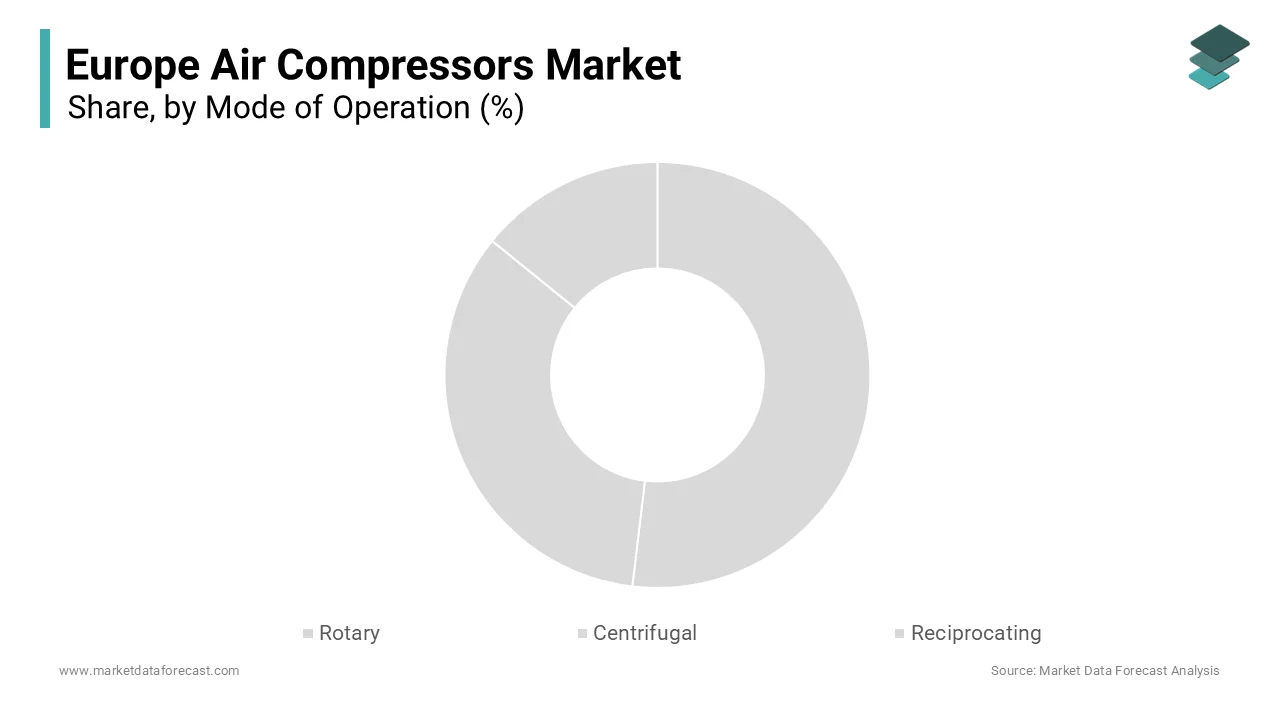
The centrifugal compressor segment is estimated to register the fastest CAGR of 8.6% from 2026 to 2034 due to its dominance in large-scale, high-volume applications such as steel production, chemical processing, and green hydrogen electrolysis where oil-free air and massive flow rates are non-negotiable. Centrifugal compressors deliver 100 percent oil-free air by design, critical for ISO 8573-1 Class 0 certification, and scale efficiently beyond 500 kW, making them indispensable in decarbonizing industries. Projects supported by the Clean Hydrogen Partnership often incorporate high-efficiency compression technologies to support the development and scaling of hydrogen production across Europe. The SSAB fossil-free steel project in Sweden employs advanced gas handling and high-purity oxygen systems, utilizing high-performance compressor technology to support hydrogen-based steel production. The European Commission's Innovation Fund provides significant funding for large-scale industrial projects aimed at reducing emissions, which promotes the adoption of modern, energy-efficient, and clean technologies, including specialized compression equipment. Companies like Atlas Copco and Siemens Energy have responded with magnetic-bearing centrifugal compressors featuring real-time surge control and digital twins. This convergence of clean industry mandates, purity requirements, and scale economics creates a structural growth vector unmatched by positive displacement technologies.
By Product Type Insights
The stationary compressors segment held the majority share of the European air compressors market in 2025. The supremacy of the segment is attributed to its integration into fixed industrial infrastructure where reliability, capacity, and energy efficiency outweigh mobility needs. These units power entire production lines in automotive plants, food packaging facilities, and semiconductor fabs, environments where compressed air is as essential as electricity or water. Industrial facilities in the EU frequently utilize centralized stationary compressor systems with extensive distribution networks, particularly in larger manufacturing units, to support production processes. The European Commission’s Ecodesign Regulation specifically targets stationary units above 2.2 kW, requiring variable-speed drives and advanced controls that further entrench their dominance. Driven by mandatory energy efficiency regulations and the need to reduce operating costs, German manufacturers are prioritizing investments in upgrading and modernizing their existing stationary compressed air systems. Additionally, national building codes in countries like the Netherlands and Denmark require dedicated compressor rooms with noise insulation and ventilation in all new industrial constructions. This institutional embedding ensures consistent demand insulated from economic volatility and consumer trends.
The portable compressor segment is anticipated to witness the fastest CAGR of 9.2% during the forecast period owing to infrastructure renewal, urban construction, and decentralized maintenance operations across Europe. Portable units are essential for road repair, pipeline testing, and emergency utility work where grid power is unavailable or impractical. In Norway and Switzerland, alpine tunnel maintenance crews rely on diesel-powered portables rated for minus 25 degrees Celsius operation. Moreover, the rise of on-demand field service, such as HVAC repair and automotive roadside assistance, fuels demand for lightweight electric portables compatible with van inverters. Companies like Kaeser and Ingersoll Rand have launched lithium-battery-powered models with silent operation for urban use, complying with EU noise directives. This convergence of public investment, climate resilience, and service economy expansion creates a dynamic growth channel distinct from traditional industrial procurement.
By Application Insights
The manufacturing segment led the European air compressors market in 2025, which covers automotive, machinery, metal fabrication, and general production where compressed air powers assembly tools, clamping systems, and material handling. Manufacturing remains a primary driver of industrial energy demand within the European Union, where compressed air systems represent a significant portion of electricity usage across various production processes. The European Commission’s Industrial Strategy utilizes Horizon Europe funding to accelerate the transition toward digitalized and climate-neutral production, focusing on research for energy-efficient industrial technologies and smart manufacturing systems. European battery manufacturing facilities increasingly require high-purity, oil-free compressed air for critical stages like electrode drying and cell formation to ensure product quality and meet strict technical standards. Manufacturers within the German Mittelstand are gradually modernizing their industrial equipment to align with energy efficiency regulations, leading to a steady shift toward advanced technologies like variable-speed compressed air units. This breadth of application, depth of regulation, and scale of industrial policy ensure manufacturing remains the primary engine of compressor demand across the continent.
The electronics and semiconductor application segment is likely to experience the fastest CAGR of 10.3% over the forecast period. The rapid expansion of the segment is fueled by Europe’s strategic push for chip sovereignty and advanced manufacturing. Semiconductor fabrication requires oil-free, ultra-dry, and particle-free compressed air for photolithography, wafer cleaning, and pneumatic handling, conditions only met by Class 0-certified rotary or centrifugal compressors with integrated dryers and filtration. The European Chips Act serves as a framework to mobilize large-scale investment into the regional semiconductor sector, focusing on enhancing production capacity and technological sovereignty through a combination of public and private funding. Advanced semiconductor fabrication facilities in Europe utilize high-capacity, specialized air treatment and compression systems to maintain the ultra-clean environments and precise atmospheric conditions necessary for wafer manufacturing. The European Medicines Agency also mandates Class 0 air for medical device manufacturing, overlapping with electronics-grade requirements. Companies like BOGE and Gardner Denver have developed cleanroom-certified compressors with zero outgassing materials and real-time purity monitoring. This convergence of geopolitical strategy, technological precision, and regulatory stringency creates a high-value niche where European engineering excellence offers decisive competitive advantage.
COMPETITIVE LANDSCAPE
The Europe air compressors market features a tiered competitive landscape where premium engineering firms dominate high integrity and high efficiency segments while Asian suppliers gain traction in standard portable and light industrial applications. At the top end companies like Atlas Copco Kaeser and BOGE compete on energy performance air purity and digital integration serving sectors where reliability and regulatory compliance outweigh initial cost. Mid tier European specialists focus on regional manufacturing and construction markets emphasizing local service networks and rapid spare parts availability. Meanwhile Chinese and Korean manufacturers exert downward pressure through competitively priced units that meet basic CE requirements but often lack advanced controls or durability. Competition is increasingly defined by alignment with EU decarbonization mandates digital factory standards and extreme environment performance rather than price alone. Differentiation arises through material quality cybersecurity hardening lifecycle cost transparency and support for regulatory compliance creating a complex environment where technical excellence and policy engagement jointly determine market success.
KEY MARKET PLAYERS
Some of the notable key players in the Europe air compressors market are
- Atlas Copco
- BAUER COMP Holding GmbH
- Hitachi Industrial Equipment Systems Co. Ltd.
- Ingersoll Rand
- KAESER KOMPRESSOREN
- MAT Holding, Inc.
- Hanwha Power Systems CO., LTD.
- Sullair LLC
- Doosan Portable Power
- Sullivan-Palatek, Inc.
- ELGi
- FS-ELLIOT CO., LLC
- ZEN AIR TECH PRIVATE LIMITED
- Frank Technologies Private Limited
- Oasis Manufacturing
Top Players in the Market
- Atlas Copco AB is a Swedish global leader in industrial air compression with deep integration across European manufacturing, automotive, and semiconductor sectors. The company specializes in energy efficient rotary and centrifugal compressors featuring oil free technology, variable speed drives, and smart connectivity. Atlas Copco’s solutions are deployed in critical infrastructure including Intel’s Magdeburg semiconductor plant, Volvo’s EV battery facilities, and green hydrogen pilot projects across Germany and France. It also expanded its AIRLINK digital platform to enable remote fleet monitoring and predictive maintenance for industrial customers across 18 European countries reinforcing its role as a strategic enabler of industrial decarbonization and digital transformation.
- Kaeser Kompressoren SE is a German engineering group renowned for high reliability stationary and portable compressors serving industrial, construction, and healthcare markets across Europe. The company excels in modular compressed air systems that combine energy efficiency with rapid deployment particularly in urban infrastructure and emergency response applications. Kaeser’s products are specified in major projects including Berlin’s U5 metro expansion and Norway’s tunnel maintenance fleets. It also enhanced its Sigma Air Manager 4.0 control system to integrate with factory energy management platforms enabling real time optimization of multi compressor networks. These innovations align Kaeser with Europe’s dual priorities of climate resilience and smart industrial operations.
- BOGE Kompressoren is a German manufacturer specializing in oil free and high pressure compressors for demanding applications in electronics food processing and green hydrogen. The company’s Class 0 certified rotary screw units are integral to semiconductor fabs in Italy and pharmaceutical plants in Switzerland where air purity is non negotiable. BOGE plays a key role in Europe’s industrial sovereignty strategy by supplying compressors for electrolyzer instrument air and nitrogen generation skids. It also partnered with the European Chips Act initiative to develop cleanroom compatible compressors with zero outgassing materials. These actions position BOGE at the forefront of Europe’s high precision industrial renaissance.
Top Strategies Used by the Key Market Participants
Key players in the Europe air compressors market prioritize compliance with EU Ecodesign and energy efficiency regulations by integrating variable speed drives high efficiency airends and smart controls into their products. They develop digital platforms for remote monitoring predictive maintenance and fleet optimization to enhance operational value. Companies focus on application specific engineering for high growth sectors like semiconductor manufacturing green hydrogen and urban infrastructure. Strategic partnerships with industrial giants public utilities and EU policy initiatives secure long term project pipelines. Additionally manufacturers invest in training certification and mobile diagnostic tools to address the shortage of skilled compressed air system auditors and accelerate deployment across diverse industrial environments.
MARKET SEGMENTATION
This research report on the European air compressors market has been segmented and sub-segmented based on categories.
By Mode of Operation
- Rotary
- Centrifugal
- Reciprocating
By Product Type
- Stationary
- Portable
By Lubrication
- Oil Filled
- Oil Free
By Application
- Manufacturing
- Oil and Gas
- Energy and Power
- Electronics and Semiconductor
- Healthcare
- Food and Beverages
- Others, Aerospace
By Country
- UK
- France
- Spain
- Germany
- Italy
- Russia
- Sweden
- Denmark
- Switzerland
- Netherlands
- Turkey
- Czech Republic
- Rest of Europe