- Product Description Description
- Table of Contents TOC
- List of Table & Figure LOT
- Get Free Sample PDF Sample PDF
Market Size, 2025
$22.20 BnMarket Estimate, 2026
$23.08 BnMarket Forecast, 2034
$31.46 BnCAGR, 2026–2034
3.95%Europe Aircraft Engine Market Report Summary
The Europe aircraft engine market was valued at USD 22.20 billion in 2025, and is estimated to reach a valuation of USD 23.08 billion in 2026, and is projected to grow to USD 31.46 billion by 2034, expanding at a CAGR of 3.95% from 2026 to 2034.
Market growth is driven by the rising demand for new-generation commercial aircraft, increasing fleet modernization programs, and the strong presence of global engine OEMs across the region. The expansion of civil aviation, growing investments in sustainable propulsion technologies, and advancements in high-efficiency turbine engines further support long-term market momentum. Europe’s focus on reducing carbon emissions, adopting hybrid-electric propulsion, and strengthening military air capabilities is also contributing significantly to market expansion.
KEY MARKET TRENDS
- Increased demand for next-generation turbine engines featuring higher fuel efficiency, lower emissions, and improved durability.
- Fleet renewal in commercial aviation, driven by rising passenger traffic and airlines shifting toward quieter, more economical engines.
- Strong push for sustainable aviation, including hybrid-electric propulsion, SAF-compatible engines, and lightweight materials.
- Technological advancements in military propulsion, such as high-thrust and adaptive-cycle engines for next-gen fighter programs.
- Deepening collaboration between European OEMs and global engine manufacturers, enabling co-development of critical engine modules and testing capabilities.
SEGMENTAL INSIGHTS
By Powerplant:
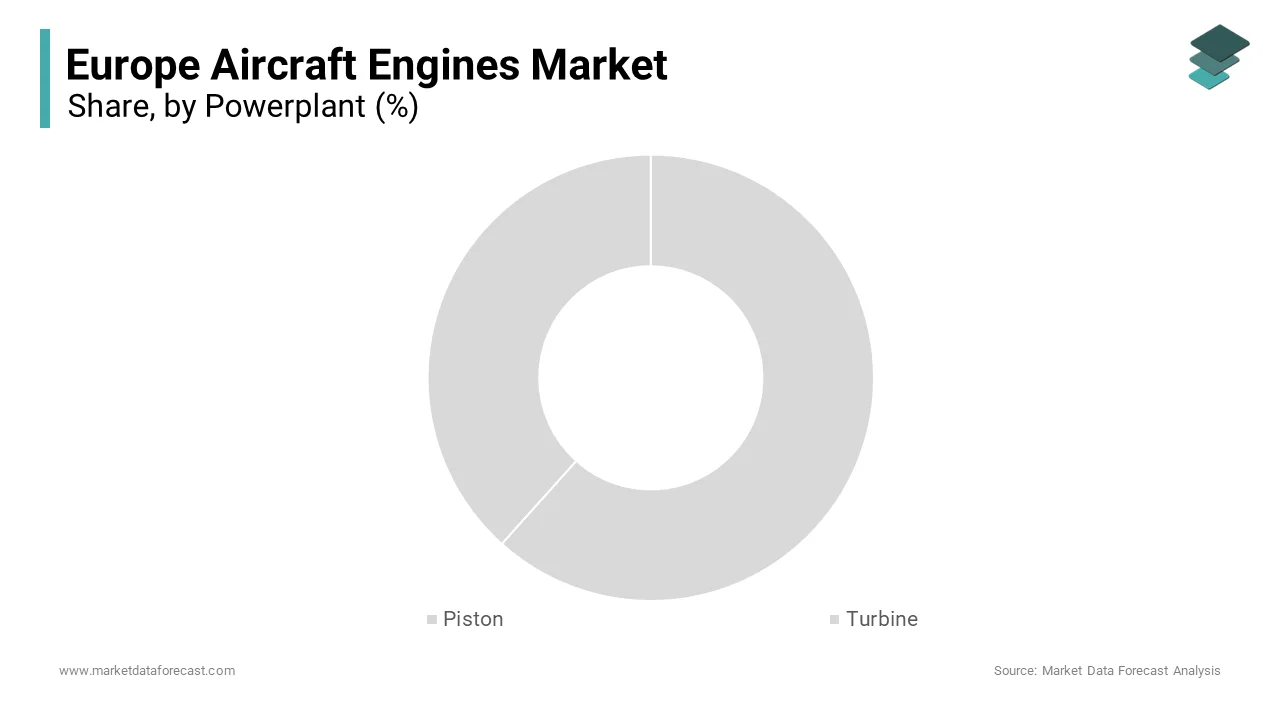
The turbine engines segment dominated the Europe aircraft engine market in 2025, supported by their essential role in both commercial jetliners and military aircraft due to superior performance and reliability.
By End User:
The civil and commercial aviation segment held 58.5% of the regional market share in 2025, driven by increased aircraft deliveries, growing air travel demand, and the adoption of fuel-efficient propulsion systems by European airlines.
REGIONAL INSIGHTS
By France
France was the leading market in 2025, accounting for 25.5% of regional share, supported by its strong aerospace ecosystem and Safran’s dominant role in engine manufacturing and R&D.
By United Kingdom
The UK is projected to secure a strong share during the forecast period due to Rolls-Royce’s global leadership in wide-body engines and its investment in next-generation propulsion technologies.
By Germany
Germany remains a key contributor, driven by MTU Aero Engines’ critical expertise in high-pressure turbine modules and its integral role in advanced military engine programs.
By Spain
Spain is expected to grow at a healthy CAGR, supported by increasing participation in European aerospace consortia and expanding component manufacturing capability.
By Sweden
Sweden is set to exhibit notable growth owing to its sovereign military propulsion programs, agile fighter-engine innovation, and investments in advanced defense aviation.
COMPETITIVE LANDSCAPE
The European aircraft engine market is dominated by global aerospace giants and regional leaders specializing in turbine technology, military propulsion, and commercial engine development. Companies are focusing on hybrid-electric research, SAF readiness, additive manufacturing, and long-term service agreements to strengthen market presence.
Major players include Safran SA, Rostec, Rolls-Royce plc, Pratt & Whitney (RTX Corporation), General Electric Company, CFM International, MTU Aero Engines AG, Honeywell International Inc., Textron Inc., and Williams International Co. LLC.
Europe Aircraft Engine Market Size
The Europe aircraft engine market size was valued at USD 22.20 billion in 2025 and is anticipated to reach a valuation of USD 23.08 billion in 2026 and USD 31.46 billion by 2034, growing at a CAGR of 3.95% during the forecast period from 2026 to 2034.
Aircraft engines are propulsion systems for commercial, military, and business aviation platforms produced or operated within the European Union and associated states. These engines include high bypass turbofans for narrow and wide body airliners to compact turboprops and advanced military afterburning turbofans that are engineered for fuel efficiency, noise reduction,n and emissions compliance under increasingly stringent regulatory frameworks. Europe stands as a global epicenter of aerospace propulsion innovation and is anchored by multinational OEMs and a dense network of specialized suppliers. As per Eurostat, civil and military aircraft engine production in the EU supports high‑skill employment across Germany, France, the UK, and Spain. The European Aviation Safety Agency certified new or modified engine types in 2024, which reflects continuous technological iteration. Moreover, Europe is a leading exporter of aircraft engines and parts according to the International Trade Centre, which is underpinned by strategic programs like the Franco‑German Future Combat Air System and Clean Aviation initiatives. This market operates at the intersection of industrial sovereignty, climate policy, and defense readiness.
MARKET DRIVERS
EU Clean Aviation Mandates and Decarbonization Roadmaps
The binding aviation decarbonization targets of Europe are accelerating investment in next-generation aircraft engines with significantly reduced carbon and nitrogen oxide emissions, which is majorly driving the aircraft engine market growth in Europe. According to the European Commission’s ReFuelEU Aviation Regulation, all aircraft operating in EU airspace must achieve a 2% sustainable aviation fuel blend by 2025, which is rising to 70% by 2050. In parallel, the Clean Aviation Joint Undertaking allocated funding in 2024 to propulsion projects, including open‑rotor architectures and hybrid‑electric demonstrators. Rolls‑Royce’s UltraFan engine, tested in Derby, demonstrated improved fuel burn relative to earlier Trent engines. Similarly, Safran and MTU Aero Engines reported progress on a hydrogen combustion chamber prototype in 2024 capable of operating on liquid hydrogen. Aviation accounts for a significant share of EU greenhouse gas emissions, which is intensifying political pressure for propulsion innovation. These regulatory and technological imperatives position engine manufacturers as pivotal enablers of Europe’s net‑zero aviation ambition.
Modernization of European Military Air Fleets Under the Strategic Autonomy Agenda
The pursuit of defense technological sovereignty of Europe is driving demand for indigenous military aircraft engines through coordinated fleet renewal programs, which is further contributing to the regional market expansion. As per the European Defence Agency’s 2024 capability planning, multiple member states have committed to replacing aging fighter and transport fleets by 2035, with emphasis on reducing reliance on non‑EU suppliers. The flagship Franco‑German‑Spanish Future Combat Air System includes a next‑generation engine co‑developed by Safran and MTU, which is supported by national and EU programmes. Concurrently, the UK’s Tempest fighter program, led by Rolls-Royce,,ce features a digitally controlled power and thermal management system enabling variable bypass ratios for multirole efficiency. Sweden’s Defence Materiel Administration confirmed in 2024 that its Gripen E fleet expansion will use domestically supported RM16 engines with enhanced thrust‑to‑weight ratios. NATO’s 2023 Defence Investment Pledge obliges members to allocate 20% of defense spending to major equipment, including propulsion systems. This confluence of geopolitical urgency, institutional collaboration, and indigenous capability development sustains robust military engine demand across Europe.
MARKET RESTRAINTS
Stringent Certification Timelines and Regulatory Fragmentation Across EASA and National Authorities
The Europe aircraft engine market faces significant delays and cost overruns due to complex certification processes and inconsistent interpretation of safety standards across the European Union Aviation Safety Agency and national regulators. As per the European Court of Auditors’ 2024 Special Report on Aviation Innovation, certification timelines for new engine types have lengthened compared to the early 2010s, which is primarily due to evolving noise and emissions criteria under Annex 16 of the Chicago Convention. In 2024, Rolls‑Royce’s Pearl 700 engine for the Gulfstream G700 experienced delays after national airworthiness authorities requested additional particulate matter testing. Such discrepancies force OEMs to conduct redundant validation campaigns, which increases development costs. Furthermore, the absence of harmonized protocols for emerging technologies like hydrogen combustion or hybrid‑electric systems creates regulatory uncertainty. According to MTU Aero Engines, its hydrogen demonstrator lacks a clear certification pathway under current EASA special conditions. This procedural friction impedes Europe’s ability to rapidly field next‑generation propulsion despite strong R&D output.
Critical Dependency on Specialized Supply Chains for High Temperature Alloys
European aircraft engine manufacturers remain vulnerable to supply chain concentration for critical raw materials and precision components essential for high-pressure turbine sections. As per the European Commission’s 2024 Critical Raw Materials List, rhenium is classified as highly supply‑critical, with refined output concentrated in Chile and the United States. A hypothetical export restriction on rhenium would risk delaying LEAP and Trent engine production due to insufficient strategic stockpiles. Similarly, the production of ceramic matrix composites relies on silicon carbide fibers sourced predominantly from Japanese firms, which creates single‑source risk. According to the European Defence Agency’s 2024 Supply Chain Resilience Assessment, only a small number of EU‑based foundries possess the capability to cast single-crystal turbine blades meeting aerospace standards. Without coordinated investment in raw material diversification and advanced manufacturing capacity under initiatives like the Important Project of Common European Interest for Microelectronics and Semiconductors, the market’s strategic autonomy remains compromised.
MARKET OPPORTUNITIES
Hydrogen Powered Propulsion Development Under Clean Aviation Flagship
Europe is spearheading global efforts to develop hydrogen combustion and fuel cell-based aircraft engines through coordinated public-private investment under the Clean Aviation initiative, which is a notable opportunity for the European aircraft engine market. As per the Clean Aviation Joint Undertaking’s 2024 Implementation Plan, funding was committed to hydrogen propulsion demonstrators targeting entry into service by 2035. Airbus, in partnership with CFM International, advanced the ZEROe hydrogen combustion program with ground and flight testing planned for the middle of this decade. Rolls‑Royce and easyJet are jointly exploring hydrogen technologies, including engines and auxiliary power units. According to the European Partnership for Clean Aviation, hydrogen‑powered aviation could reduce lifecycle climate impact by up to 90% when powered by green hydrogen produced via EU renewable energy. Additionally, the European Hydrogen Backbone initiative plans to develop around 31,500 kilometers of hydrogen pipeline by 2030 across Europe to enable future airport refueling infrastructure. These integrated efforts position Europe at the vanguard of zero‑emission aviation propulsion.
Aftermarket Services Growth Through Digital Twin and Predictive Maintenance Platforms
The expansion of digital engine health monitoring and predictive maintenance is unlocking high-margin aftermarket opportunities for European OEMs amid fleet aging and operational efficiency demands. As per the European Union Aviation Safety Agency, many narrow-body aircraft operating in EU airspace are over ten years old as of 2024, increasing reliance on maintenance, overhaul, and life extension services. Rolls‑Royce’s IntelligentEngine platform uses real‑time telemetry to predict component wear and optimize shop‑visit timing, which is reducing unscheduled downtime. Similarly, Safran’s Health Monitoring System integrates AI‑driven anomaly detection with EASA‑approved maintenance protocols, which enables condition‑based servicing for CFM56 and LEAP fleets. The European Commission’s 2024 Aviation Strategy Update emphasizes digitalization as a pillar of operational resilience, supporting cross‑OEM data‑sharing frameworks. These smart services not only enhance safety and fuel efficiency but also deepen customer lock‑in through proprietary analytics ecosystems and generate recurring revenue beyond initial engine sales.
MARKET CHALLENGES
Workforce Shortage in Advanced Manufacturing and Propulsion Engineering
The Europe aircraft engine market confronts a critical talent gap in high-precision manufacturing and propulsion systems engineering, threatening production ramp-up and innovation velocity. According to the European Skills Index 2024 published by Cedefop, aerospace manufacturing faces a shortage of certified CNC machinists and metallurgists capable of working with nickel‑based superalloys and ceramic composites. Rolls‑Royce reported in its 2024 UK Skills Review that many Derby engine assembly roles remained vacant for extended periods due to a lack of qualified candidates with five‑axis milling experience. As per the Federal Institute for Vocational Education, apprenticeship intake in aerospace mechanical trades declined between 2020 and 2024 despite government incentives. This deficit is exacerbated by aging demographics, as turbine blade inspector roles at MTU Aero Engines are staffed by a workforce with a higher‑than‑average age. Without urgent reskilling initiatives under the European Skills Agenda and expanded dual education partnerships with technical universities, Europe risks losing its edge in high‑value engine production to regions with deeper talent pipelines.
Geopolitical Export Control Restrictions on Dual-Use Engine Technologies
European aircraft engine manufacturers face escalating barriers in global markets due to tightening export controls on dual-use propulsion technologies under evolving EU and Wassenaar Arrangement frameworks, which further challenge the regional market growth. As per the European External Action Service’s 2024 Trade and Security Brief, new controls now cover adaptive cycle engines high high-pressure ratio compressors, and integrated power thermal management systems, and these are all critical next-generation military and business jet platforms. In 2024, Safran suspended delivery of upgraded M88 engines to a Southeast Asian customer after French export authorities flagged potential end use in unmanned combat aerial vehicles. Similarly, Rolls-Royce’s joint venture with a Middle Eastern MRO provider faced a licensing delay for LEAP engine repair tooling due to concerns over reverse engineering risks. According to the European Defence Agency, a significant share of propulsion-related export license applications in 2024 required intergovernmental review, causing commercial uncertainty. These restrictions not only limit revenue diversification but also complicate international collaboration on programs like FC, AS, where technology sharing must navigate overlapping national security regimes, which is ultimately fragmenting the global market and increasing compliance overhead for European OEMs.
REPORT COVERAGE
| REPORT METRIC | DETAILS |
| Market Size Available | 2025 to 2034 |
| Base Year | 2025 |
| Forecast Period | 2026 to 2034 |
| CAGR | 3.95% |
| Segments Covered | By Power Plant, End-User, and By Country |
| Various Analyses Covered | Global, Regional & Country Level Analysis, Segment-Level Analysis, DROC, PESTLE Analysis, Porter’s Five Forces Analysis, Competitive Landscape, Analyst Overview on Investment Opportunities |
| Regions Covered | UK, France, Spain, Germany, Italy, Russia, Sweden, Denmark, Switzerland, Netherlands, Turkey, the Czech Republic, and the Rest of Europe |
| Market Leaders Profiled | Safran SA Rostec, Rolls-Royce plc, Pratt & Whitney (RTX Corporation), General Electric Company, CFM International, MTU Aero Engines AG, Honeywell International Inc, Textron Inc., Williams International Co. LLC |
SEGMENTAL ANALYSIS
By Powerplant Insights
The turbine engines segment accounted for the most dominating share of the European aircraft engine market in 2025. The dominance of the turbine engines segment in the European market is mainly due to their indispensable role in commercial airliners, military jets, and regional turboprops that constitute the backbone of European aviation. Unlike piston engines, limited to light general aviation, turbine propulsion delivers the thrust-to-weight ratio, fuel efficiency, and reliability required for modern high-altitude flight. As per Eurostat, the vast majority of aircraft movements in EU airspace in 2025 involved turbine‑powered platforms, including Airbus A320neo, A350,350, and military Eurofighter Typhoon fleets. The European Aviation Safety Agency certified significantly more turbine engine models than piston variants in 2025, indicating regulatory and industrial focus. Major OEMs such as Rolls‑Royce, Safran, and MTU concentrate R&D exclusively on high‑bypass turbofans and adaptive‑cycle military engines with no significant piston development underway. Furthermore, turbine engines underpin nearly all aircraft under the EU’s Clean Aviation initiative with hydrogen and hybrid‑electric demonstrators based on turbofan cores. This technological, institutional, and operational centrality ensures turbine engines maintain near total market relevance.
By End User Insights
The civil and commercial aviation segment commanded 58.5% of the regional market share in 2025 due to the continent’s role as the home of Airbus and a dense network of legacy and low-cost carriers driving fleet demand. European airlines operated a large commercial aircraft fleet as of December 2025, with an average fleet age that is prompting accelerated replacement cycles. The LEAP engine family widely powers A320neo aircraft in European service. Major carriers such as Lufthansa, Ryanair, and easyJet have placed multi‑billion‑dollar engine orders to support growth and decarbonization, as Lufthansa’s 2025 agreements with Rolls‑Royce include performance‑based maintenance contracts extending revenue streams. Furthermore, EU airport slot regulations incentivize quieter, more efficient aircraft, pushing older models into retirement. Commercial aviation accounts for the majority of turbine engine production volume in Europe, underscoring the segment’s industrial dominance.
The military aviation segment is predicted to grow at a promising CAGR in the European aircraft engine market during the forecast period, owing to the coordinated European defense modernization and the pursuit of technological sovereignty amid evolving security threats. As per the European Defence Agency’s 2025 annual planning, multiple member states committed to replacing 4th‑generation fighter fleets with next‑generation platforms by 2040 under joint initiatives like the Future Combat Air System and Tempest. The FCAS program includes a next‑generation adaptive‑cycle engine co‑developed by Safran and MTU with serial production targeted in the 2030s. Sweden’s Gripen E expansion and Germany’s moves to replace Tornado jets with Eurofighter EK variants will drive additional demand, with new EJ200 engine orders confirmed. NATO’s 2025 Defence Investment Pledge obliges members to spend 2% of GDP on defense, with 20% earmarked for equipment, including propulsion systems. Additionally, the European Defence Industrial Strategy prioritizes engine sovereignty to reduce reliance on non‑EU suppliers. These structural, geopolitical, and institutional forces propel military aviation’s exceptional growth rate.
COUNTRY ANALYSIS
France Aircraft Engine Market Analysis
France was the most promising regional segment in the European aircraft engine market in 2025 and accounted for 25.5% of the regional market share. France is a core hub of propulsion innovation through Safran Aircraft Engines and deep integration in multinational defense and civil programs. France co‑leads the development of the CFM International LEAP engine, which powers a large share of new single‑aisle aircraft in Europe and is central to the Franco‑German Future Combat Air System’s next‑generation adaptive‑cycle engine. As per the French Directorate General for Enterprise, tens of thousands of high‑skill jobs in France are directly tied to aircraft engine manufacturing, with facilities in Villaroche and Gennevilliers producing engines in 2025. The French government allocated significant funding in 2025 under its Aerospace Recovery Plan to support hydrogen combustion R&D and digital twin maintenance platforms. Additionally, France hosts key European testing infrastructure, including the S1MA wind tunnel used for turbine validation. This combination of industrial scale, technological leadership, and state backing solidifies France’s top position.
United Kingdom Aircraft Engine Market Analysis
The United Kingdom is anticipated to account for a promising share of the European market during the forecast period. The growth of the UK market is primarily attributed to Rolls-Royce’s global leadership in wide-body and military propulsion systems. The company’s Trent XWB and upcoming UltraFan engines power the majority of Airbus A350 and A320neo fleets across European carriers, while its EJ200 engine equips the Eurofighter in multiple EU air forces. As per the UK Department for Business and Trade, Rolls‑Royce invested significantly in R&D during 2025 with a substantial share focused on sustainable propulsion, including hydrogen and hybrid‑electric demonstrators. The UK’s Tempest fighter program positions the country at the forefront of sixth‑generation engine development with major funding committed through the Combat Air Strategy. Derby alone hosts one of Europe’s largest aircraft engine production sites, employing thousands of skilled workers. Despite Brexit, the UK maintains technical alignment with EASA through a bilateral agreement ensuring continued certification access. This engineering depth, strategic vision, and export orientation sustain the UK’s strong market standing.
Germany Aircraft Engine Market Analysis
Germany is another notable market for aircraft engines in Europe. The growth of Germany in the European market is majorly driven by MTU Aero Engines’ critical role in high-pressure turbine modules and its leadership in military propulsion integration. MTU is a key risk and revenue-sharing partner in the LEAP and GP7000 programs and co-develops the FCAS engine with Safran under a 50/50 joint venture. As per Germany’s Federal Ministry for Economic Affairs and Climate Action, the aircraft engine sector supports jobs with significant clusters in Munich and Hanover. Germany is also advancing hydrogen propulsion; the DLR German Aerospace Center tested a liquid hydrogen combustion chamber in 2025, achieving stable flame conditions. The government’s 2025 Aerospace Innovation Program allocated funding to sustainable engine components, including ceramic matrix composites. Additionally, Germany’s commitment to replace its Tornado fleet with Eurofighter EK variants ensures steady military engine demand. This blend of industrial partnership, technological investment, and defense procurement cements Germany’s pivotal role.
Spain Aircraft Engine Market Analysis
Spain is projected to grow at a healthy CAGR in the Europe aircraft engine market over the forecast period. Spain has a recognized role as an essential manufacturing and assembly partner within the Airbus and FCAS ecosystems. ITP Aero produces low-pressure turbine and combustor modules for the LEAP and TP400 engines and leads Spain’s contribution to the FCAS propulsion system. As per Spain’s Ministry of Industry, Trade, and Tourism, the aerospace sector contributed to the national GDP in 2025, with engine components accounting for a significant share of export value. ITP Aero’s Zamudio facility delivered engine modules in 2025 with expansion plans supported by EU Recovery Fund grants. The Spanish Air Force’s participation in FCAS and procurement of Eurofighter EK jets further anchors military demand. Strategic geographic location and skilled labor have made Spain a preferred nearshoring destination for European OEMs seeking supply chain resilience.
Sweden Aircraft Engine Market Analysis
Sweden is expected to exhibit a notable CAGR in the European aircraft engine market during the forecast period due to its sovereign military propulsion capability and agile innovation in fighter engine development. GKN Aerospace Sweden designs and manufactures the RM16 engine for the Gripen E/F fighter, which is now exported to Brazil, Hungary, and the Czech Republic. Sweden has begun deliveries of the Gripen E aircraft to its Air Force, each powered by the domestically supported RM16 engine with advanced efficiency features. The country also participates in European collaborative programs, including FCAS engine component research through Saab’s partnership with Safran. The Swedish Energy Agency supports propulsion decarbonization initiatives, including funding programs for bioenergy with carbon capture and storage to advance climate goals. Additionally, Sweden’s neutral defense posture facilitates technology export to non-NATO countries, broadening market reach. This combination of national sovereignty, strategic collaboration, nd green innovation ensures Sweden’s outsized influence despite its smaller scale.
COMPETITIVE LANDSCAPE
Competition in the Europe aircraft engine market is characterized by a tightly integrated oligopoly of national champions operating within multinational consortia rather than direct head-to-head rivalry. Safran Rolls-Royce and MTU dominate through complementary roles in programs like CFM International, Eurojet, and the Future Combat Air System, where the company. Collaboration precedes competition. Differentiation arises not from price but from technological specialization, such as Rolls-Royce’s wide-body leadershipSafran’single-aisle single-aisle dominance, and MTU’s turbine module mastery. The market is further shaped by state-driven strategic imperatives, including decarbonization under ReFuelEU and defense autonomy under the European Defence Industrial Strategy. New entrants face prohibitive barriers due to certification complexity, supply chain entrenchment, and decades-long product cycles. Consequently, competition manifests as coordinated innovation within EU-backed frameworks, ensuring collective global relevance while safeguarding strategic sovereignty.
KEY MARKET PLAYERS
- Safran SA
- Rostec
- Rolls-Royce plc
- Pratt & Whitney (RTX Corporation)
- General Electric Company
- CFM International
- MTU Aero Engines AG
- Honeywell International Inc.
- Textron Inc.
- Williams International Co. LLC
Top Players In the Market
- Safran Aircraft Engines is a cornerstone of the Europe aircraft engine market and a global leader in propulsion systems through its role in CFM International and military programs. The company Coco-Develops produces the LEAP engine family, which powers the majority of new single-aisle aircraft worldwide and is pivotal to Airbus and Boeing fleets. In 2024, Safran accelerated hydrogen combustion research under the European Clean Aviation initiative and finalized the technical architecture for the Future Combat Air System’next-generationon adaptive cycle engine in partnership with MTU Aero Engines. It also expanded its MRO network in Eastern Europe to support growing LEAP fleets in Poland and Romania. These actions reinforce Safran’s dual leadership in sustainable civil propulsion and European defense sovereignty.
- Rolls-Royce Holdings maintains a dominant position in the Europe aircraft engine market through its advanced wide-body and military propulsion systems. The company’s Trent XWB and upcoming UltraFan engines are critical to Airbus operations, while its EJ200 powers the Eurofighter across multiple European air forces. In 2024, Rolls-Royce commenced ground testing of its hydrogen-compatible demonstrator engine in the UK and secured a major long-term service agreement with Lufthansa for UltraFan-powered A350s. It also advanced the Tempest fighter’s propulsion system under the UK’s Combat Air Strategy,, integratinAI-drivenen thermal management. These initiatives position Rolls-Royce at the forefront of decarbonization and sixth-generation combat propulsion.
- MTU Aero Engines is a key enabler of European propulsion sovereignty through its expertise in high-pressure turbine modules and military engine integration. As a major partner in the LEAP and GP7000 programs, MTU supplies critical components for global commercial fleets while leading the FCAS next-generation engine development with Safran. In 2024, MTU launched a digital twin platform for predictive maintenance across German and Dutch air forces and broke ground on a new hydrogen test facility in Munich, funded by the German Aerospace Center. It also expanded its additive manufacturing capacity for ceramic matrix composites to support Clean Aviation demonstrators. These moves strengthen MTU’s role as both a technological innovator and strategic defense partner.
Top Strategies Used by the Key Market Participants
Key players in the Europe aircraft engine market pursue deep integration in multinational civil and defense programs to secure long-term revenue and technological leadership. They invest heavily in sustainable propulsion, including a hydrogen combustion hybrid electric system, and 100% sustainable aviation fuel compatibility under EU Clean Aviation mandates. Strategic expansion of maintenance, repair, and overhaul networks across Europe enhances aftermarket dominance through performance-based service contracts. Companies also co-develop next-generation military engines under sovereign frameworks like FCAS and Tempest to reduce non-EU dependencies. Additionally, they leverage digitalization through AI-powered predictive maintenance and digital twinning platforms to improve operational efficiency and customer service.
MARKET SEGMENTATION
This research report on the Europe aircraft engine market is segmented and sub-segmented into the following categories.
By Power Plant
- Piston
- Turbine
By End-user
- Civil and Commercial Aviation
- Military Aviation
By Country
- UK
- France
- Spain
- Germany
- Italy
- Russia
- Sweden
- Denmark
- Switzerland
- Netherlands
- Turkey
- Czech Republic
- Rest of Europe