- Product Description Description
- Table of Contents TOC
- List of Table & Figure LOT
- Get Free Sample PDF Sample PDF
Market Size, 2025
$0.37 BnMarket Estimate, 2026
$0.39 BnMarket Forecast, 2034
$0.59 BnCAGR, 2026–2034
5.74%Europe Antimony Market Report Summary
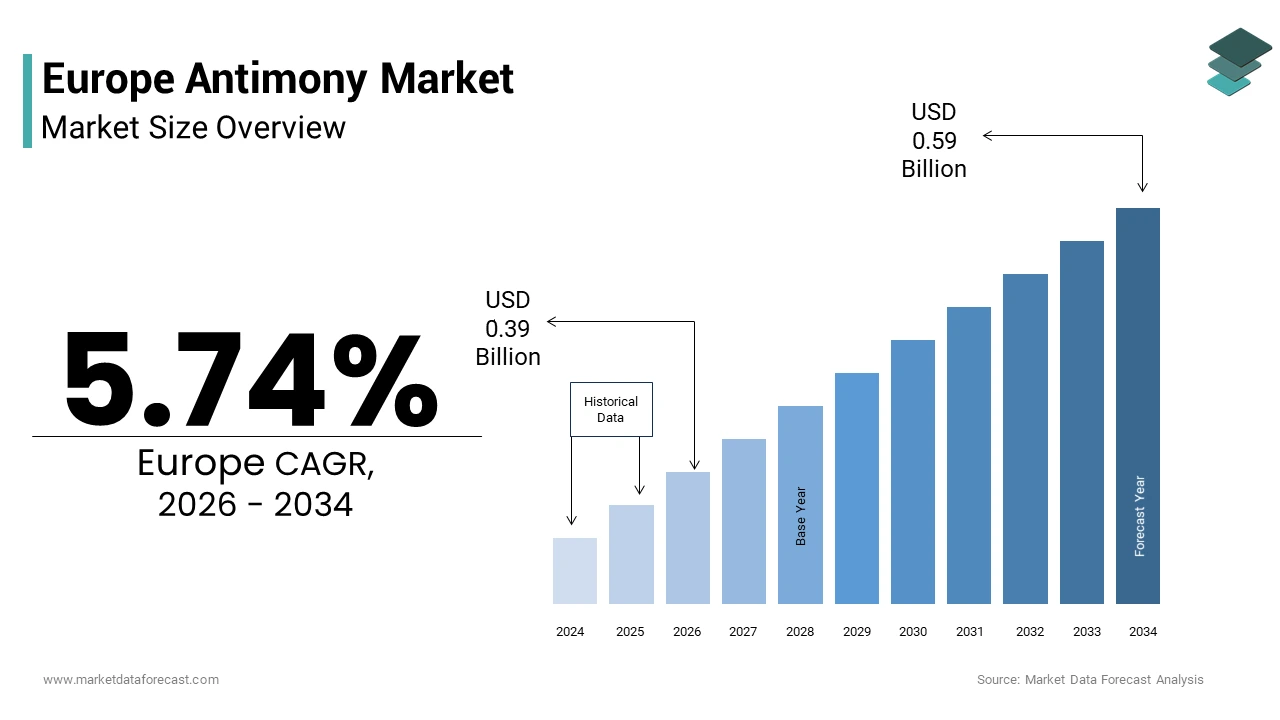
The European antimony market was valued at USD 0.37 billion in 2025, is estimated to reach USD 0.39 billion in 2026, and is projected to grow to USD 0.59 billion by 2034, expanding at a CAGR of 5.74% during the forecast period from 2026 to 2034.
The growth of the European antimony market is driven by rising demand for flame-retardant materials, expanding use in plastics, electronics, and construction applications, and increasing regulatory focus on fire safety standards across the region. Antimony’s critical role in enhancing fire resistance in polymers, textiles, and building materials continues to support steady market expansion. Additionally, growing usage in battery manufacturing, glass, and semiconductors is further strengthening demand across industrial sectors.
Key Market Trends
- Increasing adoption of antimony-based flame retardants in construction, automotive interiors, and electrical components.
- Rising demand from the plastics and polymer industry to meet stricter fire safety regulations.
- Growing applications of antimony in lithium-ion battery systems and semiconductor manufacturing.
- Shift toward sustainable and recyclable flame-retardant materials using antimony compounds.
- Expansion of electronics and electrical equipment production across Europe is boosting antimony consumption.
Segmental Insights
- By application, the flame retardants segment dominated the European antimony market in 2025, accounting for 58.5% of the total market share.
- The segment’s leadership is attributed to antimony’s high efficiency as a synergist in halogenated flame retardants, making it essential for fire-resistant plastics, cables, insulation materials, and electronic housings used across residential, commercial, and industrial infrastructure.
Regional Insights
The European antimony market is witnessing consistent growth across major industrial economies due to expanding manufacturing activities and strict fire protection regulations. Countries with strong construction, automotive, electronics, and polymer industries are driving regional demand. Western Europe remains the primary consumption hub, supported by advanced infrastructure development, high safety standards, and increased investment in industrial fire-retardant technologies.
Competitive Landscape
The European antimony market is moderately consolidated, with key players focusing on supply chain security, product quality, and strategic partnerships to strengthen their regional footprint. Companies are investing in refining technologies, recycled antimony recovery, and sustainable sourcing practices to meet regulatory requirements and rising industrial demand.
Prominent players in the European antimony market include
Campine N, Huachang Antimony Industry, United States Antimony Corp, Korea Zinc Co. Ltd, Lambert Metals International, Mandalay Resources Ltd, NYACOL Nano Technologies, and Suzuhiro Chemical & Materials.
Europe Antimony Market Size
The Europe Antimony market size was valued at USD 0.37 billion in 2025 and is anticipated to reach USD 0.39 billion in 2026 to USD 0.59 billion by 2034, growing at a CAGR of 5.74% during the forecast period from 2026 to 2034.
Current Introduction of the European Antimony Market
Antimony is a chemical element with the symbol Sb (derived from its Latin name stibium) and atomic number 51. Unlike base metals, antimony is classified as a critical raw material by the European Commission due to its irreplaceable role in fire safety and energy transition technologies, coupled with high supply concentration risk. European passenger vehicle manufacturers and aerospace industries heavily depend on antimony compounds for advanced lead-acid battery durability and as a critical flame retardant in high-performance polymers, respectively. The European Chemicals Agency identifies antimony trioxide as a hazardous substance of concern, yet it remains permitted in specific, critical applications, such as specialized polymers, because reliable, technical alternatives are currently unavailable. Europe produces negligible primary antimony, relying on imports for over 95 percent of its consumption according to sources, with major sources including Turkey, Bolivia,ia and recycled streams from end-of-life lead acid batteries. This structural dependency, combined with tightening environmental regulations and strategic stockpiling initiatives, positions antimony not as a commodity but as a geopolitically sensitive enabler of safety and decarbonization across multiple sectors.
MARKET DRIVERS
Mandatory Fire Safety Regulations in Construction and Transportation
Stringent EU-wide fire safety mandates serve as the foremost driver of the European antimony market. This is driven primarily by the use of antimony trioxide as a synergist in halogenated flame retardants. Rigid polyurethane foam insulation in building applications often utilizes specific formulations to achieve the required fire performance, which can affect the feasibility of alternative components. A substantial volume of insulation is installed annually in both residential and commercial construction projects, suggesting high demand for these specific materials. Aviation safety requirements necessitate that cabin interior materials meet specific, rigorous, vertical burn tests, which are commonly achieved with the help of particular flame retardants. Automotive regulations mandate low-flammability standards for interior components, influencing the use of certain, specific materials in applications like wiring harnesses and dashboards. Efforts to replace conventional flame retardants with phosphorus or mineral-based fillers can lead to an increase in material thickness, which may impact design and installation efficiency. Antimony remains a necessary component of Europe’s safety infrastructure by legal mandate until regulatory bodies approve technically equivalent alternatives.
Growth in Lead Acid Battery Recycling for Automotive and Energy Storage
The expansion of lead acid battery recycling networks across the region sustains secondary antimony supply while reinforcing demand through closed loop reintegration, which further propels theEuropeane antimony market. A significant proportion of vehicular lead-acid batteries in the region are collected and processed for material recovery. Recovered antimony is refined and reintroduced into the production of new batteries to improve their structural integrity and performance in deep-cycle applications. Regulatory frameworks encourage stationary lead-acid battery storage for solar energy, particularly in residential applications in southern regions. The European Battery Alliance recognizes antimony-doped lead alloys as essential for extending cycle life in partial state of charge operations. The new EU Battery Regulation is fostering a self-sustaining recycling loop, prompting companies such as Aurubis and Umicore to invest in enhanced antimony recovery, which bridges the gap between waste management and material supply.
MARKET RESTRAINTS
Classification as a Substance of Very High Concern Under REACH
The formal identification of antimony trioxide as a substance of very great concern by the European Chemicals Agency imposes significant regulatory and reputational constraints on its use, which restrains the growth of the European antimony market. Regulatory classifications under established chemical frameworks are triggering authorization requirements, which necessitate that industrial users either justify continued usage or identify substitutes. Increased compliance, monitoring, and reporting requirements are driving up operational costs, even for industries currently benefiting from exemptions. Corporate sustainability policies are placing greater emphasis on removing high-concern substances, leading to proactive phasing out of specific materials in non-critical applications. Broader, long-term regulatory goals to reduce or eliminate high-concern substances create uncertainty for sectors that currently rely on temporary exemptions. The overall trend shows a shift toward substituting traditional chemical additives with alternatives due to both regulatory pressure and corporate sustainability commitments. This regulatory trajectory discourages long term investment in anantimony-dependentormulations and accelerates R&D into alternative flame-retardant systems despite their current technical limitations.
Geopolitical Concentration of Primary Supply and Import Dependency
The region’s near-total reliance on imported antimony exposes the market to supply chain disruptions and geopolitical leverage, which hinders the expansion of the European antimony market. China historically dominated global production, but export restrictions and environmental crackdowns reduced its share; however, new dependencies have emerged,d with Turkey becoming the largest source of antimony ore to the EU, supplying a portion of imports in 20,23 as per sources. Political instability in key producing regions poses risks. Boliviastate-ownedned mining company COMIBOL accounts for a notable share of EU antimony metal imports yet faces recurring labor unrest and policy shifts. Antimony is recognized as a critical material with significant supply risks and limited circularity within the European industrial landscape. Strategic stockpiling initiatives across Europe are characterized by a fragmented approach. A limited number of nations maintain substantial strategic reserves that adequately cover extended periods of industrial consumption. The reliance on fragmented efforts highlights a potential vulnerability in the European supply chain for this material. Europe's lack of coordinated procurement and investment in internal refining leaves it susceptible to supply chain interruptions, including export controls, volatile pricing, and logistical issues, all of which could impact fire safety and battery manufacturing chains.
MARKET OPPORTUNITIES
Development of Antimony-Based Solid-State Battery Technologies
Emerging research into antimony anodes for next-generation solid-state and sodium-ion batteries offers a potential opportunity for diversification beyond traditional applications in the European antimony market. Antimony-based materials are drawing attention for sodium-ion systems due to their high theoretical capacity, which exceeds that of conventional hard carbon anodes. Moreover, antimony-tin alloys have demonstrated viability for grid-scale energy storage applications in prototype testing. The development of advanced post-lithium anode materials, including those based on antimony composites, is receiving funding support within the European Union. If scaled, these technologies could transform antimony from a niche additive into a core active material, increasing per unit value and justifying secure supply investments. Pilot production lines in Sweden and Finland are already testing antimony electrode integration, signaling a potential paradigm shift that aligns with Europe’s ambition to build a sovereign battery value chain independent of cobalt and nickel.
Circular Economy Integration Through Urban Mining Initiatives
The formalization of urban mining, recovering antimony from electronic waste and end-of-life vehicles, exhibits a major possibility to reduce import reliance and meet EU circularity targets, which is predicted to boost the expansion of the European antimony market. Electronic waste in Europe contains a significant quantity of antimony, mainly from flame-retardant plastics in electronics. Existing recovery methods struggle with challenges in separating certain polymers. Newer techniques show potential for greater efficiency and purity in extracting antimony from e-waste. The EU’s Circular Electronics Initiative mandates extended producer responsibility schemes that could fund dedicated antimony recovery lines. Companies like Umicore are piloting integrated smelters that co-process lead acid batteries and e-waste to maximize antimony yield. Antimony urban mining innovations provide a model for circularity and supply resilience, aligning with the EU's 2030 targets for domestically recycled critical raw materials.
MARKET CHALLENGES
Lack of Economically Viable Substitutes in High-Performance Applications
The absence of technically and economically feasible alternatives to antimony in critical fire safety and battery functions, despite regulatory pressure, constitutes a persistent challenge to the European antimony market. Phosphorus-based flame retardants may require higher concentrations than antimony trioxide in polyolefins to achieve similar efficacy, potentially impacting material costs and mechanical properties. Alternative flame-retardant formulations in aviation have struggled to meet smoke density requirements during burn tests. Substitutes for antimony trioxide in lead-acid batteries have been shown to reduce deep-cycle life under certain conditions. Assessments indicate that antimony trioxide is not easily substitutable in a significant number of applications. This technological lock-in forces industries to absorb compliance costs rather than switch materials, but also stifles innovation incentives since alternatives cannot compete on performance. The market is stuck in a deadlock between regulatory demands and engineering realities, pending breakthrough innovations.
Fragmented Recycling Infrastructure and Collection Inefficiencies
Inconsistent e-waste and battery collection systems across EU member states undermine antimony recovery potential and exacerbate primary import dependence, which obstructs the expansion of the European antimony market. Collection rates for electronic waste differ across nations, indicating a lack of uniform compliance with regulated channels. A notable amount of discarded electronics is processed through informal methods rather than within authorized systems. The diversion of materials outside authorized channels reduces the supply of resources available for specialized recycling processes. A significant portion of plastics treated with flame retardants is often disposed of in mixed waste streams. Methods for handling waste plastics can lead to the loss of specific materials, such as antimony, through incineration or landfilling. Even in high collection countries, sorting facilities lack sensors to identify antimony-containing polymers, leading to dilution in recycled plastic batches. The EU WEEE Directive sets harmonized targets, but enforcement is national, resulting in uneven investment in advanced separation technologies. Standardized collection protocols and EU-funded sorting upgrades are essential to prevent urban mining from remaining inefficient. This infrastructure gap not only increases environmental risk but also weakens Europe’s negotiating position in global antimony markets by limiting secondary supply leverage.
REPORT COVERAGE
| REPORT METRIC | DETAILS |
| Market Size Available | 2025 to 2034 |
| Base Year | 2025 |
| Forecast Period | 2026 to 2034 |
| CAGR | 5.74% |
| Segments Covered | By Application And By Country |
| Various Analyses Covered | Global, Regional & Country Level Analysis; Segment-Level Analysis, DROC, PESTLE Analysis, Porter’s Five Forces Analysis, Competitive Landscape, Analyst Overview of Investment Opportunities |
| Regions Covered | UK, France, Spain, Germany, Italy, Russia, Sweden, Denmark, Switzerland, Netherlands, Turkey, Czech Republic,c & Rest of Europe |
| Market Leaders Profiled | Campine N, Huachang Antimony Industry, United States Antimony Corp, Korea Zinc Co. Ltd, Lambert Metals International, Mandalay Resources Ltd, NYACOL Nano Technologies, Suzuhiro Chemical & Materials |
SEGMENTAL ANALYSIS
By Application Insights
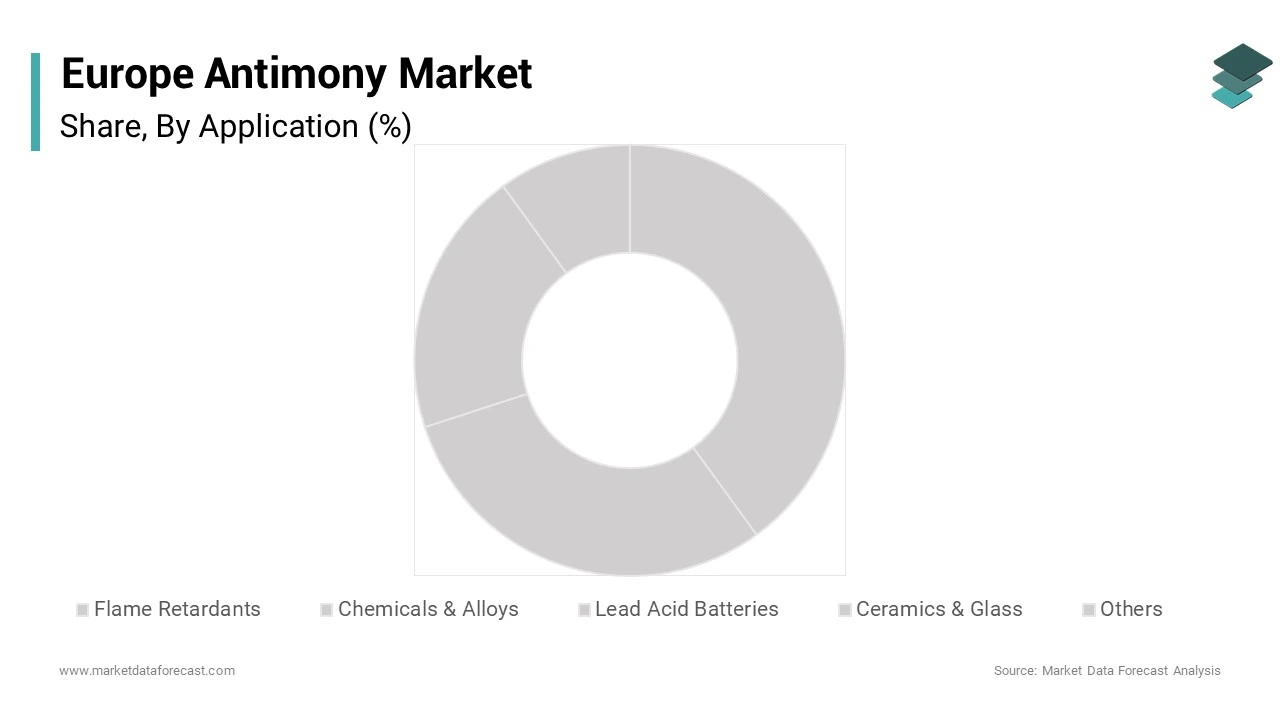
The flame retardants segment dominated the European antimony market by accounting for a 58.5% share in 2025. The dominance of the flame retardants segment is driven by non-negotiable fire safety regulations across construction, transportation,n, and electronics. Rigid polyurethane insulation in building applications often incorporates bromine-based flame-retardant systems using antimony trioxide as a synergist to meet European fire safety standards. Significant amounts of this insulation are installed annually to comply with building regulations. Aviation safety regulations for cabin materials frequently use antimony-treated flame-retardant polymers for components like seat covers. Automotive standards for low-flammability interiors also necessitate antimony in parts such as wiring harnesses. Alternative flame-retardant systems might require more material, potentially impacting product thickness, design efficiency, and cost. Antimony remains legally required in Europe's safety standards until technically equivalent alternatives are approved, ensuring its dominance in flame retardants.
The lead acid batteries segment is predicted to witness the highest CAGR of 4.8% from 2026 to 2034 due to the continued deployment of start-stop and micro hybrid vehicles, which requireantimony-dopedd lead alloy grids to enhance mechanical strength and deep cycle durability. Start-stop technology is increasingly prevalent in new passenger vehicles, indicating a focus on improved fuel efficiency. European regulations support the use of stationary energy storage for residential renewable energy systems. Certain elements, like antimony, are recognized for their role in improving battery life in renewable energy applications requiring partial state of charge operation. Emerging regulations establishing minimum recycled content are driving investment in advanced recycling methods to recover critical materials. This regulatory and technological convergence leads to lead acid batteries from a legacy application into a resilient growth vector aligned with Europe’s decarbonization and circular economy goals.
COMPETITIVE LANDSCAPE
The European antimony market features limited but highly specialized competition among integrated recyclers, specialty refiners,s and trading houses operating under intense regulatory and supply chain pressures. Unlike commodity meta, ls antimony’s classification as a critical raw material and substance ofgreath concern creates a dual constraint environment where environmental compliance and supply security are equally paramount. Competition centers on purity certifica,,tion tracea,bility and reliability rather than price alone. Large metallurgical firms like Umicore and Aurubis dominate through scale and integration with battery-waste waste streams, while niche processors like Trimex compete via technical customization and regulatory expertise. New entrants face high barriers due to permitting complexities for handling hazardous materials and the need forthe establishment of off-takee relationships with flame-retardant and battery makers. The absence of primary European mining further concentrates competition on secondary recovery and import logistics. As the EU pushes for 2030 targets on recycled content and strategic autonomy, competition is increasingly defined by circular innovation and policy engagement rather than traditional market tactics.
KEY MARKET PLAYERS
A few of the dominant market players that are in theEuropeane antimony market are
- Campine NV
- Umicore SA/NV
- Trimex Antimony & Alloy GmbH
- Aurubis AG
- Huachang Antimony Industry
- United States Antimony Corp
- Korea Zinc Co. Ltd
- Lambert Metals International
- Mandalay Resources Ltd
- NYACOL Nano Technologies
- Suzuhiro Chemical & Materials
Top Players In The Market
- Umicore is a pivotal player in the European antimony market through its advanced materials and recycling operations that recover antimony from end of life lead acid batteries and electronic waste. Headquartered in Belgium, the company operates one of Europe’s largest precious and specialty metals refining complexes,s where antimony is extracted and purifiedto battery-gradee quality. Umicore supplies refined antimony trioxide and metal to flame-retardant producers and battery manufacturers across the EU. It also collaborates with automotive OEMs to develop closed-loop recycling protocols, ensuring compliance with the EU Battery Regulation. Umicore’s integration of circular economy principles positions it as a strategic partner in Europe’s effort to reduce critical raw material import dependency.
- Aurubis plays a significant role in theEuropeane antimony market as a leading copper and specialty metals recycler that co-processes antimony during secondary smelting operations. Based in Germany, the company recovers antimony from complex scrap stream,s includine-wastete and lead-acid battery paste, at its Hamburg and Lünen facilities. Aurubis supplieshigh-purityy antimony oxide to European flame-retardant formulators and alloy producers under long term offtake agreements. In recent years, the company invested in hydrometallurgical purification technology to meet REACH compliance standards for recovered antimony. It also participates in the European Raw Materials Alliance to advance urban mining initiatives. By transforming waste into certified critical raw material,s Aurubis strengthens Europe’s supply resilience while supporting decarbonization goals through resource efficiency.
- Trimex Antimony & Alloy is a specialized European distributor and processor focused exclusively on antimony and its alloys for industrial applications. Operating from Germa,ny the company sources primary and recycled antimony globally and refines it into custom formulations for battery gr,flame-retardantdant masterbatches, and bearing alloys. Trimex maintains strategic inventory buffers to ensure supply continuity amid geopolitical disruptions and offers technical support for regulatory compliance under REACH and CLP regulations. Recentl,y the company launched a certified low arsenic antimony grade tailored for EU battery manufacturers seeking cleaner inputs. It also partners with research institutes to test antimony composites fonext-generationon energy storage. Through niche expertise and responsive logistics, Trimex bridges global supply chains with stringent European industrial requirements.
Top Strategies Used by the Key Market Participants
Key players in theEuropeane antimony market prioritize vertical integration of recycling and refining to secure supply amid import dependency and regulatory scrutiny. They invest in advanced hydrometallurgical and pyrometallurgical processes to produce REACH-compliant antimony with traceable origins. Companies actively collaborate with the automotive and construction sectors to develop closed-loop systems that align with EU Battery and Circular Economy regulations. Strategic stockpiling and buffer inventory management mitigate geopolitical risks from concentrated global production. Participation in European Raw Materials Alliance working groups shapes policy and funding for domestic processing capacity. Additionally, firms diversify into emerging applications such as sodium ion battery anodes tofuture-prooff demand. These strategies collectively enhance supply chain resilience, technical leadershi,p and regulatory alignment in a market defined by scarcity and strategic importance.
MARKET SEGMENTATION
This research report on thEuropeanpe antimony market is segmented and sub-segmented into the following categories.
By Application
- Flame Retardants
- Chemicals & Alloys
- Lead Acid Batteries
- Ceramics & Glass
- Others
By Country
- UK
- France
- Spain
- Germany
- Italy
- Russia
- Sweden
- Denmark
- Switzerland
- Netherlands
- Turkey
- Czech Republic
- Rest of Europe