- Product Description Description
- Table of Contents TOC
- List of Table & Figure LOT
- Get Free Sample PDF Sample PDF
Market Size, 2025
$12.07 BnMarket Estimate, 2026
$12.77 BnMarket Forecast, 2034
$20.12 BnCAGR, 2026–2034
5.84%Executive Summary: Europe Antipsychotic Drugs Market
- Market Scope: Regional analysis of Europe's antipsychotic therapeutics sector, detailing therapeutic classes, clinical applications, distribution channels, regulatory guidelines, and country-level profiles.
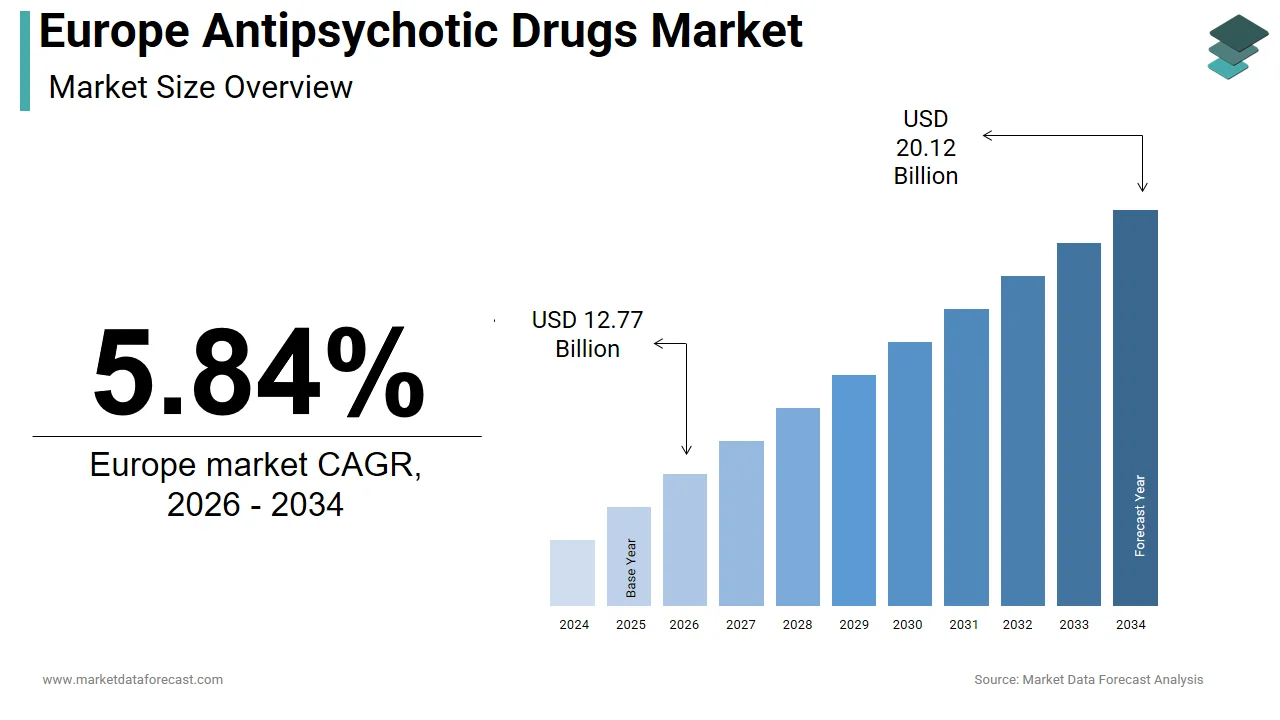
- Market Valuation: Valued at USD 12.07 billion in 2025, reaching USD 12.77 billion in 2026, and projected to expand to USD 20.12 billion by 2034, growing at a robust CAGR of 5.84% from 2026 to 2034.
- Primary Growth Drivers: Rising prevalence of mental health disorders and schizophrenia, an expanding aging demographic prone to dementia-related psychosis, and increased R&D investments for advanced combination formulations.
Key Market Segment Metrics
| Category | Leading Segment (Base Position) | Fastest-Growing / High-Growth Segment |
|---|---|---|
| By Therapeutic Class | Second-Generation (Atypical) Antipsychotics (dominated the market base position due to lower extrapyramidal side effects and broad prescription guidelines) | Third-Generation Antipsychotics (projected to experience high growth rates driven by improved partial dopamine agonist safety profiles) |
| By Application | Schizophrenia (captured the major market share, supported by high clinical diagnostic rates and standardized long-term maintenance regimens) | Dementia & Bipolar Disorder (fastest-growing application sectors driven by the escalating geriatric population and expanded psychiatric screening) |
| By Distribution Channel | Hospital Pharmacies (leading distribution channel handling institutional psychiatric care and initial prescription dispensing) | Online Pharmacies (fastest-growing retail category fueled by digital healthcare adoption, home delivery, and prescription refill apps) |
| By Country | Germany (market leader supported by dense clinical trial infrastructure, CRO activity, and high prevalence metrics for mood disorders) | United Kingdom (high-growth hub driven by government-backed long-acting injectable development and structured mental health service frameworks) |
Major Market Players & Industry Landscape
Market Structure: Highly competitive pharmaceutical landscape characterized by prominent global corporations focusing on advanced delivery formats, minimized side-effect profiles, and regulatory compliance.
Key Companies: Eli Lilly and Company, Johnson & Johnson, Pfizer Inc., AstraZeneca plc, and Otsuka Pharmaceutical Co., Ltd.
 Download Free Sample Report
Europe Antipsychotic Drugs Market Size
The size of the Europe antipsychotic drugs market was valued at USD 12.07 billion in 2025. This market is expected to grow at a CAGR of 5.84% from 2026 to 2034 and be worth USD 20.12 billion by 2034, up from USD 12.77 billion in 2026.
MARKET DRIVERS
Rising Mental Health Cases Propel Demand for Antipsychotic Drugs
The growing patient count suffering from mental disorders across European countries is one of the major factors propelling the European antipsychotic drugs market growth. Antipsychotic drugs are used by people suffering from psychosis, schizophrenia, and dementia. France is one of the European countries with the highest patient count suffering from mental diseases, and the usage of antipsychotic drugs is also high in France.
The growing geriatric population in the European region is expected to favor regional market growth. Dementia is the most common disease seen in the aging population. The disease symptoms result in behavior changes and other symptoms, such as apathy, agitation, psychosis, and hallucinations. These issues can be controlled by antipsychotic drugs, which demand market growth.
The rising R&D activities to develop advanced drugs and the availability of drugs in offline and online stores further promote the growth rate of the European antipsychotic drugs market. Manufacturers are focused on developing antipsychotic drugs in various combinations based on different people's issues. They also focus on developing drugs with minimal side effects, with different dosages that people of all ages in the region can use. In addition, the growing R&D to manufacture effective drugs and increasing investments by governmental and non-governmental organizations in favor of antipsychotic drugs are favoring the growth rate of the European market.
MARKET RESTRAINTS
Side Effects of Antipsychotic Drugs Limit Market Growth
However, side effects associated with antipsychotic drugs, such as fever, irregular heartbeats, faster breathing, sweating, muscle stiffness, and reduced consciousness, are one of the major factors hampering the market growth in the European region. In addition, a lack of awareness regarding the advantages of antipsychotic drugs among the European population living in rural and underdeveloped countries is hindering the growth of the antipsychotic drugs market in Europe. Furthermore, high costs associated with the R&D and manufacturing of antipsychotic drugs are based on several criteria inhibiting the growth rate of the European market. The lack of skilled medical professionals to detect exact mental disorders for the proper treatment is further anticipated to negatively impact the regional market growth.
REPORT COVERAGE
| REPORT METRIC | DETAILS |
| Market Size Available | 2025 to 2034 |
| Base Year | 2025 |
| Forecast Period | 2026 to 2034 |
| Segments Covered | By Therapeutic Class, Application, Distribution Channel, and Region. |
| Various Analyses Covered | Global, Regional and Country-Level Analysis, Segment-Level Analysis, Drivers, Restraints, Opportunities, Challenges; PESTLE Analysis; Porter’s Five Forces Analysis, Competitive Landscape, Analyst Overview of Investment Opportunities |
| Countries Covered | UK, France, Spain, Germany, Italy, Russia, Sweden, Denmark, Switzerland, Netherlands, Turkey, Czech Republic, and Rest of Europe |
| Market Leaders Profiled | Eli Lily and Company, Johnson and Johnson, Pfizer Inc., AstraZeneca plc, and Otsuka Pharmaceutical Co, Ltd |
COUNTRY ANALYSIS
The European market captured the second-largest share of the worldwide market in 2021 and is anticipated to hold promising occupancy in the global market during the forecast period, owing to the rising awareness regarding antipsychotic drugs and increasing approval of drugs. In recent years, it was approved to sell antipsychotic drugs in the pharmacy store based on the doctors' prescription, considering the growing population suffering from several mental disturbances in the European region.
During the forecast period, the German market is anticipated to hold a major share of the European market.
The growing number of CROs and increasing clinical trial activities of antipsychotic drugs in Germany are contributing to the growth of the European market. According to a recent survey, an estimated 40% of the German population suffers from bipolar disorder and schizophrenia. Schizophrenia results in trouble in doing daily activities, work productivity, and social functioning. Such people may have severe complications, including suicidal thoughts. In such situations, healthcare providers prescribe antipsychotic drugs to cure or prevent the symptoms.
The UK is another potential market in the European region. According to a recent survey in the United Kingdom, approximately 14 people per 100,000 have mental disorder problems. Out of which, 80% of people use psychotropic medication for treatment. Healthcare providers and researchers have found that the drug's injection format works more effectively than oral drugs. As a result, the UK government focuses on developing the injection of different dosage forms, from low to high, based on the effects seen in the patients.
KEY MARKET PLAYERS
Eli Lily and Company, Johnson and Johnson, Pfizer Inc., AstraZeneca plc, and Otsuka Pharmaceutical Co, Ltd are some of the noteworthy companies in the European antipsychotic drugs market.
MARKET SEGMENTATION
This Europe antipsychotic drugs market research report is segmented and sub-segmented into the following categories.
By Therapeutic Class
-
First-generation
-
Second-generation
By Application
- Schizophrenia
- Dementia
- Bipolar disorder
- Depression
- Others
By Distribution Channel
- Hospital Pharmacies
- Retail Pharmacies
- Online Pharmacies
By Country
- UK
- France
- Spain
- Germany
- Italy
- Russia
- Sweden
- Denmark
- Switzerland
- Netherlands
- Turkey
- Czech Republic
- Rest of Europe