Europe Application Performance Monitoring (APM) Market Size, Share, Trends & Growth Forecast Report By Application, Deployment Type, End User Industry, and By Country (Germany, United Kingdom, France, Netherlands, Sweden & Rest of Europe) – Industry Analysis and Forecast, 2025 to 2033
Europe Application Performance Monitoring Market Summary
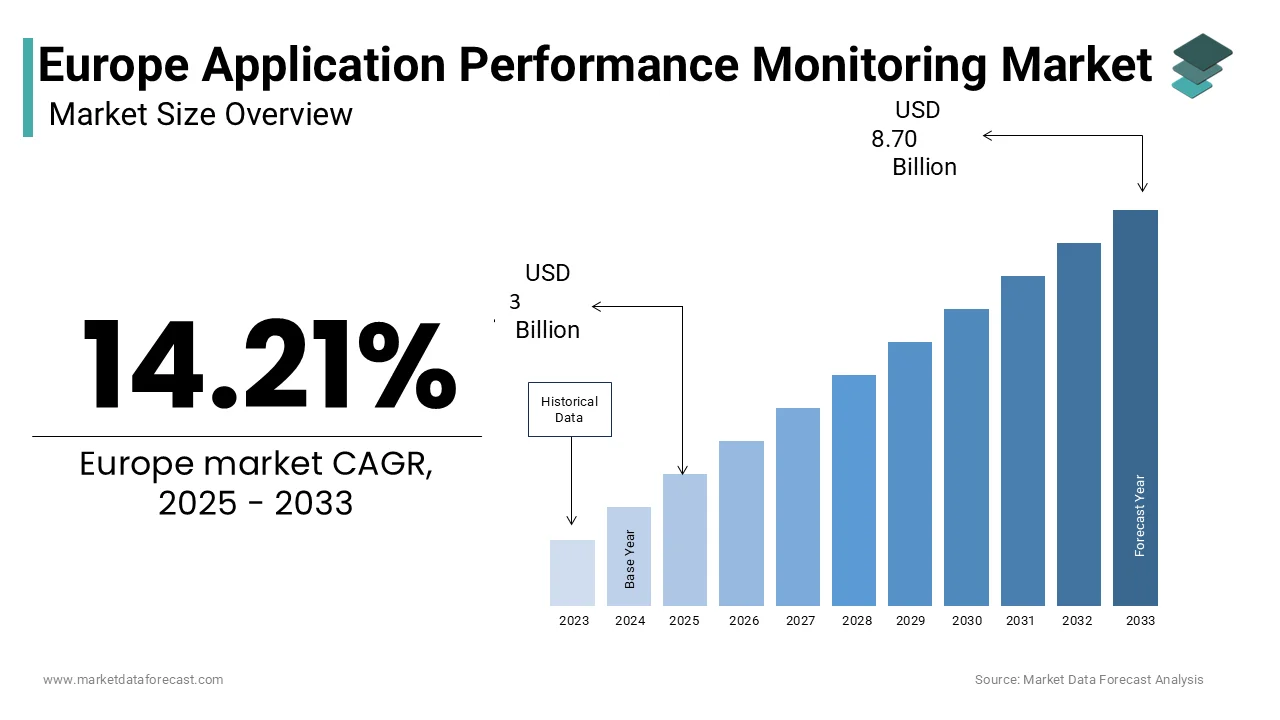
Europe application performance monitoring market was valued at USD 2.63 billion in 2024, estimated to reach USD 3.00 billion in 2025, and is projected to reach USD 8.70 billion by 2033, growing at a CAGR of 14.21% from 2025 to 2033, driven by rapid cloud-native adoption, rising digital service usage, regulatory mandates for operational resilience, and increasing reliance on AI-driven observability across enterprises and public services.
Market Highlights
- 2024 value: USD 2.63 billion
- 2025 (est): USD 3.00 billion
- 2033 forecast: USD 8.70 billion
- CAGR (2025–2033): 14.21%
Quick growth drivers
- Explosive adoption of cloud-native, microservices, and Kubernetes architectures across European enterprises.
- Rising consumer expectations for zero-downtime digital experiences in banking, e-commerce, healthcare, and government portals.
- Regulatory pressure from DORA, NIS2, GDPR, and the Digital Services Act mandates real-time monitoring and incident visibility.
- Expansion of multi-cloud and hybrid IT environments is increasing application complexity and monitoring needs.
- Growth of digital public services under the EU Digital Decade initiative.
Principal restraints
- Strict data sovereignty and cross-border data transfer regulations limit centralized telemetry processing.
- Compliance challenges following Schrems II and country-specific data residency mandates.
- High integration complexity with legacy systems such as mainframes and proprietary middleware.
- Fragmented monitoring stacks cause tool sprawl, alert fatigue, and a higher total cost of ownership.
High-value opportunities
- AI-driven observability and AIOps enabling predictive anomaly detection and automated root-cause analysis.
- Public sector digital transformation projects require continuous performance assurance and transparency.
- Growth of GDPR-compliant, Europe-hosted monitoring platforms with localized data processing.
- Adoption of OpenTelemetry-based observability to unify metrics, logs, and traces across environments.
Key operational challenges
- Shortage of skilled observability and site reliability engineers (SREs) across Europe.
- Underutilization of advanced APM features due to a lack of in-house expertise.
- Lack of standardized, interoperable observability frameworks across vendors and sectors.
- Complexity in monitoring hybrid environments spanning on-premise legacy systems and cloud workloads.
Fastest-growing segments
- Analytics & AI-powered APM: 15.5% CAGR — predictive insights and automated remediation.
- Healthcare end-users: 16.6% CAGR — mission-critical digital health platforms and zero-downtime needs.
- Hybrid deployment models: 14.1% CAGR — coexistence of legacy and cloud systems.
- End-user experience monitoring: dominant segment driven by regulatory and consumer pressure.
Regional leadership & dynamics
- Germany (26.4% share): strong industrial digitalization, strict data protection culture, and cloud adoption.
- United Kingdom: fintech maturity, NHS digital mandates, and operational resilience regulations.
- France: state-led digital modernization and sovereign cloud initiatives.
- Netherlands & Sweden: data-center density, real-time payments, and advanced digital public services.
What wins commercially
- GDPR- and DORA-compliant observability platforms with European data residency.
- AI-driven automation that reduces MTTR and alert noise.
- Unified full-stack visibility across cloud, hybrid, and legacy systems.
- Support for open standards (OpenTelemetry) and vertical-specific dashboards.
Top strategic ask for executives
Invest in AI-enabled, sovereign-ready observability platforms, expand hybrid and public-sector monitoring capabilities, accelerate OpenTelemetry adoption, and build observability skills and partnerships to maximize ROI and regulatory readiness.
Leading players
Dynatrace · Datadog · New Relic · IBM · Cisco (AppDynamics) · Microsoft · Google · Oracle · Splunk · Broadcom (CA) · Elastic · SolarWinds · ManageEngine
Europe Application Performance Monitoring Market Size
The europe application performance monitoring market was valued at USD 2.63 billion in 2024, is estimated to reach USD 3 billion in 2025, and is projected to reach USD 8.70 billion by 2033, growing at a CAGR of 14.21% from 2025 to 2033.
Application performance monitoring is the suite of technologies and practices used to observe, analyse, and optimize the availability, speed, and reliability of software applications from end user to backend infrastructure. In Europe, this discipline has become indispensable as digital transformation accelerates across finance, healthcare, retail, and public services, driving reliance on complex cloud native architectures and real-time transaction systems. Unlike basic infrastructure monitoring, modern application performance monitoring correlates user experience metrics with code-level diagnostics to enable rapid root cause identification. According to Eurostat, 78% of large enterprises in the European Union employed cloud computing services in 2023, reflecting the mainstream adoption of digital infrastructure. As per the European Commission’s Digital Economy and Society Index, European citizens interacted with an average of 17 digital public and private services per week in 2023, which is increasing expectations for seamless performance. Furthermore, the General Data Protection Regulation imposes stringent requirements on system transparency and incident response, indirectly reinforcing the need for granular application telemetry. This convergence of widespread cloud adoption, high citizen engagement with digital services, and regulatory imperatives justifies application performance monitoring as a strategic enabler of customer retention, compliance, and digital resilience across the European economic landscape.
MARKET DRIVERS
Rapid Expansion of Cloud Native and Microservices-Based Application Architectures
The widespread adoption of cloud native development and microservices architecture across European enterprises has fundamentally intensified the need for sophisticated application performance monitoring solutions, which is a key factor driving the European application performance monitoring market growth. Traditional monolithic applications offered linear execution paths that were relatively straightforward to troubleshoot, but modern distributed systems involve hundreds of loosely coupled services communicating over networks, creating intricate dependency chains where performance bottlenecks can emerge unpredictably. According to the Cloud Native Computing Foundation’s 2023 survey, 83% of European organizations now run workloads in Kubernetes environments, with an average of 127 microservices per enterprise application. This fragmentation multiplies potential failure points and obscures visibility without specialized monitoring tools capable of distributed tracing and service mesh observability. As per the European Banking Federation, major financial institutions in the EU manage over 500 microservices each to support digital banking platforms, where even sub-second latency delays can trigger customer churn. Moreover, the EU’s Digital Operational Resilience Act mandates that critical entities maintain real-time monitoring capabilities to detect anomalies and cyber disruptions. Application performance monitoring platforms that provide end-to-end transaction tracking across containers, serverless functions, and legacy systems are therefore not optional but essential for operational continuity and regulatory alignment in Europe’s increasingly modular digital ecosystem.
Escalating Consumer Expectations for Seamless Digital Experience and Service Uptime
European end users now demand near-instantaneous response times and uninterrupted availability from digital applications, whether interacting with e-commerce platforms, mobile banking apps, or government portals, which is further supporting the application performance monitoring market expansion in Europe. This behavioural shift has transformed application performance from a back-office concern into a core determinant of brand reputation and customer loyalty. According to the European Consumer Organisation, 74% of surveyed consumers in 2023 stated they would abandon a digital service after 2 or more instances of sluggish performance or downtime. The impact is quantifiable; a study by the University of Cambridge’s Centre for Digital Economy found that a 1-second delay in page load time reduces conversion rates by 7% for European retail websites. In the financial sector, the European Central Bank reported that payment application outages exceeding 5 minutes in 2023 triggered an average 18% spike in customer complaints to national regulators. These expectations are further reinforced by the EU’s Digital Services Act, which requires large online platforms to ensure service reliability and transparent incident reporting. Consequently, enterprises are compelled to deploy real user monitoring and synthetic transaction tools that simulate and measure experience across geographies, devices, and network conditions. Application performance monitoring thus serves as both a technical safeguard and a customer experience assurance mechanism in an environment where digital friction equates directly to revenue loss and reputational damage.
MARKET RESTRAINTS
Stringent Data Sovereignty and Cross-Border Data Transfer Regulations
The European application performance monitoring market faces significant constraints due to the region’s rigorous data governance framework, particularly concerning where application telemetry can be stored and processed. The General Data Protection Regulation prohibits the unrestricted transfer of personal data—including IP addresses, device identifiers, and session logs—outside the European Economic Area unless specific safeguards are in place. According to the European Data Protection Board, over 60% of application performance monitoring tools historically routed diagnostic data to global data centers in the United States, creating compliance risks that forced many European firms to disable certain features or seek localized alternatives. The 2020 Schrems II ruling further invalidated the EU-US Privacy Shield, requiring case-by-case assessments for any transatlantic data flows. As per the European Commission, 13 EU member states have enacted additional national rules requiring public sector entities to store monitoring data exclusively within sovereign cloud infrastructures. These legal complexities increase deployment costs and delay implementation timelines, as vendors must offer region-specific data residency options or partner with European cloud providers like OVHcloud or Deutsche Telekom. For multinational monitoring vendors without local data centers, market access becomes contingent on complex contractual and technical adaptations, thereby limiting choice and elevating barriers to entry for smaller European software firms seeking integrated observability solutions.
High Integration Complexity with Legacy Systems and Heterogeneous IT Environments
Many European enterprises operate hybrid IT landscapes that combine decades-old legacy applications with modern cloud services, which is creating formidable obstacles for the European application performance monitoring market. Core banking systems in Germany, national healthcare records in France, and utility billing platforms in Italy often run on mainframes or proprietary middleware that lack standard APIs or logging protocols compatible with contemporary monitoring agents. According to the European Central Bank, 78% of large financial institutions in the Eurozone still rely on COBOL-based systems for critical transaction processing, which do not natively support distributed tracing or real-time metric export. Integrating these environments requires custom instrumentation, proxy layers, or log parsing engines that are costly to develop and maintain. The European Interoperability Framework acknowledges that 61% of public sector digital services interact with at least one legacy backend, further complicating end-to-end visibility. Additionally, the absence of standardized observability formats across vendors—despite initiatives like OpenTelemetry—means that enterprises often juggle multiple monitoring silos, reducing diagnostic efficiency. As per a 2023 VDMA survey, German industrial firms managing both SAP ERP and custom IoT platforms reported an average of 4.3 different monitoring tools in use, leading to alert fatigue and inconsistent baselining. This fragmentation not only inflates the total cost of ownership but also delays the mean time to resolution during outages, diminishing the return on investment for application performance monitoring deployments.
MARKET OPPORTUNITIES
Adoption of Artificial Intelligence-Driven Observability for Predictive Anomaly Detection
The integration of artificial intelligence and machine learning into application performance monitoring platforms is a lucrative opportunity in the European application performance monitoring market. Traditional threshold-based alerting often generates false positives or misses subtle degradation patterns, whereas AI-driven observability can learn normal behaviour baselines and flag deviations before users are impacted. According to the European Institute for Innovation and Technology, 67% of European enterprises piloting AIOps in 2023 reported a reduction of over 40% in mean time to detect incidents. Financial institutions under the Digital Operational Resilience Act are particularly incentivized to adopt such capabilities, as regulators now expect proactive identification of anomalous transaction flows that could indicate cyber intrusions or system instability. The European Telecommunications Standards Institute has also published guidelines endorsing machine learning based root cause analysis for critical infrastructure operators. Vendors like Dynatrace and Datadog have launched Europe-hosted AI engines that process telemetry locally to comply with data rules while delivering automated dependency mapping and bottleneck prediction. As per Cambridge Judge Business School, AI-enhanced monitoring reduced unplanned downtime costs by an average of €2.3 million annually for large EU firms. This convergence of regulatory pressure, cost efficiency, and technological maturity positions intelligent observability as a high-growth frontier in Europe’s digital resilience strategy.
Expansion of Digital Public Services Under the EU’s Digital Decade Policy Program
The European Union’s ambitious Digital Decade initiative, which targets universal gigabit connectivity and digital public service accessibility by 2030, is creating substantial new demand for application performance monitoring across government agencies and a promising opportunity for the European market. As per the European Commission, over 24,000 public sector entities in the EU are in the process of modernizing citizen-facing portals for taxes, healthcare, education, and social benefits, all of which require real-time performance assurance. The 2023 Eurobarometer survey revealed that 82% of EU citizens now expect public services to match the responsiveness of private sector digital experiences, placing immense pressure on administrations to guarantee uptime and speed. The European Interoperability Framework mandates that all new digital government services implement continuous monitoring and user feedback loops, effectively institutionalizing observability as a procurement requirement. National initiatives such as France’s “Etat Numérique” and Germany’s “Digital Service Act” further compel agencies to publish service-level metrics publicly. Consequently, public sector demand is catalyzing contracts for monitoring platforms that support multi-tenant architectures, role-based dashboards, and integration with national identity systems like Spain’s Cl@ve or Estonia’s eID. According to the OECD, EU governments allocated €18.7 billion in 2023 specifically to digital service reliability enhancements. This public sector digitization wave not only expands the addressable market but also sets benchmarks for performance transparency that private enterprises increasingly emulate.
MARKET CHALLENGES
Persistent Shortage of Skilled Observability and Site Reliability Engineering Talent
Despite growing recognition of its strategic value, the deployment and effective utilization of application performance monitoring tools in Europe are hindered by a critical shortage of professionals skilled in observability engineering and site reliability practices, which is a significant challenge to the application performance monitoring market expansion in Europe. Modern monitoring platforms generate vast streams of metrics, traces, and logs that require expert interpretation to derive actionable insights, yet the talent pool remains insufficient. According to the European Centre for the Development of Vocational Training, the EU faced a deficit of over 350,000 cybersecurity and DevOps specialists in 2023, with observability expertise being among the most scarce subdomains. The average time to fill a site reliability engineer position in Germany or the Netherlands exceeds 90 days as per Randstad Workmonitor data, delaying monitoring optimization initiatives. Many enterprises resort to outsourcing, but managed service providers themselves struggle with capacity constraints. A 2024 survey by the Cloud Native Computing Foundation found that 58% of European firms using advanced monitoring tools reported underutilization due to a lack of in-house expertise to configure custom dashboards, set intelligent alerting policies, or conduct root cause analysis. This skills gap not only limits return on investment but also increases dependency on vendor consultants, inflating operational costs. Without coordinated upskilling through industry-academia partnerships and certification programs aligned with European digital sovereignty goals, the full potential of application performance monitoring will remain unrealized across the region.
Fragmentation of Monitoring Standards and Lack of Interoperable Observability Frameworks
The European application performance monitoring market contends with a fragmented ecosystem of proprietary formats, protocols, and vendor-specific agents that impede seamless data correlation across hybrid environments. Although open standards like OpenTelemetry have gained traction, adoption remains inconsistent, particularly among legacy monitoring tools still in use across European utilities, finance, and manufacturing sectors. According to the European Telecommunications Standards Institute, only 39% of enterprises in the EU have fully migrated to vendor-neutral telemetry collection as of 2023, leaving the majority reliant on siloed dashboards that obscure end to end transaction flows. This lack of interoperability complicates compliance with the Digital Operational Resilience Act, which requires holistic system visibility for critical entities. As per the European Union Agency for Cybersecurity’s 2024 threat landscape report, monitoring fragmentation was identified as one of the top three operational risks, with disjointed observability delaying incident response in 42% of analyzed breaches. Furthermore, national digital sovereignty initiatives—such as France’s SecNumCloud or Germany’s GAIA X—endorse different technical specifications for monitoring data, creating additional integration overhead for multinational firms. Without accelerated harmonization of observability standards through EU-level coordination, enterprises will continue to face elevated complexity costs and reduced diagnostic efficacy, ultimately undermining the reliability of Europe’s digital infrastructure.
REPORT COVERAGE
| REPORT METRIC | DETAILS |
| Market Size Available | 2024 to 2033 |
| Base Year | 2024 |
| Forecast Period | 2025 to 2033 |
| Segments Covered | By Application, Deployment Type End User Industry and Region. |
| Various Analyses Covered | Global, Regional and Country-Level Analysis, Segment-Level Analysis, Drivers, Restraints, Opportunities, Challenges; PESTLE Analysis; Porter’s Five Forces Analysis, Competitive Landscape, Analyst Overview of Investment Opportunities |
| Countries Covered | UK, France, Spain, Germany, Italy, Russia, Sweden, Denmark, Switzerland, Netherlands, Turkey, Czech Republic, Rest of Europe |
| Market Leaders Profiled | Dynatrace, LLC, New Relic, Inc., Datadog, Inc., IBM Corporation, Microsoft Corporation, Google LLC, Oracle Corporation, Cisco Systems, Inc., AppDynamics (a Cisco business), Splunk Inc., Broadcom Inc. (CA Technologies), Micro Focus International plc, SolarWinds Corporation, ManageEngine (Zoho Corporation), Riverbed Technology, Elastic N.V., ScienceLogic, Inc., LogicMonitor, Inc., PagerDuty, Inc., Axios Systems Ltd. |
SEGMENTAL ANALYSIS
By Application Insights
The end‑user experience monitoring segment dominated the market and captured 36.6% of the regional market share in 2024. The continent’s strong regulatory and consumer‑driven emphasis on digital service quality, where user satisfaction directly influences brand trust and compliance obligations are propelling the dominance of the end-user experience monitoring segment in the regional market. European regulations increasingly require organizations to demonstrate measurable service reliability and user‑centric performance. The Digital Services Act obliges large online platforms to implement real‑time monitoring of user interactions and publicly report systemic risks, including service disruptions. According to the European Commission, over 220 designated Very Large Online Platforms were required to deploy granular user experience telemetry by early 2024. Similarly, the Digital Operational Resilience Act (DORA) compels financial entities to monitor end‑to‑end transaction success rates from the customer viewpoint. The European Banking Authority reported in 2023 that 79% of EU banks had upgraded their monitoring stacks to include real user monitoring. This regulatory push transforms end‑user experience monitoring from an optimization tool into a legal necessity, ensuring its central role in European IT governance frameworks.

The analytics segment is projected to grow at a CAGR of 15.5% over the forecast period in this regional market. European enterprises are rapidly adopting AI‑powered analytics to move beyond reactive alerting toward predictive anomaly detection and automated root‑cause analysis. As per the European Institute for Innovation and Technology, 61% of large EU firms piloted machine learning‑based performance analytics in 2023, achieving a 35% reduction in mean time to resolution. Financial institutions under DORA are mandated to implement advanced behavioral baselining to detect subtle deviations that may indicate cyber intrusions or system degradation. The European Central Bank’s 2024 operational risk report noted that banks using AI‑driven observability reduced false positive alerts by 52% compared to rule‑based systems. Vendors localize training data processing within EU data centers to comply with GDPR, accelerating adoption. This convergence of regulatory alignment, technical maturity, and cost efficiency positions analytics as the vanguard of next‑generation APM.
By Deployment Type Insights
The cloud deployment segment had 52.3% of thEuropeanpe APM market share in 2024. The dominance of the cloud segment in this regional market is attributed to the region’s accelerated shift toward scalable, elastic, and managed observability solutions aligned with broader cloud adoption trends. European organizations have significantly increased reliance on public cloud platforms for application hosting, which requires cloud‑native monitoring solutions. As per Eurostat, 89% of large enterprises in the EU used cloud computing services in 2023, with 64% operating multi‑cloud environments. Major providers such as AWS, Microsoft Azure, and Google Cloud offer embedded monitoring agents that integrate seamlessly with their ecosystems, reducing deployment friction. The European Commission’s Cloud Strategy emphasizes interoperability and portability, encouraging standardized telemetry collection compatible with cloud‑based observability platforms. Furthermore, the Digital Europe Programme allocated €2.1 billion in 2023 to support SME cloud adoption, indirectly boosting demand for hosted monitoring tools. This infrastructure shift makes cloud‑deployed monitoring the default choice for new digital initiatives across the region.
The hybrid deployment segment is projected to showcase a CAGR of 14.1% over the forecast period in the European application performance monitoring market. Many European enterprises operate in transitional IT states where core transaction systems remain on‑premises while new customer‑facing features are built in the cloud. As per the European Central Bank, 71% of large financial institutions in the Eurozone still run critical payment processing on mainframes that cannot be fully migrated. Similarly, national health systems in France and Italy maintain decades‑old patient record databases that must interoperate with cloud‑based telemedicine apps. This reality demands monitoring solutions that span both environments with unified dashboards. The European Interoperability Framework explicitly endorses hybrid observability as a best practice for public sector digitization. A 2024 Fraunhofer Institute study found that 59% of DAX 30 companies deployed hybrid monitoring to ensure end‑to‑end visibility across SAP ERP and Azure‑hosted microservices.
By End‑user Industry Insights
The IT and telecom segment led the market and held the largest share of the European PMmarket in 2024. As the primary builders and operators of digital infrastructure, these entities have both the technical need and financial capacity to invest heavily in observability. IT and telecom firms in Europe serve as managed service providers, infrastructure hosts, and software developers for nearly every other industry, making application reliability central to their value proposition. According to ETSI, telecom operators managed over 12,000 enterprise cloud workloads in 2023, each requiring SLA‑backed performance guarantees. Major European IT consultancies such as Atos and Capgemini embed APM into every digital transformation contract, ensuring proactive issue detection for clients in banking, healthcare, and logistics. The GSMA Europe reports that 82% of mobile network operators now offer application experience monitoring as part of their 5G enterprise service bundles to demonstrate network quality beyond basic throughput.
The healthcare segment is the fafastestfastest-growing userin the European PMmarket and is projected to grow at a CAGR of 16.6% over the forecast period. The EU Health Strategy prioritizes interoperable electronic health records, telemedicine, and AI‑assisted diagnostics, all of which depend on highly available and responsive applications. According to the European Commission, 24 EU member states launched national digital health transformation programs in 2023, collectively investing €9.3 billion in electronic prescribing, patient portals, and remote monitoring platforms. Any performance lapse in these systems can directly impact patient outcomes, creating zero tolerance for downtime. The European Health Data Space regulation mandates real‑time auditability of health application transactions, necessitating comprehensive monitoring. A 2024 study by the European Institute of Innovation and Technology found that 67% of university hospitals in Germany, France, and the Netherlands implemented end‑user experience monitoring for their patient apps following incidents of appointment booking failures during the pandemic.
COUNTRY LEVEL ANALYSIS
Germany Application Performance Monitoring Market Analysis
Germany held 26.4% of the European application performance monitoring market share in 2024. The country’s position reflects its dense concentration of industrial software developers, financial institutions, and telecommunications providers that rely heavily on digital service reliability. Germany’s strong data protection culture, shaped by the Federal Data Protection Act, requires meticulous telemetry governance, driving demand for monitoring solutions with built‑in GDPR compliance features. According to the Federal Office for Information Security, 73% of DAX 30 companies implemented advanced end‑user monitoring in 2023 to comply with the IT Security Act 2.0. As per the Fraunhofer Institute, German manufacturers operating Industry 4.0 factories deployed application performance monitoring across 89% of their cloud‑based production control systems. Additionally, Germany hosts major European data centers for AWS, Azure, and Google Cloud in Frankfurt, creating a natural ecosystem for cloud‑native observability adoption. According to the Federal Ministry for Economic Affairs, €3.2 billion was allocated in 2024 to support digital sovereignty initiatives.
United Kingdom Application Performance Monitoring Market Analysis
The United Kingdom captured a promising share of the European market in 2024. Its prominence is primarily due to the mature fintech ecosystem, a robust digital public services framework, and a strong base of software engineering talent. The UK’s Financial Conduct Authority mandates stringent application performance reporting for all authorized payment institutions under the Operational Resilience Policy Statement. According to UK Finance, 92% of major banks implemented real‑user monitoring for their mobile banking apps in 2023. As per NHS Digital, the National Health Service’s Digital Transformation Strategy requires all patient‑facing applications to maintain 99.95% uptime, verified through synthetic monitoring. The UK’s departure from the EU has not diminished its observability investments; instead, it has accelerated the adoption of sovereign monitoring platforms to manage data flows under the UK GDPR. According to the Office for National Statistics, the UK hosts more than 11,000 active software development firms.
France Application Performance Monitoring Market Analysis
France is predicted to register a prominent CAGR in the Europe application performance monitoring market over the forecast period. The country is driven by state‑led digital modernization and a strong aerospace and finance sector. The French government’s “État Numérique” program mandates that all public digital services implement real‑time performance dashboards accessible to citizens. According to the French Digital Agency, 86% of national digital services achieved compliance with these observability requirements by late 2023. Major corporations like BNP Paribas and Airbus operate complex hybrid application landscapes that span on‑premises mainframes and cloud microservices, necessitating unified monitoring. As per CNIL, France’s Data Protection Authority has issued guidance on anonymizing user session data for monitoring purposes. In addition, France’s sovereignty cloud initiative, Cloud de Confiance,ce” partners with observability providers to ensure data residency. These coordinated public and private efforts position France as a strategic hub for secure and compliant application performance monitoring in Southern Europe.
Netherlands Application Performance Monitoring Market Analysis
The Netherlands is expected to exhibit a healthy CAGR in this regional market during the forecast period. The country’s significance arises from its role as a European data hub hosting more than 160 data centers, including major nodes for AMS‑IX, the world’s largest internet exchange. As per Statistics Netherlands, 81% of Dutch enterprises used cloud services in 2023, the highest rate in the EU. Dutch financial institutions such as ING and ABN AMRO operate real‑time payment systems that process more than 12 million transactions daily, requiring millisecond‑level performance visibility. According to the Dutch Central Bank, its 2023 operational risk directive explicitly requires continuous end‑user monitoring for all critical banking applications. Additionally, the Netherlands’ progressive stance on open data and digital transparency has led public sector bodies to publish application performance metrics proactively. With a highly skilled IT workforce and English‑language business environment, the Netherlands serves as a preferred European launchpad for global observability vendors.
Sweden Application Performance Monitoring Market Analysis
Sweden is estimated to account for a notable share of the European application performance monitoring market over the forecast period. The country’s strength lies in its world‑leading digital public services and a vibrant tech startup ecosystem centered in Stockholm. According to the Swedish Digitalisation Agency, 94% of citizens used government digital services weekly in 2023, with platforms like BankID and eHealth requiring flawless performance. As per the Swedish Financial Supervisory Authority, mandatory application performance benchmarks were introduced in 2023 for all fintechs. Major Swedish enterprises such as Ericsson and Volvo Cars operate globally distributed software systems that demand sophisticated monitoring across cloud regions. Statistics Sweden reports that 78% of Swedish SMEs adopted cloud‑based monitoring tools in 2023, the highest rate among Nordic countries. Sweden’s early adoption of the EU’s Digital Operational Resilience Act as national law further institutionalizes observability as a core IT requirement.
COMPETITIVEE LANDSCAPE
The European application performance monitoring market features intense competition among global technology leaders and specialized regional vendors, rs each striving to differentiate through innovation, compliance,, ance and service depth. The landscape is characterized by rapid technological evoluti,, on where artificial intelligen,,ce automa,tion and open telemetry standards serve as key battlegrounds. Global players leverage scale and ecosystem integrations while smaller European firms emphasize sovereignty,ignty locsupportppo, rt and public sector expertise. Regulatory complexity acts as both a barrier and a catalyst, st with stringent data protection and operational resilience laws compelling enterprises to adopt advanced monitoring while filtering non-compliant vendors. Competition extends beyond product features to include deployment flexibilitytieredty pricing models, and professional services capability. As digital transformation accelerates across financial, healthcare, care, and government sectors,ctors the ability to deliver contextual observability that bridges technical performance and business outcomes determines market leadership. This dynamic environment fosters continuous investment in research and strategic alliances e, ensuring a vibrant and adaptive competitive ecosystem.
KEY MARKET PLAYERS
Some of the companies that are playing a dominating role in the global Europe application performance monitoring market include
- Dynatrace, LLC
- New Relic, Inc.
- Datadog, Inc.
- IBM Corporation
- Microsoft Corporation
- Google LLC
- Oracle Corporation
- Cisco Systems, Inc.
- AppDynamics (a Cisco business)
- Splunk Inc.
- Broadcom Inc. (CA Technologies)
- Micro Focus International plc
- SolarWinds Corporation
- ManageEngine (Zoho Corporation)
- Riverbed Technology
- Elastic N.V.
- ScienceLogic, Inc.
- LogicMonitor, Inc.
- PagerDuty, Inc.
- Axios Systems Ltd.
TOP LEADING PLAYERS IN THE MARKET
- Dynatrace Inc is a leading global provider of observability and application performance monitoring solutions with a strong presence across Europe. The company leverages artificial intelligence and automated root cause analysis to deliver end to end visibility across cloud native and hybrid environments. Dynatrace contributes significantly to the global market through its proprietary AI engi,,ne D,avis and support for open standards like OpenTelemetry. In recent years, the company has strengthened its European footprint by expanding its data centers in Germany and the Netherlands to ensure GDPR compliant data residency. It also launchedindustry-specificc observability templates for the finance and healthcare sectors aligned with EU regulatory frameworks. These initiatives reinforce Dynatrace’s position as a trusted partner for large enterprises undergoing digital transformation across the region.
- Datadog Inc is a prominent player in the European application performance monitoring market, et known for its unified platform that combines metrics and traces in real time. The company serves a diverse clientele,e including technology firms f,, financial institutions ane-commercece businesses throughout Europe. Globally, Datadog has driven innovation in cloud-scale monitoring with deep integrations across AWS, Azure,e and Google Cloud. To bolster its European operations, Datadog opened a new engineering hub in Paris in 2023 and enhanced its EU data residency options using AWS regions in Frankfurt and Stockholm. The company also introduced localized support for the Digital Operational Resilience Act, enabling financial clients to meet EU compliance requirements. These moves underscore Datadog’s commitment to regulatory alignment and regional responsiveness.
- New Relic Inc maintains a significant role in tEuropeanope application performance monitoring landscape through itdeveloper-centricic observability platform anconsumption-baseded pricing model. The company supports European enterprises in achieving full-stackisibility across mimicroserviceses serverless functions, ns,, and infrastructure. On the global stage, New Relic has pioneered open instrumentation strategies and contributed extensively to the OpenTelemetry ecosystem. In 2023, the company expanded its European go-to-market strategy by establishing partnerships with sovereign cloud providers in France and Germany to address data sovereignty concerns. It also launched a dedicated observability dashboard for public sector digital services compliant with the European Interoperability Framework. These efforts demonstrate New Relic’s focus on accessibility compliance and public sector digital modernization across Europe.
TOP STRATEGIES USED BY THE KEY MARKET PARTICIPANTS
Key players in the European application performance monitoring market prioritize regulatory compliance by embedding features that align with GD, PR Digital Operational Resilience Act,ct and NIS2 requirements. They invest heavily in artificial intelligence to enable predictive analytics and automated incident response. Expanding data residency options through localized cloud regions in Frankfurt,, rt Paris, and Stockholm is a common tactic to address sovereignty concerns. Companies actively contribute to open standards like OpenTelemetry to ensure interoperability across hybrid environments. They also develop industry-specific observability solutions for financial CCAC, and the d public sectors to meet vertical compliance and performance needs. Strategic partnerships with European cloud providers and system integrators further enhance go-to-market reach and technical credibility. These approaches collectively reinforce trust a,gili,, ty long-termterm customer retention in a highly scrutinized regulatory landscape.
MARKET SEGMENTATION
Thisis research report on the europe application performance monitoring (apm) market, which is segmented and sub-segmented into the following categories
By Application
- End User Experience Monitoring
- Analytics
- Infrastructure Monitoring
- Application Dependency Mapping
- Others
By Deployment Type
- Cloud-Based
- On-Premise
- Hybrid
By End User Industry
- IT & Telecom
- Banking, Financial Services, and Insurance (BFSI)
- Healthcare
- Retail & E-commerce
- Manufacturing
- Government & Public Sector
- Others
By Country
- Germany
- United Kingdom
- France
- Netherlands
- Sweden
- Rest of Europe
Frequently Asked Questions
1. What is the size of the Europe Application Performance Monitoring (APM) Market in 2024?
The Europe Application Performance Monitoring (APM) Market was valued at around USD 2.60 billion in 2024, with projections to grow steadily due to rising digital transformation demands.
Germany leads as the largest market, while the UK shows the fastest growth amid cloud adoption and AI integration trends.
2. What drives growth in the Europe Application Performance Monitoring (APM) Market?
Key drivers in the Europe Application Performance Monitoring (APM) Market include digital transformation, cloud migration, and the need for real-time performance analytics in complex hybrid environments.
AI/ML integration and DevOps practices further accelerate adoption, especially in finance and telecom sectors across Germany, UK, and France.
3. . Which countries dominate the Europe Application Performance Monitoring (APM) Market?
Germany holds the top position in the Europe Application Performance Monitoring (APM) Market, followed by the UK and France, due to advanced manufacturing, smart factories, and regulatory focus on data privacy.
These nations drive demand for APM in multi-cloud and IoT-enabled applications.
4. What are key segments in the Europe Application Performance Monitoring (APM) Market?
The Europe Application Performance Monitoring (APM) Market segments into software vs. services, web vs. mobile access, and end-uses like IT/telecom, BFSI, retail, healthcare, and manufacturing.
Synthetic monitoring and real user monitoring (RUM) lead in type, with cloud deployment gaining traction.
5. How does cloud impact the Europe Application Performance Monitoring (APM) Market?
Cloud-based solutions dominate the Europe Application Performance Monitoring (APM) Market, enabling unified visibility across multi-cloud setups and supporting digital agility for enterprises.
This shift addresses hybrid IT complexities in sectors like manufacturing and telecom.
6. What role does AI play in the Europe Application Performance Monitoring (APM) Market?
AI and machine learning transform the Europe Application Performance Monitoring (APM) Market by automating anomaly detection, baselining metrics, and predictive analytics for faster issue resolution.
This enhances efficiency in high-stakes environments like German smart manufacturing.
7. Who are major players in the Europe Application Performance Monitoring (APM) Market?
Leading vendors in the Europe Application Performance Monitoring (APM) Market include those offering OCI APM, New Relic-style tools, and suites from established firms focusing on observability and tracing.
They cater to Europe's diverse needs in user experience and infrastructure monitoring.
8. How does APM benefit BFSI in the Europe Application Performance Monitoring (APM) Market?
In the Europe Application Performance Monitoring (APM) Market, BFSI leverages APM for downtime prevention, transaction monitoring, and fraud detection amid rising cyber threats and mobile banking.
Real-time analytics ensure compliance and superior customer experiences.
9. What challenges exist in the Europe Application Performance Monitoring (APM) Market?
Challenges in the Europe Application Performance Monitoring (APM) Market include integrating legacy systems with modern cloud tools and navigating strict GDPR privacy rules.
Skill gaps in advanced analytics also hinder full adoption across SMEs.
10. How is manufacturing using APM in the Europe Application Performance Monitoring (APM) Market?
Germany's manufacturing sector in the Europe Application Performance Monitoring (APM) Market uses APM for IoT monitoring, predictive maintenance, and minimizing production downtime in smart factories.
This aligns with Industry 4.0 goals for efficiency.
Related Reports
Access the study in MULTIPLE FORMATS
Purchase options starting from
$ 2000
Didn’t find what you’re looking for?
TALK TO OUR ANALYST TEAM
Need something within your budget?
NO WORRIES! WE GOT YOU COVERED!
Call us on: +1 888 702 9696 (U.S Toll Free)
Write to us: sales@marketdataforecast.com