- Product Description Description
- Table of Contents TOC
- List of Table & Figure LOT
- Get Free Sample PDF Sample PDF
Market Size, 2025
$74.32 BnMarket Estimate, 2026
$77.92 BnMarket Forecast, 2034
$113.82 BnCAGR, 2026–2034
4.85%Executive Summary: Europe Automotive Interior Market
- Market Scope: Comprehensive regional analysis of the Europe automotive interior market covering components (instrument panels, interior lighting, seating, door panels, etc.), vehicle types (passenger cars, commercial vehicles), and country-level developments across Germany, France, the UK, Italy, Spain, and more.
- Market Valuation: Valued at USD 74.32 billion in 2025, reaching USD 77.92 billion in 2026, and projected to hit USD 113.82 billion by 2034, registering a steady CAGR of 4.85% from 2026 to 2034.
- Primary Growth Drivers: A strong consumer shift towards premiumization, personalized user experiences, and the rapid adoption of sustainable, bio-based materials and circular economy components. Key restraints include raw material price volatility, supply chain disruptions, and stringent safety and environmental regulations.
Key Market Segment Metrics (2026–2034)
| Category | Leading Segment (2025 Position) | Fastest-Growing Segment |
|---|---|---|
| By Component | Instrument Panels (led with a 36.3% share in 2025 due to digital cockpits, safety modules, and central display integrations) | Interior Lighting (projected to record a robust CAGR of 10.5% driven by energy-efficient multi-color LEDs, OLEDs, and ambient user-experience designs) |
| By Vehicle Type | Passenger Cars (dominated with an 81.8% share in 2025 backed by high production volume and strong consumer focus on comfort and aesthetics) | Commercial Vehicles (projected to grow at a CAGR of 6.5% fueled by e-commerce delivery demands, ergonomic workspaces, and driver retention needs) |
| By Region / Country | Germany (commands 25.1% of the market share in 2025 anchored by robust manufacturing and global premium brands like BMW and Mercedes-Benz) | Spain (projected to grow at a CAGR of 7.2% driven by automotive manufacturing plants and rising demand for smart, connected cabin platforms) |
Major Market Participants & Market Structure
Market Structure: Highly competitive environment characterized by established global suppliers and specialized regional manufacturers focusing on technological leadership, smart surfaces, and sustainable interior architectures.
Key Companies: Continental AG, Ford Corporation, Yanfeng, Delphi Automotive Plc, Faurecia S.A., Robert Bosch GmbH, Grupo Antolin, Adient Plc, Lear Corporation, Magna International, Inc., Panasonic Corporation, Hyundai Mobis Co. Ltd, and Toyota Corporation.
Europe Automotive Interior Market Size
The Europe automotive interior market size will reach USD 74.32 billion in 2025 and is anticipated to reach USD 77.92 billion in 2026 to reach USD 113.82 billion by 2034, growing at a CAGR of 4.85% from 2026 to 2034.
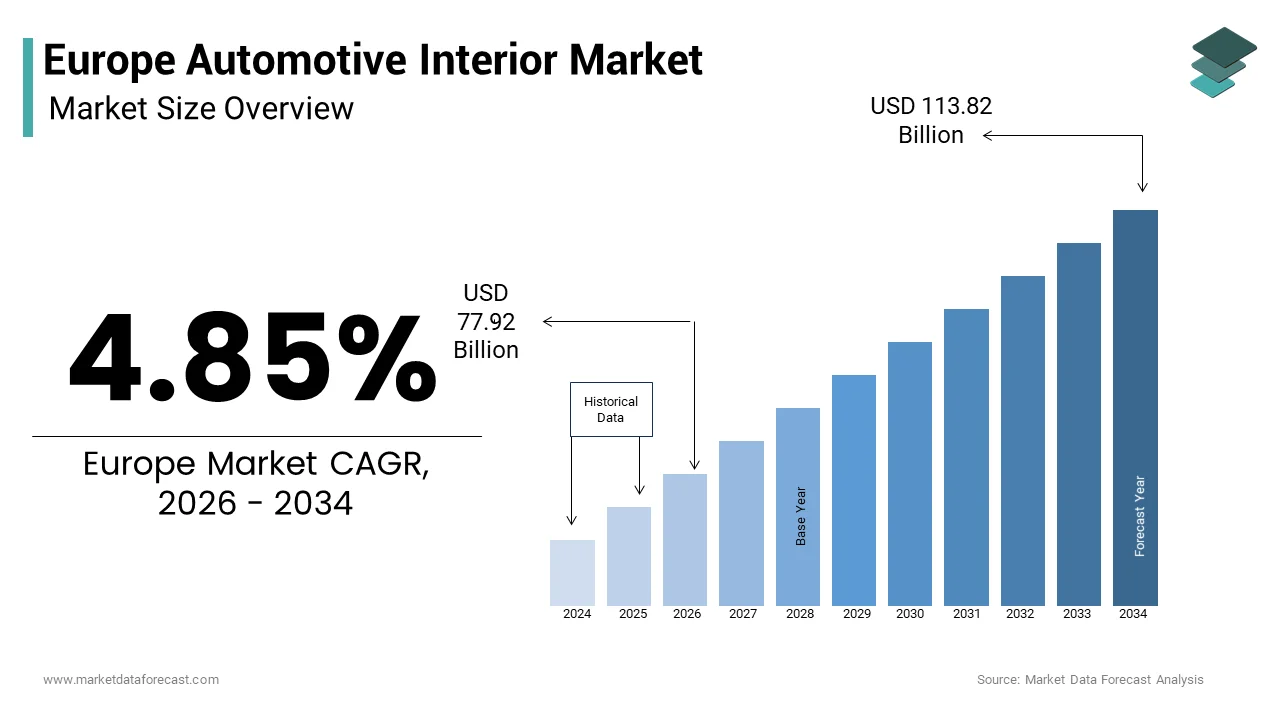
Automotive interiors are internal components within a vehicle cabin, including seating systems, dashboard modules, door panels, carpets, headliners, and cockpit electronics. This sector has evolved from purely functional assembly to a critical differentiator in vehicle branding, focusing on user experience, comfort, and aesthetic appeal. The interior is increasingly viewed as a third living space, particularly with the advent of autonomous driving technologies, which allow occupants to engage in activities beyond driving. According to the European Automobile Manufacturers Association, the European Union produced approximately 12.2 million units of passenger cars in 2023, providing a substantial baseline for interior component demand. As per the European Automobile Manufacturers Association, the average age of passenger cars in the European Union is 12.3 years, indicating a robust aftermarket for interior refurbishment and replacement parts. The shift towards electric vehicles has fundamentally altered interior architecture by eliminating transmission tunnels and allowing for more spacious and flexible cabin layouts. Regulatory frameworks, such as the European Green Deal, are pushing manufacturers towards sustainable materials and circular economy principles. Consequently, there is a growing emphasis on bio based polymers, recycled textiles, and low volatile organic compound emissions. The integration of advanced human machine interfaces further complicates the interior landscape, requiring seamless blending of hardware and software. This dynamic environment reflects a convergence of traditional craftsmanship and digital innovation, shaping the future of mobility experiences across the continent.
MARKET DRIVERS
Shift towards Premiumization and Personalized User Experience
The shift towards premiumization and personalized user experience is one of the significant factors driving the growth of the Europe automotive interiors market. Modern buyers perceive the vehicle interior as a reflection of their lifestyle and status, leading to higher expectations for material quality, customization, and comfort. According to a study by J.D. Power, interior design and quality are among the top factors influencing vehicle purchase decisions in Europe. As per a survey by McKinsey and Company, 60% of premium car buyers are willing to pay more for customized interior features, such as ambient lighting, bespoke upholstery, and advanced seating configurations. Automakers are responding by offering extensive option lists that allow customers to select from various leather grades, wood trims, and color schemes. The rise of direct to consumer sales models enables deeper engagement with customers, facilitating tailored interior packages. Furthermore, the integration of smart surfaces and haptic feedback controls enhances the perceived value of the cabin. Luxury brands are collaborating with high end fashion and furniture designers to create exclusive interior themes. This trend extends to mass market segments where manufacturers introduce premium touches to differentiate their models. The focus on wellness features, such as air purification systems and ergonomic seats, further drives demand. As vehicles become extensions of personal spaces, the emphasis on creating a unique and comfortable environment continues to propel growth in the interiors sector.
Adoption of Sustainable and Bio Based Materials
The adoption of sustainable and bio based materials is further contributing to the expansion of the Europe automotive interiors market. The European Union’s Circular Economy Action Plan mandates increased use of recycled content and reduction of waste in automotive manufacturing. According to the European Commission, a new proposal aims for a post-consumer recycled content target of 25% for plastics in new cars. As per a report by the Ellen MacArthur Foundation, major European manufacturers like BMW, Volvo, and Renault have committed to using recycled plastics, natural fibers, and vegan leather alternatives in their interior components. For instance, according to Volvo, the company aims for at least 25% of the plastic in its new cars to be made from recycled material by 2025. Consumers are increasingly environmentally conscious, with surveys indicating that 70% of European buyers prefer brands with strong sustainability credentials. This demand encourages innovation in materials, such as pineapple leaf fiber, cork, and mushroom based leathers. These bio based options offer comparable durability and aesthetics to traditional materials while reducing carbon footprints. Regulatory pressure combined with brand reputation management forces suppliers to develop eco-friendly solutions. The transition away from virgin plastics and animal derived leathers opens new supply chains and manufacturing processes. This strategic shift not only complies with legal requirements but also appeals to a growing segment of eco conscious consumers, thereby driving market expansion.
MARKET RESTRAINTS
Volatility in Raw Material Prices and Supply Chain Disruptions
Volatility in raw material prices and supply chain disruptions is hampering the growth of the Europe automotive interiors market. Interior components rely heavily on materials, such as polyurethane foam, plastics, metals, and textiles, which are subject to global price fluctuations. According to the European Chemical Industry Council, production in the European chemical industry faced a decline in 2023 as the sector added value reached 165 billion euros, reflecting a drop in its share of the European GDP to 0.96%. As per data from the German Association of the Automotive Industry, supply chain bottlenecks for semiconductors and electronic components have delayed the production of smart interior modules, such as digital cockpits and ambient lighting systems. These delays force manufacturers to halt assembly lines, resulting in lost revenue and increased inventory costs. The dependency on single source suppliers for specialized materials exacerbates vulnerability to disruptions. Additionally, logistical challenges, including port congestion and labor strikes in key transport hubs, further complicate material availability. Manufacturers struggle to pass these increased costs onto consumers in a competitive market, leading to compressed profit margins. The uncertainty surrounding raw material availability necessitates larger safety stocks, tying up capital. These financial and operational pressures hinder investment in new interior technologies and limit the ability of suppliers to innovate. Until supply chains become more resilient and stable, the market will face continued constraints on growth and efficiency.
Stringent Safety and Environmental Regulations
Stringent safety and environmental regulations is a significant restraint to the expansion of the Europe automotive interiors market. Interior components must meet rigorous standards for flammability, crashworthiness, and air quality to ensure occupant safety. According to the United Nations Economic Commission for Europe, Regulation No. 118 specifies the burning behavior of materials used in the interior construction of certain categories of motor vehicles. Compliance with these standards often requires expensive flame retardants and specialized testing procedures. As per the European Environment Agency, battery electric vehicle and plug in hybrid registrations in the EU reached approximately 2.2 million units in 2024, necessitating new material compliance for electrified cabins. These restrictions force manufacturers to reformulate products and adopt alternative bonding technologies, which can be costlier and less effective. The introduction of new safety features, such as advanced airbag systems integrated into seats and dashboards, adds complexity to interior design. Engineers must balance aesthetic goals with structural requirements, ensuring that decorative elements do not interfere with safety mechanisms. The need for continuous monitoring and certification of materials increases development time and costs. Small and medium sized suppliers may lack the resources to keep pace with evolving regulatory landscapes, leading to market consolidation. These regulatory burdens create barriers to entry and slow down the introduction of innovative interior concepts. Manufacturers must navigate this complex web of requirements while maintaining competitiveness and profitability.
MARKET OPPORTUNITIES
Integration of Smart Surfaces and Haptic Technologies
Integration of smart surfaces and haptic technologies is offering a promising growth opportunity for the Europe automotive interiors market. Smart surfaces combine touch sensors, displays, and lighting into seamless panels, replacing traditional buttons and switches. According to Continental, the company is developing integrated cockpit solutions where touch sensitive surfaces provide tactile feedback, ensuring higher safety and intuitive use. As per data from major suppliers, haptic feedback systems provide tactile responses to touch inputs, improving usability and safety by reducing driver distraction. These technologies allow for dynamic reconfiguration of controls based on driving modes or user preferences. For example, a door panel can transform into a control center for windows, mirrors, and media when touched. The aesthetic appeal of uninterrupted surfaces aligns with modern minimalist design trends. Furthermore, smart surfaces enable weight reduction by eliminating mechanical components, contributing to improved vehicle efficiency. The ability to update software allows for new functionalities to be added post purchase, creating recurring revenue streams. Automakers leverage these innovations to differentiate their brands and attract tech savvy consumers. The convergence of interior design and digital technology opens new avenues for creativity and functionality. This trend supports the evolution of the vehicle interior into a responsive and adaptive environment.
Expansion of Modular and Flexible Interior Architectures
Expansion of modular and flexible interior architectures is another significant opportunity for the expansion of the Europe automotive interiors market. Electric vehicle platforms lack traditional engine and transmission components, allowing for flat floors and reconfigurable cabin layouts. According to the European Environment Agency, battery electric vehicles accounted for 13.6% of total new car registrations in the European Union during 2024. As per reports from automotive designers, modular seating systems enable users to rotate, swivel, or remove seats to create lounge, meeting, or cargo spaces. This flexibility enhances the utility of vehicles for diverse purposes, such as ride sharing, mobile offices, or family travel. Manufacturers are developing standardized interior modules that can be easily swapped or upgraded, extending vehicle lifespan and reducing waste. The concept of software defined vehicles extends to interiors, where digital features can be customized via over the air updates. Collaborations with technology firms enable integration of augmented reality heads up displays and immersive entertainment systems. These advancements appeal to younger demographics who value versatility and connectivity. Modular designs also simplify manufacturing and repair processes, lowering costs for producers and consumers. By embracing flexibility, automakers can create multifunctional spaces that adapt to changing lifestyle needs. This approach positions interior innovation as a key value proposition in the future mobility ecosystem.
MARKET CHALLENGES
Complexity of Integrating Advanced Electronics
Complexity of integrating advanced electronics is a key challenge to the growth of the Europe automotive interiors market. Modern vehicles contain numerous sensors, cameras, and processors embedded in seats, dashboards, and door panels, requiring sophisticated wiring and cooling solutions. According to the Society of Motor Manufacturers and Traders, the increasing electronic content in modern vehicles is driving more complex electrical architectures to manage integrated infotainment and safety systems. As per industry analysis, heat management for high performance processors in confined spaces poses engineering challenges, risking component failure and safety issues. The integration of large displays and projection systems requires precise alignment and calibration, increasing production time and costs. Compatibility issues between hardware from different suppliers and software platforms can lead to system glitches and user dissatisfaction. Ensuring electromagnetic compatibility between electronic components and other vehicle systems is critical to prevent interference. The rapid pace of technological obsolescence means that interior electronics may become outdated faster than the vehicle itself, leading to consumer frustration. Manufacturers must invest heavily in research and development to create robust and scalable integration strategies. Skilled labor shortages in electronics assembly further exacerbate these challenges. Balancing aesthetic design with technical functionality requires close collaboration between designers, engineers, and software developers. Failure to address these integration complexities can result in recalls and reputational damage.
High Costs of Innovation and Development
High costs of innovation and development is another significant challenge to the Europe automotive interiors market. Developing advanced interior technologies, such as augmented reality displays, biometric sensors, and sustainable materials, requires substantial investment in research and prototyping. According to the European Automobile Manufacturers Association, the automotive industry is the number one R&D investor in the EU, with an annual spend of 73 billion euros representing 33% of the total EU R&D expenditure. As per data from financial institutions, small and medium sized suppliers often lack the financial resources to invest in cutting edge technologies, relying instead on established methods. This disparity leads to market consolidation where larger players dominate innovation. The long development cycles for vehicle interiors, typically spanning three to five years, mean that investments must be made well before market trends are fully visible. Misjudging consumer preferences can result in costly redesigns or unsold inventory. Additionally, the need for specialized tooling and manufacturing equipment for new materials adds to capital expenditures. Regulatory compliance testing further increases development costs and timelines. Manufacturers face pressure to reduce prices while delivering higher value, creating a squeeze on margins. The financial burden of continuous innovation restricts the pace of adoption for new interior concepts. Companies must balance investment risks with potential returns to remain competitive in a rapidly evolving market.
REPORT COVERAGE
| REPORT METRIC | DETAILS |
| Market Size Available | 2025 to 2034 |
| Base Year | 2025 |
| Forecast Period | 2026 to 2034 |
| CAGR | 4.85% |
| Segments Covered | By Component, Vehicle Type, and Country. |
|
Various Analyses Covered | Global, Regional, and country Analysis, Segment-Level Analysis, DROC, PESTLE Analysis, Porter’s Five Forces Analysis, Competitive Landscape, Analyst Overview of Investment Opportunities |
| Regions Covered | North America, Europe, APAC, Latin America, Middle East & Africa |
|
Market Leaders Profiled | Continental AG, Ford Corporation, Delphi Automotive Plc, Faurecia S.A., Robert Bosch GmbH, Grupo Antolin, Adient Plc, Lear Corporation, Magna International, Inc., Panasonic Corporation, Hyundai Mobis Co. Ltd, Toyota Corporation, and Others. |
SEGMENTAL ANALYSIS
By Vehicle Insights
The passenger cars segment dominated the market by accounting for 81.8% of the European market share in 2025. The dominance of passenger cars segment in this regional market can be credited to the high volume of passenger vehicle production and the intense consumer focus on interior aesthetics, comfort, and technology in personal transportation. According to the European Automobile Manufacturers Association, passenger car production in the European Union reached 12.2 million units in 2023, creating a massive demand base for interior components. As per data from automotive analysts, interior quality and design are major factors influencing purchase decisions for European car buyers, prompting manufacturers to invest heavily in premium materials and advanced features. The trend towards premiumization in the mass market segment further boosts demand for sophisticated seating systems, ambient lighting, and digital cockpits. Consumers are willing to pay extra for customized interiors that reflect their personal style and enhance driving comfort. The rapid adoption of electric vehicles, which often feature redesigned interiors with sustainable materials and spacious layouts, also contributes to this dominance. Additionally, the aftermarket for passenger car interiors remains robust due to the aging vehicle parc in Europe. The continuous innovation in user experience and connectivity within passenger vehicles ensures that this segment remains the primary driver of growth and revenue in the automotive interiors market.
However, the commercial vehicles segment is projected to grow at a CAGR of 6.5% over the forecast period. The surge in online shopping has increased demand for last mile delivery vans and heavy duty trucks requiring durable and ergonomic interiors to support driver productivity and safety. According to the European Automobile Manufacturers Association, 2.7 million commercial vehicles were produced in the European Union in 2023, marking an increase of 20.3% compared to 2022. As per logistics industry observations, companies are increasingly investing in driver comfort and connectivity features to attract and retain talent in a tight labor market. Modern commercial vehicle interiors now include advanced infotainment systems, ergonomic seats, and sleep cabins for long haul drivers. Regulatory pressures regarding driver working hours and safety standards also mandate improved interior environments. The shift towards electric commercial vehicles introduces new interior architectures with flat floors and modular designs, enhancing usability. Fleet operators recognize that better interiors lead to higher driver satisfaction and reduced turnover. Furthermore, the integration of telematics and digital interfaces in commercial vehicles supports efficient fleet management. These factors collectively accelerate the growth of the commercial vehicle interiors segment, outpacing the mature passenger car market.
By Component Insights
The instrument panels segment led the market by capturing 36.3% of the European market share in 2025. This dominance is attributed to the central role of instrument panels in housing critical driver information displays, controls, and safety systems. According to industry analysis, the instrument panel integrates multiple components, including digital clusters, heads up displays, and airbag modules, making it one of the most complex and expensive interior assemblies. As per data from major suppliers, the trend towards fully digital cockpits has increased the value content of instrument panels significantly. Modern panels feature large, high resolution screens that serve as the primary interface for vehicle functions, navigation, and entertainment. The integration of advanced driver assistance systems requires precise placement of sensors and cameras within the panel structure. Consumers perceive the instrument panel as the focal point of the cabin, influencing their overall impression of vehicle quality and technology. Automakers invest heavily in designing sleek and intuitive panels that enhance user experience and brand identity. The shift towards software defined vehicles allows for customizable display layouts, further increasing the importance of this component. The complexity of manufacturing and the high value of integrated electronics ensure that instrument panels remain the leading component segment in terms of revenue and strategic importance.
On the other end, the interior lighting segment is estimated to witness strong growth and record a CAGR of 10.5% over the forecast period. Ambient lighting has evolved from a luxury feature to a standard element in many mid-range vehicles, enhancing the aesthetic appeal and mood of the interior. According to automotive lighting specialists, the adoption of LED and OLED lighting technologies in automotive interiors is accelerating due to their energy efficiency, design flexibility, and dynamic capabilities. As per data from lighting suppliers, multi color ambient lighting systems allow users to customize the cabin atmosphere according to their preferences or driving modes. These systems can interact with other vehicle features, such as music playback, navigation alerts, and safety warnings, creating an immersive environment. The rise of electric vehicles with minimalist interiors relies heavily on lighting to define spaces and add visual interest. Regulatory standards for interior visibility and safety also support the adoption of advanced lighting solutions. Manufacturers use lighting to differentiate brands and create signature design elements. The ability to update lighting patterns via software updates adds long term value for consumers. This combination of aesthetic enhancement, functional utility, and technological innovation drives the rapid expansion of the interior lighting segment.
COUNTRY-LEVEL ANALYSIS
Germany Automotive Interiors Market Analysis
Germany was the largest national market for automotive interiors in Europe and accounted for 25.1% of the European market share in 2025 due to its robust automotive manufacturing base and the presence of global premium brands, such as BMW, Mercedes-Benz, and Audi, which set high standards for interior quality and innovation. According to the European Environment Agency, Germany accounted for more than 500,000 new battery electric vehicle registrations in 2023, maintaining its position as a major market for electrified vehicle interiors. As per data from the Federal Motor Transport Authority, German consumers prioritize interior comfort and technology, influencing manufacturers to introduce cutting edge features early in this market. The presence of major interior suppliers fosters a strong local supply chain and innovation ecosystem. Government incentives for electric vehicles accelerate the adoption of new interior architectures tailored for electric platforms. The strong engineering culture in Germany supports the development of complex integrated systems, such as smart surfaces and haptic feedback controls. High disposable income levels enable consumers to opt for premium interior packages. Germany’s role as a technology hub ensures it remains at the forefront of interior design trends and manufacturing excellence in the region.
France Automotive Interiors Market Analysis
France had the second largest position in the Europe automotive interiors market in 2025 and the market is expected to expand through a focus on stylish and eco friendly designs. French manufacturers, such as Renault, Peugeot, and Citroen, emphasize stylish and eco friendly interiors, appealing to environmentally conscious consumers. According to the European Environment Agency, France registered over 300,000 new battery electric vehicle units in 2024, showcasing a strong shift toward modern powertrain interiors. As per data from the National Institute of Statistics and Economic Studies, French consumers show a high preference for aesthetic appeal and comfort in vehicle interiors. The government’s strict environmental regulations encourage the use of bio based materials and low emission components in interior manufacturing. France is home to several specialized suppliers of textiles and plastics, contributing to the local supply chain. The popularity of compact electric vehicles in urban areas drives demand for space efficient and versatile interior solutions. Collaborations between automotive brands and fashion designers enhance the perceived value of French car interiors. The strong aftermarket sector also supports the demand for interior upgrades and replacements. France’s commitment to design excellence and sustainability ensures its prominent position in the regional market.
United Kingdom Automotive Interiors Market Analysis
The United Kingdom is estimated to account for a promising share of the Europe automotive interiors market during the forecast period. The UK is expected to see a steady increase in demand for advanced digital interfaces and sustainable materials. The UK is home to prestigious brands, such as Aston Martin, Bentley, and Rolls-Royce, which demand bespoke and high quality interior components. According to the Society of Motor Manufacturers and Traders, British manufacturers produced over 900,000 passenger cars and commercial vehicles in 2023, supporting the domestic interior component sector. As per data from industry analysts, British consumers are among the highest spenders on optional interior extras in Europe, including premium audio systems and custom upholstery. The presence of specialized suppliers and design studios supports the production of unique and high end interior solutions. The shift towards electric vehicles among luxury brands in the UK accelerates the adoption of sustainable materials and advanced digital interfaces. Regulatory support for connected car technologies facilitates the integration of smart interior features. The strong cultural appreciation for automotive heritage and design influences interior trends. Despite economic challenges, the demand for premium interiors remains resilient among affluent buyers. The UK’s influence on global luxury automotive trends ensures its continued relevance in the market.
Italy Automotive Interiors Market Analysis
Italy occupies a key position in the Europe automotive interiors market and the region is expected to maintain its status through a synergy of heritage and innovation. Italian automakers, like Ferrari, Lamborghini, and Maserati, collaborate with renowned design houses to create iconic and high performance interiors. According to the European Automobile Manufacturers Association, new car registrations in Italy jumped by 18.9% in 2023, indicating a strong recovery in the domestic vehicle market. As per data from Confindustria, the Italian automotive components sector is known for its high quality leather upholstery and custom trim work. Italian consumers value aesthetics and brand prestige, leading to a preference for visually striking and luxurious interiors. The presence of skilled artisans and specialized manufacturers supports the production of high end interior components. The tourism sector also influences the market as rental agencies equip vehicles with premium interiors to attract international visitors. Government incentives for sustainable mobility encourage the adoption of eco friendly materials in new models. Italy’s reputation for design and craftsmanship enhances the appeal of its automotive interiors globally. The synergy between automotive and fashion industries creates unique value propositions. This combination of heritage and innovation sustains Italy’s significant role in the regional market.
Spain Automotive Interiors Market Analysis
Spain is expected to grow at a CAGR of 7.2% during the forecast period. Spanish plants produce a significant volume of vehicles for major European brands, driving demand for interior components. According to the European Automobile Manufacturers Association, new car registrations in Spain grew by 16.7% in 2023, with over 940,000 units sold. As per data from the Ministry of Industry, Spanish consumers are increasingly interested in technology and connectivity features in their vehicles. The government’s support for electric mobility promotes the development of new interior architectures suited for electric platforms. The presence of international suppliers in Spain facilitates access to advanced interior technologies. The tourism industry contributes to the demand for rental vehicles with comfortable and well equipped interiors. Economic recovery and rising disposable incomes boost sales of new vehicles with upgraded interior packages. Spain’s strategic location and manufacturing capabilities make it an important hub for interior component production. The focus on value and functionality aligns with the preferences of the mass market. This dynamic environment ensures Spain’s steady growth in the regional automotive interiors landscape.
COMPETITIVE LANDSCAPE
The competition in the Europe automotive interiors market is intense characterized by established global suppliers and specialized regional manufacturers striving for technological leadership. Major players differentiate themselves through innovation in sustainable materials smart surfaces and integrated cockpit solutions. The shift towards electric and autonomous vehicles has intensified rivalry as companies develop flexible and modular interior architectures. Price pressure in the mass market segment forces manufacturers to optimize costs while maintaining high quality standards. Collaboration with technology firms for digital integration and connectivity features is a common strategy to enhance product offerings. Regulatory compliance regarding safety and environmental standards adds complexity to product development cycles. Companies that successfully balance innovation cost efficiency and sustainability tend to secure stronger positions. Continuous adaptation to changing consumer preferences and automotive trends is essential for sustaining competitiveness. The market sees frequent mergers and acquisitions as firms seek to expand their capabilities and geographic reach. Overall the landscape is dynamic with continuous evolution driven by technological advancements and regulatory changes.
KEY MARKET PLAYERS
These are the market players that are dominating the Europe automotive interior market.
- Continental AG
- Ford Corporation
- Yanfeng
- Delphi Automotive Plc
- Faurecia S.A.
- Robert Bosch GmbH
- Grupo Antolin
- Adient Plc
- Lear Corporation
- Magna International, Inc.
- Panasonic Corporation
- Hyundai Mobis Co. Ltd
- Toyota Corporation
Top Players In The Market
- Forvia SE stands as a global leader in automotive interiors formed by the merger of Faurecia and Hella. The company specializes in seating systems instrument panels and interior lighting solutions for major European automakers. Forvia recently launched its Smart Surfaces technology which integrates touch controls and haptic feedback into door panels and dashboards. This innovation enhances user experience while reducing physical buttons. The company invests heavily in sustainable materials including recycled plastics and bio based fabrics to meet environmental regulations. Forvia also expands its production capacity for electric vehicle components ensuring alignment with industry trends. Their comprehensive portfolio allows them to offer complete cockpit solutions. Strategic partnerships with technology firms enable advanced digital integration. These actions strengthen their position as a key supplier of innovative and eco friendly interior systems across the European market.
- Yanfeng is a prominent player in the Europe automotive interiors market known for its smart cabin solutions and modular design capabilities. The company provides integrated cockpits door modules and seating systems to global original equipment manufacturers. Yanfeng recently introduced its XiM23s concept car showcasing flexible seating arrangements and immersive display technologies. This demonstration highlights their focus on autonomous driving interiors. The company emphasizes lightweight construction techniques to improve vehicle efficiency and reduce emissions. Yanfeng also develops sustainable interior materials such as plant based leather alternatives. Their global manufacturing footprint ensures reliable supply chains for European clients. By focusing on user centric design and technological integration Yanfeng strengthens its competitive edge. Collaborations with software developers enhance the digital experience within vehicle cabins. These initiatives solidify Yanfeng’s reputation as an innovator in next generation automotive interior solutions.
- Adient plc is a leading supplier of automotive seating systems which constitute a significant portion of vehicle interior value. The company serves most major automakers in Europe with advanced seating technologies that enhance comfort and safety. Adient recently expanded its production of lightweight seating structures to support electric vehicle efficiency goals. The company integrates sensors into seats for health monitoring and occupancy detection improving safety features. Adience also focuses on sustainable manufacturing processes using recycled materials and energy efficient production methods. Their modular seating designs allow for flexible cabin configurations in autonomous vehicles. Adient collaborates with technology partners to develop smart seating solutions with haptic feedback. These innovations address the growing demand for personalized and comfortable driving experiences. By prioritizing sustainability and technological advancement Adient maintains its strong presence in the European automotive interiors market.
Top Strategies Used by Key Market Participants
Key players in the Europe automotive interiors market primarily focus on innovation in sustainable materials and smart surface technologies. Companies invest heavily in research and development to create eco friendly components using recycled and bio based resources. Integration of digital interfaces and haptic feedback systems enhances user experience and safety. Strategic partnerships with technology firms facilitate the development of connected cabin solutions. Manufacturers prioritize lightweight designs to improve vehicle efficiency and meet emission standards. Modular interior architectures allow for flexible configurations suited to electric and autonomous vehicles. Expansion of local production facilities ensures supply chain resilience and reduces logistical costs. Customization options cater to diverse consumer preferences and brand differentiation needs. These strategies collectively drive growth and competitiveness in a rapidly evolving industry landscape
MARKET SEGMENTATION
This research report on the Europe automotive interior market is segmented and sub-segmented into the following categories.
By Component
- Infotainment System
- Cockpit Module
- Central Console
- Door Panel
- Dome Module
- Headliner
- Interior Lighting
- Seats
By Vehicle Type
- Passenger Vehicles
- Light Commercial Vehicles
- Heavy Commercial Vehicles
By Country
- UK
- Russia
- Germany
- Italy
- France
- Spain
- Sweden
- Denmark
- Poland
- Switzerland
- Netherlands
- Rest of Europe