- Product Description Description
- Table of Contents TOC
- List of Table & Figure LOT
- Get Free Sample PDF Sample PDF
Market Size, 2025
$11.91 BnMarket Estimate, 2026
$14.14 BnMarket Forecast, 2034
$55.71 BnCAGR, 2026–2034
18.7%Executive Summary: Europe Automotive RADAR Market
- Market Scope: Comprehensive regional analysis of the Europe automotive radar market covering ranges (short-range, long-range), applications (adaptive cruise control, blind-spot detection), vehicle types (passenger cars, commercial vehicles), and country-level developments across Germany, France, the UK, Italy, Sweden, and more.
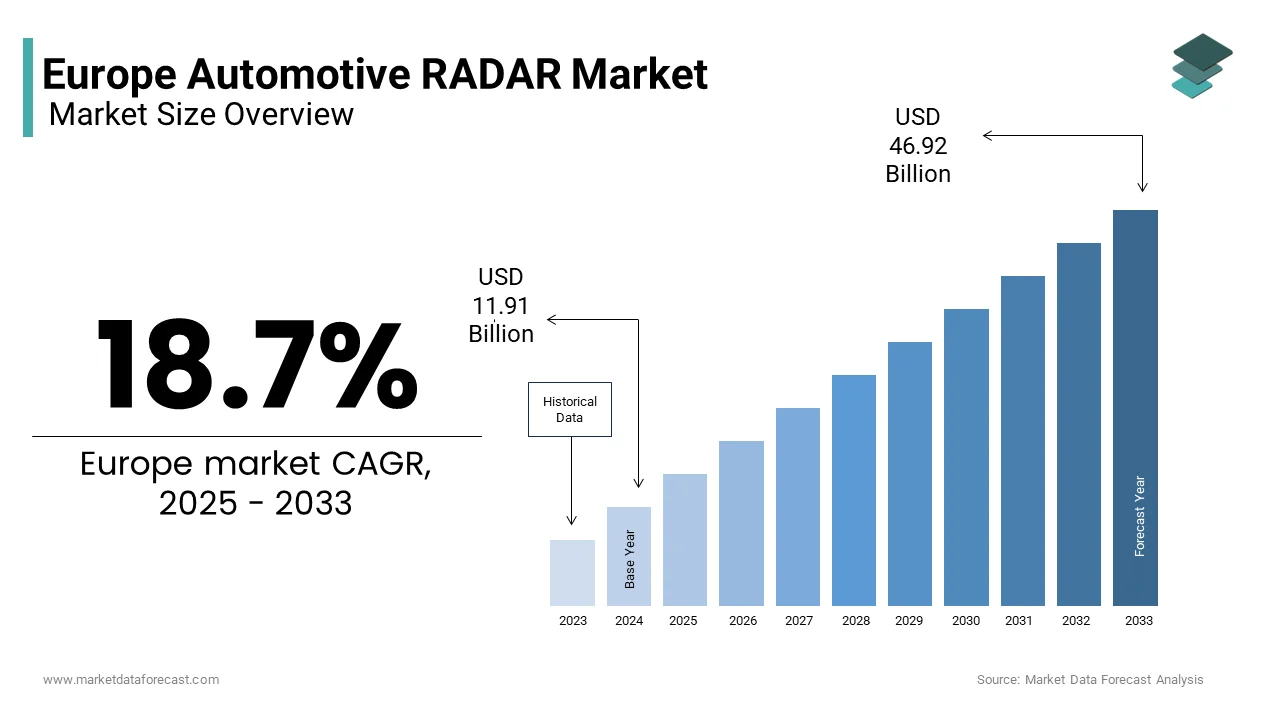
- Market Valuation: Valued at USD 11.91 billion in 2025, reaching USD 14.14 billion in 2026, and projected to hit USD 55.71 billion by 2034, registering a robust CAGR of 18.7% from 2026 to 2034.
- Primary Growth Drivers: Accelerated integration of radar systems driven by the European Union’s General Safety Regulation (GSR) mandates and the expansion of automated lane-keeping systems (ALKS). Key restraints include high system integration costs for budget vehicles and spectrum allocation uncertainties.
Key Market Segment Metrics (2026–2034)
| Category | Leading Segment (2025 Position) | Fastest-Growing Segment |
|---|---|---|
| By Range | Short-Range Radar (occupied 45.4% share in 2025 due to surround-sensing mandates, blind-spot detection, and rear cross-traffic alert requirements) | Long-Range Radar (projected to witness the highest CAGR of 13.08% driven by highway automated driving and ALKS integration) |
| By Application | Adaptive Cruise Control (held 30.8% share in 2025, standardized across mid- and premium-tier vehicle trims) | Blind-Spot Detection (projected to grow at a CAGR of 14.4% spurred by mandatory compliance under EU General Safety Regulations) |
| By Vehicle Type | Passenger Cars (captured the highest market share in 2025 supported by rigorous safety and CO2 fleet standards) | Commercial Vehicles (projected to register a CAGR of 16.6% driven by phased regulatory rollouts for heavy trucks and light commercial vehicles) |
| By Region / Country | Germany (leads the European landscape due to premium OEM concentration, strong regulatory enforcement, and advanced R&D ecosystems) | Sweden & France (exhibiting strong momentum backed by Vision Zero safety goals and comprehensive smart infrastructure initiatives) |
Major Market Participants & Market Structure
Market Structure: Highly competitive, technology-driven landscape characterized by deep OEM integration, strict functional safety protocols (ISO 21448 SOTIF), and strategic partnerships between tier-1 suppliers and semiconductor giants.
Key Companies: Continental AG, HELLA KGaA, Robert Bosch GmbH, Delphi Automotive PLC, NXP Semiconductors NV, Valeo SA, Autoliv Inc., Infineon Technologies AG, Denso Corporation, and Texas Instruments, Inc.
Europe Automotive RADAR Market Size
The Europe automotive radar market size was valued at USD 11.91 billion in 2025 and is anticipated to reach a valuation of USD 14.14 billion in 2026 and USD 55.71 billion by 2034, growing at a CAGR of 18.7% from 2026 to 2034.
Current Introduction of the Europe Automotive Radar Market
Automotive radar systems are sensor technologies that use radio waves to detect objects, distance, speed,, ed and angle relative to a vehicle, enabling advanced driver assistance and automated driving functions. In Europe, these systems are integral to safety and automation mandates across passenger and commercial vehicles. According to the European Commission, the vast majority of new cars registered in the European Union in 2024 were equipped with radar-based safety features such as automatic emergency braking or blind spot detection. According to the European Environment Agency, road traffic accounted for 21% of the EU’s total carbon dioxide emissions in 2023, which indicates the urgency for intelligent mobility solutions that enhance efficiency and reduce accidents. The European New Car Assessment Programme has made radar-dependent systems like lane keeping assist and rear cross traffic alert essential for achieving five-star safety ratings. With the EU General Safety Regulation requiring autonomous emergency braking for all new vehicle types from July 2024, radar adoption has transitioned from optional to foundational, which is positioning Europe as a regulatory and technological vanguard in automotive sensing.
MARKET DRIVERS
Mandatory Safety Regulations Accelerate Radar Integration Across Vehicle Segments
The European Union’s General Safety Regulation (Regulation (EU) 2019/2144) has made advanced driver assistance systems compulsory for all new vehicle type approvals since July 2022, with full fleet compliance required by 2024, which is one of the key factors driving the automotive radar market growth in Europe. According to the European Commission, mandated features include autonomous emergency braking, vulnerable road user detection, and drowsiness recognition, all of which rely on radar for all‑weather functionality. ETSC (European Transport Safety Council) reports that radar‑equipped vehicles demonstrated a ~30% reduction in rear‑end collisions and a ~25–27% decline in pedestrian incidents between 2020 and 2023. The regulation applies uniformly to passenger cars, light commercial vehicles, and heavy trucks to ensure radar deployment across diverse vehicle classes. Volkswagen, BMW, and Stellantis have confirmed that every new model launched in Europe since January 2024 includes at least three radar sensors as standard. This regulatory enforceability eliminates consumer optionality and guarantees baseline demand irrespective of market cycles or brand positioning, creating a structural floor for radar adoption across the automotive ecosystem.
Expansion of Automated Lane Keeping Systems Drives Demand for High‑Resolution Radar
The approval of Automated Lane Keeping Systems (ALKS) under UN Regulation No. 157 has catalyzed demand for next‑generation radar with enhanced angular resolution and object classification capabilities, which is further boosting the European automotive radar market expansion. According to UNECE and EU cybersecurity agencies, ALKS operating up to 60 km/h are now permitted on motorways in Germany, France, and the Netherlands, provided they meet stringent sensor redundancy requirements. These systems require at least four corner radars and one front long‑range unit to maintain situational awareness during hands‑off driving. As per the German Federal Motor Transport Authority (KBA), more than 470,000 vehicles with Level 2+ automation were registered in Germany in 2024, marking a 74% year‑on‑year increase. Radar is favored over camera‑only systems due to its reliability in low‑visibility conditions such as fog, snow, or heavy rain—weather events that occur on average 80–90 days per year across Central Europe, according to ECMWF (European Centre for Medium‑Range Weather Forecasts). This operational necessity positions radar not as a supplementary sensor but as a non‑negotiable core component in the architecture of conditionally automated vehicles.
MARKET RESTRAINTS
High System Integration Costs Constrain Radar Adoption in Entry‑Level Vehicles
Despite regulatory mandates, the cost of integrating multiple radar units remains a barrier for budget‑oriented vehicle segments, particularly in Southern and Eastern Europe. ACEA (European Automobile Manufacturers Association) estimates that the average bill of materials for a full radar suite exceeds €200–220 per vehicle. For entry‑level models with production margins below 5%, this represents substantial cost pressure. In 2023, Dacia and Skoda delayed radar inclusion in certain base trims in Romania and Poland, citing affordability concerns (Bloomberg reporting). Although the General Safety Regulation requires radar functionality, manufacturers exploit loopholes by using mono‑camera systems for pedestrian detection in low‑speed scenarios where radar is less critical. According to the European Commission’s Joint Research Centre, only ~68% of A‑segment vehicles sold in the EU in 2024 featured full radar suites compared to ~99% in D and E segments. This tiered implementation undermines the universality of safety benefits and slows the economies of scale needed to drive down component costs.
Spectrum Allocation Uncertainty Impedes Next‑Generation Radar Development
The future of high‑performance automotive radar in Europe is contingent on stable and harmonized spectrum access, particularly around the 79 GHz band, which offers superior resolution for short‑range applications and is further hindering the European automotive radar market growth. According to ETSI, overlapping interests from the satellite and defense sectors have delayed full allocation. While CEPT (European Conference of Postal and Telecommunications Administrations) designated 77–81 GHz for automotive use in 2023, national regulators in France and Italy imposed stricter power emission limits to protect adjacent services. As per the ESA (European Space Agency), these restrictions reduce effective detection range by up to 15 meters, compromising performance in urban environments. Moreover, the lack of global harmonization forces suppliers such as Bosch and Continental to maintain dual product lines, increasing R&D overhead. Until spectrum policy achieves full regulatory coherence and international alignment, deployment of next‑generation imaging radar will remain fragmented and cost‑inefficient across the European market.
MARKET OPPORTUNITIES
Retrofitting Legacy Fleets Creates New Aftermarket Radar Opportunities
With over 260 million passenger cars in circulation across the EU (Eurostat, 2024) and average vehicle age exceeding 12 years in countries such as Italy and Greece, a vast retrofit market is emerging for radar‑based safety upgrades, which is a prominent opportunity in the European automotive radar market. Unlike new vehicles, aftermarket adoption is driven by insurance incentives and fleet operator mandates rather than regulation. According to the European Insurance and Reinsurance Federation, commercial fleets that install blind‑spot radar systems can receive liability premium discounts of up to 15%. In 2024, Sweden’s Road Administration launched a pilot program subsidizing radar retrofits for elderly drivers, reducing collision rates by 22% within six months. Companies such as Valeo and Hella now offer modular radar kits compatible with older vehicle architectures, enabling lane‑change assist and rear cross‑traffic alerts without ECU overhauls. This aftermarket channel extends radar penetration beyond new car cycles and generates recurring revenue through software updates and calibration services, diversifying business models for sensor suppliers beyond OEM dependency.
Integration with V2X Infrastructure Enables Cooperative Perception Capabilities
The convergence of automotive radar with vehicle‑to‑everything (V2X) communication networks is unlocking cooperative perception, where radar data is shared between vehicles and roadside units to extend situational awareness beyond line of sight. According to the European Commission, the Corridors for Connected and Automated Driving initiative has equipped more than 12,000 km of the Trans‑European Transport Network with C‑V2X infrastructure by early 2025. In Germany, the A9 motorway features radar‑enabled roadside units that detect stalled vehicles and transmit alerts to approaching cars up to 300 meters ahead (German Aerospace Center). Similarly, in the Netherlands, the Smart Highway project integrates radar and 5G to warn drivers of wildlife crossings, reducing animal‑related accidents by 38% in 2024 (Dutch Ministry of Infrastructure). This sensor‑network approach transforms individual radar units from isolated detectors into nodes in a collective intelligence system, significantly enhancing safety in complex scenarios such as intersections and highway merges where occlusions are common.
MARKET CHALLENGES
Performance Degradation in Adverse Weather Remains a Persistent Technical Limitation
Although radar outperforms cameras in rain, fog, and snow, its effectiveness is not immune to environmental interference, particularly at higher frequencies, which is a key challenge to the growth of the European automotive radar market. Fraunhofer Institute research shows that heavy rainfall above 50 mm/hour can attenuate 77 GHz signals by up to 8 dB, reducing detection range by nearly 25%. In Nordic regions, where snow accumulation on radar housings is frequent, the Swedish National Road and Transport Research Institute reported that unheated sensors lost functionality in 76% of winter storm events in 2023. Manufacturers deploy hydrophobic coatings and thermal management systems, but these add cost and complexity. Moreover, dense urban canyons with reflective surfaces cause multipath interference, leading to false object detection, as confirmed by real‑world testing at the Technical University of Munich. Until these physical‑layer limitations are resolved through advanced signal processing or sensor‑fusion architectures, radar reliability in extreme conditions will remain a critical constraint for higher levels of automation.
Supply Chain Vulnerabilities in Semiconductor Sourcing Threaten Production Continuity
The automotive radar market faces significant supply chain risk due to dependence on specialized RF semiconductors, primarily gallium arsenide and silicon‑germanium chips, which further challenge the expansion of the European automotive radar market. According to the European Semiconductor Industry Association, more than 85% of these components are sourced from a concentrated set of suppliers in Germany, the US, and Japan. The 2022 chip shortage caused radar production delays across major European OEMs, with BMW and Renault reporting line stoppages averaging 11 days per plant (ECB data). Although the EU Chips Act allocated €43 billion to bolster domestic semiconductor capacity (European Commission, 2023), most investments target logic and memory chips, not analog RF components. Infineon Technologies reports that lead times for automotive‑grade radar MMICs remain at ~28 weeks in early 2025, far exceeding the industry’s 12‑week target. This structural fragility exposes the radar market to geopolitical disruptions, trade restrictions, and capacity bottlenecks that could impede the very safety systems Europe’s regulatory framework now mandates.
REPORT COVERAGE
| REPORT METRIC | DETAILS |
| Market Size Available | 2025 to 2034 |
| Base Year | 2025 |
| Forecast Period | 2026 to 2034 |
| CAGR | 18.7% |
| Segments Covered | By Range, Application, Vehicle Type, and Region. |
| Various Analyses Covered | Global, Regional, and Country-Level Analysis, Segment-Level Analysis, DROC, PESTLE Analysis, Porter’s Five Forces Analysis, Competitive Landscape, Analyst Overview of Investment Opportunities |
| Regions Covered | North America, Europe, APAC, Latin America, Middle East & Africa |
| Market Leaders Profiled | Continental AG (Germany), HELLA KGaA (Germany), Robert Bosch GmbH (Germany), Delphi Automotive PLC (United Kingdom), NXP Semiconductors NV (Netherlands), Valeo SA (France), Autoliv Inc. (Sweden), Infineon Technologies AG (Germany), Denso Corporation, Texas Instruments, Inc., and Others. |
SEGMENTAL ANALYSIS
By Range Insights
The short‑range radar segment occupied 45.4% of the European automotive radar market share in 2025. The dominance of short range radar segment in this regional market is driven by the regulatory mandates and the proliferation of surround‑sensing applications in both entry‑level and premium vehicles. The EU General Safety Regulation (GSR) explicitly requires blind spot detection and rear cross traffic alert systems for all new vehicle type approvals from July 2024. As per the European Commission, these functions rely primarily on short‑range radar operating at 77–81 GHz due to its wide field of view and high angular resolution at close distances. Vehicles typically require four short‑range units to meet coverage standards. According to Euro NCAP, vehicles without such systems are capped at a maximum of four safety stars regardless of other features. This has compelled even budget brands like Dacia and Fiat to integrate short‑range radar as standard equipment. According to the German Federal Motor Transport Authority, 98% of new cars registered in Germany in 2024 included at least four short‑range sensors, reflecting near‑universal compliance across the region.
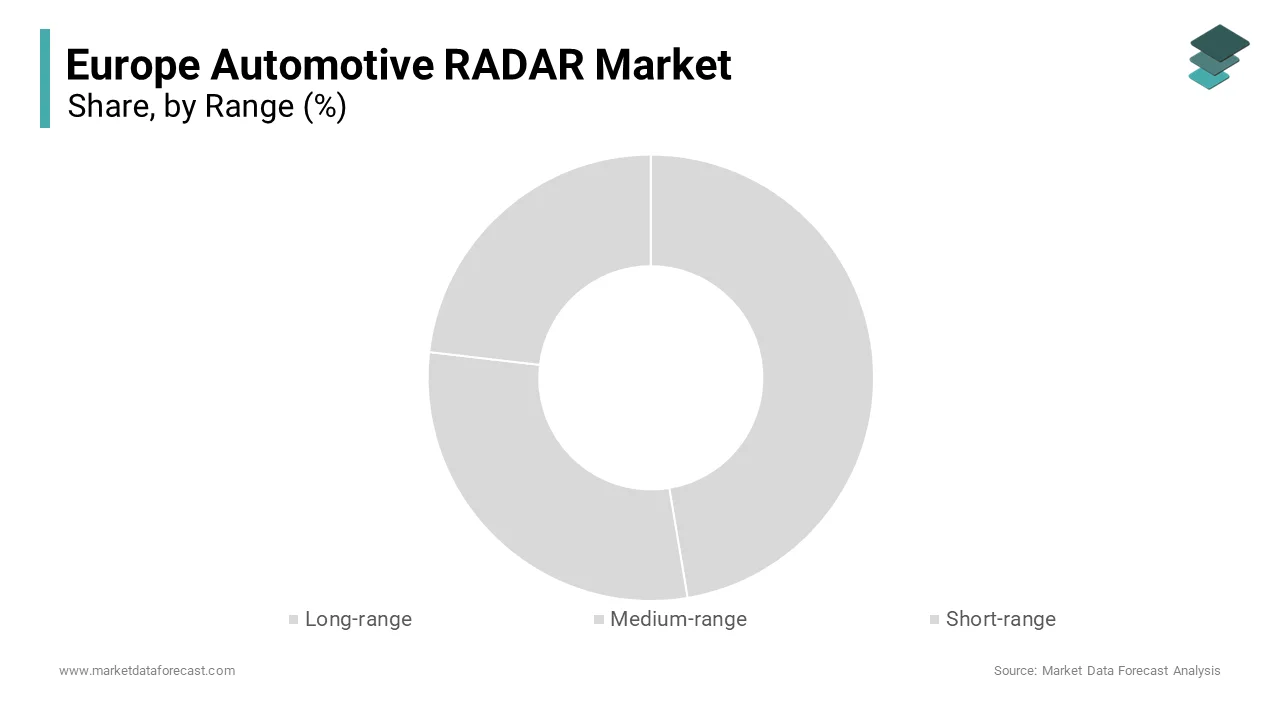
The long‑range radar segment is anticipated to witness the highest CAGR of 13.08% over the forecast period in this regional market, owing to the integration into highway automated driving systems. The deployment of conditionally automated driving on European motorways under UN Regulation No. 157 has made long‑range radar indispensable for maintaining safe following distances and detecting high‑speed obstacles. As per the German Aerospace Center (DLR), vehicles equipped with Automated Lane Keeping Systems must sustain perception up to 250 meters ahead, which is a range only achievable with 77 GHz long‑range radar. In 2024, Mercedes‑Benz’s Drive Pilot system received approval in Germany and France using a dual long‑range radar setup capable of tracking vehicles at speeds exceeding 130 km/h. According to the European Transport Safety Council, long‑range radar reduces high‑speed rear‑end collisions by up to 41% compared to camera‑only systems, especially in adverse weather. With 77,000 km of EU motorways designated for automated driving trials by 2025 (European Commission), long‑range radar demand is accelerating across premium and upper mid‑segment vehicles.
By Application Insights
The adaptive cruise control segment held 30.8% of the European automotive radar market share in 2025. The leading position ofthe adaptive cruise control segment in this regional market is attributed to the standardization across mid and premium vehicle trims. ACC has transitioned from a luxury feature to a mainstream expectation in European vehicles priced above €25,000. According to JATO Dynamics, over 89% of D and E segment cars launched in Europe in 2024 included ACC as standard equipment. Even in the C segment, brands like Volkswagen and Renault offer ACC in mid‑level trims to meet consumer demand for driving ease on congested highways. The European Commission’s CO₂ fleet targets further incentivize ACC adoption, as stop‑and‑go traffic optimization reduces fuel consumption by up to 7%, verified by the International Council on Clean Transportation. In Germany, where average annual motorway usage exceeds 12,000 km per vehicle (Federal Highway Research Institute), ACC is perceived not as automation but as essential driving ergonomics, which is making it a non‑negotiable feature for fleet and private buyers alike.
The blind‑spot detection segment is anticipated to grow at a CAGR of 14.4% over the forecast period in this regional market. The growth of the blind spot detection segment in this regional market can be credited to the mandatory inclusion under eu general safety regulation. The EU GSR mandates BSD for all new vehicle types as of July 2025, with full fleet compliance required by 2026. As per the European Commission, this requirement applies uniformly to passenger cars, light commercial vehicles, and buses, recognizing that lane‑change collisions account for over 18% of fatal accidents in Europe. Short‑range radar is the only sensor technology capable of reliably monitoring adjacent lanes at speeds between 10 and 120 km/h, regardless of lighting or weather. Euro NCAP now awards additional safety points only to vehicles with active BSD thatprovides both visual and haptic warnings. In response, PSA Group confirmed in 2023 that every Peugeot, Citroën, and Opel model would include dual rear corner radars by 2025 to ensure regulatory compliance and safety rating competitiveness.
By Vehicle Insights
The passenger cars segment captured the highest share of the European automotive radar market in 2025. The dominance of the passenger car segment in this regional market is attributed to the stringent EU safety and emissions regulations for passenger vehicles. The EU GSR and CO₂ fleet targets apply most rigorously to passenger cars, which is creating a compliance‑driven radar adoption curve. As per the European Commission, all new passenger car models must include at least four radar sensors to meet autonomous emergency braking and blind‑spot detection requirements. In contrast, commercial vehicles face phased timelines with full compliance delayed until 2028. Additionally, passenger cars benefit from higher consumer willingness to pay for safety, with 74% of EU buyers citing advanced driver assistance as a key purchase factor (European Consumer Safety Panel). This market dynamic ensures that OEMs prioritize radar integration in passenger platforms first, leveraging economies of scale to reduce costs before extending to commercial segments.
The commercial vehicles segment is projected to register a CAGR of 16.6% over the forecast period in this regional market, owing to the phased regulatory rollout for heavy‑duty and light commercial vehicles. While passenger cars led initial adoption, commercial vehicles are now entering a steep regulatory ramp‑up. As per the European Commission, all new light commercial vehicles must comply with full GSR requirements by July 2026 and heavy trucks by 2028. This includes mandatory autonomous emergency braking with vulnerable road user detection, and these functionsrequireg at least three radar units per vehicle. According to the European Road Safety Charter, commercial vehicles account for 16% of road fatalities despite representing only 6% of vehicle kilometers traveled, which makes them a priority for intervention. In response, MAN and DAF began equipping all new Euro 7-compliant trucks with front and corner radar as standard from 2025. This regulatory wave is transforming commercial fleets from radar laggards into high‑growth adopters within the next five years.
COUNTRY ANALYSIS
Germany Automotive Radar Market Analysis
Germany led the automotive radar market in Europe in 2024. The growth of Germany in the European market is majorly due to its concentration of premium OEMs, strong regulatory enforcement, and advanced R&D ecosystem. The country is home to Mercedes‑Benz, BMW, and Volkswagen, all of which integrated 4D imaging radar across their 2024 model lines. According to the German Federal Motor Transport Authority, over 95% of new vehicles registered in Germany in 2024 featured at least five radar sensors. As per the Federal Ministry for Digital and Transport, the Automated and Connected Driving Strategy has allocated €2.4 billion through 2025 to support sensor infrastructure, including radar validation testbeds. Additionally, German suppliers Bosch, Continental, and ZF account for over 60% of global automotive radar shipments, enabling tight OEM‑supplier collaboration. This synergy of manufacturing innovation, policy, and consumer demand solidifies Germany’s position as the technological nucleus of Europe’s radar landscape.
France Automotive Radar Market Analysis
France maintains a strong second position in the European automotive radar market. The position of France in the European market is driven by proactive safety regulation, automotive electrification, and urban mobility initiatives. As per the French Ministry of Ecological Transition, all new vehicles sold since January 2025 must include autonomous emergency braking and blind spot detection—both radar-dependent. The country’s push toward electric mobility has further accelerated radar adoption, as EVs like the Renault Megane E‑Tech and Peugeot e‑208 use radar for regenerative braking optimization. According to the French Road Safety Observatory, radar‑equipped vehicles showed a 34% reduction in intersection collisions in 2023. Moreover, Paris, Lyon, and Marseille are deploying radar‑enabled smart traffic systems under the France Relance plan, which share data with connected vehicles to enhance perception. This convergence of vehicle and infrastructure intelligence positions France as a leader in cooperative radar applications beyond standalone automotive use.
United Kingdom Automotive Radar Market Analysis
The United Kingdom serves as a dynamic market for radar innovation despite post‑Brexit regulatory divergence. According to the Society of Motor Manufacturers and Traders, 89% of new cars sold in the UK in 2024 included adaptive cruise control and blind spot detection as standard. The Zenzic CAM Scale project has established radar validation corridors across Birmingham and Oxfordshire, enabling real‑world testing of 4D imaging systems in mixed traffic. As per the Association of British Insurers, insurers such as Aviva and Direct Line now use radar data from connected cars to offer usage‑based policies, reducing premiums for safe driving behavior. Additionally, UK‑based startups like Metawave and Uhnder are collaborating with Jaguar Land Rover on next‑generation radar for autonomous shuttles in London. This blend of regulatory pragmatism, insurance innovation, and tech entrepreneurship sustains the UK’s relevance in the European radar ecosystem.
Italy Automotive Radar Market Analysis
Italy is characterized by high urban vehicle density and growing fleet modernization. According to ISTAT, the average age of passenger cars in Italy exceeds 12.3 years, but new registrations show rapid adoption of radar features, with 82% of 2024 models including at least three sensors. Stellantis, headquartered in Turin, has made radar standard across all Fiat, Alfa Romeo, and Lancia launches, including entry‑level models like the Fiat Panda. As per the Italian Ministry of Infrastructure, radar‑assisted emergency braking reduced rear‑end collisions by 29% on the A1 motorway between Milan and Naples in 2023. Furthermore, Italian cities such as Milan and Turin are integrating automotive radar data into smart city platforms to manage traffic flow and pedestrian safety. This dual focus on vehicle renewal and urban integration drives steady radar penetration despite economic constraints in the broader market.
Sweden Automotive Radar Market Analysis
Sweden is predicted to account for a notable share of the European market over the forecast period owing to its leadership in safety culture, vehicle automation, and extreme weather resilience. As per the Swedish Transport Administration, all new vehicles sold since 2023 must meet Vision Zero safety criteria, which effectively mandates full radar suites. Volvo and Polestar, headquartered in Gothenburg, have pioneered 4D imaging radar integration, with Volvo’s EX90 featuring eight radar units as standard. The country’s harsh winters make radar essential for all‑weather functionality where cameras fail. The Swedish Road and Transport Research Institute confirmed that radar‑equipped vehicles maintained 98% detection reliability in blizzard conditions compared to 62% for vision systems. This environmental necessity, combined with national safety philosophy, ensures Sweden remains a high‑value market for advanced radar despite its modest population size.
COMPETITIVE LANDSCAPE
Competition in the Europe automotive radar market is characterized by intense technological differentiation and deep OEM integration rather than price rivalry. Incumbents such as Bosch, Continental,l and Valeo compete on sensor accuracy,cy reliability in adverse weather,r and software sophistication rather than hardware cost alone. The mandatory nature of radar under EU safety regulations has lowered entry barriers for new players but raised performance thresholds through stringent validation protocols like ISO 21448 SOTIF. This has spurred collaboration between traditional suppliers and semiconductor firms such as NXP and Infineon to co-develop radar MMICs. Meanwhile, Chinese entrants like Hesai and RoboSense are attempting to gain footholds through cost-competitive units, though they face challenges in meeting European functional safety and cybersecurity standards. The market is thus evolving into a two-tier structure where premium players dominatehigh-endd applications while volume suppliers target entry-level compliance. Innovation in 4D imaging, radar data processing, and over-the-air calibration now defines competitive advantage more than sensor count or frequency band.
KEY MARKET PLAYERS
A few of the market players in the Europe automotive radar market include
- Continental AG (Germany)
- HELLA KGaA (Germany)
- Robert Bosch GmbH (Germany)
- Delphi Automotive PLC (United Kingdom)
- NXP Semiconductors NV (Netherlands)
- Valeo SA (France)
- Autoliv Inc. (Sweden)
- Infineon Technologies AG (Germany)
- Denso Corporation
- Texas Instruments, Inc.
Top Players In The Market
- Bosch is a foundational force in the Europe automotive radar market through its decades-long leadership in driver assistance systems and sensor development. The company supplies radar units to virtually every major European OEM, including Volkswagen, BMW, and Stellantis,s with a strong focus on 77 GHz and 4D imaging radar technologies. In 20,24 Bosch began series production of ififth-generation long-rangenge radar, featuring 170 meter detection range and sub-degree angular resolution at its Reutlingen plant in Germany. It also partnered with Microsoft to develop cloud-based radar data simulation platforms, accelerating validation for automated driving. These initiatives reinforce Bosch’s role as both a hardware innovator and software enabler, not only in Europe but globally,y where its radar systems are integrated into vehicles across North America and Asia.
- Continental plays a pivotal role in shaping the European automotive radar landscape through its scalable sensor portfolio and deep integration with vehicle architectures. The company’s ARS540 and ARS548 radar platforms are widely deployed in premium and volume vehicles for applications ranging from blind spot detection to highway pilot functions. In early 2024, Continental launched its scalable 4D imaging radar with adaptable resolution based on driving scenario, improving cost efficiency for mid-segment cars. It also established a dedicated radar calibration center in Frankfurt to support over-the-air updates and sensor fusion validation. Through these efforts, Continental strengthens its position as a full-stack sensing solutions provider while contributing to global standardization of radar performance and safety protocols across international markets.
- Valeo distinguishes itself in the Europe automotive radar market by emphasizing short-range and corner radar innovation tailored for urban mobility and parking automation. The company’s Scala lidar may dominate perception headlines, but its third-generation Park4U Remote radar system is standard on over 30 vehicle platforms across Renault PSA and Ford Europe. In 2023, Valeo introduced a radar-based occupancy detection system compliant with EU General Safety Regulation requirements for child presence alerts. It also expanded its manufacturing capacity in Tanger Morocco, to serve European OEMs with a localized supply chain,s reducing logistics emissions. Valeo’s strategy of embedding radar into comfort and regulatory compliance functions ensures its relevance beyond high-end automation, extending its global influence into emerging markets adopting European safety standards.
Top Strategies Used by the Key Market Participants
Key players in the Europe automotive radar market focus on developing 4D imaging radar with enhanced resolution and object classification to support Level 3 automation. They invest heavily in sensor fusion software that integrates radar with cameras and lidar for robust perception. Strategic partnerships with OEMs enable co-development of platform-specific radar architectures, reducing integration costs. Companies also expand manufacturing within Europe to comply with supply chain resilience directives and reduce lead times. Additionally, they leverage cloud-based simulation aand over-the-airupdate capabilities to continuously improve radar performance post deployment, aligning with evolving regulatory and safety requirements across the region.
MARKET SEGMENTATION
This research report on the Europe Automotive Radar Market is segmented and sub-segmented into the following categories.
By Range Type
- Long-range
- Medium-range
- Short-range
By Application Type
- Adaptive Autonomous Emergency Braking (AEB)
- Adaptive Cruise Control (ACC)
- Frontal Collision Warning System (FCWS)
- Blind-spot Detection (BSD)
- Intelligent Parking Assistance (IPA)
By Vehicle Type
- Passenger Cars
- Commercial Vehicles
By Country
- UK
- France
- Spain
- Germany
- Italy
- Russia
- Sweden
- Denmark
- Switzerland
- Netherlands
- Turkey
- Czech Republic
- Rest of Europe