- Product Description Description
- Table of Contents TOC
- List of Table & Figure LOT
- Get Free Sample PDF Sample PDF
Market Size, 2025
$4.27 BnMarket Estimate, 2026
$4.56 BnMarket Forecast, 2034
$7.74 BnCAGR, 2026–2034
6.83%Europe Automotive Sunroof Market Report Summary
The Europe automotive sunroof market was valued at USD 4.27 billion in 2025, is expected to reach USD 4.27 billion in 2025, and is projected to achieve USD 7.74 billion by 2034, growing at a CAGR of 6.83% from 2026 to 2034. Market growth is fueled by rising consumer preference for premium vehicle aesthetics, increased demand for comfort and ventilation features, and the growing adoption of panoramic and sunroof-equipped models across mid-range and luxury vehicle segments. Additionally, advancements in smart roof technologies and the increasing inclusion of sunroofs in electric and hybrid vehicles are further driving market expansion.
Key Market Trends
- Rising integration of sunroofs in mid-range passenger cars driven by premiumization trends.
- The growing popularity of glass roofs and panoramic sunroof systems among consumers seeking an enhanced cabin experience.
- Increasing adoption of electric operation systems offering convenience, safety, and automated controls.
- Expansion of automotive OEM partnerships with specialist roof system manufacturers to develop lightweight, durable, and energy-efficient sunroof solutions.
- Rising influence of climatic preferences and lifestyle factors supporting region-specific demand.
Segmental Insights
- Based on type, the glass sunroof segment dominated the Europe automotive sunroof market in 2025, driven by high durability, aesthetic appeal, and penetration across premium and mass-market models.
- Based on operation mode, the electric sunroof segment led the market, supported by growing preference for automated control systems and enhanced user convenience.
Regional Insights
- Germany led the regional market in 2025 with a 25.5% share, supported by strong automotive manufacturing, premium vehicle adoption, and innovation in luxury features.
- France held the second-largest share, driven by rising demand for high-spec passenger cars.
- The United Kingdom is projected to grow at a promising CAGR through increased premium car sales, while Italy continues to hold a notable market position.
- Sweden stands out with the highest sunroof penetration per capita due to climatic preferences and cultural affinity for open-roof driving.
Competitive Landscape
The Europe automotive sunroof market is competitive, with companies focusing on product innovation, lightweight design, and enhanced safety systems. Key players include Webasto Group, Inalfa Roof Systems Group B.V., Inteva Products, Yachiyo Industry Co. Ltd., Magna International Inc., AISIN CORPORATION, Wuxi Ming Fang Auto Mobile Parts, CIE Automotive, DONGHEE, and Johnan Manufacturing Inc. Leading manufacturers are investing in panoramic technologies, modular roof architectures, and OEM collaborations to enhance market reach and differentiation.
Europe Automotive Sunroof Market Size
The Europe automotive sunroof market size was valued at USD 4.27 billion in 2025 and is anticipated to reach a valuation of USD 4.56 billion in 2026 and USD 7.74 billion by 2034, growing at a CAGR of 6.83% during the forecast period from 2026 to 2034.
An automotive sunroof is an integrated glazing and opening system installed in vehicle roofs to enhance natural lighting, cabin ambiance, and occupant well-being. These systems range from conventional pop-up and sliding glass sunroofs to panoramic fixed glass roofs and advanced smart glass variants with electrochromic dimming capabilities. Unlike cosmetic accessories, sunroofs in Europe are increasingly engineered as structural and experiential elements influencing vehicle design, aerodynamics, and energy efficiency. As per Euro NCAP updated safety protocols, all roof systems must maintain structural rigidity during rollover tests,s, ensuring occupant protection without compromising openness. The European Commission’s Horizon Europe program also funds research into solar reflective and thermochromic glass coatings to reduce cabin heat gain and air conditioning load. Sunroof penetration in premium and upper midsize segments exceeds 75%, which reflects strong consumer preference for light-filled interiors. These technical, regulatory, and experiential dimensions position sunroofs as a key differentiator in the European automotive industry.
MARKET DRIVERS
Consumer Preference for Premium Cabin Experience and Natural Light
European consumers increasingly prioritize cabin ambiance and psychological well-being when selecting vehicles, driving sustained demand for sunroof systems, which is one of the key factors propelling the automotive sunroof market growth in Europe. For instance, many new car buyers value “bright and airy interiors” as a decisive feature influencing purchase decisions. In premium segments, this preference intensifies, with vehicles equipped with panoramic sunroofs receiving higher satisfaction scores for interior quality in industry studies. Automakers have responded by integrating expansive glass roofs as standard or near-standard equipment, with BMW including panoramic sunroofs in a large share of its 3 Series and X3 models sold in Europe. Volvo Cars has also reported strong demand for fixed glass roofs in its XC60 SUVs delivered in Scandinavia, reflecting high latitude daylight scarcity during the winter months. The European Lighting Association confirmed that natural light exposure in vehicles correlates with reduced driver fatigue and improved circadian rhythm. This convergence of aesthetic desire, health benefit, and emotional appeal ensures sunroofs remain a high-value feature across European vehicle portfolios.
Integration of Sunroofs in Electric Vehicle Design and Aerodynamics
The structural and thermal characteristics of sunroofs have become strategically aligned with electric vehicle development priorities in Europe, which is further propelling the European automotive sunroof market expansion. Tesla’s Model Y, produced in Berl, features a single-pane glass roof that eliminates traditional roof pillars, increasing torsional rigidity. Similarly, Renault’s Megane E-Tech uses a bonded glass roof that contributes to a 0.28 drag coefficient through seamless surface continuity. Many new EV models launched in Europe in 2023 included fixed or sliding sunroofs as standard or optional equipment, reflecting their role in weight distribution and cabin experience. Additionally, glass suppliers like Saint-Gobain have developed ultra-thin laminated glass with integrated infrared reflective layers, which reduces solar heat gain without tinting. These engineering synergies transform sunroofs from optional extras into functional components of EV architecture.
MARKET RESTRAINTS
Added Vehicle Weight and Impact on Fuel Efficiency and Emissions
The integration of sunroof systems increases vehicle curb weight and can negatively affect fuel economy and CO2 compliance, which is one of the key restraints to the European automotive sunroof market. A standard sliding sunroof adds additional weight to a vehicle, while panoramic systems can exceed 50 kilograms due to reinforced frames and laminated glass. This extra mass contributes to higher CO2 emissions for internal combustion engine vehicles over the WLTP test cycle. For automakers operating near the EU fleet average limit of 95 grams per kilometre, such penalties can trigger significant fines. Stellantis has reduced sunroof availability on entry-level Peugeot and Fiat models to meet its corporate emissions target. Glass roofs also increase solar heat gain, which requires more air conditioning energy, which in EVs can reduce range in summer conditions. These trade-offs force manufacturers to carefully balance consumer demand against regulatory and efficiency constraints.
High Repair Costs and Complexity in Accident Scenarios
Sunroof systems significantly elevate vehicle repair complexity and insurance costs, particularly in the event of roof damage or water intrusion, which is further hampering the automotive sunroof market growth in Europe. Vehicles equipped with panoramic sunroofs often incur higher body shop repair costs following minor collisions due to the need for full roof panel replacement rather than localized fixes. Water leakage claims related to sunroof seal failures have been reported in luxury segments, with average repair bills exceeding several thousand euros. The integration of sensors for rain detection, ambient light, and driver monitoring into the sunroof frame further complicates recalibration after replacement. Sunroof-equipped vehicles also tend to take longer to repair on average due to parts availability and specialized technician requirements. Additionally, glass roofs cannot be repaired like metal panes, ls, as they must be entirely replaced even for small cracks. These economic and logistical burdens deter cost-sensitive buyers and increase the total cost of ownership, particularly for used vehicles.
MARKET OPPORTUNITIES
Adoption of Electrochromic Smart Glass Technology
The integration of electrochromic smart glass presents a major growth opportunity for the European automotive sunroof market. Companies like Saint-Gobain and Webasto have commercialized SPD and PDLC-based smart sunroofs that transition from clear to tinted at the touch of a button. Mercedes-Benz introduced its “Magic Sky Control” panoramic roof on the EQS SUV, highlighting growing demand for smart glass features. The European Commission’s Horizon Europe program allocated funding to scale production of low-voltage smart glass that reduces cabin cooling load, which is supported by Fraunhofer Institute trials. Furthermore, smart glass eliminates the need for sunshades and mechanical tracks, which reduces weight and failure points. With numerous new EV models slated for European launch by 2025 featuring optional smart roofs, this technology is poised to redefine the premium cabin experience while supporting energy efficiency goals.
Expansion into Compact and Entry Level Vehicle Segments
Historically limited to premium models, sunroofs are now penetrating compact entry-level segments through cost-optimized designs and modular platforms, which is another potential opportunity for the European automotive sunroof market. Sunroof installation rates in C-segment vehicles have risen in recent years, which is driven by platform sharing and economies of scale. Renault’s new Clio and Dacia’s Sandero now offer sliding sunroofs as optional extras priced under 800 euros due to standardized roof apertures across the CMF B platform. Similarly, Hyundai’s i20 and Kia’s XCeed include fixed glass roofs in higher trims to enhance perceived value without major tooling changes. Eastern European consumers show a particularly strong preference for sunroofs as status symbols, with many compact SUV buyers selecting the option. As modular architectures reduce integration costs and consumer expectations rise, even budget-oriented brands are incorporating roof glazing to remain competitive. This democratization opens a substantial new volume channel for sunroof suppliers across Europe.
MARKET CHALLENGES
Thermal Management and Cabin Overheating in Southern Europe
Sunroofs pose significant thermal challenges in Southern European climates where summer temperatures regularly exceed 35 degrees Celsius, which is a majorly challenge to the regional market growth. Cabin temperatures in vehicles with panoramic roofs can become significantly higher during midday parking in warm climates compared to non-glass roof models. This heat buildup increases air conditioning load, which in electric vehicles reduces real-world range in summer conditions. While infrared reflective coatings mitigate some gain, they cannot eliminate it entirely and often compromise visible light transmission. Consumer surveys have noted that many sunroof owners in Southern Europe regret the feature due to excessive heat and glare. Automakers respond by offering costly ceramic tinting or retractable sunshades, adding weight and complexity. Until smart glass or active cooling becomes standard, these thermal drawbacks limit sunroof appeal in warm regions despite strong aesthetic demand.
Supply Chain Vulnerability for Specialty Automotive Glass
The persistent supply risks due to concentration in specialty glass manufacturing and dependence on rare material inputs are another significant challenge to the growth of the European automotive sunroof market. Over 85% of laminated automotive glass with acoustic and solar control properties is produced by just three companies with limited excess capacity. In 2023, a furnace outage at AGC’s Germany plant caused a six-week delay in panoramic roof deliveries, which is forcing BMW and Audi to temporarily remove the option from online configurators. The production of electrochromic layers relies on indium tin oxide, which is a critical raw material largely imported from China as per the European Commission’s 2023 Critical Raw Materials list. Lead times for advanced sunroof glass increased from 8 to 14 weeks in 2023 due to energy cost volatility and skilled labour shortages in glass forming. These supply chain fragilities make sunroof availability unpredictable and increase vulnerability to geopolitical and energy market shocks, which pose a structural risk to consistent model planning and customer satisfaction across the European automotive sector.
REPORT COVERAGE
| REPORT METRIC | DETAILS |
| Market Size Available | 2025 to 2034 |
| Base Year | 2025 |
| Forecast Period | 2026 to 2034 |
| CAGR | 6.83% |
| Segments Covered | By Type, Operation, Propulsion Type, Application, and By Country |
| Various Analyses Covered | Global, Regional & Country Level Analysis, Segment-Level Analysis, DROC, PESTLE Analysis, Porter’s Five Forces Analysis, Competitive Landscape, Analyst Overview on Investment Opportunities |
| Regions Covered | UK, France, Spain, Germany, Italy, Russia, Sweden, Denmark, Switzerland, Netherlands, Turkey, the Czech Republic, and the Rest of Europe |
| Market Leaders Profiled | Webasto Group, Inalfa Roof Systems Group B.V., Inteva Products, Yachiyo Industry Co. Ltd, Magna International Inc., AISIN CORPORATION, Wuxi Ming Fang Auto Mobile Parts, CIE Automotive, DONGHEE, Johnan Manufacturing Inc. |
SEGMENTAL ANALYSIS
By Type Insights
The glass segment led the market by accounting for the most dominant share of the European market in 2024. The dominance of the glass segment in the European market is driven by consumer demand for unobstructed views, superior durability, and seamless integration with modern vehicle aesthetics. In premium and electric vehicle segments, glass roofs are now standard due to their contribution to structural rigidity and cabin ambiance. For instance, a high share of new vehicles priced above 35,000 euros in Germany feature glass sunroofs, with panoramic variants making up a significant portion of that share. Volvo Cars reported that most of its XC60 and XC90 SUVs delivered in Scandinavia in 2023 included fixed glass roofs to maximize natural light during long winter months. Furthermore, glass sunroofs align with EV design priorities as Tesla’s Model Y, produced in Berlin, uses a single pane bonded roof that enhances torsional stiffness, as verified by independent testing. Regulatory standards also favor glass with ECE Regulation 43, requiring all roof glazing to meet strict optical clarity and impact resistance criteria, as these are the standards that fabric cannot satisfy. These aesthetic, engineering, and compliance advantages ensure glass remains the unequivocal choice across Europe’s automotive landscape.
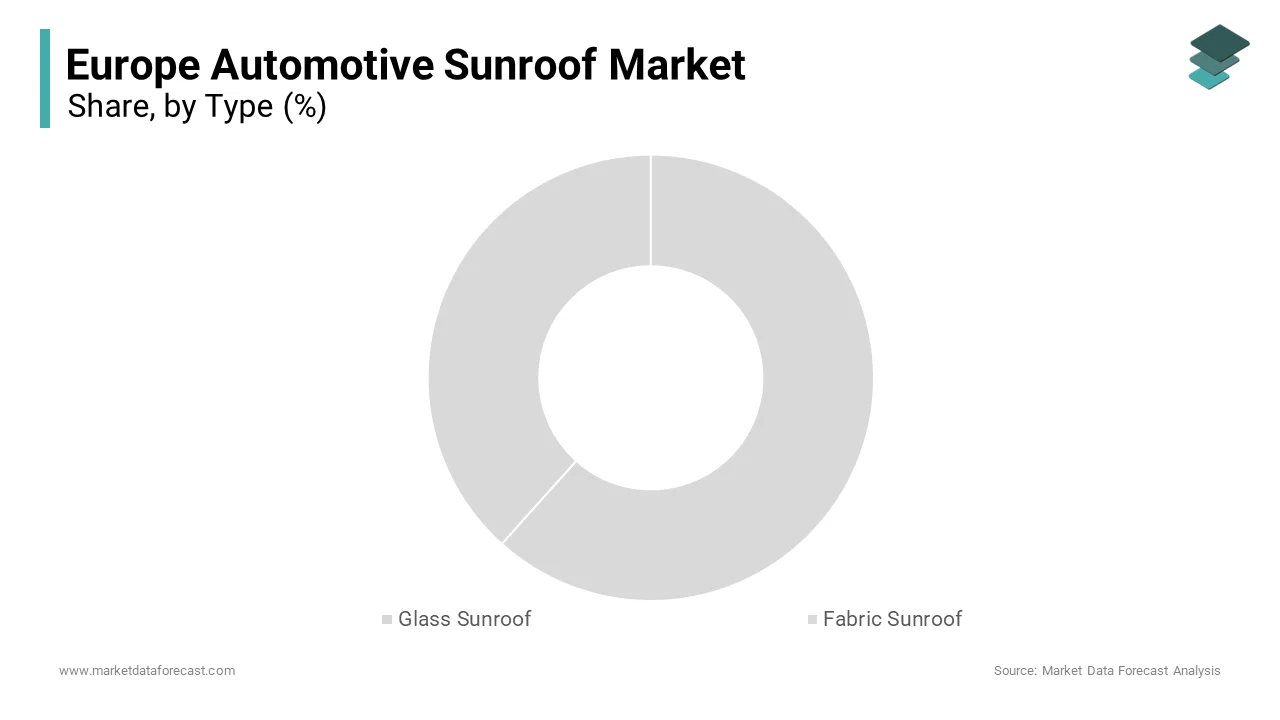
The fabric segment is fastest growing type segment in the Europe automotive sunroof market and is predicted to grow at a CAGR of 6.12% over the forecast period, owing to the renewed interest in lightweight, cost-effective opening roofs for compact urban vehicles and retro-inspired models. Fiat reintroduced a manual fabric sunroof on its 500e Icon trim, which is priced lower than glass alternatives, which is appealing to urban buyers in Italy and Spain. Similarly, some compact EVs offer fabric sunroofs that attract younger demographics seeking vintage aesthetics with modern performance. Fabric roofs reduce vehicle weight compared to glass equivalents while improving efficiency in small EVs over WLTP cycles. Additionally, fabric roofs help mitigate solar heat gain in Southern Europe, where glass roofs face consumer resistance. While niche, this revival in minimalist lightweight design is carving a sustainable niche within Europe’s diverse automotive preferences.
By Operation Insights
The electric segment commanded the largest share of the European automotive sunroof market in 2024. The dominance of the electric segment in the European market is attributed to the consumer expectations for convenience, safety, and integration with vehicle electronics. Modern electric systems include automatic anti-pinch sensors rain rain-sensing closure, and one-touch operation. In Germany, the vast majority of sunroof-equipped vehicles sold in 2023 featured electric operation. Premium brands like BMW and Mercedes integrate sunroof control into ambient lighting and climate systems, allowing voice or app-based management. Furthermore, electric mechanisms enable larger opening apertures in panoramic systems that manual cranks cannot support. For instance, electric roofs can be programmed to auto-close during rollover events to enhance occupant protection. These functional safety and experiential advantages have rendered manual operation obsolete in new vehicle design across mainstream and luxury segments.
The manual segment is expected to grow at a notable CAGR of 5.04% over the forecast period in the European market, owing to their deployment of entry-level urban EVs and heritage-inspired models where cost reduction and mechanical simplicity are prioritized. Dacia offers a manual pop-up fabric sunroof on its Spring EV at a low price point, making it among the most affordable roof-opening options in Europe. Some budget vehicles in the UK market offer manual sunroofs to avoid the weight and complexity of electric systems. Additionally, retro models like the Fiat 500e and MINI Cooper SE use manual fabric roofs to evoke classic design cues without compromising battery range. While excluded from many mainstream segments due to safety regulations, manual sunroofs are finding a defensible niche in ultra compact and lifestyle-oriented vehicles where simplicity and affordability outweigh automation.
COUNTRY ANALYSIS
Germany Sunroof Market Analysis
Germany dominated the automotive sunroof market in Europe in 2025 by capturing 25.5% of the regional market share. The dominance of Germany in the European market is driven by its premium vehicle production engineering culture and high consumer willingness to pay for comfort features.
According to the German Association of the Automotive Industry, a high share of BMW, Mercedes-Benz, and Audi vehicles produced in Germany include sunroofs, with panoramic glass common on most SUVs and EVs. The Federal Motor Transport Authority mandates that all sunroofs meet strict ECE R43 optical and safety standards and high-quality standards. Additionally, German suppliers like Webasto and Inteva operate advanced R&D centers in Bavaria, developing electrochromic and solar reflective glass technologies. In 2025, German OEMs accounted for a leading share of smart sunroof installations in Europe, as confirmed by industry consortia. This synergy of manufacturing scale, technological leadership, and affluent consumer base cements Germany’s central role in shaping sunroof innovation and penetration across the continent.
France Sunroof Market Analysis
France captured the second leading share of the European automotive sunroof market in 2025. The strong demand in the compact and mid-size segments, where sunroofs serve as key value enhancers in France, is majorly propelling the French automotive sunroof market growth. In 2025, many Peugeot 308 and Citroën C5 Aircross units sold in France included glass sunroofs, with take rates rising due to affordable pricing under the Stellantis Common Platform strategy. Renault’s electric Megane E Tech features a bonded panoramic roof that improves torsional rigidity and reduces drag to align with France’s EV transition goals. The French Environment and Energy Management Agency also promotes light-filled cabins as a passive well-being feature in its sustainable mobility guidelines. Furthermore, French design philosophy emphasizes open, airy interiors, making sunroofs a natural extension of automotive aesthetics. This blend of platform efficiency, consumer preference, and design heritage sustains France’s strong and balanced sunroof adoption across vehicle classes.
United Kingdom Sunroof Market Analysis
The United Kingdom is projected to register a promising CAGR in the European automotive sunroof market during the forecast period. Despite post-Brexit economic pressures, British consumers maintain a strong preference for premium cabin features, particularly in SUVs and executive sedans. In 2025, many Land Rover Discoveries and Jaguar XEs sold in the UK featured panoramic sunroofs as standard. MINI’s revival of the manual fabric sunroof on its Cooper SE resonated with urban buyers seeking retro charm without range penalty. The UK’s variable climate reduces heat gain concerns that deter Southern European buyers, making glass roofs more universally acceptable. Additionally, the Driver and Vehicle Standards Agency enforces stringent sunroof safety standards, which ensure high-quality installations. With robust demand in both premium and lifestyle segments, the UK remains a stable and influential market for sunroof innovation and adoption.
Italy Sunroof Market Analysis
Italy is a notable market for automotive sunroofs and is expected to account for a notable share of the European market during the forecast period, owing to the strong regional variation, with Northern urban centers showing higher penetration due to greater affluence and EV uptake. Fiat’s reintroduction of the pop-up fabric sunroof on the 500e achieved a 33% take rate in Milan and Turin in 2025, appealing to style-conscious urbanites. Meanwhile, Alfa Romeo and Maserati equip nearly all models with panoramic glass roofs as standard, reflecting Italy’sdesign-drivenn automotive culture. The Italian National Institute of Statistics reported that sunroof ownership correlates strongly with vehicle age. Although Southern Italy shows lower adoption due to heat concerns, manufacturers counter with infrared reflective glass that reduces cabin temperature by up to 9 degrees Celsius. This duality of aesthetic tradition and climate adaptation shapes Italy’s distinctive sunroof landscape.
Sweden Sunroof Market Analysis
Sweden is a prominent market for automotivesunroofsf in Europe. Sweden exhibits the highest sunroof penetration per capita in Europe, driven by unique climatic and cultural factors. With limited daylight during winter months, Swedish consumers prioritize natural light exposure for psychological well-being, making glass roofs a popular feature in Volvo XC60 and XC90 units sold domestically in 2025. For instance, vehicles with panoramic roofs can improve occupant satisfaction in seasonal affective disorder surveys. Additionally, Sweden’s mild summer temperatures minimize solar heat gain concerns prevalent in Southern Europe. Electrification further amplifies this trend as all Volvo Recharge models feature bonded glass roofs that enhance structural integrity and cabin serenity. This confluence of light scar, city cultural preference, and EV alignment makes Sweden a natural stronghold for sunroof adoption despite its modest market size.
COMPETITIVE LANDSCAPE
Competition in the Europe automotive sunroof market is characterized by a concentrated landscape dominated by established Tier 1 suppliers with deep OEM relationships and engineering expertise. Webasto Inteva and Magna lead through proprietary technology, manufacturing scale, and regulatory compliance capabilities. The market is highly dependent on vehicle platform cycles, with sunroof integration requiring early involvement in design phases, creating high switching costs for automakers. Differentiation hinges on innovation in weight reduction, thermal management, and smart features rather than price alone. While new entrants face barriers, including certification testing and tooling investment, he players compete in manual or fabric segments. The shift toward electric vehicles is reshaping competition as sunroofs evolve from comfort features to structural and energy efficiency components. This dynamic rewards incumbents with R and D infrastructure and cross-segment portfolios while pressuring laggards to innovate or exit.
KEY MARKET PLAYERS
A few of the market players in the Europe Automotive sunroof market include
- Webasto Group
- Inalfa Roof Systems Group B.V.
- Inteva Products
- Yachiyo Industry Co., Ltd
- Magna International Inc.
- AISIN CORPORATION
- Wuxi Ming Fang Automobile Parts
- CIE Automotive
- DONGHEE
- Johnan Manufacturing Inc.
Top Players In The Market
- Webasto SE is a German automotive supplier and global leader in sunroof systems with a dominant footprint across Europe. The company contributes to the global market through its innovative glass and openable roof solutions installed in premium and volume vehicles alike. In Europe, Webasto supplies panoramic sunroofs to BMW, Mercedes-Benz, Volkswagen, and Stellantis, among others. Recently, the company strengthened its position by launching its Smart Glass Roof with electrochromic dimming for the Mercedes EQS SUV and BMW iX. It also expanded its production capacity for bonded glass roofs at its Kaiserslautern facility to meet rising EV demand. These actions reinforce Webasto’s leadership in high-tech, lightweight, and energy-efficient sunroof systems aligned with Europe’s automotive transformation.
- Inteva Products is a multinational automotive supplier with significant sunroof operations in Europe serving both premium and mainstream automakers. The company plays a key role globally by delivering cost-optimized yet reliable electric sunroof systems for compact and mid-size vehicles. In Europe, Inteva supplies systems to Renault, Dacia, Hyundai, and Ford through its manufacturing plants in Romania and the Czech Republic. In 2023, Inteva introduced its ultra-lightweight sliding sunroof for urban EVs, reducing system weight by 18% through polymer frame integration. It also enhanced its anti-pinch and rain-sensing algorithms to comply with the EU General Safety Regulation 2022. These initiatives position Inteva as a strategic partner for affordable and compliant sunroof solutions across diverse European vehicle segments.
- Magna International is a global automotive technology company with a growing presence in the European sunroof market through its Complete Vehicle and Exteriors divisions. The company contributes internationally by integrating panoramic glass roofs into full vehicle builds and supplying modular sunroof modules to OEMs. In Europe, Magna produces sunroof-equipped vehicles for BMW and Jaguar Land Rover at its contract manufacturing sites in Austria and the UK. In 2024, Magna launched its structural glass roof system that eliminates traditional roof bow, increasing torsional rigidity by 12% while reducing weight. It also developed a solar reflective coating in collaboration withitSaint-Gobainhat cuts cabin heat gain by 35%. These innovations underscore Magna’s role in advancing sunroofs as functional elements of vehicle architecture.
Top Strategies Used by the Key Market Participants
Key players in the Europe automotive sunroof market focus on technological differentiation by developing electrochromic smart glass, lightweight polymer frames, and structural integration for EVs. They align closely with EU safety and emissions regulations, ns e nsurianti-pinchnch rain sensing and weight efficiency compliance. Companies invest in localized production near OEM assembly plants to reduce logistics costs and improve just-in-time delivery. Strategic partnerships with glass and chemical suppliers enable the co-development of solar reflective and thermochromic coatings. Additionally, firms offer scalable solutions ranging from premium panoramic systems to cost-effective manual roofs to capture both luxury and entry-level segments across diverse European markets.
MARKET SEGMENTATION
This research report on the Europe automotive sunroof market is segmented and sub-segmented into the following categories.
By Type
- Glass Sunroof
- Fabric Sunroof
By Operation
- Electric
- Manual
By Propulsion Type
- ICE
- Electric
By Application
- Mid-segment Vehicles
- Premium & Luxury-segment Vehicles
By Country
- UK
- France
- Spain
- Germany
- Italy
- Russia
- Sweden
- Denmark
- Switzerland
- Netherlands
- Turkey
- Czech Republic
- Rest of Europe