- Product Description Description
- Table of Contents TOC
- List of Table & Figure LOT
- Get Free Sample PDF Sample PDF
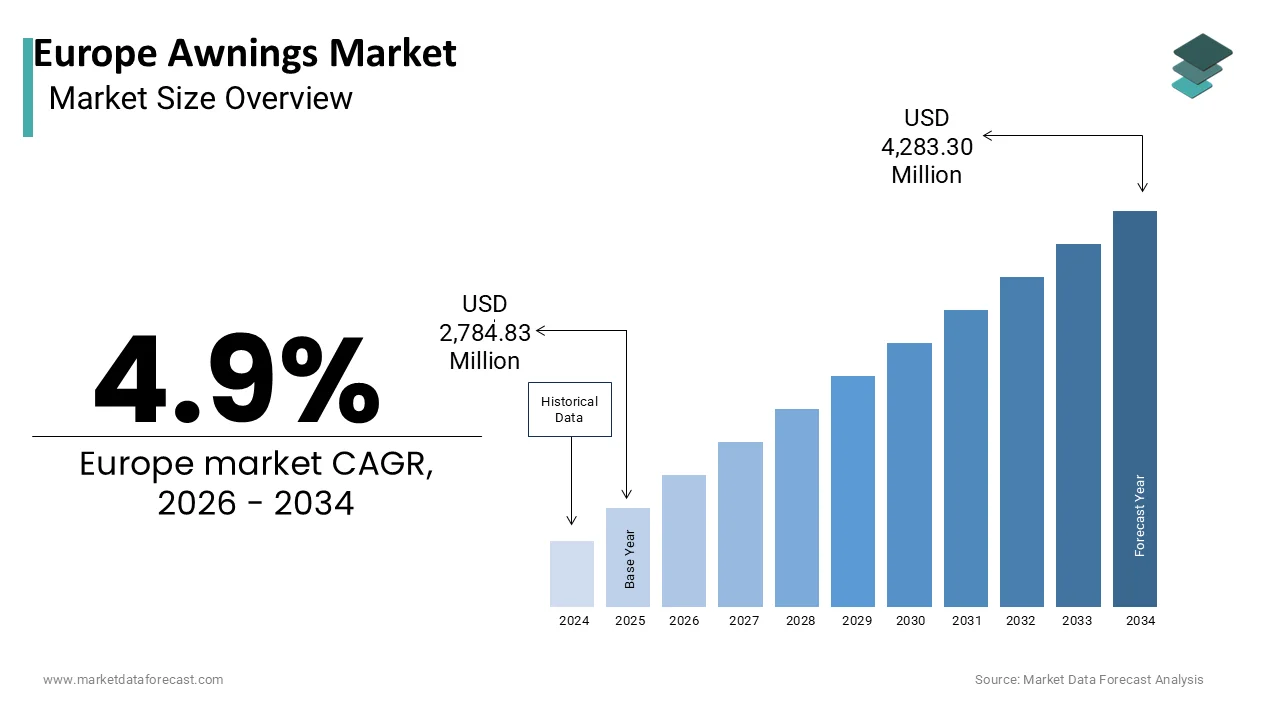
Market Size, 2025
$2,784.83 MnMarket Estimate, 2026
$2,921.29 MnMarket Forecast, 2034
$4,283.30 MnCAGR, 2026–2034
4.9%Europe Awnings Market Size
The Europe awnings market was valued at USD 2,784.83 million in 2025, is estimated to reach USD 2,921.29 million in 2026, and is projected to reach USD 4,283.30 million by 2034, growing at a CAGR of 4.9% from 2026 to 2034.
Awnings in Europe refer to retractable or fixed fabric or metal coverings installed over windows, doors,s or terraces to provide solar shading, ng thermal regulation, and outdoor living extension. The market is shaped by a confluence of architectural trends, climate adaptation policies, and energy efficiency mandates rather than mere aesthetic preference. Unlike generic sun protection solutions, NS European awnings are increasingly integrated into building energy performance systems under the Energy Performance of Buildings Directive, which requires all new constructions to meet near-zero energy standards by 2030. According to Eurostat, a majority of EU households engaged in home improvement activities in 2024, with external shading cited as a top investment for thermal comfort. As per the European Environment Agency, residential buildings account for a significant share of the EU’s final energy consumption, with cooling demand projected to rise substantially by 2050 due to increasing temperatures. The EU Strategy on Adaptation to Climate Change further promotes passive cooling measures, including awnings, to reduce urban heat island effects. National building codes in Germany, France, and Italy now mandate external solar protection for south and west-facing façades in new builds. These regulatory and climatic imperative positions awnings not as decorative add-ons but as functional components of sustainable building design.
MARKET DRIVERS
Stringent Building Energy Efficiency Regulations Drive Mandatory Installation
The European Union’s tightening building energy codes have transformed awnings from optional accessories into compulsory architectural elements in new and renovated structures, which is a key factor propelling the growth of the European awnings market. Under the Energy Performance of Buildings Directive, member states must ensure that all new residential buildings achieve nearly zero energy status by 2030, with existing buildings undergoing major renovations required to meet minimum energy standards. According to the European Commission, external solar shading such as awnings can significantly reduce summer cooling loads compared to internal blinds. In Germany, the EnEV 2024 ordinance mandates automated external shading with solar sensors for south and west-oriented windows in new homes. France’s RE2020 regulation requires dynamic solar protection for glazed areas exceeding a set threshold, while Italy’s Ministry of Ecological Transition reported widespread inclusion of awning specifications in municipal building permits.
Rising Urban Heat Island Effects Accelerate Residential Adoption
Escalating urban temperatures across Europe are driving widespread residential adoption of awnings as a cost-effective passive cooling solution, which is further boosting the expansion of the European awnings market. According to the European Environment Agency, average summer temperatures in major cities such as Madrid, Paris, and Rome have risen notably since 2000, intensifying cooling demand and health risks. The World Health Organization documented tens of thousands of heat-related deaths in Europe during the summer of 2023, prompting cities to implement urban cooling strategies. Barcelona’s municipal government launched a subsidy program covering part of awning costs for households in heat-vulnerable districts, while Vienna’s Smart City Framework includes awnings in its “Cool Roofs and Facades” initiative. The Joint Research Centre confirmed that buildings with external awnings maintain significantly lower indoor temperatures during heatwaves.
MARKET RESTRAINTS
Complex Permitting and Heritage Conservation Laws Restrict Installation
The growth of the European awnings market is likely to be restrained by the historic preservation regulations in Europe’s dense urban centers, which constrain awning adoption, particularly in UNESCO World Heritage Sites or protected architectural zones. According to the European Cultural Heritage Association, hundreds of cities enforce strict façade modification rules that prohibit external fixtures without special approval. In Paris, the Architecte des Bâtiments de France must review every awning proposal in central arrondissements, often causing delays and high rejection rates. Venice’s municipal code bans non-original external elements on canal-facing buildings to preserve historical aesthetics. The Renovation Wave Strategy acknowledges this tension but does not override national heritage laws, leaving homeowners in historic districts reliant on less effective internal blinds.
High Upfront Costs and Fragmented Subsidy Schemes Limit Mass Accessibility
Despite long term energy savings, the high initial investment required for motorized or smart awnings remains a barrier for middle-income households, which is further impeding the growth of the European market. According to the European Consumer Organisation, the average cost of a quality retractable awning with automation represents a significant portion of disposable income in Southern Europe. Subsidy programs remain fragmented and inconsistent: Germany’s KfW Bank provides grants only within larger renovation packages, while France’s MaPrimeRénov’ scheme caps reimbursement at a modest level per window. As per a survey by the European Federation of Awnings Manufacturers, many consumers delayed purchases due to affordability concerns. Without harmonized EU-level financing mechanisms or VAT reductions, awnings remain inaccessible to a large share of households, limiting their role in achieving energy transition goals.
MARKET OPPORTUNITIES
Integration with Smart Home and Building Management Systems Creates Premium Demand
The convergence of awnings with intelligent building ecosystems presents a high-value opportunity through seamless integration with smart home platforms and energy management systems. Modern awnings equipped with wind, rain, and sun sensors can communicate with HVAC systems to optimize indoor climate automatically, reducing energy use without manual intervention. According to the European Smart Homes Association, a notable share of new single-family homes in Germany and the Netherlands featured connected shading systems in 2024. Companies such as Warema and Griesser offer KNX and Zigbee-compatible motors that integrate with Apple HomeKit, Google Nest, and Bosch smart controllers. The Fraunhofer Institute for Solar Energy Systems confirmed that AI-driven awning control reduced household electricity consumption for cooling compared to manual operation. As the EU’s Ecodesign for Sustainable Products Regulation mandates interoperability by 2027, awnings will become essential nodes in responsive building networks.
Expansion of Climate Adaptive Urban Planning Drives Municipal Procurement
European cities are increasingly procuring public awnings as part of climate-resilient urban design initiatives to protect citizens from extreme heat and extend usable public space, which is another prominent opportunity in the European awnings market. Under the EU Mission on Climate Neutral and Smart Cities, municipalities are committed to implementing urban cooling measures by 2030. In Seville, Spain, large fabric canopies were installed in school playgrounds and bus stops after extreme heat events in 2023. Similarly, Copenhagen’s Cloudburst Management Plan includes retractable awnings in public squares to provide shade during heat events while allowing rainwater drainage during storms. The European Investment Bank allocated significant funding in 2024 to support “cool infrastructure” projects, including awnings in social housing and public facilities.
MARKET CHALLENGES
Lack of Standardized Performance Metrics Undermines Consumer Confidence
The absence of harmonized EU-wide testing standards for awning thermal and durability performance creates confusion and mistrust among consumers and specifiers, which is challenging the growth of the European awnings market. Unlike windows, which carryCE-markedd U values, awnings are evaluated using disparate national methods. According to the European Committee for Standardization, efforts to adopt EN 13561 for solar shading performance remain voluntary. A study by Stiftung Warentest found that advertised cooling claims varied significantly from laboratory results due to inconsistent test conditions. This opacity allows low-quality imports to flood the market with inflated efficiency ratings, undermining reputable manufacturers. Until the EU mandates certified labeling akin to appliance energy efficiency classes, the market will struggle to convey true value and justify premium investments.
Supply Chain Volatility for Technical Fabrics Threatens Cost Stability
The European awnings market faces persistent pressure from fluctuating prices and the availability of high-performance technical fabrics. Most premium acrylic and solution-dyed polyester textiles are sourced from a handful of global producers, such as Serge Ferrari and Dickson Constant, with limited regional manufacturing capacity. According to the European Textile Confederation, acrylic yarn prices surged in 2024 due to export restrictions and rising energy costs. The EU’s Chemicals Strategy for Sustainability introduced new restrictions on PFAS used in water repellent coatings, forcing rapid reformulation. Manufacturers such as Warema reported extended lead times for flame-retardant fabrics, disrupting project timelines. Without diversified sourcing or vertical integration, producers face unpredictable pricing and delayed deliveries, discouraging architects from specifying awnings in sustainability projects.
REPORT COVERAGE
| REPORT METRIC | DETAILS |
| Market Size Available | 2025 to 2034 |
| Base Year | 2025 |
| Forecast Period | 2026 to 2034 |
| Segments Covered | By Type, Product, End User, and Region. |
| Various Analyses Covered | Global, Regional, and Country-Level Analysis, Segment-Level Analysis, Drivers, Restraints, Opportunities, Challenges; PESTLE Analysis; Porter’s Five Forces Analysis, Competitive Landscape, Analyst Overview of Investment Opportunities |
| Countries Covered | UK, France, Spain, Germany, Italy, Russia, Sweden, Denmark, Switzerland, Netherlands, Turkey, Czech Republic, Rest of Europe |
| Market Leaders Profiled | Somfy Group, Warema Renkhoff SE, KE Drapeaux (KE Outdoor Design), Markilux GmbH & Co. KG, Alulux GmbH & Co. KG, Sunair Awnings (Sunair®), Dickson-Constant (Groupe Serge Ferrari), Sattler GmbH, Bras Outdoor (BRA S.p.A.), Gibus S.p.A., Harol NV, Neptunus Awnings, Laura Green Outdoor Awnings, Batavia International BV, Unger Awnings, SunSetter Products Inc., KE Protec (Outdoor shading solutions), Zill Sun and Shade GmbH, Sunprofi GmbH |
SEGMENTAL ANALYSIS
By Type Insights
The retractable awnings segment dominated the market with 61.6% of the European market share in 2025. The dominance of retractable segments in the European market is majorly driven by their adaptability, energy efficiency, and compliance with dynamic building regulations. Unlike fixed models, retractable systems allow adjustment based on sun angle, weather, and seasonal needs, optimizing both thermal comfort and daylight harvesting. According to the Energy Performance of Buildings Directive, automated external shading is recognized as a key measure for reducing cooling demand in near zero energy buildings. In Germany, the EnEV 2024 ordinance mandates motorized retractable awnings with solar sensors for new residential constructions facing south or west. France’s RE2020 regulation requires dynamic solar protection responding to real-time irradiance levels. The Fraunhofer Institute for Solar Energy Systems confirmed that sensor-controlled retractable awnings reduced summer electricity consumption by 38% compared to static alternatives.
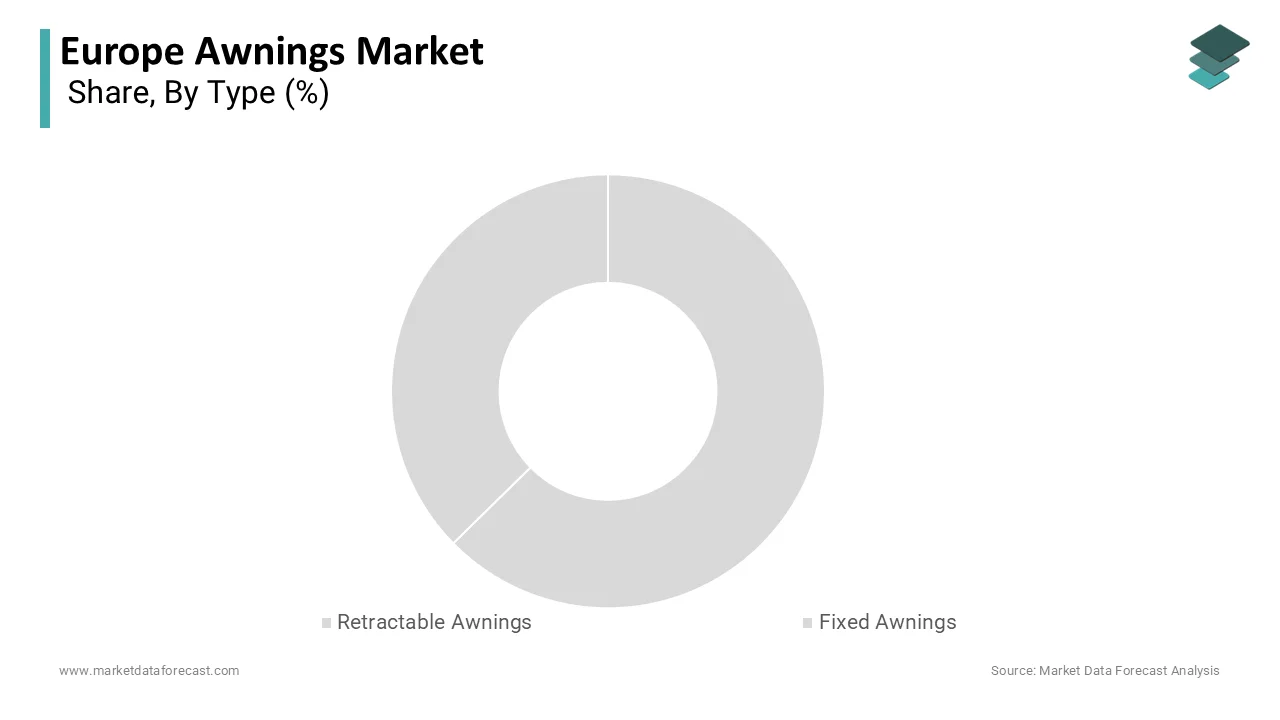
The fixed awnings segment is predicted to witness the fastest CAGR of 6.25% over the forecast period, owing to the municipal investment in public infrastructure as part of climate adaptation strategies. Cities such as Seville, Barcelona, and Athens are installing permanent fabric canopies over bus stops, playgrounds, and walkways to combat extreme heat. According to the European Environment Agency, over 120 European cities included fixed shading structures in their Urban Heat Action Plans. Spain’s Ministry for Ecological Transition allocated millions in 2024 to install fixed awnings in social housing courtyards and public squares.
By Product Insights
The patio awnings segment commanded the highest share of 51.9% of the regional market in 2025. The growth of the patio segment in the European market is attributed to Europe’s cultural emphasis on outdoor living and terrace extension. According to Eurostat, most EU households with outdoor space undertook improvements in 2024, with patio awnings ranking among the top expenditures. In Italy, the National Institute of Statistics reported that a majority of single-family homes feature covered terraces, often equipped with lateral arm or cassette awnings from brands such as Gibus and Sattler. Germany’s KfW Bank includes patio shading in its renovation subsidy program.
The window awnings segment is the fastest-growing product segment and is predicted to expand at a CAGR of 10.5% over the forecast period, owing to the binding energy efficiency mandates under national building codes. According to the European Commission, windows account for up to 40% of unwanted solar heat in summer. France’s RE2020 regulation requires bioclimatic energy demand limits achievable only withwindow-levell solar control. Germany’s EnEV 2024 specifies minimum g values for glazed façades achievable only with external shading devices. Italy’s Ministry of Infrastructure reported that most municipal permits in 2024 mandated drop arm or roller awnings on south and west-facing windows.
By End User Insights
The residential segment led the market by holding 75.5% of the European market share in 2025. The growth of the residential segment in the European market is attributed to the strong homeowner investment in thermal comfort, outdoor living, and property value enhancement. According to the European Consumer Organisation, most homeowners cited lower cooling bills as the primary reason for installing awnings in 2024. Germany’s KfW program reimbursed hundreds of millions of euros for residential shading installations. Mediterranean countries such as Spain and Italy treat terraces as essential living areas, further driving demand.
The non-residential segment is anticipated to witness the fastest CAGR of 12.6% over the forecast period, owing to the corporate sustainability mandates, public health policies, and smart building certifications. According to the European Green Building Council, nearly half of new commercial office projects in 2024 pursued certifications such as BREEAM or DGNB, which award points for dynamic external shading. Retail chains such as IKEA and Carrefour are installing motorized awnings to extend customer dwell time. Municipalities are procuring large-scale awning systems for schools, hospitals, and transit hubs under EU climate adaptation funding, with Paris installing thousands of square meters of fabric canopies in schoolyards in 2024.
COUNTRY LEVEL ANALYSIS
Germany Awnings Market Analysis
Germany dominated the awnings market in Europe in 2025 with 24.4% of the regional market share. The dominance of Germany in the European market is driven by the stringent energy regulations, advanced manufacturing, and high homeowner investment in efficiency. The EnEV 2024 ordinance mandates automated external shading for all new residential buildings with south or west-facing glazing, directly driving demand for motorized retractable systems. According to the German Federal Statistical Office, hundreds of thousands of renovation projects included awnings in 2024, supported by KfW Bank subsidies. Companies such as Warema and Markilux dominate domestic production, offering KNX-integrated systems that communicate with building energy management platforms. The Fraunhofer Institute confirmed that certified awnings reduced cooling energy use significantly. Germany’s strong DIY culture also fuels demand for premium self-installation kits.
France Awnings Market Analysis
France captured the second leading share of the European awnings market in 2025. The growth of France in the European market is attributed to the ambitious RE2020 thermal regulation and cultural emphasis on outdoor living. The law requires strict bioclimatic energy thresholds, achievable only with external solar protection. According to the Ministry of Ecological Transition, most new single-family home permits in 2024 included awning specifications. The MaPrimeRénov’ subsidy scheme reimburses part of the costs, though demand exceeds funding. Brands such as Dickson Constant and Solisysteme leverage France’s textile heritage to produce high UV-resistant fabrics. Initiatives such as Ville Étudiante install awnings in university facilities to combat urban heat.
Italy Awnings Market Analysis
Italy held a prominent share of the European awnings market in 2025. The terrace culture, intense solar exposure, and growing energy consciousness are propelling the awnings market growth in Italy. The National Recovery and Resilience Plan allocates billions to building envelope upgrades,s including external shading under the Superbonus 110% tax credit scheme. According to ISTAT, most Italian households have balconies or terraces, with many investing in retractable awnings. Manufacturers such as Gibus and Serge Ferrari Italia produce premium cassette awnings with integrated lighting and sensors. Heritage cities such as Rome and Florence increasingly permit discreet awnings as part of climate adaptation.
Spain Awnings Market Analysis
Spain is estimated to hold a notable share of the European awnings market during the forecast period owing to the extreme heat, urban density, and proactive municipal climate action. The Ministry for Ecological Transition reported widespread household installations in Andalusia and Murcia in 2024 following record heat. The national Plan de Ola de Calor allocated hundreds of millions to subsidize shading in vulnerable communities. Cities such as Seville and Valencia mandate awnings on new residential balconies facing south or west. Spanish manufacturers such as Toldos Costa and Tolsen specialize in wind-resistant models suited to coastal conditions. Tourism also drives demand in hotel terraces and restaurant patios.
Netherlands Awnings Market Analysis
The Netherlands is expected to exhibit a healthy CAGR in the European awnings market over the forecast period, owing to its focus on smart integration, sustainable materials, and urban densification. According to Statistics Netherlands, most Dutch single-family homes feature terraces. The government’s Duurzaam Wonen program includes awnings in its green renovation toolkit with VAT reductions for energy-efficient models. Companies such as WAREMA Benelux lead in KNX and Zigbee compatible systems that integrate with Philips Hue and Bosch smart ecosystems. The Dutch Building Decree 2024 encourages external shading to meet nearly zero energy targets. Cities such as Amsterdam and Utrecht install freestanding awnings in public squares as part of “cool city” initiatives.
COMPETITIVE LANDSCAPE
The European awnings market features intense competition among established national champions, regional specialists,s and emerging smart shading innovators. German and Italian manufacturers dominate the premium segment with engineered systems that meet stringent energy codes, es while French and Spanish firms lead in fabric technology aclimate-adaptedted design. Competition is increasingly defined by regulatory compliance, sustainability credentials,s and digital integration rather than price alone. Large players like Warema and Gibus leverage brand heritage and R and D scale to maintain margi, ns while smaller firms differentiate through niche aesthetics or heritage compatibility in historic districts. The absence of harmonized EU performance standards allows low-cost imports to compete on price but not durability, thereby creating a bifurcated market. Public sector demand driven by urban heat action plans is fostering new entrants focused on institutional solutions. This dynamic landscape rewards companies that balance engineering precision, social environmental responsibility, and seamless user experience across residential and civic applications.
KEY MARKET PLAYERS
Some of the companies that are playing a dominating role in the global Europe Awnings Market include
- Somfy Group
- Warema Renkhoff SE
- KE Drapeaux (KE Outdoor Design)
- Markilux GmbH & Co. KG
- Alulux GmbH & Co. KG
- Sunair Awnings (Sunair®)
- Dickson-Constant (Groupe Serge Ferrari)
- Sattler GmbH
- Bras Outdoor (BRA S.p.A.)
- Gibus S.p.A.
- Harol NV
- Neptunus Awnings
- Laura Green Outdoor Awnings
- Batavia International BV
- Unger Awnings
- SunSetter Products Inc.
- KE Protec (Outdoor shading solutions)
- Zill Sun and Shade GmbH
- Sunprofi GmbH
TOP LEADING PLAYERS IN THE MARKET
- Warema Renkhoff SE is a German manufacturer and a pioneer in external solar shading systems with a strong presence across Europe. The company specializes in motorized retractable awnings, window shading,g and integrated facade systems that comply with EU energy efficiency standards. Globally, Warema supplies premium shading solutions to commercial and residential projects in over 50 countries, emphasizing smart home integration and sustainable materials. Recently,y the company launched its WMS KNX ecosystem, enabling seamless communication between heating, n,g and lighting systems to optimize building energy use. It also introduced a new line of awnings using recycled polyester fabric certified under the EU Ecolabel. These innovations reinforce Warema’leadershipin in high-performance climate-responsive shading aligned with European green building mandates.
- Gibus S p A is an Italian leader in design-oriented awnings known for its premium cassette ssystems terrace covers,e, rs and pergolas tailored to Mediterranean lifestyles. The company exports to over 80 countries and is recognized globally for combining aesthetic elegance with technical durability in high sun environments. Gibus contributes to the international market through its patented self-supporting structures and integrated LED lighting systems. In recent actions, Ons Gibus launched the “EcoLine” collection featuring fabrics made from 100percent solution-dyed acrylic with reduced water consumption during production. It also partnered with Italian architects to develop heritage-compatible awning designs approved for historic city centers. These moves strengthen its position as a luxury yet sustainable brand in climate-conscious markets.
- Dickson Constant SAS, a French subsidiary of the Serge Ferrari Group, is a key player in technical outdoor fabrics and finished awning systems across Europe. The company supplies high UV-resistant and flame-retardant textiles to over 200 awning manufacturers globally and also produces its own branded shading solutions. Dickson Constant contributes to the global market by setting benchmarks in fabric longevity, colorfastness, and environmentalcertification. Recently, the company achieved Cradle to Cradle Gold certification for its Sunworker fabric and introduced a digital configurator tool allowing architects to simulate solar performance in real time. It also expanded its recycling program,m “Sunrecyc, le” to collect and recycle end-of-life awning fabrics into new yarns. These initiatives position Dickson Constant as a sustainability leader in the textile backbone of the awnings industry.
TOP STRATEGIES USED BY THE KEY MARKET PARTICIPANTS
Key players in the European awnings market prioritize integration with smart building ecosystems by embedding KNX Zigbee and Bluetooth connectivity for automated climate control. They invest heavily in sustainable material innovation, developing fabrics from recycled or bio-based sources certified under EU Ecolabel and Cradle to Cradle standards. Companies align product design with national energy regulations such as Germany’s EnEV and France’s RE2020 to ensure compliance and subsidy eligibility. Strategic partnerships with architects, urban planners,s and public authorities enable inclusion in municipal climate adaptation projects. Additionally, firms offer digital tools like solar simulation configurators and online measurement apps to simplify specification and installation for both professionals and homeowners across diverse European markets.
MARKET SEGMENTATION
This research report on the europe awnings market is segmented and sub-segmented into the following categories.
By Type
- Retractable Awnings
- Fixed Awnings
By Product
- Patio Awnings
- Window Awnings
- Freestanding Awnings
- Conservatory Awnings
- Others
By End User
- Residential
- Non-Residential
- Commercial Buildings
- Hospitality
- Retail
- Public Infrastructure
- Others
By Country
- Germany
- France
- Italy
- Spain
- Netherlands
- United Kingdom
- Sweden
- Rest of Europe