- Product Description Description
- Table of Contents TOC
- List of Table & Figure LOT
- Get Free Sample PDF Sample PDF
Market Size, 2025
$1.87 BnMarket Estimate, 2026
$1.98 BnMarket Forecast, 2034
$3.12 BnCAGR, 2026–2034
5.86%Europe Bagels Market Report Summary
The European bagels market was valued at USD 1.87 billion in 2025, is estimated to reach USD 1.98 billion in 2026, and is projected to reach USD 3.12 billion by 2034, growing at a CAGR of 5.86% from 2026 to 2034. The growth of the European bagels market is driven by the rising popularity of ready-to-eat bakery products, increasing urbanization and on-the-go consumption habits, and expanding product availability across retail and food service channels. Moreover, the growing preference for artisanal and flavored bagels, alongside the rising trend of breakfast convenience foods, continues to strengthen market growth across the region.
Key Market Trends
- Increasing demand for fresh and frozen bagels owing to longer shelf life and broader distribution reach.
- The growing popularity of premium, whole-grain, and gluten-free bagel varieties among health-conscious consumers.
- Expanding presence of bakery cafés, quick-service restaurants (QSRs), and breakfast chains offering innovative bagel-based menus.
- Rising consumption of grab-and-go bakery products fueled by busy urban lifestyles.
- Increasing adoption of frozen and packaged bagels in supermarkets and convenience stores.
Segmental Insights
- Based on type, the fresh and frozen bagels segment was the most prominent, capturing a substantial share of the Europe bagel market in 2025, supported by growing demand for ready-to-eat bakery items and expanded retail penetration across Europe.
- Based on application, the supermarkets segment held the leading share of 52.3% of the Europe bagel market in 2025, attributed to strong product availability, diverse brand options, and increasing consumer preference for one-stop retail shopping experiences.
Regional Insights
- The European bagels market demonstrates strong regional performance, with growing consumption of bakery and breakfast products across major economies.
- The United Kingdom led the European bagel market, accounting for 28.1% share in 2025, driven by high bagel consumption in both retail and café segments and increasing adoption of North American-style breakfast trends.
- Germany and France exhibit steady market growth supported by rising demand for convenient bakery snacks and the expansion of QSR chains.
- Eastern Europe, including Poland and the Czech Republic, is witnessing growing product availability and increased adoption of frozen bagels in retail channels.
- Southern European countries, such as Italy and Spain, are gradually adopting bagel consumption, fueled by expanding bakery product diversification and tourism-driven demand.
Competitive Landscape
- The European bagels market is moderately competitive, with both global and regional players focusing on product innovation, flavor diversification, and expanding retail distribution networks.
- Companies are introducing health-oriented bagels, including low-calorie, vegan, and gluten-free variants, to cater to evolving consumer preferences.
- Prominent players in the European bagels market include BAB Inc., Thomas’ Bagels, Lantmännen Unibake, Hovis, Panera Bread Company, McDonald’s, Bruegger’s Bagel Bakery, Dunkin’ Donuts, Einstein Noah Restaurant Group, Hostess Brands, George Weston Ltd., Aryzta Americas, Kettleman’s Bagel Company, and Flowers Foods.
- These companies are emphasizing strategic partnerships, new product launches, and bakery innovation to strengthen their market presence and meet the growing demand for convenient and premium bagel products across Europe.
Europe Bagel Market Size
The European bagel market size was valued at USD 1.87 billion in 2025 and is anticipated to reach USD 1.98 billion in 2026 and USD 3.12 billion by 2034, growing at a CAGR of 5.86% during the forecast period from 2026 to 2034.
MARKET OVERVIEW
A bagel is a ring-shaped, boiled-and-baked bread product. Originally rooted in Ashkenazi Jewish culinary tradition, bagels have undergone significant adaptation to align with evolving European dietary habits, particularly in urban and cosmopolitan settings. While still niche compared to indigenous bread forms such as the French baguette or German rye loaf, bagels are gaining traction as convenient, customizable, and versatile food items. According to Eurostat, a portion of Europe’s population lives in urban areas, which creates a dense consumer base receptive to on-the-go formats. Apart from these, the Organisation for Economic Co-operation and Development notes a structural shift toward abbreviated morning routines and increased snacking frequency, which further enables the integration of bagels into daily diets. This evolving consumption landscape provides the contextual foundation for assessing the market’s dynamics, constraints, and future potential.
MARKET DRIVERS
Rising Urbanization and On-the-Go Consumption Patterns
Urban concentration has fundamentally reshaped food purchasing behaviors, which propels the growth of the Europe bagel market. According to the United Nations Department of Economic and Social Affairs, over 70 percent of Europeans resided in urban centers in 2022, a figure expected to climb. This demographic density fosters demand for portable, durable, and satisfying food options that accommodate fast-paced lifestyles. Bagels inherently meet these criteria due to their structural integrity, ease of handling, and compatibility with a wide range of fillings. In major cities such as London, Berlin, and Amsterdam, dedicated bagel shops have multiplied, which often operate as compact kiosks in transport hubs or business districts. The International Labour Organization confirms that average weekly working hours in Western Europe range between 30 to 35 hours by reducing time for meal preparation and increasing reliance on ready-to-eat solutions. Bagels, especially when formulated with whole grains or added protein, offer perceived nutritional value without sacrificing convenience, which positions them as a strategic fit for modern urban consumption patterns.
Growing Demand for Customizable and Health-Conscious Bakery Options
Consumers in the region are increasingly prioritizing transparency, personalization, and nutritional quality in their bakery choices, which further boosts the expansion of the Europe bagel market. Bagels respond effectively through diverse formulations, such as whole wheat, multigrain, gluten-free, or high-protein variants, and through build-your-own topping models that empower consumers to manage sodium, fat, and caloric intake. The European Commission’s Farm to Fork Strategy has accelerated industry-wide reformulation, prompting bakeries to reduce sugar and salt while boosting fiber. Apart from these, the rise of flexitarian and plant-based diets has expanded demand for pairings like avocado, hummus, or dairy-free cream cheese. This alignment with contemporary health and ethical expectations transforms the bagel from a static heritage item into a dynamic platform for nutritional innovation, which drives sustained market relevance.
MARKET RESTRAINTS
Persistent Consumer Preference for Traditional European Bread Varieties
Deeply entrenched culinary traditions continue to limit its mainstream acceptance, which degrades the growth rate of the Europe bagel market. As per Eurostat, a portion of bread-related expenditure in France, Germany, and Italy is directed toward locally recognized varieties, with bagels and other foreign breads accounting for a small share of total bakery purchases in these countries. "A significant number of artisanal bakeries operate across the EU. Local bakeries maintain strong community loyalty and resist displacement by standardized or imported formats. Consequently, bagels are often perceived as novelty or convenience items rather than core dietary components, which restricts market penetration primarily to expatriate communities and metropolitan centers.
Stringent EU Regulations on Ingredient Labeling and Additive Use
The European Union’s comprehensive food regulatory framework imposes significant compliance burdens on bagel producers, particularly small and medium enterprises, and this impedes the expansion of the Europe bagel market. Regulation EC No 1333/2008, as enforced by the European Food Safety Authority, strictly controls the use of additives such as preservatives, dough conditioners, and colorants, ingredients commonly used in industrial bagel production to ensure texture and shelf life. Compliance demands extensive documentation, reformulation, and batch testing, which strain limited resources. Apart from these, under current EU rules (Regulation (EU) No 1169/2011), nutrition information for energy, fat, saturates, carbohydrates, sugars, protein, and salt is mandatory on packaged foods, which potentially deters health-conscious buyers if formulations fall short of emerging benchmarks. These constraints hinder innovation, scalability, and competitive positioning across the European market.
MARKET OPPORTUNITIES
Expansion of Plant-Based and Functional Food Innovation in Bakery
The convergence of plant-based eating and functional nutrition is setting up new opportunities for the Europe bagel market growth. This offers a high-potential avenue for bagel market differentiation. According to studies, sales of plant-based bakery products grew in recent years, with bagels emerging as a preferred format for alternative proteins and fibers. Innovations such as chickpea flour bagels or those fortified with algal-derived omega-3s align with the European Commission, which promotes nutrient-dense and eco-friendly formulations. Brands like Bagel Corner in France and Bagel Bakery in the Netherlands have launched lines featuring prebiotic fibers and plant-based cream cheeses in response. "Bagel producers can transcend traditional categorization and capture health- and ethics-driven consumer segments by embracing clean-label positioning and science-backed nutritional enhancements.
Growth of E-Commerce and Direct-to-Consumer Bakery Models
The rapid digitization of food retail also provides a major opportunity for the bagel market expansion. According to research, online food and beverage sales in the EU surged in recent years, with frozen and ambient bakery items among the fastest-growing categories. Bagels, particularly when flash-frozen, maintain quality during transit, making them ideal for e-commerce logistics. As per sources, aa portion of EU households now have access to same-day or next-day grocery delivery, enabling nationwide reach beyond physical retail footprints. Startups such as Bagel Bond in Sweden and Crust Bakery in Ireland have leveraged subscription models offering weekly deliveries of rotating flavors and artisanal toppings. Social media platforms like Instagram and TikTok further amplify discovery through user-generated content around customization, which drives organic engagement and conversion. This digital shift reduces reliance on brick-and-mortar infrastructure while enabling real-time feedback, agile product development, and targeted marketing across diverse European markets.
MARKET CHALLENGES
Labor Shortages in Artisanal and Specialty Food Production
The shortage of skilled labor in artisanal baking continues to challenge the growth of the Europe bagel market. According to studies, a portion of small and medium bakeries across the EU struggled to fill skilled baking positions. Bagel production demands precise control over boiling duration, dough hydration, and proofing conditions, skills not easily replicated by automation without compromising authenticity. The skills gap forces many bagel businesses to either limit batch sizes or adopt semi-automated processes that dilute product quality. Consequently, even in high-demand environments, production capacity remains constrained, leading to lost revenue and inconsistent brand experiences, a structural challenge that impedes scalable growth.
Volatility in Wheat and Dairy Input Costs
Fluctuating prices of core agricultural inputs, especially wheat and dairy derivatives, pose a key hindrance to the expansion of the Europe bagel market. Since bagels rely heavily on high-gluten wheat flour and dairy-based toppings like cream cheese, such volatility directly impacts margins. Small producers, lacking the scale to hedge or negotiate long-term contracts, are especially vulnerable. Furthermore, ongoing reforms under the EU’s Common Agricultural Policy, aimed at sustainability, may introduce additional short-term supply uncertainties. This economic instability complicates financial forecasting, limits reinvestment in innovation, and constrains the sector’s ability to respond competitively to market shifts.
REPORT COVERAGE
| REPORT METRIC | DETAILS |
| Market Size Available | 2025 to 2034 |
| Base Year | 2025 |
| Forecast Period | 2026 to 2034 |
| CAGR | 5.86% |
| Segments Covered | By Type, Application, and Region |
| Various Analyses Covered | Global, Regional & Country Level Analysis; Segment-Level Analysis, DROC, PESTLE Analysis, Porter’s Five Forces Analysis, Competitive Landscape, Analyst Overview of Investment Opportunities |
| Regions Covered | UK, France, Spain, Germany, Italy, Russia, Sweden, Denmark, Switzerland, Netherlands, Turkey, Czech Republic & Rest of Europe |
| Market Leaders Profiled | BAB Inc., Thomas’ Bagels, Panera Bread Company, McDonald’s, Bruegger's Bagel Bakery, Dunkin’ Donuts, Einstein Noah Restaurant Group, Hostess Brands, George Weston Ltd., Aryzta Americas, Kettleman’s Bagel Company, and Flowers Foods |
SEGMENT ANALYSIS
By Type Insights
The fresh and frozen bagels segment was the prominent segment of the Europe bagel market and captured a substantial share in 2025. Superior texture, authenticity, ty and alignment with consumer expectations for bakery freshness fuel the dominance of the fresh and frozen bagels segment. European consumers consistently prioritize sensory attributes such as chewiness, crust integrity, ty and aroma, qualities best preserved in fresh or flash-frozen bagels. Fresh bagels sold in-store or delivered frozen for home baking replicate the traditional boiling-and-baking process that defines authentic texture, unlike shelf-stable alternatives that rely on preservatives and modified starches. Retailers have expanded in-store bakery sections featuring daily-made bagels, which respond to this demand.
The logistical maturity of Europe’s cold chain network enables the reliable distribution of frozen bagels without compromising quality. Companies leverage blast-freezing technology to lock in freshness immediately after baking by extending shelf life to numerous days without additives. This infrastructure advantage ensures that fresh-like quality is accessible beyond urban artisanal shops, solidifying the segment’s market leadership.
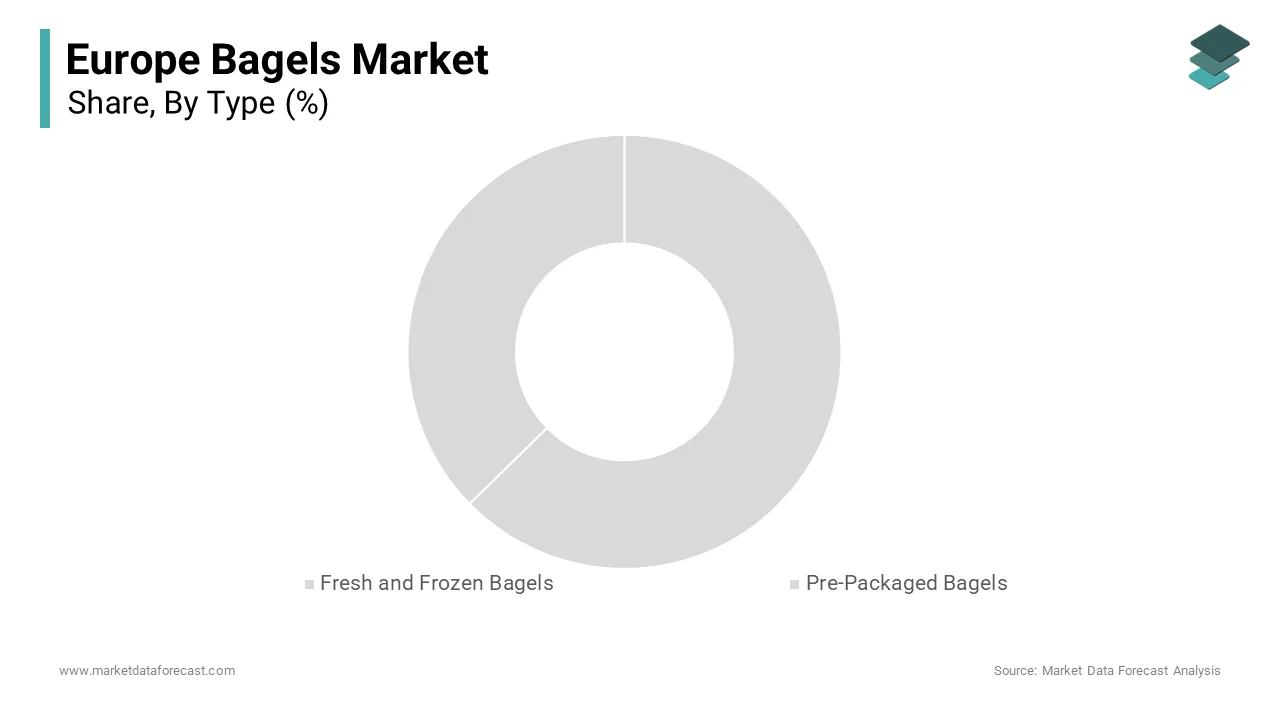
Fastest-Growing Segment: Pre-Packaged Bagels (CAGR of 9.4% from 2023 to 2030)
The pre-packaged ambient bagels segment is likely to experience the fastest CAGR of 9.4% from 2025 to 2033. The growth of the pre-packaged ambient bagels segment is propelled by the expansion of private label and value-oriented offerings and the rise of snacking and portion-controlled formats. Private label manufacturers are aggressively entering the pre-packaged bagel space with competitively priced multi-packs targeting budget-conscious households. Pre-packaged bagels meet this need with an extended shelf life of up to six months and lower per-unit costs, which enables broader retail penetration in mass channels where fresh formats are logistically unviable. Moreover, pre-packaged bagels are increasingly positioned as single-serve snack items rather than traditional breakfast bread. Some brands have introduced individual bagels with sealed cream cheese packets by targeting office and school settings. The convenience of ambient storage eliminates refrigeration needs, making these products ideal for vending machines, convenience stores, and school cafeterias. This functional repositioning from meal accompaniment to on-the-go snack unlocks new usage occasions and distribution avenues, which propels above-market growth.
By Application Insights
In 2025, the supermarkets segment held the leading share of 52.3% of the Europe bagel market. Scale accessibility and evolving in-store bakery strategies are the key driving factors of the supermarkets segment in the regional market. Major supermarket chains across Europe have significantly invested in in-store bakeries to differentiate themselves from discounters and online retailers. Some retailers produce bagels on-site using par-baked frozen dough delivered daily by ensuring freshness while maintaining operational efficiency. This model capitalizes on the theater of freshness where visible baking processes enhance perceived quality and drive impulse purchases. The strategy effectively bridges the gap between artisanal appeal and mass retail convenience, consolidating supermarkets as the dominant outlet. Supermarkets leverage their private label capabilities to offer bagels at lower price points without sacrificing perceived quality. Some chains develop proprietary recipes in collaboration with industrial bakers by enabling cost control and margin optimization. This pricing advantage, combined with prominent shelf placement and promotional bundling, ensures consistent volume turnover and reinforces supermarkets as the channel of choice for routine household purchases.
The food service segment is on the rise and is expected to be the fastest-growing segment in the global market by witnessing a CAGR of 11.2% during the forecast period. Urban centers across Europe have witnessed a proliferation of specialty cafés and brunch venues where bagels serve as signature menu items. Cities have seen the rise of bagel bars that emphasize house-cured salmon, house-made schmears, and seasonal toppings by transforming the bagel into a gourmet experience. This premium positioning attracts younger demographics seeking Instagrammable and customizable meals, which fuels foot traffic and repeat visits.
Businesses are increasingly incorporating bagels into workplace wellness and hospitality initiatives. Bagels are favored for their ease of serving, dietary adaptability, and perceived healthfulness. These programs often feature gluten-free vegan or high-protein options to accommodate diverse dietary needs, which further embeds bagels into institutional food service. This B2B demand stream provides stable recurring revenue for food service suppliers by accelerating channel growth beyond consumer-facing venues.
COUNTRY ANALYSIS
United Kingdom Bagels Market Analysis
The United Kingdom outperformed other regions in the European bagel market and occupieda 28.1% share in 2025. The domination of the United Kingdom is primarily driven by deep cultural integration and a mature specialty food scene. Bagels have transcended their ethnic origins to become a mainstream breakfast and lunch staple, particularly in London and other major cities. According to sources, domestic bagel production exceeded significant metric tons with dedicated bagel shops operating nationwide. The presence of established brands like Beigel Bake and Bagel Nash has normalized daily bagel consumption, while supermarket chains such as Sainsbury’s and Waitrose offer extensive fresh and frozen ranges. This cultural embeddedness, combined with robust retail and food service infrastructure, sustains the UK’s leadership position.
Germany Bagels Market Analysis
Germany is another key region in the European bagel market by capturing 19.8% share in 2025. The growth of Germany in the regional market is due to strong urban demand and a growing appetite for international breakfast formats. Although traditional bread culture remains dominant, younger consumers in cities like Berlin, Munich, and Hamburg are increasingly adopting bagels as convenient and customizable alternatives. German consumers also show high receptivity to health-oriented variants. The country’s efficient cold chain and dense retail network enable widespread distribution of frozen bags, supporting both food service and household consumption. This blend of innovation and logistics underpins Germany’s substantial market presence.
France Bagels Market Analysis
France is expanding steadily in the European bagel market, with selective adoption within cosmopolitan enclaves despite strong national bread traditions. Bagels are primarily consumed in Paris, Lyon, and Bor, where international influences and expatriate communities drive demand. French consumers favor premium and artisanal interpretations with local ingredients such as goat cheese or truffle oil replacing traditional cream cheese. National per capita consumption remains low compared to the UK. However, the high average spend per unit in premium venues sustains France’s notable market share.
Netherlands Bagels Market Analysis
The Netherlands grew moderately in the European bagel market due to high urbanization, progressive food trends, and strong e-commerce adoption. Dutch consumers exhibit openness to global food formats with bagels integrated into both breakfast and lunch routines. The country is also a hub for plant-based innovation, with companies like Bagel Bakery offering vegan schmears and chickpea-based bagels in response to the Netherlands’ status as Europe’s second-highest per capita consumer of plant-based foods, according to the Good Food Institute Europe. Apart from these, the Dutch embrace of direct-to-consumer models has enabled brands to scale rapidly through subscription services. This combination of dietary openness, digital engagement, and urban density supports the Netherlands’ position as a key growth market.
Sweden Bagels Market Analysis
Sweden is predicted to expand in the European bagel market from 2025 to 2033, owing to its emphasis on functional nutrition and sustainable sourcing. While bagel consumption remains modest in volume, it is growing rapidly due to alignment with national dietary guidelines that prioritize fiber and whole grains. Stockholm and Gothenburg host a cluster of Nordic-inspired bagel cafés that use locally milled rye, spelt, or oat flour and pair bagels with lacto-fermented toppings. This focus on health sustainability and digital convenience positions Sweden as a forward-looking segment within the European landscape.
COMPETITIVE LANDSCAPE
The Europe bagel market features a dynamic competitive environment characterized by the coexistence of multinational bakery conglomerates, regional specialists, and agile local artisans. While large players leverage economies of scale and integrated supply chains to dominate retail and food service channels, smaller operators differentiate through hyper-local ingredients, heritage recipes, and experiential storefronts. Competition is primarily driven by product quality, freshness, and the ability to align with health and sustainability trends rather than price alone. Innovation in texture, flavor, and nutritional profile serves as a critical battleground with frequent new launches aimed at capturing niche segments such as flexitarians and fitness-oriented consumers. The absence of dominant proprietary technology means brand authenticity and distribution agility determine market influence. As consumer expectations evolve, the competitive intensity is expected to heighten,n particularly in urban centers where culinary diversity and convenience intersect.
KEY MARKET PLAYERS
A Few of the market players in the European bagel market include
- BAB Inc
- Thomas’ Bagels
- Lantmännen Unibake
- Hovis
- Panera Bread Company
- McDonald’s
- Bruegger's Bagel Bakery
- Dunkin’ Donuts
- Einstein Noah Restaurant Group
- Hostess Brands
- George Weston Ltd.
- Aryzta Americas
- Kettleman’s Bagel Company and Flowers Foods.
Top Players in the Market
- Lantmännen Unibake is a leading bakery producer in Europe with a strong presence in the bagel segment through its extensive distribution network across Northern and Western Europe. The company integrates traditional baking methods with modern production technology to deliver fresh and frozen bagels to retail and food service channels. In recent years, Lantmännen Unibake has invested in clean label formulations and expanded its plant-based bagel range to align with evolving consumer preferences. The company also enhanced its cold chain logistics to ensure product consistency across markets and actively collaborates with supermarket private labels to co-develop exclusive bagel products tailored to regional tastes.
- Aryzta has established itself as a key player in the European bagel market by supplying both branded and private-label frozen bagels to major retailers and food service operators. The company leverages its pan-European manufacturing footprint to ensure scalable and consistent production. Aryzta recently launched a line of high-protein and fiber-enriched bagels targeting health-conscious consumers and upgraded several of its production facilities to reduce carbon emissions in line with EU sustainability mandates. These initiatives reflect its strategy to combine nutritional innovation with environmental responsibility while reinforcing its position as a reliable B2B partner across the continent.
- Hovis operates as a prominent bakery brand in the United Kingdom with growing influence in the broader European bagel landscape through its premium and accessible product positioning. Known for its heritage in bread making, Hovis entered the bagel category by introducing wholemeal and seeded variants that emphasize nutritional benefits. The company has strengthened its market presence by expanding into convenience stores and launching limited-edition seasonal flavors to drive trial and engagement. Hovis also partnered with UK-based food delivery platforms to offer fresh bagel bundles directly to consumers, enhancing its omnichannel reach and reinforcing brand relevance in an increasingly digital marketplace.
Top Strategies Used By The Key Market Participants
Key players in the Europe bagel market prioritize product innovation through the introduction of h-oriented formulations, such as high-fiber gluten-free and plant-based variants, to meet shifting dietary demands. They invest heavily in cold chain infrastructure to maintain the quality of fresh and frozen bagels across diverse geographies. Strategic partnerships with supermarket private labels enable wider retail penetration and cost-efficient distribution. Companies also adopt digital marketing and e-commerce platforms to engage younger consumers and facilitate direct-to-consumer sales. Additionally, sustainability initiatives, including reducedpackaging wastee and energy-efficient baking processes, are implemented to comply with EU regulations and appeal to environmentally conscious buyers. These multifaceted strategies collectively enhance brand loyalty, operational resilienc , and market responsiveness in a competitive landscape.
MARKET SEGMENTATION
This research report on the Europe bagel market is segmented and sub-segmented into the following categories.
By Type
- Fresh and Frozen Bagels
- Pre-Packaged Bagels
By Application
- Supermarkets
- Food Service
- Convenience store
- Other
By Country
- United Kingdom
- France
- Spain
- Germany
- Italy
- Russia
- Sweden
- Denmark
- Switzerland
- Netherlands
- Rest of Europe