- Product Description Description
- Table of Contents TOC
- List of Table & Figure LOT
- Get Free Sample PDF Sample PDF
Market Size, 2025
$7.48 BnMarket Estimate, 2026
$8.60 BnMarket Forecast, 2034
$26.16 BnCAGR, 2026–2034
14.92%Europe Battery Energy Storage System Market Size, Growth, Trends & Forecast (2026–2034)
The Europe battery energy storage system (BESS) market size was valued at USD 7.48 billion in 2025, reached USD 8.60 billion in 2026, and is projected to expand up to USD 26.16 billion by 2034, registering a compound annual growth rate (CAGR) of 14.92% from 2026 to 2034. Driven by the dual imperatives of decarbonization, integration of variable renewable energy sources (VRE), and regional energy security policies, the European market is undergoing rapid scaling from pilot projects to foundational power grid infrastructure.
Key Executive Metrics (At-a-Glance)
- 2025 Base Valuation: USD 7.48 Billion
- 2026 Current Valuation: USD 8.60 Billion
- 2034 Forecast Valuation: USD 26.16 Billion
- Compound Annual Growth Rate (CAGR): 14.92% (2026–2034)
- Regions & Countries Covered: UK, France, Spain, Germany, Italy, Russia, Sweden, Denmark, Switzerland, Netherlands, Turkey, Czech Republic, and Rest of Europe
- Leading Country Market: Germany (Captured a dominant 28.6% share in 2025 due to robust renewable integration and incentive frameworks like the KfW subsidy program).
- Leading Battery Type Segment: Lithium-Ion (Held the majority share in 2025; also the fastest-growing technology segment at a CAGR of 31.2%).
- Leading Connection Type Segment: On-Grid (Led the market in 2025 due to structured participation in regulated power markets and ancillary services).
- Fastest-Growing Component Segment: Energy Management Software (Projected to witness the highest CAGR of 34.8% due to AI-driven forecasting, revenue stacking, and VPP integration).
- Leading Application Segment: Utility-Scale (Accounted for a 58.3% share in 2025 driven by transmission-level frequency containment and renewable mandates).
- Fastest-Growing Application Segment: Residential (Estimated to register the fastest CAGR of 36.5% fueled by soaring electricity retail prices and national subsidy schemes).
Core Market Drivers
- Variable Renewable Energy Integration: Surging deployment of wind and solar assets requiring millisecond-response storage assets (like Frequency Containment Reserves) to maintain grid frequency within strict tolerances.
- Geopolitical Energy Security: Heightened priorities following fossil fuel supply disruptions, underscored by the European Commission’s REPowerEU plan emphasizing short-term resilience and long-term decarbonization.
Primary Market Restraints & Challenges
- Grid Connection & Permitting Bottlenecks: Protracted, inconsistent regulatory approvals, fragmented authorities, and legal ambiguities across member states delaying commissioning and driving up financing costs.
- Financial & Supply Chain Vulnerabilities: High upfront capital expenditures, revenue stream fragmentation, and near-total reliance on imported lithium-ion cells primarily from Asia and North America.
- Skills Gap: Shortage of engineers and technicians proficient in power electronics, grid code compliance, and battery management systems.
Europe Battery Energy Storage System Market Segmentation Highlights
| Segment Category | Largest / Dominant Segment | Fastest-Growing / Other Segments |
|---|---|---|
| By Battery Type | Lithium-Ion (Majority share) | Lithium-Ion (Fastest-growing at 31.2% CAGR), Lead-Acid, Others |
| By Connection Type | On-Grid (Leading share) | Off-Grid |
| By Component | Battery Pack & Racks | Energy Management Software (Fastest-growing at 34.8% CAGR), Others |
| By Energy Capacity Range | 10 to 100 MWh & Above 500 MWh | Others |
| By Application | Utility-Scale (58.3% share in 2025) | Residential (Fastest-growing at 36.5% CAGR), Commercial & Industrial |
| By Country | Germany (28.6% share) | United Kingdom, Italy, France, Spain, and Rest of Europe |
Major Industry Players Profiled
Key global and regional market leaders shaping the European BESS industry include Tesla, Inc., Contemporary Amperex Technology Co. Limited (CATL), LG Energy Solution Ltd., BYD Company Limited, Samsung SDI Co., Ltd., Siemens AG, ABB Ltd., Panasonic Holdings Corporation, RWE Group, Vattenfall, Fluence, Wärtsilä Energy, and sonnen.
Europe Battery Energy Storage System Market Size
The Europe battery energy storage system market size was valued at USD 7.48 billion in 2025 and is projected to reach USD 26.16 billion by 2034 from USD 8.60 billion in 2026, growing at a CAGR of 14.92%.
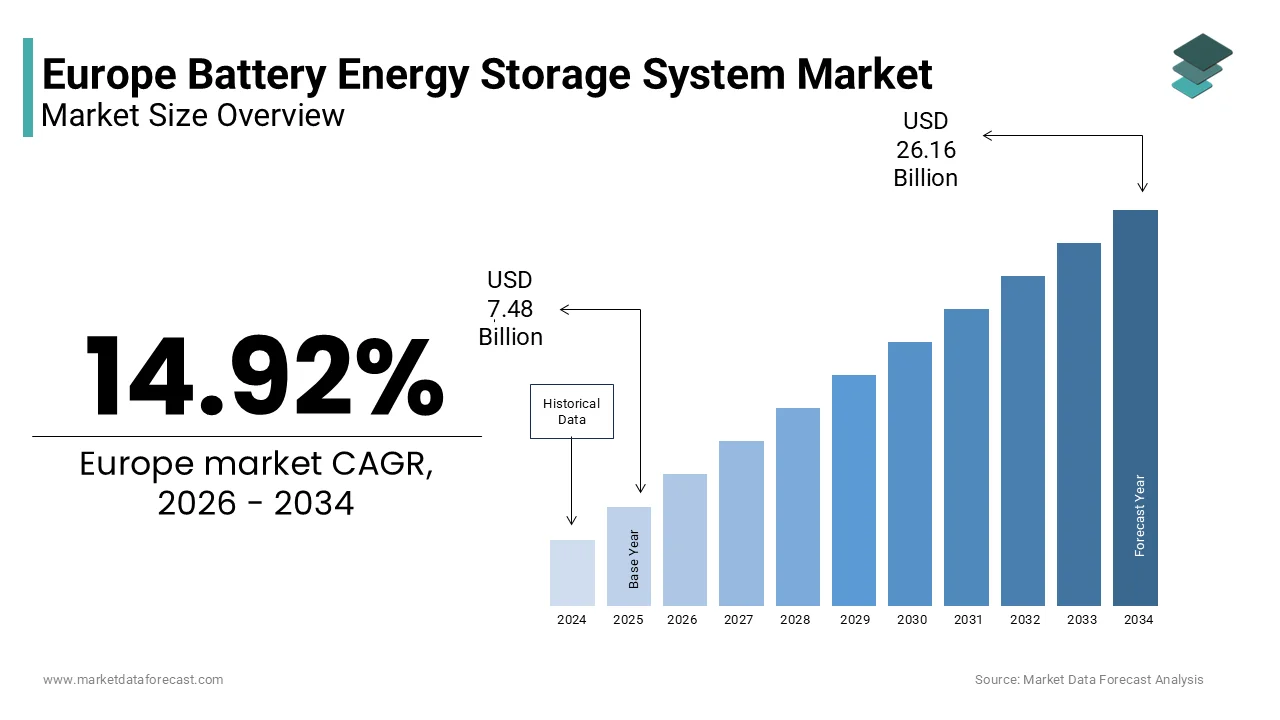
Battery energy storage system refer to electrochemical installations that store electrical energy for later discharge, primarily using lithium-ion chemistries, to provide grid stabilization, renewable integration, backup power, and demand management services. In Europe, the deployment of these systems has transitioned from pilot projects to mainstream infrastructure under the dual pressures of energy security and climate policy. According to sources, Europe is experiencing a significant expansion in operational battery storage capacity, with the rate of new additions accelerating rapidly in recent years. National energy and climate plans from all 27 member states now include explicit storage deployment roadmaps, and the EU’s revised Electricity Market Design introduces new revenue streams for fast frequency response and capacity markets. This regulatory and systemic integration positions battery energy storage not as a peripheral asset but as a foundational pillar of Europe’s decarbonized power architecture.
MARKET DRIVERS
Integration of Variable Renewable Energy Sources into National Grids
Policymakers are focused on the imperative to balance electricity supply and demand as wind and solar penetration increases across national grids, which is a primary driver of the Europe battery energy storage systems market. According to studies, renewable sources have become a dominant part of the electricity mix in Europe, with wind and solar at the forefront of this expansion. Unlike dispatchable thermal plants solar and wind exhibit inherent variability requiring rapid response assets to maintain grid frequency within the mandated 50 hertz plus or minus 0.2 hertz tolerance. Battery storage systems can discharge within milliseconds making them ideal for providing frequency containment reserves. Batteries are the preferred technology for grid-balancing services because of their speed and precision, which allows them to quickly respond to changes in the grid. To make the best use of available clean energy, batteries are being increasingly installed alongside solar farms and wind turbines. This systemic need to absorb and time shift renewable output ensures sustained and growing demand for grid scale battery systems across Europe.
Energy Security Concerns Following Geopolitical Supply Disruptions
Heightened energy security priorities following the reduction in Russian natural gas imports accelerate the growth of the Europe battery energy storage systems market. Battery storage emerged as a strategic asset to reduce dependence on imported fossil fuels for peaking and backup power. The European Commission’s REPowerEU plan explicitly identifies energy storage as critical for short term supply resilience and long term decarbonization. In response countries like Italy and Poland fast tracked permitting for storage projects under emergency energy security provisions. Households also responded with record residential storage installations. This convergence of national security policy and consumer behavior has transformed battery storage from an environmental solution into a geopolitical necessity.
MARKET RESTRAINTS
Complex and Lengthy Grid Connection and Permitting Processes
Protracted and inconsistent grid connection procedures across member states delay project commissioning and increase financing costs, which is a major restraint in the Europe battery energy storage systems market. These delays arise from fragmented regulatory authorities overlapping environmental assessments and insufficient grid capacity allocation for non generating assets. In France grid operator RTE requires separate studies for energy import and export modes even though batteries operate bidirectionally. Similarly in Germany the Federal Network Agency classifies storage as a consumption asset for connection purposes but as a generation asset for market participation creating legal ambiguity. Persistent barriers in the current system will continue to hinder deployment velocity and discourage private investment until the EU's Grid Connection Directive is fully harmonized and storage is recognized as its own asset class.
High Upfront Capital Costs and Evolving Revenue Stack Uncertainty
Substantial initial investment requirements and uncertain long term revenue visibility hinder the expansion of the Europe battery energy storage systems market. More critically revenue streams are fragmented across energy arbitrage frequency services and capacity payments with significant variation by country. The EU’s Electricity Market Design aims to standardize remuneration but implementation lags. Many projects struggle with bankability and must depend on government grants or corporate power purchase agreements because they lack long-term revenue certainty and dedicated storage tariffs. This financial fragility limits deployment to well capitalized developers and slows mass market adoption.
MARKET OPPORTUNITIES
Co-location with Renewable Generation Under EU Solar and Wind Acceleration Initiatives
Policy mandates and financial incentives promote hybrid renewable plus storage projects, which create a major opportunity for the Europe battery energy storage systems market. The European Commission’s Solar Rooftop Initiative requires all new public and commercial buildings to install solar panels from 2026 and encourages paired storage to maximize self-consumption. According to studies, There is a strong trend toward integrating solar energy with battery storage to create more reliable and valuable power plants. This hybrid approach is driven by the need to manage the intermittency of solar power and is being supported by new regulations, government funding, and policy incentives like reserved auction capacity. As a result, a significant portion of new large-scale solar projects are now being built with co-located battery systems, creating hybrid solar-plus-storage facilities. These policy levers transform storage from a standalone investment into a value enhancing component of renewable development streamlining permitting and improving project economics through shared infrastructure and unified revenue streams.
Expansion of Residential and Community Storage Through National Subsidy Schemes
The residential and community battery storage segment offers a growth opportunity for the Europe battery energy storage systems market. This is driven by generous national subsidy programs and rising household electricity prices. According to sources, Across Europe, the cost of residential electricity has seen an upward trajectory in recent times. In response, governments have launched targeted incentives to accelerate behind the meter storage adoption. This financial context is driving the adoption of home solar energy storage solutions, supported by various government incentives and evolving energy market dynamics. Several European nations have implemented robust programs to encourage households to invest in storage technology. These programs not only reduce payback periods to under few years but also aggregate distributed storage into virtual power plants. Furthermore, the operational landscape is changing, with a notable number of home batteries in the Netherlands now actively participating in grid services through energy aggregators. This policy driven democratization of storage enhances grid resilience while creating a stable demand base insulated from utility scale market volatility.
MARKET CHALLENGES
Shortage of Skilled Workforce for System Integration and Grid Compliance
The acute shortage of engineers and technicians proficient in power electronics, grid code compliance, and battery management systems is a challenge for the Europe battery energy systems market. According to the European Commission’s 2023 Skills Forecast the clean energy transition will require 1.2 million new professionals by 2030 including 85000 specifically in energy storage integration. However vocational training programs remain underdeveloped with only few EU member states offering certified battery storage curricula. Existing electrical engineers often lack exposure to DC coupling bidirectional inverters and EN 50549 grid connection standards leading to project delays and commissioning errors. The complexity of coordinating with multiple stakeholders, grid operators component suppliers and safety inspectors, further exacerbates the skills gap. Without coordinated investment in education industry certification and cross border labor mobility Europe’s ambitious storage deployment targets may be technically feasible but practically unstaffed.
Dependence on Imported Battery Cells and Supply Chain Vulnerability
Strategic vulnerability due to near total reliance on imported lithium ion cells primarily from China, South Korea, and the United States obstructs the expansion of the Europe battery energy systems market. This dependency creates exposure to trade policy shifts logistics disruptions and quality inconsistencies. The European Commission’s Critical Raw Materials Act identifies lithium nickel and graphite as strategic but does not yet classify finished cells as critical components limiting policy support. The US Inflation Reduction Act further distorts global supply by incentivizing domestic content potentially diverting cell production away from Europe. Energy sovereignty and price stability within the EU will remain vulnerable until the Net Zero Industry Act successfully builds up domestic cell production and recycling capabilities, reducing reliance on external suppliers.
REPORT COVERAGE
| REPORT METRIC | DETAILS |
| Market Size Available | 2025 to 2034 |
| Base Year | 2025 |
| Forecast Period | 2026 to 2034 |
| CAGR | 14.92% |
| Segments Covered | By Battery Type, Connection Type, Component, Energy Capacity Range, Application, and Region |
| Various Analyses Covered | Global, Regional, & Country Level Analysis; Segment-Level Analysis; DROC, PESTLE Analysis; Porter’s Five Forces Analysis; Competitive Landscape; Analyst Overview of Investment Opportunities |
| Regions Covered | UK, France, Spain, Germany, Italy, Russia, Sweden, Denmark, Switzerland, Netherlands, Turkey, and the Czech Republic |
| Market Leaders Profiled | Tesla Inc., Contemporary Amperex Technology Co. Limited (CATL), LG Energy Solution Ltd., BYD Company Limited, Samsung SDI Co., Ltd., Siemens AG, ABB Ltd., Panasonic Holdings Corporation, RWE Group, and Vattenfall |
SEGMENTAL ANALYSIS
By Battery Type Insights
The lithium-ion batteries segment held the majority share of the Europe battery energy storage systems market in 2025. The prominence of the lithium-ion batteries segment is driven by their superior energy density cycle life and declining costs relative to alternatives. Lithium-ion technology offers millisecond response times high round trip efficiency exceeding significantly and deep cycling capability essential for frequency regulation and solar time shifting. The European Commission’s Electricity Market Design further incentivizes fast responding assets through new revenue streams solidifying lithium-ion as the technical baseline for modern storage. The mass production of lithium-ion cells for electric vehicles has driven down costs creating a cross sectoral benefit for stationary storage. European storage integrators source standardized LFP and NMC cells from global supply chains achieving lower prices. This scale advantage is unattainable for lead-acid which lacks automotive demand and suffers from lead price volatility. Apart from these, the European Battery Regulation mandates recycled content and carbon footprint declarations for new batteries from 2027 accelerating adoption of traceable lithium-ion cells from certified producers.
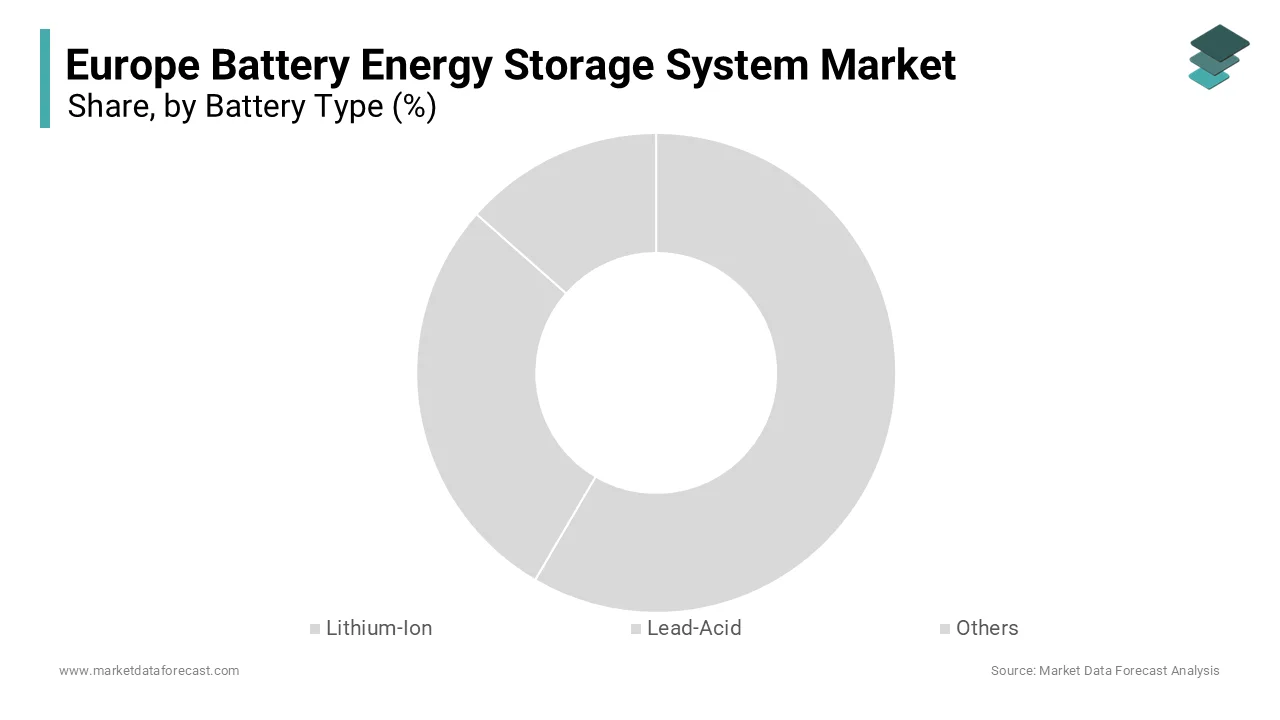
The lithium-ion segment remains the fastest growing segment in the Europe battery energy storage systems market with a projected CAGR of 31.2% from 2026 to 2034 due to policy alignment and technological maturity. The European Commission’s Net Zero Industry Act explicitly prioritizes electrochemical storage based on lithium-ion chemistries for strategic investment and state aid. National energy plans from member states designate lithium-ion as the default technology for grid scale and residential storage due to its compliance with safety and performance standards. This regulatory endorsement creates a self-reinforcing adoption cycle where policy drives deployment which further reduces costs through scale. The shift toward lithium iron phosphate chemistry has eliminated thermal runaway risks and extended cycle life. This makes LFP ideal for daily cycling applications in commercial and utility settings. Companies supply LFP cells specifically rated for stationary storage with several year warranties. These technical and safety improvements have removed the last major barriers to mass deployment across all European climate zones.
By Connection Type Insights
The on-grid segment led the Europe battery energy storage systems market in 2025 because of its integration into regulated power markets and grid infrastructure. On-grid systems can monetize multiple revenue streams including energy arbitrage frequency response and capacity payments through certified market participation. National grid operators increasingly require new renewable projects to include on grid storage to mitigate intermittency. This regulatory embedding ensures on grid storage remains the dominant model as Europe’s power system transitions to inverter based resources.
By Component Insights
The energy management software segment is predicted to witness the highest CAGR of 34.8% during the forecast period owing to need for advanced forecasting and optimized revenue stacking, and integration into virtual power plants and aggregation platforms. Storage project operators need AI-driven software to maximize revenue by predicting price spikes, frequency events, and weather patterns, especially as their assets participate in numerous overlapping markets. Companies offer cloud based platforms that integrate real time market data weather forecasts and asset health to automate bidding strategies. The EU’s upcoming grid digitalization directive will mandate such optimization capabilities for all assets above 1 megawatt by 2026. Distributed storage assets are increasingly enrolled in virtual power plants that aggregate capacity for grid services. Platforms use proprietary software to coordinate thousands of home batteries for grid balancing earning participants. This digital layer transforms physical storage into a programmable grid resource accelerating software adoption.
By Application Insights
The utility scale applications segment was the largest segment in the battery energy storage systems market by accounting for a 58.3% share in 2025. The dominance of the utility scale applications segment is driven by system level grid services and renewable integration mandates. Transmission system operators across Europe are procuring gigawatt scale battery capacity to replace fossil fuel peakers for frequency containment and voltage support. These long term agreements provide revenue certainty that enables project financing. The European Commission’s Electricity Market Design requires all member states to establish similar procurement mechanisms ensures sustained utility demand. EU member states must meet binding national contributions to the bloc’s renewable target by 2030 under the revised Renewable Energy Directive. Many countries now mandate or incentivize storage pairing to reduce curtailment and improve grid compatibility. This policy driven integration ensures utility scale storage remains the largest application segment as Europe’s power system decarbonizes.
The residential segment is estimated to register the fastest CAGR of 36.5% over the forecast period owing to national subsidy programs and rising household electricity prices, and integration into smart home ecosystems and virtual power plants. Soaring retail electricity prices have made self consumption economically compelling. Governments have responded with generous incentives. These schemes reduce payback periods to under six years. The European Commission’s Energy Poverty Observatory notes that storage adoption is now spreading beyond affluent households to middle income families seeking bill stability amid volatile energy markets. Modern residential systems integrate with smart meters heat pumps and electric vehicle chargers through energy management software. Platforms enroll households in virtual power plants paying notable euros annually for grid balancing participation. This convergence of energy autonomy economic return and digital convenience is accelerating residential adoption across Western and Central Europe.
REGIONAL ANALYSIS
Germany Market Analysis
Germany dominated the Europe battery energy storage systems market by occupying a 28.6% share in 2025, with its pioneering role in renewable integration and robust policy support. Germany’s KfW subsidy program provides 30 percent grants for home batteries paired with solar while the new Electricity Market Act enables storage to participate in redispatch markets. Apart from these, the federal government’s storage innovation fund supports next generation technologies like solid state and flow batteries. Germany’s combination of technical need regulatory foresight and consumer engagement makes it the undisputed leader in Europe’s storage transition.
United Kingdom Market Analysis
The United Kingdom was the second prominent country in the Europe battery energy storage systems market by accounting for a 17.4% share in 2025. It maintained strong growth through competitive ancillary service markets and streamlined permitting. Grid operators have substantially increased their procurement of battery capacity to manage grid stability, investing significantly in frequency response services. This strategic push is supported by a streamlined planning process, as the UK's permitted development rights for storage projects enable rapid deployment compared to typical European timelines. This efficiency has translated into the swift commissioning of a large amount of new capacity, including a very large array in West Burton. Future residential uptake is also being fostered through government policy which will mandate the inclusion of smart energy controls in all new homes. Despite Brexit the UK aligns with EU grid codes ensuring interoperability. Hence, the UK a high velocity market driven by market signals rather than subsidies.
Italy Market Analysis
Italy is expected to be the most lucrative region in the Europe battery energy storage systems market due to high electricity prices energy security concerns and aggressive subsidy schemes. It is experiencing a significant shift in its residential energy landscape, primarily driven by the increasing cost of household electricity. This economic pressure has directly led to a notable rise in homeowners adopting residential energy storage systems. The financial incentive provided by government-backed tax credits, which previously covered the full installation costs when part of a broader renovation, was a major catalyst in the surge of home battery installations. Simultaneously, the country's grid operator is actively increasing storage capacity at the utility scale to enhance grid stability and decrease reliance on energy imports.
France Market Analysis
France is moving ahead steadfastly in the Europe battery energy storage systems market, with state led energy transition planning and nuclear grid flexibility needs. The government has unveiled a significant initiative aimed at bolstering the national energy infrastructure through large-scale deployment of energy storage systems. This strategic plan earmarks billions of euros to develop a substantial storage capacity over the next decade. The grid operator has already given its approval to numerous projects, including innovative hybrid complexes that combine solar power generation with storage capabilities in the Occitanie region. To further incentivize development, the capacity market has begun including battery projects in its auctions, allocating hundreds of megawatts to storage for the first time. Simultaneously, the adoption of residential energy storage is accelerating, supported by government grants for homeowners installing home energy systems. France’s centralized approach ensures coordinated and sustained storage growth aligned with national decarbonization strategy.
Spain Market Analysis
Spain is likely to grow in the Europe battery energy storage systems market from 2026 to 2034 due to its solar boom and progressive grid regulations. Spain has solidified its position as Europe’s leading solar energy industry through a substantial expansion of its photovoltaic capacity. To address the inherent fluctuations of renewable energy sources, the national grid code requires significant integrated storage capacity for large-scale solar farms, fostering rapid growth in the development of hybrid power projects. A major energy company has inaugurated what is currently considered Europe's largest solar-plus-storage complex, located in the Extremadura region. The development of such infrastructure is supported by financial mechanisms designed to spur innovation within the European energy sector. The country’s strategic location also positions it as a future exporter of stored solar energy to Northern Europe via planned subsea interconnectors.
COMPETITIVE LANDSCAPE
KEY MARKET PLAYERS
Some of the notable key players in the Europe battery energy storage system market are
- Tesla, Inc.
- Contemporary Amperex Technology Co. Limited (CATL)
- LG Energy Solution Ltd.
- BYD Company Limited
- Samsung SDI Co., Ltd.
- Siemens AG
- ABB Ltd.
- Panasonic Holdings Corporation
- RWE Group
- Vattenfall
TOP STRATEGIES USED BY THE KEY MARKET PLAYERS
Key players in the Europe battery energy storage systems market focus on developing grid forming capabilities to support inverter based power systems and enhance grid resilience. They integrate advanced energy management software with artificial intelligence to optimize revenue stacking across multiple markets. Companies pursue strategic partnerships with transmission system operators renewable developers and utilities to secure long term offtake agreements and co located project pipelines. Vertical integration of battery cells power conversion systems and digital control platforms ensures performance consistency and supply chain security. Additionally, firms actively engage in policy advocacy to shape grid codes market rules and subsidy frameworks that recognize the full value of storage services. These strategies collectively address Europe’s unique technical regulatory and commercial landscape.
COMPETITION OVERVIEW
The Europe battery energy storage systems market features a dynamic mix of global technology providers specialized integrators and utility owned developers competing on performance reliability and digital sophistication. Unlike commodity markets competition centers on grid code compliance safety certification and revenue optimization capabilities rather than price alone. Incumbents like Fluence and Wärtsilä leverage decades of grid integration experience while innovators such as sonnen and Tesla dominate the residential segment through software and customer engagement. The EU’s stringent safety standards under EN 50694 and fire protection guidelines under CENELEC create high barriers to entry favoring established players with certified product portfolios. At the same time national differences in market design, such as the UK’s frequency response auctions versus Germany’s redispatch mechanisms, require localized commercial strategies. Competition is increasingly collaborative with joint ventures between cell makers inverter suppliers and aggregators becoming common to deliver end to end solutions. This ecosystem fosters innovation but consolidates the market around players with technical depth regulatory fluency and financial scale.
TOP PLAYERS IN THE EUROPE MARKET
- Fluence is a global leader in energy storage technology and services with a strong presence across Europe delivering grid scale and commercial battery energy storage systems. The company combines Siemens’ grid integration expertise with AES’s energy market experience to offer AI enabled storage platforms like Fluence IQ for revenue optimization. Fluence contributes globally by setting industry standards for safety interoperability and digital control in storage deployments. The company also launched its Gen6 platform in early 2025 featuring enhanced fire safety and longer duration capabilities aligned with EU grid code requirements reinforcing its position as a trusted partner for transmission operators and renewable developers.
- Wärtsilä Energy is a Finnish technology group specializing in flexible power generation and energy storage solutions with deep integration into European grid modernization programs. The company’s GEMS digital energy platform orchestrates batteries renewables and thermal assets to provide grid balancing and capacity services across multiple EU countries. Wärtsilä contributes globally by advancing grid forming inverter technology critical for inverter dominated power systems. The company also partnered with European transmission operators to validate black start capabilities under ENTSO E protocols. These actions demonstrate Wärtsilä’s role in transforming storage from an energy asset into a core grid stability resource.
- Sonnen is a German pioneer in residential and community battery energy storage operating one of Europe’s largest virtual power plants with over 200000 connected home systems. The company integrates lithium iron phosphate batteries with intelligent energy management software to enable self consumption grid services and peer to peer energy sharing. Sonnen contributes globally by proving the commercial viability of distributed storage aggregation at scale. The company also received certification for grid forming capabilities under Germany’s VDE AR N 4110 standard allowing home batteries to support local grid stability. These innovations position sonnen as a leader in democratizing energy storage while creating new revenue models for prosumers across Europe.
MARKET SEGMENTATION
This research report on the Europe battery energy storage system market has been segmented and sub-segmented based on categories.
By Battery Type
- Lithium-Ion
- Lead-Acid
- Others
By Connection Type
- On-Grid
- Off-Grid
By Component
- Battery Pack & Racks
- Energy Management Software
- Others
By Energy Capacity Range
- 10 to 100 MWh
- Above 500 MWh
- Others
By Application
- Utility
- Commercial & Industrial
- Residential
By Country
- UK
- France
- Spain
- Germany
- Italy
- Russia
- Sweden
- Denmark
- Switzerland
- Netherlands
- Turkey
- Czech Republic
- Rest of Europe