- Product Description Description
- Table of Contents TOC
- List of Table & Figure LOT
- Get Free Sample PDF Sample PDF
Market Size, 2025
$3.01 BnMarket Estimate, 2026
$3.81 BnMarket Forecast, 2034
$24.98 BnCAGR, 2026–2034
26.5%Europe Battery Management System Market Size, Growth, Trends & Forecast (2026–2034)
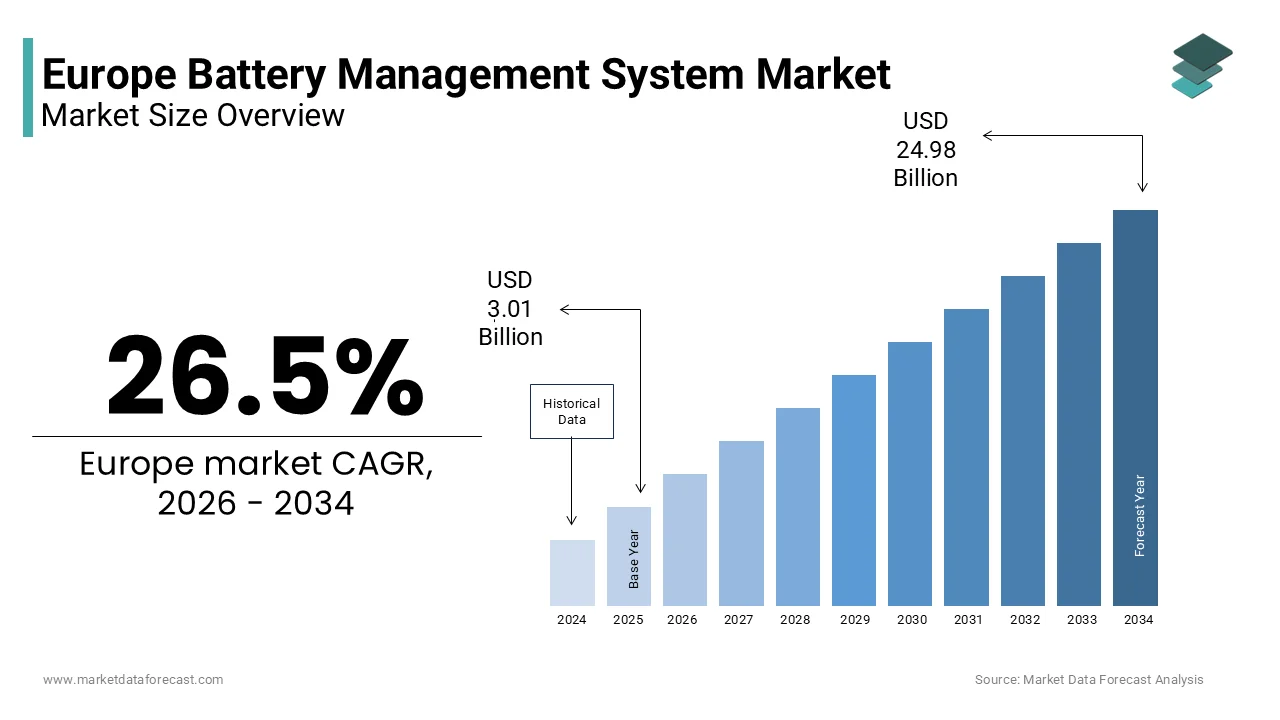
The Europe battery management system market size was valued at USD 3.01 billion in 2025, is estimated to reach USD 3.81 billion in 2026, and is projected to scale up to USD 24.98 billion by 2034, registering a staggering compound annual growth rate (CAGR) of 26.5% during the forecast period from 2026 to 2034. The market's aggressive expansion is intrinsically linked to the rapid electrification of passenger and commercial transport, the enforcement of rigorous EU safety mandates, and the integration of artificial intelligence for predictive battery health monitoring.
Key Executive Metrics (At-a-Glance)
- 2025 Base Valuation: USD 3.01 Billion
- 2026 Current Valuation: USD 3.81 Billion
- 2034 Forecast Valuation: USD 24.98 Billion
- Compound Annual Growth Rate (CAGR): 26.5% (2026–2034)
- Dominant Propulsion Segment: Battery Electric Vehicle (BEV) (holding majority market share driven by heavy reliance on large-capacity packs)
- Dominant Chemistry Segment: Lithium-ion (commanding leading share due to a mature manufacturing ecosystem and high energy density)
- Fastest-Growing Segments: Solid-State Batteries (24.2% CAGR) & Commercial Vehicles (15.4% CAGR)
- Dominant Region: Germany (serving as the central European manufacturing hub for original equipment manufacturers)
Core Market Drivers
- Stringent Safety Regulations: Mandates such as the new EU Battery Regulation requiring comprehensive digital battery passports by 2027 to ensure lifecycle traceability and safety.
- Commercial Fleet Electrification: Rapid deployment of electric buses, vans, and heavy-duty trucks to meet urban zero-emission zones, requiring robust industrial-grade BMS solutions.
- V2G & AI Integration: Advanced incorporation of artificial intelligence and machine learning to enable precise state-of-health predictions and bidirectional vehicle-to-grid power flow.
Primary Market Restraints & Challenges
- High Development Complexity: Substantial R&D costs associated with meeting ISO 26262 functional safety norms, serving as a barrier to entry for smaller manufacturers.
- Semiconductor Supply Volatility: Heavy reliance on imported high-precision analogue-to-digital converters and microcontrollers, exposing OEMs to geopolitical bottlenecks and long lead times.
- Cybersecurity Vulnerabilities: Heightened risks of cyber attacks targeting connected telematics, necessitating costly secure-by-design methodologies per the Cyber Resilience Act.
Europe Battery Management System Market Segmentation Breakdown
| Segment Category | Leading Sub-Segment (2025 Base) | Fastest-Growing Sub-Segment (2026–2034) |
|---|---|---|
| By Propulsion Type | Battery Electric Vehicle (dominant leader reliant on sophisticated central controllers for safety) | Plug-in Hybrid Electric Vehicle (fastest-growing at 12.8% CAGR, bridging the gap to full EV adoption) |
| By Vehicle Type | Passenger Cars (major volume driver backed by EU policies targeting 100% emission reduction by 2035) | Commercial Vehicles (fastest-growing at 15.4% CAGR fueled by green logistics and public transit mandates) |
| By Battery Chemistry | Lithium-ion (dominant chemistry supported by massive economies of scale and widespread integration) | Solid State Batteries (fastest-growing at 24.2% CAGR driven by next-gen thermal stability and density promises) |
| By Region | Germany (market anchor possessing robust automotive engineering and leading OEM assembly infrastructure) | United Kingdom & France (accelerating rapidly backed by aggressive net-zero phase-out plans and grid storage expansions) |
Major Industry Players Profiled
Key enterprises shaping the competitive Europe battery management system market include Robert Bosch GmbH, Denso Corporation, LG Energy Solution, Panasonic Holdings Corp., Continental AG, Marelli, Hitachi Astemo, Texas Instruments, Infineon Technologies, NXP Semiconductors, CATL (Europe), Sensata Technologies, and BYD Europe.
 Download Free Sample Report
Europe Battery Management System Market Size
The Europe battery management system market size was valued at USD 3.01 billion in 2025 and is estimated to reach USD 24.98 billion by 2034 from USD 3.81 billion in 2026, growing at a CAGR of 26.5%.
A Battery Management System (BMS) is an electronic control unit that protects, monitors, and optimises rechargeable batteries. Its core jobs include monitoring cell health, preventing safety hazards, and balancing energy. These systems ensure optimal performance by regulating voltage, temperature and current while preventing hazardous conditions such as thermal runaway or overcharging. The market is intrinsically linked to the rapid electrification of transport and the expansion of stationary energy storage infrastructure. According to the European Automobile Manufacturers’ Association, battery electric vehicles achieved a 14.6% market share of new car registrations in the European Union in 2023, reflecting an expanding infrastructure transition away from traditional internal combustion engines. As per the European Commission, implementing sustainable battery frameworks and lifecycle standards is vital for deploying clean technologies that advance the climate neutrality objectives outlined in the European Green Deal. With the implementation of the new EU Battery Regulation, manufacturers must adhere to strict sustainability and safety standards, which drive the demand for advanced diagnostic and tracking capabilities embedded within battery management systems. The integration of artificial intelligence allows for predictive maintenance and state of health estimation, extending battery lifespan and reducing waste. This technological evolution transforms battery management systems from passive monitoring devices into active intelligence hubs that optimise energy usage and enhance grid stability. The growing complexity of battery chemistries, including solid-state and lithium iron phosphate, further requires specialised management solutions tailored to specific electrochemical characteristics. Consequently, the market serves as a foundational enabler for the broader energy transition, ensuring reliability, safety and efficiency in an increasingly electrified economy.
MARKET DRIVERS
Stringent Safety Regulations and Compliance Mandates
The implementation of rigorous safety regulations and compliance mandates across the region fuels the growth of advanced systems in the Europe battery management system market. The new EU Battery Regulation establishes comprehensive requirements for battery durability, safety and carbon footprint transparency, compelling manufacturers to integrate sophisticated monitoring technologies. According to the European Parliament and the Council, the implementation of the EU Battery Regulation mandates that all industrial and electric vehicle batteries offered on the EU market must incorporate a digital battery passport starting from February 2027 to establish traceability across the regional battery ecosystem. This regulatory framework ensures that batteries are safe throughout their lifecycle from production to recycling. As per the European Union, specific restriction requirements for hazardous substances in traction and portable batteries are governed exclusively under EU Regulation 2023/1542 to streamline product safety and market surveillance compliance. The regulation also mandates minimum performance levels for cycle life and capacity retention, which can only be achieved through accurate state of charge and state of health estimation provided by high-quality management systems. Non-compliance results in significant penalties and market exclusion, driving automakers and energy storage providers to invest in certified and reliable solutions. The emphasis on fire safety, particularly in residential and commercial storage applications, further accelerates the deployment of systems with real-time thermal monitoring and fault detection capabilities. This legal imperative creates a non-negotiable demand for advanced battery management technologies, ensuring that safety remains paramount in the expanding electrified ecosystem.
Rapid Electrification of Commercial and Public Transport
The accelerated electrification of commercial fleets and public transportation networks further boosts the expansion of the Europe battery management system market. This significantly drives the demand for robust and scalable battery management systems in the region. Cities across the continent are implementing low-emission zones and phasing out diesel buses, leading to a surge in electric bus and truck deployments. According to the European Automobile Manufacturers' Association, commercial vehicle sales in Europe experienced significant growth, with registrations of fully electric vans and trucks almost quadrupling as logistics networks accelerate fleet substitution. Commercial operators prioritise total cost of ownership, making battery longevity and efficiency critical factors that depend on precise management algorithms. As per the International Council on Clean Transportation, public procurement allocations for zero-emission and alternatively fueled buses are climbing significantly to meet regional Clean Vehicles Directive mandates across Member States. The complexity of large-format battery packs used in trucks and buses necessitates modular and distributed management architectures to ensure uniform cell balancing and fault isolation. Public transit authorities mandate high availability and reliability standards, which are enforced through continuous monitoring and predictive maintenance features embedded in modern systems. The shift towards autonomous electric shuttles further increases the reliance on intelligent battery management for operational safety. This sectoral transformation generates consistent demand for industrial-grade battery management systems that offer superior performance and diagnostic capabilities compared to consumer-grade alternatives.
MARKET RESTRAINTS
High Development Costs and Technical Complexity
The substantial development costs and technical complexity associated with designing advanced BMSs are a significant limitation for smaller manufacturers and new entrants in the Europe battery management system market. Developing reliable algorithms for state of charge and state of health estimation requires extensive research and validation across diverse operating conditions, which demands significant financial investment. According to the European Investment Bank, smaller commercial industrial entities receive targeted intermediated lending packages of up to €12.5 million to improve their operational resilience and technical competitiveness in localised markets. The integration of hardware and software components must comply with rigorous functional safety norms such as ISO 26262, which adds layers of certification complexity and expense. As per the Fraunhofer-Gesellschaft, contract research collaborations with major global chemical and automotive companies are scaling up to jointly introduce innovative sustainable materials and advanced semiconductor systems into consumer markets. The rapid evolution of battery chemistries requires continuous updates to management algorithms, meaning that systems can become obsolete quickly if not designed with flexibility in mind. This constant need for innovation places a heavy burden on research budgets, limiting the ability of smaller players to compete with established giants. The high barrier to entry restricts market diversity and slows down the pace of innovation from niche specialists. Consequently, many companies opt for off-the-shelf solutions which may not be optimised for specific applications, leading to suboptimal performance and reduced competitiveness.
Supply Chain Volatility for Semiconductor Components
The volatility in the supply chain for specialised semiconductor components essential for BMSs is a critical obstacle to the growth and production stability in the Europe battery management system market. Battery management systems rely on high-precision analogue-to-digital converters, microcontrollers and communication chips which have faced global shortages and logistical bottlenecks. According to the European Union, regional industrial equipment manufacturers are navigating severe component volatility as average procurement lead times for key power management integrated circuits and microcontrollers stretch beyond 50 weeks. The dependence on Asian suppliers for key semiconductor materials exposes European manufacturers to geopolitical risks and trade fluctuations. As per Eurostat, extra-EU international trade parameters indicate that high-tech product shipments have risen to comprise approximately 20% of all regional import volumes. Price volatility for these components increases the overall cost of battery management systems, squeezing profit margins for original equipment manufacturers. The lack of domestic fabrication capacity for advanced nodes means that European companies have limited control over supply security. This uncertainty forces manufacturers to hold larger inventories, tying up capital and increasing storage costs. Furthermore, the complexity of qualifying alternative suppliers for safety-critical components extends the recovery time from disruptions. The market will remain vulnerable to external shocks that hinder consistent delivery and expansion plans. This vulnerability will last until local semiconductor production scales up sufficiently.
MARKET OPPORTUNITIES
Integration with Vehicle to Grid Technologies
The integration of battery management systems with vehicle-to-grid technologies offers a strong opportunity for Europe's market participants. This helps to expand functionality and the value proposition. As electric vehicles become mobile energy storage units, battery management systems must facilitate bidirectional power flow, allowing vehicles to supply electricity back to the grid during peak demand periods. According to the European Parliament, the rapid scaling of bidirectional charging frameworks will optimise regional short-term electricity storage assets to capture fluctuating renewable energy loads across Member States. Advanced battery management systems enable this by accurately estimating available energy and managing thermal loads during discharging cycles. As per the European Union, implementation of the revised Renewable Energy Directive accelerates regional energy consumption benchmarks to 42.5% by 2030, necessitating smart charging deployment to regulate escalating grid stress. The capability allows owners to monetise their battery assets by participating in energy markets, creating a new revenue stream. Manufacturers that develop interoperable systems compatible with various grid standards will gain a competitive edge. The growing number of smart meters and home energy management systems creates an ecosystem where battery management systems act as central controllers. This convergence of automotive and energy sectors opens new business models based on service rather than just hardware sales. By enabling seamless interaction with the grid, battery management systems become indispensable tools for the decentralised energy future.
Advancements in Artificial Intelligence and Machine Learning
The application of artificial intelligence and machine learning in BMSs unlocks potential to enhance performance prediction and extend battery lifespan, which is likely to accelerate the expansion of the Europe battery management system market. Traditional algorithms often struggle with the non-linear behaviour of ageing batteries, whereas AI-driven models can learn from vast amounts of operational data to provide more accurate state of health estimates. According to the International Renewable Energy Agency, the electrification of mobility systems is intensifying global electricity demands, accelerating the deployment of artificial intelligence and digitalised networks to manage complex grid power transformations. Machine learning algorithms enable adaptive charging strategies that optimise battery chemistry conditions based on usage patterns and environmental factors. As per the European Parliament, strategic multi-sector investments under European innovation frameworks prioritise building scalable local utility models to absorb and deploy variable alternative power generation. The technology enables personalised battery management that adjusts to individual driver behaviours or storage usage profiles. Cloud-based platforms aggregate data from thousands of units, improving algorithm accuracy through collective learning. The ability to detect micro shorts and internal defects early enhances safety and prevents catastrophic failures. Companies that embed AI capabilities into their hardware offerings can differentiate themselves in a crowded market. This technological leap transforms battery management from reactive monitoring to proactive optimisation, creating substantial value for end users.
MARKET CHALLENGES
Interoperability and Standardisation Issues
The lack of universal interoperability and standardisation among BMSs and charging infrastructure is a major challenge for seamless integration and user experience in the region, which slows down the growth of the Europe battery management systems market. Different manufacturers use proprietary communication protocols and data formats, which hinder the ability of battery management systems to interact effectively with third-party chargers and grid operators. The absence of a unified data exchange framework complicates the implementation of vehicle-to-grid services and smart charging initiatives. As per the European Union, strict mandatory regulatory baselines require that high-level communication protocols for vehicle DC charging systems natively comply with IEC 61851-24 and ISO 15118 parameters for regional market authorisation. The incompatibility increases development costs for manufacturers who must support multiple standards to ensure market access. It also creates confusion for consumers who face difficulties in integrating different energy components. The lack of standardised diagnostics interfaces makes it challenging for independent repair shops to service electric vehicles, affecting the right to repair movement. Regulatory bodies are pushing for open standards, but industry adoption remains uneven. Interoperability issues will continue to fragment the market and impede the widespread adoption of integrated energy solutions. This will happen until a cohesive ecosystem is established.
Cybersecurity Vulnerabilities in Connected Systems
The increasing connectivity of these systems introduces significant cybersecurity vulnerabilities that pose risks to both individual users and critical infrastructure, and ultimately impede the expansion of the Europe battery management system market. Modern battery management systems are connected to cloud platforms and vehicle networks, making them potential targets for cyber attacks that could compromise safety and data privacy. According to the European Union, enforcement timelines for the newly established Cyber Resilience Act require transport original equipment manufacturers to adopt robust, secure-by-design methodologies for software-defined electrical systems and telematics networks. A successful attack could manipulate charging parameters, leading to overheating or fire hazards, or steal sensitive user data regarding driving habits and location. As per the European Union, the rapid growth of smart automotive architectures is forcing the acceleration of specialised, industry-wide cybersecurity regulations to mitigate emerging vector threats against digital infrastructure components. Implementing robust cybersecurity measures adds complexity and cost to system design, requiring continuous updates to counter evolving threats. The lack of awareness among some suppliers about security best practices creates weak links in the supply chain. Regulatory frameworks like the Cyber Resilience Act mandate higher security standards, but compliance is challenging for complex embedded systems. The fear of liability and reputational damage makes manufacturers cautious about adopting fully connected features. Balancing connectivity benefits with security risks remains a critical challenge that requires ongoing vigilance and investment in secure-by-design principles.
REPORT COVERAGE
| REPORT METRIC | DETAILS |
| Market Size Available | 2025 to 2034 |
| Base Year | 2025 |
| Forecast Period | 2026 to 2034 |
| CAGR | 26.5% |
| Segments Covered | By Propulsion Type, Vehicle Type, Battery Chemistry, Topology, and Region |
| Various Analyses Covered | Global, Regional, & Country Level Analysis; Segment-Level Analysis; DROC, PESTLE Analysis; Porter’s Five Forces Analysis; Competitive Landscape; Analyst Overview of Investment Opportunities |
| Regions Covered | UK, France, Spain, Germany, Italy, Russia, Sweden, Denmark, Switzerland, Netherlands, Turkey, and the Czech Republic |
| Market Leaders Profiled | Robert Bosch GmbH, Denso Corporation, LG Energy Solution, Panasonic Holdings Corp., Marelli, Continental AG, Hitachi Astemo, Mitsubishi Electric Corp., Lithium Balance, Preh GmbH, NXP Semiconductors, Renesas Electronics, Analog Devices Inc., Texas Instruments, Infineon Technologies, Sensata Technologies, Johnson Matthey Battery Systems, CATL (Europe), BYD Europe, and Rimac Technology |
SEGMENTAL ANALYSIS
By Propulsion Type Insights
The battery electric vehicle segment was the largest in the Europe battery management system market in 2025 and occupied a commanding share. This prominence of the segment was supported by the absolute reliance on large-capacity battery packs for propulsion, which necessitates sophisticated monitoring and control systems. Unlike hybrid vehicles that have internal combustion engines as a backup, pure electric vehicles require precise state of charge and state of health management to ensure range reliability and safety. The larger battery capacities in these vehicles typically range from 50 to 100 kilowatt hours demand complex distributed battery management architectures to handle thermal regulation and cell balancing effectively. According to the International Energy Agency, global electric passenger vehicle deployment expanded by 20% year-on-year to push cumulative international electric car sales well above 20 million units. The elimination of the internal combustion engine simplifies the powertrain but increases the criticality of the battery system, making the battery management unit the central controller for vehicle performance. As per the European Parliament, regulatory baselines mandate that all new passenger cars and light commercial vehicles registered within the European Union must achieve a 100% reduction in carbon dioxide emissions by 2035. Manufacturers are investing heavily in optimising battery management algorithms to maximise range and minimise charging times, which are key selling points for consumers. This structural transition ensures that battery electric vehicles remain the primary driver of demand for high-end battery management systems in the region.
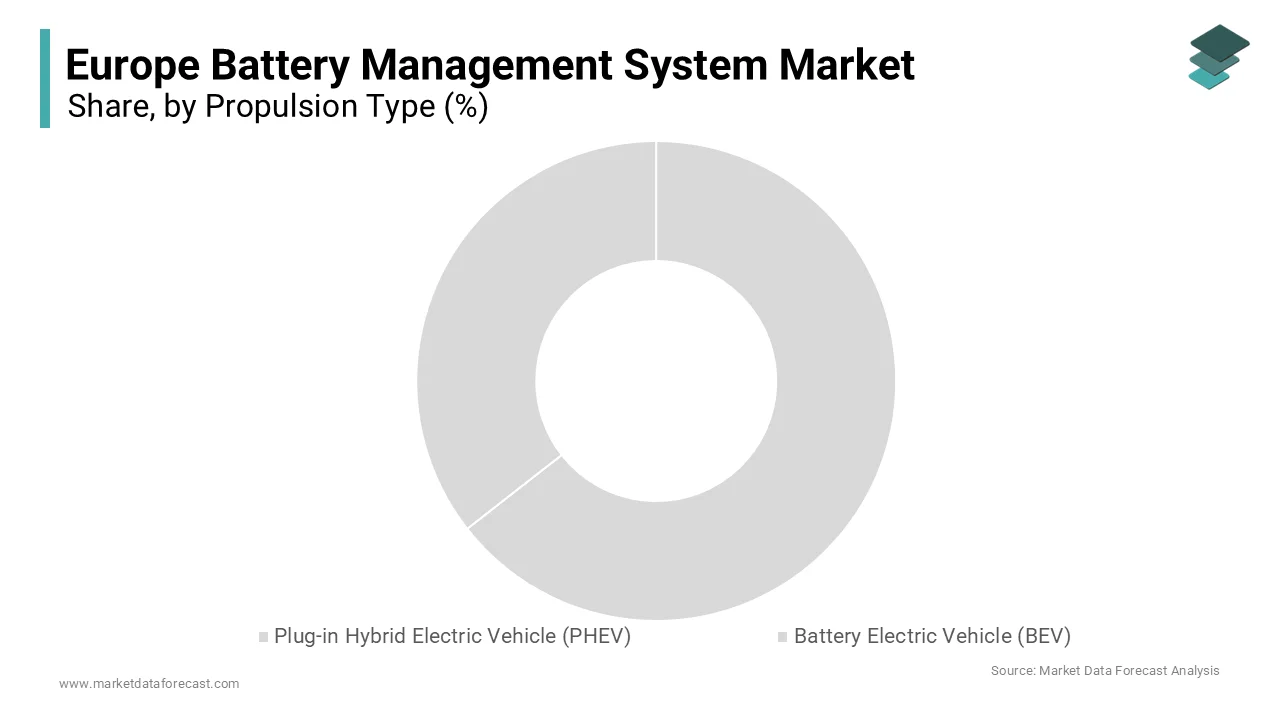
But the plug-in hybrid electric vehicle segment is likely to experience the fastest CAGR of 12.8% between 2026 and 2034 due to its role as a transitional technology for consumers hesitant to adopt fully electric vehicles. These vehicles combine an internal combustion engine with a rechargeable battery, offering flexibility and reduced range anxiety, which appeals to a broad demographic in Europe. According to Eurostat, new passenger vehicle registrations within the European Union indicate that plug-in hybrid cars experienced a 34.2% year-on-year surge to exceed one million total units. The complexity of managing two power sources requires specialised battery management systems that can optimise the interaction between the electric motor and the engine for maximum efficiency. As per the European Environment Agency, battery electric and plug-in hybrid vehicle models collectively comprise a core pillar of the European car market to lower average fleet carbon dioxide emissions. The smaller battery packs in these vehicles still require precise monitoring to ensure longevity and safety, particularly given the frequent cycling between electric and combustion modes. Automakers are introducing plug-in hybrids with larger electric ranges, which necessitates more advanced battery management capabilities similar to those in pure electric vehicles. Government incentives in several European countries continue to support plug-in hybrid purchases, making them an attractive option for fleet operators and private buyers alike. This sustained interest drives rapid adoption of specialised battery management technologies tailored for hybrid architectures.
By Vehicle Type Insights
In 2025, the passenger cars segment held the majority share in the Europe battery management system market because of the high volume of electric vehicle sales and stringent safety regulations governing personal transportation. The mass adoption of electric sedans, SUVs and hatchbacks across Europe creates a consistent and large-scale demand for reliable and cost-effective battery management solutions. According to the European Automobile Manufacturers' Association, battery electric vehicles secured a 14.6% market share of new car registrations in the European Union in 2023, establishing a critical baseline for consumer adoption trends. Consumer expectations for range, safety and charging speed drive manufacturers to integrate advanced battery management systems capable of real-time diagnostics and thermal optimisation. The competitive nature of the passenger car market forces automakers to differentiate through battery performance, which is directly controlled by the management system. Regulatory standards such as UN ECE Regulation 100 mandate rigorous testing for electrical safety, pushing manufacturers to adopt high-quality management units. The economies of scale in passenger car production allow for continuous improvement and cost reduction of battery management components. This volume-driven dynamic ensures that the passenger car segment remains the largest contributor to market revenue and technological innovation.
On the contrary, the commercial vehicles segment is anticipated to grow at the highest CAGR of 15.4% during the forecast period, fueled by the electrification of urban logistics, public transport and heavy-duty trucks. Cities across Europe are implementing zero-emission zones and clean air directives which compel fleet operators to transition to electric buses, delivery vans and trucks. As per the European Union, the newly introduced Automotive Package establishes a targeted regulatory framework to accelerate clean mobility systems and support long-term manufacturing competitiveness. Commercial applications involve intense usage patterns and high energy demands, which necessitate durable and highly efficient battery management solutions to minimise downtime and maintenance costs. According to the International Council on Clean Transportation, new registrations of zero-emission buses and coaches across the European Union grew by 50% year-on-year to reach 6,425 total units. These systems must handle higher voltages and currents while ensuring safety in dense urban environments. The total cost of ownership benefits of electric commercial vehicles depend heavily on battery longevity, which is optimised by advanced management algorithms. Government subsidies for green fleets further incentivise adoption. The complexity of managing large format batteries in trucks and buses requires modular and scalable management architectures. This strategic shift towards sustainable logistics drives the rapid expansion of the commercial vehicle segment in the battery management system market.
By Battery Chemistry Insights
The lithium-ion chemistry segment led the Europe battery management system market and captured a significant share in 2025. This leading position of the segment was attributed to its widespread adoption in electric vehicles and stationary storage applications owing to its high energy density and mature manufacturing ecosystem. The majority of electric vehicles currently on European roads utilize lithium ion batteries, which require precise voltage and temperature monitoring to prevent degradation and ensure safety. As per the International Energy Agency, global deployment of lithium iron phosphate chemistries expanded rapidly to account for over 55% of the total electric vehicle battery market share. The established supply chain and proven performance record make lithium-ion the default choice for automakers and energy storage providers. According to the Joint Research Centre, mass production efficiencies driven by electric car adoption are projected to lower average lithium-ion cell fabrication costs by at least 50% by 2030. Battery management systems for lithium-ion cells are highly optimised with extensive data libraries for accurate state estimation. The continuous improvement in lithium-ion technology, such as nickel manganese cobalt and lithium iron phosphate variants, requires adaptable management software. Regulatory support for recycling and second-life applications also favors lithium ion due to the existing infrastructure. This dominance ensures that battery management system developers focus primarily on optimising algorithms for lithium-ion chemistries. The sheer volume of installations sustains the leadership of this segment despite the emergence of alternative technologies.
However, the solid state batteries segment is on the rise and is expected to be the fastest-growing segment in the market with a CAGR of 24.2% from 2026 to 2034. This swift expansion of the segment is fuelled by their potential to overcome the limitations of liquid electrolyte lithium-ion batteries, including safety risks and energy density constraints. These batteries use a solid electrolyte, which eliminates the risk of leakage and thermal runaway, allowing for simpler and potentially less complex battery management requirements in terms of safety monitoring. Major European automakers and battery manufacturers are investing heavily in pilot production lines aiming for market entry in the late 2020s. As per the Fraunhofer Institute for Material and Beam Technology, European collaborative research initiatives are actively developing advanced solid-state chemistries to achieve next-generation cell energy densities of up to 550 watt-hours per kilogram. Although currently in the development phase, the anticipation of commercial rollout drives early investment in specialised battery management systems capable of handling the unique electrochemical characteristics of solid-state cells. The higher operating temperatures and different impedance profiles require new algorithms for state of charge estimation. Early adopters in premium vehicle segments will drive initial demand. The promise of enhanced safety and performance positions solid state batteries as the most dynamic growth area in the market.
REGIONAL ANALYSIS
Germany Market Analysis
Germany dominated the Europe battery management system market and accounted for a substantial share in 2025. This dominance of the German market was driven by its robust automotive industry and strong commitment to electromobility. The country is home to major original equipment manufacturers who are aggressively transitioning to electric vehicle production, driving demand for advanced battery management technologies. According to the Federal Ministry for Economic Affairs and Climate Action, Germany is implementing targeted framework incentives to reach its national deployment target of 15 million electric vehicles on the road by 2030. The presence of leading battery cell manufacturers and research institutions fosters innovation in battery management algorithms and hardware. As per the German Federal Statistical Office, domestic manufacturing of fully electric cars experienced an 86% year-on-year increase as the industrial sector scales up assembly infrastructure. Government incentives for electric vehicle purchases and charging infrastructure development support market growth. The strict regulatory environment ensures high standards for safety and performance, driving the adoption of sophisticated management systems. German engineering expertise in embedded systems and software development provides a competitive advantage. The focus on Industry 4.0 integrates battery management with broader vehicle connectivity initiatives. This combination of industrial strength policy support and technological leadership positions Germany as the central hub for the regional market.
United Kingdom Market Analysis
The United Kingdom followed closely behind in the Europe battery management system market and held a significant share in 2025. This growth of the UK market was supported by its ambitious net zero targets and growing electric vehicle adoption. The government’s plan to ban the sale of new petrol and diesel cars by 2030 has accelerated the transition to electrification, creating steady demand for battery management solutions. According to the UK Department for Transport, licensed zero-emission vehicle registrations in the United Kingdom expanded by 37% year-on-year to surpass 1.6 million total active vehicles on the road. The UK has a strong heritage in automotive engineering and software development, which supports the local design and integration of battery management systems. As per the UK Office for National Statistics, regional vehicle manufacturing streams are aligning operations with automated component integration protocols to manage the structural transition toward alternative fuel architectures. Government grants for plug-in vehicles and charging infrastructure encourage consumer uptake. The focus on grid stability and energy storage also drives demand for stationary battery management systems. The presence of innovative startups and research centres fosters technological advancement. Post Brexit regulations are being aligned with international standards to maintain competitiveness. The emphasis on sustainability and innovation ensures the UK remains a key player in the regional market.
France Market Analysis
France is a key player in the Europe battery management system market due to its strong nuclear energy base and proactive electric vehicle policies. The French government offers substantial subsidies for electric vehicle purchases and has invested heavily in domestic battery production through initiatives like the Verkor gigafactory. According to the French Ministry of Ecological Transition, national strategic planning mandates a transition toward low-carbon mobility infrastructure to achieve sector-wide transport decarbonisation objectives by 2050. The country has a well-established automotive industry with manufacturers focusing on affordable electric models that require cost-effective yet reliable management solutions. As per the National Institute of Statistics and Economic Studies, domestic passenger transportation metrics indicate that carbon dioxide emissions from commuter transport are the primary target for structural clean fleet substitution policies. The emphasis on energy sovereignty and reducing carbon emissions supports market expansion. French companies are active in developing software and algorithms for battery management, leveraging the country’s strong IT sector. Regulatory frameworks promote safety and recycling, encouraging innovation in management technologies. The integration of renewable energy sources also boosts demand for stationary storage management. This supportive ecosystem sustains France’s prominent role in the market.
Italy Market Analysis
Italy holds a notable share in the Europe battery management system market owing to its automotive heritage and increasing focus on sustainable mobility. The country is home to major automotive brands that are expanding their electric vehicle portfolios, creating demand for integrated battery management solutions. According to the Italian National Institute of Statistics, household expenditure on regional public and private transport modes is shifting toward alternative transport platforms as part of macroeconomic structural changes. The government’s incentive schemes for low-emission vehicles support market development. The industrial sector in northern Italy is increasingly adopting electric logistics vehicles, driving demand for commercial-grade battery management systems. As per the Italian Ministry of Economic Development, the state-allocated recovery framework actively funnels specific capital credit assets into private sector research and green transition processes under the "Transizione 4.0" industry strategy. The presence of specialised engineering firms supports the design and manufacturing of battery components. The challenge of ageing infrastructure in some regions highlights the need for reliable energy storage and management. The cultural shift towards sustainability and the popularity of small urban electric vehicles create niche opportunities. Italy’s focus on design and innovation adds value to its market contributions.
Spain Market Analysis
Spain is an emerging player in the Europe battery management system market because of its strong renewable energy potential and growing automotive manufacturing base. The country has attracted significant investment in electric vehicle and battery production with several major projects underway. According to the Spanish Ministry for Ecological Transition and the Demographic Challenge, the government has mobilised a €5 billion industrial framework via the Strategic Project for Economic Recovery and Transformation of the Electric and Connected Vehicle to accelerate electric mobility ecosystems. The abundant solar resources drive demand for stationary battery storage systems, which require advanced management for grid integration. As per the Spanish National Statistics Institute, consumer consumption shifts across metropolitan areas are experiencing evolving green infrastructure changes that align with localised sustainable development goals. The government’s Moves plan provides funding for charging infrastructure and vehicle purchases supporting market growth. Spanish companies are developing expertise in battery technology and software, contributing to the regional supply chain. The focus on tourism and sustainable transport encourages the electrification of public fleets. The favourable climate and policy support position Spain as a growing contributor to the market.
COMPETITIVE LANDSCAPE
The competitive landscape of the Europe battery management system market is characterized by intense rivalry between established automotive suppliers specialized semiconductor firms and emerging technology startups. Leading companies differentiate themselves through technological innovation focusing on accuracy safety and integration capabilities to meet the complex requirements of modern electric vehicles. Competition extends beyond hardware specifications to encompass software algorithms cybersecurity features and after sales support which are critical for long term reliability. Strategic alliances with battery cell producers and automakers create ecosystems that enhance value propositions and accelerate time to market. Price competition is moderated by the high barriers to entry related to functional safety certifications and regulatory compliance. Market consolidation occurs as larger entities acquire niche specialists to gain proprietary technologies and expand product portfolios. The push for standardization and interoperability influences competitive dynamics encouraging collaboration alongside competition. Ultimately success depends on balancing cost efficiency with superior performance and adaptability to evolving battery chemistries and grid integration needs across the diverse European automotive sector.
KEY MARKET PLAYERS
Some of the key players in Europe battery management system market are
- Robert Bosch GmbH
- Denso Corporation
- LG Energy Solution
- Panasonic Holdings Corp.
- Marelli
- Continental AG
- Hitachi Astemo
- Mitsubishi Electric Corp.
- Lithium Balance
- Preh GmbH
- NXP Semiconductors
- Renesas Electronics
- Analog Devices Inc.
- Texas Instruments
- Infineon Technologies
- Sensata Technologies
- Johnson Matthey Battery Systems
- CATL (Europe)
- BYD Europe
- Rimac Technology
Top Players in the Market
- Robert Bosch GmbH maintains a leading position in the Europe battery management system market by leveraging its extensive expertise in automotive electronics and semiconductor technology. The company develops integrated hardware and software solutions that ensure precise monitoring and safety for electric vehicle battery packs. Recently Bosch expanded its production capacity for battery control units in Germany to meet the surging demand from European automakers. They actively collaborate with cell manufacturers to optimize battery performance through advanced algorithms. Their focus on functional safety and cybersecurity aligns with strict European regulations enhancing trust among original equipment manufacturers. This strategic integration of components and software strengthens their role as a key enabler of sustainable mobility across the continent.
- Continental AG serves as a major contributor to the Europe battery management system market through its comprehensive portfolio of high voltage battery electronics and energy management solutions. The company provides scalable battery management systems that support various chemistries and vehicle architectures ensuring optimal efficiency and longevity. Continental recently launched new modular battery control units designed for next generation electric platforms offering enhanced diagnostic capabilities. They partner with leading chipmakers to secure supply chains and improve processing power. Their emphasis on open architecture allows for seamless integration with third party software fostering innovation. This approach reinforces their reputation for reliability and technological advancement in the rapidly evolving European electrification landscape.
- NXP Semiconductors N.V. plays a critical role in the Europe battery management system market by supplying essential microcontrollers and analog front end chips that form the backbone of battery monitoring systems. The company focuses on developing highly accurate and secure semiconductor solutions that enable precise state of charge and health estimation. NXP recently introduced new automotive grade processors with enhanced security features to protect against cyber threats in connected vehicles. They work closely with European tier one suppliers to co develop optimized reference designs. Their commitment to safety standards and energy efficiency drives adoption among major automakers. This foundational contribution ensures robust performance and reliability for battery management applications throughout the region.
Top Strategies Used by Key Market Participants
Key players in the Europe battery management system market prioritize strategic partnerships with battery cell manufacturers and automotive original equipment manufacturers to co develop integrated solutions that enhance performance and safety. Companies invest heavily in research and development to create advanced algorithms for artificial intelligence driven state estimation and predictive maintenance capabilities. Expansion of local production facilities and supply chain diversification helps mitigate risks associated with semiconductor shortages and geopolitical tensions. Compliance with stringent European safety and cybersecurity regulations remains a central strategy to ensure market access and build consumer trust. Manufacturers focus on modular and scalable hardware architectures to serve diverse vehicle segments from passenger cars to commercial trucks. Software defined vehicle initiatives drive the adoption of over the air updates for continuous improvement of battery management functions. These strategies collectively strengthen competitive positioning and support the rapid electrification of transport in Europe.
MARKET SEGMENTATION
This research report on the Europe battery management system market is segmented and sub segmented into following categories
By Propulsion Type
- Plug-in Hybrid Electric Vehicle (PHEV)
- Battery Electric Vehicle (BEV)
By Vehicle Type
- Passenger Cars
- Commercial Vehicles
- Two-Wheeler and Micro-mobility
By Battery Chemistry
- Lithium-ion
- Solid-state (pre-commercial)
- Other Chemistries
By Topology
- Centralized
- Distributed
- Modular
By Country
- UK
- France
- Spain
- Germany
- Italy
- Russia
- Sweden
- Denmark
- Switzerland
- Netherlands
- Turkey
- Czech Republic
- Rest of Europe