- Product Description Description
- Table of Contents TOC
- List of Table & Figure LOT
- Get Free Sample PDF Sample PDF
Market Size, 2025
$32.38 BnMarket Estimate, 2026
$33.68 BnMarket Forecast, 2034
$46.09 BnCAGR, 2026–2034
4%Executive Summary: Europe Broccoli Seeds Market
- Market Scope: Regional analysis of the European broccoli seeds market covering growth cycles, package types, application fields, country-level breakdowns, and climate-resilient hybrid breeding trends.
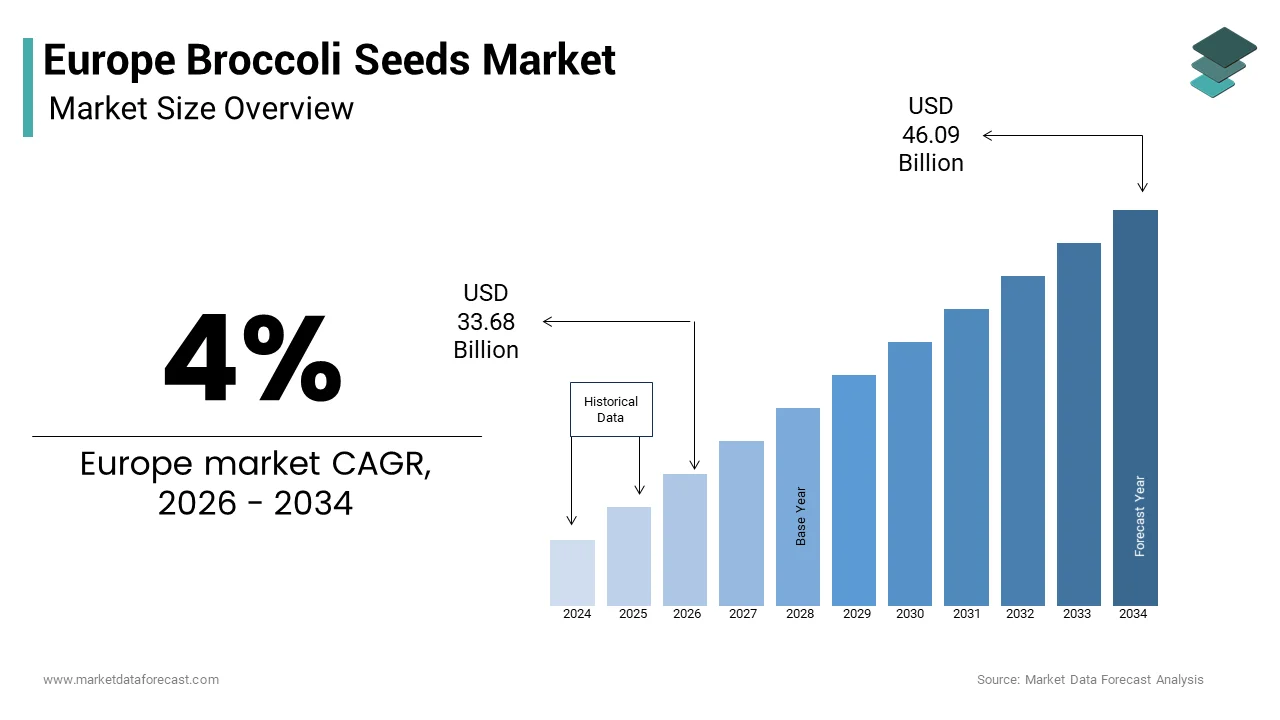
- Market Valuation: Valued at USD 32.38 billion in 2025, estimated at USD 33.68 billion in 2026, and projected to reach USD 46.09 billion by 2034, registering a steady CAGR of 4% from 2026 to 2034.
- Primary Growth Drivers: Rising consumer demand for nutrient-dense cruciferous vegetables under EU health policies; expansion of protected greenhouse cultivation and year-round production systems; and the need for heat-tolerant, disease-resistant hybrid genetics.
Key Market Segment Metrics (2026–2034)
| Category | Leading Segment / Position | Fastest-Growing Segment / Breakdown |
|---|---|---|
| By Growth Cycle | Medium Maturing Varieties (Held 52.3% share in 2025, favored for optimal yield stability and head uniformity) | Early Maturing Varieties (Projected at a CAGR of 7.4%, driven by off-season supply and climate adaptation needs in Southern Europe) |
| By Package Type | Bagged (Captured 32.2% share, utilizing tamper-evident polyethylene/foil pouches for regulatory compliance) | Bagged / Sustainable Packaging (Witnessing a CAGR of 5.1%, driven by compostable PLA/PHA materials and QR-coded digital batch tracking) |
| By Application | Farmland / Open Field (Held a dominant market share due to large-scale commercial production in Italy, Spain, and France) | Greenhouses (Projected at a CAGR of 8.9%, propelled by year-round local supply and protected climate-resilient farming) |
| By Country / Region | Italy (Top producer holding 28.3% share in 2024) & Spain (Captured 22.3% share via intensive export-oriented tunnels) | Netherlands (Innovation engine for greenhouse breeding technology and seed exports). Additional coverage includes UK, France, Germany, Russia, Sweden, Denmark, Switzerland, Turkey, Czech Republic, and Rest of Europe. |
Major Market Players & Market Structure
Market Structure: Highly competitive landscape defined by scientific precision, disease resistance, regional agronomic adaptation, and compliance with strict EU seed marketing directives.
Key Companies: Monsanto, Limagrain, Bayer Crop Science, Syngenta, Enza Zaden, Sakata Seed Europe, Rijk Zwaan, Bejo Zaden, East-West Seed, Takii, VoloAgri, Nongwoobio, Dongya Seed, Jiangsu Seed, and Asia Seed.
Europe Broccoli Seeds Market Size
The European broccoli seed market was valued at USD 32.38 billion in 2025 and is anticipated to reach a valuation of USD 33.68 billion in 2026 from USD 46.09 billion by 2034, growing at a CAGR of 4% from 2026 to 2034.
Current Introduction and Definition of the European Broccoli Seeds Market
The broccoli seeds are certified seed varieties, where hybrid, open-pollinated, and organic specifically developed for broccoli cultivation across diverse agroclimatic zones in the European Union. These seeds are engineered for traits, such as heat tolerance, disease resistance (notably to clubroot and downy mildew), uniform head formation, and extended harvest windows to meet the demands of both field and protected cultivation. According to the European Commission’s Common Catalogue of Varieties, over 180 broccoli cultivars were officially registered for EU sale in 2024, each requiring multi-year DUS (Distinctness, Uniformity, Stability) testing. As per Eurostat, broccoli production in the EU reached 620,000 metric tons in 2024, with Italy, Spain, and France accounting for 72% of output, driving consistent demand for regionally adapted seed genetics. The European Seed Association emphasizes that all commercial broccoli seeds must comply with EU seed marketing directives, ensuring traceability, phytosanitary safety, and varietal purity. This regulatory embedding positions broccoli seeds not as generic inputs but as precision agricultural tools aligned with Europe’s food security, biodiversity, and climate resilience objectives.
MARKET DRIVERS
Rising Consumer Demand for Nutrient-Dense Vegetables Under EU Nutrition Policies
Broccoli’s status as a nutrient-rich cruciferous vegetable has been amplified by public health campaigns promoting plant-based diets and cancer-preventive nutrition. The rising consumer demand for nutrient-dense vegetables is solely accelerating the growth of Europe broccoli seeds market. According to the European Food Safety Authority, broccoli is recognized as a source of vitamin C, folate, and glucosinolate compounds linked to reduced risk of chronic diseases. France’s National Nutrition and Health Program reported a 24% increase in household broccoli purchases between 2022 and 2024, driven by media coverage of its antioxidant properties. Similarly, Germany’s Federal Ministry of Food and Agriculture noted that 68% of supermarkets now feature broccoli in weekly promotions due to consistent consumer demand. This sustained dietary preference translates directly into stable planting area expansion in EU broccoli cultivation, since 2021, whichis fueling reliable demand for high-performance seeds tailored to local growing conditions and harvest cycles.
Expansion of Protected Cultivation and Year-Round Production Systems
The shift toward greenhouse and tunnel farming enables a year-round broccoli supply, increasing reliance on specialized seed varieties with controlled bolting and compact head formation. The expansion of protected cultivation and year-round production systems is additionally elevating the growth of Europe broccoli market. In the Netherlands, the Product Board for Horticulture reported that 41% of broccoli grown in greenhouses in 2024 used hybrid seeds specifically bred for low-light tolerance and uniform maturity for mechanical harvesting. Spain’s Ministry of Agriculture confirmed that Murcia and Almería regions now produce broccoli 10 months per year using heat-tolerant F1 hybrids resistant to premature flowering. The modernized horticultural infrastructure under the Common Agricultural Policy further incentivizes intensive broccoli systems. This structural move toward controlled-environment agriculture elevates seed quality from a cost factor to a yield-determining variable, driving demand for advanced, climate-resilient broccoli genetics.
MARKET RESTRAINTS
Stringent EU Regulations on Seed Registration and Genetic Innovation
The European Union’s conservative stance on plant breeding innovation significantly slows the introduction of improved broccoli varieties, particularly those developed through new genomic techniques. The stringent EU regulations on seed registration and genetic innovation isarempeding the growth of Europe broccoli seed market. According to the European Commission’s Seed Marketing Directive, all new broccoli cultivars must undergo 2–3 years of DUS testing and official registration before commercialization, a process that excludes many gene-edited llines In 2024, the European Court of Justice reaffirmed that organisms obtained by mutagenesis techniques like CRISPR-Cas9 remain subject to GMO regulations, preventing their use in conventional seed development. As per the European Seed Association, only 12 new broccoli hybrids entered the EU Common Catalogue in 2024, compared to 35 in the United States, reflecting regulatory lag.
High Susceptibility to Soil-Borne Diseases and Limited Resistant Varieties
Broccoli remains highly vulnerable to clubroot, Fusarium wilt, and black rot diseases that persist in European soils and reduce yields by up to 50% in infested fields. The high susceptibility to soil-borne diseases and limited resistant varieties are also hampering the growth of Europe broccolseeds market. According to the French National Institute for Agricultural Research INRAE, over 38% of broccoli-growing regions in Northern France show moderate to severe clubroot pressure, yet fewer than 15 commercially available EU seed varieties offer robust resistance. In Italy, the Council for Agricultural Research reported that Fusarium outbreaks in Emilia-Romagna caused €12 million in losses in 2024 due to a lack of tolerant hybrids. As per the UK’s Agriculture and Horticulture Development Board, crop rotation intervals for broccoli have extended to 5–7 years in affected areas, reducing land-use efficiency. While some Dutch and German breeders have introduced partial resistance, complete immunity remains elusive under EU organic and conventional standards. This agronomic fragility forces growers to rely on costly soil fumigation or fallowing practices increasingly restricted under the EU Sustainable Use Regulation, making disease resistance the most critical unmet need in broccoli seed development.
MARKET OPPORTUNITIES
Development of Climate-Resilient and Heat-Tolerant Hybrid Varieties
The rising temperatures and erratic spring weather across Southern and Central Europe, whichresist bolting and maintain head quality under thermal stress, will majorly expand the growth of the European broccoli seeds market in the coming years. According to the European Environment Agency, the number of days above 30°C in major broccoli-growing regions like Andalusia and the Po Valley increased by 22 days annually between 2019 and 2024, triggering premature flowering in traditional varieties. The Wageningen University in the Netherlands developed experimental hybrids with delayed bolting genes that maintained compact heads at 28°C, yielding 30% more marketable produce in 2024 trials. As per the European Commission’s Horizon Europe program, €42 million was allocated in 2024 to projects focused on heat-resilient brassica breeding, including broccoli. Companies like Rijk Zwaan and Syngenta are piloting these next-generation hybrids in Spain and Greece, where summer production is expanding.
Integration of Broccoli into EU Organic and Agroecological Farming Schemes
The EU’s push toward organic and low-input systems is driving demand for open-pollinated and organic-certified broccoli seeds that support biodiversity and soil health. The integration of broccoli into EU organic and agroecological farming solutions is expected to amplify the growth of the European broccoli seeds market. According to the European Commission, organic vegetable area grew by 11% in 2024, with broccoli among the top five crops due to its pest-repellent glucosinolates and rotational benefits. In Denmark, the Organic Farmers’ Association reported that 63% of organic broccoli growers switched to certified organic seeds in 2024 to comply with new EU organic regulation 2018/848, which mandates organic propagation material where available. As per France’s Agence Bio, sales of organic broccoli seeds rose by 29% between 2022 and 2024, led by varieties with enhanced vigor and cold tolerance for early spring planting. Seed cooperatives like Bingenheimer Saatgut in Germany now offer regionally adapted open-pollinated lines that outperform hybrids in low-fertility soils. This shift aligns with the EU’s Farm to Fork Strategy, creating a premium niche for ethically produced, ecologically functional broccoli seeds that support resilient agroecosystems.
MARKET CHALLENGES
Fragmented National Seed Certification and Phytosanitary Requirements
The divergent national interpretations of seed certification and labeling rules create barriers to cross-border seed trade and variety adoption. The fragmented national seed certification and phytosanitary requirements are acting as a primary barrier for the growth of Europe broccoli seedmarket. According to the European Commission’s Internal Market Information System, broccoli seed lots approved in the Netherlands often require additional germination or purity tests in Poland or Romania due to differing enforcement of Directive 2002/55/EC. In 2024, an Italian seed distributor reported that a clubroot-resistant hybrid registered in the EU Common Catalogue faced a 10-month delay entering the Czech Republic because local authorities demanded supplementary pathogen-free documentation not required elsewhere. As per the European Seed Association, these inconsistencies increase compliance costs by 18–25% for SME seed companies, discouraging pan-European launches. Until mutual recognition is fully enforced, European broccoli growers e,, especially in Eastern Europe, will face delayed access to innovative genetics, undermining competitiveness and climate adaptation efforts.
Limited Access to Advanced Breeding Infrastructure for Small and Medium Seed Enterprises
While large multinationals dominate broccoli seed innovation, smaller European breeders lack access to genomic selection platforms and multi-location trial networks needed to develop competitive hybrids. According to the European Cooperative Programme for Plant Genetic Resources, only 7 of the 42 broccoli breeding programs in the EU utilize high-throughput phenotyping or genomic prediction tools due to high capital costs. In Spain, the Andalusian Seed Growers’ Federation noted that 85% of local seed SMEs rely on public research stations for disease screening, a service with 18-month backlogs in 2024. As per the German Federal Office of Agriculture, developing a single F1 hybrid with clubroot and heat tolerance requires €1.2–1.8 million and 6–8 years of R&D, beyond the reach of most independent breeders. This innovation gap concentrates genetic diversity in a few corporate portfolios, reducing resilience and farmer choice. Without EU-funded shared breeding infrastructure or public-private partnerships, small enterprises cannot keep pace with climate and disease pressures, threatening long-term seed sovereignty and varietal diversity in European broccoli production.
REPORT COVERAGE
| REPORT METRIC | DETAILS |
| Market Size Available | 2025 to 2034 |
| Base Year | 2025 |
| Forecast Period | 2026 to 2034 |
| CAGR | 4% |
| Segments Covered | By Growth Cycle, Package Type, Application, and By Country |
| Various Analyses Covered | Global, Regional & Country Level Analysis, Segment-Level Analysis, DROC, PESTLE Analysis, Porter’s Five Forces Analysis, Competitive Landscape, Analyst Overview on Investment Opportunities |
| Regions Covered | UK, France, Spain, Germany, Italy, Russia, Sweden, Denmark, Switzerland, Netherlands, Turkey, the Czech Republic, and the Rest of Europe |
| Market Leaders Profiled | Monsanto, Lima Grain, Bayer Crop Science, Syngenta, Enza Zaden, Sakata, Rijk Zwaan, Bejo, East-West Seed, Takii, VoloAgri, Nongwoobio, Dongya Seed, Jiangsu Seed, ed and Asia Seed. |
SEGMENTAL ANALYSIS
By Growth Cycle Insights
The medium maturing segments accounted in holding 52.3% of the European broccoli seeds market share in 2025 due to their optimal balance between yield stability, head uniformity, and adaptability across diverse growing seasons. According to the European Seed Association, medium maturing hybrids, typically harvested 70 to 85 days after transplanting,g are preferred by commercial growers in France, Germany, and the Netherlands for their reliability in both spring and autumn field production. The French Ministry of Agriculture reported that 68% of broccoli cultivated in Brittany and Pays de la Loire in 2024 used medium cycle varieties to align with supermarket supply contracts requiring consistent head size and shelf life. In Italy, the Council for Agricultural Research confirmed that medium maturing types dominate Emilia-Romagna’s processing sector due to synchronized harvest windows that reduce labor costs. As per Wageningen University trials, these varieties demonstrate superior clubroot tolerance and heat resilience compared to early types, making them suitable for increasingly variable European climates. Their versatility across open fields and tunnel systems ensures sustained dominance as the backbone of Europe’s broccoli production calendar.
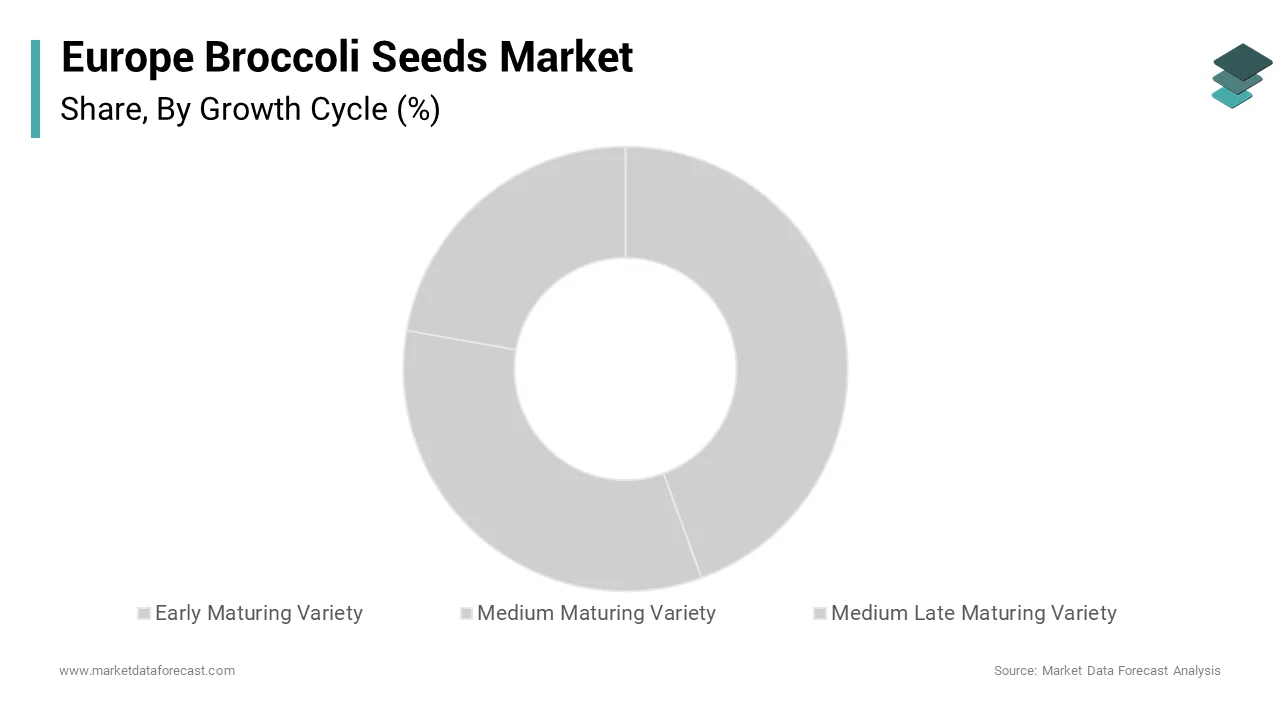
The early maturing broccoli varieties segment is expected to showcasthe a fastest CAGR of 7.4% throughout the forecast period, with the off-season supply and climate adaptation in Southern Europe. According to Spain’s Ministry of Agriculture, early cycle hybrids harvested in 55 to 65 days, now cover 38% of broccoli acreage in Murcia and Andalusia, enabling summer production when traditional varieties bolt. In the Netherlands, the Product Board for Horticulture reported that greenhouse growers increased early variety use by 29% in 2024 to meet year-round retailer demands for local produce. As per the European Environment Agency, rising spring temperatures have shortened viable planting windows, making rapid-cycle genetics essential for avoiding heat stress during head formation. Companies like Rijk Zwaan and Bejo Zaden launched cold-tolerant early hybrids in 2024 that establish in February and harvest by April,l filling the “spring gap” in Northern European markets.
By Package Insights
The bagged packaging segment was the largest by capturing 32.2% of tEuropeanope broccoli seeds market share in 2024, which is exclusively distributed in sealed, labeled polyethylene or foil pouches to ensure viability, traceability, and regulatory compliance. According to the European Commission’s Seed Marketing Directive, all commercial seed lots must be packaged in tamper-evident containers displaying variety name, lot number, germination rate, and official certification marks. The European Seed Association confirmed that canned or rigid containers are not used for broccoli seeds due to moisture retention risks and incompatibility with precision vacuum-seeding equipment. In Germany, the Federal Plant Variety Office mandates that bagged seeds undergo oxygen-barrier testing to maintain >85% germination over 12 months, with a standard met only by multi-layer laminated bags. This universal reliance on advanced bagged formats ensures seed integrity from breeder to field, making it the sole commercially viable packaging method across the EU.
The bagged segment is expected to witness the fastest CAGR of 5.1% from 2025 to 2033 due to innovations in sustainable and smart packaging that enhance seed performance and environmental credentials. According to the European Bioplastics Association, compostable seed bags made from PLA and PHA polymers captured 14% of the professional seed market in 2024, up from 5% in 2021, driven by EU Green Public Procurement rules. In the Netherlands, seed company Enza Zaden introduced QR-coded bags in 2024 that link to digital crop guides and batch-specific germination data, improving farm-level decision-making. As per the German Agricultural Society, oxygen-scavenging sachets integrated into seed bags extended broccoli seed viability by 40% under tropical storage conditions for organic farms with limited cold storage. The European Commission’s Packaging and Packaging Waste Regulation further incentivizes recyclable mono-material bags, with major suppliers like Bayer Vegetable Seeds transitioning to 100% PE designs by 2025.
By Application Insights
The farmland segment was the largest by holding a dominant share of the European broccoli seeds market in 2024, owing to the crop’s primary cultivation in open fields across major producing regions. According to Eurostat, over 48,000 hectares of broccoli were grown in open fields in the EU in 2024, with Italy, Spain, and France alone representing 72% of the total area. The Italian Council for Agricultural Research reported that 85% of broccoli destined for processing and fresh markets is field-grown due to lower production costs and scalability. In Germany, the Federal Ministry of Food and Agriculture confirmed that field cultivation remains dominant in Lower Saxony and Bavaria, where medium-maturing varieties are sown in rotation with cereals to manage soil health. As per the European Environment Agency, advances in precision drilling and drip irrigation have reduced water use in field broccoli by 22% since 2022, maintaining competitiveness against protected systems. The economic imperative of large-scale production for retail and export ensures farmland remains the primary application channel for broccoli seeds across Europe.
The greenhouse segment is expected to grow at the fastest CAGR of 8.9% owing to the demand for year-round local supply and climate-resilient production. According to the European Environment Agency, the protected broccoli area in the EU expanded by 18% between 2022 and 2024, with the Netherlands, Belgium, and southern Spain leading adoption. In the Netherlands, the Product Board for Horticulture reported that greenhouse broccoli production rose to 1,200 hectares in 2024, using dwarf, heat-tolerant hybrids specifically bred for low-light winter conditions. Spain’s Ministry of Agriculture confirmed that Almería’s “sea of plastic” now includes 850 hectares of broccoli tunnels producing from October to June by reducing reliance on Moroccan imports. As per the European Investment Bank, €210 million was allocated in 2024 to modernize greenhouse infrastructure under the Common Agricultural Policy, prioritizing energy-efficient systems for vegetable production. Retailers like Edeka and Carrefour now require year-round local broccoli, accelerating investment in controlled-environment cultivation and driving demand for specialized greenhouse-adapted seed varieties.
COUNTRY ANALYSIS
Italy Broccoli Seeds Market Analysis
Italy was the top performer of the European broccoli seeds market by occupying 28.3% ofthe share in 202,4 owing to its status as the EU’s top broccoli producer and exporter. According to ISTAT, Italy cultivated 22 000 hectares of broccoli in 2024, primarily in Puglia, Sicily, and Emilia-Romagna, supplying both fresh markets and processing plants for frozen products. The Council for Agricultural Research CREA reported that 92% of Italian growers use F1 hybrid seeds with clubroot resistance and uniform head formation to meet stringent retailer specifications. The Ministry of Agricultural Policies confirmed that national seed companies like Sementi Dotto and Nunhems Italia invest heavily in regionally adapted varieties for autumn-winter cycles, the peak production window. Italy’s strong cooperative farming model ensures rapid adoption of new genetics, while its proximity to North African competition drives continuous innovation in yield and disease tolerance.
Spain Broccoli Seeds Market Analysis
Spain was ranked second by capturing 22.3% of thEuropeanpe broccoli seeds market share in 2024 with its intensive off-season production and export orientation. According to the Spanish Ministry of Agriculture, over 14 000 hectares of broccoli are grown annually, with 68% concentrated in Murcia and Andalusia under plastic tunnels for summer and autumn harvests. The Interprofessional Association of Vegetable Producers PROEXPORT reported that Spanish broccoli exports to Germany and France grew by 19% in 2024, necessitating heat-tolerant, early-maturing hybrids that resist bolting above 28°C. Seed companies like Syngenta and Rijk Zwaan operate regional breeding stations in Cartagena to test varieties under local conditions. As per the National Institute for Agricultural and Food Research INIA, climate change has extended the viable growing season by 35 days since 2020, increasing seed turnover. Spain’s role as Europe’s winter vegetable garden ensures consistent demand for high-performance, climate-resilient broccoli seeds tailored to intensive protected systems.
France Broccoli Seeds Market Analysis
The French broccoli seed market is likely to grow with the structured supply chains and strong alignment with national nutrition policies. According to Agreste, France cultivated 6 800 hectares of broccoli in 2024, primarily in Brittany and the Loire Valley, with 74% grown under contract for retailers like Carrefour and E.Leclerc. The French Agency for Food, Environment, Agriculture,l and Occupational Health & Safety, ANSE, S mandates strict residue controls, pushing growers toward disease-resistant hybrids that reduce fungicide use. As per the Ministry of Agriculture, the “Ambition Vegetale” plan allocated €45 million in 2024 to support brassica seed innovation, including organic-certified broccoli lines. France’s blend of retail-driven quality standards, public health promotion, and agronomic support creates a stable and quality-focused seed market.
Netherlands Broccoli Seeds Market Analysis
The Netherlands broccoli seeds market growth is likely to grow with the innovation in greenhouse production and seed breeding excellence. According to the Dutch Central Bureau of Statistics, while open-field broccoli covers only 1,800 hectares, greenhouse area expanded to 1,200 hectares in 2024, making the Netherlands Europe’s leader in protected broccoli cultivation. The Product Board for Horticulture confirmed that Dutch growers rely exclusively on proprietary F1 hybrids from companies like Rijk Zwaan, Bejo Zaden, and Enza Zaden, which invest over €50 million annually in brassica R&D. Wageningen University trials in 2024 demonstrated that Dutch-bred varieties achieved 30% higher yields under low-light winter conditions than imported genetics. As per the Netherlands Enterprise Agency, seed exports of broccoli varieties reached 180 metric tons in 2024, serving markets from Scandinavia to the Middle East. The country’s fusion of agri-tech, breeding science, and export orientation positions it as Europe’s innovation engine for next-generation broccoli seeds.
Germany Broccoli Seeds Market Analysis
Germany's broccoli seed market growth is expected to have steady growth opportunities in the foreseeable future, owing to the focus on quality, organic production, and domestic consumption. According to the Federal Statistical Office, Germany cultivated 3, 200 hectares of broccoli in 2024, with 28% under organic certification. The German Agricultural Society reported that organic growers prefer open-pollinated and organic-certified hybrid seeds from Bingenheimer Saatgut and Dreschflegel, which meet EU Organic Regulation 2018/848 requirements. As per the Ministry of Food and Agriculture, the “Initiative Gemuse” campaign boosted domestic broccoli consumption by 17% in 2024, supporting local seed demand. Germany’s emphasis on sustainability, food sovereignty, and consumer trust ensures steady demand for high-integrity, regionally adapted broccoli seeds despite its smaller production footprint.
COMPETITIVE LANDSCAPE
Competition in theEuropeane broccoli seeds market is defined by scientific precision,n agronomic relevance,,e and regulatory compliance rather than price alone. Unlike the global commodity seed market,s European players compete on varietal performance under specific climatic and disease pressures across diverse regions from Scandinavia to Sicily. The landscape features a mix of multinational breeders like Rijk Zwaan and Sakata alongside specialized firms, such as Bejo Zade,n that emphasize organic and open-pollinated genetics. Regulatory constraints under the EU Seed Marketing Directive and a conservative stance on new genomic techniques limit innovation speed but reward companies with robust conventional breeding pipelines. Fragmentation across national phytosanitary rules creates barriers yet also opportunities for localized adaptation. Retailer demands for uniformity, shelf life,ife and residue-free production further shape variety development.
KEY MARKET PLAYERS
Some of the key companies in the market are
- Monsanto
- Lima Grain
- Bayer Crop Science
- Syngenta
- Enza Zaden
- Sakata
- Rijk Zwaan
- Bejo
- East-West Seed
- Takii
- VoloAgri
- Nongwoobio
- Dongya Seed
- Jiangsu Seed and Asia Seed.
Top Players In The Market
- Rijk Zwaan is a leading vegetable seed breeder with a strong presence in tEuropeanope broccoli seeds market through its high-performing hybrid varieties tailored for field and greenhouse production. The Dutch company emphasizes disease resistance, heat tolerance, and uniform head formation to meet the demands of European growers and retailers. Rijk Zwaan launched a new early-maturing broccoli hybrid resistant to both clubroot and Fusarium wilt, specifically bred for Southern European summer cycles. It also expanded its trial stations in Murcia and Emilia-Romagna to accelerate regional adaptation.
- Bejo Zaden, a Netherlands-based family-owned seed company, is renowned for its organic and conventional broccoli genetics that prioritize fflavor life,ife and climate resilience. The company supplies specialized varieties to both smallholder and large-scale farms across Western and Southern Europe. In 2024, Bejo introduced a medium-late maturing broccoli hybrid with enhanced cold tolerance for autumn harvesting in Northern Europe and launched certified organic seed lines compliant with EU Regulation 2018/848. It also partnered with German and Danish organic cooperatives to co-develop regionally adapted open-pollinated varieties. Through its commitment to agroecological principles and farmer collaboration, oOEJOstrengthens its position in Europe’s growing organic and low-input vegetable sectors.
- Sakata Seed Europe, a subsidiary of Japan’s Sakata Seed Corporation,n offers premium broccoli hybrids known for dense head formation and extended harvest windows, particularly suited for processing and fresh markets. The company leverages global breeding resources while adapting genetics to European disease pressures and seasonal patterns. In 202,4 Sakata released a heat-tolerant F1 hybrid that maintains head quality at temperatures above 28 degreesCelsiusu,s addressing bolting challenges in Spain and Italy. It also enhanced its digital seed catalog with interactive maturity and resistance filters to assist professional growers in variety selection.
MARKET SEGMENTATION
This research report on the European broccoli seeds market is segmented and sub-segmented into the following categories.
By Growth Cycle
- early maturing variety
- medium maturing variety
- medium late maturing variety
By Package Type
- bagged and canned
By Application
- farmland
- greenhouses
- others
By Country
- UK
- France
- Spain
- Germany
- Italy
- Russia
- Sweden
- Denmark
- Switzerland
- Netherlands
- Turkey
- Czech Republic
- Rest of Europe