- Product Description Description
- Table of Contents TOC
- List of Table & Figure LOT
- Get Free Sample PDF Sample PDF
Market Size, 2025
$96.52 MnMarket Estimate, 2026
$101.61 MnMarket Forecast, 2034
$153.24 MnCAGR, 2026–2034
5.27%Europe Calcium Propionate Market Size, Growth, Trends & Forecast (2026–2034)
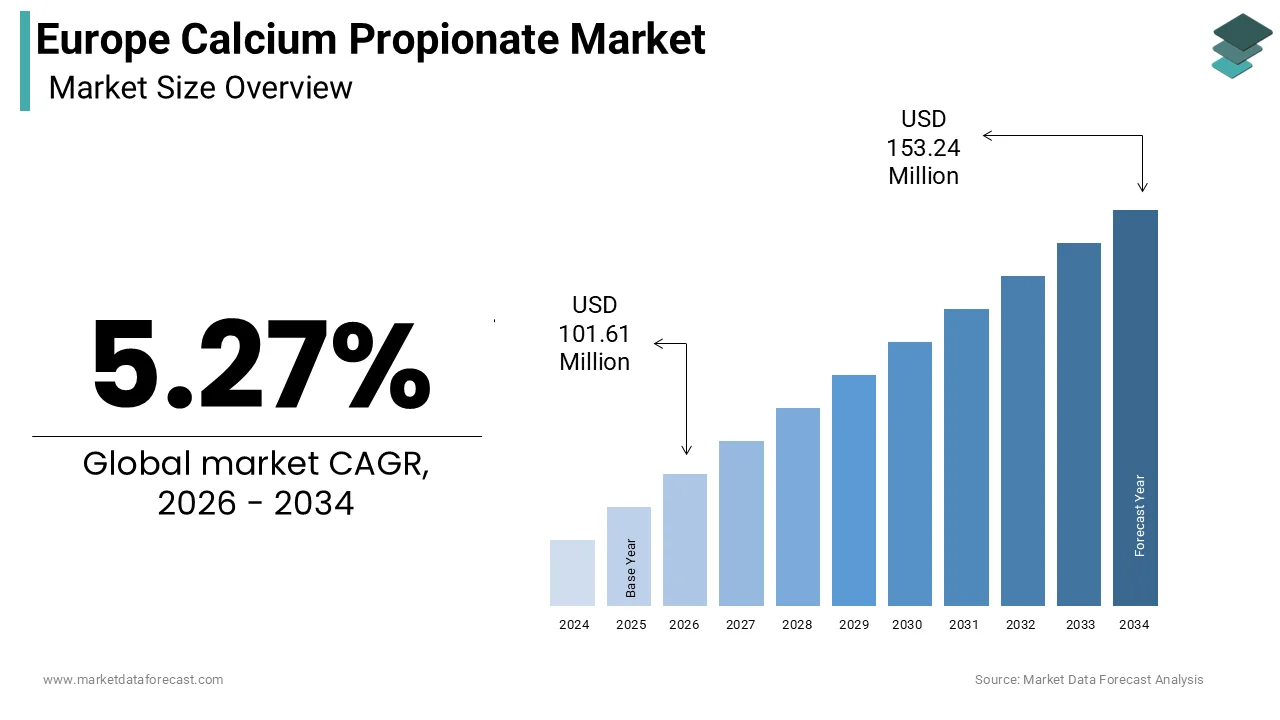
The Europe calcium propionate market size was calculated to be USD 96.52 million in 2025, is anticipated to be worth USD 101.61 million in 2026, and is projected to reach USD 153.24 million by 2034, registering a compound annual growth rate (CAGR) of 5.27% during the forecast period from 2026 to 2034. Driven by the expansion of industrial-scale bakery manufacturing, food waste reduction mandates, and rising animal feed safety standards, the preservative sector is experiencing steady, structured growth.
Key Executive Metrics (At-a-Glance)
- 2025 Base Valuation: USD 96.52 Million
- 2026 Current Valuation: USD 101.61 Million
- 2034 Forecast Valuation: USD 153.24 Million
- Compound Annual Growth Rate (CAGR): 5.27% (2026–2034)
- Dominant Application Segment: Bakery (capturing the majority market share driven by commercial bread shelf-life and anti-mold performance)
- Fastest-Growing Application: Animal Feed (projected at a 6.8% CAGR between 2025 and 2033 propelled by gut health and mold control)
- Dominant Region / Country: Germany (top market performer accounting for 21.4% share in 2024 backed by a massive industrial bakery base and advanced feed production)
Core Market Drivers
- Industrial Bakery Expansion: Shift from artisanal to centralized production facilities necessitating effective mold inhibitors like calcium propionate for broad distribution.
- Regulatory Approval & Safety Profile: EFSA endorsements and dual functionality as an additive and bioavailable calcium source under EU nutrition guidelines.
Primary Market Restraints & Challenges
- Clean-Label Skepticism: Consumer resistance toward "E-number" designations (E282) and private-label restrictions by major European retailers.
- Raw Material Cost Volatility: High natural gas and petrochemical feedstock costs impacting propionic acid pricing and manufacturer profit margins.
Europe Calcium Propionate Market Segmentation Breakdown
| Segment Category | Largest (Dominant) Sub-Segment | Fastest-Growing Sub-Segment |
|---|---|---|
| By Application | Bakery (Dominant market share driven by essential mold suppression in commercial bread and pastry supply chains) | Animal Feed (Fastest-growing at a 6.8% CAGR driven by livestock toxin control and banned antibiotic alternatives) |
| By Region / Country | Germany (21.4% share in 2024 anchored by large industrial bakeries, pork/poultry feed demand, and chemical hubs) | Italy / Netherlands (Dynamic markets advancing via Southern bakery modernization and circular food/feed technology) |
Major Industry Players Profiled
Key enterprises shaping the competitive European calcium propionate market include Jungbunzlauer Suisse AG, Perstorp Group, Kemira Oyj, Niacet Corporation, Addcon GmbH, AB Mauri, MaccoOrganiques Inc., Krishna Chemicals, A.M. Food Chemicals Co., Ltd., and Impextraco NV.
Europe Calcium Propionate Market Size
The Europe calcium propionate market size was calculated to be USD 96.52 million in 2025 and is anticipated to be worth USD 153.24 million by 2034, from USD 101.61 million in 2026, growing at a CAGR of 5.27% during the forecast period.
Calcium propionate (chemical formula: (Ca(C2H5COO)2) is a naturally occurring organic salt formed by the reaction between calcium hydroxide and propionic acid. It functions by disrupting fungal metabolism without significantly altering taste, texture, or nutritional value, making it a preferred choice in clean-label formulations where consumer scrutiny of synthetic additives is high. Unlike sodium benzoate or potassium sorbate, calcium propionate also contributes a bioavailable source of calcium, adding functional value in fortified foods. Its use is strictly regulated under the European Union’s food additive framework, where it is assigned E number E282 and permitted only within defined concentration limits across specific food categories. The European Food Safety Authority permits the use of calcium propionate within defined maximum concentrations as a preservative in various bread and fine bakery products to extend shelf life. It maintains a massive industrial production volume of bakery products, driven by high demand for bread and confectionery items across the region. According to sources, the majority of retail bakery sales in the European Union are driven by packaged, convenient, and extended-shelf-life products over traditional, fresh-only alternatives. This trend toward convenience and reduced food waste intensifies reliance on effective, approved preservatives. Furthermore, the European Commission’s Farm to Fork Strategy emphasizes food safety and shelf-life extension as pillars of sustainability, indirectly reinforcing the role of calcium propionate in minimizing post production losses across the food supply chain.
MARKET DRIVERS
Expansion of Industrial Bakery Production Drives Preservative Demand
The structural shift from artisanal to industrial-scale bakery manufacturing across Europe is a primary driver of the Europe calcium propionate market. This is due to the heightened need for microbial control in mass-produced goods. According to research, the trend in the EU is toward a greater reliance on centralized production facilities for bread and pastry sold in supermarkets, a model that relies on methods to extend shelf life for logistical efficiency and managing stock levels. In contrast to traditional bakeries that sell daily fresh goods, industrial producers must ensure products remain mold-free for several days, a window during which untreated items would typically spoil. Calcium propionate is uniquely suited for this role as it effectively suppresses common spoilage organisms like Aspergillus and Penicillium without interfering with yeast fermentation during proofing. Industrial bread producers widely utilize effective anti-mold agents like calcium propionate to ensure a longer shelf life necessary for broad distribution, although there is increasing interest in developing natural alternatives to meet clean-label consumer demand. In addition, the consolidation of retail supply chains, where a single distribution center may serve hundreds of stores, necessitates uniform product stability, further entrenching preservative use. This industrialization trend, accelerated by labour shortages and cost pressures, ensures sustained and growing demand for calcium propionate across Europe’s commercial baking sector.
Regulatory Acceptance and Safety Profile Reinforce Formulation Preference
Calcium propionate benefits from decades of scientific evaluation and regulatory endorsement across European food safety frameworks, which makes it a trusted and low-risk preservative choice for manufacturers, and thereby propels the expansion of the Europe calcium propionate market. European food safety assessments confirm that authorized levels of calcium propionate do not present genotoxic or carcinogenic risks to consumers. This rigorous validation stands in contrast to other preservatives like sodium benzoate, which faces periodic consumer backlash over potential benzene formation. The additive’s dual function as a calcium source also aligns with EU nutritional fortification guidelines, particularly in products targeting children and the elderly. As a legal preservative, calcium propionate contributes to dietary calcium intake without incurring negative nutrient profile scores. Moreover, calcium propionate is exempt from the European Union’s strict allergen labeling requirements and is compatible with organic certification under specific conditions when derived from natural fermentation. Research indicates that food technologists favour calcium propionate for its superior stability during baking and its neutral effect on flavor profiles. This combination of regulatory clarity, functional versatility, and consumer acceptability cements its position as the preservative of choice in sensitive categories like children’s snacks and whole grain breads.
MARKET RESTRAINTS
Consumer Preference for Clean Label and “Free From” Claims Limits Adoption
The growing consumer skepticism toward any ingredient perceived as “chemical” or “artificial,” even when scientifically validated and regulatory approved, is a significant restraint on the Europe calcium propionate market. Despite its natural origin and safety record, calcium propionate is increasingly excluded from products marketed under clean label or “no preservatives” claims due to its E number designation and complex nomenclature. According to a study, a significant portion of Western European shoppers actively avoids products containing E-numbered additives, reflecting a strong consumer preference for clean-label products. This sentiment is amplified by retailer policies; major chains like Carrefour in France and Edeka in Germany have implemented private label clean label standards that prohibit E282 even in categories where spoilage risk is high. Consequently, manufacturers reformulate with alternative preservation methods such as vinegar extract,s cultured wheat starch, or modified atmosphere packaging,g which often prove less effective or more costly. Technical analyses show that preservative-free bread is significantly more susceptible to rapid mold growth compared to bread treated with calcium propionate, which extends its shelf life. This trade-off between marketing appeal and product integrity creates persistent pressure to reduce or eliminate calcium propionate despite its functional necessity.
Volatility in Raw Material Sourcing and Production Costs Affects Supply Stability
The production of calcium propionate relies on propionic acid and calcium hydroxide, both subject to price fluctuations driven by energy markets and petrochemical feedstock availability, which hinders the expansion of the Europe calcium propionate market. The European Chemical Industry Council emphasizes that high natural gas prices in Northwestern Europe continue to drive up costs for raw materials and chemical precursors like propionic acid, maintaining pressure on production competitiveness. As calcium propionate is typically sold at narrow margins to food and feed manufacturers, these cost spikes directly compress producer profitability and trigger price pass-through that buyers resist in competitive segments like bakery. Furthermore, the European Union’s REACH regulation imposes stringent reporting and safety data requirements on chemical intermediates, increasing compliance overhead for smaller producers. According to research, high energy prices and economic uncertainty are causing European chemical companies to pause capacity expansion and face potential production declines. Unlike globally traded commodities,s calcium propionate production is regionally concentrated with limited redundancy, making the supply chain vulnerable to plant outages or logistical disruptions. This cost and supply instability discourages long term contracts and incentivizes buyers to explore alternatives, even if less effective, constraining market predictability and investment in innovation.
MARKET OPPORTUNITIES
Rising Demand for Extended Shelf Life Plant-Based and Alternative Bakery Products
The rapid growth of plant-based and gluten-free bakery items presents a significant opportunity for calcium propionate due to their heightened susceptibility to microbial spoilage, which provides new opportunities for the Europe calcium propionate market. Unlike traditional wheat bread, these alternatives often lack natural preservative compounds like gluten-bound antioxidants and have higher moisture activity, accelerating mold development. According to research, plant-based bakery products experienced significant retail growth in Europe, with new product launches increasing as the market focuses on plant-based alternatives in the bakery category. Many of these items, such as chickpea flour muffins or oat-based buns, require preservatives to achieve a commercially viable shelf life, yet must comply with clean label expectations. Calcium propionate is uniquely positioned here because it is permitted in organic and vegetarian certified products and does not interfere with delicate flavor profiles common in plant-based formulations. Recent food science research indicates that, compared to conventional methods, specialized preservative formulations, such as those involving calcium propionate and, to a lesser extent, vinegar-based systems, significantly improve the mold-free shelf life of gluten-free bread. The expansion of plant-based bakery sections is driving a surge in demand for compliant preservatives, establishing calcium propionate as a vital tool for innovation in this high-growth market.
Integration into Sustainable Food Waste Reduction Strategies
Calcium propionate is increasingly recognized as a tool for achieving the European Union’s ambitious food waste reduction targets, which creates new institutional and policy-driven demand. This is expected to fuel the expansion of the Europe calcium propionate market. A large quantity of food is wasted within the European Union each year, with bakery items constituting a considerable part of these losses in households and stores. Mold growth and staleness are the main reasons contributing to the discarding of these baked goods. Extending the useful life of bakery products could potentially decrease the total amount of discarded items. National initiatives such as France’s anti-food waste law mandate retailers to donate unsold but safe food, but only if it remains within its consumption window, making preservatives like calcium propionate operationally essential. Furthermore, the EU’s upcoming “Right to Repair” style legislation for food, formally the Food Waste Prevention Framework, encourages the use of approved technologies that enhance durability. Food manufacturers participating in the EU’s Circular Food System Partnership are now required to report on shelf-life extension measures, indirectly elevating the status of calcium propionate from a mere additive to a sustainability enabler. This policy alignment opens avenues for public-private collaboration and positions calcium propionate as a contributor to circular economy goals.
MARKET CHALLENGES
Technical Limitations in Non-Bread Applications Restrict Market Diversification
Calcium propionate exhibits limited utility in other food categories, despite its efficacy in bakery systems, which challenges the growth of the Europe calcium propionate market. This is due to pH dependency and flavour interaction constraints. The compound is only effective in environments with a pH below 5.5 and loses antimicrobial activity in neutral or alkaline conditions common in dairy beverages, meat products, and ready meals. Besides, in high-fat or protein matrices, calcium ions can bind to casein or lipids, reducing bioavailability and preservative efficacy. This restricts its use almost exclusively to bread and some pet foods, limiting diversification opportunities as bakery markets mature. Attempts to microencapsulate or combine it with synergists have yielded inconsistent results and face regulatory hurdles under EU novel food rules. Consequently, manufacturers seeking broad-spectrum preservation must rely on multiple additives, increasing formulation complexity and labeling burden. Calcium propionate’s growth in Europe’s evolving functional food market is currently limited to its traditional uses, as it remains restricted by technical physicochemical barriers.
Regulatory Fragmentation in Organic and Specialty Food Certification
Inconsistent approval across the regional organic and specialty food certification schemes is a persistent challenge for the Europe calcium propionate market. This creates formulation uncertainty for manufacturers targeting premium segments. While the EU organic regulation permits calcium propionate in processed organic foods under strict conditions, it is explicitly banned by private standards such as Demeter biodynamic certification and certain national organic labels in Germany and Sweden. European organic bakery producers are increasingly eliminating the synthetic preservative calcium propionate to comply with stringent, voluntary retailer-specific organic standards and to meet consumer demand for cleaner labels. Similarly, free-from and clean-label coalitions like the UK’s Soil Association exclude it despite EFSA’s safety confirmation. This regulatory fragmentation forces brands to maintain dual production lines, one with and one without calcium propionate, which increases operational costs and inventory complexity. Reformulating bread to remove conventional preservatives results in significant cost increases for bakery manufacturers due to increased operational inefficiencies and higher product costs. The adoption of this additive in Europe’s fastest-growing food markets will remain hindered by fragmented compliance standards rather than a lack of scientific validation.
REPORT COVERAGE
| REPORT METRIC | DETAILS |
| Market Size Available | 2025 to 2034 |
| Base Year | 2025 |
| Forecast Period | 2026 to 2034 |
| CAGR | 5.27% |
| Segments Covered | By Application, And Region |
| Various Analyses Covered | Global, Regional & Country Level Analysis; Segment-Level Analysis; DROC, PESTLE Analysis; Porter’s Five Forces Analysis; Competitive Landscape; Analyst Overview of Investment Opportunities |
| Regions Covered | UK, France, Spain, Germany, Italy, Russia, Sweden, Denmark, Switzerland, Netherlands, Turkey, and the Czech Republic |
| Market Leaders Profiled | Niacet Corporation, Addcon GmbH, AB Mauri, MaccoOrganiques Inc, Perstorp Holdings AB, Kemira, Krishna Chemicals, A.M. Food Chemicals Co Limited, and Impextraco NV |
SEGMENTAL ANALYSIS
By Application Insights
The bakery segment dominated the Europe calcium propionate market by accounting for a substantial share in 2024. The dominance of the bakery segment is driven by its irreplaceable role as the primary anti-mold agent in commercial bread and pastry production. This growth is further supported by the fundamental microbiological vulnerability of baked goods, which provide an ideal environment for mold growth due to their moisture content, neutral pH, and ambient storage conditions. According to sources, large-scale European industrial bakers prioritize extended shelf lives for packaged goods to ensure products remain fresh throughout nationwide distribution chains and centralized retail storage, as untreated bread would otherwise spoil shortly after production. Calcium propionate is uniquely effective in this context because it inhibits common spoilage fungi like Aspergillus glaucus and Penicillium roqueforti without interfering with yeast activity during proofing or altering sensory attributes. Furthermore, European food safety standards provide a clear legal framework for the use of preservation agents in bread and delicate baked goods, establishing specific safety thresholds that allow manufacturers to maintain product quality and shelf stability. National food safety agencies in Germany, France, and the Netherlands routinely monitor compliance but affirm its safety, reinforcing manufacturer confidence. The structural shift from artisanal to industrial baking, where a large share of volume now originates from large-scale facilities, according to research, further entrenches reliance on this preservative as a non-negotiable component of food safety and economic viability across Europe’s bakery supply chain.
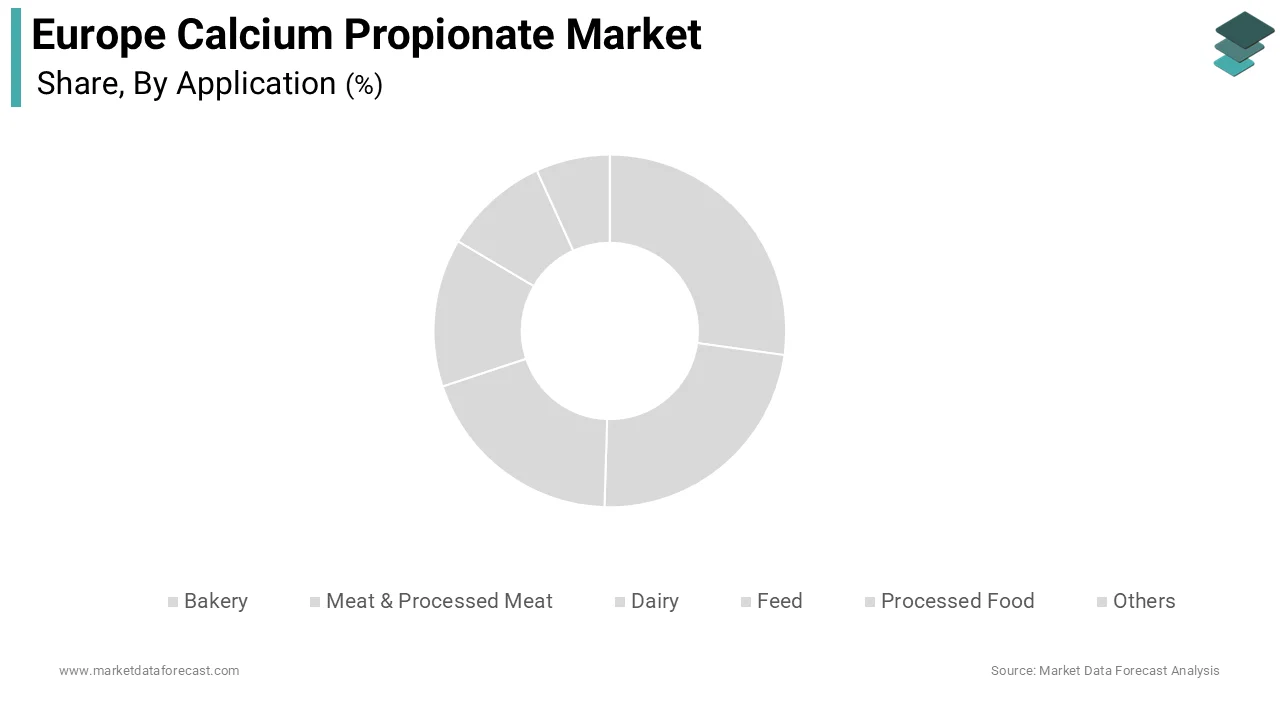
The animal feed segment is likely to experience the fastest CAGR of 6.8% between 2025 and 2033 due to the dual need to prevent spoilage in stored feed and support animal gut health without relying on antimicrobial growth promoters banned under EU legislation. The European Feed Manufacturers’ Federation emphasizes that the European Union maintains substantial annual compound feed volumes, which remain naturally vulnerable to mold and toxin development due to moisture levels and standard storage environments. Calcium propionate acts as an effective mold inhibitor in feed mills and on farms, particularly in humid regions like Northern Italy and the Netherlands. Crucially, it also contributes bioavailable calcium, supporting bone development in poultry and swine. Scientific assessments from European research bodies indicate that treating feed with calcium propionate serves as an effective method for suppressing fungal growth, thereby decreasing the prevalence of harmful toxins in livestock nutrition. Besides, European Union livestock policies continue to prioritize the transition from traditional medicinal additives toward sustainable organic acids, establishing these compounds as a recognized standard for maintaining animal health and safety. Europe's expanding livestock sector, coupled with strict feed safety laws, is transforming calcium propionate from a recommended additive into a vital safeguard for feed.
REGIONAL ANALYSIS
Germany Calcium Propionate Market Analysis
Germany led the Europe calcium propionate market by accounting for a 21.4% share in 2024. The supremacy of the German market is propelled by its massive industrial bakery sector, stringent food safety standards, and advanced feed production infrastructure. The country produces millions of metric tons of baked goods annually, with a significant share originating from centralized facilities that rely on preservatives for shelf life management. German food law strictly enforces EU additive regulations but also mandates additional documentation on sourcing and purity through the Lebensmittelbuch guidelines, ensuring only high-grade calcium propionate enters the supply chain. The feed industry further drives demand as Germany is the EU’s largest pork and poultry producer, requiringmold-freee compounded feed year-round. Companies like BASF and Jungbunzlauer operate major production and R and D hubs in the country, enabling tight integration with downstream users. Moreover, German consumers exhibit high trust in science-based regulation. This blend of industrial-scale regulatory rigor and scientific literacy makes Germany the cornerstone of European calcium propionate consumption.
United Kingdom Calcium Propionate Market Analysis
The United Kingdom was the second-largest country in the Europe calcium propionate market by holding a 15.2% share in 2024. The growth of the UK market is fuelled by a paradoxical dynamic where bakery demand faces clean label pressure while feed applications grow steadily. Major UK supermarkets are increasingly removing artificial preservatives from their private-label breads to satisfy consumer demand for simpler, clean-label ingredients, though these additives remain common in bread produced for the food service sector. The feed sector offsets this decline. The UK animal feed industry continues to see robust production volumes, with manufacturers favoring preservatives like calcium propionate over older alternatives because they are easier to handle safely and better accepted by livestock. Post Brexit, the UK retained EU food additive rules but introduced faster approval pathways for feed preservatives under the Animal Feed Regulation,s enabling quicker adoption of alternatives. Companies maintain dual formulation strategies to serve both clean-label and cost-sensitive segments. Despite clean label headwinds, the UK’s large livestock base and centralized food manufacturing ensure sustained baseline demand, making it a resilient and strategically important market.
France Calcium Propionate Market Analysis
France is another key player in the Europe calcium propionate market due to the tension between its celebrated artisanal baking tradition and the economic necessity of industrial production. Many traditional, preservative-free bakeries operate throughout the country, highlighting a strong artisan presence. A significant portion of national bread consumption originates from industrial or semi-industrial production methods. These industrial products frequently use additives to ensure longer shelf life. A large volume of bakery goods is produced annually, with retail outlets and discount supermarkets influencing this production. Market demand in retail settings often favors products designed to last longer on shelves. The feed sector also contributes significantly; France is the EU’second-largestst pig producer, requiring consistent protection in stored feed. The national agency reaffirmed the safety of E282 and actively distinguishes it from controversial additives like sodium benzoate. This regulatory clarity allows manufacturers to use it without reputational risk in non-artisanal channels. Thus, France’s market reflects a dual track system where tradition defines premium perception, but industry dictates volume, ensuring stable calcium propionate consumption.
Italy Calcium Propionate Market Analysis
Italy is moving ahead steadily in the European market, owing to its expanding livestock sector and modernization of bakery supply chains in the South. As per sources, Italy produced significant tons of baked goods, but regional disparities persist. While Northern Italy has long used industrial preservatives, Southern regions are only now transitioning from daily fresh models to packaged formats due to urbanization and retail consolidation. This shift creates new demand for calcium propionate, particularly in sliced bread and buns sold in discount chains like Lidl and Eurospin. Italy's poultry industry is adopting calcium propionate in feed production to meet directives aimed at reducing fungal contamination. The sector has seen an increase in the use of organic acids as alternatives to preservatives with handling restrictions. Feed manufacturers are modifying formulations to comply with stricter mycotoxin monitoring standards. The combination of bakery industrialization in emerging regions and feed safety imperatives across the agricultural heartland positions Italy as a high-potential growth market within Southern Europe.
Netherlands Calcium Propionate Market Analysis
The Netherlands is likely to expand in the Europe calcium propionate market from 2025 to 2033 due to its leadership in feed technology and circular food system innovation. The country is Europe’s second-largest agricultural exporter and produces notable tons of compound feed annually, with calcium propionate widely used to ensure stability during export shipping and humid storage. Dutch feed companies like ForFarmers and De Heus are pioneers in acidifier blends where calcium propionate provides both preservation and calcium fortification. The Netherlands hosts advanced industrial producers that supply pan-European retailers requiring a consistent shelf life. Moreover, the Netherlands actively promotes calcium propionate as a tool for food waste reduction. The Dutch government includes it in its National Food Waste Prevention Program as a permitted intervention. This dual focus on agricultural efficiency and sustainability positions the Netherlands as a forward-looking market where calcium propionate is valued not just as a preservative but as a functional component of resilient food systems.
COMPETITION OVERVIEW
The Europe calcium propionate market features a competitive landscape dominated by a handful of established chemical and food ingredient companies that emphasize purity, sustainability, and regulatory compliance over price competition. Unlike commodity chemical markets, differentiation here stems from production methodology, with European players favoring fermentation-based routes over petrochemical synthesis to meet clean label and organic demands. Competition is concentrated in two core segments, industrial bakery and animal feed, with players tailoring technical support and formulation guidance to each. Price pressure exists but is mitigated by the additive’s low inclusion rates and critical functional role in preventing spoilage. New entrants face high barriers, including stringent REACH and food additive regulations, complex certification requirements, and long qualification cycles with major bakery and feed customers. The market is also influenced by retailer clean-label policies, which vary by country, creating a fragmented demand environment. Leading firms respond by offering dual product lines and digital traceability to serve both premium and value channels. Ultimately, success depends on balancing scientific credibility, environmental performance, and application expertise across Europe’s diverse and regulation-heavy food and feed ecosystems.
KEY MARKET PLAYERS
A few major players of the Europe calcium propionate market include
- Niacet Corporation
- Addcon GmbH
- AB Mauri
- MaccoOrganiques Inc
- Perstorp Holdings AB
- Kemira
- Krishna Chemicals
- A.M. Food Chemicals Co., Ltd.
- Impextraco NV
Top Strategies Used by the Key Market Participants
Key players in the Europe calcium propionate market focus on sustainable production by shifting to bio-basedfeedstocks and renewable energy to align with EU Green Deal objectives and customer ESG requirements. They invest in technical service teams that help bakery and feed customers optimize dosage levels to balance efficacy with clean label goals. Companies pursue certifications such as ISCC PLUS organic compliance and food safety standards like FSSC 22000 to differentiate their offerings in a crowded additive space. Vertical integration of fermentation and purification processes ensures consistent purity and traceability, which is critical for regulatory acceptance. Strategic capacity expansions in Central and Eastern Europe address growing demand from industrial bakeries and feed mills in emerging markets. Firms also develop digital tools for supply chain transparency, including batch-level sustainability metrics and shelf-life prediction models. Additionally, they collaborate with research institutions to generate application-specific data demonstrating calcium propionate’s role in food waste reduction and animal health, thereby reinforcing its value beyond basic preservation.
Leading Players in the Market
Jungbunzlauer Suisse AG is a leading European producer of food-grade calcium propionate with a strong reputation for high purity and sustainable manufacturing derived from fermentation-based processes. Headquartered in Switzerland, the company supplies both the food and feed industries across the continent with products compliant with EU regulations and organic certification standards. Jungbunzlauer differentiates itself through its commitment to clean label alignment, offering calcium propionate free from synthetic residues and produced using renewable energy at its Swiss and Austrian facilities. It also launched a technical support program for bakery customers focused on optimizing dosage to balance shelf life extension with clean label aspirations. Its vertically integrated fermentation platform ensures consistent quality and traceability, reinforcing trust among premium food manufacturers seeking transparent ingredient sourcing.
Perstorp Group, a Sweden-based specialty chemicals company, plays a significant role in the Europe calcium propionate market through its ProMyte and ProSid lines tailored for animal nutrition and food preservation. The company leverages its expertise in organic acid chemistry to producehigh-efficacyy calcium propionate formulations that address both mold inhibition and gut health in livestock. Perstorp’s feed-focused solutions are widely adopted in Nordic and Benelux countries, where stringent mycotoxin regulations drive demand for reliable preservatives. The company also intensified collaboration with feed mill operators in Spain and Poland to customizeanti-moldd blends that integrate calcium propionate with other organic acids. This strategic focus on agricultural resilience and circular chemistry strengthens its position in Europe’s evolving feed safety landscape.
Kemira Oyj, a Finnish global leader in sustainable chemical solutions, contributes to the Europe calcium propionate market primarily through its food and feed additives division, which emphasizes food safety and resource efficiency. Although historically focused on water treatment and pulp chemicals, Kemira has expanded its food preservation portfolio to include fermentation-derived calcium propionate meeting EU purity standards. The company serves large-scale bakery producers and feed integrators across Germany, the Netherlands,s and Scandinavia with a focus on consistent supply and regulatory compliance. It also partnered with a major Dutch bakery conglomerate to co-develop low-dosage application protocols that extend shelf life while minimizing additive visibility on labels. These initiatives reflect Kemira’s broader strategy of embedding sustainability and digital transparency into functional ingredient supply chains.
MARKET SEGMENTATION
This research report on the Europe calcium propionate market has been segmented and sub-segmented based on application and region.
By Application
- Bakery
- Meat & Processed Meat
- Dairy
- Feed
- Processed Food
- Others
By Region
- UK
- France
- Spain
- Germany
- Italy
- Russia
- Swede
- Denmark
- Switzerland
- Netherlands
- Turkey
- Czech Republic
- Rest of Europe