- Product Description Description
- Table of Contents TOC
- List of Table & Figure LOT
- Get Free Sample PDF Sample PDF
Market Size, 2025
$21.35 BnMarket Estimate, 2026
$23.68 BnMarket Forecast, 2034
$54.17 BnCAGR, 2026–2034
10.9%Executive Summary: Europe Cancer Monoclonal Antibodies Market
- Market Scope: European market analysis covering production methods, sources, routes of administration, therapy areas, and country-level landscapes.
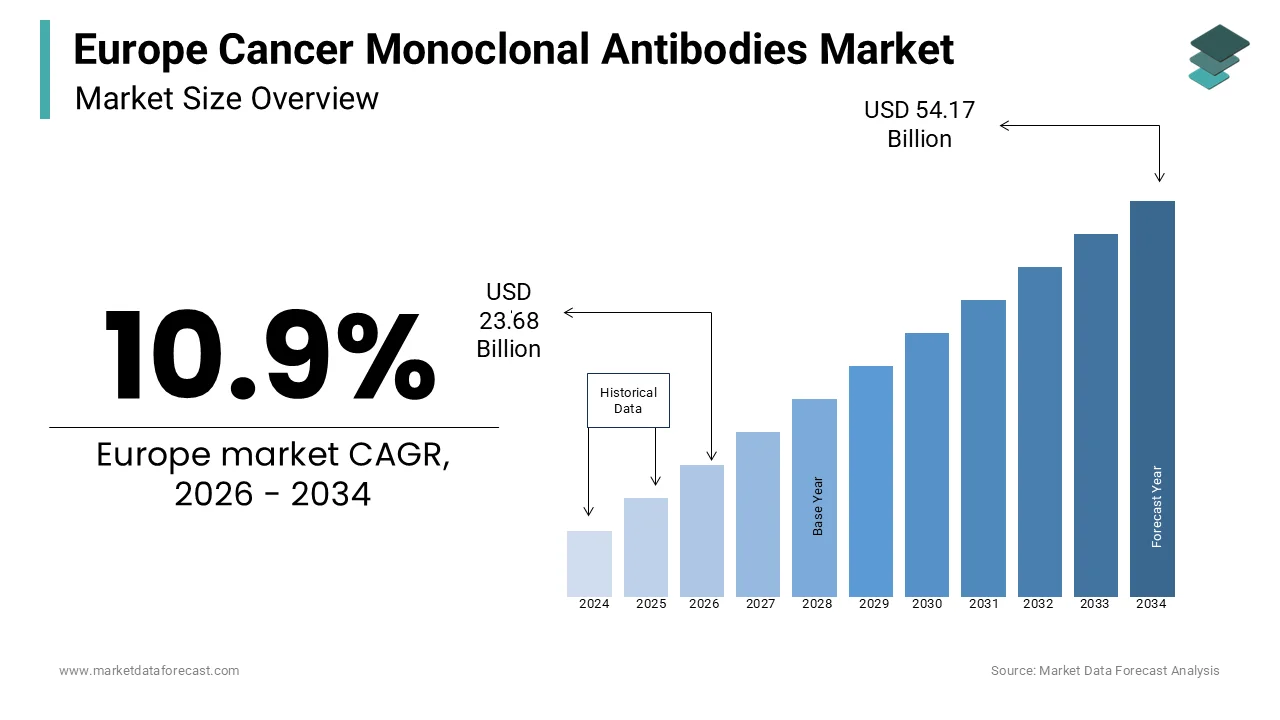
- Market Valuation: Valued at USD 21.35 billion (2025), estimated at USD 23.68 billion (2026), and projected to reach USD 54.17 billion by 2034, growing at a CAGR of 10.90% (2026–2034).
- Primary Growth Drivers: Rising prevalence of chronic and oncological diseases, expanding adoption of targeted therapeutic procedures, growing regional healthcare expenditures, and continuous development of innovative biological drugs across European healthcare centers.
Key Market Segment Metrics (2026–2034)
| Category | Leading / Key Segments | Fastest-Growing Segment |
|---|---|---|
| By Production Method | In-Vitro and In-Vivo | — |
| By Source | Human, Humanized, Chimeric, and Others | — |
| By Route of Administration | Intravenous (IV) and Subcutaneous (SC) | — |
| By Therapy Area | Oncology, Hematology, Inflammatory & Autoimmune Disorders, Ophthalmology, and Others | — |
| By Region / Country | United Kingdom (largest share, followed by Italy and Germany) | Spain and Rest of Europe (projected to gain leading shares) |
Major Market Players & Market Structure
Market Structure: Highly competitive landscape driven by targeted cancer therapies, innovative drug development pipelines, favorable reimbursement policies, advanced research capabilities, and regulatory approvals.
Key Companies: Amgen, Genmab, Bristol Myers Squibb, GlaxoSmithKline, Eli Lilly, Roche, Immunogen, Seattle Genetics, Novartis, and Spectrum Pharmaceuticals.
 Download Free Sample Report
Europe Cancer Monoclonal Antibodies Market Size
The Europe Cancer Monoclonal Antibodies Market is projected to grow from USD 21.35 billion in 2025 to USD 23.68 billion in 2026 and reach USD 54.17 billion by 2034, registering a CAGR of 10.90% during the forecast period from 2026 to 2034.
The Europe cancer monoclonal antibodies market comprises targeted biologic therapies engineered to bind specific antigens on malignant cells or modulate immune responses for oncological treatment across European nations. This therapeutic class includes checkpoint inhibitors, antibody-drug conjugates, and bispecific antibodies that have redefined precision medicine standards in regional healthcare systems. According to the World Health Organization International Agency for Research on Cancer, approximately 4.5 million new cancer cases were diagnosed in Europe in 2022, creating substantial clinical demand for advanced immunotherapies. The European Medicines Agency has authorized over 30 novel monoclonal antibody indications since 2020, reflecting accelerated regulatory pathways for breakthrough oncology treatments. According to Eurostat, cancer remains the second leading cause of mortality in the European Union, accounting for 26% of all deaths, which drives sustained investment in innovative therapeutic modalities. National health technology assessment bodies increasingly evaluate these biologics based on real-world effectiveness and patient-reported outcomes rather than solely clinical trial endpoints. This evolving evaluation framework influences reimbursement decisions and market access strategies across member states. The market definition now encompasses companion diagnostics and biomarker testing infrastructure essential for identifying eligible patient populations, ensuring optimal therapeutic utilization within publicly funded healthcare systems.
MARKET DRIVERS
Rising Geriatric Population and Age-Related Cancer Incidence
Demographic shifts toward an aging society primarily drive the European cancer monoclonal antibodies market growth. According to Eurostat projections, individuals aged 65 years and older will constitute 29% of the total European Union population by 2050, representing an increase from 21% in 2022. This demographic expansion directly correlates with cancer incidence, as age is the most significant risk factor for malignancy development. According to the European Cancer Information System, 78% of all new cancer diagnoses in Europe occur in patients over 60 years of age, necessitating therapeutic options suitable for elderly populations with comorbidities. Monoclonal antibodies offer targeted mechanisms with potentially lower systemic toxicity compared to conventional chemotherapy, making them preferable for frail geriatric patients who cannot tolerate aggressive cytotoxic regimens. Healthcare systems are adapting treatment protocols to accommodate this demographic reality by prioritizing therapies with manageable safety profiles and convenient dosing schedules. The convergence of demographic pressure and therapeutic suitability creates sustained baseline demand independent of economic cycles. Manufacturers increasingly design clinical trials specifically enrolling elderly participants to generate evidence supporting label expansions for this growing patient cohort, thereby aligning product development with epidemiological realities shaping European oncology practice.
Accelerated Regulatory Approvals and Adaptive Pathways
Streamlined regulatory frameworks implemented by the European Medicines Agency have significantly reduced time to market for innovative cancer monoclonal antibodies, which is further contributing to the European cancer monoclonal antibodies market expansion. According to the European Medicines Agency annual report, the median review time for priority medicines designated under the PRIME scheme decreased to 270 days in 2023, compared to 420 days for standard procedures. According to the European Commission, 45% of new oncology approvals in 2023 utilized adaptive pathways allowing conditional marketing authorization based on surrogate endpoints pending confirmatory data. Such regulatory flexibility encourages investment in high-risk innovative molecules targeting rare mutations or refractory cancers where traditional pivotal trials would be prohibitively lengthy. The predictability of approval timelines reduces commercial uncertainty, enabling better resource allocation for manufacturing scale-up and market preparation. This supportive regulatory environment positions Europe as an attractive first-launch region for global biopharmaceutical companies seeking rapid return on research investments. Consequently, the pipeline of monoclonal antibodies entering European markets continues expanding, driven by confidence in efficient evaluation processes that balance speed with rigorous safety oversight.
MARKET RESTRAINTS
Stringent Health Technology Assessment and Reimbursement Barriers
National health technology assessment bodies impose rigorous cost-effectiveness thresholds that frequently delay or restrict market access for high-priced cancer monoclonal antibodies despite regulatory approval, which is hindering the regional market expansion. According to the European Observatory on Health Systems and Policies, 60% of new oncology drugs approved by the European Medicines Agency between 2019 and 2023 faced initial rejection or restricted reimbursement recommendations from national assessment agencies due to insufficient value demonstration. According to the Office of Health Economics, the average time from European Medicines Agency approval to patient access varies from 90 days in Germany to over 500 days in countries like Poland and Romania, reflecting fragmented reimbursement landscapes. These disparities create unequal patient access across the continent, undermining the single market principle and complicating pan-European launch strategies. Manufacturers must negotiate separate pricing agreements with each member state, often accepting confidential discounts or managed entry agreements to secure coverage. The administrative burden of preparing multiple country-specific dossiers diverts resources from research and development activities. Uncertainty regarding final reimbursement terms discourages investment in marginal indications where commercial returns may not justify development costs. This restraint fundamentally shapes portfolio prioritization decisions, favoring indications with clearer value propositions over scientifically interesting but economically challenging therapeutic areas.
High Manufacturing Complexity and Supply Chain Vulnerabilities
Biological manufacturing of monoclonal antibodies involves intricate processes susceptible to variability, contamination, and capacity constraints that limit supply reliability and increase production costs. According to the European Federation of Pharmaceutical Industries and Associations, batch failure rates for complex biologics average 5% to 10%, resulting in significant financial losses and potential drug shortages. According to the European Directorate for the Quality of Medicines, 35% of quality alerts issued in 2023 related to sterility assurance issues in sterile injectable products, including monoclonal antibodies. Establishing compliant manufacturing facilities requires capital investments exceeding 500 million euros and lead times of 4 to 6 years, creating substantial barriers to entry and scaling challenges during demand surges. Dependency on single-source suppliers for critical raw materials, such as cell culture media and chromatography resins, exacerbates vulnerability to geopolitical disruptions and trade restrictions. Cold chain logistics requirements add further complexity and cost, particularly for last-mile delivery to remote healthcare facilities. These operational constraints limit the ability of manufacturers to respond rapidly to unexpected demand increases or supply interruptions. Consequently, companies maintain conservative inventory policies that can contribute to periodic shortages affecting patient continuity of care and eroding prescriber confidence in product availability.
MARKET OPPORTUNITIES
Expansion of Biosimilar Competition and Cost Savings
Patent expirations for blockbuster monoclonal antibodies create substantial opportunities for the European cancer monoclonal antibodies market. According to the European Generic and Biosimilar Medicines Association, biosimilars launched in Europe between 2018 and 2023 generated cumulative savings exceeding 15 billion euros,s and this enables reinvestment in innovative therapies. According to the IQVIA Institute, biosimilar penetration for trastuzumab reached 85% within 3 years of first entry, demonstrating rapid adoption when clinical equivalence is established. This competitive dynamic expands treatment eligibility to patients previously excluded due to cost barriers, particularly in Eastern European countries with limited oncology budgets. Originator companies also benefit by launching authorized biosimilars or next-generation improved formulations to defend franchise value. Regulatory guidance from the European Medicines Agency confirms interchangeability without additional clinical trials, reducing development timelines and costs for biosimilar sponsors. The maturation of the biosimilar ecosystem creates opportunities for contract development and manufacturing organizations specializing in complex biologics production. This virtuous cycle of competition and innovation sustains market growth even as individual products face generic erosion. Stakeholders increasingly view biosimilars as essential components of sustainable healthcare financing rather than threats to innovation, fostering collaborative approaches to market development.
Integration of Companion Diagnostics and Precision Medicine
Advances in biomarker identification enable stratification of patient populations likely to respond to specific monoclonal antibodies, improving therapeutic efficacy and economic value propositions. According to the Personalized Medicine Coalition, 75% of new oncology drug approvals in Europe in 2023 included companion diagnostic requirements, reflecting a shift toward targeted treatment paradigms. According to the European Society for Medical Oncology, biomarker-selected patients receiving pembrolizumab achieved response rates exceeding 40%, compared to 15% in unselected populations, validating precision medicine approaches. Diagnostic companies partner with pharmaceutical firms to co-develop validated assays ensuring accurate patient identification at the point of care. National screening programs increasingly incorporate molecular testing, expanding eligible populations for targeted therapies. For example, France’s nationwide lung cancer genotyping platform identifies actionable mutations in 60% of tested samples, directing patients to appropriate monoclonal antibody treatments. This integration enhances clinical outcomes while reducing wasteful spending on ineffective therapies, improving cost-effectiveness ratios for payers. Manufacturers leverage biomarker data to support premium pricing justified by superior efficacy in defined subpopulations. The convergence of diagnostics and therapeutics creates integrated business models where value derives from complete solutions rather than standalone products, opening new revenue streams and competitive differentiation opportunities.
MARKET CHALLENGES
Managing Immune-Related Adverse Events and Safety Signals
Monoclonal antibodies, particularly immune checkpoint inhibitors, induce unique toxicities requiring specialized management protocols that strain healthcare resources and complicate treatment decisions. According to the European Society for Medical Oncology clinical practice guidelines, grade 3 or 4 immune-related adverse events occur in 15% to 20% of patients receiving combination immunotherapy, necessitating hospitalization and immunosuppressive interventions. According to the Uppsala Monitoring Centre, reports of fatal myocarditis associated with checkpoint inhibitors increased by 300% between 2018 and 2023, highlighting emerging safety concerns requiring vigilant pharmacovigilance. These unpredictable toxicities can occur months after treatment initiation, demanding long-term monitoring beyond typical clinical trial follow-up periods. Community hospitals often lack expertise to recognize and manage rare immune-mediated conditions, leading to delayed diagnosis and worse outcomes. Training programs for oncologists, nurses, and emergency physicians consume significant educational resources, while malpractice liability concerns may deter some providers from prescribing these agents. Patient fear of severe side effects contributes to treatment refusal or early discontinuation, compromising therapeutic benefits. Manufacturers invest heavily in risk management plans and post-authorization safety studies, adding regulatory burden and cost. Balancing potent anti-tumor activity with acceptable safety profiles remains an unsolved challenge limiting broader adoption despite proven efficacy in advanced malignancies.
Workforce Shortages and Infrastructure Capacity Constraints
Chronic deficits in specialized oncology personnel and infusion facility capacity impede timely administration of monoclonal antibodies, which is creating bottlenecks to the European cancer monoclonal antibodies market. According to the European Cancer Organisation workforce survey published in 2024, Europe faces a shortage of 35,000 oncology nurses and 8,000 medical oncologists relative to current patient volumes, with vacancy rates exceeding 25% in rural regions. According to the Organisation for Economic Co-operation and Development, average waiting times for cancer treatment initiation exceed 30 days in 12 European countries, breaching recommended benchmarks and potentially worsening prognoses. Monoclonal antibody administration requires dedicated infusion chairs, specialized nursing supervision, and extended observation periods, consuming scarce facility resources. Day case units operate at near full capacity, forcing cancellations and rescheduling that disrupt treatment continuity. Rural patients face additional travel burdens accessing centralized infusion centers, contributing to geographic inequities in care delivery. Subcutaneous formulations offer partial relief but require reformulation investments and regulatory approvals. Workforce burnout accelerates turnover, exacerbating staffing crises and increasing reliance on temporary agency personnel with variable competency levels. This structural deficit represents a fundamental capacity constraint that no amount of therapeutic innovation can overcome without parallel investments in human capital and physical infrastructure across European healthcare systems.
COMPETITIVE LANDSCAPE
The competitive landscape of the Europe Cancer Monoclonal Antibodies Market is characterized by intense rivalry among established pharmaceutical giants and emerging biotechnology firms striving for therapeutic innovation. Major participants continuously invest in research and development to introduce novel mechanisms of action such as bispecific antibodies and antibody-drug conjugates that offer superior efficacy over existing standards. This drive for innovation results in frequent clinical trial initiations and regulatory submissions targeting rare and refractory cancers. Companies also compete through strategic acquisitions and licensing agreements aiming to broaden their product portfolios and access cutting-edge technologies. Digital integration plays a crucial role as firms leverage real-world data to optimize treatment protocols and demonstrate value to health technology assessment bodies. Regulatory compliance remains a significant differentiator, with companies navigating diverse national reimbursement frameworks to ensure market access. Price competition is moderated by value-based pricing models focusing on clinical outcomes rather than cost alone. Brand reputation and clinical support significantly influence prescribing decisions, creating loyalty among oncologists. The market sees continuous evolution as biosimilars enter the space,e challenging originators to innovate further, ensuring dynamic and progressive competition across the continent.
KEY MARKET PLAYERS
Some of the companies that are playing a dominating role in the Europe Cancer Monoclonal Antibodies Market include:
- Amgen Inc.
- Genmab A/S
- Bristol-Myers Squibb Company
- GlaxoSmithKline plc
- Eli Lilly and Company
- Roche
- ImmunoGen, Inc.
- Seagen Inc. (formerly Seattle Genetics)
- Novartis AG
- Spectrum Pharmaceuticals, Inc.
TOP LEADING PLAYERS IN THE MARKET
- Roche Holding AG maintains a dominant position in the European oncology sector through its extensive portfolio of targeted therapies and diagnostic solutions. The company actively invests in research and development to expand its pipeline of bispecific antibodies and antibody-drug conjugates tailored for complex cancer types. Recent initiatives include expanding manufacturing capacity in Switzerland to ensure consistent supply of critical biologics across the continent. Roche collaborates closely with academic institutions to validate biomarkers enhancing precision medicine applications. Their strategic focus on integrated care combines diagnostics with therapeutics, improving patient outcomes. This commitment to innovation and comprehensive support solidifies their reputation as a trusted partner for healthcare providers seeking advanced cancer treatments.
- Bristol Myers Squibb Company demonstrates strong market presence through its leadership in immuno-oncologyand hematology treatments utilizing monoclonal antibodies. The company emphasizes clinical excellence by conducting large-scale trials across multiple European countries to validate efficacy in diverse populations. Recent actions involve launching new indications for checkpoint inhibitors addressing unmet needs in rare cancers. They have strengthened distribution networks by partnering with local logistics providers, rs ensuring timely delivery to hospitals. Investment in digital health platforms facilitates remote patient monitoring, enhancing adherence and safety. Their agile approach to regulatory changes enables rapid market entry for new therapies,apies positioning them as a responsive leader in European oncology care.
- AstraZeneca PLC leverages its robust scientific heritage to deliver innovative monoclonal antibodies targeting specific molecular pathways in lung and breast cancers. The company focuses on developing next-generation antibodies with improved safety profiles and extended half-lives for patient convenience. Recent developments include establishing regional centers of excellence in the United Kingdom and Sweden to accelerate clinical research. They actively engage with payers to demonstrate value through real-world evidence supporting reimbursement decisions. Strategic alliances with biotech firms foster innovation in novel targets. Their dedication to scientific rigor and patient-centricity ensures sustained growth and reinforces their status as a key contributor to advancing cancer care standards throughout Europe.
TOP STRATEGIES USED BY KEY MARKET PARTICIPANTS
Key players in the Europe Cancer Monoclonal Antibodies Market primarily employ strategic partnerships and pipeline diversification to maintain competitive advantage. Companies invest heavily in collaborations with academic research centers to identify novel targets and validate biomarkers essential for precision medicine. This focus on scientific discovery allows them to develop differentiated therapies addressing unmet medical needs. Simultaneously, firms expand manufacturing capabilities within Europe to mitigate supply chain risks and ensure compliance with local regulations. These investments facilitate rapid response to demand fluctuations and regulatory requirements. Additionally,y manufacturers prioritize health economics outcomes research to demonstrate value to payers, rs securing favorable reimbursement terms. Such multifaceted strategies enable companies to navigate complex regulatory landscapes effectively while strengthening brand loyalty among clinicians and patients across European healthcare systems.
MARKET SEGMENTATION
This research report on the European Cancer Monoclonal Antibodies Market has been segmented and sub-segmented into the following categories
By Production Method
- In-Vitro
- In-Vivo
By Source
- Human
- Humanized
- Chimeric
- Others
By Route of Administration
- Intravenous (IV)
- Subcutaneous (SC)
By Therapy Area
- Inflammatory & Autoimmune Disorders
- Oncology
- Hematology
- Ophthalmology
- Others
By Country
- UK
- France
- Spain
- Germany
- Italy
- Russia
- Sweden
- Denmark
- Switzerland
- Netherlands
- Turkey
- Czech Republic
- Rest of Europe