- Product Description Description
- Table of Contents TOC
- List of Table & Figure LOT
- Get Free Sample PDF Sample PDF
Market Size, 2025
$5.89 BnMarket Estimate, 2026
$6.15 BnMarket Forecast, 2034
$8.69 BnCAGR, 2026–2034
4.41%Europe Canned Seafood Market Report Summary
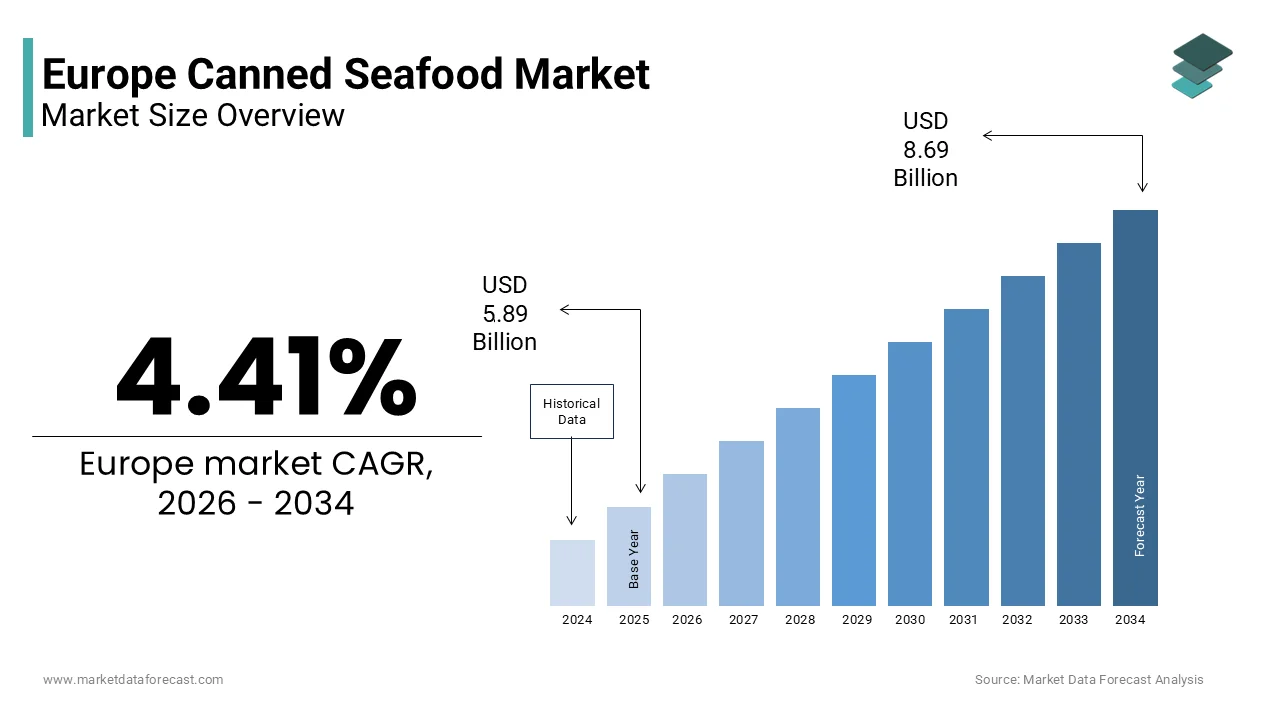
The Europe canned seafood market was valued at USD 5.89 billion in 2025, is estimated to reach USD 6.15 billion in 2026, and is projected to reach USD 8.69 billion by 2034, growing at a CAGR of 4.41% during the forecast period. Market growth is driven by increasing demand for convenient seafood products, rising consumer preference for protein rich food options, and expanding retail availability of shelf stable seafood products. Canned seafood remains popular across Europe due to convenience, affordability, long shelf life, and nutritional benefits. Growing interest in healthy eating habits and sustainable seafood consumption is further supporting market expansion.
Key Market Trends
- Rising demand for convenient and ready to consume seafood products is driving market growth.
- Increasing consumer preference for protein rich and nutrient dense food products is boosting market expansion.
- Growing demand for sustainable seafood sourcing and traceability is supporting industry development.
- Expansion of organized retail channels and online grocery platforms is enhancing product accessibility.
- Innovation in premium seafood offerings and eco friendly packaging solutions is influencing market development.
Segmental Insights
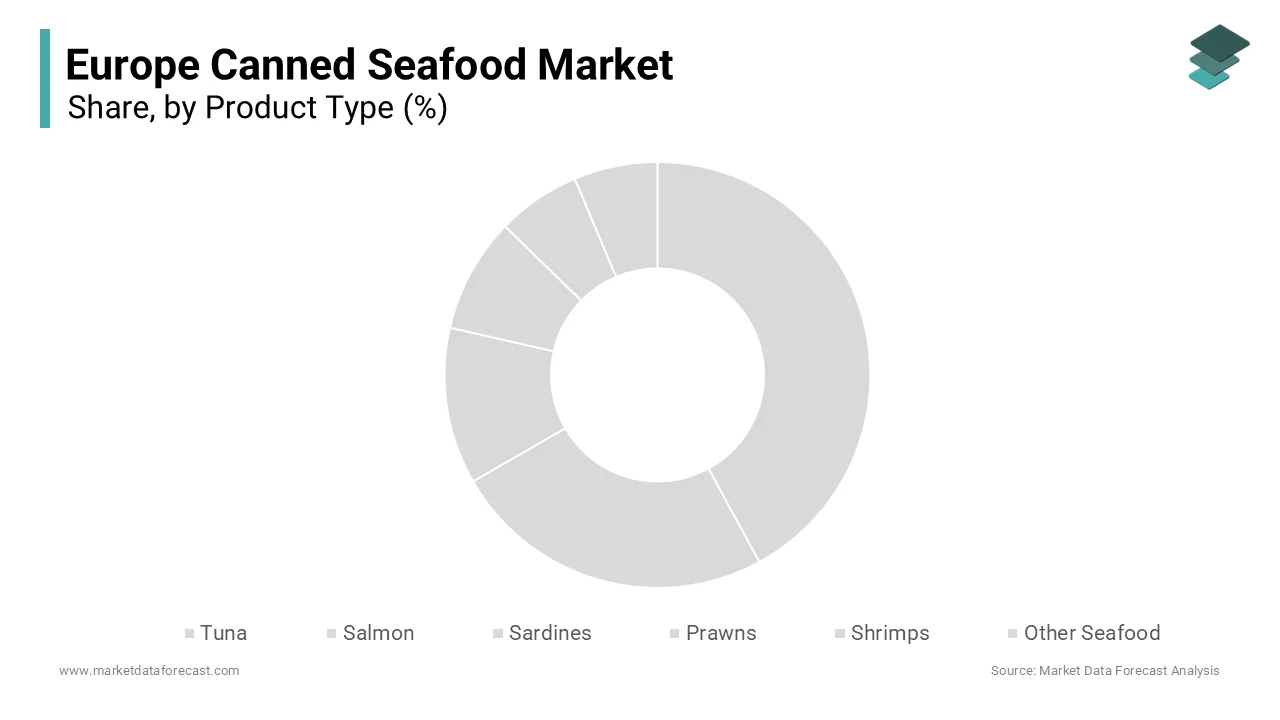
- Based on product type, the tuna segment accounted for 46.4% of the Europe canned seafood market share in 2025. This dominance is attributed to strong consumer preference, broad product availability, and high protein nutritional value.
Regional Insights
- Spain emerged as the leading market in the Europe canned seafood industry in 2025 and is expected to maintain its dominant position during the forecast period. Strong seafood consumption culture, established seafood processing capabilities, and growing demand for convenient seafood products continue to support market growth.
Competitive Landscape
The Europe canned seafood market is highly competitive, with key players focusing on sustainable fishing practices, premium seafood products, and packaging innovation to strengthen their market position. Companies are investing in traceability technologies, nutritional product development, and retail expansion strategies. Prominent players in the Europe canned seafood market include Bumble Bee Seafoods, StarKist Co., Nippon Suisan Kaisha Ltd., Maruha Nichiro Corporation, Icicle Seafoods Inc., LDH (La Doria) Ltd., Thai Union Frozen Products, American Tuna, Inc., Universal Canning, Inc., Trident Seafoods Corporation, and Connors Bros. Ltd..
Europe Canned Seafood Market Size
The Europe canned seafood market size was valued at USD 5.89 billion in 2025 and is projected to reach USD 8.69 billion by 2034 from USD 6.15 billion in 2026, growing at a CAGR of 4.41%.
According to the European Market Observatory for Fisheries and Aquaculture Products, apparent consumption of fishery products reached 22.89 kilograms per capita in 2023, representing the lowest level recorded in the past decade. As per the latest Eurobarometer survey, 58% of Europeans consume fish at home at least once a month, though weekly consumption declined to 33%, marking a 4% point decrease since 2021. The European Union maintains stringent regulatory frameworks governing food safety, traceability, and sustainability certification which fundamentally shape market operations. According to the European Market Observatory for Fisheries and Aquaculture Products, the EU self-sufficiency rate for fishery products rose marginally to 38.1% in 2023 following years of decline. As per the latest Eurobarometer survey, consumer purchasing behaviour increasingly prioritises cost considerations with 55% of respondents identifying price as the primary decision factor, overtaking visual product attributes. The preservation method inherent to canned seafood aligns with contemporary demands for reduced food waste and pantry resilience particularly amid economic volatility and supply chain uncertainties affecting fresh protein availability across European households.
MARKET DRIVERS
Rising Demand for Convenient and Affordable Protein Sources
European consumers increasingly prioritise practical food solutions that balance nutritional value with economic accessibility, which is one of the major factors driving the European canned seafood market growth. According to the Eurobarometer survey, cost has emerged as the most influential purchasing factor for 55% of European seafood buyers, surpassing appearance and freshness considerations. This economic sensitivity has accelerated adoption of canned seafood which offers extended shelf life, reduced preparation time, and lower price points compared to fresh alternatives. As per the European Market Observatory for Fisheries and Aquaculture Products, household expenditure on fishery products reached EUR 62.8 billion in 2024, yet actual consumption volumes declined, reflecting price driven substitution toward preserved formats. Canned tuna and sardines provide high quality protein containing essential omega 3 fatty acids at accessible price thresholds supporting dietary needs across income segments. The convenience factor resonates strongly with urban populations and dual income households where time scarcity limits fresh meal preparation. According to research from the European Commission, proximity to coastal regions influences consumption patterns, yet canned formats enable inland consumers to maintain seafood intake despite geographical constraints. As per the latest Eurobarometer survey, retail data indicates frozen and tinned product purchases now surpass fresh categories in several European markets, driven by value perception and storage flexibility. This structural shift toward preserved proteins reflects broader food system adaptation where canned seafood serves as both nutritional safeguard and budget management tool amid persistent inflationary pressures affecting European food budgets.
Growing Consumer Preference for Sustainable and Traceable Seafood
Environmental consciousness increasingly shapes European purchasing decisions with sustainability credentials becoming decisive factors in canned seafood selection, which is further fuelling the regional market expansion. According to the European Commission, 58% of Europeans consume fishery products monthly, yet demand for verified sustainable sourcing has intensified across all demographics. The Marine Stewardship Council certification has gained substantial traction with northern European consumers particularly prioritising ecolabelled products that demonstrate responsible fisheries management. As per the Centre for the Promotion of Imports from developing countries, traceability through digital verification including QR code enabled supply chain transparency represents an emerging standard for premium canned seafood segments. European regulatory frameworks mandate catch certificates for all imported fishery products ensuring compliance with illegal unreported and unregulated fishing prevention protocols. According to the European Market Observatory for Fisheries and Aquaculture Products, the EU trade deficit in seafood narrowed by 2% in 2024, partly reflecting consumer willingness to pay premiums for verified sustainable imports. This preference extends beyond environmental concerns to encompass social responsibility including fair labour practices and community based fisheries management. Retailers increasingly curate canned seafood assortments featuring certified sustainable options responding to documented consumer willingness to switch brands based on sustainability claims. The convergence of regulatory requirements and voluntary certification schemes creates market incentives for producers to invest in transparent sourcing practices thereby strengthening consumer trust and brand loyalty within the European canned seafood segment.
MARKET RESTRAINTS
Stringent Regulatory Compliance Requirements Increasing Operational Costs
European canned seafood producers and importers face complex regulatory obligations that elevate operational expenditures and create market entry barriers. According to the European Commission, all fishery products entering the EU market must carry validated catch certificates documenting legal harvesting practices, which imposes administrative burdens particularly on small scale exporters from developing regions. As per the Centre for the Promotion of Imports, maximum residue limits for heavy metals including mercury at 1.0 milligrams per kilogram for tuna and cadmium at 0.10 milligrams per kilogram for sardines require rigorous testing protocols throughout supply chains. These compliance requirements necessitate investment in laboratory infrastructure, quality control personnel, and documentation systems that disproportionately affect smaller market participants. According to the European Market Observatory for Fisheries and Aquaculture Products, the EU imported 5.9 million metric tons of fisheries products valued at EUR 29.9 billion in 2024, yet regulatory friction contributes to trade inefficiencies and delayed market access. The revised EU fisheries control regulation mandates enhanced traceability and monitoring technologies further increasing compliance costs for processors and distributors. As per the European Food Safety Authority, histamine formation, thermostable allergens, and packaging related contaminants represent additional safety parameters requiring continuous verification. These multifaceted regulatory demands, while essential for consumer protection, create cost structures that limit price competitiveness against non compliant imports and constrain margin flexibility for European manufacturers. The cumulative effect restricts market dynamism and may reduce product variety available to price sensitive consumer segments.
Declining Per Capita Seafood Consumption Amid Shifting Dietary Preferences
European consumer habits reveal a structural decline in seafood intake that constrains market expansion potential for canned formats, which is further impeding the European canned seafood market expansion. According to the Eurobarometer survey, only 33% of Europeans consume fishery products at least once weekly, representing a four percentage point decrease since 2021, while the proportion of respondents who never consume seafood at home rose to 15%. As per the European Market Observatory for Fisheries and Aquaculture Products, apparent consumption reached 22.89 kilograms per capita in 2023, the lowest level in ten years, driven by reduced aquaculture output and lower import volumes. This consumption contraction reflects multiple factors including generational shifts toward plant based proteins, concerns about marine contaminants, and changing culinary traditions among younger demographics. According to research from the European Commission, proximity to coastal areas strongly influences consumption with 79% of residents within five kilometres of the coast consuming seafood monthly, compared to 49% of those living over two hundred kilometres inland. However, even coastal populations demonstrate reduced frequency, indicating broader behavioural trends beyond geographical access. The preference for fresh over preserved formats persists among certain consumer segments despite convenience advantages of canned products. This consumption stagnation limits volume growth potential and intensifies competitive pressures within the canned seafood segment requiring innovative positioning to reverse declining engagement patterns.
MARKET OPPORTUNITIES
Expansion of Value Added and Ready to Eat Canned Seafood Formats
Product innovation presenting canned seafood in convenient ready to consume formats is setting up new opportunities for the growth of the Europe canned seafood market. According to the Centre for the Promotion of Imports, retailers increasingly seek value added formats including pouches, easy open cups, and meal kits that reduce preparation time while maintaining nutritional integrity. As per Eurobarometer data, 69% of European consumers consider catch date information important on labels, indicating demand for transparency that can be leveraged through premium positioning of prepared canned products. The multicultural composition of European populations creates opportunities for ethnically inspired canned seafood meals incorporating Mediterranean, Asian, and Latin American flavour profiles that appeal to diverse consumer preferences. According to the European Market Observatory for Fisheries and Aquaculture Products, intra EU trade in fishery products reached EUR 31.7 billion in 2024, demonstrating robust distribution infrastructure capable of supporting new product launches across member states. Manufacturers can capitalise on growing interest in single serve portions and on the go consumption occasions by developing portable canned seafood snacks that align with busy urban lifestyles. As per market observations, the expansion of shelf stable product ranges beyond traditional cans into flexible packaging addresses consumer desires for reduced waste and storage efficiency. This innovation pathway enables premium pricing strategies while differentiating offerings in a crowded marketplace. The convergence of convenience demand, culinary experimentation, and packaging advancement positions value added canned seafood as a dynamic growth segment within the broader European protein market.
Digital Traceability Technologies Enhancing Consumer Trust and Brand Value
Integration of digital verification systems into canned seafood supply chains presents opportunities for the regional market growth. According to the Centre for the Promotion of Imports, traceability through QR codes enabling consumers to access supply chain information from ocean to plate represents an emerging standard, particularly in northern European niche markets. As per the European Commission, transparency regarding origin, production method, and sustainability certification influences purchasing decisions for a substantial proportion of seafood buyers. Blockchain enabled tracking systems can document fishing location, processing facilities, transportation routes, and quality verification steps providing immutable records that enhance brand credibility. According to the European Market Observatory for Fisheries and Aquaculture Products, the EU trade deficit narrowed by 2% in 2024, partly reflecting consumer willingness to support verified sustainable imports which digital traceability can substantiate. This technological capability addresses growing concerns about product authenticity and ethical sourcing while creating marketing narratives that resonate with environmentally conscious consumers. As per industry observations, digital traceability facilitates targeted recalls and quality management, reducing reputational risk for manufacturers. The investment in verification infrastructure can be leveraged through premium product lines and retailer partnerships that prioritise transparent sourcing. This opportunity aligns with broader European digitalisation initiatives in food systems and positions early adopters to capture value from consumers seeking accountability in their purchasing decisions.
MARKET CHALLENGES
Volatility in Raw Material Supply and Pricing Due to Climate and Regulatory Factors
European canned seafood manufacturers face persistent uncertainty in securing consistent raw material supplies at stable prices due to intersecting environmental and policy pressures, which is a significant challenge to the European canned seafood market growth. According to the European Market Observatory for Fisheries and Aquaculture Products, EU domestic landings reached 2.9 million metric tons valued at EUR 5.6 billion in 2023, representing the lowest volume in a decade, constrained by quota restrictions and ecosystem based management approaches. As per the European Commission, climate change impacts including shifting fish stocks, ocean acidification, and extreme weather events disrupt traditional fishing patterns and affect species availability critical for canned production. The revised EU fisheries control regulation mandates enhanced monitoring and sustainable harvesting practices which, while environmentally necessary, can limit short term catch volumes for key species like tuna and mackerel. According to the Food and Agriculture Organization, the EU accounts for approximately 35% of global fish imports by value, creating dependency on external supplies vulnerable to geopolitical tensions and trade policy changes. Price volatility for raw materials directly affects manufacturing margins and retail pricing strategies, potentially reducing consumer demand for canned formats. As per market analysis, salmon imports increased by 5% in 2024, yet tighter quotas for Northeast Arctic cod supported price increases to EUR 6.90 per kilogram, reflecting supply constraints affecting multiple species. This input cost instability challenges long term production planning and investment decisions within the canned seafood segment, requiring sophisticated risk management approaches to maintain competitiveness.
Intensifying Competition from Alternative Protein Sources and Fresh Seafood Formats
The European canned seafood segment contends with growing competitive pressure from both plant based alternatives and premium fresh seafood offerings that challenge its value proposition. According to the Eurobarometer survey, fresh fish remains the most preferred format among European consumers with over 45% expressing preference for fresh or frozen products over preserved options. As per research from the European Commission, health perceptions strongly influence product choice with fresh seafood viewed as superior in nutritional quality despite scientific evidence supporting the nutritional integrity of properly processed canned varieties. The rapid expansion of plant based protein products including legume based spreads and algae derived alternatives provides consumers with sustainable options that compete directly with canned seafood for pantry space and meal occasions. According to the European Market Observatory for Fisheries and Aquaculture Products, household expenditure on fishery products grew by 4% in 2024, yet consumption volumes declined, indicating substitution effects and budget reallocation toward alternative protein sources. Retail shelf space allocation increasingly favours innovative fresh and frozen formats with enhanced convenience features that erode the traditional advantage of canned products. As per market observations, the multicultural evolution of European diets introduces diverse protein preferences that may not align with traditional canned seafood consumption patterns. This competitive landscape requires canned seafood manufacturers to invest in consumer education, product innovation, and marketing strategies that reposition preserved formats as contemporary sustainable choices rather than legacy convenience products.
REPORT COVERAGE
| REPORT METRIC | DETAILS |
| Market Size Available | 2025 to 2034 |
| Base Year | 2025 |
| Forecast Period | 2026 to 2034 |
| CAGR | 4.41% |
| Segments Covered | By Product, and Region |
| Various Analyses Covered | Global, Regional, & Country Level Analysis; Segment-Level Analysis; DROC, PESTLE Analysis; Porter’s Five Forces Analysis; Competitive Landscape; Analyst Overview of Investment Opportunities |
| Regions Covered | UK, France, Spain, Germany, Italy, Russia, Sweden, Denmark, Switzerland, Netherlands, Turkey, and the Czech Republic |
| Market Leaders Profiled | Bumble Bee Seafoods, StarKist Co, Nippon Suisan Kaisha Ltd, Maruha Nichiro Corporation, Icicle Seafoods Inc., LDH (La Doria) Ltd, Thai Union Frozen Products, American Tuna, Inc, Universal Canning, Inc, Trident Seafoods, Corporation, Connors Bros. Ltd |
SEGMENTAL ANALYSIS
By Product Type Insights
The tuna segment commanded for the dominant position in the Europe canned seafood market with 46.4% of the regional market share in 2025. The dominance of tuna segment in the European market is driven by the tuna's established presence in European pantries and its alignment with contemporary consumer priorities. Tuna maintains market dominance due to its deep integration into European dietary patterns and its adaptability across diverse culinary applications. According to the European Market Observatory for Fisheries and Aquaculture Products, tuna represents the most consumed marine species across the European Union with per capita consumption reaching 3.07 kilograms annually. This widespread acceptance translates into consistent retail demand across both traditional and modern retail channels. The product's neutral flavour profile enables incorporation into Mediterranean salads, Northern European sandwiches, and quick meal preparations, appealing to varied regional preferences. As per the Centre for the Promotion of Imports from developing countries, canned tuna accounts for over 60% of shelf stable seafood purchases in major European markets, reflecting its role as a pantry staple. Retailers prioritise tuna listings due to its reliable turnover and broad demographic appeal spanning budget conscious households to premium gourmet segments. The product's nutritional profile featuring high protein content and essential omega 3 fatty acids further strengthens its positioning among health oriented consumers. According to Eurobarometer data, 58% of Europeans consume fishery products monthly with tuna frequently cited as the most accessible preserved option. This entrenched consumption pattern combined with continuous product innovation in flavours and packaging formats sustains tuna's market leadership and creates resilient demand fundamentals that withstand economic volatility and shifting food trends.
However, the shellfish segment is a promising segment and is estimated to record a CAGR of 7.4% during the forecast period in the European market owing to the evolving consumer preferences and strategic product development initiatives. Canned prawns and shrimps are experiencing accelerated growth due to successful repositioning as premium convenience products that align with European gourmet trends. According to the Centre for the Promotion of Imports, retailers increasingly feature canned shellfish in premium aisles alongside specialty ingredients, reflecting consumer willingness to pay for elevated preserved seafood options. As per market observations, the average retail price for canned prawns exceeds that of standard tuna by 35%, indicating successful value based positioning that supports margin expansion for manufacturers. European consumers particularly in urban centres seek restaurant quality ingredients for home preparation and canned shellfish delivers this promise with minimal effort. According to Eurobarometer data, 69% of European seafood buyers consider product origin important, creating opportunities for geographically differentiated shellfish offerings from regions like the North Atlantic or Mediterranean. Manufacturers respond with single origin labeling, artisanal packing methods, and sustainable certification that justify premium pricing. The segment benefits from limited domestic European production of tropical shrimp creating import opportunities for suppliers from Asia and Latin America. As per the European Market Observatory for Fisheries and Aquaculture Products, imports of prepared crustaceans grew by 8% in 2024, reflecting rising demand that outpaces overall seafood category growth. This premium positioning combined with expanding flavour innovations including garlic herb and spicy variants attracts younger demographics seeking convenient yet sophisticated meal solutions. The convergence of gourmet appeal, import accessibility, and product innovation positions canned shellfish for sustained above market growth.
REGIONAL ANALYSIS
Spain Canned Seafood Market Analysis
Spain led the canned seafood market in Europe in 2025 and is expected to showcase high demand and secure a dominant position in the industry over the next few years, backed by advanced clinical systems and a highly organized healthcare network. As per industry data, Spain processes approximately 343,000 tonnes of canned seafood annually with an industry value exceeding 1.6 billion USD, reflecting deep manufacturing capabilities. The country benefits from extensive Atlantic and Mediterranean fishing grounds that supply raw materials for tuna, sardines, and anchovies. As per ANFACO CECOPESCA, the Spanish seafood canners association, domestic production focuses on premium formats including olive oil packed tuna and traditional salt cured anchovies that command higher margins. Spanish brands such as Calvo and Jealsa have established strong distribution across European retail networks leveraging quality perceptions associated with Mediterranean sourcing. According to the European Market Observatory for Fisheries and Aquaculture Products, Spain exports over 90% of its canned seafood production to other European markets, demonstrating integration into regional supply chains. The country's canning infrastructure concentrated in Galicia supports economies of scale that enhance cost competitiveness. As per market observations, Spanish manufacturers invest in sustainable fishing certifications and traceability technologies to meet evolving European regulatory and consumer expectations. This combination of production scale, quality positioning, and export focus sustains Spain's market leadership while creating opportunities for value added product development that responds to premiumisation trends across European retail channels.
Germany Canned Seafood Market Analysis
Germany is poised for progressive advancement over the coming years as modern blood safety mandates and alternative materials shape procurement trends. According to continental market assessments, Germany represents a critical market within the Europe Canned Seafood sector, driven by high per capita consumption and sophisticated retail infrastructure. As per regional statistics, seafood consumption in Germany reached 13.7 kilograms per capita in 2018, reflecting growing acceptance of preserved formats among health conscious consumers. The country relies heavily on imports to meet domestic demand as it lacks significant domestic tuna fishing or processing capacity. As per the Centre for the Promotion of Imports, German retailers prioritise sustainable and MSC certified canned seafood with over 68% of pole and line caught tuna products carrying ecolabels. This sustainability focus creates opportunities for suppliers who can verify responsible sourcing practices. German consumers demonstrate strong preference for private label canned seafood which accounts for over 60% of retail volume, according to market observations. Major discounters including Aldi and Lidl drive volume through competitive pricing while maintaining quality standards that support repeat purchases. According to the European Market Observatory for Fisheries and Aquaculture Products, Germany ranks among the top three European importers of canned tuna from non EU suppliers, reflecting its role as a consumption centre rather than production hub. The market benefits from efficient logistics networks connecting North Sea ports to inland distribution centres ensuring product availability across urban and rural regions. As per industry analysis, German canned seafood demand remains resilient during economic volatility due to the category's value perception and pantry staple status. This combination of import dependency, sustainability expectations, and retail sophistication positions Germany as a high volume stable market that rewards compliant and transparent suppliers.
United Kingdom Canned Seafood Market Analysis
The United Kingdom is anticipated to exhibit rapid growth during the next several years, fueled by major investments in healthcare access and clinical infrastructure development. As per regional trade statistics, the UK imported approximately 79,000 tonnes of canned tuna from non European suppliers in 2019, demonstrating continued reliance on global supply chains despite Brexit related trade adjustments. British consumers demonstrate strong brand loyalty to established names including John West and Princes which together account for over 70% of retail value, according to market observations. These brands invest in product innovation including infused flavours and ready meal formats that appeal to time constrained households. As per the European Market Observatory for Fisheries and Aquaculture Products, UK household purchases of canned fish declined by approximately 10% in volume terms between 2018 and 2020, yet value remained stable, reflecting premiumisation trends. The market benefits from high urbanisation rates and dual income households that prioritise convenient protein solutions. According to industry analysis, British retailers increasingly feature sustainable sourcing claims on canned seafood packaging responding to consumer demand for environmental accountability. As per Eurobarometer, 55% of UK seafood buyers identify price as primary factor, yet a growing segment demonstrates willingness to pay premiums for verified sustainable options. Post Brexit trade arrangements continue to evolve with new agreements securing zero tariff access for key suppliers including Ecuador and Seychelles. This combination of brand strength, innovation focus, and evolving trade frameworks supports the UK's position as a high value market that rewards quality and transparency.
France Canned Seafood Market Analysis
France is projected to witness steady improvements over the upcoming years, driven by the expansion of centralized clinical frameworks and rural blood drives. For instance, French consumers exhibit particular affinity for canned tuna packed in olive oil and traditional sardine preparations, reflecting Mediterranean culinary heritage. As per the Centre for the Promotion of Imports, France ranks as the leading European importer of canned sardines with annual volumes exceeding 9,900 tonnes primarily sourced from Morocco and other North African suppliers. Domestic brands including Saupiquet and Petit Navire maintain strong retail positions through heritage positioning and quality associations. According to the European Market Observatory for Fisheries and Aquaculture Products, French household expenditure on fishery products grew by 4% in 2024 despite volume declines, indicating consumer willingness to invest in premium preserved formats. The market benefits from extensive specialty retail networks including fromageries and epiceries that feature artisanal canned seafood alongside gourmet ingredients. As per Eurobarometer, 69% of French consumers consider catch date information important on labels, creating opportunities for transparency focused branding. French retailers increasingly curate canned seafood assortments featuring regional origins and sustainable certifications to differentiate offerings. According to industry observations, the market demonstrates resilience during economic volatility due to the category's role in traditional French meal preparation. This combination of culinary tradition, premium positioning, and retail sophistication sustains France's status as a high value market that rewards quality, authenticity, and verified sourcing practices.
Italy Canned Seafood Market Analysis
Italy will likely focus on strengthening its clinical distribution logistics and blood donor programs in the upcoming years. According to industry data, Italian consumers demonstrate particular preference for canned anchovies and tuna used in pasta sauces, salads, and antipasti preparations. As per the European Market Observatory for Fisheries and Aquaculture Products, Italy ranks as the top European destination for canned anchovy imports from non EU suppliers with annual volumes exceeding 8,000 tonnes. Domestic brands including Rio Mare and Nostromo maintain strong retail positions through quality positioning and culinary heritage associations. According to market observations, Italian retailers feature extensive canned seafood selections reflecting the category's role in everyday meal preparation. As per Eurobarometer, proximity to coastal regions influences consumption with 79% of residents within five kilometres of the coast consuming seafood monthly, yet canned formats enable inland consumers to maintain intake. The market benefits from strong tourism flows that reinforce demand for traditional Italian preserved seafood among both domestic and international consumers. According to the European Market Observatory for Fisheries and Aquaculture Products, Italian household purchases of canned fish demonstrate stability during economic volatility, reflecting the category's pantry staple status. Manufacturers respond with product innovations including ready meal kits and gourmet packaging that appeal to younger demographics while maintaining traditional quality standards. This combination of culinary integration, import dependency, and brand heritage sustains Italy's position as a stable high value market that rewards authenticity and quality consistency.
COMPETITIVE LANDSCAPE
The Europe canned seafood market features a competitive landscape characterised by established global brands regional specialists and emerging niche players. Market dynamics reflect tension between volume driven private label offerings and premium branded products that command higher margins. Competition intensifies around sustainability credentials with manufacturers investing in MSC certification and traceability platforms to differentiate offerings. Retailer power remains significant as major chains influence product selection pricing and promotional strategies across European markets. Innovation cycles accelerate as companies respond to consumer demand for convenience health and transparency through new formats flavours and packaging solutions. Supply chain capabilities including sourcing reliability processing efficiency and distribution reach represent critical competitive advantages. Regulatory compliance costs create barriers to entry that favour larger players while niche brands compete through artisanal positioning and regional authenticity. The market rewards companies that balance cost efficiency with quality perception and sustainability verification while adapting to evolving consumer preferences across diverse European regions.
Key Market Players
Some of the key players in the Europe canned seafood market are
- Bumble Bee Seafoods
- StarKist Co.
- Nippon Suisan Kaisha Ltd.
- Maruha Nichiro Corporation
- Icicle Seafoods Inc.
- LDH (La Doria) Ltd.
- Thai Union Frozen Products
- American Tuna, Inc.
- Universal Canning, Inc.
- Trident Seafoods Corporation
- Connors Bros. Ltd.
Top Players in the Market
- Thai Union Group Thai Union Group operates as a global seafood leader with significant European canned seafood presence through brands including John West and Petit Navire. The company leverages vertically integrated supply chains connecting Pacific fishing grounds to European processing and distribution networks. Recent strategic initiatives include investments in sustainable fishing certifications and digital traceability platforms that enhance brand credibility among European consumers. Thai Union actively develops premium product lines featuring single origin sourcing and artisanal packing methods to capture value in growing gourmet segments. The company collaborates with European retailers on private label programmes that combine cost efficiency with quality standards. Through continuous innovation in flavours packaging and sustainability credentials Thai Union strengthens its competitive position while responding to evolving European consumer expectations for transparency and environmental responsibility.
- Bolton Group Bolton Group maintains a strong European footprint through its Rio Mare brand which leads canned tuna sales in Italy and holds significant share across Southern European markets. The company focuses on premium positioning through olive oil packing Mediterranean sourcing narratives and culinary heritage associations. Recent actions include expansion of ready to eat meal formats and investment in sustainable fishing partnerships that align with European regulatory and consumer priorities. Bolton Group enhances distribution through strategic relationships with major retail chains and specialty food channels. The company emphasises product quality through rigorous sourcing standards and transparent supply chain communication. By balancing traditional quality perceptions with contemporary convenience innovations Bolton Group sustains brand relevance while capturing value in premium canned seafood segments across European markets.
- StarKist StarKist operates in European markets through strategic partnerships and targeted brand positioning focused on value and accessibility. The company leverages global sourcing capabilities to ensure consistent supply of canned tuna and other seafood products across European retail channels. Recent initiatives include development of sustainable sourcing programmes and packaging innovations that reduce environmental impact while maintaining product integrity. StarKist collaborates with European distributors to expand availability in both mainstream and discount retail formats. The company emphasises nutritional benefits and convenience attributes to appeal to budget conscious consumers seeking reliable protein sources. Through continuous improvement in supply chain efficiency and product quality StarKist strengthens its position as a trusted provider of affordable canned seafood across diverse European market segments.
Top Strategies Used by Key Market Participants
Key players in the Europe Canned Seafood Market prioritise sustainability certification and traceability technologies to build consumer trust and comply with evolving regulatory requirements. Companies invest in premium product development including gourmet formats ready meals and ethnic flavour profiles to capture value in growing segments. Strategic partnerships with European retailers enable expanded distribution and private label opportunities that enhance volume and margin potential. Manufacturers focus on supply chain resilience through diversified sourcing and vertical integration to mitigate raw material volatility. Digital marketing and social media engagement strengthen brand connection with younger demographics while highlighting nutritional benefits and convenience attributes. Innovation in packaging formats including easy open lids pouches and portion controlled servings addresses contemporary consumer preferences for convenience and reduced waste.
MARKET SEGMENTATION
This research report on the Europe canned seafood market is segmented and sub segmented into following categories
By Product Type
- Tuna
- Salmon
- Sardines
- Prawns
- Shrimps
- Other Seafood
By Region
- Germany
- Italy
- France
- U.K
- Spain