Europe Carbon Steel Market Size, Share, Trends And Growth Forecasts Research Report, Segmented By Type, Application and Country – Industry Analysis (2026 to 2034)
Market Size, 2025
$301.87 BnMarket Estimate, 2026
$313.34 BnMarket Forecast, 2034
$422.28 BnCAGR, 2026–2034
3.80%Europe Carbon Steel Market Report Summary
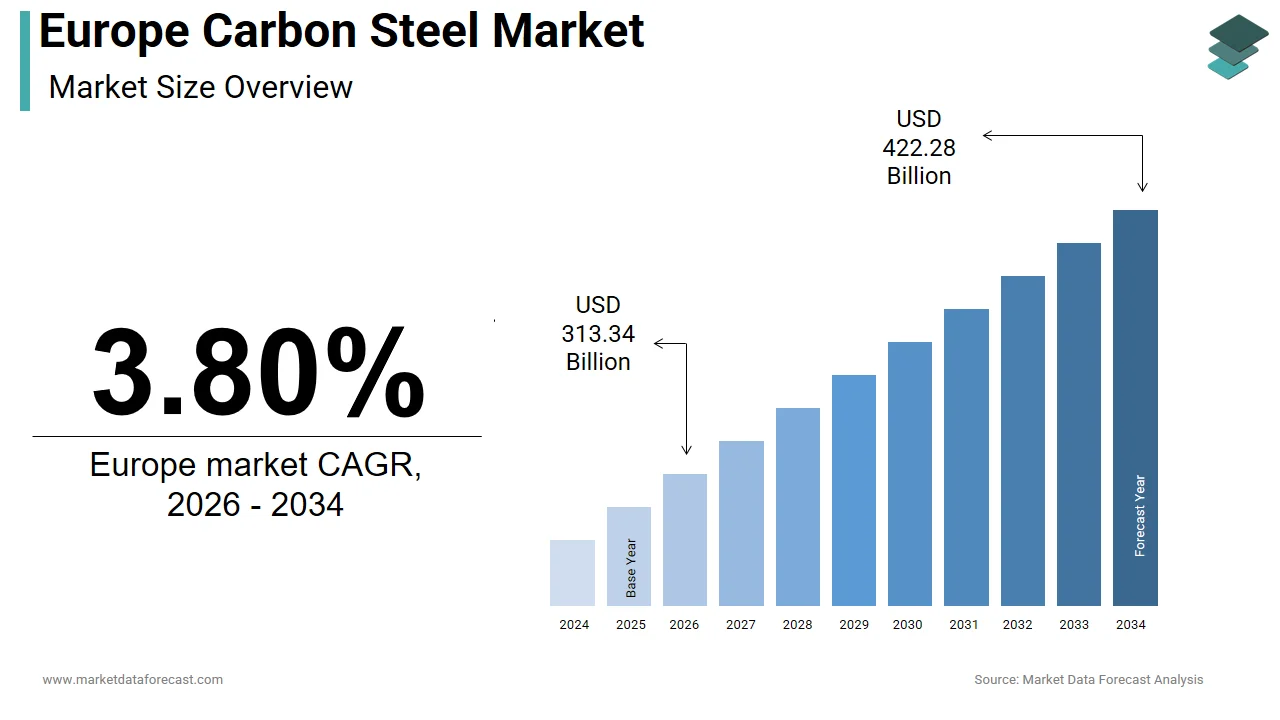
The European carbon steel market was valued at USD 301.87 billion in 2025, is estimated to reach USD 313.34 billion in 2026, and is projected to reach USD 422.28 billion by 2034, growing at a CAGR of 3.80% from 2026 to 2034. The growth of the European carbon steel market is driven by increasing demand from the construction, automotive, and manufacturing sectors, along with rising investments in infrastructure development and industrial modernization. Growing emphasis on sustainable steel production, the expansion of renewable energy projects, and technological advancements in steel recycling and processing are further fueling market growth. Moreover, the shift toward low-carbon steel production and hydrogen-based green steel initiatives has broadened opportunities for environmentally sustainable industrial growth across Europe.
Key Market Trends
- Rising adoption of low-carbon steel is driven by its cost efficiency, recyclability, and environmental benefits.
- Growing demand from the construction and automotive industries, supported by infrastructure expansion and vehicle manufacturing recovery.
- Increasing focus on sustainable steelmaking technologies, including hydrogen-based production and electric arc furnaces.
- Expansion of renewable energy and industrial infrastructure projects, boosting demand for durable and versatile carbon steel components.
- Strong emphasis on circular economy and decarbonization policies, encouraging innovation in green steel manufacturing across Europe.
Segmental Insights
- Based on type, the low carbon steel segment was the largest and held a significant share of the Europe carbon steel market in 2024. The segment’s dominance is attributed to its high ductility, weldability, and wide-ranging applications in construction, automotive, and consumer goods industries, appealing to end users seeking strength, versatility, and cost efficiency.
- Based on application, the building and construction segment accounted for the largest share of the Europe carbon steel market in 2024. The dominance of this segment stems from the rapid pace of infrastructure development, urbanization, and housing modernization, which continue to drive the demand for structural-grade steel across residential, commercial, and industrial projects.
Regional Insights
The European carbon steel market is witnessing consistent growth across major economies, supported by strong manufacturing capabilities, infrastructure investments, and export competitiveness in steel-based products.
- Germany was the largest contributor, accounting for 22.8% of the European carbon steel market share in 2024, driven by its robust industrial base, expanding automotive sector, and advanced engineering capabilities.
- Italy held the second-largest share, at 14.6%, fueled by construction activity, manufacturing expansion, and steady energy sector investments.
- France remains an attractive market, propelled by state-led infrastructure programs, defense-oriented industrial demand, and green manufacturing incentives.
- Spain expanded moderately, supported by renewable energy buildout, urban regeneration policies, and industrial diversification efforts.
- Turkey is anticipated to witness strong growth in the Europe carbon steel market from 2025 to 2033, owing to its strategic role as a manufacturing and export hub bridging Europe and neighboring regions.
Competitive Landscape
The European carbon steel market is characterized by the dominance of leading global and regional manufacturers with strong production capacities, technological expertise, and integrated supply chains. Key players are focusing on enhancing sustainability, expanding production facilities, and adopting green steelmaking technologies to strengthen their competitive edge. Strategic collaborations, R&D investments, and digital process innovations are further enabling companies to align with Europe’s carbon neutrality targets. Prominent players include ArcelorMittal, NIPPON STEEL CORPORATION, POSCO, Baosteel Group Corporation, JFE Steel Corporation, Tata Steel Limited, ThyssenKrupp AG, HBIS Group, and JSW Steel Corporation.
Europe Carbon Steel Market Size
The Europe carbon steel market was valued at USD 301.87 billion in 2025, is estimated to reach USD 313.34 billion in 2026, and is projected to reach USD 422.28 billion by 2034, growing at a CAGR of 3.80% from 2026 to 2034.
Carbon steel refers to the iron-carbon alloys containing up to 2.1 percent carbon by weight used extensively in construction, automotive, machinery, and energy infrastructure. Unlike specialty steel segments, carbon steel remains the backbone of Europe’s industrial material base due to its strength, cost efficiency, and recyclability. According to studies, the EU typically consumes around 140-160 million tonnes of steel annually, and low-carbon (carbon) steel is dominant in construction and mechanical applications due to its low cost and versatility. As per sources, a significant portion of European steel is produced in electric arc furnaces (EAFs) using recycled scrap. The European Commission’s Carbon Border Adjustment Mechanism (CBAM) has been implemented to put a carbon price on imported goods, including iron and steel, to prevent carbon leakage and incentivize local low-carbon production within the EU. This regulatory and circular economy framework positions Europe’s carbon steel not as a commodity but as a strategic material integral to both industrial resilience and climate neutrality.
MARKET DRIVERS
Infrastructure Renewal Under the EU Recovery and Resilience Facility
The unprecedented allocation of public funds to modernize Europe’s aging infrastructure is a major driver of the Europe carbon steel market. Consequently, this surges the demand across the transport energy and urban development sectors. As of August 2024, the European Commission had disbursed €265.4 billion from the Recovery and Resilience Facility (RRF), and EU countries are required to allocate at least 37% of their total expenditure to climate objectives (which they have exceeded, reaching an average of 42%). Investments in major rail networks like France's Grand Paris Express and Germany's Deutschlandtakt are significant drivers of demand for specialized rail steels. Similarly, the REPowerEU plan and national RRPs support the modernisation and expansion of electricity grids, with RRF-funded measures expected to modernise 14,000 km of electricity transmission and distribution lines. Urban regeneration initiatives are also revitalizing public housing with steel-framed modular construction to meet earthquake resilience standards. This public investment wave transforms carbon steel from a cyclical material into a policy-anchored demand stream essential for executing Europe’s green and digital transition.
Growth in Offshore Wind Energy Installations
The exponential expansion of offshore wind capacity in European waters is generating substantial new demand for high-strength carbon steel in turbine towers, foundations, and subsea cabling structures, which propels the expansion of the European carbon steel market. The European Union has established ambitious goals to significantly expand its offshore wind energy capacity over the coming decades. The construction of offshore wind infrastructure requires substantial quantities of carbon steel. The North Sea region is experiencing considerable activity, with numerous large-scale offshore wind projects recently approved for development. Specific grades of high-strength carbon steel are predominantly used in the construction of these offshore structures. EU policy encourages the use of locally produced and certified materials from European steel manufacturers in renewable energy projects. This confluence of climate policy, industrial strategy, and material suitability ensures carbon steel remains indispensable to Europe’s clean energy architecture.
MARKET RESTRAINTS
Stringent EU Emissions Trading System Compliance Costs
The escalating carbon pricing under the European Union Emissions Trading System imposes substantial financial burdens on integrated carbon steel producers reliant on blast furnace basic oxygen furnace routes, thereby restraining production economics and growth of the Europe carbon steel market. According to studies, the carbon price within the EU Emissions Trading System (ETS) is on a significant upward trend and is projected to continue increasing in the near future. In addition, High and rising carbon prices are substantially increasing the compliance costs for integrated steel plants, impacting their financial viability. As per sources, due to the pressure of high energy and carbon compliance costs, some European blast-furnace lines have been idled, indicating a trend of production cuts in the steel industry. The ETS will continue to penalize conventional carbon steel production and accelerate structural contraction in the integrated segment as long as hydrogen-based direct reduction or carbon capture retrofits remain limited to pilot scale and are not yet commercially viable.
Dependence on Imported Raw Materials and Energy Volatility
There is a persistent vulnerability due to its heavy reliance on imported iron ore, metallurgical coal, and natural gas, which exposes it to geopolitical disruptions and price volatility and inhibits the expansion of the Europe carbon steel market. According to studies, a notable share of the EU’s iron ore and a significant portion of its coking coal are sourced from outside the bloc, primarily from Brazil, Australia, and the United States. Energy endures as a critical cost variable, notwithstanding reduced gas dependency through efficiency gains and scrap recycling. This dual exposure to raw material supply chains and energy markets constrains investment predictability and undermines the sector’s ability to plan long-term capacity expansions in an environment of escalating decarbonization pressure.
MARKET OPPORTUNITIES
Circular Economy Integration Through Enhanced Scrap Utilization
The region’s advanced scrap collection and recycling infrastructure opens the way to decarbonize carbon steel production while enhancing supply chain sovereignty, which in turn creates new opportunities for the growth of the Europe carbon steel market. According to research, the EU collects millions of tonnes of obsolete steel scrap annually with a notable recycling rate. This abundant secondary resource enables electric arc furnace mills to produce carbon steel with lower CO2 emissions compared to blast furnace routes. European steelmakers are actively working to establish a circular industrial future for carbon steel by investing heavily in scrap processing hubs and digital material passports. These efforts are a direct response to the Carbon Border Adjustment Mechanism (CBAM), which incentivizes low-emission production, and the Net Zero Industry Act (NZIA), which promotes robust domestic circular value chains.
Development of Hydrogen-Based Direct Reduced Iron Hubs
The emergence of regional hydrogen valleys dedicated to green steel production gives a potential opportunity for the Europe carbon steel market. This can be achieved by enabling near-zero emission primary steelmaking. According to research, there is substantial financial investment and policy support within the European Union aimed at developing hydrogen-based direct reduced iron (DRI) facilities for green steel production. These hubs co-locate electrolyzers, renewable energy, and steel plants to produce carbon steel using green hydrogen instead of coal. As per research, new initiatives for steel manufacturing have successfully demonstrated a significant reduction in associated carbon dioxide emissions compared to the average production methods currently used in the EU. Multiple industrial projects are working towards ambitious targets to establish a large-scale annual production capacity for low-emission carbon steel by the end of the decade. Critically, these initiatives retain the material properties and supply reliability of conventional carbon steel while meeting Science-Based Targets. This pathway allows Europe to preserve its industrial steel base while aligning with climate imperatives, which turns decarbonization from a cost into a competitive differentiator.
MARKET CHALLENGES
Technological Obsolescence of Integrated Blast Furnace Plants
The accelerating obsolescence of aging integrated blast furnace facilities that lack the technical or economic capacity to retrofit for deep decarbonization, thereby constraining the growth of the Europe carbon steel market. The operational lifespan of existing blast furnaces in the EU is notably advanced, with many units exceeding or approaching their intended design life. These plants were engineered for coal-based reduction and cannot easily adapt to hydrogen injection or carbon capture without prohibitively expensive overhauls. Adapting current furnace infrastructure for partial hydrogen use is a substantial financial undertaking and results in decreased production efficiency. Consequently, mills face a stark choice between early closure and stranded assets. A projected stable steel demand through 2035, driven by infrastructure and energy needs, faces a significant supply security threat due to a capacity gap. This gap can only be closed if electric arc furnace (EAF) expansion and Direct Reduced Iron (DRI) projects scale rapidly, a solution currently constrained by insufficient grid capacity and scrap availability.
Trade Distortions from Global Overcapacity and Dumping
Trade distortions stemming from global overcapacity, particularly in China, and subsidized exports that affect fair competition and decarbonization incentives are a significant problem that hampers the expansion of the Europe carbon steel market. China's steel production capacity substantially exceeds its domestic demand, which contributes to increased exports during economic downturns. The European Union has seen a rise in carbon steel imports from non-European countries like Turkey, India, and Vietnam, often priced significantly below market value. This imbalance penalizes European producers investing in green steel while rewarding carbon-intensive imports, slowing the sector’s clean transition, and eroding the industrial base essential for strategic autonomy.
REPORT COVERAGE
| REPORT METRIC | DETAILS |
| Market Size Available | 2025 to 2034 |
| Base Year | 2025 |
| Forecast Period | 2026 to 2034 |
| Segments Covered | By Type, Application, and Country. |
| Various Analyses Covered | Global, Regional, and Country-Level Analysis, Segment-Level Analysis, Drivers, Restraints, Opportunities, Challenges; PESTLE Analysis; Porter’s Five Forces Analysis, Competitive Landscape, Analyst Overview of Investment Opportunities |
| Countries Covered | UK, France, Spain, Germany, Italy, Russia, Sweden, Denmark, Switzerland, Netherlands, Turkey, Czech Republic, and the Rest of Europe. |
| Market Leaders Profiled | ArcelorMittal, NIPPON STEEL CORPORATION, POSCO, Baosteel Group Corporation, JFE Steel Corporation, Tata Steel Limited, ThyssenKrupp AG, HBIS Group, and JSW Steel Corporation. |
SEGMENTAL ANALYSIS
By Type Insights
The low carbon steel segment accounted for the largest share of the Europe carbon steel market in 2025. The supremacy of the low-carbon steel segment is attributed to its exceptional formability, weldability, and cost efficiency, which makes it the default choice for high-volume structural and automotive applications. A further driver of this segment is its dominance in the construction sector, where a notable share of reinforcing bars and structural sections used in residential and commercial buildings are made from grades with less than 0.25 percent carbon. Moreover, a different growth factor of this segment is its irreplaceable role in automotive body manufacturing. Even as automakers adopt advanced high-strength steels, these are often built on low-carbon matrices. Robust EU infrastructure spending and vehicle production are the foundation of this segment's entrenched dominance.
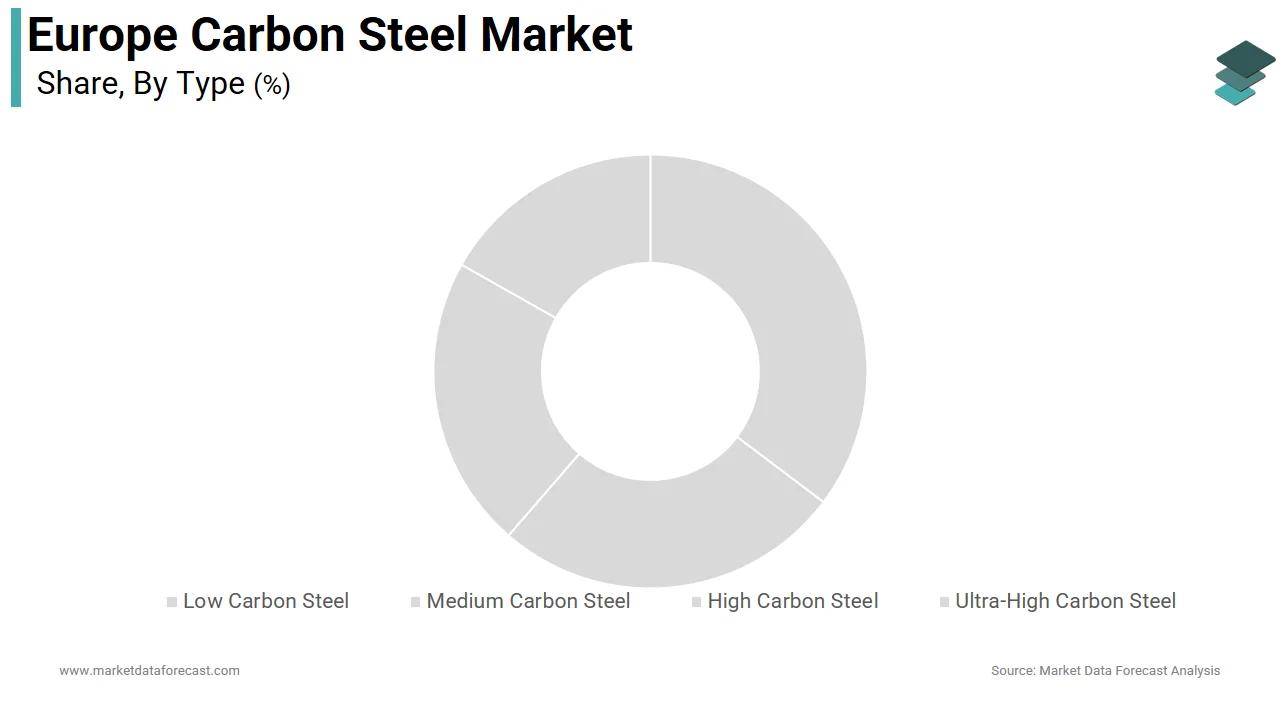
The high carbon steel segment is expected to exhibit a noteworthy CAGR of 5.8% from 2026 to 2034 due to demand for high-strength wear-resistant components in industrial machinery and renewable energy systems. This segment, defined by carbon content between 0.60 and 1.0 percent, is essential for manufacturing springs, cutting tools, and bearings that endure high stress and fatigue. The expansion of precision agriculture also fuels the growth of this segment. Moreover, the EU’s Machinery Regulation mandates longer equipment lifespans and repairability, which favours durable high-carbon components over lighter alternatives. This niche, yet vital, segment is experiencing sustained growth, driven by the acceleration of industrial output and clean energy deployment.
By Application Insights
The building and construction segment continued to dominate the Europe carbon steel market in 2025. Factors such as its foundational role in structural frameworks, infrastructure, and urban development drive the growth of the building and construction segment. The material’s high strength-to-weight ratio, fire resistance, and recyclability make it indispensable for multi-story buildings, bridges, and public works. Regulatory reinforcement further propels the growth of this segment. Urbanization trends further amplify demand, spurring vertical construction and transit-oriented development. Hence, construction will continue anchoring carbon steel demand through the decade.
The automotive and transportation segment is predicted to witness the highest CAGR of 6.3% from 2025 to 2033, owing to the simultaneous modernization of internal combustion vehicles and the structural needs of electric mobility. Lightweighting efforts have led to the adoption of aluminum and composites for exterior body panels. However, advanced carbon steel grades are still predominantly used for the underbody chassis and safety cages of both conventional and electric automobiles. A different growth factor of this segment is the expansion of rail and urban mobility. The automotive segment is surpassing others in steel intensity and volume growth, a trend fuelled by the rebound in production after the pandemic and increasing investments in clean transportation solutions.
COUNTRY LEVEL ANALYSIS
Germany Carbon Steel Market Analysis
Germany stood as the leading country in the Europe carbon steel market and accounted for a 22.8% share in 2024. The prominence of the German market is due to its dual role as Europe’s industrial powerhouse and infrastructure leader. The country’s manufacturing sector, involving automotive machinery and engineering, consumes millions of tonnes of carbon steel annually. Major German luxury car manufacturers are sustaining high production volumes, indicating a continued strong demand for steel in vehicle manufacturing. Germany is significantly investing in its rail network modernization, a program that will substantially increase the demand for structural steel. This fusion of industrial-scale public investment and strategic policy ensures Germany’s continued dominance in both consumption and technological advancement of carbon steel.
Italy Carbon Steel Market Analysis
Italy held the second largest share of 14.6% of the Europe carbon steel market in 2024. Its growth in the regional market is driven by its extensive construction sector and specialized machinery exports. Italy’s prominence in industrial equipment, particularly in textile, food processing, and packaging machinery, further boosts demand for medium and high-carbon steel components. The country’s focus on the circular economy also stands out, supported by advanced scrap sorting facilities. Italy’s blend of construction dynamism, industrial specialization, and recycling excellence cements its pivotal role in the regional market.
France Carbon Steel Market Analysis
France is an attractive region in the Europe carbon steel market and is propelled by state-led infrastructure programs and defense-oriented industrial demand. Several sectors in France are contributing to increased demand for carbon steel. Major infrastructure projects like the Grand Paris Express and the expansion of nuclear energy capacity with new reactors require substantial amounts of carbon and specialized carbon steel. Apart from these, government investment in industrial modernization and increased defense spending are boosting demand for steel in industrial sites, armored vehicles, and naval platforms. This combination of public mega projects, strategic industry, and energy sovereignty ensures sustained and diversified steel demand.
Spain Carbon Steel Market Analysis
Spain expanded moderately in the Europe carbon steel market owing to its renewable energy buildout and urban regeneration policies. It is significantly accelerating its expansion of wind and solar capacity, a move that is driving substantial demand for carbon steel used in the construction of related infrastructure. The national government is prioritizing major investments in a green and digital transition through its Recovery Plan, including large-scale programs for renovating residential properties and modernizing key railway corridors across the country. Spain's construction sector has demonstrated a strong rebound and continues to grow robustly, supported by rising investor confidence, increased building permits, and public and private sector activity. Spain is leveraging its extensive solar resources and coordinated EU funding to tie its steel demand predominantly to green infrastructure projects, moving away from conventional industrial use.
Turkey Carbon Steel Market Analysis
Turkey is anticipated to grow in the Europe carbon steel market from 2025 to 2033 due to its role as a manufacturing and export hub bridging Europe and Asia. Turkey is a significant crude steel producer in Europe, with most production consumed domestically by sectors like construction and automotive. Major infrastructure projects and automotive exports contribute to the high demand for steel. Despite geopolitical complexities, Turkey’s integrated production base, competitive energy costs, and strategic location sustain its significant footprint in the European supply chain, particularly for rebar and hot rolled coil used in Southern and Eastern Europe.
COMPETITIVE LANDSCAPE
Competition in the Europe carbon steel market is undergoing a fundamental transformation from price and scale-based rivalry to a race for decarbonization credibility and supply chain resilience. Traditional integrated producers like ArcelorMittal and ThyssenKrupp are competing not only with each other but with emerging green steel startups and global exporters subject to the Carbon Border Adjustment Mechanism. The European Union’s stringent climate policies have redefined competitiveness, where access to low-cost renewable energy, circular scrap supply, and public funding for innovation are as critical as metallurgical efficiency. This environment favors companies with strong European manufacturing footprints, deep industrial customer relationships, and demonstrable progress on emission reduction. Simultaneously, consolidation is accelerating as smaller mills struggle with compliance costs and energy volatility. The result is a two-tier market where technologically advanced low-emission producers capture premium contracts while conventional capacity faces structural decline. In this context, competitive advantage stems from environmental performance, policy alignment, and the ability to deliver certified low-carbon steel at an industrial scale.
KEY MARKET PLAYERS
Some of the companies that are playing a dominating role in the Europe carbon steel market include
- ArcelorMittal
- NIPPON STEEL CORPORATION.
- POSCO
- Baosteel Group Corporation
- JFE Steel Corporation
- Tata Steel Limited
- ThyssenKrupp AG
- HBIS Group
- JSW Steel Corporation
TOP PLAYERS IN THE MARKET
- ArcelorMittal is the leading steel producer in Europe and a pivotal force in the global carbon steel industry with integrated operations spanning Germany, France, Belgium, and Poland. The company supplies low and medium-carbon steel products to automotive, construction, and energy sectors across the continent. It has pioneered the Smart Carbon initiative, which combines circular carbon technologies and renewable hydrogen to decarbonize steelmaking. Recently, ArcelorMittal commissioned its first large-scale Torero plant in Ghent, Belgium, to convert waste wood into biochar for blast furnace injection and launched XCarb green steel certificates to meet corporate climate commitments. These actions reinforce its leadership in sustainable carbon steel while maintaining supply reliability for Europe’s industrial base.
- ThyssenKrupp Steel is a major supplier of high-quality carbon steel flat products serving automotive, mechanical engineering, and construction industries primarily in Germany and Western Europe. The company is renowned for its advanced high-strength steels used in vehicle lightweighting and safety systems. It has committed to becoming climate neutral by 2045 through its tkH2Steel program, which transitions production from coal-based blast furnaces to hydrogen-based direct reduction. These moves position it at the forefront of Europe’s green steel transformation while preserving technical excellence in carbon steel innovation.
- Tata Steel is a key producer of carbon steel with major operations in the Netherlands and the United Kingdom, focusing on automotive, packaging, and construction segments. The company supplies over 7 million tonnes annually of hot-rolled cold cold-rolled, and coated steel products to European manufacturers. It is actively advancing its Decarbonisation Roadmap through the Athos project in IJmuiden, which integrates carbon capture and storage to reduce emissions. These strategic initiatives demonstrate its commitment to aligning carbon steel production with Europe’s net-zero objectives while maintaining industrial competitiveness.
TOP STRATEGIES USED BY THE KEY MARKET PARTICIPANTS
Key players in the Europe carbon steel market focus on decarbonization through hydrogen-based direct reduction, carbon capture, and circular raw material use to comply with EU climate regulations. Companies are investing in green steel certification schemes to meet corporate offtake demand from the automotive and construction sectors. Strategic partnerships with renewable energy providers and technology firms enable an integrated clean energy supply for steel plants. Firms are also modernizing electric arc furnace capacity to increase scrap-based production and reduce reliance on imported iron ore. Additionally, producers are engaging in policy advocacy to shape Carbon Border Adjustment Mechanism implementation and secure public funding under the Net Zero Industry Act. These strategies reflect a shift from commodity production to value-added low-emission steel solutions aligned with Europe’s industrial and environmental priorities.
MARKET SEGMENTATION
This research report on the Europe carbon steel market has been segmented and sub-segmented into the following categories.
By Type
- Low Carbon Steel
- Medium Carbon Steel
- High Carbon Steel
- Ultra-High Carbon Steel
By Application
- Building and Construction
- Automotive & Transportation
- Industrial Equipment
- Others
By Country
- United Kingdom
- France
- Spain
- Germany
- Italy
- Russia
- Sweden
- Denmark
- Switzerland
- Netherlands
- Rest of Europe
Frequently Asked Questions
1. Which type dominates the europe carbon steel market?
Low carbon steel is the largest revenue-generating segment, registering the fastest growth during the forecast period
2. What drives growth in the europe carbon steel market?
Growth is driven by rising demand from automotive, infrastructure, and construction industries across europe
3. How does sustainable steel production impact the market?
The push for low-carbon and eco-friendly steel manufacturing boosts adoption and investments in europe
4. Which countries lead the europe carbon steel market?
Germany leads with the highest CAGR, followed by France, Italy, and the UK in steel consumption and production
5. How does carbon steel use vary by industry in europe?
Automotive and construction industries are key consumers of carbon steel, driving significant demand
6. How important is technological advancement in steel manufacturing?
Advancements improve production efficiency and steel quality, influencing market competitiveness in europe
7. What are challenges in the europe carbon steel market?
Challenges include regulatory policies, supply chain disruptions, and fluctuations in raw material prices
8. How does the energy sector affect carbon steel demand?
Expansion in energy infrastructure projects heightens carbon steel consumption for pipelines and machinery
9. What innovations are shaping the europe carbon steel market?
Development of lightweight and high-strength steel variants caters to advanced automotive and construction needs
10. What future trends will impact the europe carbon steel market?
Trends include green steel initiatives, circular economy adoption, and increased infrastructure investments
Related Reports
Access the study in MULTIPLE FORMATS
Purchase options starting from
$ 2000
Didn’t find what you’re looking for?
TALK TO OUR ANALYST TEAM
Need something within your budget?
NO WORRIES! WE GOT YOU COVERED!
Call us on: +1 888 702 9696 (U.S Toll Free)
Write to us: sales@marketdataforecast.com