- Product Description Description
- Table of Contents TOC
- List of Table & Figure LOT
- Get Free Sample PDF Sample PDF
Market Size, 2025
$0.51 BnMarket Estimate, 2026
$0.53 BnMarket Forecast, 2034
$0.72 BnCAGR, 2026–2034
3.86%Europe Steel Market Summary
The Europe steel market was valued at USD 0.51 billion in 2025, is estimated to reach USD 0.53 billion in 2026, and is projected to reach USD 0.72 billion by 2034, growing at a CAGR of 3.86% from 2026 to 2034. The growth of the Europe steel market is driven by the expansion of the construction sector, rising demand from the automotive industry, adoption of green steel production technologies, and increasing government support for decarbonization initiatives across the region.
Key Market Trends
- Growing shift toward low-carbon and hydrogen-based steelmaking supported by the European Green Deal and sustainability policies.
- Rising demand for flat steel products in automotive and machinery manufacturing applications.
- Expanding steel recycling initiatives, promoting circular economy practices and reducing energy consumption.
- Increasing integration of AI, IoT, and automation in steel production to improve process efficiency and quality control.
- Surge in infrastructure modernization projects and urban redevelopment driving long-term steel demand.
Segmental Insights
- Based on Product: The flat steel segment accounted for 60.5% of the Europe steel market share in 2024, driven by its widespread use in automotive bodies, shipbuilding, and industrial equipment manufacturing. The segment continues to benefit from advancements in high-strength, lightweight steel materials catering to EV and renewable energy applications.
- Based on Application: The building and construction segment led the market, holding a 45.3% share in 2024, supported by ongoing infrastructure renewal, housing projects, and commercial construction activities. The segment’s growth is reinforced by the preference for durable and sustainable construction materials across the EU.
Regional Insights
- The Europe steel market shows distinct regional patterns influenced by industrialization, environmental policy, and sectoral demand.
- Germany dominated the market with a 25.6% share in 2024, owing to its strong automotive and machinery manufacturing base and ongoing investments in green steel technologies.
- France and the United Kingdom recorded steady growth, supported by infrastructure development and industrial renewal programs.
- Eastern Europe, including Poland and the Czech Republic, is witnessing rising production capacity and foreign investments in steel manufacturing, strengthening regional supply chains.
- Southern Europe is gradually recovering from economic slowdowns, with moderate growth expected in construction-related steel demand.
Competitive Landscape
- The European steel market is moderately consolidated, with key players focusing on process innovation, sustainability, and capacity expansion.
- Leading companies are investing heavily in decarbonization technologies and R&D for advanced steel grades to enhance competitiveness and meet EU carbon neutrality goals.
- Prominent players in the Europe steel market include ArcelorMittal, Baosteel Group, Emirates Steel, JFE Steel Corporation, Nippon Steel Corporation, NUCOR, Outokumpu, POSCO, Tata Steel, and Thyssenkrupp.
- These companies are emphasizing strategic partnerships, technological integration, and environmentally friendly production to strengthen their market footprint across Europe.
Europe Steel Market Size
The Europe steel market size was valued at USD 0.51 billion in 2025 and is anticipated to reach USD 0.0.53 billion in 2026 to USD 0.72 billion by 2034, growing at a CAGR of 3.86% during the forecast period from 2026 to 2034.
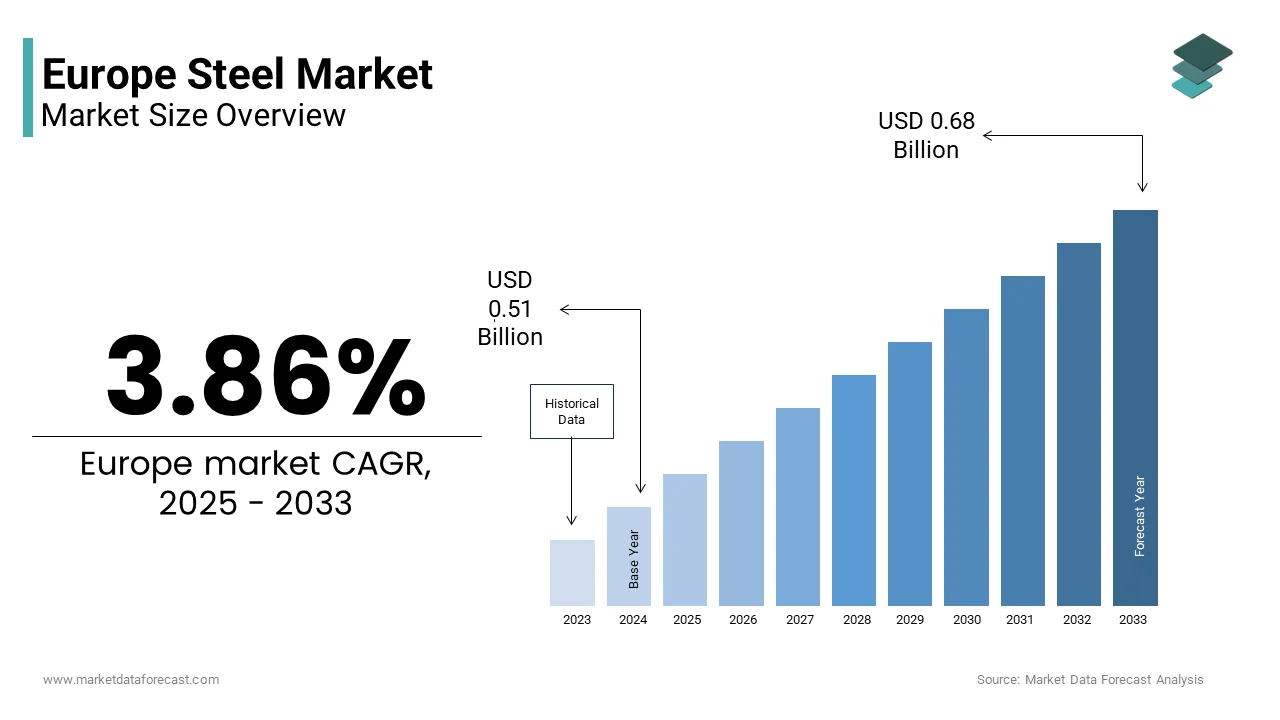
Steel is an alloy primarily composed of iron and carbon, known for its enhanced strength and fracture resistance compared to pure iron. According to EUROFER, steel production in the EU in 2023 was approximately 126 million metric tons. Germany was the EU's largest steel producer in 2023, its output of around 35.4 million metric tons represented approximately 28% of the EU's total. Flat steel dominates the product landscape, driven by its widespread use in automotive and construction sectors, as per data from the International Iron and Steel Institute (IISI). The growing emphasis on decarbonization has accelerated investments in green steel technologies, with Sweden and Austria leading in hydrogen-based production methods. As per sources, low-carbon steel reduces greenhouse gas emissions by appealing to environmentally conscious manufacturers. Apart from these, rising demand for infrastructure development, particularly in Eastern Europe, has bolstered consumption, which ensures sustained market momentum despite challenges such as fluctuating raw material costs and geopolitical tensions.
MARKET DRIVERS
Infrastructure Development Projects
Infrastructure development projects are a key driver of the Europe steel market. According to studies, The European Commission has pledged to mobilize at least €1 trillion in sustainable investments across the EU under the Green Deal framework, drawing from public and private sources, including the EU budget and InvestEU program. This trend is particularly pronounced in Eastern Europe, where urbanization and modernization efforts have amplified the need for durable materials. Poland and Romania lead in construction activity, leveraging steel for bridges, highways, and public transit systems. Besides, government incentives for sustainable building practices have further strengthened steel's dominance, which ensures broader accessibility to eco-friendly solutions.
Automotive Industry Expansion
The expansion of the automotive industry is also a major accelerator of the expansion of the Europe steel market. According to the European Automobile Manufacturers' Association (ACEA), over 12 million passenger cars were produced in the EU in 2023, and steel generally accounts for 60–65% of a typical car's total weight, including its structural components, chassis, and other parts. Germany leads in automotive manufacturing, leveraging advanced high-strength steel to enhance vehicle safety and fuel efficiency. As per studies, using advanced high-strength steels (AHSS) in the body structure can reduce its weight by 25–39% compared to conventional steel. Furthermore, the shift toward electric vehicles (EVs) has increased demand for specialized steel grades tailored to battery enclosures and motor housings, which ensures sustained market growth.
MARKET RESTRAINTS
Fluctuating Raw Material Costs
Fluctuating raw material costs pose a barrier to the growth of the Europe steel market. According to EUROFER, 2023 was marked by considerable economic uncertainty, high energy costs, and weak demand, which impacted raw material prices and contributed to a contraction in apparent steel consumption. This volatility is particularly pronounced in countries like Italy and Spain, where smaller steel producers lack the financial resilience to absorb rising costs. In addition, geopolitical tensions have exacerbated supply chain disruptions, further complicating procurement. As per study published by the European Central Bank, supply chain disruptions and energy price shocks in the euro area have had a significant effect on industrial production, especially in energy-intensive sectors
Stringent Environmental Regulations
Stringent environmental regulations is also a major restraint in the growth of the Europe steel market. According to sources, the European steel industry is working toward ambitious decarbonization targets, with a wide-scale transformation still in progress and most plants yet to achieve near-zero emissions. This lengthy process discourages smaller companies from entering the market, reducing competition and innovation. In countries like France and Belgium, local governments impose additional restrictions on emissions and energy usage, further complicating compliance. Challenges arising from evolving EU regulations and high energy costs, along with competition from global overcapacity, have put significant pressure on the European steel sector and impacted capacity expansion.
MARKET OPPORTUNITIES
Adoption of Green Steel Technologies
The adoption of green steel technologies offers a potential opportunity for the growth of the Europe steel market. According to the European Environmental Agency, hydrogen-based steel production reduces greenhouse gas emissions, which appeals to manufacturers seeking compliance with EU decarbonization goals. Sweden and Austria have positioned themselves as leaders in this space, with startups developing scalable solutions tailored to industrial needs. A study by CEPS indicates that green steel has a significantly higher production cost, a 'green premium', than traditional steel, though this may decrease in the future with lower energy prices and carbon taxes. Apart from these, partnerships between academia and industry ensure scientific validation by enhancing product credibility. These innovations position green steel as a transformative force in the market, ensuring sustained growth and innovation.
Growing Demand for Lightweight Steel Alloys
The growing demand for lightweight steel alloys provides a new opportunity for growth of the Europe steel market. According to sources, lightweight alloys reduce material usage, which makes them ideal for industries such as automotive and aerospace. Germany and France have embraced this trend, with manufacturers developing specialized grades tailored to specific applications. As per research, lightweight steel improves fuel efficiency, which appeals to automakers seeking compliance with emission regulations. These factors position lightweight steel as a key growth driver in the market by ensuring broader adoption and sustained innovation.
REPORT COVERAGE
| REPORT METRIC | DETAILS |
| Market Size Available | 2025 to 2034 |
| Base Year | 2025 |
| Forecast Period | 2026 to 2034 |
| CAGR | 3.86% |
| Segments Covered | By Product, Application, and Country |
| Various Analyses Covered | Regional & Country Level Analysis, Segment-Level Analysis, DROC, PESTLE Analysis, Porter’s Five Forces Analysis, Competitive Landscape, Analyst Overview of Investment Opportunities |
| Regions Covered | UK, France, Spain, Germany, Italy, Russia, Sweden, Denmark, Switzerland, Netherlands, Turkey, Czech Republic, and the Rest of Europe |
| Market Leaders Profiled | ArcelorMittal, Baosteel Group, Emirates Steel, JFE Steel Corporation, Nippon Steel Corporation, NUCOR, Outokumpu, POSCO, Tata Steel, Thyssenkrupp |
SEGMENTAL ANALYSIS
By Product Insights
The flat steel segment dominated the Europe steel market by holding a share of 60.5% in 2024. The dominance of the flat steel segment is driven by its versatility and widespread use in industries such as automotive, construction, and appliances. According to research, flat steel accounts for a portion of all steel consumed in the automotive sector, which reflects its important role in vehicle manufacturing. Germany leads in flat steel production by leveraging advanced rolling technologies to enhance product quality. As per studies, flat steel reduces production costs by supporting its dominance in the market. Besides, government incentives for sustainable manufacturing ensure compliance with environmental standards, which appeals to eco-conscious consumers.

The long steel segment is expected to exhibit a noteworthy CAGR of 8.5% from 2025 to 2033. The rapid growth of the long steel segment is fueled by its increasing use in infrastructure and construction projects, which require durable and versatile materials. Poland and Turkey have embraced this trend, with startups developing corrosion-resistant grades tailored to harsh environments. As per studies, long steel reduces maintenance costs, which positions it as the most dynamic segment in the market.
By Application Insights
The building and construction segment led the Europe steel market and occupied a share of 45.3% in 2024. The prominence of the building and construction segment is propelled by the material's durability, versatility, and widespread use in structural frameworks, bridges, and infrastructure projects. According to research, steel accounts for a share of materials used in large-scale construction projects across Europe, which reflects its vital role in urbanization and modernization efforts. Germany leads in steel consumption for construction by leveraging advanced fabrication techniques to enhance structural integrity. As per studies, steel reduces lifecycle costs, which strengthens its dominance in the market. Furthermore, government incentives for sustainable building practices have further supported its appeal, which ensures broader accessibility to eco-friendly solutions.
The automotive and transportation segment is predicted to witness the highest CAGR of 9.2% during the forecast period. The increasing demand for lightweight and high-strength steel grades tailored to vehicle manufacturing and public transit systems has majorly contributed to the growth of the automotive and transportation segment. According to research, steel accounts for a portion of materials used in automotive production, and is driven by its ability to enhance safety and fuel efficiency. Sweden and France have embraced this trend, with manufacturers developing specialized alloys tailored to electric vehicles (EVs) and high-speed rail systems. These factors position automotive and transportation as the most dynamic application segment in the market.
COUNTRY ANALYSIS
Top Countries in the Market
Germany Market Analysis
Germany was the top performer in the Europe steel market and captuirng 25.6% share in 2024. The prominence of Germany is driven by the country’s robust industrial base, advanced technological infrastructure, and strong policy support for innovation. According to sources, millions of metric tons of steel were produced nationwide, supported by investments in green steel technologies such as hydrogen-based production. Berlin and Munich lead in R&D initiatives by leveraging collaborations between academia and industry to develop scalable solutions. Government incentives for sustainable manufacturing have further strengthened Germany’s dominance, which ensures broader accessibility to eco-friendly products. Apart from these, the country’s strategic focus on export-oriented growth has positioned it as a global leader in high-quality steel production.
Italy Market Analysis
Italy is the second-largest region in the Europe steel market by accounting for 15.1% share in 2024. The growth of the Italy is due to its focus on specialty steel grades tailored to niche applications such as luxury automotive manufacturing and marine engineering. According to sources, millions of metric tons of steel were produced nationwide, which reflects its vital role in regional industries. Milan and Turin lead in innovation, with startups developing corrosion-resistant alloys tailored to harsh environments. Besides, the government’s focus on decarbonization has encouraged manufacturers to adopt renewable energy sources, ensuring compliance with EU environmental standards. Also, it is smaller in scale compared to Germany, and Italy’s strategic emphasis on quality and craftsmanship positions it as a key player in the regional market.
COMPETITIVE ANALYSIS
The Europe steel market is characterized by intense competition, driven by the presence of established players and emerging innovators. The market is moderately consolidated, with ArcelorMittal, ThyssenKrupp, and Salzgitter AG dominating the landscape. These companies compete on the basis of technological superiority, product scalability, and strategic collaborations. Smaller firms, however, are gaining ground by focusing on niche segments, such as green steel and specialty alloys. The competitive dynamics are further shaped by regulatory requirements, which mandate rigorous testing and compliance, creating barriers to entry for new entrants. Pricing burdens also influence competition, as companies strive to offer cost-effective solutions without compromising quality. Despite these challenges, the market’s growth potential remains robust, fueled by increasing demand for sustainable materials and advancements in steel technologies.
KEY MARKET PLAYERS
A few of the market players in the Europe steel market include
- ArcelorMittal
- Baosteel Group
- Emirates Steel
- JFE Steel Corporation
- Nippon Steel Corporation
- NUCOR
- Outokumpu
- POSCO
- Tata Steel
- Thyssenkrupp
Top Players In The Market
The Europe steel market is led by three key players: ArcelorMittal, ThyssenKrupp, and Salzgitter AG. These companies collectively account for a portion of the regional market share, leveraging their extensive product portfolios and technological expertise. ArcelorMittal dominates with its flagship flat steel products, which are widely regarded as benchmarks for quality and sustainability. ThyssenKrupp follows closely, offering innovative long steel solutions tailored to infrastructure and automotive applications. The company’s focus on expanding its green steel capacity has resulted in a year-over-year growth in its sustainable product line. Salzgitter AG rounds out the top three, with a strong presence in specialty steel grades. Its commitment to decarbonization ensures eco-friendly designs, which supports its global standing.
Top Strategies Used By Key Market Participants
Key players in the Europe steel market employ a variety of strategies to strengthen their positions. Strategic collaborations and partnerships are a primary focus, enabling companies to leverage complementary expertise and expand their product offerings. For instance, ArcelorMittal has partnered with leading research institutions to develop hydrogen-based steel production methods tailored to carbon neutrality goals. Mergers and acquisitions are another important strategy, allowing firms to consolidate their market presence. ThyssenKrupp, for example, acquired a startup specializing in advanced metallurgy, enhancing its capabilities in lightweight steel alloys. Furthermore, these companies prioritize geographic expansion, targeting underserved regions to increase accessibility. Salzgitter AG has invested heavily in establishing production facilities across Eastern Europe, which ensures broader market penetration. Product innovation remains central to their strategies, with substantial R&D investments driving the development of advanced solutions tailored to evolving consumer needs.
MARKET SEGMENTATION
This research report on the Europe steel market is segmented and sub-segmented into the following categories.
By Product
Flat Steel
Long Steel
By Application
- Building & Construction
- Automotive & Transportation
- Heavy Industry
- Consumer Goods
- Others
By Country
- UK
- Russia
- Germany
- Italy
- France
- Spain
- Sweden
- Denmark
- Poland
- Switzerland
- Netherlands
- Rest of Europe