- Product Description Description
- Table of Contents TOC
- List of Table & Figure LOT
- Get Free Sample PDF Sample PDF
Market Size, 2025
$3.41 BnMarket Estimate, 2026
$3.87 BnMarket Forecast, 2034
$10.58 BnCAGR, 2026–2034
13.40%Europe CCTV Cameras Market Report Summary
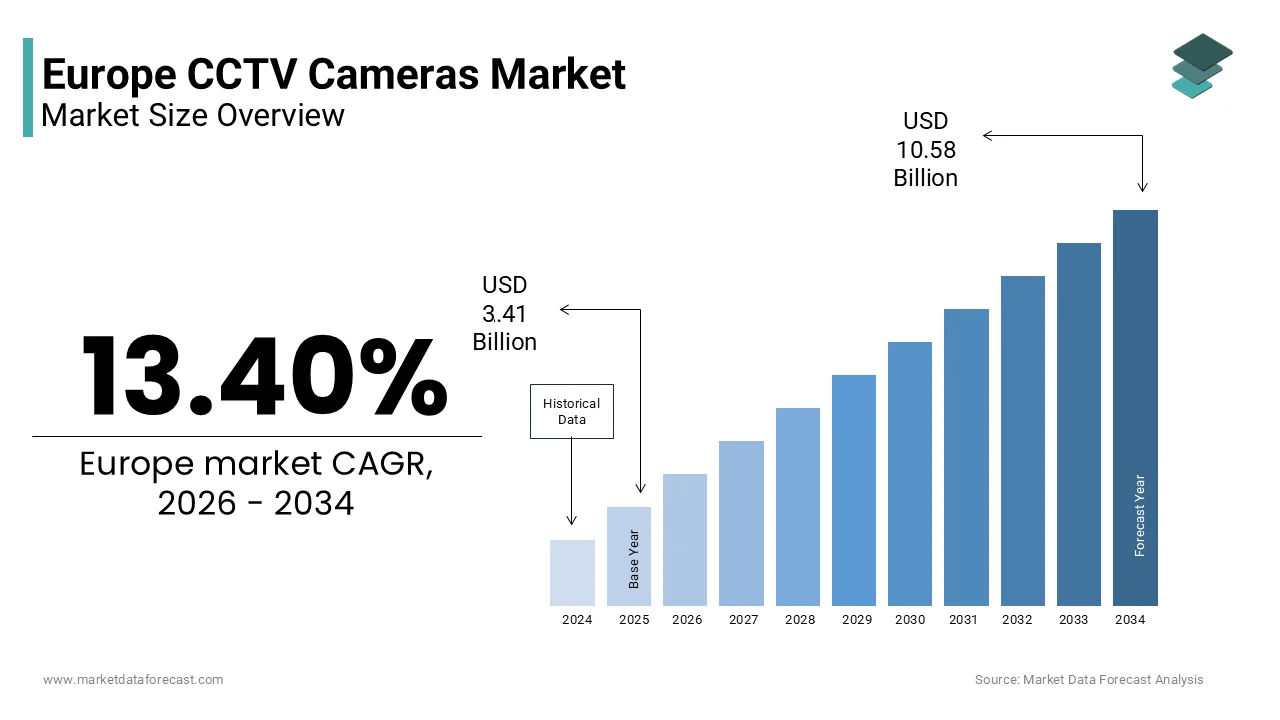
The Europe CCTV cameras market was valued at USD 3.41 billion in 2025, is estimated to reach USD 3.87 billion in 2026, and is projected to reach USD 10.58 billion by 2034, growing at a CAGR of 13.40% during the forecast period. The growth of the Europe CCTV cameras market is driven by increasing concerns about public safety, rising adoption of smart surveillance technologies, and expanding use of video monitoring systems across commercial and public infrastructure. Governments and private organizations are increasingly investing in advanced surveillance systems to enhance security and crime prevention. In addition, the integration of artificial intelligence, facial recognition, and cloud based video management systems is significantly improving the capabilities of modern CCTV solutions across Europe.
Key Market Trends
- Increasing adoption of intelligent video surveillance systems equipped with artificial intelligence and analytics for improved threat detection.
- Growing deployment of CCTV cameras across smart city projects, transportation hubs, retail stores, and public infrastructure.
- Rising demand for high resolution IP cameras that provide enhanced image quality, remote monitoring capabilities, and scalable network integration.
- Expansion of cloud based video surveillance systems that enable centralized monitoring and data storage.
- Increasing investments in security infrastructure by governments and private organizations to strengthen public safety and crime prevention.
Segmental Insights
- Based on product, the dome security camera segment held the largest share of the Europe CCTV cameras market in 2025. Dome cameras are widely used in commercial spaces, retail stores, offices, and public buildings due to their compact design, wide viewing angles, and discreet appearance that helps prevent tampering.
- Based on technology, the IP security camera segment dominated the Europe CCTV cameras market in 2025. IP cameras offer advanced features such as remote accessibility, high resolution video recording, and seamless integration with network based monitoring systems, making them increasingly preferred across security applications.
- Based on application, the commercial segment accounted for the largest share of the Europe CCTV cameras market in 2025. The extensive use of surveillance systems in retail outlets, offices, shopping malls, and commercial complexes to enhance security and monitor operations is driving the growth of this segment.
Regional Insights
- The Europe CCTV cameras market is witnessing strong growth across several countries due to increasing demand for advanced surveillance technologies and rising security concerns.
- Germany accounted for the largest share of the Europe CCTV cameras market and held 23.6% of the regional market share in 2025. The country’s strong security infrastructure, expanding smart city initiatives, and increasing adoption of intelligent surveillance systems are key factors supporting market growth.
- Other European countries are also experiencing rising demand for CCTV systems driven by increasing investments in urban safety infrastructure, transportation security, and commercial surveillance applications.
Competitive Landscape
The Europe CCTV cameras market is highly competitive with the presence of global surveillance technology providers and established security solution manufacturers. Companies are focusing on developing high resolution cameras, artificial intelligence powered video analytics, and integrated security platforms to enhance surveillance capabilities. Strategic partnerships, product innovation, and expansion of smart security solutions are helping companies strengthen their position in the European market. Prominent players in the Europe CCTV cameras market include Hikvision, Dahua Technology, Axis Communications, Bosch Security Systems, Hanwha Techwin, FLIR Systems, Sony, Panasonic, and Honeywell.
Europe CCTV Cameras Market Size
The Europe CCTV cameras market size was valued at USD 3.41 billion in 2025 and is projected to reach USD 10.58 billion by 2034 from USD 3.87 billion in 2026, growing at a CAGR of 13.40%.
CCTV cameras comprise a sophisticated ecosystem of video surveillance technologies ranging from analogue high-definition units to advanced networked IP cameras equipped with artificial intelligence and edge computing capabilities. This sector serves as the foundational layer for physical security infrastructure across public spaces commercial enterprises and residential properties throughout the continent. The definition has evolved beyond passive recording to include active threat detection behavioral analysis and real time data integration with broader smart city platforms. According to Eurostat, the urban population in the European Union reached high levels in 2023, which is creating dense environments where automated monitoring is essential for crowd management and crime prevention. As per the European Union Agency for Law Enforcement Cooperation, property crime rates in major metropolitan areas remain a persistent concern, which is prompting municipalities to invest heavily in visible deterrents. The General Data Protection Regulation established by the European Parliament reshapes how these systems operate by mandating strict protocols for data privacy, storage, and access. According to the International Telecommunication Union, broadband penetration in Europe is widespread, enabling the seamless transmission of high-resolution video streams required for modern cloud-based surveillance. The market is characterized by a shift toward cybersecurity hardened devices that prevent unauthorized access and ensure the integrity of recorded evidence. This technological maturation transforms CCTV from a simple observational tool into an intelligent component of comprehensive safety and operational efficiency strategies.
MARKET DRIVERS
Escalating Security Threats and Terrorism Prevention Initiatives
The rising frequency of security incidents and the persistent threat of terrorism is majorly driving the expansion of European CCTV cameras market. Governments and private entities recognize that visible camera networks serve as both a deterrent to criminal activity and a critical tool for post-incident investigation and forensic analysis. As per the European Union Agency for Law Enforcement Cooperation, terrorist attacks and foiled plots in recent years have led to a strategic reassessment of public space security, resulting in increased funding for monitoring infrastructure. Data from national interior ministries in countries like France and the United Kingdom shows a direct correlation between major security events and subsequent budget allocations for expanding CCTV coverage in transport hubs and crowded venues. The need for real-time situational awareness drives the adoption of cameras with panoramic views and low-light capabilities that allow operators to monitor large areas effectively. Furthermore, the integration of license plate recognition systems at city entry points helps authorities track suspicious vehicles and manage traffic flow during emergencies. Public perception of safety significantly influences tourism and local commerce, creating economic pressure on city councils to maintain robust surveillance networks. The inability of human patrols to cover vast urban landscapes necessitates the use of automated eyes that operate continuously without fatigue. This imperative to protect citizens and critical infrastructure ensures sustained demand for high-performance surveillance solutions.
Mandates for Smart City Development and Urban Digitalization
Government-led initiatives to transform European cities into intelligent and connected ecosystems drive substantial demand for networked CCTV cameras equipped with IoT sensors and analytics software, which is further boosting the European CCTV cameras market growth. Urban planners view video surveillance as a central nervous system that collects vital data on traffic patterns, pedestrian flows, and environmental conditions to optimize city services. According to the European Commission, hundreds of cities have joined the Smart Cities Marketplace to share best practices and accelerate the deployment of integrated digital solutions, including intelligent video management. These projects require cameras capable of edge processing to analyze data locally and reduce bandwidth usage while providing instant insights for traffic signal adjustment and emergency response coordination. Data from the European Topic Centre on Air Pollution reveals that many municipalities now integrate air quality sensors into camera housings to create multi-functional street furniture. The push for sustainable mobility relies on surveillance to enforce low-emission zones and monitor electric vehicle charging stations, ensuring compliance with environmental regulations. Local authorities prioritize vendors who offer open-architecture systems that can integrate with existing municipal databases and emergency dispatch centers. The ability to leverage video data for urban planning decisions, such as optimizing public transport routes, adds significant value beyond traditional security applications. This strategic alignment between digital transformation goals and surveillance technology creates a robust growth trajectory for the market.
MARKET RESTRAINTS
Stringent Data Privacy Regulations and Compliance Burdens
The rigorous enforcement of the General Data Protection Regulation (GDPR) acts as a significant restraint on the Europe CCTV cameras market by imposing strict limitations on data collection, storage, and processing practices. Organizations must navigate complex legal requirements regarding consent, data minimization, and the right to be forgotten, which increases the administrative and technical costs of deploying surveillance systems. As per the European Data Protection Board, authorities have issued substantial fines to entities found non-compliant with video surveillance rules, creating a climate of caution among potential adopters. The regulation mandates that cameras must not capture unnecessary footage of private properties or individuals not relevant to the security purpose, requiring precise positioning and masking features. Data from legal compliance firms indicates that the cost of implementing privacy-enhancing technologies such as automatic blurring and encrypted storage can increase project budgets significantly. The requirement to conduct Data Protection Impact Assessments before installation delays deployment timelines and discourages small businesses from investing in advanced systems. Public skepticism regarding mass surveillance further pressures companies to limit the scope and retention periods of recorded footage. The varying interpretation of GDPR rules across different member states creates a fragmented regulatory landscape that complicates pan-European deployments. These legal hurdles create barriers to entry and slow down the overall pace of market expansion despite the clear demand for security solutions.
High Implementation Costs and Cybersecurity Vulnerabilities
The substantial upfront investment required for modern IP-based surveillance infrastructure combined with ongoing cybersecurity risks is further impeding the growth of the European CCTV cameras market. Transitioning from legacy analog systems to high-resolution network cameras involves significant capital expenditure for hardware, software licensing, and network upgrades that strain the budgets of small and medium-sized enterprises. As per the European Union Agency for Cybersecurity, the number of cyberattacks targeting IoT devices, including CCTV cameras, increased sharply in 2023, highlighting the vulnerability of connected surveillance networks. The cost of securing these devices against hacking attempts through regular firmware updates, network segmentation, and encryption adds to the total cost of ownership. Industry surveys reveal that many organizations hesitate to deploy cloud-based video management systems due to fears of data breaches and unauthorized access. The complexity of managing large-scale camera fleets requires specialized IT skills, which are often scarce and expensive to recruit. Supply chain disruptions have also led to volatile pricing for semiconductor components used in camera sensors, affecting project feasibility. The risk of reputational damage from a security breach involving surveillance footage deters many potential buyers from adopting connected solutions. These financial and technical challenges create a conservative market environment where organizations prioritize cost-cutting measures over growth initiatives.
MARKET OPPORTUNITIES
Integration of Artificial Intelligence for Predictive Analytics
The convergence of artificial intelligence with video surveillance presents a promising opportunity for the Europe CCTV cameras market to evolve from reactive monitoring to proactive threat prevention. Smart cameras equipped with deep learning algorithms can analyse behavior patterns, detect anomalies, and predict potential security incidents before they occur, offering unprecedented value to end users. As per the European Artificial Intelligence Alliance, a majority of security directors plan to invest in AI-driven surveillance solutions by 2025 to enhance operational efficiency and reduce false alarms. These systems can distinguish between humans, animals, and vehicles, reducing the workload on security personnel and enabling faster response times to genuine threats. Data from the International Data Corporation suggests that shipments of AI-enabled cameras in Europe will double by 2026 as organizations seek data-driven insights for business intelligence. Retailers utilize people counting and heat mapping features to optimize store layouts and staffing levels, turning surveillance into a revenue-generating tool. The ability to perform real-time facial recognition for access control in secure facilities adds another layer of utility for corporate and government clients. Manufacturers who embed edge computing capabilities directly into camera hardware will gain a competitive advantage by offering low-latency analytics without relying on cloud connectivity. This technological leap positions CCTV systems as essential components of intelligent building management and public safety ecosystems.
Expansion of Cloud-Based Video Surveillance as a Service
The growing adoption of cloud computing models offers a lucrative avenue for the deployment of flexible, scalable and cost-effective surveillance solutions across diverse sectors in Europe. Video Surveillance as a Service (VSaaS) eliminates the need for expensive on-premise servers and maintenance teams, allowing businesses to pay only for the storage and features they consume. According to the European Cloud Partnership, the shift toward cloud-native applications in the security sector has accelerated, with a significant share of new installations utilizing hybrid or fully cloud architectures. This model enables remote access to live feeds and archived footage from any device, facilitating efficient management of multi-site operations for retail chains and logistics companies. Data from market analysts indicates that the recurring revenue potential of subscription-based services attracts manufacturers to develop user-friendly cloud platforms with advanced analytics included. The scalability of cloud storage allows organizations to easily expand their camera networks without significant capital outlays, adapting to changing security needs dynamically. Furthermore, cloud providers offer robust cybersecurity measures and automatic software updates that address common vulnerabilities associated with local systems. The ability to integrate video data with other cloud-based enterprise systems enhances overall operational visibility and decision-making. This shift toward service-oriented models opens new revenue streams and democratizes access to advanced surveillance technology for smaller organizations.
MARKET CHALLENGES
Complexities in Cross-Border Data Sovereignty and Storage
Navigating the intricate landscape of data sovereignty laws is challenging the growth of the European CCTV cameras market. Different member states have varying requirements regarding where video data must be stored and processed, creating logistical and legal hurdles for multinational operators. As per the European Data Protection Board, guidelines on cross-border data transfers require strict adherence to adequacy decisions and standard contractual clauses, which can be technically complex to implement. Surveillance providers face the risk of non-compliance if data inadvertently flows to servers located outside approved jurisdictions, leading to severe penalties and operational disruptions. Data from legal experts indicates that many European organizations struggle to define clear data residency policies for their video surveillance networks due to conflicting national regulations. The requirement to maintain separate data silos for different countries increases infrastructure costs and reduces the efficiency of centralized management platforms. Public concern over foreign access to sensitive video footage further pressures governments to impose stricter localization mandates. The lack of harmonized standards for data handling across the EU creates a fragmented market environment that complicates product development and deployment strategies. Balancing the benefits of global cloud connectivity with stringent local data protection laws remains a persistent obstacle for market growth.
Rapid Technological Obsolescence and Interoperability Issues
The fast pace of innovation in surveillance technology and a lack of universal interoperability standards are further challenging the expansion of the regional market. Organizations investing in proprietary camera systems often find themselves locked into specific vendor ecosystems, making it difficult and costly to upgrade or expand their networks with third-party devices. As per the European Committee for Standardization, efforts to create unified protocols for IP surveillance have progressed slowly, leading to compatibility issues between cameras from different manufacturers and video management software. Data from industry reports reveals that a large share of existing surveillance installations face challenges when attempting to integrate new AI features due to legacy hardware limitations. The rapid emergence of higher-resolution sensors and advanced analytics renders older equipment obsolete within a few years, forcing frequent capital expenditures. The absence of plug-and-play functionality increases installation time and requires specialized technical expertise for configuration and troubleshooting. Vendors frequently discontinue support for older models, leaving customers with unsupported security gaps. This dynamic environment creates uncertainty for buyers who fear their investments will lose value quickly. Addressing these interoperability gaps requires greater industry collaboration and adherence to open standards, which remains an ongoing struggle in a highly competitive market.
REPORT COVERAGE
| REPORT METRIC | DETAILS |
| Market Size Available | 2025 to 2034 |
| Base Year | 2025 |
| Forecast Period | 2026 to 2034 |
| CAGR | 13.40% |
| Segments Covered | By Product, Technology, Application, Resolution, Services, and Region |
| Various Analyses Covered | Global, Regional, & Country Level Analysis; Segment-Level Analysis; DROC, PESTLE Analysis; Porter’s Five Forces Analysis; Competitive Landscape; Analyst Overview of Investment Opportunities |
| Regions Covered | UK, France, Spain, Germany, Italy, Russia, Sweden, Denmark, Switzerland, Netherlands, Turkey, and the Czech Republic |
| Market Leaders Profiled | Hikvision (CN), Dahua Technology (CN), Axis Communications (SE), Bosch Security Systems (DE), Hanwha Techwin (KR), FLIR Systems (US), Sony (JP), Panasonic (JP), Honeywell (US) |
SEGMENTAL ANALYSIS
By Product Insights
The dome security camera segment led the market by commanding for the highest share of the Europe CCTV cameras market in 2025. The dominance of dome security camera segment in the European market is driven by its versatile design, aesthetic appeal, and psychological deterrent effect which makes it ideal for both indoor and outdoor commercial environments. According to the European Retail Forum, dome cameras are widely used in shopping centers across the EU because their enclosed housing protects internal components from dust, moisture, and physical tampering. The second major driver is the ease of installation and maintenance as the compact form factor allows for quick mounting on ceilings and walls without requiring extensive structural modifications. According to the European Security Technology Association, dome cameras hold a significant portion of total unit sales in the region due to their ability to blend seamlessly with modern architectural designs while providing wide angle coverage. The availability of varifocal lenses within dome housings enables installers to adjust the field of view precisely to cover critical areas such as cash registers and entry points. Furthermore, the perception of constant surveillance created by the opaque dome casing effectively discourages shoplifting and unauthorized access even when the camera is not actively recording. These functional and aesthetic advantages solidify the leading position of dome cameras in the regional product landscape.
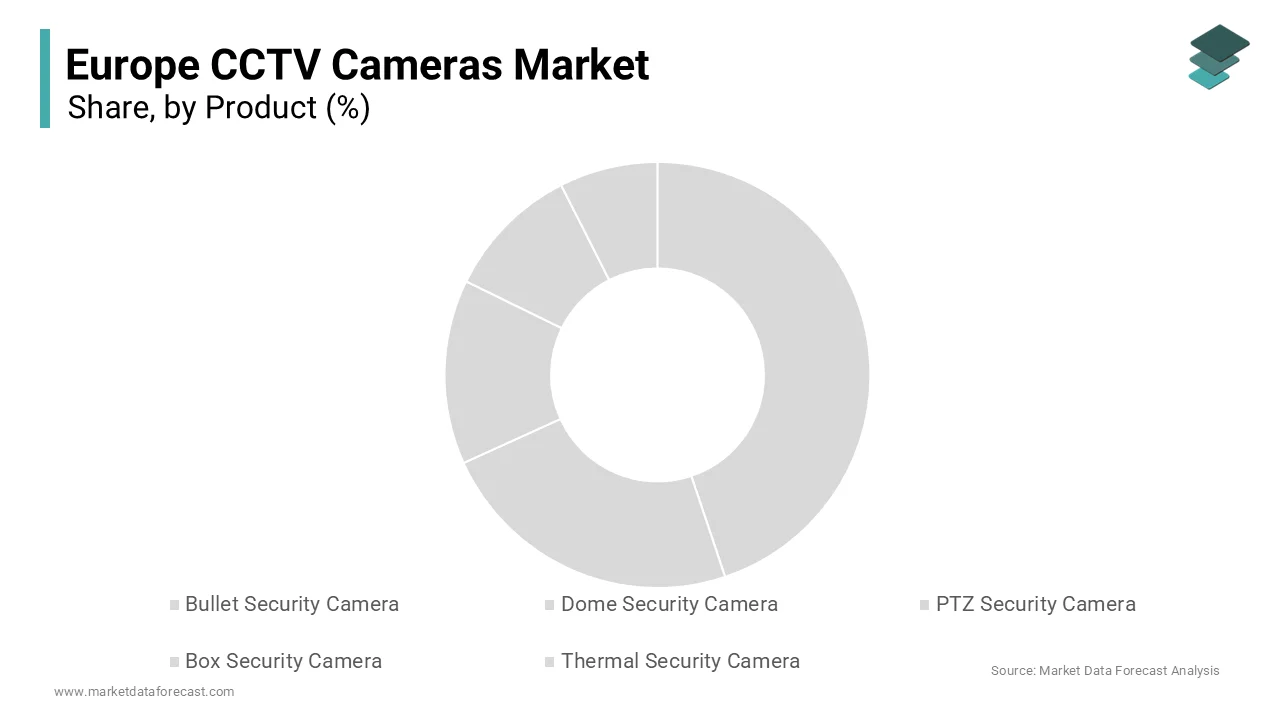
The thermal security camera segment is projected to register the highest CAGR of 19.2% over the forecast period in the European market owing to the growing need for perimeter protection and operation in complete darkness or adverse weather conditions and the unique capability of thermal sensors to detect heat signatures rather than visible light. As per the European Border and Coast Guard Agency, investments in thermal imaging technology for border surveillance have increased to enhance detection of illegal crossings regardless of lighting or fog. According to the European Industrial Security Federation, factories and power plants are increasingly deploying thermal cameras to monitor equipment temperatures and prevent fires alongside traditional security duties. The integration of artificial intelligence with thermal feeds allows for accurate human and vehicle detection with significantly fewer false alarms compared to motion sensors triggered by animals or swaying vegetation. Government grants for enhancing national security and protecting energy assets further accelerate procurement cycles for these specialized devices. The declining cost of uncooled thermal detectors has also made this technology accessible to commercial applications beyond high end military use. The combination of all-weather reliability and dual use potential for safety and security positions thermal cameras as the most rapidly expanding product category.
By Technology Insights
The IP security camera segment held the dominant position in the Europe CCTV cameras market by capturing the leading share of the European CCTV cameras market in 2025. The growth of the IP security camera segment in the European market is fueled by the superior image resolution, scalability, and advanced analytics capabilities inherent in network-based architectures. This leadership is driven by the ongoing migration from legacy analogue systems to digital networks that support high-definition video transmission over existing Ethernet infrastructure. According to the European Telecommunications Standards Institute, most new surveillance projects initiated in 2023 specified IP based solutions to leverage bandwidth efficiencies and remote accessibility features. The second critical driver is the seamless integration of IP cameras with broader building management systems and cloud platforms enabling centralized monitoring and data storage across multiple locations. According to the European Cloud Partnership, adoption of cloud video management software has grown significantly, necessitating the use of networked cameras capable of secure internet connectivity. The ability to embed intelligent algorithms directly into the camera edge allows for real time object recognition and behavior analysis without overwhelming central servers. Furthermore, the Power over Ethernet standard simplifies installation by delivering both data and electricity through a single cable, reducing deployment costs and complexity. The demand for cyber hardened devices that comply with strict European data protection regulations further reinforces the preference for modern IP technology over vulnerable analog alternatives. These technological advantages ensure that IP cameras remain the cornerstone of contemporary surveillance strategies.
By Application Insights
The commercial segment had the major share of the European CCTV cameras market in 2025. The leading position of commercial segment in the European market is attributed to the extensive presence of retail outlets, office buildings, hospitality venues, and financial institutions that require robust loss prevention and asset protection. According to Eurostat, the service sector constitutes a large portion of the European economy representing a vast installed base of surveillance systems in shops, restaurants, and corporate headquarters. The second major driver is the utilization of video data for business intelligence where retailers analyse customer footfall and dwell times to optimize store layouts and staffing schedules. According to the European Retail Research Group, many major retail chains upgraded their surveillance systems in 2023 to include people counting and heat mapping features. Insurance companies often mandate the installation of certified CCTV systems as a condition for coverage offering premium discounts that incentivize commercial adoption. The need to monitor supply chains and prevent internal theft in warehouses further boosts demand for comprehensive camera networks. The versatility of commercial systems to integrate with point-of-sale terminals and access control readers creates a holistic security solution that is difficult for other segments to match in scale. These economic and operational factors secure the leading position of the commercial sector.
The residential segment is anticipated to witness the fastest CAGR of 20.6% over the forecast period in this regional market owing to the rising concerns over home security and the proliferation of affordable DIY smart home devices. As per the European Consumer Organisation, sales of consumer grade security cameras have grown as households sought to protect against package theft and burglary during periods of economic uncertainty. According to national police forces in several EU countries, there is a correlation between neighborhood watch apps and increased adoption of doorbell cameras and outdoor Wi Fi units. The integration of two-way audio and cloud storage subscriptions offers added value that appeals to tech savvy residents seeking peace of mind. Government initiatives promoting safe neighborhoods and the availability of tax deductions for home security improvements in certain regions further stimulate market activity. The trend toward connected living where cameras interact with smart locks and lighting systems creates an ecosystem effect that drives recurring purchases. The lowering price point of high-definition cameras democratizes access to advanced surveillance technology for average consumers propelling the residential segment to the forefront of market growth.
REGIONAL ANALYSIS
Germany CCTV Cameras Market Analysis
Germany led the CCTV cameras market in Europe in 2025 with 23.6% of the regional market share. The growth of Germany in the European market is attributed to its robust industrial base and stringent approach to data privacy which sets regional standards. The nation serves as the primary hub for manufacturing and logistics where high value assets require sophisticated monitoring solutions compliant with rigorous federal regulations. According to the German Federal Office for Information Security, the country has implemented tough cybersecurity certification requirements for surveillance equipment driving demand for high quality trusted hardware. The industrial sector contributes heavily as factories utilize thermal and IP cameras for both safety and process optimization adhering to Industry 4.0 principles. According to the German Retail Association, investment in anti-theft technologies including advanced video analytics has surged to combat organized retail crime. German consumers and businesses prioritize data sovereignty leading to a preference for locally manufactured or certified European brands that guarantee GDPR compliance. The presence of major global security manufacturers with R&D centers in Germany fosters innovation in privacy enhancing features like automatic blurring. Furthermore, the reconstruction and modernization of public transport infrastructure following reunification continues to drive large scale public surveillance projects. The combination of industrial demand, regulatory leadership, and technological expertise solidifies Germany's position as the dominant force in the regional market.
United Kingdom CCTV Cameras Market Analysis
The United Kingdom retained a prominent spot in the Europe CCTV cameras market in 2025 owing to a long-standing culture of public surveillance and aggressive smart city deployments. The country is characterized by one of the highest densities of CCTV cameras per capita in the world reflecting a societal acceptance of video monitoring for crime prevention and traffic management. As per the Home Office, the UK government continues to fund the expansion of facial recognition trials and automated license plate recognition networks to enhance law enforcement capabilities. According to the British Security Industry Association, the commercial sector is rapidly upgrading to AI enabled systems to integrate with emergency services for faster response times. The legacy of extensive analog infrastructure is being replaced by modern IP networks to support higher resolution and remote access needs. The Brexit effect has led to new supply chain dynamics encouraging local assembly and stockpiling of critical security components. Additionally, the thriving fintech and banking sectors in London drive demand for high security surveillance in corporate offices and data centers. The strong collaboration between private security firms and public authorities ensures continuous innovation and deployment of cutting-edge surveillance technologies. This unique blend of historical precedent and forward-looking policy makes the UK a key growth engine.
France CCTV Cameras Market Analysis
France is estimated to hold a prominent share of the European CCTV cameras market over the forecast period owing to the by intensive state led initiatives to combat terrorism and secure major international events. France leverages surveillance technology as a core component of its national security strategy resulting in massive public sector procurement cycles. According to the French Ministry of the Interior, the Safe City program has allocated significant resources to install new cameras with video analytics capabilities in Paris and other major cities ahead of upcoming global gatherings. According to the National Police, the use of drone mounted cameras and mobile surveillance units has increased to manage large crowds and protests. The hospitality and tourism sectors also contribute substantially as hotels and landmarks upgrade systems to ensure visitor safety and comply with insurance mandates. French regulations emphasize the protection of civil liberties leading to the development of specialized software that anonymizes footage unless a specific threat is detected. The automotive industry in France utilizes advanced vision systems for quality control and factory security driving industrial demand. The government's push for technological sovereignty encourages the adoption of European made cameras to reduce dependency on foreign suppliers. These strategic priorities ensure sustained high-volume demand for advanced surveillance solutions throughout France.
Italy CCTV Cameras Market Analysis
Italy is projected to witness a healthy CAGR in the European CCTV cameras market over the forecast period owing to its vast cultural heritage sites and manage the influx of millions of tourists annually. The Italian market is characterized by specialized surveillance requirements for historic centers where discreet and aesthetically pleasing cameras are mandatory to preserve architectural integrity. As per the Italian Ministry of Culture, many historical sites have undergone security upgrades incorporating hidden dome and thermal cameras to prevent vandalism and theft of artifacts. According to the Italian National Institute of Statistics, crime rates in tourist hotspots have prompted local authorities to invest in integrated command centers linked to extensive camera networks. The tourism industry drives significant commercial demand as hotels, museums, and retail districts deploy systems to monitor crowd flow and ensure visitor safety in congested areas. The fashion and luxury goods sectors also contribute to demand as high end boutiques require sophisticated anti-theft measures. Government incentives for urban regeneration projects often include funding for smart lighting and surveillance infrastructure to revitalize city squares. The unique challenge of balancing security with preservation fosters innovation in miniaturized and custom designed camera solutions. Italy's specific needs ensure a distinct and valuable niche within the broader European surveillance landscape.
Spain CCTV Cameras Market Analysis
Spain is anticipated to register a notable CAGR in the European CCTV cameras market over the forecast period due to its extensive coastline requiring maritime surveillance and its status as a top global tourist destination demanding robust public safety measures. The Spanish market is characterized by a strong focus on securing beaches, ports, and border crossings to manage migration flows and prevent illicit activities. According to the Spanish National Police, the implementation of integrated surveillance systems along the Mediterranean coast has increased to enhance situational awareness and rescue operations. According to the Spanish Confederation of Business Organizations, retail and hospitality businesses are increasingly adopting cloud-based video solutions for multi-site management. The tourism sector drives commercial adoption as resorts and entertainment complexes install comprehensive networks to ensure guest safety and manage large seasonal crowds. The government's smart city initiatives in Barcelona and Madrid serve as models for integrating surveillance with traffic and environmental monitoring. The rise in property crimes in urban areas has also stimulated residential demand for DIY security kits. The favorable climate allows for year-round outdoor surveillance operations maximizing the utility of installed systems. The combination of geographic challenges and economic reliance on tourism ensures Spain remains a dynamic and growing market for CCTV technologies.
COMPETITIVE LANDSCAPE
The competition in the Europe CCTV cameras market is characterized by intense rivalry between established global giants and agile regional specialists who vie for dominance through technological superiority and strict regulatory compliance. Market leaders leverage their extensive distribution networks and strong brand reputations to secure large scale government and enterprise contracts while smaller firms often focus on niche applications or specialized analytics software. The landscape is highly dynamic with companies constantly striving to integrate advanced features like facial recognition thermal imaging and automated threat detection to attract security conscious clients. Regulatory adherence regarding data privacy and cybersecurity acts as a significant barrier to entry ensuring that only well capitalized entities with robust quality assurance systems can thrive. Price competition remains fierce particularly in the commoditized residential segment where margin pressures force manufacturers to optimize production costs continuously. Strategic collaborations between hardware vendors and software developers are becoming increasingly common as firms seek to offer integrated ecosystems rather than isolated devices. This competitive environment fosters rapid technological advancement and benefits end users through improved reliability and diverse options across the region.
KEY MARKET PLAYERS
Some of the notable key players in the Europe CCTV cameras market are
- Hikvision (CN)
- Dahua Technology (CN)
- Axis Communications (SE)
- Bosch Security Systems (DE)
- Hanwha Techwin (KR)
- FLIR Systems (US)
- Sony (JP)
- Panasonic (JP)
- Honeywell (US)
Top Players in the Market
- Bosch Security Systems stands as a premier German engineering powerhouse delivering advanced video surveillance solutions that set global benchmarks for image quality and data integrity. The company contributes significantly to the worldwide market by pioneering intelligent cameras equipped with edge analytics and robust cybersecurity features tailored for critical infrastructure. Recently Bosch has strengthened its position in Europe by launching new AI driven camera series that comply strictly with European privacy regulations while offering superior low light performance. Their strategic focus involves integrating video management software with building automation systems to create holistic security ecosystems for smart cities. The firm actively collaborates with local authorities to deploy scalable networks that enhance public safety without compromising civil liberties. Continuous investment in research and development allows Bosch to lead in thermal imaging and panoramic video technologies. By emphasizing local manufacturing and data sovereignty Bosch ensures trust among European clients who prioritize compliance and reliability in their security investments.
- Axis Communications operates as a Swedish innovator and global leader in network video solutions driving the transition from analogue to digital surveillance across diverse sectors. The company plays a pivotal role in the international market by introducing open platform cameras that support third party applications and seamless system integration. Recent actions to strengthen its market position include the release of next generation chipsets enabling deep learning analytics directly on the device edge for real time decision making. Axis has expanded its European footprint by establishing dedicated cybersecurity centers to ensure all products meet the highest standards of protection against digital threats. Their commitment to sustainability is evident in the development of energy efficient devices and recyclable packaging materials aligned with green initiatives. The firm prioritizes partnerships with system integrators to deliver customized solutions for retail transportation and industrial environments. By fostering an ecosystem of developers Axis enables continuous innovation in video analytics. This approach solidifies their reputation as a trusted partner for organizations seeking flexible and future proof surveillance technologies.
- Hanwha Vision serves as a leading global provider of high-performance video surveillance equipment leveraging decades of optical expertise to deliver exceptional clarity and reliability. The company contributes extensively to the worldwide market by offering a comprehensive portfolio ranging from cost effective fixed cameras to sophisticated PTZ units with advanced tracking capabilities. To strengthen its market position Hanwha Vision recently rebranded and unified its product lines under a single identity emphasizing innovation and customer centric design. They have invested heavily in artificial intelligence research to introduce cameras capable of accurate object classification and behavioral analysis in complex environments. The firm actively participates in European trade shows to showcase its latest cyber hardened devices that address growing concerns about network security. Hanwha Vision focuses on providing flexible storage options including onboard SD cards and cloud compatibility to suit varying infrastructure needs. Their dedication to quality assurance and rigorous testing ensures durability in harsh weather conditions. This strategic emphasis on technological advancement and robust support services enables Hanwha Vision to compete effectively against established rivals in the dynamic European landscape.
Top Strategies Used by Key Market Participants
Key players in the Europe CCTV cameras market primarily focus on product innovation and cybersecurity enhancement to differentiate their offerings in a highly regulated environment. Manufacturers invest heavily in research and development to embed artificial intelligence and edge computing capabilities directly into camera hardware for real time analytics. Another major strategy involves forming strategic partnerships with local system integrators and cloud service providers to deliver comprehensive end to end surveillance solutions. Companies are increasingly prioritizing compliance with General Data Protection Regulation by designing privacy enhancing features such as automatic blurring and secure data encryption. Expansion of local manufacturing and assembly facilities helps firms mitigate supply chain risks and meet data sovereignty requirements imposed by European governments. Additionally, vendors are developing subscription-based software models to generate recurring revenue streams from video management and analytic services. These combined efforts enable market participants to navigate regulatory complexities and capture growth opportunities in diverse application sectors.
MARKET SEGMENTATION
This research report on the European CCTV cameras market has been segmented and sub-segmented based on categories.
By Product
- Bullet Security Camera
- Dome Security Camera
- PTZ Security Camera
- Box Security Camera
- Thermal Security Camera
By Technology
- IP Security Camera
- Analog Camera
By Application
- Commercial
- Residential
- Industrial
By Resolution
- HD
- Non HD
By Services
- Professional Service
- Managed Service
By Country
- UK
- France
- Spain
- Germany
- Italy
- Russia
- Sweden
- Denmark
- Switzerland
- Netherlands
- Turkey
- Czech Republic
- Rest of Europe