- Product Description Description
- Table of Contents TOC
- List of Table & Figure LOT
- Get Free Sample PDF Sample PDF
Market Size, 2025
$423.5 MnMarket Estimate, 2026
$470 MnMarket Forecast, 2034
$1,078 MnCAGR, 2026–2034
10.94%Europe CDSS Market Size
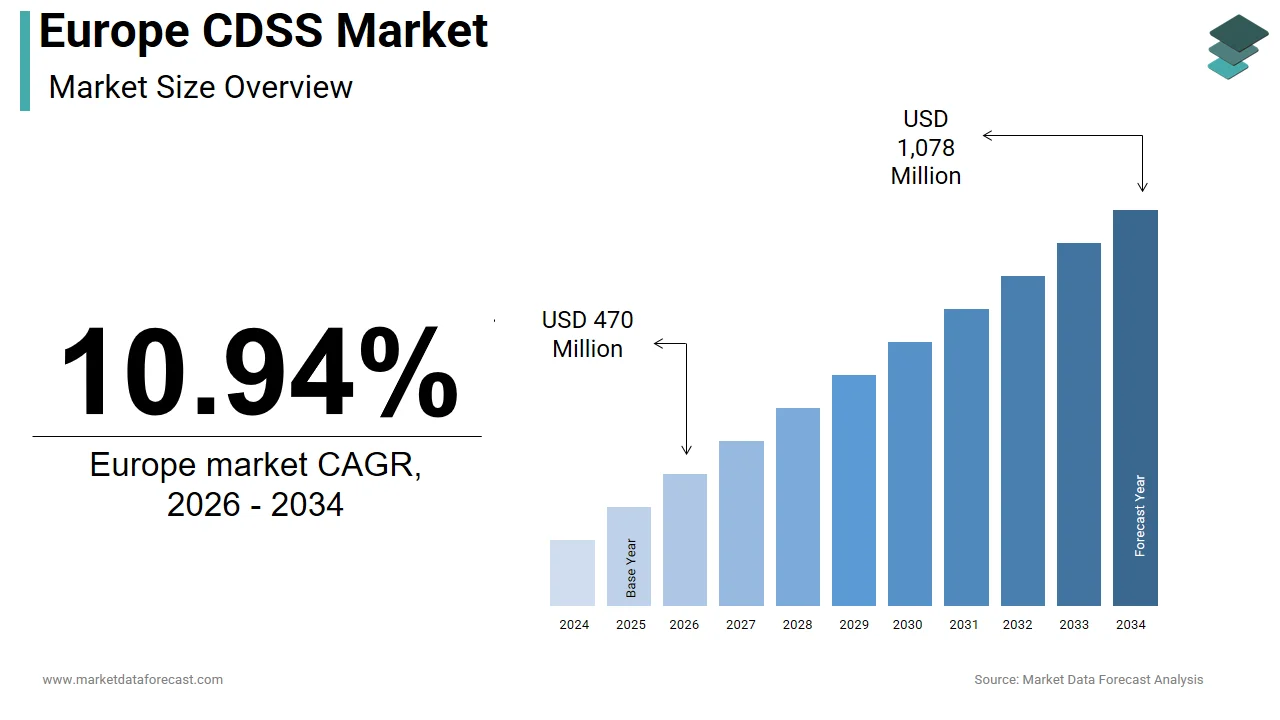
The size of the Europe clinical decision support system market was valued at USD 423.5 million in 2025. This market is expected to grow at a CAGR of 10.94% from 2026 to 2034 and be worth USD 1,078 million by 2034, up from USD 470 million in 2026.
A clinical decision support system is a health information technology that integrates patient data with evidence-based guidelines, algorithms, and predictive analytics to assist clinicians in diagnosis, treatment planning, and care coordination at the point of care. These systems operate within electronic health records and include functionalities such as drug interaction alerts, sepsis prediction protocols, diagnostic imaging support, and chronic disease management pathways. The adoption of Europe of clinical decision support is shaped by stringent data governance under the General Data Protection Regulation, interoperability mandates from the European Health Data Space, and a strong emphasis on clinical validation. According to the Digital Decade 2024 eHealth Indicator Study by the European Commission, the EU-27 average composite score for maturity in eHealth services increased to 79% in 2023 (from 72% in the previous year). More than 21 Member States launched national initiatives to embed artificial-intelligence-enabled clinical-decision tools into routine practice. Integration of AI-based decisions is widely acknowledged as advancing, but is still limited. According to multiple reviews of the European hospital-admission evidence, approximately 5% of hospital admissions in Europe are due to adverse drug reactions. The convergence of digital infrastructure, public-health need, and regulatory innovation positions clinical-decision-support systems as pivotal instruments in Europe’s pursuit of safer, more efficient, and personalised healthcare delivery.
MARKET DRIVERS
Escalating Burden of Adverse Drug Events and Medication Errors
Medication safety remains a critical public health priority across Europe, driving demand for intelligent prescribing and alerting functionalities within clinical decision support systems, which is one of the key factors driving the growth of the European CDSS market. According to multiple literature sources, around 5% of all hospital admissions in Europe are attributable to adverse drug reactions. According to sources, computerized clinical decision support systems reduce medication errors and adverse drug events, although exact figures vary widely. The systemic interventions reflect a continent-wide recognition that algorithmic oversight is essential to mitigating human cognitive overload, which is ensuring pharmacovigilance in complex care environments.
Integration of Artificial Intelligence in Diagnostic and Predictive Workflows
The infusion of artificial intelligence into clinical decision support is transforming passive alerting systems into proactive diagnostic and risk-stratification tools across European healthcare settings, which is further boosting the regional market expansion. According to a 2025 review by the European Society of Radiology (ESR), a large number of AI-enabled imaging algorithms have received CE marking for use in Europe. According to sources, reduced time-to-antibiotics improves outcomes. The shift from rule-based to learning-based systems reflects a broader movement in which algorithmic oversight is essential to mitigating human cognitive overload, which is ensuring precision medicine across the continent.
MARKET RESTRAINTS
Fragmented Health Information Systems and Lack of Interoperability
Despite policy ambitions, the growth of the Europe clinical decision support system market is significantly hindered by the absence of standardized data exchange across disparate electronic health record platforms and regional health information systems. According to the European Health Data Space initiative, many hospitals in Southern and Eastern Europe still operate legacy electronic health record systems that lack application programming interfaces necessary for real-time data ingestion by decision-support engines. As per a 2023 survey by the European Federation of Medical Informatics, clinicians in Italy and Spain often had to manually re-enter patient data into decision-support tools due to system incompatibility, which is undermining workflow integration and adoption fidelity. In Germany, findings from Techniker Krankenkasse indicate that a minority of outpatient clinics are able to transmit structured laboratory and medication data to national decision-support registries. Moreover, the absence of a unified European terminology standard (such as SNOMED CT) implementation across all Member States limits the portability of clinical logic modules. Until interoperability becomes a regulatory prerequisite rather than a voluntary enhancement, decision-support systems will remain isolated islands of intelligence rather than scalable components of a learning health ecosystem.
Stringent Regulatory and Clinical Validation Requirements
The deployment of clinical decision support systems in Europe faces considerable delays due to rigorous regulatory scrutiny and evolving expectations for clinical evidence under the European Union Medical Devices Regulation, which is further hampering the expansion of the European market. According to the European Coordination Committee of the Radiological, Electromedical and Healthcare IT Industry, the average time to achieve CE certification for a Class IIa decision-support software increased to 16 months in 2023 due to heightened demands for analytical and clinical validation studies. The European Medicines Agency emphasized in its 2023 guidance that algorithms influencing diagnosis or treatment must demonstrate performance across diverse demographic sub-groups to mitigate bias. In France, the National Authority for Health rejected 12 decision-support applications in 2023 for insufficient real-world validation in primary care settings. Additionally, the requirement for post-market surveillance plans under Annex XIV of the Medical Devices Regulation has increased compliance costs by an average of €900 000 per product as per a Deloitte analysis commissioned by MedTech Europe. These regulatory complexities disproportionately affect academic spin-offs and small health-tech firms, which are limiting innovation diversity and slowing patient access to next-generation decision-support tools.
MARKET OPPORTUNITIES
Expansion of Decision Support in Chronic Disease Management Programs
The strategic focus of Europe on preventing hospitalizations through proactive chronic care is creating substantial opportunities for longitudinal clinical decision support systems tailored to conditions such as diabetes, heart failure, and chronic obstructive pulmonary disease, which is a potential opportunity for the European CDSS market. According to the European Observatory on Health Systems and Policies, chronic conditions are a major driver of hospital admissions across Europe. A digital diabetes-management platform implemented in Denmark showed average reductions in HbA1c levels among its enrolled patients. Portugal’s national health service piloted a remote monitoring program for heart-failure patients that triggered nurse outreach based on decision-support analysis of weight, blood pressure, and symptoms, reducing 30-day readmissions. An initiative documented integrated decision-support in primary care for elderly patients with multiple chronic conditions, which is cutting emergency visits. These programs demonstrate how decision support can shift from episodic alerts to continuous‐care orchestration, enabling sustainable models of population health management.
Adoption of Federated Learning for Privacy-Preserving AI Development
The emergence of federated learning architectures offers a promising opportunity to develop robust clinical decision support algorithms without centralizing sensitive patient data, thereby aligning with the strict privacy mandates of Europe. According to multiple policy analyses of the European Commission’s AI Watch initiative, a number of cross-border federated-learning projects were launched under Horizon Europe in 2023 to enable hospitals across Germany, France, and Finland to collaboratively train sepsis and stroke-prediction models while keeping data local. Federated analysis techniques are increasingly endorsed by the European Health Data Space Regulation as a compliant mechanism for secondary use of health data. These developments reflect a growing shift from centralized to distributed model-training paradigms in clinical decision support that helps reconcile data-utility with data-privacy without compromising on security or sovereignty.
MARKET CHALLENGES
Algorithmic Bias and Lack of Representativeness in Training Data
The prevalence of algorithmic bias stemming from non-representative training datasets that underrepresent elderly women and ethnic minorities is one of the major challenges to the expansion of the European CDSS market. According to the European Society of Cardiology, a 2023 audit of 42 commercially available cardiovascular risk prediction tools found that 31 were calibrated primarily on male patient data, leading to underestimation of risk in women by up to 27%. According to the European Institute of Innovation and Technology Health, only 18 % of AI-based decision support models validated in 2023 included sufficient representation of patients over 80 years old, despite this group accounting for 23 % of the EU population. In the Netherlands, researchers at Erasmus MC demonstrated that a widely used sepsis prediction algorithm exhibited 19% lower sensitivity in patients of non-European ancestry due to biased vital sign thresholds. The European Medicines Agency issued a safety communication in 2023 urging developers to conduct subgroup performance analyses before market authorization. Until training data reflects Europe’s demographic diversity, decision support systems risk perpetuating health inequities rather than mitigating them.
Clinician Resistance and Workflow Integration Barriers
Persistent resistance from healthcare professionals and poor integration into clinical routines continue to limit the effective utilization of clinical decision support systems across European institutions, which is further challenging the growth of the clinical decision support systems market in Europe. According to a 2024 systematic review, about 52% of intensive-care nurses reported uncertainty about how to manage alarm fatigue in their units. A 2021 qualitative study of UK junior doctors found that many reported limited formal training in acute-care decision making and cited time and workload as key barriers. According to the research on nursing alarm fatigue, in one ICU setting, nurses responded to between 150 and 400 alarms per patient per day, which is a volume that dramatically increases the risk of alerts being ignored. Furthermore, the European Working Time Directive’s restrictions on clinician hours intensify time pressure, making poorly designed systems feel like additional burdens rather than aids. Without human-centered design co-creation with end users and alignment with actual clinical workflows, even the most sophisticated decision support tools risk becoming digital ornaments rather than instruments of improved care quality and safety.
REPORT COVERAGE
| REPORT METRIC | DETAILS |
| Market Size Available | 2025 to 2034 |
| Base Year | 2025 |
| Forecast Period | 2026 to 2034 |
| Segments Covered | By Product, Application, Delivery Mode, Component, and Country. |
| Various Analyses Covered | Global, Regiona,l and Country-Level Analysis, Segment-Level Analysis, Drivers, Restraints, Opportunities, Challenges; PESTLE Analysis; Porter’s Five Forces Analysis, Competitive Landscape, Analyst Overview of Investment Opportunities |
| Countries Covered | UK, France, Spain, Germany, Italy, Russia, Sweden, Denmark, Switzerland, Netherlands, Turkey, Czech Republic, and the Rest of Europe |
| Market Leaders Profiled | McKesson Corporation, Cerner Corporation, Siemens Healthineers GmbH, Philips Healthcare, Allscripts Healthcare, LLC, athenahealth, Inc., NextGen Healthcare Inc., Koninklijke Philips N.V. (Royal Philips), IBM Corporation, Epic Systems Corporation, Agfa-Gevaert Group, Wolters Kluwer N.V., Becton, Dickinson and Company, Cabot Technology Solutions, GE HealthCare, Nordic, BeeKeeperAI, BSCO Industries, Inc., and Others. |
SEGMENTAL ANALYSIS
By Product Insights
The integrated EHR segment held the largest share of the European CDSS market in 2024 due to its seamless workflow alignment and policy-driven adoption mandates. European healthcare institutions increasingly prioritize unified digital platforms that eliminate data silos and reduce cognitive burden on clinicians. According to the European Commission’s Digital Health and Care Strategy, many EU Member States are being encouraged to adopt interoperable EHR systems and structured data frameworks to support clinical decision-support modules. In Germany, the Hospital Future Act (KHZG) allocated €4.3 billion to modernise hospital IT infrastructure. The United Kingdom’s National Health Service mandates that all acute trusts use EHR systems compliant with designated Digital Technology Assessment Criteria that evaluate clinical decision-support capabilities. Furthermore, the European Health Data Space regulation incentivises structured data capture within EHRs to enable secondary use for decision-support logic. This systemic integration ensures that alerts and recommendations are context-aware, real-time, and actionable, and these factors are driving clinician acceptance and clinical impact across the continent and contributing to the domination of the integrated EHR segment in the European CDSS market.
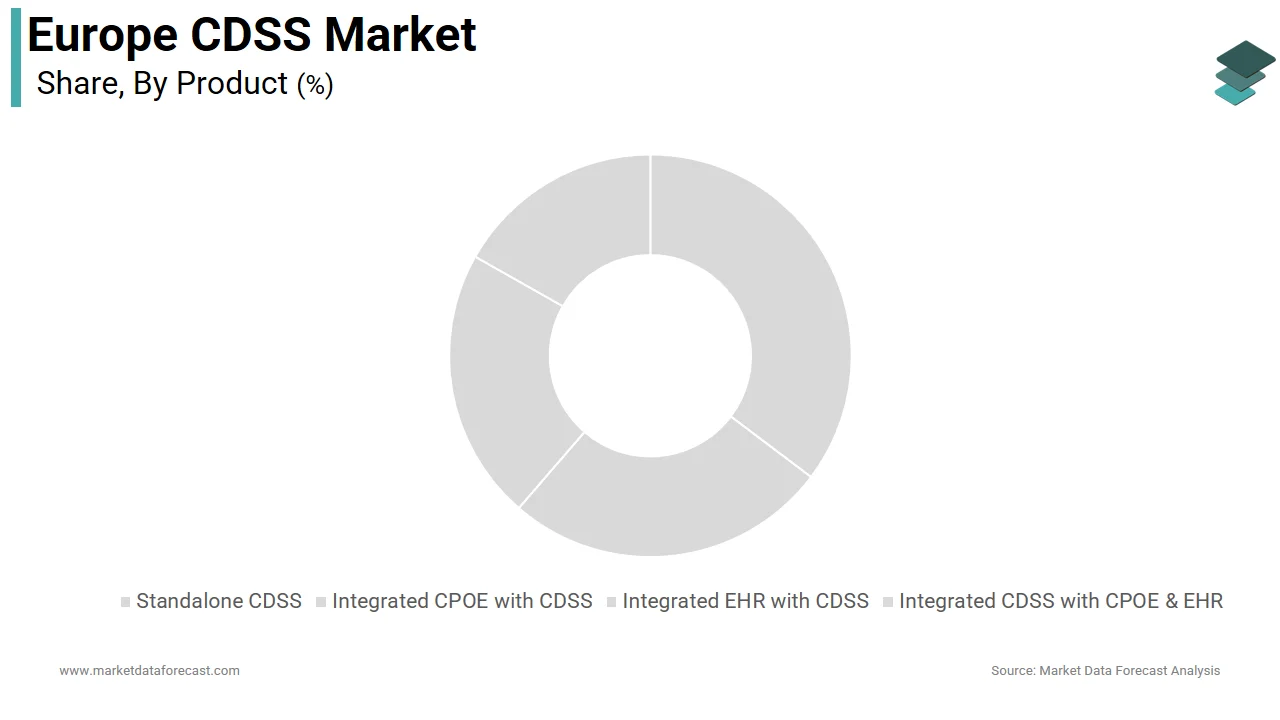
The standalone CDSS is a promising segment and is predicted to showcase a CAGR of 13.8% over the forecast period in the European CDSS market, owing to the rising need for specialized diagnostic and predictive tools in settings where legacy EHRs cannot be easily upgraded. These modular platforms cater to niche applications such as oncology imaging interpretation, antimicrobial stewardship, and rare disease diagnosis, where deep domain expertise outweighs the benefits of full EHR integration. According to the European Society of Medical Imaging Informatics, numerous AI-based decision-support tools for radiology have received CE-marking in recent years, which is enabling deployment even in hospitals using non-compatible EHRs. In Sweden, the Karolinska University Hospital adopted a standalone sepsis-prediction engine that interfaces with its existing EHR via FHIR APIs to achieve a high alert accuracy in its deployment. The European Commission’s AI for Health partnership funded multiple standalone CDSS pilots in 2023, focused on paediatric and geriatric care, where commercial EHRs lack tailored logic. Additionally, many small and medium-sized clinics in Southern Europe often lack resources for full EHR overhauls but can adopt cloud-based standalone CDSS subscriptions starting at modest monthly costs. This flexibility and specialization are fuelling rapid adoption of standalone CDSS in resource-constrained and high-precision care environments and propelling the expansion of the segment in the European market.
By Application Insights
The drug interaction checking segment accounted for 36.6% of the regional market share in 2024. The growth of the drug interaction checking segment in the European market is attributed to the persistent public health burden of adverse medication events and strong regulatory emphasis on prescribing safety. Polypharmacy is widespread across Europe, with a recent study finding a prevalence of 36.2% among adults aged 65 and over taking five or more medications daily. According to the estimations of the European Medicines Agency, around 5% of all hospital admissions in Europe are attributable to adverse drug reactions. In France, the National Authority for Health mandates that all electronic prescribing systems integrate validated drug-interaction databases such as Thériaque, which covers over 25,000 medications and 180,000 interaction pairs. Germany’s statutory health insurance requires EHR vendors to embed the ABDA drug database with quarterly updates as a condition for reimbursement eligibility. As per the National Health Service in the United Kingdom, its National Clinical Decision Support Service blocked over 1.2 million high-risk prescribing combinations in 2023 alone, primarily involving anticoagulants, antibiotics, and cardiovascular agents. This convergence of demographic need, clinical evidence, and policy enforcement is boosting the drug-drug interaction segment’s dominance in the European market.
The early sepsis detection segment is expected to exhibit a CAGR of 17.7% over the forecast period in the European market, owing to the high mortality rates, national quality mandates, and advances in real-time physiological analytics. According to the European Sepsis Alliance, more than 3.4 million people develop sepsis each year in Europe, and about 700,000 die as a result. The European Society of Intensive Care Medicine updated its 2023 guidelines to recommend automated early warning systems in all acute care settings. Denmark’s national health authority implemented a mandatory sepsis CDSS across its hospitals in 2023 to improve early recognition and treatment workflows. As per the Netherlands’ National eHealth Living Lab, hospitals are increasingly adopting machine-learning-based sepsis prediction models integrated with vital-sign monitors. Furthermore, the European Commission included sepsis detection algorithms in its 2023 Important Projects of Common European Interest funding stream to support cross-border validation. These clinical and policy drivers position sepsis CDSS as a high-impact frontier in acute-care safety and drive the growth of the early sepsis detection segment in the European market.
COUNTRY LEVEL ANALYSIS
Germany Clinical Decision Support System Market Analysis
Germany dominated the CDSS market in Europe in 2024 by holding 24.4% of the regional market share 2024. The dominance of Germany in the European market is driven by its universal healthcare system, advanced hospital IT infrastructure, and strong regulatory incentives for digital transformation. Germany operates hospitals nationwide, many of which have implemented electronic health records with integrated decision-support functionalities. According to the Hospital Future Act, the federal government has provided €3 billion in funding, supplemented by €1.3 billion from states and hospitals, specifically to support digital modernization, including partially or fully automated clinical decision-support systems. Germany’s statutory health insurance covers 87 million residents and mandates that all outpatient physicians use EHR systems compliant with the Telematics Infrastructure framework, which includes drug-interaction and allergy checking. The German Medical Association maintains the ABDA drug database, and updated approximately every 14 days and is integrated into the vast majority of prescribing systems. Additionally, research hospitals like Charité Berlin lead in AI CDSS validation through partnerships with the German Center for Cardiovascular Research. This combination of policy funding scale and clinical governance is contributing to the dominance of Germany in the European CDSS market.
United Kingdom Clinical Decision Support System Market Analysis
The United Kingdom held the second leading share of the European CDSS market in 2024. The centralized National Health Service and nationally coordinated digital health strategy in the UK are driving the UK market growth. NHS England mandates that all acute trusts implement EHR systems meeting the Digital Technology Assessment Criteria, which include robust clinical decision support for prescribing, deterioration detection, and allergy checking. According to sources, an estimated 237 million medication errors occur annually in England. The United Kingdom also leads in real-world evaluation as the Oxford University Hospitals NHS Foundation Trust partnered with the Medicines and Healthcare products Regulatory Agency to assess AI-driven sepsis and acute kidney injury prediction models across large multisite datasets. Scotland’s Digital Health and Care Innovation Centre launched a federated-learning platform enabling CDSS development across multiple health boards without data centralization, with evidence showing that federated models can outperform locally trained ones. Despite post-Brexit adjustments, the NHS’s scale-integrated data assets and clinical safety standards sustain its influence on CDSS deployment models across Europe, which is contributing to the promising position of the UK in the European CDSS market.
France Clinical Decision Support System Market Analysis
France occupied the third-largest share of the European CDSS market in 2024. The growth of France in the European market is driven by centralized health technology assessment and mandatory integration of decision support into national digital health frameworks. The French National Authority for Health evaluates and certifies clinical-decision-support logic used in public healthcare with validated modules accessible through the Mon Espace Santé national health portal. According to France’s Ministry of Health, more than 97% of the population had a Mon Espace Santé profile opened by early 2025. France’s public hospital system, AP-HP, implemented a unified EHR across multiple hospitals in Paris in 2023, featuring integrated CDSS for antibiotic stewardship and early deterioration detection. According to France’s National Institute of Health and Medical Research, an AI-based CDSS for diabetic retinopathy screening achieved a sensitivity of 90.53% and specificity of 97.13% in a hospital dataset study. Furthermore, the France 2030 investment plan allocated large-scale public funding in 2023 to expand AI-enabled decision support in oncology and rare diseases. This top-down approach ensures consistent high-quality CDSS deployment across public and private care settings, and fuels the growth of the CDSS market in France.
Netherlands Clinical Decision Support System Market Analysis
The Netherlands is predicted to account for a prominent share of the Europe clinical decision support system market during the forecast period due to its advanced interoperability infrastructure and leadership in predictive analytics for acute care. The National eHealth Living Lab of the Netherlands operates a certified testing environment where numerous CDSS algorithms undergo real-world validation before nationwide rollout. According to the Dutch Ministry of Health, the country has made significant progress in EHR interoperability under the Nictiz standards, which emphasise structured data exchange and embedded decision support. An OECD review confirms that modern health information exchange practices are advancing in the Netherlands. In 2023, the Netherlands made strides in early warning and vital-sign monitoring integration, and these studies show that continuous wireless monitoring linked to hospital systems improved detection of deterioration. The Dutch Federation of University Medical Centers leads in federated-learning approaches for CDSS development, which is enabling collaborative AI training without requiring patient-data centralization. Additionally, the Netherlands hosts major global health-IT innovation centres supporting rapid prototyping and clinical adoption. This ecosystem of standards, validation, and innovation is supporting the CDSS market growth in the Netherlands.
Sweden Clinical Decision Support System Market Analysis
Sweden is anticipated to register a notable CAGR in the Europe clinical decision support system market over the forecast period, owing to its universal digital health records, national quality registries, and pioneering use of AI in public healthcare. According to the Swedish eHealth Agency, Sweden’s healthcare system is organized across 21 regions that continue to expand shared digital-health infrastructure. Sweden’s National Board of Health and Welfare mandates that all electronic prescriptions undergo automated drug-interaction and renal-dosing checks against the national FASS drug database, which covers the full range of marketed medications. Sweden’s innovation agency Vinnova continues to fund digital-health and CDSS-related projects supporting the use of national registry data in areas such as geriatric care and mental health. Furthermore, Sweden’s participation in the European Health Data Space pilot enables cross-border CDSS validation with Finland and Estonia. This combination of data availability policy mandates and research integration makes Sweden a leader in evidence-based intelligent care delivery and drives the growth of the Swedish CDSS market.
COMPETITIVE LANDSCAPE
The Europe clinical decision support system market features a dynamic competitive landscape shaped by global EHR vendors, European health tech specialists, and academic spin-offs developing niche AI algorithms. Large players like Epic and Oracle Health leverage their integrated platforms to embed decision support as a core workflow component, while European firms such as Philips and Dedalus focus on acute care and regional interoperability. Competition is increasingly defined by clinical validation, quality of evidence, and alignment with national digital health strategies rather than technical features alone. Regulatory complexity under the Medical Devices Regulation creates barriers for small innovators, yet public funding mechanisms like Horizon Europe enable collaborative validation. Differentiation arises through contextual relevance, multilingual support, and seamless integration with national drug databases and quality registries. As healthcare systems shift from volume to value, the ability to demonstrate measurable impact on safety outcomes and efficiency determines market leadership more than sales reach. The market is thus evolving toward ecosystem-based competition where trust, interoperability, and clinical impact outweigh standalone product capabilities.
KEY MARKET PLAYERS
Some of the companies that are playing a dominating role in the Europe clinical decision support system market include
- McKesson Corporation
- Cerner Corporation
- Siemens Healthineers GmbH
- Philips Healthcare
- Allscripts Healthcare, LLC
- athenahealth, Inc.
- NextGen Healthcare Inc.
- Koninklijke Philips N.V. (Royal Philips)
- IBM Corporation
- Epic Systems Corporation
- Agfa-Gevaert Group
- Wolters Kluwer N.V.
- Becton, Dickinson and Company
- Cabot Technology Solutions
- GE HealthCare
- Nordic
- BeeKeeperAI
- BSCO Industries, Inc.
TOP PLAYERS IN THE MARKET
- Epic Systems Corporation plays a pivotal role in the Europe clinical decision support system market through its integrated electronic health record platform, which embeds advanced decision support logic for medication safety, chronic disease management, and sepsis prediction. Although headquartered in the United States, Epic has expanded significantly in Europe with implementations in major academic medical centers in the Netherlands, Sweden, and the United Kingdom. In 2024, Epic partnered with Amsterdam University Medical Centers to co-develop a federated learning module for early deterioration detection that complies with the European Health Data Space framework. The company also enhanced its drug interaction database to align with European pharmacopeias, including the French Thériaque and German ABDA systems. These initiatives demonstrate Epic’s commitment to localizing clinical intelligence while maintaining global interoperability standards.
- Cerner Corporation, now operating under Oracle Health, is a key contributor to the Europe clinical decision support system market through its Millennium and HealtheIntent platforms, which integrate evidence-based alerts, predictive analytics, and population health tools. The company supports over 120 healthcare organizations across the United Kingdom, Ireland, and the Nordic regions with EHR systems featuring certified CDSS modules for antimicrobial stewardship and heart failure management. In 2023, Cerner launched a cloud-based sepsis prediction engine validated in collaboration with the UK’s National Health Service and compliant with the Digital Technology Assessment Criteria. It also integrated real-time drug interaction checking aligned with the European Medicines Agency’s safety guidelines. By embedding clinical decision support within a scalable cloud architecture, Oracle Health strengthens its position as a strategic partner in Europe’s digital transformation.
- Philips Healthcare is a leading European innovator in clinical decision support with a focus on acute care analytics and AI-driven diagnostic assistance. Its IntelliSpace Enterprise Edition and eICU Program provide real-time monitoring, sepsis prediction, and early warning scores deployed across intensive care units in Germany, France, and the Netherlands. In 2024, Philips received CE certification for its AI-enabled deterioration detection algorithm, which analyzes 50-plus physiological parameters to predict adverse events up to six hours in advance. The company also collaborated with the Karolinska University Hospital to validate a federated learning model for cardiac arrest prediction without centralizing patient data. By combining clinical workflow integration with ethical AI governance, Philips reinforces its role as a trusted enabler of intelligent care across European healthcare systems.
TOP STRATEGIES USED BY THE KEY MARKET PARTICIPANTS
Key players in the Europe clinical decision support system market prioritize deep integration of decision logic within certified electronic health record platforms to ensure seamless clinician adoption. They invest in federated learning and privacy-preserving AI development to comply with the General Data Protection Regulation while enabling cross-institutional model training. Strategic partnerships with national health services, universities, and regulatory bodies facilitate real-world validation and reimbursement alignment. Companies also localize clinical content by integrating country-specific drug databases, terminologies, and treatment guidelines such as Thériaque in France and FASS in Sweden. Finally, they align product roadmaps with the European Health Data Space and Digital Europe Programme to influence interoperability standards and accelerate public sector procurement.
MARKET SEGMENTATION
This Europe clinical decision support system market research report is segmented and sub-segmented into the following categories.
By Product
- Standalone CDSS
- Integrated CPOE with CDSS
- Integrated EHR with CDSS
- Integrated CDSS with CPOE & EHR
By Application
- Drug-drug interactions
- Drug allergy alerts
- Clinical reminders
- Clinical guidelines
- Drug dosing support
- Others
By Delivery Mode
- Web-based Systems
- Cloud-based Systems
- On-premises Systems
By Component
- Hardware
- Software
- Services
By Country
- UK
- France
- Spain
- Germany
- Italy
- Russia
- Sweden
- Denmark
- Switzerland
- Netherlands
- Turkey
- Czech Republic
- Rest of Europe