- Product Description Description
- Table of Contents TOC
- List of Table & Figure LOT
- Get Free Sample PDF Sample PDF
Market Size, 2025
$594.85 MnMarket Estimate, 2026
$690.33 MnMarket Forecast, 2034
$1991 MnCAGR, 2026–2034
14.37%Europe Center Pivot Irrigation Systems Market Size, Growth, Trends & Forecast (2026–2034)
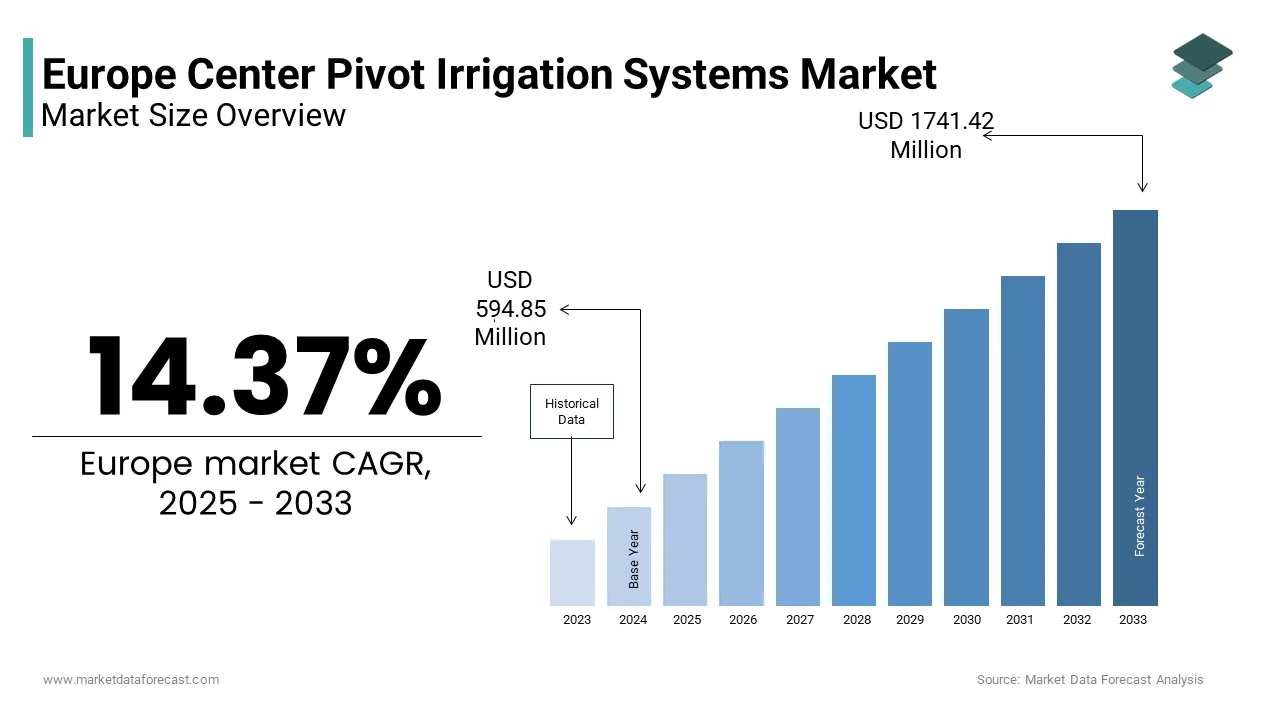
The Europe center pivot irrigation systems market size was valued at USD 594.85 million in 2025, stands at USD 690.33 million in 2026, and is projected to surge up to USD 1,991.67 million by 2034, registering an impressive compound annual growth rate (CAGR) of 14.37% during the forecast period from 2026 to 2034. Propelled by escalating water scarcity across Southern and Eastern Europe, strict European Commission agricultural compliance mandates, and the rapid rollout of digital precision farming tools, the market represents one of the fastest-growing sectors in global agricultural technology.
Key Executive Metrics (At-a-Glance)
- 2025 Base Valuation: USD 594.85 Million
- 2026 Current Valuation: USD 690.33 Million
- 2034 Forecast Valuation: USD 1,991.67 Million
- Compound Annual Growth Rate (CAGR): 14.37% (2026–2034)
- Dominant Field Segment: Large Fields (Largest Market Share)
- Fastest-Growing Field Segment: Medium Fields (CAGR of 7.12%)
- Dominant Crop Segment: Cereals & Grains (Led by maize and wheat)
- Fastest-Growing Crop Segment: Oilseeds & Pulses (Driven by EU protein independence goals)
- Dominant Country Market: Spain (Accounting for 27.5% regional share)
Core Market Drivers & Restraints
- Drivers: Persistent water scarcity and declining reservoir levels in Southern Europe (Spain, Italy, Greece), the EU’s Common Agricultural Policy (CAP) eco-schemes offering funding incentives, and integration with high-tech platforms like Valley's FieldNET and Lindsay's FieldWise.
- Restraints & Challenges: High initial capital expenditure (CAPEX), fragmented landholding patterns (small farm sizes across Western Europe), strict environmental and water abstraction zoning regulations, and a shortage of specialized local technical service providers.
Europe Center Pivot Irrigation Systems Market Segmentation Breakdown
| Segment Category | Leading / Dominant Segment | Fastest-Growing Segment |
|---|---|---|
| By Field Size | Large Fields | Medium Fields (7.12% CAGR) |
| By Crop Type | Cereals & Grains | Oilseeds & Pulses |
| By Component | Spans (33.8% Share) | Control Panels (10.1% CAGR) |
| By Key Country | Spain (27.5% Market Share) | Romania & Hungary |
Major Industry Players Profiled
Key global and regional market participants shaping the European landscape include Valmont Industries (Valley), Lindsay Corporation (Zimmatic), Reinke Manufacturing Company Inc., T-L Irrigation Company, Netafim Limited, Bauer GmbH, Alkhorayef Group, Grupo Fockink, Pierce Corporation Ltd., and Rainfine (Dalian) Irrigation Co.
Europe Center Pivot Irrigation Systems Market Size
The Europe center pivot irrigation system market size was valued at USD 594.85 million in 2025 and is anticipated to reach USD 690.33 million in 2026 to reach USD 1991.67 million by 2034, growing at a CAGR of 14.37% during the forecast period from 2026 to 2034.
A center pivot irrigation system is a mechanized overhead irrigation technology where a rotating arm distributes water in a circular pattern from a central pivot point. These systems are engineered for large-scale field crops and offer precise water application, reduced labor requirements, and integration with digital agronomy tools. While more commonly associated with arid regions globally, center pivot adoption in Europe is growing selectively in water-stressed and high-value agricultural zones where efficiency and compliance with environmental regulations are paramount. According to Eurostat, a significant share of EU agricultural land experienced drought stress in 2023, particularly in Spain, Italy, and southern France, which is driving interest in controlled irrigation. As per the European Environment Agency, agricultural water abstraction accounts for a large portion of total freshwater use in Southern Europe, which is intensifying pressure to modernize delivery methods. Furthermore, the European Commission’s Common Agricultural Policy now links direct payments to the adoption of water-saving technologies under eco-schemes, creating financial incentives for precision irrigation. This regulatory and climatic context positions center pivot systems as a strategic response to Europe’s evolving water governance and climate resilience agenda.
MARKET DRIVERS
Increasing Water Scarcity in Southern Europe Drives Adoption of Efficient Irrigation
Persistent and intensifying water scarcity across Southern Europe is a primary catalyst for center pivot irrigation adoption as farmers seek to optimize limited water resources while maintaining crop yields, which is one of the key factors driving the growth of the European center pivot irrigation systems market. According to the European Drought Observatory, a significant share of the EU’s agricultural land faced severe or extreme drought conditions during the 2023 growing season, with Spain, Italy, and Greece recording the lowest reservoir levels in decades. In response, the European Commission’s Water Reuse Regulation mandates that member states reduce freshwater abstraction in high-stress river basins by 2030. Center pivot systems can reduce water use compared to traditional flood irrigation, as confirmed by trials at the University of Valencia. In Spain’s Guadalquivir Basin, where agricultural water quotas were cut in 2023, new center pivot installations were commissioned for maize and sunflower fields. Similarly, in Italy’s Po Valley, regional authorities now subsidize pivot system costs under the Lombardy Water Efficiency Plan. This convergence of environmental stress, policy mandates, and yield protection ensures sustained demand in vulnerable regions.
Integration with Precision Agriculture and Digital Farming Platforms Enhances ROI
The compatibility of center pivot systems with precision agriculture technologies is significantly boosting their economic appeal across European large-scale farms, which is further boosting the center pivot irrigation systems market growth in Europe. Modern pivots integrate GPS guidance, soil moisture sensors, and variable rate irrigation controllers that adjust water application in real time based on crop needs and field variability. Data-driven irrigation systems are increasingly being adopted on large farms in countries such as France, Germany, and Hungary. Companies like Valmont and Lindsay offer Pivot Watch and FieldNET platforms that connect to satellite imagery and weather forecasts, enabling remote operation and water budgeting. In Romania, trials by the National Institute of Agricultural Research demonstrated sensor-guided pivots improved wheat water use efficiency while maintaining yields. Additionally, the Common Agricultural Policy’s eco schemes provide bonus payments for farms using digital irrigation management certified by national authorities. Many European pivots now use Galileo-enabled controllers for sub-meter accuracy. This digital synergy transforms center pivot systems from mere water applicators into intelligent agronomic tools that justify capital investment through measurable resource and yield optimization.
MARKET RESTRAINTS
High Initial Capital Cost and Limited Suitability for Small or Irregular Fields
A major restraint in the Europe center pivot irrigation systems market is the substantial upfront investment required, combined with the need for large contiguous circular fields. According to Eurostat, about 64% of EU farms operate on less than 10 hectares, which makes pivot deployment physically and economically unviable. Even in large holdings, field shapes are often constrained by hedgerows, roads, and natural boundaries inherited from historical land division patterns. Many arable fields in Western and Central Europe are irregular or fragmented, limiting pivot coverage efficiency. Additionally, financing remains a barrier as surveys on EU agricultural enterprises indicate that access to long-term agri equipment loans with favorable terms is limited. While EU rural development funds provide partial subsidies, uptake is low due to complex application procedures and co-financing requirements. Consequently, adoption remains confined to expansive corporate farms in specific regions rather than broad agricultural transformation.
Stringent Environmental and Zoning Regulations Restrict Installation in Sensitive Areas
The deployment of center pivot systems in Europe faces significant regulatory hurdles related to water rights, land use zoning, and environmental protection, which further hinders the European center pivot irrigation systems market. In many member states, the installation of large irrigation infrastructure requires multiple permits from water basin authorities, environmental agencies, and local municipalities. According to the European Environment Agency, 14 EU countries classify intensive irrigation as a potential threat to groundwater-dependent ecosystems under the Habitats Directive, thereby imposing strict discharge and abstraction limits. In Spain’s Murcia region, new pivot installations near protected wetlands were banned in 2023 following a ruling by the National High Court citing aquifer overexploitation. Similarly, in Denmark, the Water Planning Act prohibits center pivots in nitrate vulnerable zones unless paired with closed loop drainage systems. As per the European Commission’s 2024 Nitrates Directive review, over 35% of agricultural land in the EU falls under such regulated zones. These legal constraints not only delay projects but often render them economically unfeasible due to required mitigation measures such as buffer strips or water recycling infrastructure.
MARKET OPPORTUNITIES
Expansion of Renewable Energy Integration for Off-Grid Pivot Operations
The coupling of center pivot systems with on-site renewable energy is a strategic opportunity for the European center pivot irrigation systems market. Many large farms in Eastern and Southern Europe operate in areas with limited or unreliable rural electrification, making diesel-powered pivots costly and carbon-intensive. According to the European Solar Irrigation Initiative, hundreds of hybrid solar-diesel pivot systems were installed in Spain, Romania, and Bulgaria in 2023, which is reducing fuel consumption significantly. Companies like T-L Irrigation and Reinke now offer solar-ready pivot packages with battery storage that qualify for EU green grants under the Rural Development Program. In Greece, the National Energy and Climate Plan provides subsidies for solar-powered irrigation equipment to support decarbonization targets. As per the International Renewable Energy Agency, solar-powered pivots in Europe can achieve payback periods under six years due to rising diesel prices and carbon taxation. This clean energy synergy not only lowers operating costs but also aligns with the EU’s Farm to Fork and Green Deal objectives for sustainable water and energy use in agriculture.
Modernization of Aging Irrigation Infrastructure Under CAP Eco Schemes
The European Union’s Common Agricultural Policy is creating a major opportunity for the center pivot irrigation systems market in Europe. With over 40% of EU irrigation infrastructure built before 1990, many systems suffer from high leakage and inefficiency. According to the European Commission, billions of euros were allocated between 2023 and 2027 specifically for water-saving technology upgrades in climate-vulnerable regions. In Italy’s Emilia Romagna region, farmers received co-financing for replacing flood irrigation with center pivots under the PSR 2023 plan. Similarly, in Hungary, the National Agricultural Advisory Service reported a notable increase in pivot applications in 2023 following streamlined CAP subsidy access. These programs often require integration with soil moisture monitoring and water accounting software, which ensures that investments deliver measurable efficiency gains. As water pricing mechanisms expand across the EU, modern systems become increasingly cost-effective. This policy-driven modernization wave is transforming center pivot technology from a niche solution into a mainstream tool for sustainable water stewardship.
MARKET CHALLENGES
Fragmented Supply Chain and Limited Local Technical Support Networks
The underdeveloped local supply chain and scarcity of trained service technicians outside core agricultural regions are one of key challenges to the European center pivot irrigation systems market. Most major manufacturers are headquartered in the United States and rely on a limited network of European distributors primarily in Spain and Eastern Europe. According to the European Agricultural Machinery Association, fewer than 20 certified pivot service centers exist across the entire EU, with none in countries like Belgium, Austria, or Finland. This gap leads to extended downtime during breakdowns, as surveys have found that average repair response times in Central Europe often exceed two weeks due to parts shipping delays. Additionally, language barriers and a lack of localized training hinder proper operation and maintenance. As per the European Institute for Agricultural Engineering, only a handful of vocational schools in the EU offer specialized courses in mechanized irrigation systems. Without robust after-sales support, farmers face increased risk of system underperformance or premature failure, which is undermining confidence in capital-intensive adoption.
Climate-Induced Uncertainty in Rainfall Patterns Complicates Investment Planning
Despite water scarcity concerns, the increasing unpredictability of seasonal rainfall across Europe creates hesitancy among farmers to commit long-term pivot investments, which is further challenging the regional market growth. According to the forecast of the climate models from the European Centre for Medium Range Weather, greater interannual variability with some seasons experiencing extreme drought while others face excessive rainfall, reducing irrigation needs. In 2023, Northern France and Germany recorded above-average precipitation, which is leading to postponed planting and minimal irrigation use despite prior pivot installations. According to the European Commission’s Climate Adaptation Strategy, more than half of EU farmers cite climate volatility as a top barrier to long-term infrastructure investment. Center pivot systems typically require 7 to 10 years to achieve return on investment, yet erratic water demand undermines payback predictability. Additionally, insurance products covering irrigation underutilization due to weather are limited in Europe. This financial uncertainty discourages risk-averse producers, even in water-stressed zones, from adopting high-cost mechanized systems.
REPORT COVERAGE
| REPORT METRIC | DETAILS |
| Market Size Available | 2025 to 2034 |
| Base Year | 2025 |
| Forecast Period | 2026 to 2034 |
| CAGR | 14.37% |
| Segments Covered | By Field Insights, Crop Type, Mobility, Component & Region |
| Various Analyses Covered | Global, Regional & Country Level Analysis, Segment-Level Analysis, DROC, PESTLE Analysis, Porter’s Five Forces Analysis, Competitive Landscape, Analyst Overview on Investment Opportunities |
| Regions Covered | UK, France, Spain, Germany, Italy, Russia, Sweden, Denmark, Switzerland, Netherlands, Turkey, Czech Republic & Rest of Europe |
| Market Leaders Profiled | CPI systems market includes T-L Irrigation Company, Netafim Limited, RoEhren- Und Pumpenwerk, Lindsay Corporation, Valmont Industries, Alkhorayef Group, Reinke Manufacturing Company Inc., Grupo Fockink, Vodar (Tianjin) Co. Ltd, Pierce Corporation Ltd., Bauer GmbH, Rainfine (Dalian) Irrigation Co. |
SEGMENT ANALYSIS
By Field Size Insights
The large fields segment accounted for the most dominating share of the Europe center pivot irrigation systems market in 2024. The dominance of the large fields segment in the European market is driven by the geometric and economic design of center pivot systems, which require contiguous circular areas of at least 40 hectares to operate efficiently. In Eastern and Southern Europe, large corporate and cooperative farms increasingly manage consolidated land blocks suitable for mechanized irrigation. According to Eurostat, millions of hectares of EU farmland are held in holdings larger than 100 hectares, with Romania, Spain, and Hungary leading consolidation trends. In Romania, the average farm size in the agricultural plains of Teleorman and Dolj exceeds 200 hectares, which enables full coverage by single pivot units. Additionally, the Common Agricultural Policy’s eco schemes prioritize water efficiency investments on large holdings where impact per euro is maximized. Many subsidies approved under the European Commission’s Rural Development Network in 2023 were granted to farms over 200 hectares. This structural alignment between landholding patterns and pivot engineering ensures continued concentration in the large field segment.
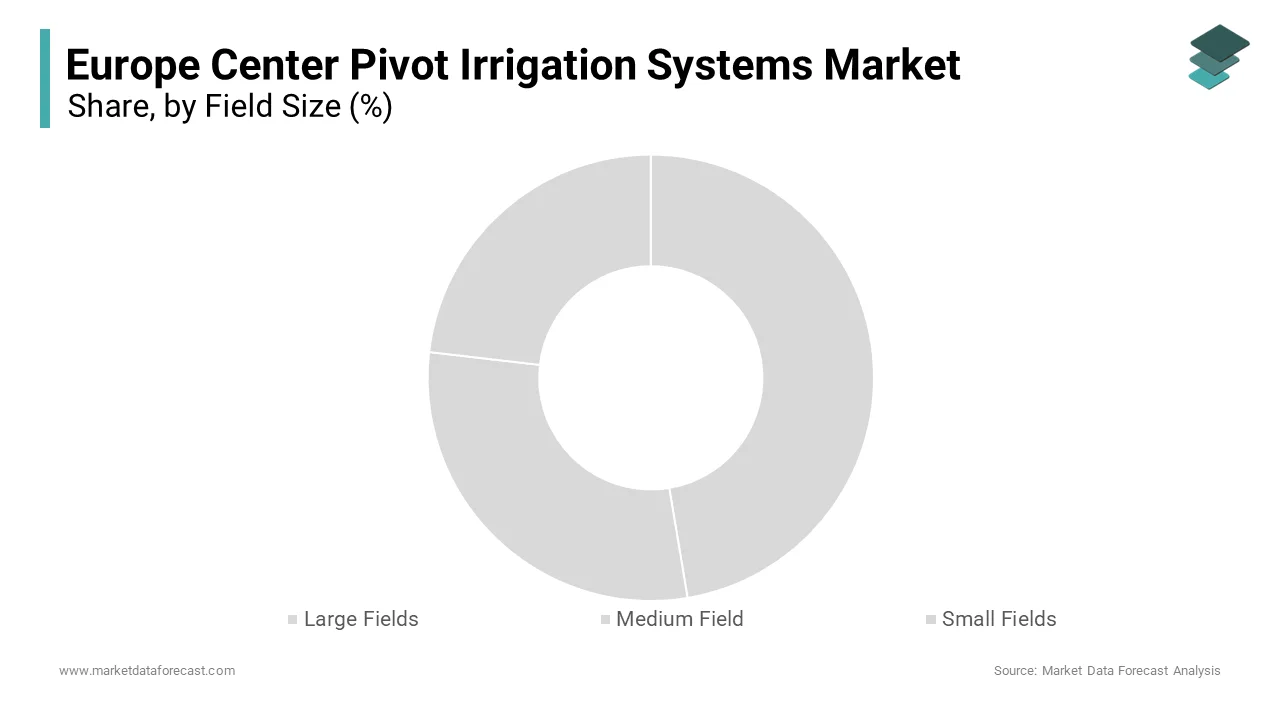
The medium fields segment represents the fastest-growing segment and is predicted to grow at a CAGR of 7.12% over the forecast period in this regional market, owing to the innovations in modular and linear pivot adaptations that enable partial circular coverage on fields as small as 20 hectares. Companies like Reinke and Lindsay now offer “corner arm” extensions and end gushut-offff systems that adjust water application to fit rectangular plots, which are common in Central Europe. In Hungary, the National Agricultural Advisory Service reported a notable increase in pivot inquiries from 50 to 100-hectare farms in 2023 following CAP subsidy clarifications that included medium holdings. Additionally, cooperative models are emerging where neighbouring farms pool land for shared pivot use; in France’s Centre Val de Loire region, several irrigation cooperatives commissioned joint systems in 2023 covering significant areas. As per Copa Cogeca, rising water pricing and drought frequency are compelling mid-sized producers to overcome historical hesitation. This blend of technological adaptation, policy inclusion, and collective action is unlocking previously inaccessible market potential.
By Crop Insights
The cereals and grains segment occupied the most dominant share of the European market in 2024. The dominance of the cereals and grains segment in the European market is attributed to the extensive cultivation of water-sensitive cereal crops in Southern and Eastern Europe, where rainfall is insufficient during critical growth stages. Maize alone occupies over 9 million hectares in the,, with a significant share located in drought-prone regions of Spain, Romania, and France, as per Eurostat. Pivot systems deliver uniform water during silking and grain filling phases, which directly influence yield stability, as trials have shown that irrigated maize under pivots can yield substantially higher than rainfed conditions. Additionally, cereals are often grown in large monocultures on consolidated fields ideal for pivot deployment. The EU’s Protein Plan also indirectly supports cereal irrigation, as maize is used as a rotational crop in pulse systems. This combination of agronomic necessity, economic scale, le and policy context solidifies cereals and grains as the dominant application segment.
The oilseeds and pulses segment is the fastest-growing crop segment and is projected to witness a prominent CAGR during the forecast period. The growth of the oilseeds and pulses segment in the European market is driven by the EU’s strategic push to reduce soybean imports through domestic protein crop cultivation, which is primarily rapeseed, sunflower, and field peas. These crops exhibit high water sensitivity during flowering and pod filling,, ng as insufficient moisture can reduce oil content significantly. In Romania, sunflower farmers using pivots reported higher yields and improved oil concentration in 2023. Similarly, in Spain’s Castilla-La Mancha region, pivot-irrigated chickpeas achieved notable protein gains, qualifying for premium export contracts. The Common Agricultural Policy’s eco schemes now provide bonus payments for irrigated protein crops as part of crop diversification mandates. As per DG AGRI, hundreds of thousands of hectares of new oilseed area were brought under irrigation in 2023. This policy-driven agronomic shift positions oilseeds and pulses as the most dynamic growth frontier
By Component Insights
The spans segment dominated the Europe center pivot irrigation systems market in 2024 by holding 33.8% of the regional market share. The growth of the spans segment in the European market is attributed to the structural and material intensity of spans, which constitute the primary framework of the pivot system, which is typically comprising galvanized steel tubes, towers, and truss assemblies that support the entire water distribution arm. A standard 500-meter pivot requires 8 to 12 spans, each representing significant material and engineering value. Over 95% of pivot spans use hot-dip galvanized steel to withstand decades of outdoor exposure with corrosion resistance validated under EN ISO 1461 standards. In Eastern Europe, where systems operate year-round despite harsh winters, span durability is paramount; farms often report service lives exceeding 15 years per pivot. Additionally, span length directly determines irrigated area, making it the costliest and most critical component in system design. This combination of material value, engineering complexity, and longevity ensures that spans remain the highest revenue segment.
The control panels segment is estimated to record a CAGR of 10.1% over the forecast period in the European center pivot irrigation systems market due to the rapid integration of smart irrigation technologies that transform pivots from mechanical water applicators into data-driven agronomic tools. Modern control panels now incorporate IoT connectivity, GPS guidance, soil moisture feedback, and variable rate algorithms, enabling real-time adjustments via smartphone apps. In Spain, a large share of new pivot installations in 2023 included telemetry-enabled panels linked to the National Irrigation Observatory for water accounting compliance. Similarly, in Hungary, the Rural Development Program mandates digital monitoring for all subsidized systems. As per the European GNSS Agency, Galileo-integrated panels reduce positioning errors to under 30 centimeters, enhancing application precision. Companies like Valmont and Lindsay offer subscription-based analytics services that generate recurring revenue while improving farm water productivity. This digital transformation redefines the control panel as the intelligence hub of modern irrigation.
COUNTRY ANALYSIS
Spain Center Pivot Irrigation Systems Market Analysis
Spain dominated the center pivot irrigation systems market in Europe by accounting for 27.5% of the regional market share in 2024. The dominance of Spain in the European market is attributed to the chronic water scarcity, extensive arable plains, and strong policy support for irrigation modernization. Over 3.8 million hectares of Spanish farmland are irrigated with maize, sunflower, and alfalfa, concentrated in Castilla-La Mancha and Andalusia. Reservoir levels in 2023 averaged around 42% capacity, triggering mandatory efficiency upgrades. The National Hydrological Plan allocates significant funding annually for pivot subsidies covering up to half of the costs. Additionally, Spain leads in solar-powered pivot adoption with more than 150 hybrid systems installed in 2023 to offset high diesel prices. This fusion of environmental necessity, regulatory enforcement, and renewable integration cements Spain’s unrivaled market leadership.
Romania Center Pivot Irrigation Systems Market Analysis
Romania captured a substantial share of the European center pivot irrigation systems market in 2024. The growth of Romania in the European market is driven by vast consolidated farmland in the southern plain, where average field sizes exceed 150 hectares, which is ideal for center pivot deployment. Romania irrigates over 2 million hectares primarily for maize and sunflowers, er with pivot installations showing strong growth in 2023. A key factor is generous CAP funding; the National Strategic Plan provides up to 60% co-financing for water-saving technologies under measure 4.1. Additionally, low labor availability favors mechanized systems; rural depopulation has reduced the agricultural workforce significantly since 2019, as confirmed by Eurostat. Foreign agribusinesses operating large holdings have installed hundreds of pivots since 2020. This combination of land structure, policy support, and corporate farming ensures Romania’s rapid ascent.
France Center Pivot Irrigation Systems Market Analysis
France is predicted to occupy a prominent share of the European market over the forecast period owing to the strategic adoption in drought-vulnerable regions like Centre Val de Loire and Occitanie, where maize and sunflower dominate. Although France has historically relied on surface irrigation, pivot use is rising due to stricter water quotas as the Loire Basin Authority reduced summer abstraction in 2023, prompting modernization. As per the French Ministry of Agriculture, more than 120 new pivots were commissioned in 202,3 with a majority featuring digital control panels for compliance reporting. Cooperative models are also emerging; in Eure et Loir, farming collectives jointly invested in a shared 600-meter pivot covering 280 hectares. Additionally, the Eco Regime scheme provides payments per hectare for farms using precision irrigation. This blend of regulatory pressure, collective action, and digital compliance sustains France’s steady growth.
Italy Center Pivot Irrigation Systems Market Analysis
Italy is a notable market for the center pivot irrigation systems market in Europe. The growth of Italy in the European market is driven by the Po Valley, which faces severe groundwater depletion and nitrate regulations. Maize and soybean growers are adopting pivots to comply with the Po District Basin Plan that mandates water reduction by 2027. As per the Lombardy Regional Authority, more than 90 pivots were installed in 2023, all featuring low-pressure sprinklers to minimize runoff. Additionally, Italy leads in pivot integration with fertigation, allowing precise nutrient delivery during irrigation, which is a requirement under the National Fertilization Plan. The National Recovery and Resilience Fund allocated substantial funding for irrigation modernization in 202wit withth 3prthe priority given tonto circular water systems. This regulatory and environmental urgency drives consistent adoption despite high land fragmentation elsewhere.
Hungary Center Pivot Irrigation Systems Market Analysis
Hungary is projected to grow at a healthy CAGR in the European market over the forecast period, owing to the rapid modernization of Soviet era irrigation infrastructure on large state and private holdings in the Great Hungarian Plain. Over 1.7 million hectares are under irrigation primarily for maize, sunflower, rice, and wheat as per the National Food Chain Safety Office. A pivotal driver is the National Agricultural Support Scheme, which in 2023 provided subsidies for center pivots with mandatory digital monitoring. As per the Hungarian Agricultural Advisory Service, pivot installations grew significantly year on year, with strong uptake of corner arm systems for rectangular fields. Additionally, rising summer temperatures have increased crop water demand. This policy, climate, and agronomic alignment ensure Hungary’s continued expansion in mechanized irrigation.
COMPETITIVE LANDSCAPE
The Europe center pivot irrigation systems market is characterized by a concentrated yet adaptive competitive landscape dominated by three US-based manufacturers that have tailored their global platforms to European regulatory and agronomic realities. Competition is less about price and more about system durability, digital integration,n and compliance with water governance frameworks such as the EU’s eco schemes and national abstraction limits. While large corporate farms in Spain and Romania drive volume through full-scale pivot adoption mid mid-sized holdings in France and Hungary demand modular and cost-shared solutions. The absence of significant European native manufacturers creates reliance on imported technology but also allows global players to set technical standards. Service capability remains a key differentiator given the shortage of trained technicians across the continent. As water scarcity intensifies and digital farming expands, competition increasingly hinges on the ability to deliver not just hardware end-to-end water productivity solutions that combine engineering precision with policy responsiveness and localized support.
KEY MARKET PLAYERS
Some of the market leaders of the CPI systems market include
- T-L Irrigation Company
- Netafim Limited
- RoEhren- Und Pumpenwerk
- Lindsay Corporation
- Valmont Industries
- Alkhorayef Group
- Reinke Manufacturing Company Inc.
- Grupo Fockink
- Vodar (Tianjin) Co. Ltd
- Pierce Corporation Ltd.
- Bauer GmbH
- Rainfine (Dalian) Irrigation Co.
Top Players In The Market
- Valmont Industries Inc maintains a strong presence in the Europe center pivot irrigation systems market through its Valley brand, which supplies advanced mechanized irrigation solutions to large farms in Spain, RRomaniHungaryryy. The company integrates GPS guidance, variable rate technology, and remote monitoring via its FieldNET platform to enhance water efficiency and compliance with EU sustainability mandates. In 2023, Valmont expanded its European distribution hub in Madrid to reduce delivery lead times and launched solar-ready pivot packages tailored for Southern Europe’s high irradiance conditions. It also partnered with the Spanish National Irrigation Observatory to align telemetry data with national water accounting requirements. These initiatives reinforce Valmont’s commitment to localized support and regulatory alignment while strengthening its global leadership in precision irrigation.
- Lindsay Corporation plays a strategic role in the Europe center pivot irrigation systems market through its Zimmatic brand, offering high durability pivots engineered for diverse European field conditions. Headquartered in the United States, the company serves major agricultural regions in France, Spain, Italy, and Eastern Europe with systems featuring corrosion-resistant alvanization and modular span designs. In early 202,4, Lindsay introduced its FieldWise Connect platform in Europe, enabling real-time pivot control through smartphone applications and integration with Galileo satellite positioning. It also established a technical training center in Budapest to address the shortage of certified service technicians in the region. These actions enhance operational reliability and digital adoption while reinforcing Lindsay’s reputation for rugged engineering and farmer-centric innovation across the continent.
- Reinke Manufacturing CoCompanyactivelyparticipates in the Europe center pivot irrigation systems market by providing customizable pivot systems optimized for medium and large fields in water-stressed regions. The company focuses on Eastern and Southern Europe, where it collaborates with local dealers to offer corner arm extensions and end gun management for non-circular plots. In 2023, Reinke launched its Reinke iQ control panel with IoT-enabled diagnostics and cloud-based irrigation scheduling compatible with EU data privacy standards. It also introduced a financing program in partnership with European agricultural banks to lower entry barriers for mid-sized farms. These localized strategies position Reinke as an agile and responsive player attuned to Europe’s structural and financial irrigation challenges while contributing to global advancements in adaptive pivot design.
Top Strategies Used By The Key Market Participants
Key players in the Europe center pivot irrigation systems market are localizing supply chains by establishing regional distribution and service hubs to reduce delivery times and improve after-sales support. Companies are integrating digital control panels with IoT connectivity, Galileo positioning, and cloud-based analytics to meet EU water accounting and eco scheme compliance requirements. Strategic partnerships with national irrigation authorities and research institutes are being formed to validate water savings and align system performance with regional agronomic needs. Product customization—including corner arms, modular span, and solar-ready configurations—is addressing Europe’s field shape and energy constraints. Additionally, firms are developing financing and cooperative ownership models to overcome high capital barriers for mid-sized farms. These strategies collectively enhance accessibility, sustainability, and regulatory alignment in a market shaped by climate and policy pressures.
MARKET SEGMENTATION
This market research report on the European center pivot irrigation systems market is segmented and sub-segmented into the following categories.
By Field Insights
- Large Fields
- Medium Field
- Small Fields
By Crop Type
- Cereals & Grains
- Oilseeds & Pulses
- Other Crop Types
By Mobility
- Stationary
- Mobile Center Pivot Irrigation Systems
By Component
- Spans
- Pivot Points
- Drive Trains
- Control Panels
- Sprinkler Drops
By Country
- United Kingdom
- France
- Spain
- Germany
- Italy
- Russia
- Sweden
- Denmark
- Switzerland
- Netherlands
- Rest of Europe