- Product Description Description
- Table of Contents TOC
- List of Table & Figure LOT
- Get Free Sample PDF Sample PDF
Market Size, 2025
$1.92 BnMarket Estimate, 2026
$2.14 BnMarket Forecast, 2034
$5.20 BnCAGR, 2026–2034
11.71%Global Center Pivot Irrigation Systems Market Size, Growth, Trends & Forecast (2026–2034)
The global center pivot irrigation systems market size was valued at USD 1.92 billion in 2025, stands at USD 2.14 billion in 2026, and is projected to expand up to USD 5.20 billion by 2034, registering a compound annual growth rate (CAGR) of 11.71% over the forecast period from 2026 to 2034 (noting extensive industry metrics up to 15.25%). Driven by mounting global freshwater scarcity, the rapid consolidation of large-scale mechanized farming, and the integration of precision agriculture and IoT digital platforms, the market continues to undergo robust expansion.
Key Executive Metrics (At-a-Glance)
- 2025 Base Valuation: USD 1.92 Billion
- 2026 Current Valuation: USD 2.14 Billion
- 2034 Forecast Valuation: USD 5.20 Billion
- Compound Annual Growth Rate (CAGR): 11.71% (2026–2034)
- Dominant Field/Mobility Segment: Stationary & Large Fields (Largest Share & Fastest-Growing)
- Dominant Crop Segment: Cereals & Grains (Largest Share)
- Dominant Geographic Region: North America (Led by the United States & Nebraska)
Core Market Drivers & Restraints
- Drivers: Intensifying global water scarcity crises, expansion of large commercial agribusiness holdings (such as in the US Great Plains and Brazilian Cerrado), and technological convergence with digital farming tools like Lindsay's FieldNET Advisor.
- Restraints & Challenges: High initial capital outlays and infrastructure requirements for small-to-medium producers, unsuitability for rugged or hilly terrains, and energy grid dependency or groundwater depletion regulations.
Global Center Pivot Irrigation Systems Market Segmentation Breakdown
| Segment Category | Largest Segment | Fastest-Growing Segment |
|---|---|---|
| By Field Type | Stationary | Stationary |
| By Mobility / Field Size | Large Fields | Large Fields |
| By Crop Type | Cereals & Grains | Cereals & Grains |
| By Region | North America | Asia-Pacific |
Major Industry Players Profiled
Key global market participants include Lindsay Corporation (Zimmatic), Valmont Industries (Valley), Reinke Manufacturing Company Inc., T-L Irrigation Company, Netafim Limited, Bauer GmbH, Alkhorayef Group, Grupo Fockink, Pierce Corporation Ltd., and Rainfine (Dalian) Irrigation Co.
Global Center Pivot Irrigation Systems Market Size
The global center pivot irrigation systems market was valued at USD 1.92 billion in 2025 and is anticipated to reach USD 2.14 billion in 2026 and USD 5.20 billion by 2034, growing at a CAGR of 11.71% during the forecast period from 2026 to 2034.
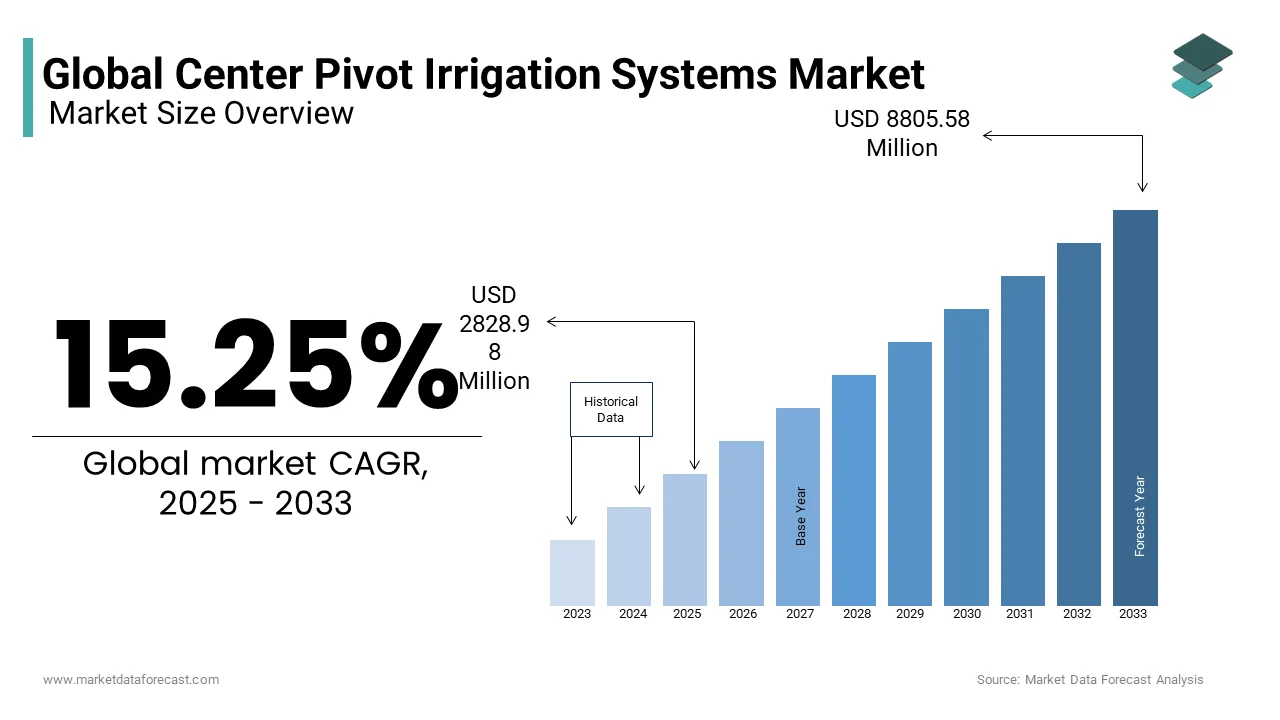
A center pivot irrigation system is a mechanized agricultural watering method where equipment rotates around a central pivot point to deliver water in a circular pattern across fields. This technology is engineered for large-scale uniform water distribution with minimal labor input and is particularly suited to flat terrains cultivated with row crops, forage,e or cereals. As global freshwater resources face mounting pressure,ure the role of engineered irrigation efficiency becomes critical in sustaining food production. Agriculture is the predominant user of global freshwater resources, but a significant portion of this water is not effectively utilized due to widespread inefficient application methods. In contrast, modern irrigation technologies, such as center pivot systems utilizing low-pressure and variable-rate technology, demonstrate substantially higher application efficiencies than conventional, less sophisticated irrigation practices. The expansion of arable land under mechanized irrigation, particularly in regions like the Great Plains of the United States and the Cerrado of Brazil, underscores the system’s operational relevance in modern agronomy.
MARKET DRIVERS
Water Scarcity and the Imperative for Efficient Irrigation
The accelerating global water crisis is a primary driver for the center pivot irrigation systems market. Global freshwater availability per capita has decreased, reflecting intensifying competition among municipal, industrial, and agricultural users. In agriculture, which remains the largest consumer of freshwater, the inefficiencies of flood and furrow methods exacerbate losses through evaporation, runoff,f and deep percolation. Center pivot systems counter this by enabling precise water placement directly to the crop root zone, often integrated with soil moisture sensors and weather forecasts. Field studies by the University of Nebraska-Lincoln and other institutions have shown that modern variable rate irrigation in corn fields uses less water and produces more grain compared to traditional irrigation plots. Furthermore, governments inwater-stressedd regions are incentivizing high-efficiency systems. For instance, the Australian government, through the Murray-Darling Basin Plan, has allocated substantial funds via various programs to assist farmers in replacing traditional irrigation with more efficient systems to improve water efficiency and environmental outcomes. These converging pressures and policy levers position center pivot technology as a strategic response to hydrological constraints.
Expansion of Large-Scale Mechanized Farming
The global trend toward consolidating agricultural holdings into large-scale commercial operations further propels the expansion of the center pivot irrigation systems market. This directly fuels the demand for center pivot irrigation. Small, fragmented farms are increasingly giving way to expansive agribusinesses that prioritize operational uniformity, ty labor reduction, and input optimization. In Brazil, the average farm size in the state of Mato Grosso is a complex issue, but large commercial farms have become more prominent. This shift is driven by a significant expansion of soybean and cotton production into the Cerrado biome, where center pivot systems are widely used for irrigation. Similarl earlyly in Kazakhstan, a considerable area of land has been converted to industrial grain production in recent years. Center pivot systems are increasingly adopted as the primary choice for irrigating wheat due to their suitability for modern, precision-guided machinery and efficient field planning. The United States further exemplifies a shift towards larger-scale irrigation. A substantial majority of irrigated cropland utilizing center pivots consists of large fields, as evidenced by recent national agricultural surveys. These structural transformations in land use and farm economics create a natural alignment with the spatial and logistical requirements of center pivot systems, making them indispensable in the architecture of modern commodity agriculture.
MARKET RESTRAINTS
High Initial Capital Investment and Infrastructure Requirements
The substantial upfront cost associated with installing center pivot irrigation systems remains a serious barrier to widespread adoption, particularly among small and medium-scale producers, which restricts the growth of the center pivot irrigation systems market. Establishing modern, large-scale irrigation systems often requires a substantial initial capital outlay that covers only the primary equipment, excluding the additional costs of developing power and water infrastructure. This capital intensity is compounded by the need for reliable electricity access, terrain, and pressurized water supply,y all of which may necessitate additional civil and electrical works. The widespread adoption of motorized irrigation remains hindered across much of the African continent because a majority of farming areas lack reliable connections to the national power grid. Even in developed economies, the cost recovery periods can extend beyond five years, deterring risk-averse farmers. Agricultural producers often recognize that advanced irrigation technologies would lead to significant resource efficiency, yet they frequently postpone these upgrades due to the high costs of entry and a lack of available financing. The economic threshold for entry remains prohibitively high for a significant segment of the farming community without targeted financing mechanisms like low-interest loans or public-private co-investment models.
Unsuitability for Irregular or Hilly Terrain
These systems are inherently constrained by topographical and spatial limitations, rendering them impractical for circular or uneven fields, which impedes the expansion of the center pivot irrigation systems market. Center pivot irrigation is most effective on level or slightly undulating land, as steeper grades can strain the machine's framework and compromise the uniformity of water application. According to a study, A substantial portion of the world's farmland consists of terrain that is too rugged or steep for standard mechanical irrigation, particularly in mountainous and highland regions. Besides, the circular irrigation pattern inherently leaves corners unirrigated, resulting in land use inefficiency. Because center pivots travel in a circle, they naturally leave the corners of square fields untouched, resulting in a portion of the land not receiving water unless specialized corner-reach equipment is used. The availability of corner arm extensions and linear add-ons comes at the price of increased cost and complexity, which undermines the system's economic edge. Consequently, in nations like Vietnam, where farming is dominated by small-scale family plots and fragmented land, large-scale circular irrigation systems are rarely used because the field sizes do not accommodate their expansive footprint. These physical constraints fundamentally limit the technology’s universal applicability regardless of water scarcity or crop value.
MARKET OPPORTUNITIES
Integration with Precision Agriculture and Digital Farming Platforms
The convergence of center pivot systems with data-driven agronomic tools shows an opening for the growth of the center pivot irrigation systems market. Modern pivots are increasingly equipped with telematics, soil moisture probes, and variable rate irrigation controllers that respond dynamically to real time field conditions. This integration transforms irrigation from a uniform application into a spatially intelligent input aligned with crop needs. University of Georgia research demonstrates that integrating center pivot irrigation with satellite-based evapotranspiration models significantly enhances water conservation and promotes a notable increase in cotton lint yields compared to traditional irrigation methods. Equipment manufacturers are accelerating this shift. Lindsay Corporation is continuously upgrading its established FieldNET Advisor platform, which utilizes advanced machine learning and field data to provide enhanced, customized irrigation recommendations to growers, helping them optimize water use and crop performance. Furthermore, government digital agriculture initiatives are creating enabling environments. The Indian government is actively promoting the adoption of modern irrigation technologies through schemes like the Per Drop More Crop initiative, which provides financial assistance to farmers for micro-irrigation systems to enhance water use efficiency across key agricultural states. The pivot is transforming from a basic irrigation tool into a responsive hub within a digital agronomic network, increasing its utility beyond watering.
Retrofitting Legacy Systems with Water and Energy Saving Technologies
Upgrading the vast existing base of older center pivot installations with modern efficiency-enhancing components offers a potential pathway for the expansion of the center pivot irrigation systems market. Millions of pivots installed before 2010 operate with high-pressure spray nozzles and fixed-rate application, leading to excessive water and energy consumption. Adopting advanced, low-elevation irrigation technologies, such as mobile drip irrigation or low-energy precision application systems, leads to significant increases in overall water and energy efficiency in crop production compared to traditional methods in regions like the Texas High Plains. The economic incentive is compelling. Across the Ogallala Aquifer region, groundwater levels are experiencing a continuous and concerning decline, leading to increased regulatory focus and greater operational costs for farmers. Kansas has implemented several water conservation initiatives, including the Water Transition Assistance Program and irrigation technology funding, which encourage water rights retirement and the adoption of water-saving practices in agricultural production. Similarly, the South African Department of Water and Sanitation employs various regulatory programs, such as the No Drop certification initiative, which encourage improved water use efficiency and the modernization of infrastructure to manage water resources better. This upgrade pathway allows producers to extend asset life while achieving sustainability targets without full system replacement.
MARKET CHALLENGES
Energy Dependency and Operational Vulnerability to Power Fluctuations
Center pivot systems rely heavily on consistent electrical or diesel-powered energy to operate pumps and drive motors, which makes them vulnerable to energy price volatility and grid instability, thereby inhibiting the growth of the center pivot irrigation systems market. In regions with unreliable electricity, such as parts of Pakistan and Nigeria, frequent voltage drops or outages can halt irrigation during critical crop growth stages, leading to yield loss. According to research, a substantial population across Sub-Saharan Africa continues to lack access to reliable electricity, presenting a significant barrier to the widespread use of mechanized irrigation systems and broader economic development. Even in developed economies,s rising energy costs impact operational economics. Facing rising and volatile electricity costs, agricultural producers in California are increasingly modifying their operational schedules, such as shifting irrigation activities to off-peak energy hours, which presents a challenge to optimal farming practices. Furthermorediesel-powereded systems face exposure to fuel market swings. In response to the significant and sudden escalation of diesel fuel prices across Europe in 2022, notably in France during the energy crisis, some agricultural operations were forced to limit or ration essential practices like irrigation due to heightened operational costs. Emerging solar hybrid solutions are still too expensive for widespread use, which introduces operational risk and impacts long-term investment decisions regarding pivot technology.
Regulatory and Environmental Scrutiny Over Groundwater Depletion
Intensifying oversight of groundwater extraction poses a challenge to the center pivot irrigation systems market. This is especially true in aquifer-dependent regions. Many pivot-intensive areas rely on non-renewable or over-drafted aquifers, leading to regulatory intervention that restricts pumping volumes or mandates metering. The Ogallala Aquifer, which spans a vast portion of the American Great Plains, has seen its water table drop significantly since the start of large-scale agricultural development. To manage this steady loss, environmental agencies in states like Kansas and Texas have established compulsory conservation programs that restrict how much water can be drawn for local farming. To ensure the long-term viability of groundwater, water conservation districts in the Texas Panhandle have introduced more stringent limits on the amount of water available for seasonal crop irrigation. These regulatory shifts are forcing local producers to change how they operate their irrigation machinery and adopt more water-efficient practices to stay within their assigned allocations. Similarly In India, national water authorities have designated numerous regions in Punjab as critically overdrawn due to excessive pumping. In these specific areas, government regulations now strictly prohibit the installation of new equipment for drawing groundwater, aiming to halt further environmental degradation and encourage farmers to switch to less water-intensive crops. These measures compel farmers to either fallow land,d adopt less water-intensive crops, or seek alternative sources, all of which reduce the effective utility of existing pivot infrastructure. Regulatory constraints will continue to limit the operational scope of center pivot systems in critical agricultural zones unless coordinated aquifer management and recharge initiatives are implemented.
REPORT COVERAGE
| REPORT METRIC | DETAILS |
| Market Size Available | 2025 to 2034 |
| Base Year | 2025 |
| Forecast Period | 2026 to 2034 |
| CAGR | 15.25% |
| Segments Covered | By Field Type, Crop Type, MobiliTypepee, and Region |
| Various Analyses Covered | Global, Regional & Country Level Analysis, Segment-Level Analysis, DROC, PESTLE Analysis, Porter’s Five Forces Analysis, Competitive Landscape, Analyst Overview on Investment Opportunities |
| Regions Covered | North America, Europe, APAC, Latin America, Middle East & Africa |
| Market Leaders Profiled | CPI systems market includes T-L Irrigation Company, Netafim Limited, RoEhren- Und Pumpenwerk, Lindsay Corporation, Valmont Industries, Alkhorayef Group, Reinke Manufacturing Company Inc., Grupo Fockink, Vodar (Tianjin) Co. Ltd, Pierce Corporation Ltd., Bauer GmbH, Rainfine (Dalian) Irrigation Co. |
SEGMENT ANALYSIS
By Field Insights
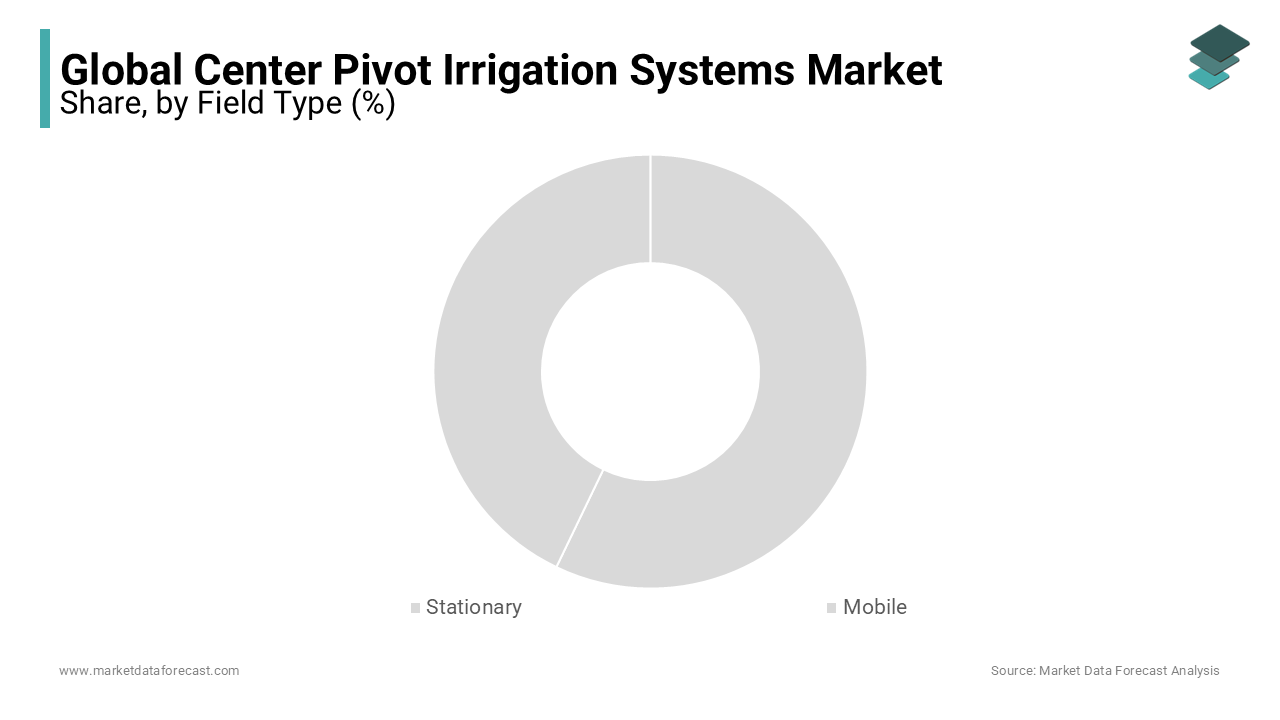
The stationary segment is the biggest category under the center pivot irrigation systems market and is expected to drive forward during the forecast period. This growth can be attributed to its productivity, affordability, and consistency. This model considerably increases productivity by ensuring high water efficiency. These are devised to deliver high-water management and decrease waste. Moreover, the segment’s market share was elevated by its simple usability. They are simple to operate for users and only require intervention.
By Mobility Insights
When considering the field type, the field segment accounted for the largest market share. Center pivot irrigation systems are widely employed in large fields, the reason being high returns on investment and reduced cost per acre. In the mobility category, stationary center pivot irrigation systems have a larger market share compared to mobile systems due to the feasibility and ease of use of stationary systems in large fields. In addition, this system is effective in serving extensive fields with low labour requirements, providing a reliable method for achieving uniform water distribution. Further, the incorporation of several technologies is transforming this system's operations into large fields, which ultimately expands the segment’s market size. Likewise, drones are recognised as pivotal innovations in precision farming. They facilitate cultivators to monitor and access their livestock and yields remotely. This assists in enhancing their decision-making process, maintenance, and harvests. All these factors collectively contribute to the expansion of this market.
By Crop Insights
Component segmentation is done under Spans, Pivot Points, Drive Trains, Control Pand, and SpiKlerer Drops. The cereal and crops segment accounted for the highest revenue, followed by the oilseeds and pulses segment. Intensive growth in cereal crop demands and the use of cereal in animal feed and biofuels drive the application of center-pivot irrigation systems in cereal crops. Moreover, these crops thrive with persistent levels of soil moisture. This irrigation type allows for accurate control through water application, which supports maintaining ideal moisture conditions important for seed germination and growth.
REGIONAL ANALYSIS
North America Market Analysis
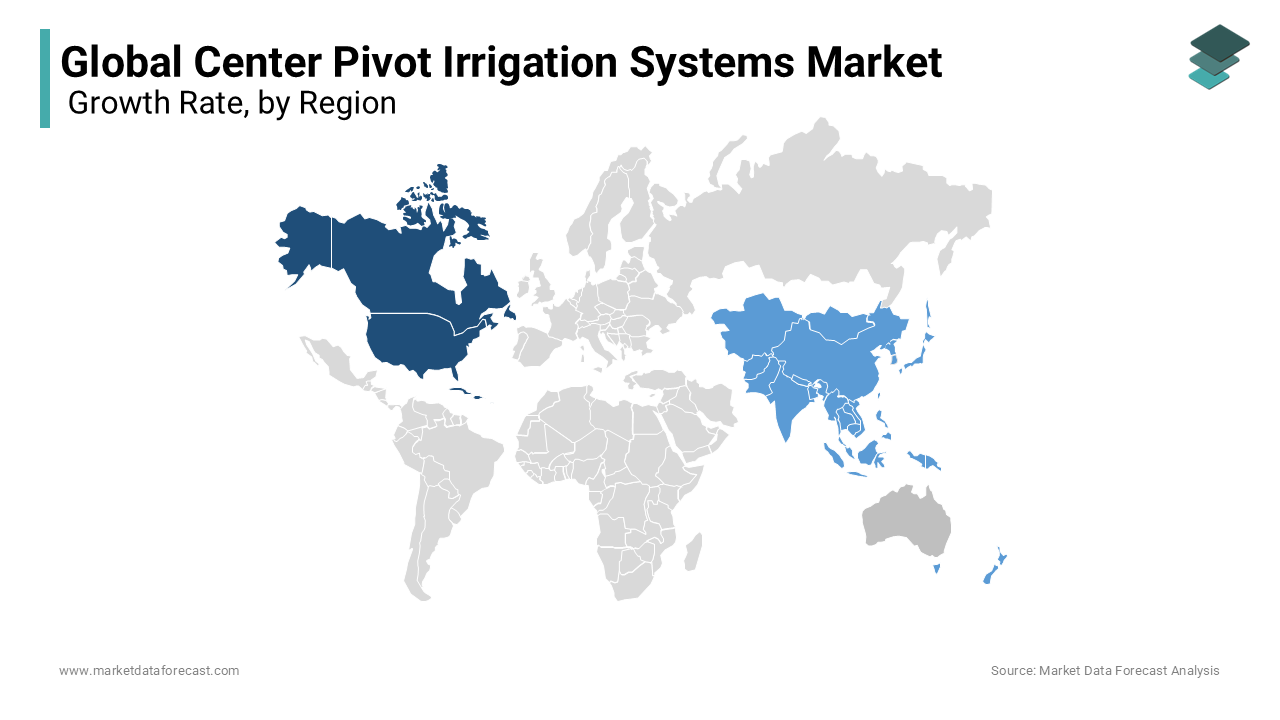
The global market for center pivot irrigation systems is dominated by North America, and the US is the fastest-growing and has the highest market share in this region. The regional market is commanded by the United States. In the U.S., there are about 150 thousand center pivot systems in service as of now, covering over 20 million acres of agricultural land. In addition, Nebraska ranks as the most prominent state for irritation in the country and is also a key manufacturer of this system. It is the 3rd largest state in agricultural receipts in the nation, with an anticipated 55 thousand systems serving around 6.7 million acres.
Asia Pacific Market Analysis
Asia Pacific is expected to show a significant growth rate in the coming years; although it is a labour-intensive region, the increasing need for high-yielding crops is anticipated to influence the growth of CPI systems within the region. Furthermore, a substantial share of the growth in this market during the upcoming 10 years is expected to arrive from the Asia-Pacific and Africa region, propelled by the increase in population, escalating desertification and dryness, combined with rising needs from several nations such as Australia, India, China, Jordan, and Libya.
Europe Market Analysis
Europe accounts for the second-largest share of the center pivot irrigation systems market. Considering current dynamics in the region, escalating labour shortages, rising prices of agricultural products, etc., the demand for these systems is anticipated to surge in the region.
COMPETITIVE LANDSCAPE
The center pivot irrigation systems market is characterized by a mix of established engineering firms and specialized agricultural equipment manufacturers competing on durability, digital integration, and service support. Competition is less about price and more about the total cost of ownership systemm reliability, type, and adaptability to local agronomic and regulatory conditions. Leading players differentiate through proprietary control systems, ems, remote diagnostics, and compatibility with precision agriculture ecosystems. While North America remains a mature market, the companies aggressively target growth in Latin America, Africa, and parts of Asia where large-scale farming is expanding, and groundwater management is becoming policy-driven. Innovation in energy efficiency, such as solar hybrid drives and low-pressure nozzles, is a key battleground. The market also sees rising pressure to demonstrate environmental stewardship, prompting firms to embed sustainability metrics into product design and customer reporting tools. This competitive landscape fosters continuous engineering refinement and deeper collaboration with public water authorities and research institutions.
KEY MARKET PLAYERS
Some of the market leaders of the CPI systems market include
- T-L Irrigation Company
- Netafim Limited
- RoEhren- Und Pumpenwerk
- Lindsay Corporation
- Valmont Industries
- Alkhorayef Group
- Reinke Manufacturing Company Inc.
- Grupo Fockink,
- Vodar (Tianjin) Co. Ltd
- Pierce Corporation Ltd.
- Bauer GmbH
- Rainfine (Dalian) Irrigation Co.
Top Players In The Market
- Lindsay Corporation is a pioneer in center pivot irrigation technology and the developer of the Zimmatic brand, which is recognized globally for its durable and technologically advanced systems. The company integrates hardware with its FieldNET platform, enabling remote monitoring, ng variable rate irrigation, and predictive maintenance. In recent years, Lindsay has enhanced its offerings by incorporating artificial intelligence-driven agronomic insights and expanding connectivity through partnerships with satellite data providers.
- Valmont Industries is a leading innovator in irrigation infrastructure through its Valley brand, which delivers center pivot and linear irrigation systems worldwide. The company emphasizes smart water management by embedding IoT sensors, telemetry,ry acloud-basedsed analytics into its equipment. Valmont has strengthened its market position by expanding its manufacturing footprint in Brazil and India to serve regional demand more efficiently.
- Reinke Manufacturing Company is a family-owned global supplier of center pivot irrigation systems known for customization, flexibility, and robust engineering suited to challenging field conditions. The company’s Reinke Remote solution enablereal-timeme pivot control through mobile applications and integrates with third-party agronomic platforms. Recently, Reinke launched its Reinke Connect telematics suite, which provides diagnostic alerts and irrigation performance analytics to optimize water and energy use. The firm also prioritized sustainability by developing low-pressure spray package options that reduce water loss and energy consumption, reinforcing its commitmentto resource-efficientagriculture.
Top Strategies Used By The Key Market Participants
Key players in the center pivot irrigation systems market focus on integrating digital technologies such as IoT sensors, remote mmonitoringgg and variable rate irrigation to enhance water and energy efficiency. They invest in regional manufacturing and assembly hubs to reduce lead times and comply with local content requirements. Strategic partnerships with agronomic service providers, r RSSsatellite imagery firms, and renewable energy companies help create holistic farm solutions. Product customization for terrain adaptability and crop-specific needs remains a core differentiator. Additionally, companies prioritize after-sales service networks and training programs to bubuild long-termustomer loyalty in both developed and emerging agricultural regions.
MARKET SEGMENTATION
This research report on the global center pivot Irrigation System market has been segmented and sub-segmented into the following categories.
By Field Type
- Stationary
- Mobile
By Mobility
- Cereals & Grains
- Oilseeds & Pulses
- Other Crop Types
By Crop Type
- Large fields
- Medium field
- Small fields
By Region
- North America
- Europe
- Asia Pacific
- Latin America
- Middle East and Africa