- Product Description Description
- Table of Contents TOC
- List of Table & Figure LOT
- Get Free Sample PDF Sample PDF
Market Size, 2025
$375.7 MnMarket Estimate, 2026
$434.32 MnMarket Forecast, 2034
$1388 MnCAGR, 2026–2034
15.63%Latin America Center Pivot Irrigation Systems Market Size
The Latin America center pivot irrigation systems market size was valued at USD 375.7 million in 2025 and is anticipated to reach USD 434.32 million in 2026 to USD 1388.28 million by 2034, growing at a CAGR of 15.63% during the forecast period from 2026 to 2034.
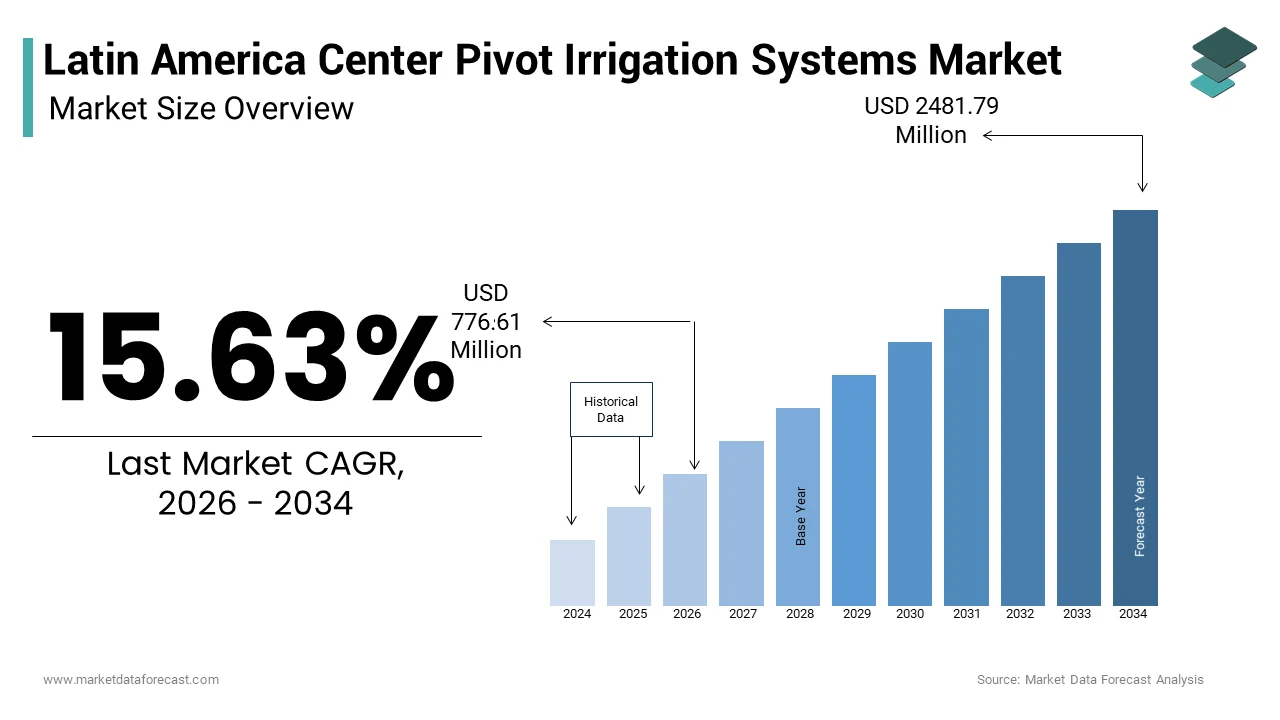
MARKET OVERVIEW
The center pivot irrigation systems is designed to distribute water efficiently over large agricultural plots. The adoption of such technology is driven by the need to maximize crop yield per unit of water used, particularly in major agrarian economies like Brazil and Argentina. As per the Food and Agriculture Organization of the United Nations, agriculture accounts for approximately 70% of global freshwater withdrawals, a figure that necessitates efficient irrigation solutions in Latin America where rainfall patterns are becoming increasingly erratic. However, the current penetration rate remains low compared to North America, which is indicating significant room for growth. The integration of precision agriculture technologies with center pivot systems allows farmers to monitor soil moisture levels and adjust water application in real time.
MARKET DRIVERS
Escalating Water Scarcity And Climatic Variability Drive Adoption Of Efficient Irrigation Technologies
The intensifying frequency of droughts and unpredictable rainfall patterns is leveraging the growth of the Latin America center pivot irrigation systems market. Farmers are increasingly compelled to shift from rain fed agriculture to controlled irrigation methods to safeguard crop yields against climate induced risks. According to the Economic Commission for Latin America and the Caribbean, the region has experienced a 25% increase in drought severity over the past two decades, directly impacting agricultural productivity in key producing zones. In Brazil, which is the world’s largest soybean exporter, prolonged dry spells in the Mato Grosso region have led to significant yield losses, prompting large scale agribusinesses to invest in water efficient technologies. The substantial improvement in water conservation is in areas, where aquifer depletion is a growing concern. Furthermore, the El Nino Southern Oscillation continues to disrupt weather patterns by causing erratic precipitation that makes reliance on natural rainfall increasingly risky. The deforestation in the Amazon has contributed to a decline in regional rainfall by exacerbating water stress in agricultural heartlands. Consequently, the ability of center pivot systems to deliver precise amounts of water directly to the root zone minimizes evaporation losses and ensures optimal plant growth even during dry periods.
Government Subsidies And Financial Incentives Accelerate Mechanization In Agricultural Sector
The governmental support through subsidies and favorable credit lines in lowering the financial barriers associated is also driving the growth of the Latin America center pivot irrigation systems market. High initial capital costs often deter small and medium sized farmers from adopting advanced irrigation technologies, but targeted policy interventions are mitigating this hurdle. In Brazil, the Moderniza Agro program provides low interest financing for the purchase of agricultural machinery, including irrigation equipment, thereby stimulating market growth. Livestock and Supply of Brazil, agricultural credit reached record levels in recent years with billions of reais allocated specifically for technological modernization. Similarly, in Argentina, the government has implemented tax exemptions on the import of irrigation components to encourage local adoption. Additionally, international organizations are funding projects aimed at improving water management infrastructure in rural communities. These initiatives often include technical assistance and training programs that help farmers optimize the use of center pivot systems. The combination of financial support and educational resources that creates an enabling environment for widespread adoption. Moreover, national policies aligned with sustainable development goals prioritize water conservation by making irrigation upgrades a strategic priority for public investment.
MARKET RESTRAINTS
High Initial Capital Investment And Maintenance Costs Restrict Market Penetration
The substantial upfront cost required for purchasing and installing center pivot irrigation systems remains a significant barrier to widespread adoption, among smallholder farmers, who constitute a large portion of the agricultural sector in Latin America. According to the Food and Agriculture Organization of the United Nations, smallholders manage approximately 80% of farms in Latin America but often lack access to sufficient capital or credit facilities to afford such expensive machinery. This financial constraint limits the market primarily to large agribusinesses and corporate farms, leaving a vast segment of the agricultural sector reliant on less efficient irrigation methods. Furthermore, the ongoing maintenance costs associated with these systems, including repairs to motors, gears, and sprinkler heads, add to the total cost of ownership. Rural areas often lack specialized technical service providers, leading to prolonged downtime and higher repair expenses when breakdowns occur. The limited infrastructure in remote agricultural regions increases logistical challenges and costs for obtaining spare parts and skilled labor. The complexity of operating advanced systems also requires trained personnel, necessitating additional investment in workforce training.
Limited Technical Expertise And Infrastructure Deficits Impede Effective System Utilization
The effective operation and maintenance of center pivot irrigation systems require a level of technical expertise that is hindering the growth of the Latin America center pivot irrigation systems market. The limited technical expertise and infrastructure deficits is impeding the growth of the latin America center pivot irrigation systems market. Many farmers lack the necessary skills to manage complex automated systems, leading to suboptimal performance and frequent mechanical failures. There is a significant gap in agricultural extension services that provide training on modern irrigation technologies. This knowledge deficit results in improper system calibration, uneven water distribution, and increased energy consumption, which undermines the economic viability of the investment. Additionally, the inadequate rural infrastructure in many parts of the region poses logistical challenges for the installation and upkeep of these systems. Poor road conditions hinder the transportation of heavy equipment and spare parts to remote farm locations, causing delays in repairs and increased operational costs. Electricity supply instability is another critical issue, as center pivot systems rely on consistent power sources to operate effectively. Frequent power outages in rural areas can disrupt irrigation schedules and damage sensitive electronic components.
MARKET OPPORTUNITIES
Integration Of Internet Of Things And Precision Agriculture Technologies Creates Growth Avenues
The emergence of center pivot irrigation systems with Internet of Things sensors and precision agriculture platforms is likely to set up new opportunities for the growth of the Latin America center pivot irrigation systems market. By integrating smart sensors that monitor soil moisture, weather conditions, and crop health, farmers can automate irrigation schedules and optimize water usage with unprecedented accuracy. Companies are increasingly offering modular upgrades that allow existing center pivot systems to be retrofitted with smart controllers and variable rate irrigation capabilities. The rollout of fifth generation networks in major agricultural regions will further enhance the reliability and speed of data transmission, supporting more sophisticated automation features. The ability to apply varying amounts of water to different zones within a field based on real time soil conditions maximizes crop yield while minimizing environmental impact. This technological evolution aligns with the growing demand for sustainable farming practices among global buyers of Latin American agricultural products. Furthermore, the accumulation of historical data from these systems enables predictive analytics that help farmers anticipate potential issues and plan maintenance proactively. The integration of artificial intelligence algorithms can further refine irrigation strategies by learning from past performance metrics.
Expansion Of Cultivated Area For High Value Export Crops Drives Demand For Advanced Irrigation
The continuous expansion of cultivated land dedicated to high value export crops, such as soybeans, corn, and fruits creates a robust demand for efficient irrigation solutions like center pivot systems. The expansion of cultivated area for high value export crops is also to thrive the growth of the Latin America center pivot irrigation systems market. Center pivot systems are particularly well suited for these large scale operations due to their ability to cover vast areas uniformly and efficiently. The cultivation of high value fruits and vegetables in countries like Chile and Peru also relies heavily on precise irrigation to meet strict quality standards required by international markets. The need to maintain product quality and consistency throughout the year drives investment in advanced irrigation technologies that can mitigate the risks associated with climate variability. Additionally, the shift toward double cropping systems, where two harvests are taken from the same land in one year, increases the pressure on water resources and necessitates more efficient irrigation methods.
MARKET CHALLENGES
Climate Change Induced Weather Extremes Pose Operational Risks To Irrigation Infrastructure
The increasing frequency and intensity of extreme weather events due to climate change pose significant operational risks to center pivot irrigation infrastructure is one of the major challenges for the growth of the latin America center pivot irrigation systems market. Strong winds, hailstorms, and heavy rainfall can cause physical damage to pivot spans, towers, and sprinkler heads, leading to costly repairs and extended downtime. In regions prone to high winds, such as the Pampas in Argentina, structural integrity of center pivot systems is a major concern by requiring additional reinforcement and regular inspections. Heavy rainfall can lead to soil saturation and flooding, which may destabilize the foundation of pivot towers and disrupt electrical connections. Furthermore, rising temperatures increase evaporation rates, which can reduce the effectiveness of irrigation if not properly managed through adjusted scheduling and technology upgrades. The unpredictability of weather patterns makes it difficult for farmers to plan irrigation cycles accurately, potentially leading to over or under watering. These climatic challenges necessitate the development of more resilient irrigation systems that can withstand harsh environmental conditions. Manufacturers are responding by designing equipment with enhanced durability and weather resistant features, but the additional costs associated with these upgrades can be burdensome for farmers.
Regulatory Uncertainty And Environmental Compliance Requirements Create Implementation Hurdles
Navigating the complex and often evolving regulations surrounding water usage and environmental protection is additionally to inhibit the growth of the Latin America center pivot irrigation systems market. Governments are increasingly implementing stricter regulations on water extraction and discharge to protect natural resources and ecosystems. In Brazil, the Forest Code requires farmers to maintain legal reserves of native vegetation, which can limit the available land for irrigation infrastructure and complicate permit approvals. The obtaining water use permits involves a lengthy bureaucratic process that can delay project implementation and increase compliance costs. Similarly, in Mexico, changes in water concession policies have created ambiguity for large scale agricultural operations relying on groundwater sources. Environmental impact assessments are often mandatory for new irrigation projects, requiring detailed studies and public consultations that can extend timelines and increase expenses. The lack of harmonized regulations across different regions within countries adds to the complexity, forcing companies to navigate disparate legal requirements. Furthermore, enforcement of environmental laws can be inconsistent by leading to unpredictable operational risks. Farmers must stay informed about regulatory changes and invest in compliance measures to avoid penalties and reputational damage.
REPORT COVERAGE
| REPORT METRIC | DETAILS |
| Market Size Available | 2025 to 2034 |
| Base Year | 2025 |
| Forecast Period | 2026 to 2034 |
| CAGR | 15.63% |
| Segments Covered | By Field, Crop, Mobility, Component, and Country |
| Various Analyses Covered | Regional and Country-Level Analysis, Segment-Level Analysis, DROC, PESTLE Analysis, Porter’s Five Forces Analysis, Competitive Landscape, Analyst Overview of Investment Opportunities |
| Regions Covered | Germany, the UK, France, Spain, Russia, Sweden, Denmark, Italy, Switzerland, the Netherlands, and the Rest of Europe. |
| Market Leaders Profiled | T-L Irrigation Company, Netafim Limited, RoEhren- Und Pumpenwerk, Lindsay Corporation, Valmont Industries, Alkhorayef Group, , Reinke Manufacturing Company Inc., Grupo Fockink, Vodar (Tianjin) Co. Ltd, Pierce Corporation Ltd., Bauer GmbH, Rainfine (Dalian) Irrigation Co. |
SEGMENTAL ANALYSIS
By Field Insights
The large fields segment was accounted in holding 56.8% of the Latin America Center Pivot Irrigation Systems Market share in 2025 due to the prevalence of extensive agribusiness operations in key exporting nations, such as Brazil and Argentina. These countries feature vast tracts of arable land dedicated to commodity crops like soybeans and corn, which require uniform and efficient water distribution over expansive areas. According to the United States Department of Agriculture, Brazil possesses approximately 60 million hectares of agricultural land suitable for grain production, with a significant portion located in the Cerrado region where large scale mechanization is standard practice. Center pivot systems are ideally suited for these large plots because they can cover areas exceeding 100 hectares with minimal labor input and high operational efficiency. The economies of scale achieved by deploying these systems on large fields significantly reduce the per hectare cost of irrigation, making them the preferred choice for corporate farms and large cooperatives. As per the Brazilian Agricultural Research Corporation, the average farm size in the Mato Grosso state, a primary agricultural hub, exceeds 5000 hectares, necessitating robust irrigation infrastructure that can manage vast territories effectively. Furthermore, the topography of these regions is generally flat, which facilitates the installation and operation of long span center pivot systems. The ability to automate irrigation across such large areas ensures consistent crop quality and yield, which is critical for meeting the stringent requirements of international buyers.
The medium fields segment is likely to witness a fastest CAGR of 6.8% during the forecast period with the rapid adoption of these systems among mid-sized commercial farmers seeking to enhance productivity and compete in globally. This segment includes farms ranging from 50 to 500 hectares, which are increasingly recognizing the benefits of mechanized irrigation over traditional methods. These farmers are motivated by the need to improve water use efficiency and crop yields to remain competitive against larger agribusinesses. Center pivot systems offer a scalable solution that fits the land holdings of medium sized operators by providing a balance between cost and performance. As per the Economic Commission for Latin America and the Caribbean, government programs aimed at supporting medium sized enterprises have increased access to credit and technical assistance, facilitating the purchase of irrigation equipment. The desire to diversify crop portfolios and engage in higher value production, such as fruits and vegetables, also drives demand in this segment. These crops require precise water management to ensure quality, which center pivots can deliver effectively.
By Crop Insights
The cereals and grains segment was the largest by holding 34.2% of the Latin America Center Pivot Irrigation Systems Market share in 2025 with the massive production volumes of soybeans and corn in key export markets like Brazil and Argentina. These commodities are the backbone of the region’s agricultural economy, accounting for a significant share of global trade. Center pivot systems are extensively used in the cultivation of these crops, particularly in regions with seasonal rainfall deficits, to ensure consistent yields and meet export deadlines. The large scale nature of cereal and grain production aligns perfectly with the coverage capabilities of center pivots, which can efficiently water hundreds of hectares with minimal labor. As per the Brazilian Agricultural Research Corporation, irrigated soybean yields are up to 30% higher than rain fed yields, providing a strong economic incentive for farmers to invest in irrigation infrastructure. The strategic importance of these crops for national economies also leads to greater government support and investment in irrigation projects. Furthermore, the global demand for animal feed and biofuels continues to rise, sustaining the expansion of cereal and grain cultivation in Latin America.
The oilseeds and pulses segment is projected to register a fastest CAGR of 7.2% from 2026 to 2034 with the rising global demand for plant-based proteins and sustainable oils. Consumers worldwide are shifting toward healthier and more environmentally friendly diets by boosting the consumption of crops such as sunflowers, canola, and various pulses. Farmers are responding to this demand by expanding the cultivation of these crops, often in rotation with cereals to improve soil health and break pest cycles. Center pivot irrigation is essential for maximizing the yield and quality of oilseeds and pulses, which are sensitive to water stress during key developmental stages. The high value nature of these crops justifies the cost of advanced irrigation systems, as even small improvements in yield can significantly impact revenue. Furthermore, the sustainability credentials of pulse crops, which fix nitrogen in the soil, align with global environmental goals by attracting additional support and investment.
By Component Insights
The spans segment was the largest by holding a dominant share of the Latin America Center Pivot Irrigation Systems Market in 2025, as these structural elements form the foundational framework that determines the coverage capacity and overall effectiveness of the system. Spans are the long pipes that connect the towers and support the sprinkler packages by extending outward from the central pivot point to cover the circular field area. In Latin America, where large fields are common, longer spans are preferred to maximize the irrigated area per unit by reducing the number of pivots required and lowering overall infrastructure costs. The durability of spans is critical, as they must withstand continuous movement, wind loads, and the weight of water and sprinklers. Manufacturers are increasingly using high strength steel and aluminum alloys to enhance the longevity and performance of spans in harsh climatic conditions. The demand for replacement and upgrade of spans in existing systems also contributes to the segment’s dominance, as farmers seek to improve the efficiency of older installations.
The control panels segment is lucratively to register a fastest CAGR of 8.5% from 2026 to 2034 with the rapid integration of smart technologies and remote monitoring capabilities. Modern control panels serve as the brain of the irrigation system by allowing farmers to automate operations, adjust water application rates, and monitor system status in real time. The expansion of mobile network coverage in rural Latin America has enabled the widespread adoption of internet connected control panels that can be accessed via smartphones or tablets. This connectivity empowers farmers to manage their irrigation systems from anywhere, improving responsiveness to changing weather conditions and crop needs. The number of connected agricultural devices in the region has doubled in the past three years, reflecting the growing embrace of digital farming solutions. Control panels equipped with sensors and data analytics capabilities provide valuable insights into water usage, energy consumption, and system performance, helping farmers optimize resource efficiency. The ability to program precise irrigation schedules and receive alerts for potential issues reduces labor requirements and prevents costly breakdowns.
COUNTRY ANALYSIS
Brazil Center Pivot Irrigation Systems Market Analysis
Brazil was the out performer in the Latin America center pivot Irrigation Systems Market by accounting for 45.4% of the share in 2025 with its status as a global agricultural powerhouse and the extensive adoption of mechanized farming in the Cerrado and Matopiba regions. The country’s vast arable land and favorable climate for soybean and corn production create a robust demand for efficient irrigation solutions. The government’s Moderniza Agro program provides favorable credit lines for purchasing irrigation equipment, further stimulating market growth. The presence of major international and domestic manufacturers in Brazil ensures a competitive supply chain and accessible technical support for farmers. Additionally, the increasing frequency of droughts in key producing states has heightened the urgency for reliable irrigation systems to safeguard crop yields. The strong export orientation of Brazilian agriculture, particularly in soybeans and coffee, drives the need for consistent quality and volume, which center pivot systems help achieve.
Argentina Center Pivot Irrigation Systems Market Analysis
Argentina center pivot irrigation systems market was ranked second by capturing 25.3% of share in 2025 with the strong tradition in grain production and the expansion of irrigation in the Pampas and northern regions. According to the Argentine Chamber of Agricultural Machinery Manufacturers, sales of center pivot systems have increased by 15% annually, driven by the need to mitigate the risks of erratic rainfall and improve crop productivity. The government’s tax incentives for importing agricultural machinery have lowered the cost of acquisition for farmers, encouraging adoption. As per the National Institute of Agricultural Technology, irrigated agriculture in Argentina has shown a 20% higher yield stability compared to rain fed systems, highlighting the economic benefits of these investments. The concentration of large scale farms in the Pampas region facilitates the deployment of extensive center pivot networks, leveraging economies of scale. Furthermore, the growing interest in high value crops such as fruits and vegetables in provinces like Mendoza and San Juan is expanding the application of precision irrigation technologies.
Mexico Center Pivot Irrigation Systems Market Analysis
Mexico Center Pivot Irrigation Systems Market is esteemed to grow steadily in coming years with its diverse agricultural output and the role of irrigation in arid and semi arid regions. The country is a major producer of vegetables, fruits, and grains, with intensive farming practices in states like Sinaloa, Sonora, and Bajío relying heavily on mechanized irrigation. The proximity to the United States market drives the demand for high quality produce, which requires precise water management to meet strict standards. The challenge of water scarcity in northern Mexico has accelerated the transition from flood irrigation to more efficient methods, with center pivots offering a viable solution for large scale operations. Additionally, the integration of renewable energy sources, such as solar power, with irrigation systems is gaining traction, reducing operational costs and environmental impact.
Chile Center Pivot Irrigation Systems Market Analysis
Chile center pivot irrigation systems market growth is driven by its highly developed export oriented fruit and wine industries that demand precise and reliable irrigation. The country’s unique geography, with a long north south axis and diverse microclimates that necessitates tailored irrigation solutions for different crop types. The agricultural exports have grown by 10% annually, with irrigated crops such as grapes, berries, and avocados playing a central role in this success. The Central Valley, the heart of Chilean agriculture, relies extensively on center pivot and other mechanized irrigation systems to ensure consistent quality and yield. The government subsidies for irrigation infrastructure have facilitated the adoption of efficient technologies among small and medium sized farmers. The strict environmental regulations and water rights framework in Chile encourage the use of water saving technologies by making center pivots an attractive option for compliant and sustainable farming.
COMPETITIVE LANDSCAPE
The competition in the Latin America Center Pivot Irrigation Systems Market is characterized by the presence of established global manufacturers and emerging local players who strive to capture market share through innovation and service excellence. Leading companies differentiate themselves by offering advanced technological features such as remote monitoring and variable rate irrigation, which appeal to large scale agribusinesses seeking efficiency and sustainability. The market sees intense rivalry in terms of product durability and after sales support, as farmers prioritize reliability and minimal downtime. Local distributors play a crucial role in this competitive landscape by providing localized expertise and faster response times for maintenance issues. Price competition is also significant, particularly among medium and small scale farmers who are sensitive to initial investment costs.
KEY MARKET PLAYERS
Some of the market leaders of the CPI systems market include
- T-L Irrigation Company
- Netafim Limited
- RoEhren- Und Pumpenwerk
- Lindsay Corporation
- Valmont Industries
- Alkhorayef Group,
- Reinke Manufacturing Company Inc
- Grupo Fockink
- Vodar (Tianjin) Co. Ltd
- Pierce Corporation Ltd.
- Bauer GmbH
- Rainfine (Dalian) Irrigation Co.
Top Players In The Market
- Lindsay Corporation maintains a robust presence in the Latin America Center Pivot Irrigation Systems Market through its renowned Zimmatic brand. The company focuses on delivering high efficiency irrigation solutions tailored to the diverse agricultural landscapes of Brazil and Argentina. Lindsay recently enhanced its digital offerings by integrating advanced remote monitoring capabilities into its FieldNET platform. This strategic move allows farmers to optimize water usage and improve crop yields through data driven decisions. The company actively collaborates with local distributors to ensure comprehensive technical support and timely maintenance services.
- Valmont Industries significantly contributes to the Latin America market via its Valley Irrigation brand, known for durable and efficient center pivot systems. The company prioritizes expanding its service network across key agricultural zones in Brazil and Mexico to enhance customer accessibility. Valmont recently launched new energy efficient drive trains that reduce operational costs for farmers. These innovations align with the growing demand for sustainable farming practices in the region. The company also invests in training programs for local technicians to ensure optimal system performance and longevity.
- Reinke Manufacturing Company plays a vital role in the Latin America Center Pivot Irrigation Systems Market by offering customizable irrigation solutions. The company emphasizes strong relationships with local dealers to provide tailored support for various crop types and field conditions. Reinke recently introduced upgraded control panels with enhanced connectivity features, enabling seamless integration with precision agriculture tools. This development addresses the increasing need for real time data access among Latin American farmers. The company also participates in regional agricultural exhibitions to showcase its latest technologies and engage with potential clients.
Top Strategies Used By Key Market Participants
Key players in the Latin America Center Pivot Irrigation Systems Market primarily employ strategies focused on technological innovation and strategic partnerships to strengthen their competitive position. Companies are increasingly integrating Internet of Things sensors and artificial intelligence into their systems to offer precision irrigation solutions that enhance water use efficiency. This technological advancement allows farmers to monitor soil moisture and adjust water application in real time. Additionally, manufacturers are expanding their distribution networks by collaborating with local dealers and service providers to ensure timely maintenance and support. This approach helps overcome logistical challenges in remote agricultural areas. Another major strategy involves offering flexible financing options and leasing models to make high cost irrigation systems more accessible to medium sized farmers. Companies also prioritize sustainability by developing energy efficient components and promoting eco friendly farming practices.
MARKET SEGMENTATION
This research report on the Latin America liquid feed market is segmented and sub-segmented into the following categories.
By Field Type
- Large Fields
- Medium Field
- Small Fields
By Crop Type
- Cereals & Grains
- Oilseeds & Pulses
- Other Crop Types
By Mobility
- Stationary
- Mobile Center Pivot Irrigation Systems
By Component
- Spans
- Pivot Points
- Drive Trains
- Control Panels
- Sprinkler Drops
By Country
- Mexico
- Brazil
- Argentina
- Chile
- Rest of Latin America